Owning the First 30 Minutes: From Promotion Proof to Career Direction

The Blank Heading at 10:47 p.m.
I met Maya, a 29-year-old product-operations analyst in Toronto, after a performance-review email sent her straight to the promotion rubric before she had answered what she wanted the new responsibilities to change. At 10:47 p.m. on a Tuesday, her kitchen table held a Google Doc titled "Promotion Evidence," three job-description tabs, and a salary-band spreadsheet she had promised herself she would stop checking.
I watched her add another completed project to the document. The fridge hummed behind her, the laptop fan pushed warm air against her wrists, and blue screen light pooled across the table. When she reached the blank heading, "What I Want More Of," her shoulders rose toward her ears and a restless pressure tightened her chest.
"I can explain why I deserve the title," she told me, "but not what I want the title to change." She could describe scope, visibility, and cross-team influence. She could not name which responsibilities she wanted on an ordinary Tuesday. The promotion had become proof of forward movement, while the work and life it was meant to lead toward remained unwritten.
From where I sat, it looked like running up an escalator without checking which floor it reached. Each new achievement gave her a brief lift, then dropped her back into comparison, self-doubt, and another search for evidence. I told her that she could be genuinely ambitious and still not know what she wanted the next title to be for. "We do not have to force a five-year answer tonight," I said. "We can make a small map of what your ambition is trying to reach. That is our Journey to Clarity."

Choosing a Compass for Career Direction
I asked Maya to place her phone face down, take one slower breath than usual, and notice what happened in her shoulders when she imagined receiving the promotion. Then I shuffled slowly while she kept the question in view. The process was a practical transition: a way to move attention away from LinkedIn, review-cycle pressure, and imagined futures long enough to examine the question directly.
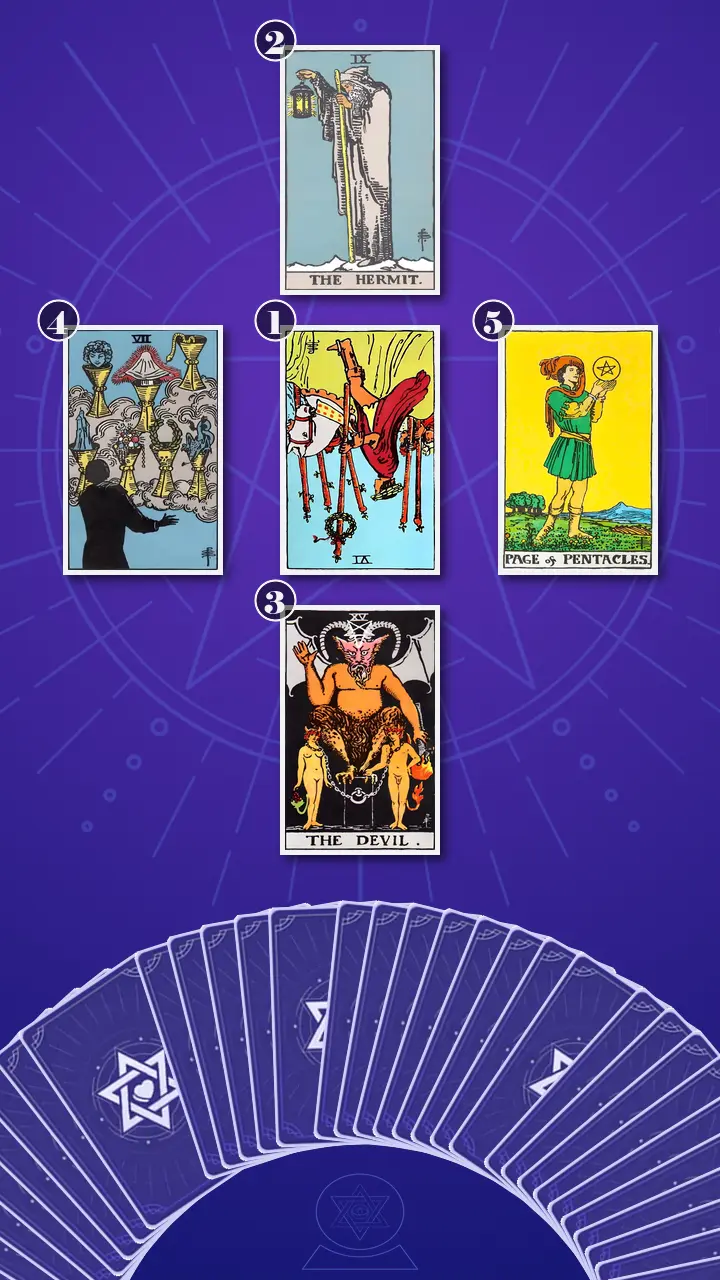
I chose a five-card spread called The Inner Compass \u00b7 Context Edition. For anyone wondering how tarot works in a career reading, this spread does not predict whether Maya will receive a promotion or tell her what she must do. It gives separate places to the present behavior, the hidden pressure underneath it, the images clouding the future, the inner criterion that can provide direction, and the next practical movement.
A Celtic Cross would have added ten positions and more layers than this focused question needed. This contextualized compass keeps the reading close to the actual chain: the promotion chase at the center, the status attachment below, the projected career possibilities to the west, true north above, and one evidence-producing experiment to the east. I would begin with what I could observe, descend to what sustained it, move through the fog, rise to the lantern, and finish with something Maya could test in real work.
The center would show the current bearing. The southern position would reveal the hidden tether that made advancement feel compulsory. The western position would map the career images and comparisons that kept her researching instead of testing. Above them, true north would ask for a personally credible criterion, and the eastern horizon would turn that criterion into a bounded next step.
Where the Applause Stops
Position 1: The Reversed Victory
I began at the visual center. The card I turned represented the observable present-state behavior: building a promotion case and pursuing visible progress without a defined picture of the work desired afterward. It was the Six of Wands, in reversed position.
The rider raised above the crowd looked, in modern terms, like a person whose achievements were visible across dashboards, Slack messages, performance rubrics, and LinkedIn updates. But reversed, the fire of recognition was blocked and over-relied upon. Maya opened a new tab after every compliment to check whether the praise was strong enough to support her promotion case. She pasted a manager's message into her evidence document, enjoyed a two-minute lift, and then decided it did not count until the organization changed her title.
"This is the part where I tell myself I am being strategic," she said. "I volunteer for the cross-team rollout because it will count later, even if I do not know why I want it now." I pointed to the laurel tied to the raised wand. The public victory was not false; her work had value. The problem was that she was asking visible achievement to perform a second job: choosing her direction and stabilizing her worth.
Maya gave a short, bitter laugh. "That is too accurate. Almost rude." I did not rush to soften it. First, her thumb stopped moving over the edge of her phone. Then her eyes left the card and fixed on the blank document as though a familiar week were replaying there. Finally, she exhaled through her nose and let her hand fall open on the table. I told her the card was not accusing her of vanity; it was showing a measurement system that could count activity but could not measure whether the work made her feel more awake.
I asked, "If nobody else could see the result, which part of the promoted work would still deserve your attention?" She did not answer immediately. That pause was useful. It made a little room between wanting recognition and knowing what the recognition was supposed to support.
Position 3: The Chain Beneath the Badge
I moved below the center to the southern pull, the hidden force that grounds, drains, binds, or exerts pressure beneath the conscious direction. The card was The Devil, in upright position.
The Devil did not mean disaster, and I said so plainly. In this position, the card showed a blockage created by attachment: the promotion timeline had begun to feel like an obligation, and questioning it had become tangled with the fear of losing status, safety, or a stable sense of worth. The energy was excessive in its hold and deficient in choice. A real salary increase would help with Toronto rent and savings, but the title carried an additional emotional charge that money alone could not explain.
I brought the loose chains in the image beside a familiar status loop: a colleague changes their LinkedIn title, Maya opens a salary-transparency thread, checks compensation bands, accepts another high-visibility assignment, and stays late documenting the work. The chain was loose in the card, yet the bargain felt tight in her body. "I cannot question this until I have earned it," she said quietly. Then, after a pause, she added, "I keep calling it ambition because uncertainty sounds worse."
I named the compound pattern carefully: urgency with shame underneath. No one had asked her to make a promotion the central measure of whether her career was valid. The rule had become an auto-renewing subscription to proving herself; the payment was extra workload, and the temporary benefit was a brief feeling of being safe.
Maya's shoulders pulled higher. Her jaw tightened, and her fingers closed around the pen until the knuckles paled. She looked at the salary spreadsheet, then at the loose-chain image, and gave a small shake of her head. I said, "I am not telling you to quit, reject advancement, or pretend money does not matter. I am asking which part is an actual requirement and which part is the bargain protecting your identity as a successful person." Her grip loosened, but she kept looking at the card.
Position 4: Seven Tabs, Seven Futures
I turned west to the position that maps prior assumptions, fading patterns, and interference clouding the current sense of direction. The card was the Seven of Cups, in upright position.
The silhouetted figure facing seven cloud-borne cups looked exactly like Maya after work: product-operations manager, program manager, strategy role, people leadership, and a career-pivot guide spread across the laptop. Each option offered a vivid identity, salary, lifestyle, or imagined version of confidence. None had been tested in an ordinary week. The energy here was excess and dispersion, with water spreading attention across possibilities instead of carrying it toward evidence.
"Maybe the right future is in the next tab," Maya said. She had gathered information about other people's progress, but had not contacted anyone who did the work or taken one bounded piece of it. The screen was bright against the dark kitchen, and the laptop fan kept up its low mechanical insistence. I asked her to translate one title into an ordinary Tuesday: five likely tasks, two recurring meetings, one pressure point, and one part she might want more of.
She shifted in her chair and closed one tab, then reopened it. I recognized the motion as the mind trying to preserve every option because narrowing attention felt like losing a future. I told her that the Seven of Cups did not demand a permanent choice. It asked her to stop treating imagination as evidence and let one possibility meet the texture of real work.
When The Hermit Lit One Honest Lantern
Position 2: True North in a Small Pool of Light
The room became unusually quiet when I reached the card above the center. This position represented the personally credible value or criterion that could replace the promotion title as Maya's primary source of direction: true north. I turned over The Hermit, in upright position.
The Hermit was not asking Maya to disappear from professional life or solve everything alone. Its energy was balanced discernment: enough solitude to hear her own criteria, enough practical connection to test them. The lantern illuminated only a few steps, which was precisely the point. She did not need a complete career map. She needed one honest quality in an ordinary workweek, such as useful collaboration, protected focus time, autonomy, or solving messy operational problems.
At this point I used the lens I call Workplace Typecasting Analysis. I looked at the office ecosystem around Maya: who was invited to define the problem, who was asked to coordinate everyone else's decisions, who received praise for reliability, and who was allowed to claim authority. Maya had been cast as a dependable supporting role. She was visible enough to carry the rollout, but not always positioned as the person who named the direction. That typecasting helped explain why a promotion seemed like the only way to become more central.
I added my second lens, Leadership Narrative Construction. I was not asking Maya to perform confidence or imitate a louder colleague. I was helping her rewrite the professional sentence she had been living inside: from "I am the person who proves I can support every moving part" to "I am the person who identifies which moving part matters, explains why, and chooses a bounded piece to lead." That was a change in authorship, not a demand for a new personality.
At 10:47 p.m. in that Toronto kitchen, Maya could make the promotion file more convincing while the heading "What I Want More Of" stayed blank. The spread returned to that quiet gap: the problem was not a lack of drive, but who had been allowed to define what her drive was for.
You do not need a louder round of applause to create direction; you need one honest criterion of your own, held up like The Hermit's lantern.
A promotion can confirm movement, but it cannot choose your destination. Direction begins when one criterion you genuinely value matters more than the title's ability to prove progress to everyone else.
Her inhale stopped halfway. Her pupils widened, and she looked past the card to the rain-dark window as if the last two years were replaying there: the extra documentation, the praised rollout, the evenings spent comparing levels. Her hand tightened around the pen. "But does that mean I have been doing it wrong?" The question came out sharper than the rest of the reading. I told her no; it meant the strategy had been protecting her in one way while narrowing her choices in another.
For a moment, Maya's mouth opened without sound. Then her shoulders dropped by a fraction, her grip released, and her eyes grew bright. She pressed both feet into the floor and took a breath that reached lower into her ribs. When she spoke again, her voice was rough but steadier: "Maybe I do not need the whole map. Maybe I need one criterion I can believe."
I asked her, "Now, use this new perspective to remember: was there a moment last week when this insight might have made you feel differently?" She returned to the Tuesday rollout she had accepted automatically. The work itself had not been meaningless; the constant stakeholder translation had drained her, while untangling the handoff problem had held her attention. That distinction was small, but it was real evidence.
This was the first movement from externally measured promotion momentum toward self-authored career direction. The Hermit did not remove uncertainty. It gave uncertainty a smaller, kinder shape: one criterion, one observation, one choice that belonged to Maya before it belonged to any title.
Position 5: The Responsibility You Can Actually Test
I finished at the eastern horizon, the position that converts insight into one bounded movement through which it can be tested and integrated. The card was the Page of Pentacles, in upright position.
The Page held one pentacle at eye level while the wider landscape remained available behind him. I read that as grounded curiosity and practical balance. Maya did not need to rank every possible future or announce a complete professional identity. She needed to choose one responsibility from a possible next role and study its actual texture inside work that already existed.
I described a Thursday-morning version: choose facilitating a process-improvement session, analysing operational data, or coordinating one launch handoff. Ask a trusted colleague to let her observe or own one defined section for 30 to 45 minutes. Beforehand, predict her energy and curiosity. Within 15 minutes afterward, record what actually happened, including one engaging moment and one draining moment. The pentacle was not a new title. It was concrete evidence held carefully enough to teach her something without turning the result into a verdict on her potential.
Maya sat straighter, though not dramatically. She opened her calendar and found a process review already scheduled for Thursday. "I could ask to take the first part instead of volunteering for the whole thing," she said. I nodded. That sentence had the quiet quality of a choice. Ambition was still present, but it was no longer driving with its eyes closed.
From Promotion Proof to Personal Evidence
I read the five cards as one story. The reversed Six of Wands showed a present organized around public proof: visible assignments, praise copied into documents, and achievements that could not settle until a title confirmed them. The Devil revealed the bargain beneath that behavior: advancement offered temporary safety and social legibility in exchange for letting the badge define progress. The Seven of Cups showed what happened next; comparison and career content multiplied possible identities until Maya had more imagined futures and less direct evidence.
The Hermit supplied the missing function. It narrowed attention to a personally chosen criterion, and The Page of Pentacles carried that criterion into a real responsibility. The spread moved from fire that kept performing, through water that kept dispersing, across the absence of clearly named boundaries, and into earth: one task, one observation, one piece of usable evidence.
The cognitive blind spot was not that Maya needed more ambition or better research. It was that she had been treating uncertainty as an information shortage and assuming the next title would solve it. She could explain how to qualify for advancement, but she had not been testing what kind of work made her more focused, curious, or willing to stay engaged. The transformation direction was clear: move from building a promotion case first to testing one desired responsibility at a time, then let the evidence shape the ambition.
I told her that a promotion could be a useful vehicle. It could bring higher pay, broader scope, stronger learning, or a different kind of authority. But a vehicle could not choose its destination. The purpose of this reading was not to make advancement seem shallow or to turn a career pause into a moral ideal. It was to return the steering decision to Maya.
The One-Lantern Career Check and the Ordinary-Tuesday Test
I gave Maya three small next steps. Each one was designed to create information without demanding a public reinvention, unpaid overtime, or perfect certainty.
- The One-Lantern Career CheckOn Tuesday at 10:15 p.m., close the promotion rubric and job-description tabs, set an eight-minute timer in the Notes app, and write three qualities you want in an ordinary workweek without naming a title. Then review the last five workdays in your calendar and mark specific tasks with a plus, question mark, or minus for energy, curiosity, and resentment.If writing feels performative, use a private voice memo and start with one criterion. The note does not need to be shared, polished, or large enough to count as a five-year plan.
- The Responsibility Beta ExperimentBy Friday, choose one responsibility from a role you are considering, such as facilitating a process review, analysing operational data, or coordinating a launch. Ask a trusted colleague to let you observe or own one bounded part of existing work for 30 to 45 minutes. Before the task, predict your energy and curiosity; within 15 minutes afterward, record what actually happened in your body and attention.Do not create unpaid overtime or volunteer for an entire project to prove commitment. Use work already on the calendar, trade or remove another task where possible, and remember that a result of "not for me" is still evidence.
- The Protagonist Reframe DirectiveAt the next cross-departmental meeting, speak once before someone assigns you the supporting work. I asked Maya to rehearse this micro-script: "I see the decision we need to make. I recommend we start with ____. I can own the next 30-minute piece and report back on ____." The purpose is to disrupt the established subordinate persona with one clear act of authorship, not to dominate the room.Write the sentence in your calendar notes and say it once. One visible claim of direction is enough; the goal is to gather evidence about how leadership feels when it begins with a criterion she chose.
I called the method Evidence Before Identity. The next responsibility would not decide whether Maya was a leader, whether she should accept the promotion, or whether she had chosen the perfect career path. It would simply give her a better question to answer than another hour of comparison.

A Week Later, One Quiet Proof
Four days later, Maya sent me a message: "I asked to own the first 30 minutes of the process review. I liked untangling the handoffs, not the performance of being seen." She still woke the next morning with the thought, "What if I am wrong?" This time, she opened her work log instead of LinkedIn and wrote down what the task had actually shown her.
That was the first proof of change, not a solved career and not a guaranteed promotion. Maya had allowed one ordinary responsibility to become data. She had begun moving from achievement autopilot and comparison fatigue toward grounded curiosity, where ambition could remain while its destination became more deliberate.
I had only held the lantern and helped name the pattern. Maya was the one who chose the criterion, asked for the bounded experiment, and started rewriting her professional story from supporting role to author of the next scene. The cards did not take her agency; they made it easier for her to see where it had been waiting.
When every promotion post makes your shoulders rise and your chest tighten, it can feel safer to chase a title than to admit you are not sure whether the life beyond it is yours. But noticing that tension is already a form of finding clarity, because it separates the movement from the meaning you still get to choose.
If one ordinary workday could be your next piece of evidence, which responsibility would you be curious enough to try for an hour, without asking it to decide your whole future?