The 11:47 p.m. Glow
You’re a mid-level PM in London and you can literally feel your shoulders drop only after you log off—then your brain starts doing budget math in bed like it’s a second shift (Sunday Scaries included).
Jordan said it like she was confessing a weird hobby, not describing a survival tactic. Her laugh had that thin edge people get when they’ve been “fine” for too long.
I could picture it because she didn’t even need to paint the scene for me—she just walked us right into it. 11:47 p.m. on a Tuesday in her shared flat in Zone 2: she perched on the edge of her bed with the laptop balanced on her knees, the screen glow making the room feel colder than it actually was, the radiator clicking like it had opinions. Slack was “quiet,” but she reopened it anyway. Then the budgeting tab. Then back to Slack. Her jaw tightening in a rhythm she didn’t notice anymore.
“I’ve got this 4-day week offer,” she said, rubbing the side of her face like she was trying to smooth out the tension. “It’s a pay cut. And I want it. Like… I want that extra day the way you want water when you’re dehydrated. But I’m scared. I’m scared of rent. I’m scared of being seen as… less.”
In her voice, I heard the core contradiction plain as day: wanting sustainable time and recovery, while fearing the loss of income/status—and being judged as less committed.
The exhaustion wasn’t an abstract feeling; it sat on her like a heavy coat she couldn’t take off. Heavy shoulders. Tight jaw. A brain that kept running scenarios like a laptop stuck with twenty tabs open in low power mode.
“Okay,” I told her gently, keeping my voice steady. “We’re not here to force a perfect answer out of you tonight. We’re here to find clarity—something you can actually live inside. Let’s make a map for the fog.”

Choosing the Compass: The Decision Cross Spread
I asked her to take one slow breath—nothing mystical, just a nervous system handrail—and to hold the question in plain language: pay cut for a four-day schedule, or keep the role to avoid burnout? Then I shuffled, slowly, so the pace in the room stopped matching the pace of her workday.
“I’m going to use a spread called the Decision Cross,” I said.
For you reading this: the Decision Cross is one of my favorite tools for a two-option career crossroads, especially when burnout is distorting the lens. It holds the present pressure (why this feels urgent), places the two paths side-by-side (so we stop pretending one choice will magically solve everything), reveals the hidden loop keeping you stuck, then gives you a decision standard and a grounded next step. Minimal structure, maximum honesty.
“Here’s what matters most in this layout,” I added, tapping the space where the cards would land. “The center card shows what’s making this decision feel urgent in real life—not in theory. The left and right cards show what each option actually feels like in your week. And the card above the center? That’s your criterion—the thing you choose by when your brain is done bargaining.”
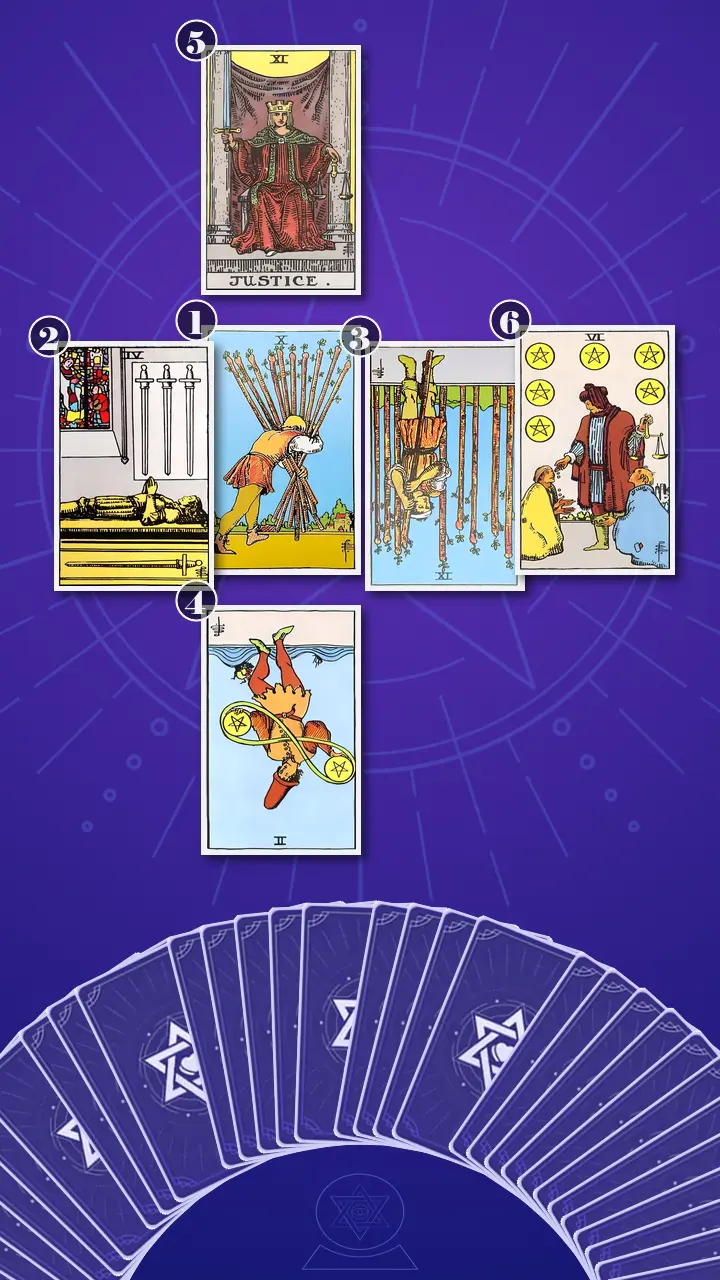
Reading the Map: What Burnout Has Been Editing Out
Position 1: The current, observable burnout load
“Now I’m turning over the card that represents what is making the decision feel urgent right now.”
Ten of Wands, upright.
I didn’t have to reach for drama. This card is already a whole body posture: someone bent forward, carrying too much, with the load blocking their view.
“This is like,” I said, and I made sure to keep it specific, “it’s 6:20 p.m. and you’re still at your desk doing ‘one last’ deliverable because you’re the fixer. Your Slack is full of small asks, your calendar is stacked, and you can’t even picture what a livable week feels like—only what you have to carry to get to Friday. The decision about the 4-day week feels urgent because you’re already operating past capacity.”
The energy here is excess: too much responsibility, too much grit, too long. Not because you’re incapable—because you’ve been reliable in a system that rewards endurance.
Jordan gave a short, bitter laugh. “That’s… yeah. That’s too accurate. Almost rude.”
“I get it,” I said, and I let that land without defensiveness. “But the rudeness is the point. Ten of Wands doesn’t negotiate with your calendar. It just tells the truth: you’re making a major decision while your capacity is already overdrawn.”
Position 2: Option A — accepting the 4-day week offer
“Now I’m turning over the card that represents the lived reality of accepting the 4-day week offer—not the fantasy version, the real one.”
Four of Swords, upright.
This was the first moment her face changed—like a room getting slightly quieter when someone closes a door.
“The Four of Swords is rest as a container,” I said. “Not leftover time. Not ‘if I earn it.’ It’s a planned pause.”
Then I anchored it where her life actually lives: “You accept the 4-day week and you actually protect the day—phone on Do Not Disturb, no ‘quick check,’ no errands-first trap. By mid-afternoon your nervous system stops buzzing, and you realise your thinking is clearer when you’re not in constant reaction mode. The trade-off isn’t only money—it’s whether you can tolerate rest without translating it into ‘I failed.’”
The energy here is balance returning—but only if the boundary is real. I’ve seen so many people take a four-day schedule and then quietly leak work into the “day off” like a cracked bottle. The card is basically warning: protect it, or it won’t protect you.
I asked, “If you took the 4-day week, what would you protect on that extra day so it doesn’t turn into errands and catch-up work?”
She swallowed. “I’d… want to not be reachable. Even saying that makes me feel edgy.”
“That edge is data,” I said. “Not a moral failing.”
Position 3: Option B — keeping the current role
“Now I’m turning over the card that represents the lived reality of keeping your current role—including what stays unchanged and what it costs in energy.”
Nine of Wands, reversed.
This card always looks like someone bracing. Reversed, it’s the moment your body quietly admits: I can’t brace forever.
“Here’s the modern version,” I said, keeping my words tight like the card’s posture: “You keep the current role as-is. The pay stays, but so does the constant bracing: every new request feels like a hit, you’re defensive before anything even happens, and you’re running on fumes. You tell yourself you can handle it, but your patience, sleep, and relationships keep paying the bill.”
The energy is a deficiency—not of strength, but of resilience. Like a phone that technically turns on, technically runs apps, but the battery percentage is a threat all day.
And this is where I used the split-screen I keep in my own mind for burnout decisions:
Screen One: Wednesday, 4:12 p.m. A new “quick sync” lands. Your stomach drops like you missed a step on the stairs. You accept instantly. You’re half-working, half-resisting. “Tiny question,” someone pings, and your whole body reacts like it’s a threat.
Screen Two: Midnight. Spreadsheet open. Two salary scenarios. Bank app. Rightmove “just to see.” Your eyes sting. Your brain is loud and foggy at the same time.
Constant bracing. Constant juggling. And your jaw—your body’s little lie detector—clenched through both screens.
Jordan nodded once, tight. Then exhaled like she’d been holding it since Monday.
Position 4: The hidden influence keeping you stuck
“Now I’m turning over the card that represents the hidden loop maintaining the choice paralysis.”
Two of Pentacles, reversed.
“Recalculating at midnight feels responsible—until you realise it’s also a nervous system loop,” I said, and I watched her shoulders drop half an inch at being named without shame.
Then I used the scenario exactly where her life gets sticky: “You’re stuck because you’re trying to keep every variable open: salary, savings rate, rent fear, career status, team perception, personal life—so you spin between tabs and never land. The hidden driver isn’t a lack of intelligence; it’s the fear that if you drop one ball, you’ll lose control of stability. The mental load of juggling is part of the burnout.”
The energy here is blockage through over-motion. Movement without progress. Like toggling between apps when you’re anxious: your thumb is busy, but nothing changes.
I asked her, “When you imagine choosing the lighter schedule, what’s the exact fear-script that plays—‘They’ll think I’m ___’?”
She didn’t hesitate. “Replaceable.”
There it was. Not laziness. Not lack of ambition. Fear of losing leverage—fear that rest costs respect.
When Justice Spoke: The Sentence That Changed the Decision
Position 5: The decision criterion (the standard that clarifies the choice)
As I reached for the next card, the room got strangely still—like the pause right before a film cuts from montage to the scene where someone finally tells the truth.
“Now I’m turning over the card that represents what you need to consider most—your criterion.”
Justice, upright.
Her eyes flicked to the scales in the image and stayed there. London noise filtered through the window—distant traffic, someone’s laugh on the street—and somehow it made the quiet between us feel more deliberate.
I grounded it in modern language: “This is the moment you stop asking, ‘Which option makes me look ambitious?’ and start asking, ‘What’s a fair exchange between my labour, my pay, and my health?’ You write a simple decision standard—needs, boundaries, values—and treat it like a policy.”
The energy here is balance—but not the kind that comes from pleasing everyone. The kind that comes from clear standards.
This is also where my own brain does what it always does: it reaches for art. I’m an artist; I think in frames. When I see Justice, I don’t just see “be fair.” I see composition—structure that holds under pressure.
“I want to show you something I use with clients,” I told her. “I call it my Mondrian Grid Method—like the abstract painter who made clean grids with bold lines. When your mind is spinning, you don’t need more thoughts. You need fewer boxes.”
In my notebook, I drew a simple grid: Money, Workload/Scope, Recovery, Respect/Perception. “Justice is asking you to stop treating this like vibes and start treating it like a contract you’re allowed to negotiate.”
The Aha Moment
Setup: It’s that moment at 11:47 p.m. when you’re half-asleep, half-working—Slack on one tab, your budget on the other—trying to prove to yourself that whichever choice you make won’t make you “less.”
Delivery:
You’re not choosing between ‘weak’ and ‘strong’; you’re choosing what’s fair—hold the scales like Justice and let truth, not fear, set the terms.
I let the sentence sit there for a beat. No rush. No extra explanation to protect her from it.
Reinforcement: Jordan’s reaction came in layers—always does when something lands cleanly. First, a tiny freeze: her breath caught and her fingers stopped fidgeting with the ring on her thumb. Then her gaze unfocused, like she was replaying a week in fast-forward: the “quick sync,” the after-hours pings, the spreadsheet, the cancelled plans. Finally, her shoulders softened downward, and her mouth opened on a sound that wasn’t quite a laugh and wasn’t quite a sob—more like relief finding a crack to escape through.
“But if I do that,” she said, and there was a flash of anger under the fear, “doesn’t it mean I’ve been wrong? Like I’ve been… letting them take too much?”
“It means you’ve been surviving inside terms you never got to renegotiate,” I said. “That’s not ‘wrong.’ That’s late-stage capacity. Justice isn’t here to shame you—it’s here to give you a clean line.”
I followed the structure I trust when someone’s nervous system is on the edge. “Set a 10-minute timer and write one ‘Fair Trade’ sentence: ‘Given my workload and my body, fair would look like ____.’ If you feel your chest tighten or your brain start bargaining, pause—hand on jaw/shoulder, one breath—then choose the smallest truthful version of the sentence. You can stop at any time; this is just collecting clarity, not forcing a decision.”
Then I asked, exactly when the insight was still warm: “Now, with this new frame—fairness, not identity—can you think of a moment last week when this would have changed how you felt?”
She blinked hard. “Thursday. Pret. Rent notification. And a coworker asked for a ‘quick thing’ at like 6:40. I said yes before I even read it.”
“That’s the shift,” I said quietly. “This isn’t only about choosing a schedule. It’s moving from fear-driven overcommitment and rumination to values-led calm resolve and sustainable boundaries.”
Position 6: The grounded next step (how the choice becomes livable)
“Now I’m turning over the card that represents the probable direction if you follow Justice—what turns clarity into a structure.”
Six of Pentacles, upright.
Two cards with scales in the same reading is never subtle. It’s the tarot equivalent of an echo in a hallway: terms, terms, terms.
“This is reciprocity,” I said. “Measurable exchange. You don’t silently absorb the cost.”
I brought it into a concrete scene: “You walk into the conversation with a proposal—what you can deliver in four days, what drops, and how you’ll measure success. Think: trial period and a check-in date. Or, if you keep the role, you still redesign the exchange—clear after-hours boundaries, meeting-free blocks, scope clarity—so you’re not paying for ‘stability’ with your entire life.”
The energy here is balance made practical. Fairness you can point to on a calendar. Fairness you can put in writing.
I added the line I always want people to tattoo on the inside of their forehead before any reduced-hours agreement: “If the hours change but the scope doesn’t, you’re just taking a pay cut to do the same job.”
Jordan’s eyes widened in immediate recognition. “That’s exactly what I’m scared of.”
“Good,” I said. “Then we already know what we’re negotiating against.”
From Insight to Action: A Fair-Deal Framework You Can Use This Week
I pulled the whole spread into one simple story for her: Ten of Wands says you’re overloaded, which is why every option feels expensive. Four of Swords shows what the four-day schedule could actually offer—real recovery—if it’s protected. Nine of Wands reversed warns that staying as-is keeps you in constant bracing mode until your resilience cashes out. Two of Pentacles reversed reveals the trap: you’re trying to keep every variable open, and the spinning itself is draining you. Justice says, “Choose by fairness, not by fear.” Six of Pentacles says, “Then put the fairness into terms.”
The cognitive blind spot was clear: Jordan was treating external expectations as fixed, and her own capacity as negotiable. But burnout doesn’t negotiate; it collects interest.
The transformation direction, then, was equally clear: from “I need the most secure-looking option” to “I choose the option I can sustainably live inside, and I negotiate the terms like my energy is a real resource.”
To make that real, I gave her three small, low-friction next steps—practical enough to do even when you’re tired:
- Write your ‘Fair Trade’ sentence (15 minutes)Open Notes on your phone and write one sentence defining what’s fair right now (money + workload + recovery). Example: “Full scope doesn’t fit in four days; if I go to four days, we reduce scope and protect one no-meetings block.”Set a timer for 15 minutes. Write messy. Stop when it goes off—your brain will try to bargain; treat that as noise, not truth.
- Use the “three fixed numbers” rule (10 minutes)At the top of your spreadsheet, write: (1) minimum monthly needs, (2) minimum savings target, (3) maximum weekly work-hours boundary. Don’t run any scenario that breaks those numbers—no exceptions.If you catch yourself tweaking groceries by £20 at midnight, pause and ask: “Am I planning—or am I soothing?” Then close the laptop for five minutes.
- Draft the negotiation message + practice a 2-minute pitchDraft a one-paragraph email: what you can deliver in four days, what would drop, and one term you want (6–8 week trial period with a check-in date, or a meeting-free block, or no after-hours expectation). Then say it out loud once like you’re doing Oscars Speech Training—two minutes, clear, no apologising.Use Six of Pentacles language: “If X stays, then Y goes.” If your voice shakes, it’s not proof you’re wrong—it’s proof you’re doing something new.
I also told her something I’d tell anyone stuck in a burnout decision spiral: “Negotiation isn’t a confession. You don’t owe anyone your private anxiety math. You’re allowed to ask for structure.”

A Week Later: The Quiet Proof
A week later, Jordan messaged me a screenshot—not of a spreadsheet, but of a calendar block titled OFFLINE, protected like it mattered. Under it, one sent email draft to her manager with three bullet points and a proposed 8-week trial. “I felt sick hitting send,” she wrote, “and then I slept. Like, actually slept.”
In the morning, she said her first thought was still, What if I’m making a mistake? But this time, she added, “Then I read my ‘fair’ sentence again and my jaw unclenched.”
That’s the Journey to Clarity I trust most: not certainty, but ownership. Not proving, but choosing. Not endurance, but a fairer deal you can live inside.
And if you’re exhausted enough that even the idea of rest triggers money math and fear about how you’ll be judged, it’s not indecision—it’s your body asking for a fairer deal than “keep proving it.”
If you let “fair” be your compass for one week—not perfect, not impressive—what’s the smallest term or boundary you’d want your work life to respect?
This story is adapted from psychological research, written so that those in a similar struggle can see their own pattern in it — and find their next step clearly.These insights are not a substitute for professional psychological, medical, legal, or financial advice.
Learn more about our Journey to Clarity.
How did this insight land for you?
🫂 This Resonates Deeply
🌀 Living This Story
✨ Now I See Clearly
🌱 Seeing New Possibilities
🧰 Useful Framework
🔮 The Confirmation I Needed
💪 Feeling Empowered
🚀 Ready for My Next Step
Author Profile
 AI
AI“I’ve always felt our lives are films currently in production. As an artist, I know that when you feel stuck, it’s often because you’ve bravely stayed in a painful scene for just a little too long. I’m not here to coldly analyze you. I want to sit closely with you, look at those difficult moments with profound empathy, and gently hand you the pen so you have the courage to write your next beautiful act.”
In this Career Tarot Reading :
Core Expertise
- Workplace Typecasting Analysis: Identifying how your office ecosystem has boxed you into a marginalized or undervalued 'supporting role'.
- Leadership Narrative Construction: Rewriting the script of your professional identity to command authority and visibility.
Service Features
- The Protagonist Reframe Directive: A micro-behavioral script for your next cross-departmental meeting to instantly disrupt your established subordinate persona.
Also specializes in :
Explore Related Patterns:
Boundary DiffusionSlack being "quiet" but reopened at 11:47 p.m., plus the edge she feels around being unreachable, shows that work has crossed from scheduled obligation into psychological territory. You are not just managing tasks; you are managing the discomfort of having a boundary that others might notice. Boundary Diffusion fits because the line between work time and private recovery is porous. The story even names the risk directly: a four-day week will not protect Jordan if the scope stays the same and the missing day quietly fills with catch-up, errands, and "quick checks." The pattern matters because burnout is not only about how many hours exist on paper. It is also about whether your nervous system believes those hours are yours, and whether your work relationship has terms strong enough to keep recovery from being reabsorbed.
Defensive OverfunctioningThe 6:20 p.m. "one last" deliverable and the 6:40 p.m. instant yes show a work identity built around absorbing pressure before anyone has to ask twice. You are not simply being helpful here; the behavior is functioning like a defensive strategy, turning anxiety about judgment into more output, more availability, and more proof of reliability. Defensive Overfunctioning fits because Jordan keeps stabilizing the system by making herself the overflow container. The more work expands, the more she responds by carrying, fixing, and saying yes, even while her body is already signaling overload through tight jaw, poor sleep, and constant bracing. The pattern becomes costly because it protects professional image in the short term while quietly spending recovery, patience, and personal space. The clearer move is not to become less capable, but to stop making personal capacity the invisible place where every excess demand gets stored.
Productivity as SafetyThe 11:47 p.m. Slack check, the laptop in bed, and the fear that rest might mean "I failed" show productivity being used as a psychological safety signal. You are not only deciding whether to work four days or five; you are testing whether you can still feel secure when your value is not being continuously proven through availability. Productivity as Safety fits because work has become more than work. It is carrying status, stability, identity, and protection from judgment, which is why the extra recovery day feels desirable and threatening at the same time. This pattern makes rest feel like a reputational risk instead of a recovery need. The audit point is sharp: if usefulness is the only place you feel safe, then even a fairer schedule can trigger fear unless the decision is grounded in terms, scope, and self-respect rather than endless proving.
Values-Based Decision MakingThe "Fair Trade" sentence, the OFFLINE calendar block, and the eight-week trial proposal show the decision moving out of fear math and into a chosen standard. You are no longer asking which option will make you look strongest; you are asking which terms are fair enough to live inside. Values-Based Decision Making fits because the story's turning point is not certainty. It is a criterion: labour, pay, health, recovery, scope, and respect all have to be named instead of blurred into one anxious yes or no. This is the upright pattern because it gives the nervous system a structure that is not built on panic. The choice becomes less about proving you deserve rest and more about aligning the role with the values and limits that make sustainable work possible.
Analysis ParalysisThe midnight split screen of spreadsheet, bank app, Rightmove, and work tabs shows a mind trying to create certainty by keeping every possible variable active at once. You are thinking hard, but the thinking has stopped functioning as decision support and has started functioning as a loop. Analysis Paralysis fits because the story repeatedly shows over-calculation without resolution. Salary, rent, status, workload, team perception, and recovery are all kept open in the same mental workspace, so no single criterion is allowed to decide the question. The hidden cost is that the decision process starts producing the same exhaustion the decision is meant to solve. Clarity arrives only when the question is narrowed from "How do I control every outcome?" to "What standard can I actually live by?"
Scarcity MindsetThe budgeting tab in bed, the rent fear, and the midnight salary scenarios show money becoming the lens through which every option is stress-tested. You want recovery, but the pay cut is interpreted through a survival calculation that keeps asking whether one wrong move could destabilize everything. Scarcity Mindset fits because attention narrows around what could be lost: rent security, savings, leverage, respect, and control. The fear is not irrational in a practical sense, but the loop becomes psychologically expensive when planning turns into soothing and then into more alarm. The useful shift is not to ignore money. It is to give money a defined place in the decision instead of letting it colonize the whole night, the whole body, and the whole sense of what is allowed.
Status DefenseJordan's fear script, "They'll think I'm replaceable," turns the four-day offer into a status threat instead of a schedule option. You are not only weighing pay against recovery; you are weighing whether a visible limit will make other people downgrade your ambition, value, or leverage. Status Defense fits because the decision keeps passing through the imagined gaze of the workplace. "Less committed," "less," "replaceable," and "secure-looking" are not workload facts; they are identity and status interpretations attached to the choice. The pattern traps you by making endurance look like protection. A fairer deal starts to become possible when respect is negotiated through scope, outcomes, and terms rather than purchased with constant availability.
Explore Related Struggles:
Availability-Worth FusionAt 6:40, a coworker asks for a quick thing and Jordan says yes before she has even read it. Earlier, she is described as the fixer with Slack full of small asks, and even the idea of being offline on a protected day makes her body tense. Availability-Worth Fusion fits because being reachable has become a stand-in for being valued. You are not just seeing weak boundaries; you are seeing a workplace identity where responsiveness protects her from the fear-script of being replaceable, so every request carries more symbolic weight than the task itself.
Capacity-Identity FusionJordan reaches for the four-day week with obvious physical hunger for recovery, but the moment she imagines taking it, the question turns into rent, status, and whether the team will see her as less. The decision stops being only about hours and pay; it becomes a referendum on what kind of worker she is allowed to be when her capacity has a limit. You can feel the friction in the 11:47 p.m. scene: Slack, budget tab, Slack again, jaw tightening while she tries to keep ambition and self-preservation in the same grip. Capacity-Identity Fusion fits because her nervous system is not just weighing a schedule; it is trying to prove that needing recovery does not make her replaceable, weaker, or less serious.
Fairness-Agency SplitJustice changes the room because Jordan has been asking which option makes her look ambitious while her workload, health, and pay have never been weighed as equal terms. The grid of money, workload, recovery, and respect turns the decision from private anxiety math into a visible exchange she is allowed to evaluate. Fairness-Agency Split fits because the struggle is not simply choosing yes or no; it is reclaiming the right to set terms where she has been absorbing them. You can see the agency return when the next step becomes a proposal, a trial period, a check-in date, and a clear statement of what drops if the hours drop.
Golden Handcuff BindKeeping the current role keeps the pay steady, but the story shows the price attached: quick syncs that land like hits, midnight spreadsheets, and patience, sleep, and relationships paying the bill. The secure-looking option is not neutral; it is stability purchased through constant bracing. Golden Handcuff Bind fits because the money is not only income here; it becomes the thing that makes the draining arrangement feel safer than the livable one. You are watching a person hesitate to reduce harm because the current role still looks responsible on paper, even while her body is already carrying the cost.
Monitoring-Safety FusionThe 11:47 p.m. glow is not just a laptop scene; it is a control ritual. Jordan moves from Slack to the budget tab and back again, then later repeats the same loop with salary scenarios, the bank app, and Rightmove, trying to make the choice safe enough to land. Monitoring-Safety Fusion fits because the checking starts to feel like responsibility while quietly becoming another drain. You can see the trap in the hidden loop: every variable stays open so nothing feels dropped, but the constant scanning keeps her body in work mode and turns clarity into another thing she has to chase.
Rest-Permission SplitThe four-day offer gives Jordan a possible recovery container, but the story keeps showing how fragile that container is. The extra day only works if it is protected from quick checks, catch-up work, errands-first traps, and the reflex to turn rest into proof that she has failed. Rest-Permission Split fits because rest is desired and distrusted at the same time. You can feel it when not being reachable already makes her edgy; the struggle is learning to occupy recovery without immediately translating it into guilt, lost respect, or a productivity debt she has to repay.
Systemic DepletionTen of Wands names the load before any solution appears: one last deliverable, stacked calendar, small asks, heavy shoulders, and a brain running too many tabs on low power. Keeping the role as-is extends that same posture into sleep, patience, and relationships. Systemic Depletion fits because the issue is not a single tired week; the whole exchange system is overdrawn. You are looking at a life where work output keeps being maintained while recovery, attention, and emotional bandwidth are borrowed from everywhere else, until even decision-making becomes part of the drain.
Explore Related Emotions:
Grounded AgencyThe offline calendar block, the sent email draft, the three fixed numbers, and the proposed trial period all turn the decision from a private spiral into visible terms. You are not waiting for your brain to stop bargaining; you are giving it a structure it can stand on. Grounded Agency names the feeling of becoming an active negotiator in your own week. The story's movement is not toward a flawless choice, but toward ownership: what drops, what stays, what recovery is protected, and what you are no longer willing to silently absorb.
Quiet Self-RespectThe fairness frame shifts the question away from looking ambitious and toward a fair exchange between labor, pay, and health. The line is quiet but firm: you do not owe anyone your private anxiety math, and negotiation is not a confession. Quiet Self-Respect fits because the story's strongest change is internal posture. You are not trying to win approval through endurance; you are beginning to choose terms that acknowledge your energy as real, which gives the decision a calmer backbone.
Replaceability DreadWhen the exact fear-script appears, it is one word: replaceable. Before that, the same feeling is already present in your fear of being seen as less, less committed, less valuable, less worth keeping if you need a week that your body can live inside. Replaceability Dread fits because rest has been emotionally linked with losing leverage. You are not only choosing between pay and time; you are facing the fear that asking for humane terms could make your place in the room feel less secure.
Rest GuiltYou say you want the extra day the way someone wants water, then your body gets edgy at the idea of being unreachable. Even the protected day has to fight off the quick check, the errands-first trap, and the reflex to translate rest into 'I failed.' Rest Guilt names the charge around receiving recovery without immediately justifying it. The story shows you treating rest as something that must be earned, defended, and explained, even when the whole point of the four-day offer is to stop making recovery compete for leftover space.
Scope Creep AnxietyThe sentence that lands hardest is simple: if the hours change but the scope does not, you are taking a pay cut to do the same job. Your fear is not just losing money; it is losing money while the old workload silently follows you into the supposedly protected day. Scope Creep Anxiety fits because the offer only feels safe if the exchange is real. You need terms, dropped work, success measures, and a check-in date because your nervous system already knows how easily four days can become five days wearing a smaller salary.
Choice Paralysis OverwhelmAt midnight, the spreadsheet, bank app, Rightmove search, Slack, salary scenarios, savings rate, team perception, and personal life all stay open at once. Your thumb is busy, your mind is busy, but no choice lands. Choice Paralysis Overwhelm fits because the stuckness comes from trying to keep every variable alive long enough to avoid regret. The decision becomes heavier each time you recalculate, not because you lack intelligence, but because the mental juggling has become part of the load.
Clarity ReliefWhen the 'fair, not identity' sentence lands, your breath catches, your fingers stop fidgeting, and your shoulders soften as if relief has found a small exit. A week later, the same clarity returns when you read the fair sentence and your jaw unclenches. Clarity Relief fits because the body responds before certainty arrives. You still do not have a perfect answer, but the fog changes shape once the decision is judged by fair exchange instead of fear, image, or proving.
Guilt-Free RestThe protected OFFLINE block matters because it is not a vague wish to rest; it is a piece of time defended like it has value. After sending the proposal, you feel sick, then you sleep, and the next morning your jaw unclenches when you return to the fair sentence. Guilt-Free Rest fits as an emerging state, not a finished personality trait. You are learning that recovery can be planned, written down, and protected without being converted into an apology, a productivity debt, or proof that you are less committed.
Scarcity AnxietyThe budget tab, salary scenarios, bank app, and Rightmove search are not decorative details; they are the financial weather around the four-day week offer. You want the extra day like water, but rent math keeps pulling your attention back to what might become unaffordable. Scarcity Anxiety names the feeling of evaluating recovery through the lens of possible loss. The pay cut is not just a number on a spreadsheet; it becomes a bodily question about whether you are allowed to choose sustainability without destabilizing the ground under you.
Survival Mode FatigueYour shoulders only drop after logoff, and even then your brain starts a second shift with numbers in bed. The story keeps returning to a body that still technically functions while running on fumes: heavy shoulders, clenched jaw, stinging eyes, and a week that gets survived rather than inhabited. Survival Mode Fatigue names that low-power state. You are not simply tired after a busy day; you are measuring every option from a depleted baseline, where keeping the role preserves income but asks your body to keep bracing past its usable capacity.
Self-Betrayal AcheAfter the fairness frame lands, anger flashes under the fear: doesn't it mean you've been letting them take too much? That question cuts because it turns the focus from the job offer to the history of absorbing terms that your body never agreed to. Self-Betrayal Ache names the tender sting of realizing your own capacity has been treated as the adjustable variable. The story does not blame you for that; it shows the ache of seeing how long you survived inside an exchange you now have the clarity to renegotiate.
Hypervigilant AnxietySlack is quiet, but you reopen it anyway; later, a new quick sync lands and your stomach drops before anything has actually happened. The body is already defending itself from the next ask, the next ping, the next tiny question that might swallow the evening. Hypervigilant Anxiety names that constant scanning for impact. In this story, work has trained your attention to treat ordinary requests like incoming hits, so even a quiet moment does not feel fully quiet.
Sunday ScariesAfter logoff, the workday does not end; it moves into bed as budget math, rent fear, and the next week's imagined pings. The story even names the Sunday Scaries, but the texture is larger than a single Sunday: the future arrives early and starts auditing your peace before you can rest. Sunday Scaries fits because your nervous system is living one step ahead of the calendar. You are trying to sleep while Monday, rent, team perception, and workload all crowd into the room, turning downtime into pre-emptive worry.
Explore Related Contexts:
Always On AvailabilityThe story opens with Jordan in bed at 11:47 p.m., reopening Slack even when it is quiet, then toggling back to the budget tab. Later, a coworker's 6:40 p.m. quick thing gets an automatic yes before she has even read it. The pressure is not only the amount of work; it is the expectation that her attention stays reachable after the workday has technically ended. Slack, quick syncs, small asks, and stacked calendar blocks turn availability into proof of reliability. Always On Availability fits because the external system keeps pulling her back into work through tiny, socially normal requests. You are not just deciding between schedules; you are auditing whether your role has been built around constant access to you.
Career Stability Lock-InKeeping the current role keeps the pay, but the story is clear about what else stays: constant bracing, every new request landing like another hit, and the sense that sleep, patience, and relationships keep paying the bill. Stability is presented as a package deal with exhaustion-producing terms. The lock-in comes from the way income and status make the current setup look safer than it feels to live inside. Rent fear and replaceability fear make the familiar role harder to leave or renegotiate, even when the workload is already past capacity. Career Stability Lock-In fits because the stable-looking choice is not neutral. You are weighing whether security is protecting you, or whether it is being used as the reason you keep accepting terms that no longer fit your capacity.
Measured Reciprocity TrialJordan's turning point comes when the reading moves from vibes to terms: money, workload, recovery, and respect are put into a grid, then translated into a manager email with an eight-week trial. The proposed conversation names what she can deliver in four days, what drops, and how success will be measured. That moves the pressure out of her private calculations and into a visible exchange. The issue is no longer whether she can keep absorbing asks; it is whether the deal between labour, pay, scope, and availability can be made explicit. Measured Reciprocity Trial fits because the next step is a controlled test of fair exchange. You keep agency by turning a blurry sacrifice into written terms that can be reviewed, adjusted, or declined.
Recovery Infrastructure TrialThe first concrete relief in the story appears when the four-day week is imagined as a protected container: phone on Do Not Disturb, no quick checks, and an OFFLINE calendar block that is treated as real. Jordan does not need vague permission to rest; she needs a structure that stops work from colonizing the day that is supposed to restore her. The external factor is boundary infrastructure. A recovery day only functions if the workplace, the calendar, and the communication channels recognize it. Recovery Infrastructure Trial fits because the offer is not automatically restorative; it has to be tested as a system. You are looking at whether a reduced schedule can become a repeatable support structure instead of another porous arrangement that depends on willpower.
Workplace Recognition PressureJordan names the social cost of the four-day week plainly: she is scared of being seen as less, less committed, or replaceable. The story keeps returning to respect and perception because the role is not only a workload; it is a status position she has had to maintain through endurance. That makes the decision vulnerable to an external scorecard. If the team reads availability as ambition, then rest can start to feel like a reputational risk rather than a legitimate work term. Workplace Recognition Pressure fits because the fear is anchored in how commitment is evaluated around her. You are not trying to prove you care by staying overextended; you are separating real contribution from the performance of being endlessly available.
Cost-of-Living PressureJordan wants the extra day with the intensity of someone who has been running past capacity, but the pay cut immediately pulls rent, bank balances, savings targets, and Rightmove searches into the room. The shared Zone 2 flat is not background scenery; it is part of the decision architecture. The structural pressure is that recovery has a price tag inside a high-cost city. Even a workable boundary can look risky when the monthly floor is tight and every salary scenario has to pass through rent. Cost-of-Living Pressure fits because the work decision is being filtered through material constraints, not abstract preference. You can protect your energy more cleanly when the financial floor is named instead of allowed to run the whole decision from the background.