Extend or Push Through?

Explore the pressure around an extension decision, related tarot cards, and reading insights from similar academic crossroads.

Thesis Extension Crossroads
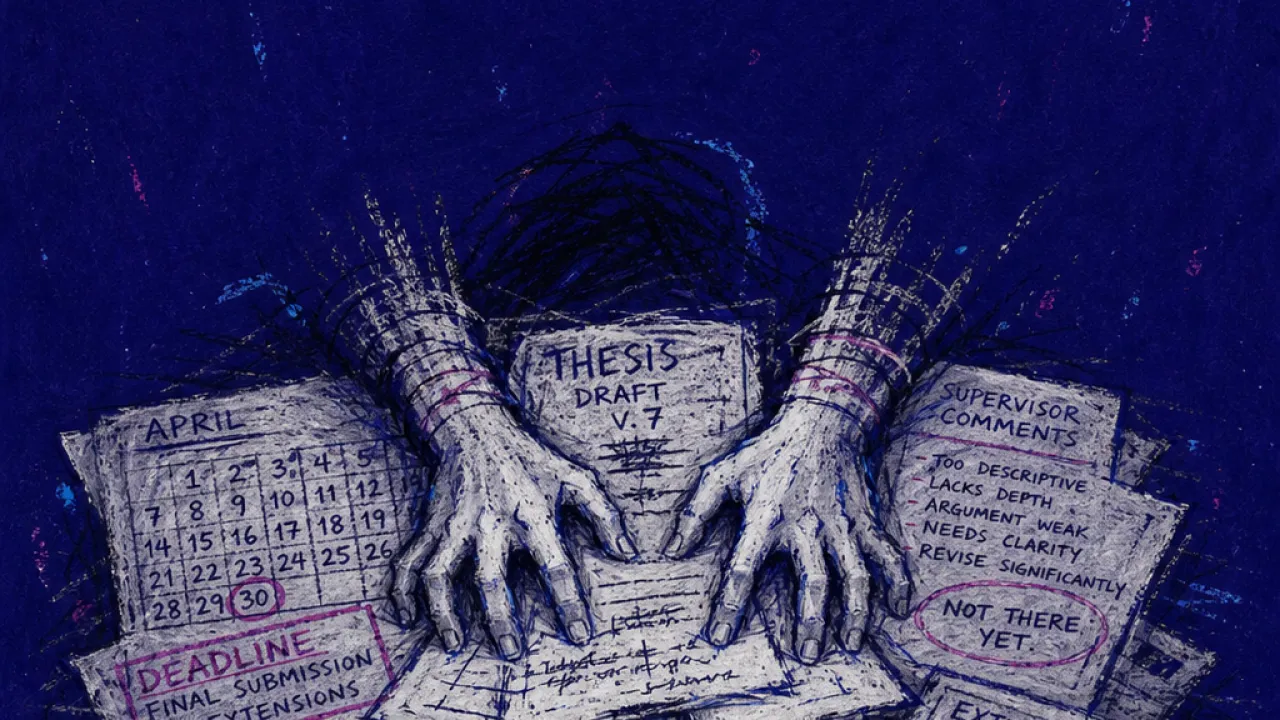
A hunched figure over thesis pages, wrists pressed by calendar sheets and comments into a forked path of pale paper

What is this situation?

Thesis Extension Crossroads — you reach the point in your program where the deadline is close enough to be counted in days, but the thesis still lives in scattered chapters, supervisor comments, half-answered emails, and a draft folder full of versions you can no longer tell apart. You sit in the library or at your kitchen table after work, wrists pressed against the desk edge, trying to decide whether to push through another sleepless week or fill out the extension form that will move the whole calendar: graduation, funding, housing plans, job applications, the question everyone keeps asking about when you will be done. Your supervisor says the work needs more tightening, the department page lists rules in calm language, classmates are posting submission photos, and every ordinary message from admin starts to feel like a timer placed beside your laptop. The choice is not just more time or no more time; it is a public mark on a private struggle, a decision that has to be explained to people who only see a deadline, not the slow feedback loops and competing obligations behind it. Each day narrows into a loop of writing, checking policy pages, rereading comments, calculating dates, and wondering which option will cost less later. By night, your shoulders are locked over the keyboard and the same paragraph keeps returning under the cursor, much like the figure on the Two of Wands, holding a small world from behind a wall while one path stays close and the other remains only visible in the distance.

Why it's not you?

The problem is not that you are bad at finishing or that you failed to care enough. A Thesis Extension Crossroads is created by deadline rules, delayed feedback, funding dates, admin paperwork, and academic timelines that make one form carry too many consequences. That pressure belongs to the setup around you, not to some flaw in your ability to work.

Thesis Extension Crossroads in Tarot Cards

That Thesis Extension Crossroads is the moment a thesis deadline stops being a simple due date and becomes a decision with admin, supervisor, and calendar pressure attached. The locked shoulders over your keyboard are part of an environmental, structural dynamic around time, approval, and institutional paperwork. The cards below do not tell you whether to extend or push through; they reflect the outline of the pressure around the choice. Here are the Tarot Cards that tend to mirror this kind of academic crossroads.

The Hierophant
Upright
The institutional figure sits between pillars while two students face him and crossed keys lie at the threshold. The scene places access, recognition, and progression inside a formal academic order, closely matching an extension process governed by department policy, supervisor endorsement, paperwork, and authorised exceptions. You are not simply deciding how long to write; you are negotiating with the rules that determine which version of extra time counts as legitimate. The upright keys show that a formal route exists, while the hierarchy explains why using it can still feel like exposing a private production struggle to institutional judgment.
The Chariot
Reversed
The charioteer stands above two differently oriented sphinxes without visible reins, while the city and road define a journey that requires coordinated movement. Reversed, the vehicle cannot convert intention into progress because thesis quality, the official deadline, supervisor timing, paid work, and downstream plans are pulling through incompatible control systems. You can be highly motivated and still remain stationary when the forces attached to the degree do not move together. The blocked vehicle reframes the extension crossroads as a coordination failure between institutional calendars, not evidence that you lack a destination or the will to reach it.
Justice
Upright
The seated figure holds balanced scales in one hand and an upright sword in the other, framed by pillars and a formal curtain. The scene turns an emotionally loaded crossroads into a structured comparison of evidence, rules, and consequences, closely mirroring an extension process governed by departmental criteria and documented reasons. You are making a private capacity decision through a public institutional procedure. The upright scales keep a route to legibility open: thesis readiness, delayed feedback, competing work, funding conditions, and calendar effects can be recognised as distinct facts rather than compressed into a moral judgment about finishing on time.
The Hanged Man
Upright
The figure hangs motionless from a living beam while a halo marks a clear shift in perspective. The suspension interrupts ordinary forward motion but does not erase the path, making the image a precise model for an extension that moves the calendar so unfinished academic work can be viewed and reorganised outside the final-days rush. You are deciding whether the deadline should remain the controlling clock or become one variable in a wider completion process. The upright pause keeps time usable: it reveals the difference between an indefinite drift and a bounded suspension with a specific academic function.
The World
Reversed
The wreath encloses a central figure at the culmination of a cycle, while four figures witness the completed structure from the corners. Reversed, the academic container is almost complete but remains open: chapters exist, comments have accumulated, and the degree is near its endpoint, yet the thesis has not become one stable final submission. You are dealing with an incomplete closure rather than an empty project. The reversed threshold clarifies why the final days feel disproportionately intense: only a limited amount of work may remain, but that work controls whether years of study can cross into formal completion.
Two of Pentacles
Reversed
The juggler's two pentacles are connected by an endless loop while ships pitch on uneven waves behind him. Reversed, paid work and thesis production stop functioning as a flexible rotation; each consumes the time needed by the other, and administrative checking adds a third demand to a system visibly designed for two. You may interpret the slipping schedule as evidence that your study discipline has failed. The reversed image instead identifies a resource mismatch between academic labour and the hours available around employment and life maintenance, placing the extension decision inside the real architecture of the week.
Three of Pentacles
Reversed
The craftsperson stands on a bench while two other figures hold plans inside a structured building. Reversed, the shared design no longer organises the work: supervisor comments arrive late or point in competing directions, questions remain unanswered, and the thesis draft develops without a stable agreement about what is submission-ready. You may be carrying the visible responsibility for completion while depending on a feedback relationship you do not fully control. The reversed workshop locates part of the bottleneck in coordination, showing how fragmented academic collaboration can create a deadline crisis even when substantial individual labour has already been invested.
Seven of Pentacles
Upright
The worker leans on his tool and studies pentacles growing from a plant that has not yet reached harvest. Labour and material are already present, but the scene refuses to equate invested effort with immediate readiness; it creates a legitimate checkpoint between continued cultivation and premature collection. You are assessing whether the thesis needs more work because its argument has not matured or whether deadline pressure is making every imperfection look disqualifying. The upright crop keeps further development possible while exposing the real timing issue: institutional harvest day and academic readiness have fallen out of sync.
Eight of Pentacles
Upright
The craftsperson works at a bench beneath a vertical sequence of completed pentacles, while another piece remains under active construction and one lies near the ground. The image makes iterative production visible: a thesis is assembled through repeated revision, with finished sections, current work, and discarded or superseded versions occupying the same workspace. You are deciding whether the remaining craft labour can credibly fit inside the final days or requires a changed timetable. The upright bench preserves access to focused improvement, but it also reveals that tightening chapters is real production time rather than a cosmetic final step that can be compressed without limit.
Two of Swords
Reversed
The blindfolded figure holds two swords across her chest while rocks interrupt the water behind her. Reversed, the crossed arrangement no longer provides a stable holding position: supervisor comments, policy pages, funding conditions, and deadline calculations accumulate without resolving which consequence should carry the most weight. You are not short of information so much as trapped between information that answers different questions. The reversed image shows why repeated checking can intensify the decision rather than settle it, because the choice requires an explicit hierarchy among thesis quality, calendar continuity, and material security.
Eight of Swords
Upright
The blindfolded and bound figure stands among eight swords, but the enclosure is incomplete and the ground remains open between them. The image captures how real rules, deadlines, funding conditions, and authority relationships can be internalised as a total ban on movement even when the constraints differ across submission, extension, and later planning. You may be collapsing several conditional consequences into one absolute conclusion that every option proves failure. The upright scene preserves a distinction between restriction and impossibility, making room to inspect which barriers are institutional facts, which are uncertain forecasts, and which were produced by the pressure to decide immediately.
Nine of Swords
Upright
The figure sits upright in bed with hands covering the face while nine swords occupy the dark wall above. The swords remain outside the body, like deadline emails, supervisor comments, policy clauses, and calculated dates that have been mentally carried from the desk into the hours intended for sleep. You may be rerunning the same paragraph and the same extension consequences long after active work has stopped producing new information. The upright image makes that psychological cache visible without treating it as a personal defect: external academic signals have become an internal night shift, and their repetition is not the same as clearer analysis.
Two of Wands
Upright
The figure stands between two wands, holding the world while a wall separates his current position from the open landscape. One option keeps the established submission calendar close; the other makes room for further revision but reaches into graduation, funding, housing, and job plans that cannot yet be fully inspected. You are making a consequential choice with enough perspective to see that neither route is local. The upright stance preserves agency at the threshold, framing the extension form as a decision between two concrete timelines rather than a verdict on whether you deserve to finish.
Six of Wands
Reversed
The rider moves through a crowd wearing a laurel wreath, with another wreath raised on the staff above him. Reversed, the public milestone no longer confirms private readiness; classmates' submission photos and questions about graduation turn one cohort timeline into a social scoreboard that obscures the different feedback, funding, work, and supervision conditions behind each thesis. You may experience an extension as visible loss of status even when it protects the quality of the work. The reversed procession reveals that recognition has become attached to finishing on schedule, leaving the actual production conditions of the thesis outside the frame.
Eight of Wands
Reversed
Eight wands travel together across an open sky toward a clear landscape. Reversed, that shared trajectory breaks down into stalled messages, late comments, unresolved administrative questions, and information that arrives too slowly to be integrated before the thesis deadline. You are being asked to make a time-sensitive decision inside a communication system that is not moving at the same speed as the calendar. The reversed flight pattern identifies the bottleneck outside your writing alone: supervisor and department response times have consumed part of the interval that the final decision now appears to measure.
Ten of Wands
Upright
The figure carries all ten wands toward a nearby town, with the bundle obscuring both his face and the route directly ahead. The thesis may be close to completion, but chapters, references, supervisor comments, formatting, forms, paid work, and ordinary obligations have been consolidated into one final academic load. You are encountering the point where more effort does not automatically produce better control over the submission. The upright path confirms that the work can move, while the overloaded posture makes the cost structure visible: the final stage has become a single-person delivery problem with almost no tolerance for delay or error.

Thesis Extension Crossroads in Tarot Card Reading Insights

For anyone sitting inside a Thesis Extension Crossroads, the question often moves from one deadline to the whole academic setup pressing around it. Other people have brought similar timing, feedback, and submission pressure into readings too. These Tarot Reading Insights show what came up when that crossroads entered the spread.
Psychological Contexts Related to Thesis Extension Crossroads