Finding Clarity in the 8:58 a.m. Highlighted-to-Death Silence
If you’re the kind of postgrad who shows up with the readings highlighted to death and still can’t find the first sentence fast enough when the professor says “Any thoughts?”—this is that academic visibility shame.
Maya met me on a drizzly London morning in my café, the kind of rain that makes the whole street smell like wet stone and espresso grounds. She sat at the small table by the window where the light is soft enough to feel forgiving, but not soft enough to hide. Her laptop was already open—out of habit, she told me—PDF margins glowing neon like a highlighter had been used as a coping mechanism. Her fingers kept worrying the cap of her pen, click-click, like her body was trying to edit time itself.
“It’s always right before I speak,” she said. “I have the thought, but I can’t find the first sentence fast enough. And then—someone else jumps in. I nod like I’m fine. But inside it’s like… my throat gets tight and my chest won’t expand all the way.”
She paused, then gave me the line that was really the whole story: “I want to contribute and be taken seriously. But I’m terrified one imperfect sentence will label me as not smart.”
What she carried wasn’t abstract anxiety. It was anticipatory dread with a physical address: a locked throat, shallow breathing, shoulders that wanted to climb up around her ears, restless hands that needed somewhere to put the electricity.
I set down a small glass of water next to her coffee. “Okay,” I said, gently, the way you speak to someone standing on ice. “Let’s not try to force confidence. Let’s map the system that’s happening in the five seconds before you could speak—and find one next step that’s real. Our whole journey today is about finding clarity without demanding perfection.”
Choosing the Compass: Celtic Cross · Context Edition
I invited Maya to take one slow breath—not as a ritual for the universe, just a way to tell the nervous system, we’re not running. I shuffled slowly, the cards making that soft paper sound that always reminds me of tamping coffee: steady pressure, no drama, just enough to make the next thing possible.
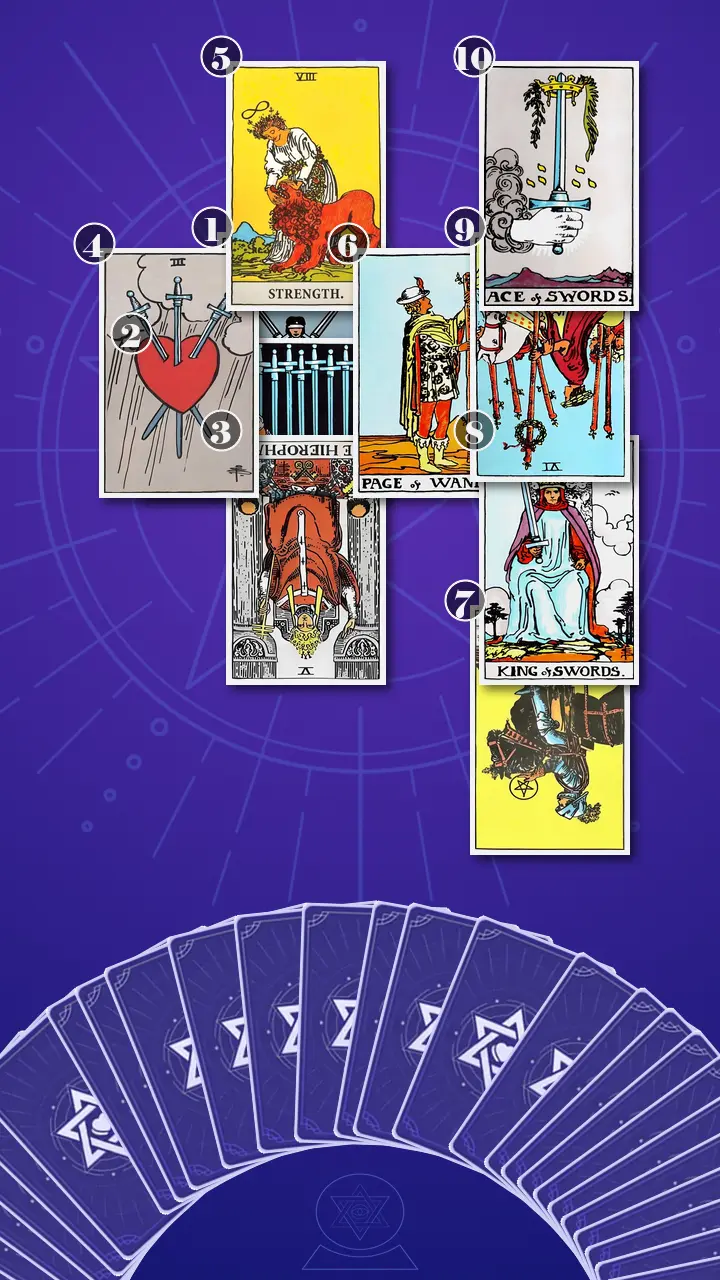
“Today we’ll use a spread called the Celtic Cross · Context Edition,” I told her. “It’s one of the clearest ways to see how tarot works as a practical tool: not predicting your life, but showing the chain—what freezes you, what feeds it, where it started, and what could actually shift it.”
For you reading this: I chose this spread because Maya’s question isn’t a simple yes/no. She needs a full mechanism. The center of the cross shows the present freeze and the immediate obstacle. The lower cards reveal the root belief system and the past shame imprint. The crown card shows what she’s trying to embody, and the near-future card gives a next step she can try in the very next seminar. Then the side “staff” tracks self-position, environment, hopes/fears, and integration—how clarity gets built over time.
“We’ll pay special attention to three places,” I said, tracing the layout with my finger: “the freeze point, the past shame imprint, and the bridge—the inner quality that gets you from silence into speech.”
Reading the Map: Card Meanings in Context
Position 1 — The Micro-Freeze Before Your Voice: Two of Swords (upright)
I turned over the first card. “Now we open the card that represents the present freeze point: what happens in you right before you speak.”
Two of Swords, upright.
I watched Maya’s eyes flick to the blindfolded figure and the crossed blades over the chest. “This is like being in the seminar circle with your notebook open like a shield,” I said. “You can feel a decent point forming, but you keep it behind a mental don’t-risk-it filter while you hunt for the perfect first sentence. By the time you’re ready, the conversation has already changed topics—and you tell yourself you’ll speak next time.”
Energy-wise, this is blockage: not a lack of intelligence, but a self-protective pause that blocks breath and timing. The crossed swords aren’t ‘bad’—they’re defensive architecture.
To make it concrete, I mirrored the inner monologue I hear so often in rooms like hers: “Not that word. Too obvious. Wait. That sounds basic. Someone else will say it better. Don’t start wrong.”
Maya let out a short laugh that had a little bitterness tucked inside it. “That’s… honestly kind of cruel,” she said. “But yeah. That’s exactly it.” Her hand went to her chest like she’d caught herself doing it.
“This isn’t a lack of intelligence,” I told her. “It’s a nervous system doing math under a spotlight.”
Position 2 — The Crossing Obstacle: Nine of Swords (upright)
“Now we open the card that represents the immediate mental/emotional obstacle that blocks speaking in the moment.”
Nine of Swords, upright.
“The real obstacle isn’t the content,” I said. “It’s the internal post-game.” I nodded toward her phone, face-down on the table like a tiny sleeping judge. “You imagine being corrected, dismissed, or remembered for the wrong sentence, so your brain rehearses every possible critique in advance. Then you leave class and replay it on the Tube like a doom-loop—tense even though nothing is happening now.”
This card is excess in Air energy: too much analysis, too much negative rehearsal, too much ‘pre-mortem’—like having thirty browser tabs open and calling it research when it’s really avoidance-by-optimization.
When I said “Tube replay,” her jaw tightened, then she noticed it and consciously unclenched. She didn’t look at me; she looked at the rain streaking down the glass. “It’s like I’m building a courtroom around a sentence I never even said,” she whispered.
Position 3 — The Root Mechanism Underneath: The Hierophant (reversed)
“Now we open the card that represents the root mechanism: the deeper belief system that makes speaking feel high-stakes.”
The Hierophant, reversed.
“This is the internal gatekeeper,” I said. “You treat speaking as if you’re submitting a graded essay in real time. There’s an invisible rubric in your head: the approved academic tone, the exact reference, the flawless wording. You keep editing until you sound like the version of a student you think the room rewards.”
This is blockage again, but with a specific flavor: authority pressure internalized. It’s not that your professor is a villain. It’s that your body reacts as if one wrong sentence would revoke your membership card.
“You’re not on trial,” I added, and I meant it. “You’re in a conversation that gets smarter in real time.”
Maya’s shoulders lowered on a long exhale, like she’d been holding a breath since October. “It does feel like… Succession vibes,” she said, half-wry. “Like everything is status.”
“Exactly,” I said. “And when your brain thinks it’s a status room, it demands status-language. Certainty. The perfect citation. No typos.”
Position 4 — The Past Shame Imprint: Three of Swords (upright)
“Now we open the card that represents the past shame imprint: the old wound that still shapes your voice today.”
Three of Swords, upright.
I didn’t invent an event. Tarot doesn’t need me to. The image does the work: heart, storm, sharpness. “This points to a past moment where being seen hurt,” I said. “A correction that landed too fast. A dismissal. That particular kind of silence after you spoke. In today’s seminar, nothing like that is necessarily happening—but your body reacts as if the same storm is about to hit.”
The energy here is learned association. Speech equals exposure; exposure equals pain. So silence starts to look like safety.
Maya’s fingers curled around her cup, then released. Her eyes went glassy for a second—not tears, just recognition. “I hate that it still runs me,” she said. “It was years ago. Different class. Different people.”
“That’s the thing about shame,” I said quietly. “It’s loyal. It keeps trying to protect you long after the original danger passed.”
Position 5 — The Bridge You’re Trying to Embody: Strength (upright)
I let the café settle for a beat: the espresso machine hissed once in the back, a spoon clinked against porcelain, and outside the rain eased into a softer tapping. “We’re turning over the most central card in this reading,” I said. “The one that represents what you’re trying to embody—the bridge between fear and action.”
Strength, upright.
Setup—because I wanted it to land in her body, not just her mind: Maya was still trapped in the same moment she’d described—professor looks up, room goes quiet, her chest tightens, and she rewrites the first sentence for the third time as the opening disappears. Her strategy was ‘think better.’ But her problem wasn’t a lack of ideas.
Stop treating seminar as a trial you must survive, and start practicing calm bravery—open the lion’s mouth gently, one sentence at a time.
The sentence hung there. Maya’s breathing actually paused—like her system had to decide whether to accept it. Then her eyes unfocused for a second, as if she was replaying a memory on the Central line. Her throat bobbed in a swallow. Her fingers froze mid-fidget, hovering above the pen. And then—slowly—her shoulders dropped, not all at once, but in a series of tiny releases, like she was setting down a bag she’d forgotten she was carrying. She let out a shaky exhale that sounded almost like a laugh, except it wasn’t funny; it was relief.
“But if I do that…” she said, and there was a flash of anger in it, protective and hot. “Doesn’t it mean I’ve been doing it wrong this whole time?”
I shook my head. “It means you’ve been doing what worked to keep you safe. Strength isn’t about forcing yourself to ‘be confident.’ It’s regulation. It’s compassion plus a tiny act.”
Here’s where my café brain kicks in—my own little inner flashback. When an espresso shot tastes harsh, you can’t fix it by staring at the cup harder. You adjust the grind, the pressure, the timing. Speaking is the same. Your nervous system is the machine. Strength is learning the settings.
I leaned in. “You know my thing—I diagnose focus like I diagnose caffeine.” I tapped the table once, gentle. “Your body is sensitive to stimulation. If you walk into seminar already buzzing from adrenaline and a double espresso, you’re asking your system to speak while it’s vibrating. Strength says: steady the body first. Then speak.”
“Now,” I asked her, “with this new lens—regulated courage—can you think of a moment last week when you felt the opening and lost it? What would have changed if the goal was one sentence counts, not ‘deliver the whole thesis’?”
Maya’s face softened. “There was a pause when someone mentioned the author’s assumptions,” she said. “I had a clean thought. I just… tried to make it perfect.”
“That’s the shift,” I said. “This isn’t just about a seminar comment. It’s a move from tight dread to controlled discomfort while taking a small risk—toward steadier self-trust.”
Position 6 — The Next Realistic Step: Page of Wands (upright)
“Now we open the card that represents the next step: the most realistic, actionable move you can take in the next seminar.”
Page of Wands, upright.
“This is the brave beginner,” I said. “Your next move is a small experiment: you go in with one seed sentence prepared, then say it early. It’s not a perfect thesis—just a spark. You let the conversation shape it, and you discover you can refine your thinking out loud instead of finishing it privately first.”
Energy-wise this is balance—Fire returning. Not burning the room down. Just enough heat to move.
“Clarity isn’t something you wait for—it’s something you make out loud,” I added, because this is exactly where people need permission to stop treating speech like a final draft.
Position 7 — Your Default Under Pressure: Knight of Pentacles (reversed)
“Now we open the card that represents your self-position: how you show up internally and the habit you default to under pressure.”
Knight of Pentacles, reversed.
“You’re reliable,” I told her. “Prepared. Diligent. But under pressure, that becomes stalled motion. You keep polishing notes, adding highlights, stacking sources, treating every comment like a deliverable.”
This is deficiency of movement: work without forward motion. The horse is still. The pentacle becomes weight.
Maya nodded once, sharp. “I have a Notion participation tracker,” she admitted. “Like… I’m tracking not speaking.”
“That is so painfully on-brand for this card,” I said, and she smiled despite herself.
Position 8 — The Seminar Vibe Around You: King of Swords (upright)
“Now we open the card that represents the environment: the social tone, authority cues, and context you’re reacting to.”
King of Swords, upright.
“This room rewards clarity and structure,” I said. “People speak in clean claims, quick challenges, strong opinions. Even if no one is targeting you, your system reads the tone as cross-examination.”
The energy here is excess of sharpness—useful, but intimidating. And it pairs with Hierophant reversed to create that ‘approved voice’ pressure.
“So we adapt without shrinking,” I continued. “You don’t need a perfect speech. You need a structure you can trust: one claim, one support, one question.”
Position 9 — The Visibility Knot: Six of Wands (reversed)
“Now we open the card that represents your hopes and fears: what you secretly want from speaking and what you fear it could cost.”
Six of Wands, reversed.
“You want recognition,” I said plainly, “but attention feels risky—like being measured. So you aim for invisibility while secretly craving impact. You only want to speak if it’ll land as impressive, which turns participation into a status gamble instead of a practice.”
This is blockage around visibility. The fear isn’t just being wrong. It’s being seen while imperfect.
Maya’s mouth tightened. “I hate how much I’m tracking who gets nodded at,” she said. “It’s like… I’m watching the leaderboard.”
“And that’s why we redefine winning,” I said. “Not applause. One rep.”
Position 10 — Integration Through Practice: Ace of Swords (upright)
“Now we open the card that represents integration: what becomes possible when you take the next step and keep practicing.”
Ace of Swords, upright.
“When you speak—even briefly—you cut through the fog,” I said. “The sharpness you’ve been waiting to feel internally shows up after you say the simple version out loud. You leave with one clean sentence of what you meant, and it becomes evidence that your voice can be clear without being perfect.”
This is balance in Air: mind as a tool again, not a courtroom.
Maya looked at the card for a long second. “So the clarity comes after,” she said. “Not before.”
“Exactly,” I said. “You don’t get to pre-feel certainty. You get to practice honesty.”
From Insight to Action: Your Next Seminar Reps
When I stepped back and told Maya the story the spread was telling, it went like this: You freeze (Two of Swords) because your mind predicts pain and runs a private trial (Nine of Swords). Underneath that is an internal gatekeeper demanding an ‘approved’ smart voice (Hierophant reversed), reinforced by an old sting memory where being seen hurt (Three of Swords). The bridge isn’t more prep—it’s regulated courage (Strength), which makes a beginner-level experiment possible (Page of Wands). You stop mistaking diligence for safety (Knight of Pentacles reversed), adapt to a crisp room with simple structure (King of Swords), untie the visibility knot (Six of Wands reversed), and let clarity arrive through one clean, spoken point (Ace of Swords).
The cognitive blind spot was clear: Maya had been treating the five-second seminar opening like a final exam—so her brain demanded a final-draft sentence. The transformation direction is smaller and kinder: shift from trying to deliver a flawless statement to offering a small, testable contribution you can refine aloud.
Here’s the practical plan I gave her—actionable advice, not self-improvement punishment. One sentence counts.
- Write the Seed Line (2 minutes, before you leave)At the top of your notes, write one starter you can say as-is: “One way to read this is…” or “I’m wondering if the author assumes…” Keep it to one sentence—no citations, no disclaimers.Use my Latte Memory Technique: if you’re grabbing coffee anyway, write the seed line on the back of the receipt or in the foam as a visual cue. You’re training recall, not performing genius.
- Speak Once in the First 20 MinutesWhen the first opening appears, plant both feet on the floor, take one full exhale, and say only the seed sentence. Stop. Let the room respond. That’s the rep.If you freeze, treat it as a body moment, not a character flaw: feel your feet, exhale, and say the smallest true version. Aim for 12–20 seconds max.
- Filter the Aftershock (30 seconds, after class)Write one neutral line: “What I meant was ___.” Not a post-mortem. Just the clean takeaway. This becomes your evidence of clarity, not the fear narrative.My Knowledge Filtration rule: if a thought is just mental sludge (rankings, imagined tone, ‘they’ll remember me’), don’t drink it. Let it stay in the filter. Keep only what’s useful.
One extra note—because I’m a café owner and I think in caffeine: if you’re already running hot on seminar mornings, don’t spike yourself. Use a gentle “focus blend” instead of a jitters blend. I told Maya to try half-caff or a smaller coffee, earlier, so her system isn’t fighting both adrenaline and espresso at 11 a.m. That’s my Focus Period Diagnosis in plain English: set your body up to succeed before you ask it to speak.

A Week Later: Ownership, Not Certainty
A week later, Maya messaged me after her seminar. “I did it,” she wrote. “I spoke once early. Literally one sentence. My voice shook a bit, but nobody died.”
She described it in a way I loved because it was so human: she’d walked into Bloomsbury with rain in her hair, sat down, felt the familiar throat-lock… then put her feet flat, exhaled, and said, “I’m wondering if the author assumes stability where there isn’t any.” She stopped. Someone built on it. The discussion moved forward like a door that actually opens when you push it.
Her bittersweet proof, in under fifty words: she slept through the night for the first time in weeks—then woke up and her first thought was still, What if I sounded obvious? Only this time she noticed it, took one breath, and got dressed anyway.
That’s the real Journey to Clarity: not becoming fearless, but becoming less ruled. Not proving brilliance in one sentence, but practicing a voice you can trust in public, one gentle rep at a time.
When the room goes quiet and you feel your throat lock, it’s not that you have nothing to say—it’s that part of you is still trying to avoid the old sting of being seen and judged in public.
If you didn’t have to prove you belong in one sentence, what’s the smallest honest ‘seed line’ you’d be willing to try out loud next time—just as an experiment?
This story is adapted from psychological research, written so that those in a similar struggle can see their own pattern in it — and find their next step clearly.These insights are not a substitute for professional psychological, medical, legal, or financial advice.
Learn more about our Journey to Clarity.
How did this insight land for you?
🫂 This Resonates Deeply
🌀 Living This Story
✨ Now I See Clearly
🌱 Seeing New Possibilities
🧰 Useful Framework
🔮 The Confirmation I Needed
💪 Feeling Empowered
🚀 Ready for My Next Step
Author Profile
 AI
AI“For twenty years, I’ve listened to stories unfold over the warm aroma of coffee. I don’t believe life’s complexities always require grand theories to be solved; often, we just need a safe place to tidy up our reality. I don’t offer high-minded preaching—just grounded, heartfelt insights to help you regain your sense of control amidst the clutter of daily life.”
In this Study Tarot Reading :
Core Expertise
- Syllabus Deconstruction: Stripping the paralyzing dread from massive deadlines by reducing them to mechanical, emotionless daily tasks.
- Study Environment Auditing: Identifying physical clutter and disorganized systems that quietly drain your limited psychological bandwidth.
Service Features
- The Desktop Reset Ritual: A pragmatic 15-minute physical clearing exercise to instantly restore visual order and mental clarity before opening a textbook.
Also specializes in :
Explore Related Patterns:
Rejection SensitivityMaya predicts correction, dismissal, and lasting negative judgment before the current room has responded, then scans approving nods as evidence of who belongs. A sharp but ordinary academic tone is filtered through the expectation that one visible error will carry disproportionate social meaning. When you anticipate rejection this strongly, ambiguous cues can feel like verdicts and silence can seem safer than collecting real evidence. Rejection Sensitivity explains why the threat arrives before the feedback: the mind prepares for exclusion in advance, while a small spoken experiment lets the present interaction provide information that prediction alone cannot supply.
Self-SilencingMaya has a relevant thought, keeps it behind an internal filter, and then nods as if she is fine when someone else takes the opening. The silence protects her from immediate scrutiny, but it also conceals both her contribution and the fact that she wanted to participate. When you use silence to prevent an imperfect version of you from being evaluated, protection and self-erasure begin to look identical. Self-Silencing names that defensive tradeoff: you reduce the short-term risk of judgment by withholding the very voice through which confidence, feedback, and intellectual belonging could develop.
Shame BindingMaya identifies that the original sting belongs to years ago, in a different class with different people, while her throat and chest still react in the present seminar before she has said anything. The story does not establish the exact past event, but it clearly establishes that an earlier experience of being seen became associated with pain. When one exposed moment becomes evidence about your whole intellectual worth, a limited mistake is no longer processed as limited. Shame Binding describes that identity-level fusion: an imperfect sentence appears to mean that you are not smart. Naming the association allows you to separate the old warning from the current room and test whether present visibility can end differently.
Analysis ParalysisMaya already has a relevant thought, but the five-second opening fills with competing edits until someone else speaks. Her cognitive effort is real, yet it is directed toward eliminating every possible flaw at precisely the moment when a simple decision is required. When you keep analyzing in order to guarantee a safe outcome, more thought can reduce rather than improve your ability to act. Analysis Paralysis is the resulting freeze: sentence optimization overloads the decision window, while the seed-line experiment restores movement by replacing an impossible final draft with one sufficiently clear starting point.
PerfectionismMaya arrives with the readings highlighted extensively, keeps adding sources, and edits her opening sentence while the opportunity to speak disappears. Preparation is doing more than helping her understand the material; it is being used as defensive control over the possibility of public imperfection. When you make polished wording the admission price for participation, a workable thought can feel unsafe simply because it is unfinished. Perfectionism is operating here as protection from shame, and the practical shift is to let one accurate but incomplete sentence count as participation rather than treating every comment as a final submission.
Threshold ToleranceMaya's voice shakes, but she says the sentence anyway and lets another participant build on it. The next morning, the familiar doubt returns, yet she notices it, takes a breath, and continues with her day instead of treating the thought as a command. When you stop requiring certainty before action, discomfort becomes a threshold rather than a stop sign. Threshold Tolerance captures the new capacity being practiced here: you remain present through the exposed first seconds, take a bounded risk, and allow the outcome to be useful without demanding that it prove your brilliance.
Status DefenseMaya watches who receives approving nods, experiences the seminar as a leaderboard, and interprets a crisp discussion style as cross-examination even though no one is targeting her. These cues turn a shared inquiry into a perceived ranking system in which every sentence appears to announce intellectual status. When you read conversation primarily through rank, you may reach for approved language, flawless citations, and visible certainty to defend your place. Status Defense explains why the room feels higher-stakes than the actual interaction supports: the contribution is no longer just an idea but a test of whether you deserve to be taken seriously.
Emotional RegulationMaya plants both feet, completes one full exhale, and says a prepared seed sentence while some activation is still present. She does not force herself to feel confident first; she reduces the task to a short contribution that her body can carry through. When you steady the body and shrink the behavioral demand, activation becomes information to work with rather than proof that you should stay silent. Emotional Regulation is the bridge in this story because it creates enough internal space for choice, allowing speech to begin before fear, adrenaline, or self-consciousness has completely disappeared.
RuminationMaya rehearses possible criticism before speaking, replays the seminar on the Tube afterward, and still wakes after a successful contribution wondering whether she sounded obvious. The evaluation continues even when the social event is over and no corrective action is available. When you repeatedly review an interaction to prevent future shame, reflection can become a closed loop that produces vigilance rather than useful learning. Rumination is visible in that loop: the mind keeps reopening the case, while the neutral sentence about what you meant offers a boundary between extracting information and putting your identity back on trial.
Explore Related Struggles:
Academic Shame SpiralMaya can point to the exact moment the old shame enters the present: the room goes quiet, a thought forms, and her throat tightens before any actual criticism has happened. The story names a past correction, dismissal, or painful silence without inventing details, and the important fact is that her body responds to a current seminar as if the old public sting is about to repeat. You are not looking at a simple lack of confidence here. The shame has become a timing system. It arrives before speech, predicts pain, and makes silence look protective even when silence costs her the contribution she wants to make. The struggle is that the past is no longer only a memory; it is operating as a live filter on public voice. Seeing that structure gives you a cleaner next step: speak to the present room in the smallest honest sentence, rather than letting the old room decide whether your voice is safe.
Clarity-Exposure SplitMaya waits for the first sentence to become clean enough before she lets it leave her mouth, and that wait is exactly where the opening disappears. Her mind asks for clarity in private, while the seminar only offers clarity through the exposed act of speaking. You can feel the split in the way she has a real thought but treats the simple version as too risky. The sentence has to be visible before it can be refined, yet visibility is the part her system is trying to avoid. The practical pressure point is not to become fearless or eloquent on command. It is to let a seed line enter the room while it is still small, so clarity can be made in motion instead of held hostage behind perfection.
Inner Tribunal LockMaya describes building a courtroom around a sentence she never even said, and that image fits the whole mechanism. The professor's question becomes less like an invitation and more like a hearing, with an invisible rubric judging tone, citation, and wording before her thought gets air. You are watching a private authority system take over the public moment. No one in the room has to attack her for the trial to begin, because the judge has already moved inside her timing, breath, and self-editing. The struggle is not that thinking is the enemy. It is that thought has been forced to pass through a verdict machine before it can become speech. The next step has to bypass the full trial with one usable claim, one support, or one question.
Performance-Worth FusionMaya says the central line out loud: she wants to be taken seriously, but one imperfect sentence feels as if it could label her as not smart. That makes a seminar comment carry far more weight than a seminar comment can reasonably hold. You can see the fusion when a spoken thought stops being a contribution and becomes a referendum on intelligence. The room is no longer just discussing a text; it becomes a place where worth seems to be confirmed or revoked in real time. This is why more preparation alone cannot fully loosen the knot. The task is to separate being smart from sounding flawless on the first try, so participation can become evidence of engagement instead of a pass-fail test of value.
Visibility-Execution SplitMaya wants recognition and impact, but when attention turns toward her, execution contracts. She aims for invisibility while secretly wanting her contribution to matter, which turns the simple act of speaking into a risky visibility event. You can see this in the way she tracks who gets nodded at and only wants to speak if the sentence will land as impressive. The public spotlight does not just reveal the thought; it seems to measure the person offering it. The next step works because it lowers the visibility stake without erasing the desire to be heard. Speaking once early, for twelve to twenty seconds, lets action happen before the whole self has to be presented for judgment.
Status-Belonging FusionMaya names the seminar as having Succession vibes, where everything feels like status, and later admits she is watching who gets nodded at like a leaderboard. The academic room becomes a social ranking system, not just a place where people test ideas. You can feel how belonging gets tied to visible approval. A nod, a clean challenge, or a polished claim starts to look like proof of membership, while a shaky sentence feels as if it could push her outside the room's invisible standard. The struggle is that participation becomes a bid for status instead of a way to join the conversation. A smaller seed sentence matters because it breaks the spell of the leaderboard and gives you a way to belong through engagement, not through perfect display.
Knowledge-Output GapMaya has the readings marked up, the notes open, and even a tracker for participation, yet the prepared knowledge does not cross the line into speech quickly enough. The problem is not empty preparation; it is a jam between knowing and producing under live conditions. You can feel the friction in the five seconds before she speaks. More highlighting gives her more material, but it also gives the gatekeeper more to check, so the output window closes while the thought is still being polished. The useful shift is to treat the first sentence as a bridge, not a finished product. One clean seed line moves knowledge from private control into public circulation, where it can be shaped by the conversation instead of trapped in the margins.
Explore Related Emotions:
Cautious VulnerabilityMaya's next step is deliberately small: write one seed line, speak once in the first twenty minutes, and stop. The plan does not ask her to become fearless or deliver a polished thesis; it asks her to let one honest sentence be visible before it feels fully perfected. That makes the vulnerability contained enough to survive. Planting both feet, taking one full exhale, and saying the smallest true version gives her body a boundary around exposure, so speaking can become an experiment instead of a verdict. Cautious Vulnerability fits because the movement forward is tender, limited, and real. You are watching someone risk being heard without abandoning self-protection completely, which is exactly why the action can happen.
Imposter Exposure FearMaya says the core line out loud: she wants to contribute and be taken seriously, but one imperfect sentence feels like it could label her as not smart. The danger is not the sentence by itself; it is what she imagines the sentence will reveal about her standing in the room. Her inner gatekeeper demands the approved tone, the precise reference, and the polished wording before she can speak. That makes every ordinary contribution feel like a membership check, as though the wrong phrasing could expose her as someone who does not belong there. Imposter Exposure Fear fits because the story is built around the dread of being seen before feeling fully authorized. You are not watching someone who lacks intelligence; you are watching someone whose intelligence gets trapped behind the fear that public imperfection will be treated as proof.
Performance FreezeMaya has the reading, the thought, and the opening, but the body interrupts before the voice can arrive. Her throat locks, her chest narrows, her fingers keep clicking the pen cap, and the first sentence gets edited so intensely that someone else steps into the silence. That sequence turns speaking into a physical bottleneck rather than an intellectual problem. You can see the mind trying to protect itself by delaying the moment of exposure, while the body pays for that protection with tight breath, stalled timing, and a shrinking window for action. Performance Freeze fits because the central pain is not having nothing to say; it is having a thought become trapped at the exact point where it would become public. The next step in the story works because it does not demand instant confidence. It gives the freeze a smaller doorway: feet down, one exhale, one seed sentence.
Rulebook ShameMaya walks into seminar with highlighted PDFs, polished notes, and even a tracker for participation, yet the preparation does not turn into speech. The more the notes accumulate, the more the spoken sentence has to pass an invisible academic rubric before it is allowed out. That rubric makes her own voice feel unauthorized unless it arrives in the correct tone, with the right citation, and without any rough edges. Preparation becomes a gate rather than a bridge, and the shame gathers around every place where her real-time thought feels too unfinished to count. Rulebook Shame names the specific pressure of measuring your live voice against a private standard that keeps moving. It is not just perfectionism as a habit; it is the felt heat of believing that breaking the room's imagined rules will expose something deficient in you.
Shame SpiralMaya leaves the seminar and replays it on the Tube as if the room is still happening around her. Even the sentence she never said becomes material for an inner courtroom, with imagined correction and dismissal rehearsed before any real response exists. The spiral works by converting silence into evidence. She nods like she is fine, but privately the mind keeps returning to what might have happened, what might have sounded obvious, and how she might have been remembered. Shame Spiral fits because the feeling does not stay contained inside the five seconds before speaking. It loops before class, during the opening, after the missed chance, and again after the successful attempt, only now she can notice it and keep moving.
Grounded AgencyA week later, Maya still feels the familiar throat-lock before speaking. The difference is that she puts her feet flat, exhales, and says the prepared seed line anyway: “I’m wondering if the author assumes stability where there isn’t any.” That moment matters because agency returns through a body-level action, not through perfect certainty. She uses a structure she can trust and lets the room respond, which turns participation from a pass-fail identity test into something she can actually practice. Grounded Agency fits the final movement of the story: not becoming fearless, but becoming less ruled. You can still hear the old thought afterward, but it no longer controls the whole day.
Status AnxietyMaya describes the seminar as having Succession vibes, and later admits she is tracking who gets nodded at like a leaderboard. The room's intellectual sharpness may be normal for the context, but her system reads it as ranking, judgment, and possible demotion. That turns participation into a status gamble. A comment is no longer just a contribution to a shared conversation; it becomes a public bid to be seen as smart enough, quick enough, and worth taking seriously. Status Anxiety fits because the pressure comes from perceived position in the room, not only from the content of the reading. You can feel how every nod, clean claim, and strong opinion becomes data about where she stands, making the smallest sentence feel socially expensive.
Explore Related Contexts:
Academic Spotlight MomentMaya arrives with the readings done, the PDFs marked up, and a real point forming, but the pressure concentrates when the professor says 'Any thoughts?' and the room waits. That is not a generic study problem; it is a public academic visibility moment where timing, authority, and peer attention all converge in a few seconds. The external structure matters because the seminar offers a legitimate opening, but it also turns that opening into a measurable scene. Someone else can jump in, the discussion can move on, and silence can become its own kind of participation record. You are not only deciding whether you have an idea; you are deciding whether to let the room witness an unfinished version of your thinking. Academic Spotlight Moment fits because the pain point is the social exposure attached to speaking before certainty has arrived. The next step is not to erase visibility, but to make it smaller and more usable: one early seed sentence, spoken before the room becomes a private courtroom.
Model Student Performance TrapMaya says she wants to contribute and be taken seriously, but one imperfect sentence feels as if it could label her as not smart. In the reading, that pressure appears through the invisible rubric: the approved academic tone, the exact reference, the flawless wording, and the sense that speaking is a graded essay happening in real time. This turns the seminar from a space for developing ideas into a performance stage for proving that you belong. The problem is not that you lack preparation; the story shows the opposite. The problem is that preparation has been recruited into a model-student script where every contribution must arrive polished enough to protect your academic identity. Model Student Performance Trap fits because the external academic culture rewards fluency, confidence, and quick intellectual packaging, while your actual learning process needs room for a first draft out loud. The practical release is to stop treating the first sentence as proof of intelligence and use it as a small public entry point into the conversation.
Safe Visibility TrialMaya's next seminar rep is deliberately small: write one seed line, speak once in the first 20 minutes, stop after the sentence, and let the room respond. When she tries it, her voice shakes a bit, but someone builds on the point and the discussion moves forward. That turns visibility into a contained trial rather than a demand for a flawless performance. The boundary is practical and social at the same time: one sentence is enough to enter the exchange, and the room's response becomes real evidence instead of an imagined verdict. Safe Visibility Trial fits because the next step is exposure with scaffolding. You are not being asked to dominate the seminar or prove brilliance; you are testing whether a small, honest contribution can survive being heard in public and still leave you with agency afterward.
Critique Panel PressureThe seminar around Maya is described as a room that rewards clarity, structure, quick challenges, and strong opinions. Even when nobody is targeting her, that social tone carries the shape of cross-examination: speak cleanly, respond quickly, and do not expose a weak sentence. That environment makes critique feel immediate before critique has actually happened. The old memory of being corrected, dismissed, or met with silence gives the current room a sharper edge, so a normal academic exchange starts to feel like a panel deciding whether your thought deserves to stay in circulation. Critique Panel Pressure fits because the external stage is not private reflection; it is a public intellectual room with authority cues and peer judgment built into the format. Your next move needs a structure that can survive that sharpness without shrinking: one claim, one support, one question.