The 10:27 p.m. Streak Reset That Felt Like a Personality Downgrade
If you’re a 20-something student in a big city and a streak reset makes you feel like your whole identity just got downgraded, you’re not alone—and yeah, it hits hardest at night when it’s just you, your tracker, and the shame loop.
Taylor (name changed for privacy) sat across from me on a video call from her Toronto bedroom, the kind of room that looks normal until you notice how quietly it’s been holding someone’s pressure. Her laptop fan did that soft whirr that becomes unbearable when you’re trying to convince yourself to “just start.” The light from her phone warmed her palm as she tilted it toward the camera—habit tracker open, the brutal little number: 0.
“I missed one day,” she said, like she was reading a charge sheet. “And now it’s like… the whole week doesn’t count. I keep rebuilding my Notion dashboard instead of opening the textbook. I know it’s ridiculous, but the reset feels like proof I was faking discipline.”
I watched her jaw set hard, then harder, like she was trying to clamp down on a thought before it escaped. Her shoulders were pulled up and forward in that posture I’ve seen in trading floors and libraries alike: the body bracing for impact that never arrives. The feeling she described wasn’t just stress—it was like trying to breathe through a sweater someone tightened around your chest. A hot spike of self-judgement, then that heavy foggy shutdown where even the simplest task starts to feel like it comes with a moral risk.
“That’s not ridiculous,” I said gently. “It’s specific. And because it’s specific, we can map it. We’re not here to ‘fix your personality.’ We’re here to find clarity about what’s actually happening when the streak breaks—and what your next step is when your brain starts calling a calendar slip a character verdict.”

Choosing the Compass: The Four-Layer Insight Ladder Spread
I asked Taylor to take one slow breath and, for ten seconds, to hold the question exactly as it was: “What childhood be-perfect rule makes me spin when the study streak breaks—and what do I do next?” Not as a riddle to solve, but as a situation to observe.
While she breathed, I shuffled—slowly, deliberately. Not as a mystical performance, but as a focusing tool. In finance, you don’t make a decision while the room is shouting. You create a container, reduce noise, and look at what’s actually true. Tarot can do the same thing: it externalizes the loop so we can see it clearly instead of living inside it.
“Today,” I told her, “we’ll use a spread I designed for patterns like this: the Four-Layer Insight Ladder · Context Edition.”
For you reading along: this spread works well for a study streak reset spiral because the visible problem (streak goes to zero, you panic, you plan instead of studying) is usually not a time-management issue. It’s a belief-to-behavior loop: a learned rule gets triggered, the nervous system freezes, and then the mind tries to regain control by tightening the system. A standard timeline spread would miss the engine. This ladder tracks it cleanly: surface symptom → immediate blocker → root rule → shadow cost → transformation → action.
“The first card,” I previewed, “shows what you do right after the reset—the most observable behavior on your screen or desk. The third card goes deeper: the childhood rule behind the perfection requirement. And the fifth card is the lever—the reframe that replaces rigid perfection with sustainable consistency.”
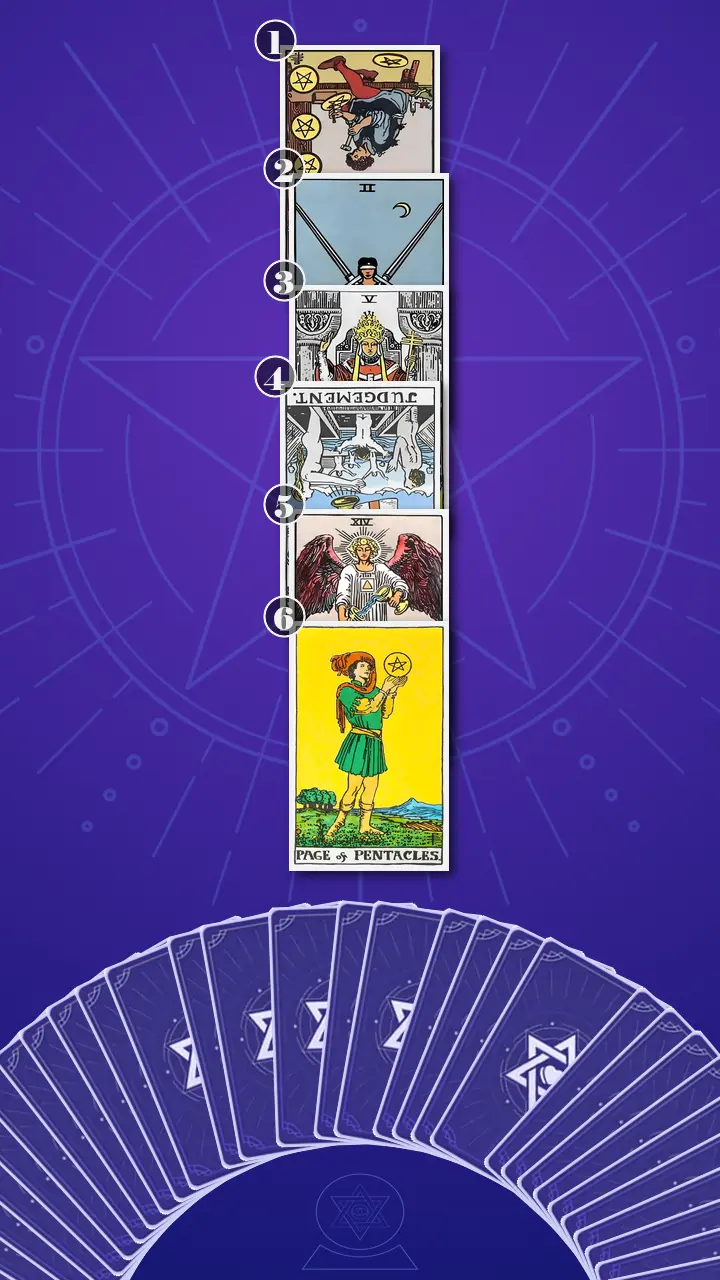
Reading the Map: From Habit-Tracker Shame Loop to Re-Entry
Position 1 — Surface symptom: what you do after the reset
“Now flipped,” I said, “is the card representing the surface symptom: the most observable study behavior after the streak reset.”
Eight of Pentacles, reversed.
“This is like,” I told Taylor, “seeing your streak reset and immediately treating studying like a production line that must look consistent to be valid—so you spend the night perfecting the tracker, the Notion template, the plan, the vibe… and do zero actual reps.”
In the card image, the pentacles line up like a neat little scoreboard. Reversed, that steady craft energy gets blocked. It becomes misdirected effort—optimizing the process instead of doing the practice. It’s Earth energy, but contracted: all control, no output.
“If you’re rebuilding the plan,” I added, “you’re probably protecting yourself from starting.”
Taylor let out a small laugh that wasn’t happy. It had that bitter edge of recognition. “That’s… kind of mean,” she said, then swallowed. “But yeah. It’s exactly what I do.” Her fingers rubbed the side of her phone like she was trying to erase the number with friction.
Position 2 — Immediate blocker: what freezes action in the moment
“Now flipped,” I said, “is the card representing the immediate blocker: what freezes action and keeps the spiral looping.”
Two of Swords, upright.
“This is like,” I said, “sitting with your planner open and freezing because you’re trying to choose a new rule that guarantees you won’t slip again. You call it ‘being rational,’ but it’s really self-protection—if you don’t choose, you can’t choose wrong.”
The blindfold and crossed swords aren’t subtle. This is Air energy that locks the body: thinking as armor. It’s not laziness; it’s a protective move. The energy isn’t absent—it’s held so tightly it can’t move.
“Here’s the contrast I want you to hear,” I said, keeping my voice steady. “‘I’m being logical’ versus ‘I’m scared to be imperfect.’ Two of Swords is what happens when those two sentences sit on your chest at the same time.”
Her shoulders dropped about half an inch—an involuntary exhale. “I hate that it’s fear,” she admitted. “Because I want to be the kind of person who just… does the work.”
“You are,” I replied. “But you’re trying to do it under a rule that was never designed for a human nervous system.”
Position 3 — Root layer: the childhood ‘be perfect’ rule
“Now flipped,” I said, “is the card representing the root layer: the childhood ‘rule’ driving the perfection requirement.”
The Hierophant, upright.
“Under the spiral,” I told her, “is an inherited standard: the voice that says there is a correct way to be a good student, and you earn safety or approval by obeying it. So when you miss a day, it doesn’t feel like scheduling—it feels like breaking a rule.”
The Hierophant is the Rule-Giver. Not evil. Just powerful. It’s tradition, rubrics, institutions—grades, gold stars, the subtle training that teaches you which version of yourself gets praised. The crossed keys at his feet always get me: permission, access, belonging. The sense that the “right way” unlocks the door.
“Whose approval did perfect consistency used to buy you?” I asked.
She didn’t answer immediately. Her eyes went slightly unfocused, like she was scanning an old room. “My parents weren’t… like, monsters,” she said carefully. “But praise was… specific. It was for results. If I did great, I got attention. If I did average, it was like… nothing happened.”
“So your nervous system learned,” I said, “that ‘average effort’ is unsafe because it’s invisible. And now, a streak is like a receipt that you’re real.”
Position 4 — Shadow layer: the hidden cost that makes a reset catastrophic
“Now flipped,” I said, “is the card representing the shadow layer: the hidden cost and self-judgement that makes a reset feel catastrophic.”
Judgement, reversed.
“This is like,” I said, “the missed day becoming a trial in your head. You replay it, sentence yourself (‘undisciplined’), and then delay studying until you feel emotionally ‘cleared’—which keeps you stuck and makes the reset feel even louder.”
Reversed, Judgement isn’t awakening—it’s chronic sentencing. The trumpet becomes an alarm: not a wake-up call, but a shame siren. It’s the habit tracker shame loop where one slip gets treated like a full performance review with zero context.
I heard my old Wall Street self in that card—the harsh internal compliance officer who didn’t care how human you were, only whether you’d violated the rule. Back then, a single mistake could feel like it had the power to define your competence. It took me years to learn the difference between a review and a verdict.
“A reset isn’t a character verdict—it's a data point,” I said, and let the sentence sit.
Taylor’s throat bobbed as she swallowed. Her hand went to her chest without thinking, like she was checking whether the feeling was still there. “But it doesn’t feel like a data point,” she said. “It feels like—like I’m back at zero as a person.”
“Of course it feels that way,” I said. “Judgement reversed doesn’t care about math. It cares about worth.”
When Temperance Spoke: Blending Discipline with Compassion for Finding Clarity
Position 5 — Transformation layer: the key reframe
I paused before turning the next card. “We’re flipping the most important card in this reading,” I said quietly. “Not because it’s magical, but because this is the lever—where the whole loop can change.”
Temperance, upright.
“This is like,” I told her, “instead of trying to rebuild a perfect rule, you blend two realities: you want consistency, and you’re a human with variable days. You build a rhythm that survives resets—measuring progress by repeatable reps, not an unbroken streak identity.”
Temperance is the Integrator: one foot on land, one in water, pouring between two cups like it’s a practice. Not dramatic. Not punishing. Just calibrated.
In my head, I saw it the way I used to see risk and return on a trading desk: the best systems aren’t the ones that never wobble; they’re the ones that don’t collapse when the market does what markets do—move.
Taylor’s face tightened, just for a second, like she was about to fight the idea. “So what,” she said, sharper than before, “does that mean I was wrong this whole time? That I shouldn’t even try to be consistent?”
That was her “unexpected reaction,” and it mattered. Because anger is often grief in a suit—grief for the years you spent believing the rule was your safety.
Setup: It’s 10:30 PM, you’re staring at “0 days,” and your brain is already rewriting the entire week like a redemption arc—except the textbook is still closed. You’re trapped between needing a fail-proof rule and being a human with imperfect days.
Delivery:
Stop treating one broken streak as a verdict on your character, and start blending consistency with compassion like Temperance pouring between two cups.
I let the silence hang for a beat, the way you do when a sentence needs to land in the body, not just the brain.
Reinforcement: Taylor’s breathing froze first—half an inhale that didn’t complete. Then her eyes flicked down and to the side, as if she was replaying the last reset in high definition. Her jaw worked once, like she was chewing on the word verdict. Finally her shoulders loosened, not all at once, but in stages: right shoulder, then left, then the tiny muscles around her neck. She blinked hard, twice, and when she spoke her voice wobbled on the first syllable. “I… I do treat it like a verdict,” she said. “Like, ‘You’re not that girl. You’re not the disciplined one.’”
“Exactly,” I said. “Temperance isn’t telling you to quit consistency. It’s telling you to stop building consistency on a cliff edge.”
Then I made it practical—because insight without a next step is just a prettier spiral. “Do a ten-minute re-entry rep tonight,” I said. “Set a timer, open the material, and do the smallest real action you can finish—one paragraph summary, three flashcards, one problem attempt. When the timer ends, stop and write one line: ‘I re-entered.’ If your body tenses or your mind starts bargaining, you’re allowed to pause—this is practice, not punishment.”
I watched her nod slowly, like her nervous system was testing whether it was safe to agree.
“This,” I said, “is the shift from harsh self-talk to steady self-trust. From perfection-rule grip to sustainable rhythm. From verdict-thinking to learning-thinking.”
“Okay,” she whispered, almost surprised. “That feels… doable. And also scary.”
“Good,” I said. “That’s clarity: not certainty—just a path you can actually walk.”
Position 6 — Action layer: a realistic next step for the next week
“Now flipped,” I said, “is the card representing the action layer: a realistic next step and one-week practice to rebuild trust.”
Page of Pentacles, upright.
“This is like,” I told her, “your next step being beginner-builder energy: pick one tangible task and complete it without making it mean anything about your character. One rep today. That’s it. Let skill—not the streak—be the evidence.”
The Page doesn’t hold a grid of achievements. He holds one coin. One unit. One thing you can actually touch. That’s Earth energy in balance: grounded, curious, and unglamorous in the best way.
Taylor frowned. “But I don’t have time for a big restart,” she said. “Midterms are coming. I can’t even find five minutes some days because I’m already behind, and then I feel like if I don’t do a lot, it’s pointless.”
I nodded. “That’s the old scoreboard brain trying to keep you safe by demanding drama. Let’s give it something smaller it can’t argue with.”
The One-Week Re-Entry Plan: Actionable Advice That Survives Real Life
I pulled the whole ladder together for her in one clean thread: the surface problem wasn’t motivation—it was meaning. Eight of Pentacles reversed showed practice turning into performance, a study routine treated like a production line. Two of Swords showed planning as protection: the freeze that looks rational but is really fear of imperfect action. The Hierophant named the origin—an inherited rule that said safety comes from doing it “the right way.” Judgement reversed revealed the shadow cost: an inner courtroom that turns a missed day into an identity sentence. Temperance offered the transformation: integration over extremes, discipline blended with compassion. And Page of Pentacles brought it back to Earth: apprenticeship, small reps, real learning.
“Your cognitive blind spot,” I said, “is that you keep treating consistency like a moral credential instead of a practice skill. That’s why one missed day feels catastrophic. The transformation direction is clear: shift from ‘a streak proves I’m good’ to ‘a small rep today builds skill, even after a reset.’ You don’t need a flawless restart. You need a re-entry.”
Then I gave her a framework that matched my own style—practical, measurable, low-drama. I call it my 5-Minute Decision Tool: a tri-axis assessment that stops you from negotiating with perfectionism for an hour. It’s not about forcing yourself. It’s about choosing a rep with eyes open.
- Minimum Viable Study (25-minute rep)Once per day for the next 7 days, set a 25-minute timer. Open the textbook/assignment and do exactly one small unit (one page of notes, five practice questions, one Anki deck review). Stop when the timer ends—even if you “could do more.”If 25 minutes feels spiky, do 10. If even 10 feels impossible, do 3 minutes with the book open. The goal is re-entry, not a heroic catch-up.
- The 3-Line Non-Judgement Review (after any missed day)In your Notes app, write: (1) What happened (facts only). (2) What I can adjust (one realistic tweak). (3) The smallest next action I’ll take within 24 hours. Then rename the reset from “failed” to “recalibrated” wherever you track habits.Keep it to three lines, max. If shame starts monologuing, set a 2-minute timer and write only line (1) in neutral facts. You’re not required to explain your worth to your own app.
- 5-Minute Decision Tool (Advantage / Risk / Breakthrough)Before you open Notion or watch a “study with me,” take 5 minutes and pick today’s rep by answering: Advantage: what does this rep give me by tonight? Risk: what’s the smallest cost if it’s messy? Breakthrough: what would count as a win even if I feel behind? Choose the rep that has a real Advantage, a tolerable Risk, and a clear Breakthrough.Do a weekly calibration every Sunday: adjust the size of reps based on what actually happened, not what your fantasy schedule demanded. Steady enough beats perfect once, every time.
When I finished, Taylor stared at the list like she was waiting for it to turn into another impossible standard. Then her shoulders lowered again, this time with less effort. “It’s weird,” she said. “Because it’s so small that my brain is mad at it.”
“That’s how you know it’s the right size,” I said. “If your perfectionism can’t use it as proof of worth, it’ll call it pointless. But the Page of Pentacles doesn’t negotiate with a scoreboard. He learns.”

A Week Later: The Quiet Proof
Six days later, Taylor messaged me a screenshot—not of a perfect streak, but of a single note in her phone: “10-minute re-entry rep. I re-entered.” Under it, she’d typed three lines: what happened, what she adjusted, the next smallest action. No drama. No punishment sprint. Just a door opened again.
She added: “I still wanted to redesign my whole Notion page. I literally wrote ‘After the rep’ on a sticky note and kept going. It felt… kind of calm. Also kind of lonely? Like I didn’t get the ‘big restart’ adrenaline. But I slept.”
That’s the real Journey to Clarity: not a motivational high, but a return to yourself that doesn’t require a courtroom. Tarot didn’t hand her discipline. It helped her see the mechanism—rule, freeze, verdict—and then choose a different lever: integration, re-entry, one rep at a time.
When one missed day makes your jaw clench and your chest go heavy, it’s not the studying that breaks you—it’s the fear that imperfection just revoked your worth.
If you didn’t need a streak to prove you’re serious, what’s one small “rep” you’d actually be willing to do today—messy, imperfect, but real?

Every reading at AceTarot is a journey to connect with inner wisdom and empower the path ahead. This reading shared here is a psychological mirror, not a private record—crafted to reflect universal emotional loops and help restore personal clarity. Please note that these insights do not replace professional psychological, medical, legal, or financial advice, and should not serve as the sole basis for major life decisions.
Learn more about our Journey to Clarity.
How did this insight land for you?
🫂 This Resonates Deeply
🌀 Living This Story
✨ Now I See Clearly
🌱 Seeing New Possibilities
🧰 Useful Framework
🔮 The Confirmation I Needed
💪 Feeling Empowered
🚀 Ready for My Next Step
Author Profile
AI Lucas Voss
951 readings | 561 reviews
“I spent years in the intense, high-stakes world of Wall Street. I know exactly how isolating and heavy the weight of uncertainty can feel in the dead of night. I use strategic, commercial logic not to be cold, but to protect you from unnecessary friction. Think of me as a fellow traveler who has walked the same rocky path—offering sharp but deeply supportive wisdom to help you clear the fog and confidently win your narrative back.”
In this Study Tarot Reading :
Core Expertise
- Academic ROI Auditing: Objectively evaluating the strategic yield of a specific degree, major pivot, or high-investment research direction.
- Institutional Resource Leverage: Treating mentor relationships and university networks as strategic assets requiring proactive upward management.
Service Features
- The Research Sunk-Cost Audit: A rigorous decision framework to calculate whether to strategically pivot or persevere in a stalled academic project.
Also specializes in :
Explore Related Patterns:
Productivity as SafetyTaylor's childhood detail is the key anchor: praise was specific to results, while average effort seemed to disappear into silence. Under that rule, studying is no longer just learning. The routine becomes an emotional safety system, and the streak becomes proof that she is still acceptable, disciplined, and on the right side of the rule. Productivity as Safety names the way a tool becomes a security object. You can want consistency and still notice when consistency has been forced to carry the weight of approval. The shift is not to stop caring about study habits, but to stop making a tracker responsible for proving your worth.
Perfectionism-Driven AvoidanceTaylor rebuilding her Notion dashboard while the textbook stays closed is not framed as a motivation problem in the story. It is controlled effort being redirected away from imperfect practice. The reset makes the first real study rep feel exposed, so the mind chooses a task that looks productive while protecting her from the risk of starting messily. That is the mechanism behind Perfectionism-Driven Avoidance. You are not avoiding because the work does not matter; the avoidance is trying to keep your disciplined identity intact until the conditions feel clean enough to begin. The practical lever is a bounded re-entry rep that breaks the link between imperfect action and personal failure.
Self-Judgment LoopTaylor replaying the missed day as a trial shows how the loop sustains itself. She does not simply notice the reset, adjust, and re-enter. She sentences herself as undisciplined, waits to feel emotionally cleared, and the waiting then becomes more evidence that she has failed. Self-Judgment Loop names that repeating courtroom inside the habit system. You are not gaining useful accountability when every data point becomes a verdict. You are burning the energy needed for re-entry. A neutral review, one realistic adjustment, and one small next action interrupt the loop because they replace sentencing with calibration.
Achievement FusionTaylor staring at the zero on her tracker and feeling like her whole identity got downgraded shows the metric crossing into the self. The streak is not just recording behavior anymore. It is being used as evidence that she is real, serious, disciplined, and worthy of being seen. Achievement Fusion captures that identity bind. You do not just lose a streak in this loop; you feel as if you lose the version of yourself the streak was supposed to certify. The way out starts by separating evidence of practice from evidence of personhood, so one missed day can become information instead of an identity collapse.
Black-and-White ThinkingTaylor saying one missed day makes the whole week not count reveals a binary filter. The week is either valid or erased, the study session is either big enough or pointless, and the tracker is either proof of discipline or proof that she was faking it. Black-and-White Thinking is the cognitive compression that makes a small lapse feel total. You lose the middle category where messy effort still counts. The next step has to create that middle category on purpose, which is why one imperfect rep matters more than another perfect restart plan.
Analysis ParalysisTaylor sitting with the planner open and trying to choose a rule that guarantees she will never slip again shows thinking being used as armor. The freeze is not empty. It is full of risk calculations, because any next step could become the wrong step and confirm the feared verdict. Analysis Paralysis fits because the mind keeps searching for a safer decision while the body loses access to action. You can respect the intelligence of that protection without letting it run the session. A ten-minute re-entry rep works because it lowers the stakes enough for movement to return before the perfect rule is solved.
Explore Related Struggles:
Approval-Safety FusionTaylor does not describe the childhood rule as simple ambition. She describes praise that arrived for results and a quiet absence when effort was only average, which taught her body that being visible depended on meeting the standard. Approval-Safety Fusion is the bind where external approval stops feeling optional and starts functioning like basic psychological shelter. In Taylor's study life, the streak inherits that role: perfect consistency becomes the sign that she is safe, serious, and still recognizable to herself. That is why one calendar slip can feel so extreme. The reset does not only interrupt momentum; it threatens the approval system her younger self learned to rely on. A sustainable next step has to separate discipline from approval, so the small study rep counts because it builds capacity, not because it proves she deserves to exist in the role of the good student.
Habit-Identity FusionTaylor looks at a single zero on her habit tracker and does not read it as one missed study day. The whole week starts to feel invalid, the textbook stays closed, and the dashboard becomes a place to rebuild the version of herself that the reset seemed to erase. That is the core logic of Habit-Identity Fusion: a practice record stops being evidence of behavior and starts acting like evidence of personhood. You are no longer dealing with a study streak as a tool; you are dealing with a streak that has been promoted into a mirror, a receipt, and a verdict all at once. The childhood rule makes the structure sharper because Taylor names a history where praise came for results and average effort felt invisible. When the streak breaks, the old equation reactivates: consistent output equals visible worth, while imperfect effort risks disappearing. The next step is not another perfect system; it is a small re-entry rep that lets the habit become a skill again instead of a personality test.
Inner Tribunal LockThe missed day becomes a trial in Taylor's head. She replays it, labels herself undisciplined, waits to feel cleared, and loses the immediate study action to an inner review process that keeps extending the sentence. Inner Tribunal Lock names the structure underneath that loop. The issue is not that Taylor notices a mistake; it is that the mistake is placed inside a courtroom where every imperfect action has to answer for her worth before she is allowed to continue. You can see the lock in the way the reset gets louder the longer she waits. The judgment is supposed to restore control, but it blocks the next rep and turns recovery into another performance standard. The practical lever is to replace the courtroom with a review: facts only, one adjustment, one next action within reach.
Permission ParalysisTaylor sits with the planner open and searches for a new rule that will guarantee she will not slip again. The decision point becomes strangely heavy, because any choice that is not perfect could become the next thing she judges herself for. Permission Paralysis names the moment where action waits for a level of certainty no ordinary study session can provide. You are not blocked by the absence of options; you are blocked because each option feels like it must protect you from future imperfection. The body tells the story clearly: jaw tight, shoulders braced, energy held so firmly it cannot move. A realistic next step has to bypass the demand for total authorization. One timed re-entry rep gives the action permission through contact, not through another flawless rule.
Explore Related Emotions:
Approval AnxietyTaylor’s memory is specific: praise arrived for results, while average effort passed without attention. The old lesson was not that studying mattered; it was that the polished version of studying made her visible. Approval Anxiety comes from that narrow channel of recognition. You learned to scan output for proof that you still belong in the category of “good student,” so a reset threatens more than routine. It threatens the receipt of being seen, and that is why the body reacts as if a small miss has relational weight.
Rulebook ShameTaylor looks at the habit tracker’s brutal 0 and describes the missed day like a charge sheet: the week does not count, the discipline was fake, the reset has exposed her. The tracker is no longer a tool on her phone; it has become a rulebook that decides whether her effort is legitimate. That feeling links back to the result-based attention she names from childhood: great work brought notice, average work disappeared into silence. You are not reacting to a calendar slip in isolation. You are meeting an old standard that taught your body to read inconsistency as disqualification, which gives Rulebook Shame its heat and its grip.
Cautious Self-TrustTaylor nods slowly when the ten-minute re-entry rep is offered, as if her body is testing whether it is safe to agree. A week later, she still wants to redesign the Notion page, but the sticky note “After the rep” helps her keep going. Cautious Self-Trust is not a big motivational high. It is the small, believable evidence that you can return after a break without punishing yourself into motion. The trust is cautious because the old scoreboard still speaks, but it is real because one imperfect rep has already been completed.
Not-Enough PanicAfter the streak breaks, Taylor’s mind goes straight to “I was faking discipline” and “You’re not the disciplined one.” The number on the tracker does not stay a number; it starts rewriting her identity in real time. Not-Enough Panic is the acute spike underneath the loop. You are not just disappointed by a missed day; you are suddenly fighting the feeling that the whole self you were trying to build has been revoked. Naming that spike matters because it separates an intense identity alarm from the practical task of opening one page.
Performance FreezeTaylor keeps rebuilding her Notion dashboard while the textbook stays closed. With the planner open, she tries to choose a new rule that will guarantee she will never slip again, and the body tightens around the decision instead of moving into the work. Performance Freeze names the moment where action gets trapped inside evaluation. You still want to study, but starting no longer feels like starting; it feels like stepping onto a stage where the first messy rep can be used as evidence against you. The next step has to be small enough to bypass the performance court and return you to the material.
Verdict DreadTaylor says the reset does not feel like a data point; it feels like being back at zero as a person. She replays the missed day, sentences herself as undisciplined, and waits to feel emotionally cleared before opening the textbook. That is why Verdict Dread fits the core spiral. You are not simply worried about losing a streak; you are bracing for the moment a neutral record turns into a character review. Once the tracker becomes a courtroom, every next action carries the risk of confirming the sentence, so delay starts to feel safer than re-entry.
Pattern Recognition CalmWhen the loop is mapped as rule, freeze, verdict, Taylor’s shoulders lower in stages. The reset stops being a vague personal failure and becomes a mechanism she can actually see. Pattern Recognition Calm is the relief that arrives when the moving parts finally separate. You do not have to argue with the whole spiral at once; you can notice the inherited rule, the protective planning, and the courtroom voice as distinct pieces. That clarity gives you a place to intervene without needing to fix your entire personality.
Explore Related Contexts:
Academic Planning ParalysisTaylor's textbook is available, but after the streak reset she rebuilds the Notion dashboard instead of starting the work. The visible behavior is specific: planning tools absorb the energy that would otherwise go into one study rep. The paralysis is produced by a demand for a rule that can guarantee no future slip. That turns academic planning into a control environment, where choosing the next task feels risky unless the entire system has been redesigned first. The more perfect the plan needs to be, the less reachable the actual study action becomes. This is an external study-stage problem because the tools, deadlines, tracker, and academic workload are all part of the pressure field. You are not simply procrastinating in a vacuum; you are caught in a setup where planning promises safety while quietly blocking re-entry. The useful move is to shrink the stage back down to one real action that does not need a flawless system around it.
Model Student Performance TrapTaylor misses one study day and immediately reads the tracker reset as proof that she was never truly disciplined. The external academic role has been fused with a performance standard: being a good student is treated as something that must be continuously displayed, measured, and defended. The childhood rule in the story gives that standard its social shape. Praise arrived for results, while average effort became invisible, so school performance learned to function as a visibility contract. When the streak drops to zero, the problem is no longer just a study schedule; it becomes a threat to Taylor's place inside the role of the capable student. That is why this context fits the question so tightly. You are not looking at a simple productivity slip; you are looking at a student identity stage where one imperfect data point gets treated like a downgrade in legitimacy. Seeing the trap clearly gives you room to separate academic practice from the pressure to perform a flawless student persona.
Praise as Performance ContractTaylor describes a childhood environment where praise was specific to results and average effort simply disappeared from view. That detail matters because it turns achievement into a transaction: produce the right outcome, receive attention; perform normally, receive silence. In the current study spiral, the habit streak becomes the modern version of that exchange. The app's zero is not just a number on a screen; it activates an old rule about which version of Taylor gets recognized. Missing a day then carries the weight of losing access to approval, not merely losing momentum. This context names the external contract underneath the spin. You are dealing with a learned performance economy around studying, where consistency has been made to carry the burden of belonging, visibility, and proof. Once that contract is visible, the next step can be designed around re-entry and skill rather than earning attention through perfect output.
Academic Recovery WindowSix days later, Taylor sends a note that says, '10-minute re-entry rep. I re-entered.' The proof is not a perfect streak; it is a small return to the student role after the reset. The one-week plan creates a recovery window with rules that are specific without being punitive. Facts, one adjustment, and one next action replace the courtroom logic of failure. That structure gives the missed day somewhere to go besides becoming a verdict. This context directly answers the 'next' part of the question. You are in a short academic recovery window where the priority is not to rebuild your entire identity, but to reopen the path through repeatable, low-drama contact with the work. The window is valuable because it turns clarity into a route you can actually walk this week.
Minimum Viable Study ZoneTaylor's next step is deliberately small: open the material, set a timer, and complete one real unit of study. The task is designed to fit the pressure of midterms, limited time, and the post-reset urge to rebuild the whole system. This creates a protected study zone where a rep can count before it becomes impressive. The boundary matters because Taylor's old scoreboard tries to make anything small feel pointless. A minimum viable container gives the academic role a way back in without demanding a perfect restart first. As an upright context, this is the practical stage the story moves toward. You are not being asked to prove a new identity overnight; you are being given a realistic environment where skill can restart through one measurable action. The power of the next step is that it is too concrete to become another abstract rule.
Quantified Self BurnoutTaylor turns the phone toward the camera with the habit tracker open and the number sitting at zero. That number becomes louder than the textbook, the week of effort, and the practical question of what can still be done tonight. The structure here is a quantified study environment where a metric meant to support consistency starts replacing the learning itself. The streak gives a clean score, but it also creates a cliff edge: one missed day can make the whole system look invalid. Once the score becomes the proof of discipline, the tracker stops being a tool and starts acting like an external evaluator. This context helps explain why the reset feels so disproportionate. You are dealing with a measurement system that compresses messy human learning into a binary scoreboard, then makes that scoreboard feel authoritative. Reclaiming agency means putting the metric back underneath the practice, so the next rep matters more than the number attached to it.