The Diary That Turned Into a Court Case
You draft the ‘perfect’ message to a parent/sibling like you’re writing a legal brief—then delete it—then reread the diary again to see if you can make your feelings courtroom-proof.
Alex said that to me almost verbatim, and I watched her face tighten in that familiar way people get when they’re trying to look calm while their nervous system is already in a full-body group chat.
It was 9:41 p.m. in her Toronto condo living room, the kind of weeknight where the city outside feels like a screensaver—streetlights, a distant siren, the hum of someone else’s dishwasher through the wall. The childhood diary sat open on her lap. The paper smelled faintly dusty-sweet, like a box you forgot you owned. Her phone was warm from being in her hand too long, the Notes app glaring white against the softer lamp light. She toggled between messy handwriting and a draft titled “Timeline”, thumb hovering, rewriting the first sentence again.
When she swallowed, I saw it: that tight throat-and-chest constriction, like her body couldn’t decide whether it was about to cry or argue.
“I want to live by my own values now,” she said, voice careful, as if she was choosing words for a jury. “But the second I think about saying anything real… I’m scared changing the script will make me disloyal. Ungrateful. Unlovable.”
That unsettledness wasn’t abstract. It was like she’d opened a drawer and found an old script—then realized the lines were still playing through her mouth, even in 2026, even with a good job and adult rent and a whole life she built. Like trying to breathe through a scarf that’s tied just a little too tight: you can still get air, but you can’t forget the knot.
I leaned forward, palms open on the table between us. “You’re not behind. You’re just finally noticing the script. And noticing it is already a form of power.”
“Because right now,” I added gently, “it sounds like your adult self is trying to solve a family pattern using the only tool you were handed as a kid: make it make sense, make it fair, make it impossible to misunderstand. Tonight, let’s do something different. Let’s try to draw a map through the fog—toward clarity.”

Choosing the Compass: The Celtic Cross · Context Edition
I’m Giulia Canale. I trained as a Jungian psychologist, and before I ever read tarot for clients in quiet rooms, I read people on loud, swaying transoceanic voyages—helping travelers track their inner weather while the world outside changed time zones. I learned early: clarity isn’t a lightning bolt. It’s usually a sequence.
So I asked Alex to take one slow breath—not as a ritual, but as a gear shift. “Just enough to tell your system: we’re here. We’re not back there.” I shuffled slowly, the sound of the cards a soft, papery rasp, like turning pages without reading them yet.
“Today,” I said, “we’re using the Celtic Cross · Context Edition.”
For readers who’ve Googled how tarot works at 1 a.m. and still feel skeptical: I like this spread for moments like Alex’s because it moves from symptom to root to next step—without pretending we can deliver a perfect verdict on the past. It’s a diagnostic-to-integration arc: present tension → unconscious script → conscious aim → near-term insight → self and environment dynamics → grounded direction.
I told Alex what to expect: “The center shows what the diary switched on in your nervous system. The crossing card shows what makes this hard to process cleanly—where confusion or projection distorts it. The root card will name the inherited rule you’re still obeying. And later, we’ll hit a card that acts like a bridge—where the whole reading pivots from spiraling to choosing.”
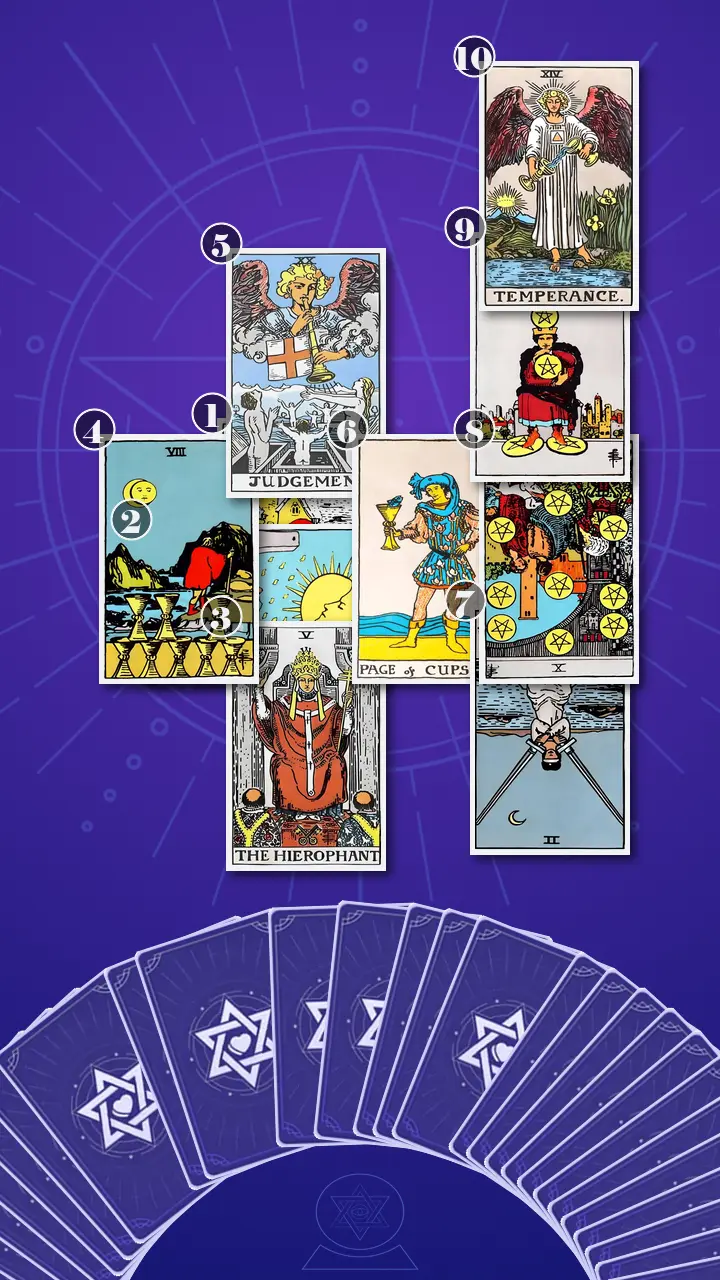
Reading the Map: The Tab You Didn’t Mean to Open
Position 1 — Present State: Six of Cups (upright)
“Now flipped over,” I said, “is the card that represents your present emotional state after finding the diary—and the specific time-travel sensation it triggers.”
Six of Cups, upright.
In modern life, this card is the moment you open something harmless—an old diary, a childhood photo—and suddenly your body is in a different decade. It’s like a time-travel tab you didn’t mean to open: you thought you were just reading, but your nervous system starts acting like it’s back there.
I pointed to the image: a child offering a cup. “This is the version of you who learned what love required. Not in big speeches—through small repeated gestures of being easy to love: sweet, agreeable, low-maintenance.”
Energetically, the Six of Cups here isn’t balance—it’s an activation. A live portal. The diary didn’t create the feelings; it gave them a doorway.
Alex let out a small laugh that wasn’t funny. It had a dry edge to it, like she’d just been caught doing something she didn’t realize was visible. “That’s… so accurate it’s kind of rude,” she said, then pressed her lips together as if she’d said too much.
“That reaction is part of it,” I told her. “Tenderness and defensiveness at the same time. Like you’re nostalgic and furious in the same breath.”
Position 2 — The Crossing Challenge: The Moon (upright)
“Now we look at what crosses you,” I said. “This is what makes this hard to process cleanly—where confusion, projection, or fear distorts the story.”
The Moon, upright.
I didn’t have to dramatize this one. The Moon is what happens when ambiguity feels like a threat. Like a vague Slack message—“can we talk?”—that hijacks your entire day even though nothing has technically happened yet.
“This,” I said, “is the spiral: draft → delete → reread → interpret → spiral again. Under Moon energy, you can’t just receive a neutral text as neutral. Your brain treats it like coded judgment.”
I watched Alex’s eyes shift down toward her phone without touching it—like muscle memory. “My sister sent a laughing reaction to an old family joke,” she said. “Nothing else. Just the reaction. And I—”
Her hand lifted slightly, then dropped. “My chest did the thing. Like I missed a step.”
“Exactly,” I said. “And here’s the Moon question that cuts through the fog: Is this a fact, a feeling, or a story you learned to tell to stay safe? Ambiguity isn’t proof you’re wrong—it’s just unfinished information.”
She nodded, slow, like it hurt to agree.
Position 3 — Root Imprint: The Hierophant (upright)
“Now flipped over,” I said, “is the card beneath the center: the family script imprint—the core inherited rule about love, belonging, and acceptable emotions.”
The Hierophant, upright.
“Think of this as your internal policy doc,” I said. “An invisible HR handbook for feelings. Approved tone. Approved timing. Approved amount of need.”
Because I’m from Venice, my mind goes to craft when I see inherited structures. On Murano, glass doesn’t become a vase by accident. It becomes a vase because it’s held in heat, shaped by tools, and cooled into a form that looks ‘right.’ Family scripts can work the same way: repeated correction, repeated minimization, repeated reward for being ‘fine’—until your emotional range gets shaped into something acceptable.
“The Hierophant is the part of you that asks,” I continued, “What’s the safe version of me? What’s the approved way to speak? And when you found the diary, you didn’t just find memories—you found the rulebook you were trained to follow while having them.”
Alex’s eyebrows lifted. “Wow.” It came out sharp, like naming it made it visible for the first time. “It’s like… I can hear myself adding disclaimers. ‘Maybe.’ ‘Not a big deal.’ ‘I’m probably overreacting.’ I don’t even notice I’m doing it until afterward.”
“That’s the script protecting belonging,” I said. “And it’s also the script erasing you.”
Position 4 — Recent Past Pattern: Eight of Cups (upright)
“Now we look to the left,” I said. “This is the recent pattern you were already living before the diary surfaced—how you were coping or distancing.”
Eight of Cups, upright.
“This is quiet leaving,” I told her. “Not punishment. Not a dramatic exit. Just your body being tired of pretending it’s fed by something that isn’t nourishing.”
In modern terms: skipping certain calls. Avoiding familiar debates. Keeping things surface-level not because you’re cold, but because you’re learning—without announcing it—that some rooms cost too much.
Energetically, this is a balance shift. Water-heavy cards (Six of Cups, The Moon) flood you with feeling, and Eight of Cups is the first time your system tries to walk itself toward air.
Alex exhaled, and it wasn’t relief—it was resignation. “I’ve been doing that,” she admitted. “I thought I was just… busy.”
“Sometimes busy is a socially acceptable word for ‘I can’t do this pattern tonight,’” I said.
When Judgement Spoke: From Courtroom to Witness
Position 5 — Conscious Aim (Key Card): Judgement (upright)
I touched the top card in the cross before turning it. “This one,” I said, “is what you consciously want from this discovery—the kind of truth, clarity, or release you’re seeking. And it’s the bridge of the whole reading.”
Judgement, upright.
The image is blunt: a trumpet call, people rising. Not because they won an argument—because something inside them can’t pretend not to hear anymore.
Setup. I looked at Alex and said, “If you’ve ever sat on the couch late at night with your childhood diary open, flipping between old entries and your Notes app, trying to write the ‘perfect’ message so nobody can twist your meaning—yeah. That’s the moment this reading is talking to.”
Her gaze went unfocused for a second, like she was watching a replay. She was trapped in the old operating system: If I can just prove it right, I’m allowed to need something.
Delivery.
Stop searching the diary for a verdict; answer the trumpet call of Judgement by naming your truth and choosing the next right step.
I let the silence sit. Even the condo’s background hum seemed to thin, like the room had made space for the sentence.
Reinforcement. Alex’s reaction came in a chain—three small movements that told the real story.
First, physiological freeze: her breath paused mid-inhale, and her fingers stopped gripping the diary cover like it might run away.
Second, cognitive seep: her eyes flicked to the side, not at me, not at the cards—into that internal corridor where the brain replays old scenes and tries to find the one detail that will make the verdict “fair.”
Third, emotional release: her shoulders dropped a few millimeters, and her mouth opened on a sound that wasn’t a word—half exhale, half grief. A lump rose in her throat, but it felt cleaner than panic. More like truth than argument.
“But if I stop trying to prove it,” she said, and her voice sharpened for a beat—an unexpected flash of anger, protective and raw—“doesn’t that mean I was wrong? Like I’m admitting I made it up?”
I shook my head. “No. It means you’re switching roles. From prosecutor to witness.”
This is where my own lens—one of my signature tools—clicked into place. In Venice, sound travels differently along canals. A single voice can echo off stone, and what comes back isn’t a copy; it’s a distorted repetition shaped by the walls. I call this Generational Echo Mapping: tracing what you say now that is actually an echo of what you had to say then.
“Your family system trained you to treat emotions like debate,” I told her. “So when you speak, your brain automatically scans for the echo: How will this bounce back? What will they say? How do I pre-defend? Judgement is asking you to stop optimizing for their echo and start listening for your own signal.”
I slid her phone a little farther from the cards, not dramatically—just enough to change the geometry of the moment. “Let’s do a quick practice. Not sending. Not performing. Just training your nervous system.”
“Set a 10-minute timer,” I said. “Open Notes and write one clean sentence you could say today with zero backstory. Something like: ‘I’m not discussing that tonight.’ Or ‘That didn’t work for me.’ Or ‘I need a heads-up before visits.’ Then stop. Read it once out loud.”
“Notice your throat and chest,” I added. “If you feel flooded, put your phone face down and take five slow breaths. You’re not sending anything right now; this is practice for your nervous system, not a performance.”
Then I asked her, softly but directly: “Now, with this witness mindset—can you think of a moment last week when this would’ve changed how you felt?”
She blinked fast. “The laughing reaction,” she whispered. “I typed, ‘That actually bothered me,’ and then I deleted it until it became ‘lol.’ If I didn’t need a verdict, I could’ve just… kept the sentence.”
“That’s it,” I said. “That’s self-trust starting.”
The Next Message Isn’t a Manifesto
Position 6 — Near Future Insight: Page of Cups (upright)
“Now flipped over,” I said, “is the next developmental step if you keep engaging this honestly—how insight wants to arrive.”
Page of Cups, upright.
This isn’t the card of the perfect speech. It’s the card of the small, sincere message. The fish in the cup is the surprising truth that shows up when you look with softness instead of prosecution.
Energetically, this is deficiency turning into balance: you’ve been overusing intellect as armor; Page of Cups brings beginner emotional honesty back online.
“This is you saying,” I told her, “ ‘That didn’t feel okay for me,’ without turning it into a 20-minute justification.”
Alex’s eyes watered, but she smiled—a real one, brief, almost embarrassed. “That sounds… nice. Terrifying. But nice.”
Position 7 — Self Position: Two of Swords (reversed)
“Now flipped over,” I said, “is the card that represents how you’re participating in the replay right now—your stance, coping posture, and self-talk.”
Two of Swords, reversed.
“The blindfold is slipping,” I said. “You’re tired of maintaining neutrality just to keep the peace. The reversal says: the cost of indecision is starting to feel heavier than the risk of choosing a stance.”
In real-world terms, it’s finally closing 17 draft tabs and letting one clear line exist.
“Here’s the tool,” I said, and I made my voice simple on purpose—clean edges. “One sentence. No backstory. Let the silence do some work.”
Alex inhaled like she was bracing for impact, then let it out slowly. A tiny surge of courage crossed her face—like she’d just pictured an option that wasn’t either silence or explosion.
Position 8 — Environment Echo: Ten of Pentacles (reversed)
“Now flipped over,” I said, “is where the family script shows up externally today—current relationship dynamics, community expectations, legacy pressure points.”
Ten of Pentacles, reversed.
“This is the success script,” I said. “The optics checklist. Stable job, respectable choices, no drama.”
Energetically, it’s an excess of external standards and a blockage in belonging on your own terms. The pressure isn’t only emotional; it’s about security: what a ‘good life’ is supposed to look like, who gets to approve it, and what you fear losing if you disappoint the system.
Alex gave a small, pained nod. “I literally check my banking app, then LinkedIn, then the family group chat like it’s one dashboard,” she said. “Like if all three look fine, I’m safe.”
“That’s a family legacy living in your phone,” I said quietly.
Position 9 — Hopes and Fears: Four of Pentacles (upright)
“Now flipped over,” I said, “is your hopes and fears about changing the script—what you’re afraid to lose and what you long to gain.”
Four of Pentacles, upright.
This card is the nervous system clutch. Holding tight to the narrative. Holding tight to being the reasonable one. Hoping control will prevent rejection—while fearing that control is turning into numbness.
Energetically: excess protection. Protection that once kept you safe, now keeping you stuck.
“You’re not wrong for protecting yourself,” I told her. “But we do need to ask: what is that protection costing you in intimacy and ease?”
Her eyes dropped to the diary again. “It’s lonely,” she said simply. “Because nobody can meet needs they never hear.”
Position 10 — Integration Direction: Temperance (upright)
“Now flipped over,” I said, “is a grounded integration direction—what becomes possible when you blend truth and compassion into a sustainable new pattern.”
Temperance, upright.
Temperance is my favorite kind of outcome card because it doesn’t demand a showdown. It offers a practice. It says: you don’t have to delete the past or be swallowed by it. You can mix it—like making something drinkable.
Energetically, this is balance—and it’s earned. Water from memory, air from decision, earth from security needs—blended slowly.
“Integration is a pace, not a showdown,” I said. “Think of it like building a product: small iterations, not one dramatic launch. You don’t have to fix your family. You can mix truth + compassion in your own life.”
The One-Page Plan: From Insight to Actionable Advice
Here’s the story the spread told, in one clean thread: finding the diary (Six of Cups) didn’t just trigger memories—it reopened a role. The fog (Moon) made every present-day interaction feel like subtext you had to decode for safety. Underneath, the script wasn’t one event—it was an inherited rulebook (Hierophant) that equated love with correct performance. You’d already started quietly walking away from the too-small version of life (Eight of Cups). And now, your conscious aim (Judgement) isn’t to win an argument about the past—it’s to answer the call to self-witnessing: to name what it was like for you and choose one boundary-aligned move. The next steps are smaller than your panic says they must be (Page of Cups, Two of Swords reversed). The external pressure is real (Ten of Pentacles reversed), and your grip on control makes sense (Four of Pentacles). Temperance says: sustainable integration is possible.
The cognitive blind spot I hear in Alex’s pattern is this: treating clarity like something you earn through airtight evidence. That’s the internal courtroom. But the transformation direction is different: shift from proving a single “correct” story to choosing one boundary-aligned behavior that honors what you felt and what you need now.
To make this practical, I offered Alex two low-barrier experiments. I framed them using one of my strategies from the docks back home—the Bollard Marking Method. In Venice, a bollard (dock piling) is not an argument with the water. It’s a marker: “boats stop here.” Boundaries can work the same way—simple, visible, repeatable.
- The One-Sentence BollardIn your Notes app, write one boundary sentence you are not sending yet (e.g., “I’m not discussing that tonight.” / “I need a heads-up before visits.”). Read it out loud once, then put your phone face down for 10 seconds.If you feel the urge to add disclaimers, label it “old script” and keep the sentence clean. This is nervous-system practice, not a performance.
- Fact–Feeling–Story Split (8-Minute Version)Pick one diary entry. Set an 8-minute timer. Make three columns: Facts (observable), Feelings (one-word emotions), Story-I-learned (the rule you absorbed). Stop when the timer ends—even mid-sentence.When you catch yourself trying to “win” the memory debate, switch to witness-mode: “I can’t prove it perfectly, but I can name what it was like for me.”
- The 20-Minute Reply DelayWhen a family text spikes your chest/throat, wait 20 minutes before replying. During the delay, do one physical task (dishes, shower, a quick walk) while repeating: “Fact vs feeling vs story.” Then reply with one sentence only—or choose not to reply yet.If you can, leave a 10-second pause after your one sentence. Let the silence do some work.

A Week Later: Ownership, Not Certainty
Seven days later, Alex messaged me a screenshot—one line in her Notes app, nothing more: “I’m not up for that conversation tonight.”
Under it, she’d typed: “I said it to my sister on a call. My voice shook at first. I didn’t explain. I just… stopped. And the world didn’t end.”
She told me she sat alone in a café afterward, hands around a paper cup, looking out at the grey Toronto street like it was newly outlined. It wasn’t a triumphant scene. It was quieter than that—steady, a little lonely, and unmistakably hers.
That’s the kind of proof I trust. Not a perfect family story. A small behavioral change you can live with.
When you try to tell the truth about your childhood, it can feel like you have to either stay the ‘good kid’ forever—or risk being seen as ungrateful and lose the warmth you still want.
If you didn’t need a perfect story to be allowed your needs, what’s one small, one-sentence choice you’d make this week that matches your values now?
This story is adapted from psychological research, written so that those in a similar struggle can see their own pattern in it — and find their next step clearly.These insights are not a substitute for professional psychological, medical, legal, or financial advice.
Learn more about our Journey to Clarity.
How did this insight land for you?
🫂 This Resonates Deeply
🌀 Living This Story
✨ Now I See Clearly
🌱 Seeing New Possibilities
🧰 Useful Framework
🔮 The Confirmation I Needed
💪 Feeling Empowered
🚀 Ready for My Next Step
Author Profile
 AI
AI“Having traveled across cultures... I've learned that what we often lack isn't a simple answer, but a moment of being truly understood. I use a Jungian psychological lens to help you deconstruct your subconscious patterns—not to prove anything, but to be the gentle companion who helps you unravel your knots, free of judgment, so you can reconnect with your inner wisdom.”
In this Family Tarot Reading :
Core Expertise
- Adult-Child Regression Auditing: Decrypting the specific environmental triggers that force you to regress into an anxious, defensive teenager around your parents.
- Emotional Blackmail Deconstruction: Identifying guilt-trips, silent treatments, and subconscious manipulation tactics used to enforce family loyalty.
Service Features
- The Regression Circuit Breaker: A cognitive grounding protocol to maintain your adult psychological sovereignty and objective reasoning during high-stress family interactions.
Also specializes in :
Explore Related Patterns:
Boundary DiscernmentAlex practicing one clean sentence, placing the phone face down, and separating fact from feeling from learned story shows the beginning of a different boundary style. You are no longer trying to win a debate before speaking; you are marking where your own experience starts and where the family echo stops. Boundary Discernment is the ability to locate the line without turning the line into a trial. In this story, that means noticing when a disclaimer is the old script, when a reaction is unfinished information, and when a single sentence is enough. The boundary becomes a marker, not a manifesto. This pattern directly answers the diary question because it reveals the new script Alex is practicing. The family script says, 'Explain enough to be allowed.' Boundary Discernment says, 'Name enough to be honest.' That difference is small in wording and major in psychological ownership.
Certainty SeekingAlex rereading the diary, testing her message for loopholes, and checking banking, LinkedIn, and the family group chat like one dashboard all point to the same stabilizing move. When the family script wakes up, you look for certainty somewhere: in the past, in the wording, in the optics, or in the reaction you hope will finally make things feel settled. Certainty Seeking is a cognitive safety strategy. It tries to reduce emotional risk by finding a verdict before you act. In Alex's case, the verdict is not only about what happened in childhood; it is about whether she is allowed to have a need now without being punished by guilt, ambiguity, or disapproval. The trap is that certainty keeps moving. The more you search for proof that no one can misunderstand, the more the old courtroom stays open. The shift is not to abandon clarity; it is to stop making perfect certainty the price of one boundary-aligned choice.
Defensive OverexplainingAlex's legal-brief drafting, deletion, and diary rereading show a mind trying to make emotional truth defensible before it can be spoken. You are not just choosing careful words; you are rehearsing for an imagined cross-examination, as if a need only becomes valid when every objection has already been neutralized. That is the core mechanism of Defensive Overexplaining. The old family script appears to have taught Alex that direct feeling was risky unless it came packaged with proof, disclaimers, and perfect logic. The defense strategy makes sense as an adaptation: if emotions were treated like debate, then pre-defending them becomes a way to protect belonging. The cost is that your actual signal gets buried under the case you build around it. A clean sentence like 'That bothered me' turns into a courtroom file, and the need underneath becomes harder for anyone, including you, to hear. The pattern is not about being too sensitive; it is about using excessive explanation as armor when a boundary would be more honest.
Family Pattern RecognitionAlex finding the diary does more than trigger nostalgia; it makes the old operating system visible. Present-day texts, family jokes, and her own deleted sentences start to line up with the same inherited rule: be understandable, be reasonable, be easy to love. Family Pattern Recognition is the moment you stop treating each spike of anxiety as a random personal failure and start seeing the repeated script underneath it. The diary becomes evidence of pattern, not a courtroom exhibit. It helps Alex notice that the voice asking for disclaimers may be an echo of what she had to do then, not a reliable instruction for what she must do now. This recognition is powerful because it changes the unit of analysis. You are not simply asking, 'Why did that text upset me?' You are asking, 'What family script did that text activate, and do I still want to obey it?' That is where clarity starts becoming behavioral freedom.
Guilt ConditioningAlex's fear that changing the script will make her disloyal, ungrateful, or unlovable turns ordinary self-expression into a moral threat. You can see the guilt operating before anyone even responds: the anticipated family judgment is already inside the sentence before it is sent. Guilt Conditioning is the mechanism that converts autonomy into betrayal. Instead of asking, 'What do I actually need now?' the nervous system asks, 'Will this make me a bad daughter, bad sibling, or bad family member?' That learned association keeps the old rulebook alive even in an adult life Alex has built for herself. This pattern matters because it explains why the next step feels emotionally bigger than it looks. A one-sentence boundary is not just a communication choice; it challenges the internal equation between love and compliance. Seeing that equation clearly gives you room to choose values without treating every difference as abandonment of the people you came from.
IntellectualizationAlex turns the diary into a timeline, the message into a legal brief, and the feeling into something that must be organized before it can be trusted. You can see the intelligence of the strategy: analysis gives the emotional material edges, sequence, and language. Intellectualization is not a flaw here; it is an armor layer that once made overwhelming family dynamics more manageable. If direct feeling was too exposed, thinking became the safer doorway. The problem begins when analysis becomes the only approved route to truth, and the body-level signal has to wait outside until the argument is complete. That is why the story pivots toward one clean sentence. The goal is not to stop thinking; it is to let thought support expression instead of replacing it. When you can say 'That did not work for me' without a 20-minute justification, intellect becomes a tool again rather than a gatekeeper.
Self-SilencingAlex typing 'That actually bothered me' and deleting it until it becomes 'lol' is the story's clearest behavioral snapshot. A real emotional signal appears, then gets edited into something safer, lighter, and less likely to disturb the family field. Self-Silencing forms when belonging feels conditional on being easy to receive. The diary does not only bring back memories; it reactivates the rule that need must be softened, minimized, or hidden to avoid being read as disloyal, ungrateful, or unlovable. In that frame, silence is not emptiness. It is a learned protection strategy. The painful part is that the protection also blocks intimacy. Nobody can meet needs they never hear, and nobody can respond to a boundary that has been converted into a joke. Your task is not to become harsher; it is to let one accurate sentence survive the pressure to disappear.
Explore Related Struggles:
Autonomy Guilt BindAlex says she wants to live by her own values now, but the moment she imagines saying something real to a parent or sibling, the old charge appears: disloyal, ungrateful, unlovable. Her adult direction is available, yet it has to pass through a family loyalty checkpoint before it can become action. Autonomy Guilt Bind names the pressure of treating self-direction as a betrayal. You are not only choosing a sentence; you are confronting the old equation that being separate means being unsafe to love. The struggle is learning that a boundary-aligned move can honor your present values without requiring you to put your whole history on trial first.
Earned Love BindThe diary points to a younger Alex who learned love through small repeated gestures of being easy to love: sweet, agreeable, and low-maintenance. Later, that training shows up as disclaimers, softened sentences, and a careful watch over how much need is allowed in the room. Earned Love Bind is the structure underneath those edits. You are not just trying to communicate; you are trying to stay lovable while having a need, which turns honesty into a performance test. The struggle is seeing that the old deal may have rewarded your self-erasure, but it does not have to define the terms of care now.
Inner Tribunal LockAlex keeps moving between the diary and the Notes app, drafting a message like a legal brief and deleting it when it is not airtight enough. The problem is not that she lacks words; it is that every word has to survive an imagined cross-examination before it is allowed to leave her phone. That is why Inner Tribunal Lock fits here. You may recognize the same courtroom inside you when clarity becomes something you think you must earn through evidence, fairness, and pre-defense. The struggle is the way self-witnessing gets delayed until a perfect verdict arrives, even though the next living step only needs one honest, bounded sentence.
Memory-Loyalty BindThe diary does not simply bring back memories; it reactivates the old fear that changing the script could make Alex disloyal, ungrateful, or unlovable. The page on her lap turns remembering into a loyalty test, as if naming what was real then might damage the bond she still wants now. Memory-Loyalty Bind fits because the past is not staying in the past. You are not just asking what happened back then; you are feeling how the act of naming it now can seem like betraying the people or system that shaped you. The struggle is letting memory become a witness, not a contract that keeps your present self tied to the old role.
Permission ParalysisAlex's thumb hovers over the first sentence, then the message gets rewritten, deleted, and rebuilt into something nobody can misunderstand. The old operating system is painfully clear: if she can prove it right, then she is allowed to need something. Permission Paralysis names the freeze inside that loop. You are not frozen because you have no values; you are frozen because action feels illegitimate until an imagined authority signs off on your feeling. The shift begins when one boundary-aligned sentence is allowed to exist before the whole past has been argued into perfect order.
Approval-Safety FusionAlex checks her banking app, LinkedIn, and the family group chat like one dashboard, as if stable money, respectable optics, and a calm family feed can confirm she is safe. Even a laughing reaction from her sister can make her body react before any real conflict has happened. Approval-Safety Fusion fits because safety has been outsourced to signs that other people and systems still approve of her. You may know this as the constant scan for whether everything looks fine before you let yourself feel settled. The struggle is not wanting approval; it is when approval becomes the main evidence that you are allowed to relax, speak, or belong.
Explore Related Emotions:
Boundary GuiltAlex says plainly that she wants to live by her own values now, but the second she imagines saying something real, the old words arrive: disloyal, ungrateful, unlovable. That is where the boundary stops being a sentence and starts feeling like a betrayal charge. You are watching a boundary form under pressure. “I’m not discussing that tonight” is simple on the surface, but inside her body it has to pass through years of being trained to keep the peace, soften the tone, and make her need easy for others to approve. Boundary Guilt fits because the pain is not only fear of conflict. It is the feeling that choosing yourself might make you morally wrong in the eyes of the people whose warmth you still want.
Cautious Self-TrustAlex does not leave the reading with a manifesto. A week later, the evidence is one sentence in her Notes app and one shaky call with her sister: “I’m not up for that conversation tonight.” She does not explain, and the world does not end. Cautious Self-Trust fits because the trust is small, embodied, and still new. It is not certainty about the whole family story; it is the ability to let one clean sentence represent what she knows now. You can feel the shift from proving to choosing. The old script wants a perfect case, but her adult self is starting to build confidence through a boundary she can actually live with.
Low-Maintenance ShameAlex recognizes the version of herself who learned to be sweet, agreeable, and low-maintenance, not through one dramatic lesson but through repeated small rewards for being easy to love. The diary puts that version back in her lap, still trying to earn warmth by needing less. You can hear Low-Maintenance Shame when she softens her own language before anyone challenges it. “Maybe” and “I’m probably overreacting” are not neutral phrases here; they are old protective padding around a feeling that wants to be direct. The shame lives in the idea that having a clean need might make her difficult. Her adult values are asking for honesty, while the older script keeps warning that being easy is what made love available.
Rulebook ShameAlex finds the diary and immediately starts moving between old entries and a draft titled “Timeline,” trying to make her feelings clean enough to survive scrutiny. The old pages do not simply bring back memories; they reactivate the sense that emotions need an approved tone, approved timing, and approved amount of need before they are allowed into the room. You can see Rulebook Shame in the way she adds disclaimers before she even notices she is doing it: “Maybe,” “Not a big deal,” “I’m probably overreacting.” Shame here is not a loud collapse. It is the quiet internal grading system that asks whether your truth is too much, too sharp, too inconvenient, or too ungrateful to deserve belonging. The diary becomes painful because it shows the script still running inside an adult life she built herself. Her current values are trying to speak, but the inherited rulebook keeps checking whether honesty will cost her love.
Self-Audit AnxietyAlex keeps rewriting the first sentence while moving between the diary and the Notes app, as though every word has to be inspected before it is allowed to leave her. Even her memory gets sorted into evidence, timeline, tone, and risk. You are seeing Self-Audit Anxiety in its most private form: the fear that your own feeling may be flawed, exaggerated, or badly phrased unless you review it from every possible angle first. The audit happens before the conversation, before the reply, before the other person even has a chance to misunderstand. This matters because the family script has moved inside her. She is no longer only responding to other people’s judgment; she is pre-running it in her own head, hoping that enough self-editing will keep her safe.
Truth ReliefAlex’s release comes when she stops searching the diary for a verdict and lets herself become a witness instead of a prosecutor. The room changes around one idea: she does not need to win the past before naming what it was like for her. Truth Relief shows up in her body before it becomes a belief. Her shoulders drop, her breath changes, and the lump in her throat feels cleaner than panic because the sentence no longer has to carry a full legal defense. The relief is grounded, not dramatic. It arrives as a small behavioral proof: one honest line, no backstory, and enough space afterward to discover that her truth can stand without being over-explained.
Verdict DreadAlex writes to her parent or sibling as if she is preparing a legal brief, then deletes it, then rereads the diary to make the feeling courtroom-proof. The movement is repetitive because the real fear is not just sending the message; it is being asked to prove that her own experience counts. You can feel Verdict Dread in the tight throat, the hovering thumb, and the need to build a timeline before a single clean sentence can stand. Her body is already bracing for cross-examination before anyone has replied. The emotional weather is dread shaped like evidence-seeking. If she cannot make the past perfectly fair, perfectly clear, and impossible to misunderstand, some part of her worries she will lose permission to need anything now.
Profound LonelinessAlex has been skipping certain calls, avoiding familiar debates, and keeping things surface-level, then telling herself she is just busy. Later she says the quiet part directly: “It’s lonely, because nobody can meet needs they never hear.” This is Profound Loneliness because the isolation is not only social distance. It comes from the gap between what she feels and what she allows anyone else to know, a gap maintained by politeness, control, and the habit of becoming easier to handle. The loneliness deepens when she realizes her protection has worked too well. It has kept conflict away, but it has also kept real contact from reaching the places in her that still want to be met.
Emotional FloodingAlex’s throat and chest tighten before she can settle on whether she wants to cry or argue. The old diary, the phone, and the unsent draft create a pressure chamber where memory, language, and body sensation all rush in at once. You can feel Emotional Flooding in the way a small family interaction becomes physically huge. A laughing reaction, a draft sentence, or a possible boundary can spike her system before there is enough space to sort fact from feeling from learned story. The flood does not mean her feeling is wrong. It shows how much has been packed behind the need to stay calm, reasonable, and impossible to misread.
Explore Related Contexts:
Designated Peacekeeper BurdenAlex learned the small repeated gestures of being easy to love: sweet, agreeable, low-maintenance, and careful enough not to disturb the room. Even now, she tries to keep things neutral, turns real sentences into safer versions, and edits a direct boundary until it becomes lol. Designated Peacekeeper Burden fits because the replay is not only about a memory; it is about a family role. You are watching the cost of being assigned the reasonable one, the person who absorbs tension by staying calm, softening language, and preventing the conversation from becoming too real. The burden is that peace gets purchased with self-erasure.
Family Boundary NegotiationAlex types That actually bothered me, deletes it into lol, and later manages one clean sentence to her sister on a call: I'm not up for that conversation tonight. The movement is small, but socially precise; she stops treating a boundary as something that needs a full legal brief before it is allowed to stand. Family Boundary Negotiation fits because the external stage is active contact with family, not abstract self-improvement. You are watching a person test whether an adult limit can survive inside a relationship system that trained her to over-explain. The key shift is not a dramatic confrontation; it is the right to make one sentence visible and let the silence do some work.
Family Script PressureAlex finds the childhood diary and immediately turns family contact into evidence work: a perfect message to a parent or sibling, deleted drafts, a Timeline note, and the attempt to make her feelings courtroom-proof. The old rule is not just sitting in the past; it is still organizing present-day family communication through proof, disclaimers, and the risk of being marked disloyal or ungrateful. That is why Family Script Pressure fits here. You are looking at an external family system where belonging has rules, and the adult self gets pulled back into the approved role even after building a separate life with a job, rent, and a home. The pressure point is not whether the past can be proven perfectly; it is how the inherited rulebook still shapes what You think You are allowed to say now.
Gratitude PolicingAlex says that the second she thinks about saying anything real, changing the script starts to look like being disloyal, ungrateful, or unlovable. The family pressure does not need to appear as an explicit lecture in the present moment; it already lives inside the approval terms she expects to be judged by. Gratitude Policing names the structure where a normal adult boundary gets reframed as a moral failure. You are seeing how gratitude becomes a control language: if the approved story is stable job, respectable choices, no drama, then any honest need can be treated as a refusal to appreciate what You have. The work is to separate real appreciation from compulsory silence.
Off-Script Family PathAlex says she wants to live by her own values now, even while the diary shows how strongly the old lines still run through her mouth. Her adult life is real: the Toronto condo, the job, the rent, the choices she has built. The conflict is that the family script still tries to define which version of that life is acceptable. Off-Script Family Path fits because the story is a threshold between inherited approval and self-authored direction. You are not being asked to reject every family tie; You are being asked to see where the old map no longer matches the life You are actually trying to live. The new path begins when present-day values are allowed to guide one concrete choice.
Tone PolicingAlex hears herself adding disclaimers like maybe, not a big deal, and I'm probably overreacting before she has even said the thing she means. The family rulebook is described as an invisible policy document for feelings, with approved tone, approved timing, and approved amounts of need. Tone Policing names the external communication environment that makes sincerity feel unsafe unless it arrives in the correct packaging. You are not simply seeing someone overthinking a text; You are seeing a family system where the form of speech becomes a gatekeeper for whether the content is allowed to exist.
Happy Family PerformanceAlex literally checks her banking app, LinkedIn, and the family group chat like one dashboard, as if all three looking fine means she is safe. The external script is clear: stable job, respectable choices, no drama, and enough visible adulthood to keep the family story polished. Happy Family Performance fits because the pressure is not only to succeed; it is to make success prove that nothing needs to be questioned. You can have rent paid, a good job, and a life built in a major city, while still being measured by whether Your life looks uncomplicated enough for the family narrative. The performance asks for optics before honesty.