Week Plan v4 Gave Way to One Question That Revealed the Next Step

When Self-Directed Learning Paralysis Looks Like a Perfect Planner
If you can work hard once the steps are numbered but spend an open-ended study block redesigning Notion, you may know self-directed learning paralysis better than you know the assigned reading.
At 8:00 p.m. on a Tuesday, Jordan, a 21-year-old undergraduate in Toronto, appeared on my screen from their small apartment near campus. Beside them, an untouched reading curled at the corners. Three study-method videos, a colour-coded Google Calendar, and a blank document called “Week Plan v4” glowed across their laptop. The radiator clicked behind them, the laptop fan whirred, and Jordan took a sip of coffee before making a face at how cold it had become.
“I can work hard once I know what I’m supposed to be doing,” they told me. Their jaw shifted as if they were trying to loosen it without drawing attention to the movement. “But when a course gives me outcomes and deadlines without telling me what order to follow, I open everything. Videos, Reddit, the textbook, the class Discord. Then I make a plan for how I’m going to make the plan.”
I watched their shoulders rise each time they mentioned another resource. They wanted to manage their studies independently, but choosing their own route felt like staking three expensive hours on an unmarked trail. The feeling was not a vague lack of motivation. It was like holding a key over six identical locks while a countdown ran in the background: every choice looked potentially wasteful, and keeping the key in the air briefly felt safer than trying the wrong door.
“Why do I procrastinate when no one gives me a clear study path?” Jordan asked. “Everyone else seems to have a system that works. What if I study the wrong thing and prove I can’t manage this on my own?”
“I don’t hear laziness in that,” I said. “I hear someone working very hard to remove every chance of making an inefficient choice. From the outside, it looks like organisation. From the inside, it feels like trying to make one choice safe enough to begin. Let’s use the cards to map that pattern, find the fear underneath it, and identify a next step that remains yours to revise.”

Choosing a Ladder Instead of Demanding a Map
I asked Jordan to place both feet on the floor, let their shoulders drop as far as they comfortably could, and take one ordinary breath while holding the question in mind. I shuffled slowly. I treat this pause as a change of cognitive tempo, not a performance of mystery: it helps the nervous system leave comparison mode long enough to observe the problem.
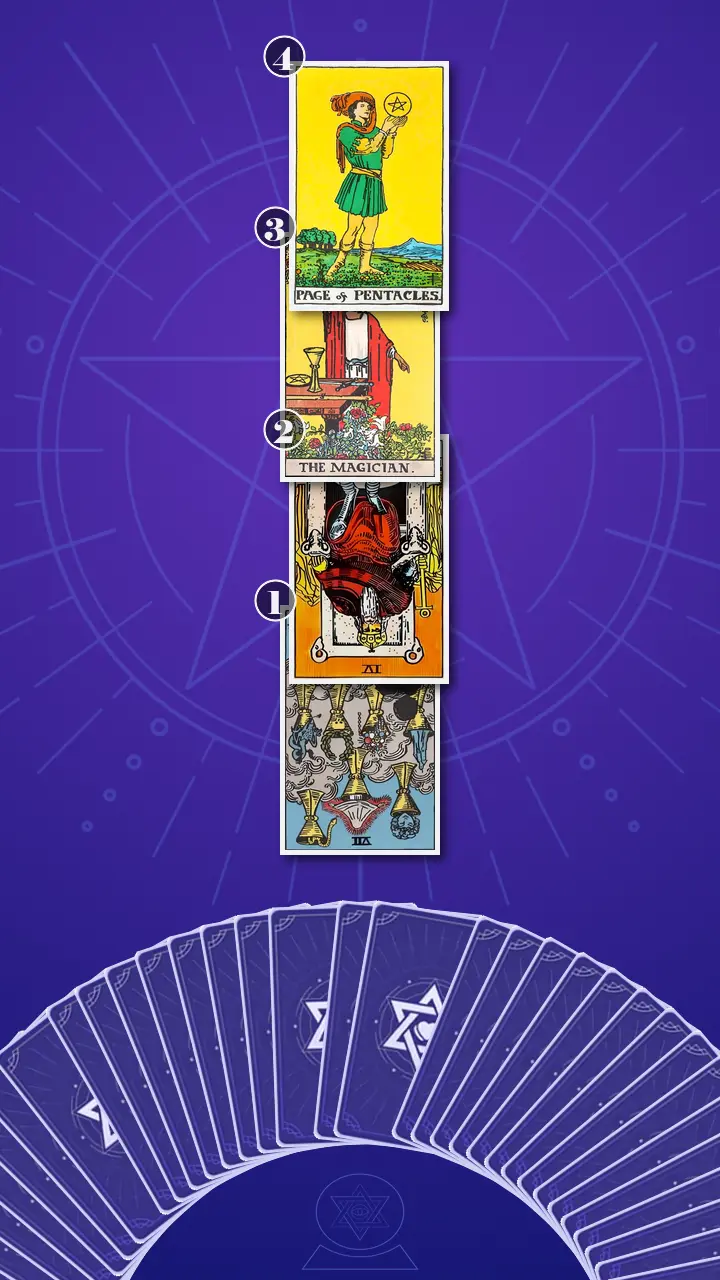
I chose the Four-Layer Insight Ladder, a four-card tarot spread designed to move upward through a problem without pretending to predict a fixed outcome. It was a precise fit because Jordan’s visible procrastination was only the first layer. I needed to separate the surface habit from the fear maintaining it, then identify a transforming resource and translate that resource into a grounded study practice.
I arranged the cards in a vertical line. The bottom position would show the diagnostic symptom: comparing resources and reorganising plans without selecting a task. The second would reveal why creating structure without external authority felt unsafe. The third, the hinge of the reading, would show the cognitive and behavioural shift available to Jordan. The top card would turn that shift into something repeatable at an actual desk.
This is how tarot works best in a question like this: not as an authority that hands down the correct study system, but as a structured mirror. Card meanings in context help me distinguish behaviours that can otherwise blur together. The cards would not choose Jordan’s route. They could help Jordan see what happened at the moment of choosing.
Reading the Tabs That Never Quite Become a Task
The Surface Pattern: Seven of Cups Reversed
I turned over the card representing the diagnostic symptom: comparing resources, reorganising plans, and failing to select a concrete study task when instructions were broad. It was the Seven of Cups, reversed.
In the familiar image, seven cups float in a cloud, each offering a different promise or threat. Reversed, the card showed possibility becoming internal overload and confused prioritisation. Its Water energy was not flowing toward one choice; it was circulating among imagined outcomes, keeping every option mentally active.
“This looks like the beginning of one of your open-ended study blocks,” I said. “You open the course outline, two explainer videos, three articles, a class Discord thread, and a new planning template. Each option seems capable of preventing a bad decision, so you keep comparing until the timer ends without a page read or a question attempted.”
I pointed to the suspended cups. “They remind me of browser tabs being used as external memory. Every tab says, ‘Don’t forget that I might be the correct answer.’ The inner loop becomes: ‘If I compare one more option, maybe the right starting point will become obvious.’ But the contact needed to discover whether a resource is useful never happens.”
Jordan’s breath caught. Their fingers stopped above the trackpad, their gaze moved across the open tabs as if replaying the last several evenings, and then a small laugh escaped them.
“That’s so accurate it’s almost rude,” they said, smiling with more bitterness than amusement. “I tell myself I’m being responsible. Then it’s 10:30 and I haven’t touched the actual assignment.”
“Planning can look productive while protecting you from the risk of choosing,” I replied. “That doesn’t make the planning fake. It means the planning is doing an emotional job as well as an academic one. For a few minutes, it lets you feel as though no wrong route has been taken.”
I asked Jordan which activities had filled their last unstructured study block before they touched the course material. They named a YouTube search for “active recall vs note taking,” a new Notion template, two messages to classmates, and a half-written clarification email. Naming the sequence shifted the reading away from self-criticism and toward observable mechanics.
The Hidden Rule: The Emperor Reversed
I turned over the card representing the psychological root: the fear of losing control or exposing poor judgement when Jordan had to create their own structure. It was The Emperor, reversed.
The upright Emperor embodies structure, boundaries, and organising authority. In reversal, that energy can become blocked or overcorrected. Jordan could reliably follow a lecturer’s numbered milestones, but a broad brief sent them searching for equivalent authority in tutors, friends, apps, and increasingly rigid schedules. They could label a three-week timetable “final,” miss one block, and then feel that the entire structure had lost legitimacy because nobody outside them had validated it.
I looked at the Emperor’s stone throne and concealed armour. The image reminded me of a track mixed so tightly that no instrument has room to breathe: technically controlled, but brittle under any variation. Jordan’s calendar looked authoritative, yet it contained no completed course output. Beneath it ran the thought, “I can trust a route when a lecturer gives it to me, but if I write it, it feels like guessing.”
“You are not short on options,” I said. “You are short on permission to choose provisionally.”
Jordan’s hand went to their jaw. For several seconds, they said nothing.
“Following structure and authoring structure aren’t the same skill, are they?” they finally asked.
“Exactly. And struggling with the second does not cancel your ability in the first. It means your self-authored structure has been asked to feel as certain as an instructor-approved syllabus before it has gathered any evidence. That is an impossible entry requirement.”
I asked what a poor first choice would seem to prove about them. Jordan looked away from the screen and answered quietly: “That I’m not actually independent. That I only do well when someone tells me exactly what to do.”
I let the sentence sit without correcting it too quickly. The reversed Emperor revealed a protective strategy, not a character flaw. Jordan’s rigid planning was armour around the vulnerable act of testing their own judgement. The blind spot was that the armour also prevented the experience that could strengthen that judgement.
When the Magician Put Every Tool on One Table
The Transforming Resource: The Magician Upright
The radiator clicked once and went quiet as I reached the visual hinge of the spread. I turned over the card representing the key shift from seeking a perfect route to using available tools for one testable step. It was The Magician, upright.
The Magician holds several tools, but unlike the Seven of Cups, none of them floats as an untested promise. The wand, cup, sword, and pentacle rest on one solid table. Each has been assigned a function. One hand reaches toward possibility while the other points toward the ground, translating intention into observable action. This was balanced agency: enough focus to choose, enough flexibility to learn, and no demand for mastery in advance.
I translated the image into Jordan’s desk. One PDF. One notebook. One timer. One answerable question. Jordan would close every other tab, write, “In 25 minutes, I will use this resource to answer this question,” and begin before the choice felt fully validated. The resulting paragraph or practice score would not prove that the route was perfect. It would create real evidence for revising the next step.
At 8:00 p.m., Jordan’s reading had remained untouched while three study-method videos, a colour-coded calendar, and “Week Plan v4” filled the laptop. The session looked organised from outside, yet their jaw had tightened because no coursework had moved. The Magician did not ask them to feel certain. It asked them to bring one option down from the cloud and give it a temporary job.
I drew on the diagnostic lens I call Cognitive Tempo Calibration. After years of studying sound and energy, I have learned to listen for the point where effort falls out of rhythm. Jordan’s natural working tempo was not inherently slow or undisciplined. The disruption occurred in the silent gap before the first beat: when no lecturer supplied the count-in, Jordan tried to compose the entire semester before playing a single bar.
My Focus Disruption Audit made the dissonant chord equally clear. It was not just notifications, YouTube, or Notion. The central interruption was the recurring thought that a self-chosen task had to justify the whole route. Each new resource restarted the song before the first phrase could resolve. The repair was not a louder command to focus. It was a smaller unit of commitment: one tool assigned one function for one short interval.
The absence of a perfect map is not proof that you cannot study; choose one tool, name one task, and place it on the Magician's table.
I stopped speaking. The line seemed to remain between us while the laptop fan softened into the room’s background noise.
Jordan went completely still. Their lips parted, but no answer came; one hand hovered above the desk as if they had forgotten what they were reaching for. Then their eyes moved from the card to the untouched reading, and I watched recognition arrive with an uncomfortable edge. Their eyebrows drew together, their jaw set again, and they said, “But doesn’t that mean I’ve been doing this wrong the whole time?” The words came out sharper than anything they had said earlier.
“No,” I said. “It means you found a strategy that reduced the immediate risk of being wrong. It helped you feel protected, until the cost of that protection became larger than the relief. We don’t need to shame the strategy to update it.”
The tension in Jordan’s face shifted rather than vanishing. Their eyes reddened slightly. Their raised shoulders lowered in stages, and the hand above the desk settled palm-down beside the book. A long breath left their chest, followed by a quieter one. For a moment, they looked almost unsteady, as if putting down a heavy bag had revealed how tired their arms were. Relief was there, but so was the vulnerable blankness of realising that no perfect system would take responsibility for the next choice.
“Clarity is not the entry fee for studying,” I said. “It is evidence you build by testing one small choice. You do not have to endorse a method forever. You only have to assign it a job for 25 minutes.”
I invited them to use that perspective on the previous week. “Can you remember one moment when this insight might have changed how the evening felt?”
Jordan returned to the Tuesday desk scene. “I had one practice question open,” they said. “I closed it because I thought I should review the whole unit first. I could have just tried it and found out what I didn’t know.” Their voice trembled slightly, then steadied. “Maybe the path isn’t something I find before studying. Maybe it’s something the work helps me draft.”
That was the emotional crossing in the reading: from shame-driven overplanning and external reassurance-seeking toward provisional self-direction and grounded engagement. It was not complete confidence. It was the first willingness to let direct experience carry more authority than another polished study system.
The Practice That Holds One Thing Steady: Page of Pentacles Upright
I turned over the card representing the practical study posture through which the new perspective could become lived experience. It was the Page of Pentacles, upright.
The Page holds one pentacle at eye level while standing in a cultivated field. Their attention is balanced, patient, and specific. The rest of the landscape still exists, but it is not being solved all at once. In Jordan’s life, this looked like choosing one practice problem, studying the worked example, attempting an answer, and recording one gap to revisit. That modest task would be concrete enough to finish and informative enough to shape the next session.
“For this block, this page is the whole field,” I said. “The semester does not disappear. You are simply refusing to make every future demand compete for attention inside the next 25 minutes.”
The Page’s Earth energy grounded the reading. The Seven of Cups had shown options floating without practical assignment. The reversed Emperor had tried to contain the uncertainty through external rules or rigid control. The Magician coordinated the available tools. Now the Page gave one learning object sustained contact, allowing competence to grow through repetition instead of planning at a distance.
Jordan looked at the reading beside their laptop and named a single section: pages 18 through 24. Their fingers unclenched around the edge of the desk.
“I could read those and explain the main claim in four sentences,” they said. “Not build the whole exam plan. Just do that.”
“That is enough to create the next piece of information,” I replied. “One finished question gives you more direction than ten untested systems.”
The 25-Minute Evidence Loop
I gathered the four cards into one coherent study story. Jordan had learned to work within clear external milestones, so increasingly independent coursework exposed a skill that had not yet been allowed to develop: authoring temporary structure. When instructions became broad, multiple resources turned into competing claims to correctness. Rigid planning then offered short-term control, but delaying direct work produced no learning evidence. As deadlines tightened, the missing evidence made the next choice feel even more dangerous.
The spread also showed the resource already available. Jordan could choose, test, observe, and adjust. The Magician did not replace one authority with another; it relocated agency to the act of assigning a tool a limited purpose. The Page of Pentacles made that agency sustainable through patient contact with one learnable object.
I named the cognitive blind spot plainly: Jordan had been treating the absence of a prescribed route as evidence that they were unable to begin. They had also been asking a first step to prove the quality of an entire semester plan. The transformation was smaller and more practical: a study path could be a working draft, not a verdict on their competence.
To make that shift usable, I adapted my Syncopated Study Session into two compact experiments. I described the rhythm as a short musical phrase: a clear downbeat to name the task, one bounded work interval, and a resolving note that records what the attempt revealed. The pause after the block was part of the rhythm, because revision should come from evidence rather than panic.
- Run the One-Table 25-Minute TestBefore one study block this week, close every resource except one. At the top of a blank document, write one answerable question and the sentence, “For the next 25 minutes, I will use this resource to answer this one question.” Set a timer and produce one visible output: three bullet notes, one solved problem, one paragraph, or one labelled diagram. When the timer ends, write, “This helped me see…” and “My next useful question is…” before opening another source.Treat the block as a trial, not a contract. On a low-energy day, use a five-minute version. A precise discovery that the source is unhelpful still counts as evidence.
- Draft a Three-Step Version 1 RouteChoose one current topic and spend no more than five minutes writing three steps in a plain phone note or on paper. Label the route “Version 1.” Make the first step finishable in one block, such as, “Read pages 18–24 and explain the main claim in four sentences.” Place a revision checkpoint immediately after step one, where you may keep, change, or discard the remaining steps based on what the work revealed.Do not improve Version 1 before completing its first step. If the step is still too broad, reduce it to one paragraph, example, diagram, or practice question.
I asked Jordan to notice that neither experiment required them to ignore their limits. They could shorten the timer, stop when the chosen object was complete, or change a route that proved genuinely unhelpful. Self-direction did not mean forcing themselves through exhaustion. It meant creating enough structure to meet reality, then allowing reality to answer back.

A Week Later, One Question Was Finished
Six days later, I received a short message from Jordan. They had cleared the extra tabs, read pages 18 through 24, and written four sentences about the central claim. The first sentence was awkward, they told me, but the fourth revealed the exact concept they needed to review next.
They had then created a three-step Version 1 route for the next topic. One step changed after the first work block, and instead of reading that revision as proof that the plan had failed, they treated it as proof that the plan was learning from the work.
That night, they slept through until morning. Their first thought was still, “What if I picked the wrong thing?” This time, they smiled, opened the result-and-next-question note, and let the evidence answer.
I did not see a person whose study life had been permanently solved. I saw a quieter and more meaningful proof: Jordan had moved from waiting for external permission to testing a provisional choice. The cards had offered a language for the pattern, but Jordan had created the change by closing the tabs, naming the task, and meeting one piece of the material directly.
When no one gives us the next step, I know how quickly a blank document can tighten the jaw and pull the shoulders upward. We can want to direct our own work while fearing that one imperfect choice will expose us as incapable. I also know that noticing this conflict means we are no longer entirely inside it. We can place one tool on the table without promising to use it forever.
If your next study choice could be a draft rather than a verdict, which single paragraph, problem, diagram, or lecture segment would you place on your own Magician’s table for a 25-minute evidence loop?