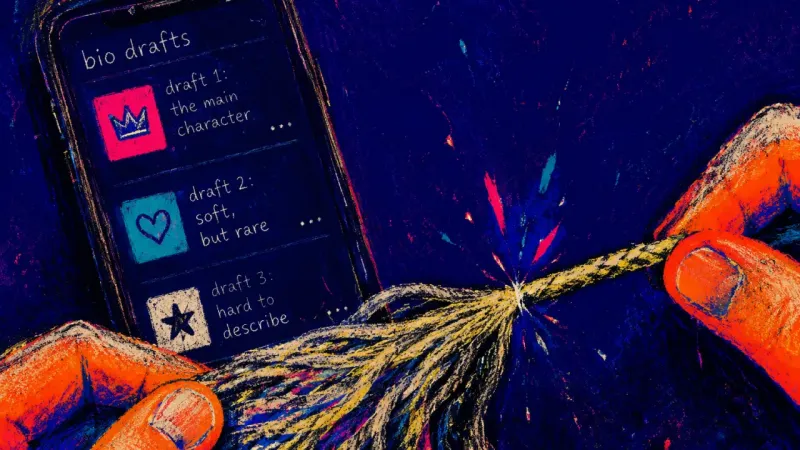
The 11:18 p.m. Bio Box Freeze (Dating-App Self-Presentation Paralysis)
If you keep rewriting your bio in Notes, screenshotting drafts, texting a friend for approval, and still deleting everything at midnight… I know that loop. I’ve watched it happen to people in quiet cabins mid-Atlantic and, lately, in tiny city apartments where the only witness is a phone screen.
Taylor sank into the chair across from me and laughed like she’d already lost an argument she didn’t agree to have. “It’s one box of text,” she said, rubbing the side of her neck. “Why does it feel like a referendum on my whole personality?”
She described 11:18 p.m. on a Sunday in her Toronto apartment: throw blanket pulled up, radiator ticking like it was counting down, the harsh glow of the teal-and-white UI making the room feel even smaller. The cursor blinked in the empty bio box—steady, patient, almost smug. Each blink landed in her chest like a tiny tap on a bruise.
“I type something,” she said, “and then my brain goes, cringe. Or basic. Or try-hard. So I delete it. Then I scroll other profiles ‘for inspo’ until I feel… nothing. Numb. And I tell myself I’ll do it tomorrow.”
As she spoke, I watched her shoulders creep up without her noticing—like she was bracing for impact. Her throat moved as if she were swallowing words back down. The feeling she carried wasn’t just “nerves.” It was like standing in front of a bright stage light in a dark theatre, trying to look casual while your stomach quietly locks into a fist.
“Okay,” I told her, keeping my voice low and steady. “We’re not here to force confidence. We’re here to find clarity. Let’s treat this like a map: what makes you shrink, what story feeds it, and what one step would feel honest enough to try.”

Choosing the Compass: The Four-Layer Insight Ladder Spread
I asked Taylor to take one slow breath, not as a ritual for the universe, but as a simple nervous-system handoff—like closing twenty browser tabs so you can finally read one page. While she held her question in mind, I shuffled slowly and watched the way her jaw softened a millimeter with each exhale.
“Today I’m going to use something I call the Four-Layer Insight Ladder · Context Edition,” I said. “It’s a four-card tarot spread for dating app bio anxiety—especially when the bio box triggers that freeze-and-delete loop.”
For you, the reader, here’s why this spread works: when you’re stuck in dating-app self-presentation paralysis, the problem usually isn’t vocabulary. It’s the invisible job the bio has been assigned: it becomes an approval test, a performance review, a verdict. This spread stays minimal on purpose: it names the surface behavior, traces it to the self-worth story underneath, offers a reframe that restores calm visibility, and ends with one realistic experiment.
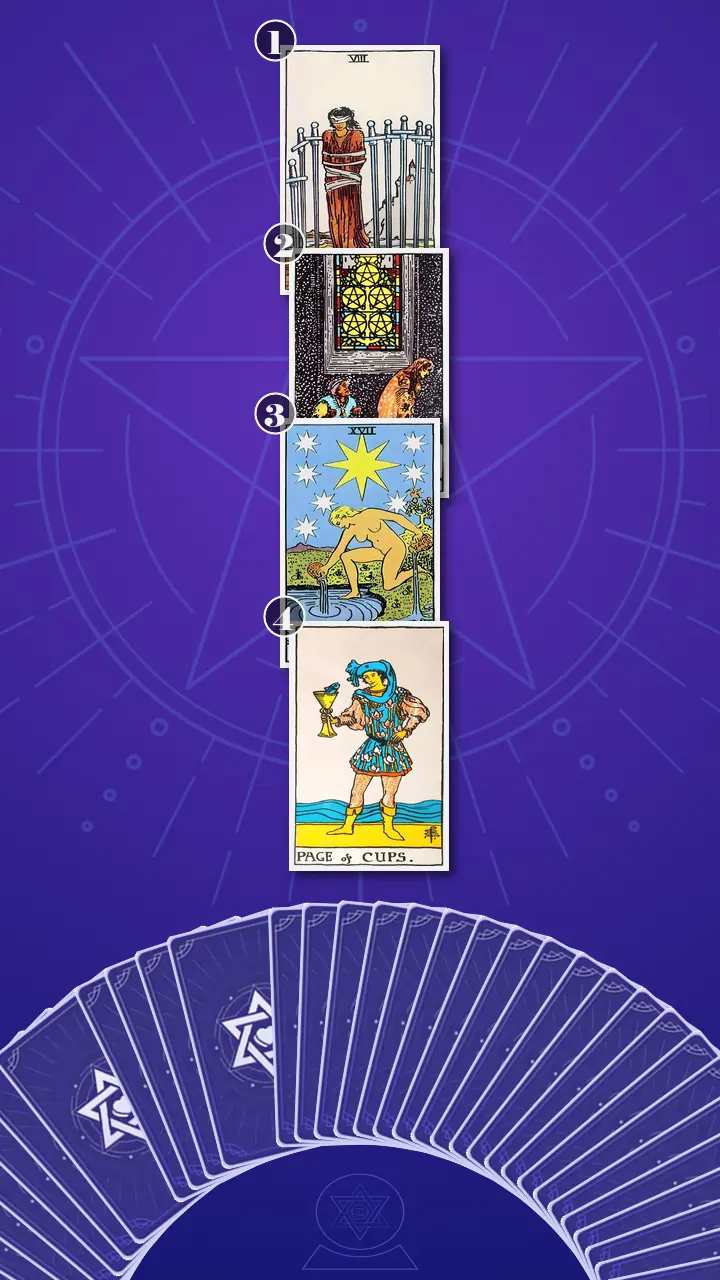
“Card one,” I explained, “shows the shrink response—what you reliably do in the first five minutes the cursor starts blinking. Card two shows the root story—the belonging belief underneath the editing. Card three is the antidote—the perspective shift that changes what the bio is for. Card four is your one step this week.”
Reading the Ladder: Four Cards, One True Pattern
Position 1: The Automatic Shrink Move
“Now we flip the card that represents your Surface shrink response: the specific mental/behavioral pattern that shows up when facing the dating app bio box,” I said.
Eight of Swords, upright.
“This is you staring at the dating app bio box like it’s a courtroom transcript,” I told her. “The cursor blinks and your inner editor starts cross-examining every word: ‘Too much. Too basic. Not funny enough. Trying too hard.’ So you keep reopening the draft to ‘fix it,’ but the real cage is an invisible rule: you must be instantly likable and un-messy to deserve a swipe.”
In this card, restriction isn’t a locked door. It’s a blindfold plus loose rope—energy that’s blocked by imagined judgment. The Eight of Swords is what happens when your mind tries to keep you safe by making you small.
I leaned in a little, because this part matters. “There’s a line I say gently, not to scare you—just to be honest: If you can’t be rejected for the real you, you also can’t be chosen for the real you.”
Taylor gave a tight exhale that almost turned into a laugh. Then it did—small, bitter, like she’d just recognized her own handwriting. “That is… rude,” she said, eyes on the card. “Like, accurate. But rude.”
“Totally fair,” I said. “The Eight of Swords can feel brutal because it’s specific. But it’s also hopeful. Those ropes are loose. Which means this isn’t a life sentence. It’s a habit.”
Position 2: The Root Self-Worth Story Underneath
“Now we turn over the card that represents your Root self-worth story: the belonging/worth belief that makes self-expression feel unsafe or ‘too much’,” I said.
Five of Pentacles, upright.
“Under the editing isn’t just perfectionism,” I told her. “It’s a scarcity story about belonging. You scroll other profiles and think, ‘They’re the kind of person people want,’ and your bio turns into an application for access. You minimize your preferences, flatten your quirks, and try to sound low-maintenance so you won’t be ‘too much.’”
The Five of Pentacles is energy in deficiency: not enough warmth, not enough welcome, not enough permission. And it’s painfully modern. It’s the moment you see a friend’s engagement post, a soft-launch Story, a group chat lighting up about a weekend couple’s trip—and your body quietly concludes, I’m outside the window looking in.
Taylor’s hand went to her stomach like she was checking something was still there. Her eyes softened, not dramatic—just honest. “I hate that this is about… belonging,” she said. “I wanted it to be about copy.”
“I know,” I said. “But this is good news in a weird way. Because if it’s about belonging, then you can stop trying to solve it with more polishing. Polishing doesn’t heal a wound. It just makes the armor shinier.”
I watched her shoulders again—still lifted, as if her body was holding a bag she forgot she was carrying. In my work as a Jungian psychologist, I trust body signals as messengers. Not medical advice—just an energy lens. And the message here was clear: responsibility overload in the chest, vigilance in the throat, a quiet ache that said, please let me in.
“Stop writing from ‘please choose me,’” I added softly, letting it land between us, “and start writing from ‘here’s how to find me.’”
Position 3: When The Star Clears the Sky (The Reframe + Inner Antidote)
“Now,” I said, “we’re turning over the card that represents your Reframe and inner antidote: the perspective shift that loosens the worth-proving loop and restores self-trust.”
The room felt quieter as the card slid free—like the radiator paused to listen.
The Star, upright.
“This is the moment you stop treating your bio like it has to justify your worth,” I said. “You write one clear sentence that’s true—no hedging, no trying to be universally cool—and you let it act like a beacon. Instead of optimizing for mass appeal, you optimize for recognition.”
In The Star, the energy is balanced and flowing. It’s not a spike. It’s consistency. And because my background is literally Venice—water, tides, circulation—my mind goes straight to my own method: Venetian Aqua Wisdom. In the canals, when water stagnates, everything feels heavier. When it circulates, the whole system clears. The Star is circulation returning.
I glanced at Taylor’s posture. “Before we even talk words,” I said, “I want to name what your body is doing. This is my Energy Flow Diagnosis—not as a diagnosis like a doctor, but as a pattern read. Your shoulders have been subtly hunched since you described the bio box. That’s your nervous system bracing. The editing isn’t just mental. It’s muscular.”
She swallowed. “Yeah,” she said. “It’s like I’m waiting to get hit.”
Setup (the moment you’re trapped in): I slowed my voice. “You know that moment on your couch after work—Toronto winter dark outside, phone screen too bright—when you’ve rewritten your bio three times, sent a screenshot to a friend, and still can’t hit ‘save’ because it feels like you’re about to be judged in public.”
Delivery (the sentence I want you to keep):
Stop writing from the cold doorstep of “please choose me,” and start writing under The Star’s clear sky—one honest line that guides the right match toward you.
I let silence sit there for a beat. No fixing it. No softening it with a joke.
Reinforcement (what happened in her body): Taylor’s breath stopped for half a second—like her lungs needed permission. Her fingers, which had been gripping her sleeve, loosened one by one. Then her shoulders dropped in a way that looked almost involuntary, as if something inside her finally believed it could put the bag down.
And then—unexpectedly—her face tightened again. Her eyebrows pulled together. A flash of irritation, sharp and clean. “But… if I do that,” she said, voice a notch louder, “doesn’t that mean I’ve been doing it wrong? Like I’ve been begging?”
I didn’t rush to soothe it away. “I’m glad you said that,” I told her. “Because that anger is self-respect waking up. The point isn’t ‘you were wrong.’ The point is: you were protecting yourself with the tools you had. The Five of Pentacles wrote the story—earn your place. The Eight of Swords enforced it—don’t give them ammo. The Star is offering a new job description.”
I taught her a quick reset I use between meetings—one of my Quick Recovery Techniques. “Put your phone face down for a second,” I said, even though her phone was in her bag. “Drop your shoulders. Unclench your jaw. Three slow breaths—longer exhale than inhale.”
Her eyes unfocused like she was replaying the last week. Then her gaze returned, clearer. I asked, exactly as I always do when The Star shows up: “Now, with this new lens—can you think of a moment last week when you started editing for safety, and this would’ve helped you feel different?”
She nodded slowly. “Friday night,” she said. “I wrote ‘Bookstore first dates over loud bars’ and then I panicked and changed it to a joke about pineapple on pizza. I don’t even care about pineapple.”
“That,” I said gently, “is your first piece of data. Not evidence of failure. Evidence of what you actually want.”
And right there, the emotional shift happened—the beginning of that journey from self-conscious bracing and approval-driven self-editing to calm visibility. Not perfect confidence. Just space.
“Also,” I added, “your bio isn’t a verdict. It’s a signal.”
Position 4: The One Step That’s Light Enough to Try
“Now we turn over the card that represents your One step this week: a small, concrete self-expression experiment that moves from editing to authentic signaling,” I said.
Page of Cups, upright.
“Your one step isn’t a rebrand,” I told her. “It’s a small, brave offering. One line that includes a specific delight and a gentle invite: ‘Bookstore first dates and a long walk after—tell me what you’re reading.’ It’s not trying to win everyone; it’s trying to be readable.”
The Page holds a cup, and a fish pops out—unexpected, weirdly charming. That’s the card’s entire lesson: don’t sand yourself down into a generic vibe. Let one real detail live.
I watched a smile pull at the corner of Taylor’s mouth. Not big. But real. The kind that shows up when something feels doable.
“Specific beats impressive,” I said. “Every time.”
She nodded. “I can do one line,” she said. “I think.”
“And if you can’t do it perfectly,” I said, “good. Perfect is the courtroom. We’re leaving the courthouse.”
The No-Courtroom Bio Week: Actionable Advice That Doesn’t Require a Personality Overhaul
When I looked at all four cards together, the story was clean: the Eight of Swords shows the over-edit loop (Air—thoughts policing expression). The Five of Pentacles shows the ache underneath it (Earth—belonging scarcity). The Star restores the system by changing the job of the bio (Air—clean perspective). And the Page of Cups turns that perspective into one small human action (Water—gentle emotional offering).
Your cognitive blind spot, Taylor’s cards suggested, was this: you were treating the bio box like it was collecting evidence about your worth, when it’s actually meant to send a signal about fit. That’s the transformation direction: from “my bio must earn approval” to “my bio is a filter that helps the right people find me.”
Here are the next steps I gave her—small, specific, and designed for real life, not for a fantasy version of you with unlimited nervous-system capacity:
- Write the One-Delight + One-Invite line (in the app, not Notes)Set a 10-minute timer. In your dating app bio, write exactly one line that includes (1) one specific delight (a real you-thing: used bookstores, Kensington Market dumplings, Queen West coffee, a walk by the lake), and (2) one gentle invitation (“Say hi if you’d do ___ for a first date”).Expect the “this is embarrassing” spike. That’s not a sign it’s wrong—it’s a sign you stopped hiding. If you freeze, do three slow breaths and drop your shoulders before touching the keyboard again.
- Run the 7-day no-edit bio experimentPost the line as-is. Set a calendar reminder for 7 days later: “Bio data check (no self-judgment).” For the full week, no optimizing, no rewriting in Notes, no late-night prompt-maxxing spiral.Tell yourself: “Let the app sort for fit—not for my worth.” If you feel the urge to edit, pause and ask: “Am I editing for clarity—or editing for safety?”
- Do the 2-minute Signal Check + a 3-minute body resetRight before you hit Save, ask: “Would my kind of person recognize me from this?” If yes, stop. Then do a quick reset: phone face down, shoulders down and back, unclench jaw, three slow breaths. If you’re on the TTC, use it as a commute meditation: feel your feet, relax your neck, and let your exhale be longer than your inhale.This is my Modern Fatigue Analysis in action: screens amplify bracing. Your body is allowed to be part of your dating strategy. Tiny posture shifts can interrupt the whole spiral.
She also wanted a safety net, so I gave her one constraint: if she sends the line to a friend, she can ask only, “Does this sound like me?”—not “Is this good?” Because “good” invites the courtroom back in.

A Week Later: The Quiet Proof of Finding Clarity
Six days later, Taylor messaged me. Not an essay. Just a screenshot and two sentences.
Her bio line read: “Bookstore first dates > loud bars. Bonus points if you’ll do a walk by the lake after.”
“I posted it,” she wrote. “My chest did the thing. I didn’t edit. I went to make tea and didn’t look at my phone for an hour.”
It wasn’t a rom-com ending. It was something better: a small act of self-trust. She’d gotten fewer matches than her “cool minimalist” version—but the messages she did get were specific. Someone asked what she was reading. Someone suggested a Queen West coffee then a bookstore browse. And she admitted, almost sheepishly, that she felt lighter even before the dates happened.
I thought about The Star again—the way it doesn’t beg the sky to approve of it. It just shines. This whole session had been a Journey to Clarity: from bracing and shrinking, to one honest signal held steady long enough to teach her something real.
When the cursor blinks in that empty bio box and your chest tightens, it’s not because you’re “bad at dating”—it’s because some part of you learned that being truly seen could mean being dismissed fast.
If your bio didn’t have to earn you approval—only help your kind of person recognize you—what’s one small, specific truth you’d let stay on the screen this week?
This story is adapted from psychological research, written so that those in a similar struggle can see their own pattern in it — and find their next step clearly.These insights are not a substitute for professional psychological, medical, legal, or financial advice.
Learn more about our Journey to Clarity.
How did this insight land for you?
🫂 This Resonates Deeply
🌀 Living This Story
✨ Now I See Clearly
🌱 Seeing New Possibilities
🧰 Useful Framework
🔮 The Confirmation I Needed
💪 Feeling Empowered
🚀 Ready for My Next Step
Author Profile
 AI
AI“Having traveled across cultures... I've learned that what we often lack isn't a simple answer, but a moment of being truly understood. I use a Jungian psychological lens to help you deconstruct your subconscious patterns—not to prove anything, but to be the gentle companion who helps you unravel your knots, free of judgment, so you can reconnect with your inner wisdom.”
In this Introspection Tarot Reading :
Core Expertise
- Shadow Integration Audit: Objectively mapping suppressed emotions (anger, shame, grief) that are covertly draining your psychological bandwidth.
- Inner-Critic Neutralization: Deconstructing the harsh, subconscious self-judgment loop that masquerades as 'self-discipline'.
Service Features
- The Active Imagination Protocol: A structured psychological journaling technique to safely dialogue with your 'Shadow', turning internal friction into deep self-compassion.
Also specializes in :
Explore Related Patterns:
Approval SeekingTaylor screenshotting drafts and texting a friend before posting shows that the bio's authority has moved outside of her. Instead of asking whether the line is true, she searches for reassurance that it will be acceptable. The cognitive mechanism is external validation under pressure. The imagined dating-app audience becomes a panel of judges, and the friend becomes a temporary regulator for the anxiety that follows. That is why the story makes such a sharp distinction between 'Does this sound like me?' and 'Is this good?': the second question hands the bio back to the courtroom. Approval Seeking fits because the loop is organized around permission. You are not seeing healthy feedback integration; you are seeing a pattern where self-expression cannot feel safe until someone else pre-clears it. The useful shift is to make support narrower and more reality-based, so feedback helps preserve the self rather than edit the self out.
Rejection SensitivityTaylor describes one box of text as a referendum on her whole personality, and the reading frames the cursor like a courtroom transcript. That language matters because it shows the mind scaling up a small act of dating-app visibility into a global judgment of the self. The cognitive distortion is anticipatory rejection. Before anyone has swiped, messaged, ignored, or responded, the imagined audience is already cross-examining her wording and assigning meaning to it. The body follows that story by bracing, tightening, and preparing for impact, as if ordinary exposure has become social danger. Rejection Sensitivity fits because the bio box is not merely uncomfortable; it is treated as a place where being seen could quickly become being dismissed. You can see why the one honest line feels both small and huge: it interrupts the prediction that rejection of a preference would equal rejection of the whole person.
Self-SilencingTaylor changing 'Bookstore first dates over loud bars' into a pineapple-on-pizza joke is the cleanest behavioral clue in the story. She does not simply edit for clarity; she removes the detail that would let someone recognize her actual preferences and replaces it with something safer, flatter, and less personally exposing. The defense mechanism is self-protection through reduction. If a specific desire could be judged, dismissed, or read as too much, the safer move is to become more generic before anyone else gets the chance to react. The cost is that the bio becomes less rejectable only because it becomes less real. Self-Silencing fits because Taylor's shrink response is not only internal criticism; it becomes a concrete suppression of preference. You can see the pattern in how she tries to sound low-maintenance, swallows the sentence that matters, and chooses social acceptability over accurate self-representation. The repair begins when one true detail is allowed to stay on the screen without being negotiated away.
Authentic Self-ExpressionTaylor's final bio line, 'Bookstore first dates > loud bars. Bonus points if you'll do a walk by the lake after,' keeps a specific preference visible instead of sanding it down into a generic joke. The action is small, but psychologically it changes the function of the bio. The new mechanism is self-expression with a clear boundary around audience fit. Instead of optimizing for mass appeal, she lets the line act as a filter, which means the goal is no longer to be universally liked. The bio becomes a signal that helps the right person recognize her, not a performance that has to win everyone. Authentic Self-Expression fits because the story shows Taylor choosing accuracy over approval. You can see the shift in how her body responds afterward: she still feels the chest tightening, but she does not obey it by editing herself away. That is not perfect confidence; it is the beginning of self-trust under visibility.
Perfectionism-Driven AvoidanceTaylor's repeated cycle of drafting, screenshotting, asking for approval, and deleting the bio at midnight shows an avoidance system disguised as refinement. The visible behavior is editing, but the function is protection: as long as the wording can still be improved, it never has to be exposed to real judgment. The self-worth story underneath turns the bio into a performance review. Words like cringe, basic, and try-hard become inner verdicts, so the mind keeps polishing to prevent the imagined humiliation of being seen as too much or not enough. That is why the loop feels exhausting but strangely hard to stop: the editing gives temporary control while keeping the real risk postponed. Perfectionism-Driven Avoidance fits because the problem is not a lack of vocabulary or discipline. You are watching a defense mechanism where impossible standards create a socially acceptable reason to stay hidden. The one-step shift is not forcing confidence; it is lowering the bio's job from proving worth to sending one honest signal about fit.
Secure VisibilityTaylor posting the line as-is and leaving it alone for the week is the story's clearest corrective behavior. Her chest still reacts, which means the old threat system has not vanished, but she no longer treats that sensation as an instruction to disappear. The mechanism is secure visibility: allowing a true signal to remain available without immediately optimizing it for approval. By making tea and not checking the phone for an hour, she separates her worth from the app's instant feedback cycle and lets the bio gather data instead of becoming a verdict. Secure Visibility fits because the point is not becoming fearless. You are seeing a small act of stable self-presentation held long enough to build trust. The shift is from 'I can only be seen once I am perfectly safe from rejection' to 'I can be visible in a measured way and still stay connected to myself.'
Self-Judgment LoopTaylor's inner editor keeps cross-examining every line as too much, too basic, not funny enough, or trying too hard. Each revision looks like progress from the outside, but internally it keeps returning her to the same verdict-driven question: is this good enough to protect me from judgment? The loop is maintained by self-criticism that pretends to be quality control. Instead of helping her choose clearer words, the inner critic keeps generating new reasons not to save anything. That turns attention into a tunnel where the bio's actual purpose, helping the right people recognize her, disappears behind the need to avoid embarrassment. Self-Judgment Loop fits because the story repeats the same mental circuit: write, evaluate, shame-spike, delete, postpone. You are seeing a cognitive trap where critique becomes the main activity and expression becomes the thing being deferred. The exit is not a more perfect sentence; it is a different standard for stopping.
Scarcity MindsetTaylor's bio anxiety is explicitly tied to the belief that belonging is scarce and conditional. The story names the ache underneath the editing as not enough warmth, not enough welcome, and not enough permission, which turns a dating-app prompt into a test of whether she gets to be included. The cognitive schema says access must be earned by being smaller, easier, and less specific. That belief explains why she tries to sound low-maintenance and why a real preference feels risky: if there is only a narrow doorway into being wanted, any detail could feel like the thing that gets her left outside. Scarcity Mindset fits because the core self-worth story is organized around limited belonging. You are not just seeing nervousness about dating; you are seeing the assumption that acceptance is a scarce resource and that the safest strategy is to reduce the self until it seems easier to choose.
Comparison TrapTaylor scrolling other profiles for inspiration turns into a comparison scan, not a creative warm-up. The moment she starts reading other people as 'the kind of person people want,' her own bio stops being a place to describe herself and becomes a place to catch up. The cognitive mechanism is selective attention under scarcity. Her mind overweights other people's visible desirability signals and underweights her own actual preferences, so the app environment starts to feel like proof that belonging is already happening somewhere else. From there, the bio becomes an application for access rather than a signal of compatibility. Comparison Trap fits because the story shows a narrowing of identity through upward social comparison. You can see it in the shift from 'What would my kind of person recognize?' to 'How do I sound like someone people want?' The first question creates fit; the second creates self-erasure.
Action ParalysisTaylor freezing in front of the bio box is visible in both the behavior and the body. She has enough material to write, but when the cursor starts blinking, her shoulders lift, her throat tightens, and the decision to save becomes harder than the sentence itself. The defense is action freeze under social evaluation. Deleting, scrolling, and saying 'tomorrow' are not random distractions; they reduce immediate exposure while preserving the hope that a better version can be posted later. The nervous system gets short-term relief, but the self-presentation task remains unresolved. Action Paralysis fits because the stuck point is the transition from private drafting to public visibility. You are seeing the moment where thinking does not lead to action because action would make the self available for response. The one-line experiment works because it makes the action small enough for the system to complete.
Explore Related Struggles:
Approval-Safety FusionTaylor keeps rewriting the bio in Notes, sending screenshots to a friend, and deleting drafts when the cursor turns into a judgment point. The bio is no longer just a short profile field; it has been assigned the job of proving she is likable, clean, and safe enough to be chosen. You can feel the bind in the way every sentence has to pass a safety check before it is allowed to exist. The friend, the draft, and the other profiles become a review system, so expression gets routed through approval instead of fit. The struggle is Approval-Safety Fusion because visibility only feels survivable when it has already been pre-approved. The useful shift is not forced confidence; it is noticing when you are editing for safety rather than clarity, then letting one honest line stay long enough to become information.
Belonging-Authenticity SplitTaylor writes that she prefers bookstore first dates over loud bars, then panics and swaps the line for a pineapple joke she does not even care about. The moment is small, but it shows the exact trade being made: recognizability is sacrificed for acceptability. You are watching belonging demand a smaller version of the self. The bio has to sound open enough for strangers, cool enough beside other profiles, and safe enough to avoid being called cringe, so the line that actually points to her world gets pushed off the screen. The struggle is Belonging-Authenticity Split because the wish to be included is pulling against the need to be real. The one-step repair starts when you stop asking whether everyone will like the line and ask whether your kind of person could find you through it.
Low-Maintenance Worth LockUnder the editing, Taylor keeps minimizing preferences, flattening quirks, and trying to sound low-maintenance so she will not be read as too much. The bio starts to behave like an application for access, where the safest applicant is the one with the fewest demands. You do not disappear all at once in this pattern. You become easier, smoother, more broadly palatable, and less findable. The cost is that the profile may avoid friction while also removing the details that could make connection feel mutual. The struggle is Low-Maintenance Worth Lock because worth gets tied to being undemanding. The lock loosens when a real preference is allowed to stay on the screen without being treated as a liability.
Visibility-Connection SplitTaylor's honest bio line gets fewer matches than the cooler minimalist version, but the messages become more specific. Someone asks what she is reading, and someone suggests coffee followed by a bookstore browse, which shows that the line did what it was meant to do. You can feel the split in the earlier freeze: being visible enough to be recognized also means being visible enough to be dismissed. The safer profile protects against fast rejection, but it also blocks the kind of connection that depends on a real signal. The struggle is Visibility-Connection Split because connection requires the very visibility that feels risky. The grounded step is to let one specific truth stay visible long enough to sort for recognition instead of mass approval.
Identity Verdict LockTaylor says it is only one box of text, then immediately names how large it feels: a referendum on her whole personality. The cursor is not just waiting for words; it has become a witness to whether she can prove enough of herself in a few lines. You can see how disproportionate the task becomes once the bio is asked to carry identity-level stakes. A joke, a preference, or a sentence about bookstores is no longer just a signal; it becomes evidence for whether she is interesting, desirable, normal, or too much. The struggle is Identity Verdict Lock because a small act of self-description is treated like a final judgment on the self. The way out begins by returning the bio to its proper size: not a verdict, not a trial, just a signal about fit.
Explore Related Emotions:
Approval AnxietyTaylor sends drafts to a friend and keeps returning to the question of whether the line is good. The bio has been assigned the job of proving she is acceptable, so even a playful sentence starts to feel like it needs a panel of invisible reviewers to sign off. Approval Anxiety names the inner weather of outsourcing permission before self-expression can stay visible. You are not simply checking grammar here. The story shows a deeper need for reassurance that the self being shown will not cost belonging.
Belonging ShameTaylor scrolls other profiles and reads them as proof that other people are the kind of person people want. The image of being outside the window looking in turns the bio into an application for access instead of a place to be found. Belonging Shame fits the ache under the editing loop. It is the fear that your real texture might not be welcome. You can hear it in the quiet pull toward please let me in, where self-expression becomes smaller because belonging feels conditional.
Cautious VulnerabilityTaylor is asked for one clear sentence that is true, with no hedging and no attempt to be universally cool. The step stays small through one specific delight, one gentle invite, and one detail allowed to remain visible. Cautious Vulnerability names the brave-but-realistic opening in the story. You are not jumping into total confidence. You are testing whether a true preference can survive on the screen long enough for the right person to recognize it.
Low-Maintenance ShameTaylor minimizes preferences, flattens quirks, and changes 'Bookstore first dates over loud bars' into a pineapple joke she does not even care about. The true preference is not rejected by anyone else first. It is sanded down before it can be seen. Low-Maintenance Shame names the pressure to make yourself easy to choose by becoming less specific. You shrink one step when a real desire starts to feel like too much, so the bio performs chill instead of letting a recognizable self stay on the screen.
Micro-Performance ShameTaylor's inner editor labels each attempt cringe, basic, or try-hard before the words have had any chance to breathe. A single sentence becomes a tiny stage where every adjective feels overexposed. Micro-Performance Shame fits because the shame is attached to a small act of presentation, not a giant life decision. You are watching the self get policed at the scale of a bio line, where even sounding interested, funny, or specific can feel embarrassing.
Performance FreezeTaylor rewrites the bio in Notes, screenshots drafts, asks for approval, and still deletes everything at midnight. The blinking cursor, raised shoulders, and swallowed words turn a tiny text box into a full-body stop sign, so action narrows into typing, judging, erasing, and postponing. Performance Freeze fits because the block is not a lack of vocabulary. It is a moment where expression feels like exposure. You can feel the body trying to avoid impact before anything has happened, which makes one honest line feel larger than it is and keeps the screen empty.
Quiet Self-TrustSix days later, Taylor posts the bookstore line, feels her chest tighten, and does not edit. She makes tea, leaves the phone alone for an hour, and discovers she feels lighter before any date has happened. Quiet Self-Trust fits because the proof is not dramatic. You trust yourself by keeping one honest signal steady, letting the app sort for fit, and learning that your worth does not have to be renegotiated every time a cursor blinks.
Rejection ChillTaylor braces like she is waiting to get hit, and the story names the deeper rule that being rejected for the real version could feel fast and personal. Being truly seen has been linked with the possibility of being dismissed. Rejection Chill is the cold drop that arrives before any actual rejection happens. You shrink not because the sentence is wrong, but because visibility carries a remembered threat that the wrong person might make a quick decision about a true part of you.
Verdict DreadTaylor says one box of text feels like a referendum on her whole personality, and the reading keeps returning to courtroom language around cross-examined words, evidence about worth, and public judgment before hitting save. The app bio stops being a signal and becomes a trial. Verdict Dread is the feeling that a small choice might deliver a total conclusion about who you are. You shrink because the imagined stakes are wildly inflated, and the cursor starts to feel less like an editing tool than a judge waiting for a final answer.
Visibility ReliefTaylor's shoulders drop when the bio stops being a verdict and becomes a signal. The same screen that once felt like a courtroom starts to function more like a beacon, and the messages that arrive are fewer but more specific. Visibility Relief names the release that comes from being recognizable instead of broadly approved. You are still visible, but the visibility has a different job now. It is not to win everyone, only to help the right people find the true outline of you.
Explore Related Contexts:
Conditional Belonging PressureTaylor describes one box of text as if it can decide whether her whole personality is acceptable. Under the editing, the bio starts to operate like an application for access: sound appealing enough, clean enough, easy enough, and maybe the door opens. The surrounding social cues make that pressure sharper. Other profiles look like the kind of person people want, while engagement posts, soft launches, and couple-trip chatter stage belonging as something already happening somewhere else. You are not just writing a dating bio in that field; you are negotiating an implied rule that says welcome must be earned through instant likability. That is the core shrink story the case exposes. When belonging feels conditional, self-expression becomes risk management, and every specific preference looks like possible evidence against you. Naming the pressure gives you leverage: the task is not to prove you deserve entry, but to make a clear enough signal that the right kind of connection can locate you.
Dating App Performance LoopTaylor keeps rewriting the bio in Notes, screenshoting drafts, texting a friend for approval, and still deleting everything at midnight. A single app field starts carrying the weight of a public review, where every sentence can be judged as basic, try-hard, not funny enough, or too much. That pressure is not just about finding better wording. The dating app turns self-description into a scoreable surface, and Taylor responds by polishing, checking, postponing, and erasing before the profile can become visible. You are watching a platform-shaped performance loop: the more the bio is treated as evidence of value, the harder it becomes to use it as a simple signal of fit. The useful audit here is structural. The loop shrinks your action space to editing and approval-seeking, while the actual dating task requires one readable line that lets compatible people respond. Once the bio stops functioning like a verdict, you regain room to post, observe, and adjust from real data instead of imagined judgment.
Low-Maintenance Dating PressureTaylor names the move clearly: she minimizes her preferences, flattens her quirks, and tries to sound low-maintenance so she will not be read as too much. The clearest proof is Friday night, when she writes, Bookstore first dates over loud bars, panics, and replaces it with a pineapple-on-pizza joke she does not even care about. That edit shows a real external dating pressure, not a personal failure. The app environment rewards broad appeal, quick readability, and low-friction charm, so specificity can start to feel risky before anyone has even responded. You shrink by making yourself easier to consume, but the cost is that the profile becomes less useful for finding people who would actually recognize you. The later result sharpens the pattern: the cool minimalist version gets more matches, while the specific bookstore line gets fewer but better messages. That difference matters because it separates visibility from mass approval. The pressure asks you to be unobjectionable; the better dating signal asks you to be findable.
Safe Visibility TrialTaylor posts the line, Bookstore first dates > loud bars. Bonus points if you'll do a walk by the lake after, and then she does something more important than optimizing it: she leaves it alone. Six days later, the bio is still up, her chest has done the familiar tightening, and she has not edited the signal away. That small container changes the external situation. The seven-day no-edit experiment protects the bio from late-night revision loops, friend approval spirals, and the urge to sand off every specific edge. You get a limited trial of visibility, not a demand to become instantly confident or permanently exposed. The response data matters because it is concrete. Taylor gets fewer matches than the cool minimalist version, but the messages are more specific: someone asks what she is reading, and someone suggests coffee and a bookstore browse. The trial proves that safe visibility is not about winning everyone; it is about holding one honest signal steady long enough for fit to become observable.
Algorithmic Comparison LoopTaylor scrolls other profiles for inspo until the search stops helping and turns into blankness. The same comparison field keeps expanding through engagement posts, soft-launch Stories, and group-chat updates about weekend couple trips, all of which make other people's romantic visibility look smoother and more available than her own. The app and the feed create a moving benchmark. You are not comparing one honest draft to one honest person; you are comparing an unfinished line to curated profiles, public milestones, and social proof. In that environment, the bio never feels ready because the target keeps shifting every time another polished signal appears. This is why the loop keeps sending Taylor back to deletion instead of clarity. Looking for inspiration becomes a way of outsourcing the standard for desirability, and the more external examples she absorbs, the less stable her own signal feels. The path back is not more scrolling; it is narrowing the frame enough for one real preference to survive the comparison field.