When the Group Chat Turned Into a Verdict
If you're a late-20s city woman who can handle Slack, decks, and client notes all week but goes weirdly silent the second the group chat says pool on Saturday, I know that pattern well. When Taylor came to me, she wasn't asking a small RSVP question. She was asking the harder one underneath it: was she actually tired, or was body shame making the call again?
She described 6:14 p.m. in her Los Feliz apartment so clearly I could almost feel the room with her: three swimsuits half-folded on the bed, the AC rattling in the window, a faint sunscreen smell lifting off last weekend's tote by the door, her phone hot in her palm from staring at the group chat too long. She wanted the sun, the dumb poolside jokes, the feeling of being included. And yet the second she pictured walking from towel to water, her stomach pulled tight and her shoulders curved inward like her body was trying to disappear before anyone else could look.
“I can't tell if I actually want to stay home,” she told me, “or if I'm just scared to be seen.”
I believed her immediately. Shame had already turned a casual invite into a private performance review. It was sitting in the room like wet elastic pulled too tight across the ribs — halfway between bracing and shrinking, like leaving a message on read in your own nervous system.
I leaned forward and kept my voice soft. “That makes sense,” I said. “And shame loves to dress up as practicality. We don't have to force a brave answer tonight. Let's make a map instead, and find out whether this is an honest no, a real maybe, or appearance-based avoidance wearing a sensible outfit.”

Choosing the Compass: The Shadow Spread · Context Edition
I asked her to put both feet on the floor and take one slow breath before she touched the deck. Then I asked her to hold the question in its real form: not Should I go, but What choice would honor both my comfort and my desire for connection? For me, the shuffle is never about theater. It is simply a way of helping the mind stop doom-scrolling long enough for the deeper pattern to speak.
For this reading I chose The Shadow Spread · Context Edition, a four-card tarot self-inquiry arc I use when the visible problem is obvious but the real driver is underneath it. This is how tarot works best in moments like this — not as a prediction machine, but as a structured mirror. I care more about card meanings in context than disconnected keywords. A larger spread would have added noise. This one keeps the logic tight: symptom, root shame script, antidote, then the next grounded experiment.
I explained the structure plainly. The first card would show the shutdown pattern that appears when the invite lands. The second would reveal the older body-shame story about worth and belonging. The third would identify the inner medicine that can interrupt self-criticism. The fourth would turn insight into a body-honoring next step, so the final choice becomes conscious instead of automatic.
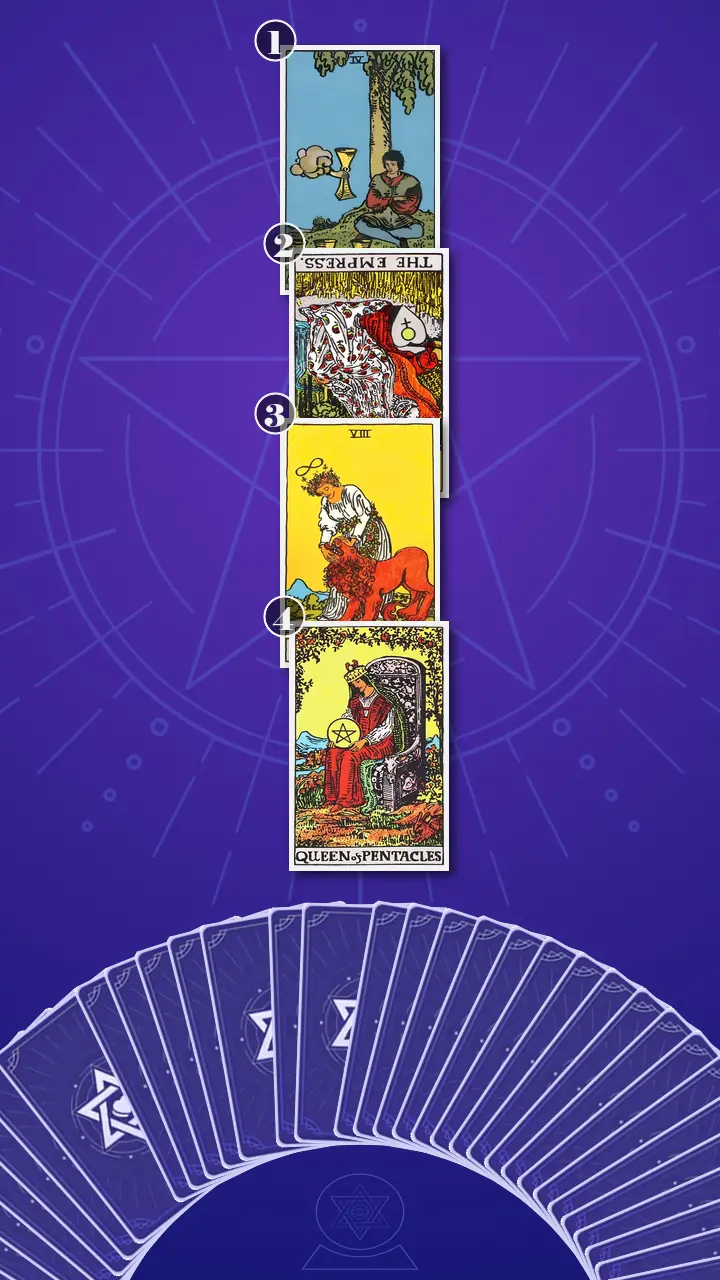
I laid the four cards in a vertical line, top to bottom, like a staircase through the same moment. From years working intuition on ships, I learned that clarity often arrives in layers: first the visible weather, then the hidden current, then the correction, then the safe route into port.
Reading the Staircase from Shutdown to Self-Possession
Position 1: The Towel Before the Water
Now I turned over the card for the exact shutdown pattern that appears when the pool-party invite lands — the visible urge to delay, detach, or bail. The Four of Cups, upright.
In modern life, this card looks exactly like Taylor opening the invite and emotionally stepping away before she has even checked what she wants. Instead of answering, she moves between weather apps, swimsuit tabs, old camera-roll photos, and a half-written excuse in Notes, so withdrawal starts looking practical. The crossed arms in the card feel like pre-emptive bracing — emotionally wrapping yourself in a towel before anyone has even looked at you. It carries that brutally familiar energy: I want to go, but I do not want to be perceived.
Energetically, I read this as blockage. Not a lack of desire, and not proof that she should stay home. It is the moment her social self goes on airplane mode. My Procrastination Decoding lens always catches the same loop here: trigger, delay ritual, brief relief, then a stronger belief that hiding is safer. Sometimes “I'm not in the mood” is just shame in a neutral outfit.
When I asked her, “When the invite came in, what did you reach for first — curiosity, your mirror, your camera roll, the weather app, or the excuse text?” she let out a small, bitter laugh. “Wow,” she said, rubbing the edge of her phone case with her thumb. “That is uncomfortably accurate.” The laugh did what laughs sometimes do in readings: it opened the door just enough for the truth to enter.
Position 2: The Mirror as Scorecard
Then I turned to the card representing the older body-shame story and the underlying fear about worth and belonging that was driving the urge to disappear. The Empress, reversed.
As a Jungian psychologist, I always pay attention when an archetype of abundance appears in shadow. Upright, The Empress is embodiment, pleasure, softness, worth that does not need defending. Reversed, she often shows me a body being treated like a project under review instead of a home. In Taylor's life, that looked like harsh bathroom light, side-angle photos, deleting them within thirty seconds, and the thought she said out loud before she could stop herself: “If I felt better in my body, this would not even be a question.”
This is the deeper wound. The pool party is not the whole problem. The older rule is: if my body is not acceptable enough, belonging is not safe enough. That is why a casual hang starts to feel like a public grading session. The Venus shield becomes worth tied to appearance. The wheat field becomes the body's capacity for comfort and aliveness — still there, but no longer trusted. It is like turning the bathroom mirror into an analytics dashboard for your worth.
Here the energy is not balance but distortion and deficiency. Self-worth is blocked, receptivity is blocked, and the body gets demoted from living place to evidence. When I said, “What if the real problem is not the pool party, but how fast your body gets turned into an exam?” she gave a full-body wince. First her breath caught. Then her gaze drifted past me, as if replaying every deleted photo. Then her shoulders climbed toward her ears before slowly dropping back down. “Yeah,” she said quietly. “That's exactly it.”
When Strength Put a Hand on the Lion
By the time I reached the third card, the room had gone unusually still. Even the AC seemed to lower its rattle, and the stripe of evening light on the table slipped off the mirror-bright edge of her phone. Key cards do that sometimes. They change the temperature of a reading before anyone says a word.
Position 3: Belonging Is Not an Audition
I turned over the card for the inner quality that interrupts self-criticism and helps separate shame from honest preference. Strength, upright.
Belonging Is Not Something Your Body Has to Audition For
In daily life, this card is not a makeover fantasy. It is the smaller and much braver move of noticing the urge to cancel, taking one slow breath, and refusing to let the loudest self-critical voice make the whole decision. The lion is the body-shame alarm when it starts blaring. The gentle hands are the part of Taylor that can stay kind and regulated instead of attacking herself to regain control. Energetically, this is balance: intensity is present, but it no longer gets to drive the whole car. Strength is like muting the loudest tab in your browser without shutting down the whole computer.
I gave her the setup plainly. “You know that moment — the invite is sitting there, your phone is warm in your hand, and somehow a simple day by the pool has already become a private referendum on whether your body is acceptable enough to show up.” She nodded once, but I could see she was still caught inside the old rule that said there had to be a correct, appearance-approved answer.
Not the old rule that says you must earn visibility by shrinking first, but the Strength move of meeting the lion of shame with a steady hand and staying on your own side.
The real choice is not swimsuit or no swimsuit. The real choice is whether shame gets to impersonate your preference.
Whenever Strength appears in a question like this, I use my Choice X-Ray. It reveals the hidden costs shame tries to hide inside sensible language. A shame-based no can buy ten minutes of relief, but it quietly charges interest in missed connection and teaches the nervous system that visibility is dangerous. A forced yes made from self-bullying is not freedom either; it costs self-trust. Strength looks for the third path: the answer that lets Taylor stay on her own side while she decides.
For one second she froze so completely that even her thumb stopped moving. Then her eyes lost focus, as if she were replaying every half-written excuse text she had ever sent. Then the emotion arrived in layers: a flash of anger, a swallow, a wet shine in her eyes. “But if that's true,” she said, and her voice came out sharper than before, “doesn't that mean I've been letting this run me for years?”
“It means something in you learned to protect belonging by hiding first,” I said. “That is not stupidity. That is an old strategy. But it may be an expensive one now.” For a brief second, my mind flashed back to a bridge deck in rough water, years ago at sea. The best captains never screamed at the storm; they lowered their center of gravity, steadied the wheel, and made room for the next precise move. Strength has always felt like that to me — courage as regulation, not force.
I gave her a concrete practice right there, because insight lands better when the body can touch it. “Before you reply,” I said, “set a five-minute timer. Put on the version of the outfit you would most likely wear, add the cover-up you would actually bring, place one hand on your ribcage, and ask: If nobody graded my body, what would I want — and what would help me feel supported? If that feels like too much, scale it down to one written note. The pause still counts.”
Then I asked her, “Using this new lens, can you think of a recent moment when this would have changed how you felt?” She exhaled so visibly I watched her whole chest soften. Her hand went to her sternum without planning it. “Last weekend,” she said. “I would've waited before cancelling. I might still have left early. But I don't think I would've disappeared that fast.” That was the shift, right there: from shame-driven self-surveillance to grounded self-trust around social visibility. Not perfect confidence. Just the first honest inch of it.
Position 4: The Body-Honoring Exit Plan
Finally, I turned over the card for the embodied next step that could put all of this into practice. The Queen of Pentacles, upright.
This is one of my favorite answers when someone asks how to know if they really want to stay home or if they are avoiding being seen. The Queen of Pentacles does not demand fearless visibility. She asks for support. In Taylor's world, that meant choosing the swimsuit she could actually breathe in, bringing the oversized button-up, eating before leaving, taking her own ride, and giving herself permission to stay one hour and go. The card holds a simple truth: you can want comfort without making your body the problem.
Energetically, this is grounded balance. After the emotional shutdown of the Four of Cups and the distorted embodiment of The Empress reversed, the reading finally lands in earth. The body stops being a battlefield and becomes a site of practical care. It is like choosing the route, charger, snack, and exit plan before deciding whether the trip is worth taking.
Here I brought in the Port Decision Model I learned from years around docking schedules and changing weather. I never tell someone to make a port call without checking conditions, timing, and a clean exit. I treat social visibility the same way. No answer should be made while hungry, dysregulated, underdressed for your own comfort, or trapped without a ride. When I said that, Taylor gave me a look that was half relief, half disbelief. “So I don't have to either go all in or bail dramatically?” she asked.
“Exactly,” I said. “A real maybe is allowed. An hour is allowed. Leaving early is allowed. A centered no is also allowed. The goal is not fearless visibility. It's one honest choice from your own side.”
From Insight to a Comfort-First RSVP
When I stepped back and looked at the whole spread, the story was clean. First came the Four of Cups: the visible shutdown, the unread message, the disappearance into weather checks and mirror-adjacent delay. Beneath that sat The Empress reversed: the older shame script that turns the body into a scorecard for worth and belonging. Strength interrupted the old reflex, not by demanding confidence, but by offering self-compassionate courage and a gap between the shame spike and the RSVP. Then the Queen of Pentacles translated that gap into conditions the body could actually live with. That is why The Shadow Spread · Context Edition worked so well here: it separated symptom from root, antidote from action.
The blind spot was not that Taylor was weak or flaky. It was that she had been treating the first surge of shame as objective information. She was asking, Do I look good enough to go, when the truer question was, What choice would honor both my comfort and my desire for connection? That is the transformation direction every card pointed to. Shame loves to dress up as practicality, and clarity begins the moment that costume stops fooling you.
So I gave her a small, usable framework — part tarot integration, part reality testing, part nervous-system logistics. Nothing dramatic. Just actionable advice she could try before the next invite made body image decide her social life.
- Shame-or-Preference CheckBefore replying to this invite or the next one, set a 60-second timer and make two notes in your phone: What I want, and What shame is saying. Do it wherever you first catch yourself spiraling — on your bed, in the bathroom, or in the car — before you start editing the excuse text.Tip: If writing feels clunky, record a one-minute voice memo instead. The point is not a breakthrough. The point is a gap in autopilot.
- Comfort-First RSVPIf the answer is mixed, send one honest middle-ground message to the group chat, such as: I might swing by for a bit — I'll confirm later. One sentence only. No over-explaining, no twelve-round editing session in Notes.Tip: A maybe is not flaky when it is more truthful than a panic-yes or a shame-no.
- Body-Honoring Exit PlanWithin the next 48 hours, do my Reality Testing version of the Queen of Pentacles: put on the swimsuit and cover-up you would actually wear for 10 minutes at home, skip the mirror, notice fabric, breath, temperature, and movement, then pack one support item — water, snack, sunscreen, or a soft towel — and decide your ride and exit line before the event day.Tip: Comfort is not cheating. If the full plan feels big, choose just two supports and start there.
I told her one more thing before we closed the session: whether her final answer became yes, no, or maybe, I wanted it to come from self-respect rather than self-rejection. That distinction matters more than forcing any particular social outcome.

A Week Later: The Quiet Proof
A week later, Taylor sent me a screenshot instead of a long explanation. It was the text she had sent: I might swing by for a bit. Then came the update underneath it: she had gone, brought the oversized shirt, eaten before leaving, driven herself, and stayed just over an hour. She did not emerge from the afternoon magically cured. She left a little early, sat alone in her car for two quiet minutes with the AC on, and laughed once at the old thought — what if everyone noticed — because this time it had not been the only voice in the room.
That is what I mean by a Journey to Clarity. Not a dramatic reinvention. Not bullying the body into confidence. Just moving from hiding on command to choosing with more honesty, more comfort, and more self-trust.
When being seen starts to feel like a verdict, even a casual invite can make the stomach lock and the thumb hover over the excuse text before desire has had any vote at all. If that feeling lives anywhere in you, please know this: the moment you can tell the difference between a shame-no and an honest-no, the old rule has already loosened.
So the next time the group chat lights up and the loudest tab in your mind starts shouting, what tiny comfort, boundary, or small experiment could help you stay on your own side long enough to hear what you actually want?
This story is adapted from psychological research, written so that those in a similar struggle can see their own pattern in it — and find their next step clearly.These insights are not a substitute for professional psychological, medical, legal, or financial advice.
Learn more about our Journey to Clarity.
How did this insight land for you?
🫂 This Resonates Deeply
🌀 Living This Story
✨ Now I See Clearly
🌱 Seeing New Possibilities
🧰 Useful Framework
🔮 The Confirmation I Needed
💪 Feeling Empowered
🚀 Ready for My Next Step
Author Profile
 AI
AI“Having traveled across cultures... I've learned that what we often lack isn't a simple answer, but a moment of being truly understood. I use a Jungian psychological lens to help you deconstruct your subconscious patterns—not to prove anything, but to be the gentle companion who helps you unravel your knots, free of judgment, so you can reconnect with your inner wisdom.”
In this Choice Tarot Reading :
Core Expertise
- Fear-Driven Logic Decoupling: Separating authentic desire from the subconscious fear of failure in your decision matrix.
- Hidden Cost Deconstruction: Identifying and quantifying the unstated psychological 'emotional bills' attached to each option.
Service Features
- The Shadow Choice Experiment: A 48-hour paper exercise to intentionally 'choose' the most feared option, forcing your subconscious to reveal its true defense mechanisms and breaking the paralysis.
Also specializes in :
Explore Related Patterns:
Boundary DiscernmentTaylor's eventual message, I might swing by for a bit, is not avoidance disguised as politeness; it is a boundary that leaves room for contact without trapping her. The oversized shirt, eating before leaving, driving herself, staying just over an hour, and leaving early all turn the social plan into something she can consent to in pieces. Boundary Discernment fits because the decision is no longer forced into all-in visibility or total disappearance. You can see her learning to tell the difference between a centered no, a real maybe, and a shame-no, which is exactly the boundary skill the question is asking for.
Conditional Self-WorthThe older rule Taylor names is precise: if her body is not acceptable enough, belonging is not safe enough. That rule turns the mirror into an authority figure and makes the group chat feel less like an invitation than a test she has to pass before she can be included. Conditional Self-Worth fits because her access to connection is being routed through appearance approval. You are not looking at ordinary indecision here; the decision gets distorted because worth, safety, and social permission have been tied to how acceptable the body feels in that moment.
Visibility AvoidanceTaylor wants the sun, the dumb poolside jokes, and the feeling of being included, but the image of walking from towel to water makes her stomach tighten and her shoulders curve inward. Her body starts preparing to disappear before anyone in the group has actually judged her. Visibility Avoidance fits because the threat is not the party itself; it is the exposure of being perceived. You can see the defense strategy in the urge to cancel, delay, or stay unread, all of which reduce short-term visibility while making the next invitation feel even more loaded.
Reality TestingThe two-note check, the question about what she would want if nobody graded her body, and the ten-minute outfit trial without using the mirror all give Taylor a way to test the shame story against present reality. Instead of letting the first alarm decide, she gathers concrete evidence from breath, fabric, movement, hunger, transport, and exit options. Reality Testing fits because the intervention breaks the fusion between feeling and fact. You can see Taylor move from automatic self-surveillance into a cleaner audit of what is true, what is fear, and what support would make a real choice possible.
Shame-Driven DelayTaylor does not simply forget to RSVP; she moves through weather apps, swimsuit tabs, old photos, and a half-written excuse while the phone stays hot in her palm. The delay gives her a short hit of relief because not answering postpones the moment of being seen. Shame-Driven Delay fits because the pause is not neutral. You can see shame dressing itself as practicality, using reasonable-looking checks to keep the choice suspended until avoidance feels like the safest option.
Emotional ReasoningTaylor treats the first surge of shame as if it might be reliable evidence that she should stay home. The story keeps returning to the same confusion: is this an honest no, or is fear of being seen impersonating a preference? Emotional Reasoning fits because a body alarm is being translated into a conclusion before it has been checked. You can feel how the tight stomach and shrinking posture become persuasive, even though the reading later shows that discomfort is information to examine rather than a verdict to obey.
Secure VisibilityTaylor does go, but the proof is quiet: she brings the oversized shirt, eats beforehand, drives herself, stays just over an hour, and takes two minutes alone in the car afterward. Visibility happens with support rather than with self-bullying. Secure Visibility fits because the goal is not to become fearless at the pool. You can see a more stable pattern forming when she allows herself to be seen while still protecting comfort, timing, and exit, so the old thought that everyone noticed is no longer the only voice in the room.
Explore Related Struggles:
Desire-Shame BindTaylor wants the sun, the dumb poolside jokes, and the feeling of being included, but the moment she imagines walking from towel to water, her body starts preparing to disappear. She names the split herself when she says she cannot tell whether she actually wants to stay home or is just scared to be seen. Desire-Shame Bind fits because the wanted thing and the shame spike arrive at the same doorway. You do not lose desire; it gets braided with the threat of being judged, so the RSVP begins to feel like a verdict on whether wanting connection is safe. The practical shift in the reading is the separation of preference from the old body verdict. When shame can no longer impersonate your no, the choice can become smaller, more honest, and more self-protective without letting self-rejection make the whole call.
Social Self-Judgment LockThe group chat starts as a casual invite, but in Taylor's apartment it becomes a private performance review. Three swimsuits on the bed, a hot phone in her hand, and a half-written excuse turn the room into a judging chamber before any friend has said a word. Social Self-Judgment Lock fits because she is not responding to the actual pool party yet. She is responding to an imagined audit where every movement from towel to water could be used as evidence against her. You can feel how exhausting that lock becomes: the social world looks open from the outside, but inside it is already narrowed by a verdict that has not happened. The useful move is not forced confidence; it is reality separation, asking what is actually known, what is imagined, and what support would let the real event be smaller than the internal court case.
Visibility-Safety SplitThe walk from towel to water becomes the pressure point: Taylor wants to be in the group, but imagined visibility makes her stomach tighten and her shoulders curl inward. Her body reacts to being seen as if social exposure requires immediate protection. Visibility-Safety Split fits because the danger signal is attached to perception itself. The pool party is not only a plan on Saturday; it becomes the place where being visible, being evaluated, and staying safe get tangled into one decision. That is why checking weather apps, scrolling swimsuit tabs, and drafting excuses can feel briefly calming. You get relief from exposure, but the relief also teaches the body that visibility is something to escape. The support plan gives safety a different job: not hiding you from the world, but helping you enter it with exits, comfort, and consent intact.
Explore Related Emotions:
Belonging ShameHarsh bathroom light, side-angle photos, and deleted images turn the body into evidence before the group chat has even received an answer. The line she says out loud, that if she felt better in her body this would not be a question, shows how quickly belonging becomes conditional. Belonging Shame is the ache underneath the RSVP dilemma: the old rule that says connection is safer only after the body has passed inspection. You are not simply deciding whether to attend a pool party; you are meeting the part of you that learned to protect inclusion by hiding first. This label matters because it keeps the focus on the wound in the belonging system, not on whether a swimsuit can solve it.
Cautious Self-TrustThe screenshot says, I might swing by for a bit, and the update that follows is deliberately modest: she brings the oversized shirt, eats before leaving, drives herself, stays just over an hour, and leaves early. Nothing in that sequence depends on becoming magically confident first. Cautious Self-Trust is the emotional gain of letting a partial, supported choice count. You are learning that trust does not have to arrive as certainty; it can arrive as one breathable condition, one honest maybe, one exit plan, and one afternoon where the old thought is not the only voice in the room. That makes the decision belong to you again.
Social Exposure DreadYou can picture the walk from towel to water before you can picture the afternoon itself. That imagined crossing turns a casual invite into a scene of exposure, where the body is no longer just participating in a day by the pool but standing in front of an invisible panel of judges. Social Exposure Dread names the specific charge around wanting to be included while not wanting to be perceived. The dread is not proof that you do not want connection; it is the body's alarm going off around the cost of being visible in a group setting. Once that is named, the RSVP stops being a referendum on your worth and becomes a choice that can include comfort, boundaries, and a real exit.
Verdict DreadThe group chat says pool on Saturday, but the room receives it like a verdict. Swimsuits on the bed, the hot phone, and the imagined towel-to-water walk all gather around one silent question: will this body be judged acceptable enough to show up? Verdict Dread captures the way evaluation floods the decision before anyone else has actually spoken. You are not only weighing a social plan; you are bracing for an imagined ruling on your body, your ease, and your right to belong. Naming the verdict quality gives you a way to interrupt it, because a feared judgment is not the same thing as your true preference.
Visibility PressureYour phone is hot in your palm, three swimsuits are half-folded on the bed, and the event has not even happened yet when your stomach tightens and your shoulders fold inward. The pressure is not coming from the pool itself; it comes from the imagined moment of being looked at, where the body starts preparing to shrink before desire has had time to speak. Visibility Pressure fits because the story turns being seen into a physical load. You want the sun, the jokes, and the feeling of being included, but the thought of crossing from towel to water makes visibility feel like something to survive. Naming that pressure helps separate the wish for connection from the reflex to disappear under an imagined gaze.
Quiet Self-RespectThe answer is allowed to be yes, no, or maybe, as long as it does not come from self-rejection. That distinction changes the whole field: a real maybe is allowed, leaving early is allowed, and a centered no is allowed without turning the body into the problem. Quiet Self-Respect fits because the story's clearest movement is toward a choice that honors both comfort and connection. You do not have to bully yourself into visibility to prove growth, and you do not have to disappear to stay safe. The self-respect is quiet because it does not perform confidence; it simply refuses to let an old body rule impersonate preference.
Regulated CourageShe is asked to put both feet on the floor, take one slow breath, and pause before touching the deck or answering the group chat. That small delay changes the shape of the moment: the loudest self-critical voice is still present, but it no longer gets immediate control of the RSVP. Regulated Courage fits because the brave move here is not forcing confidence or pretending the pool feels easy. It is staying steady enough to ask what you would want if nobody graded your body, then letting the answer arrive with support around it. The courage lives in remaining on your own side while intensity is still in the room.
Shame SpiralThe invite lands, and the decision immediately scatters into weather apps, swimsuit tabs, old camera-roll photos, and a half-written excuse in Notes. Each small detour looks practical on the surface, but together they keep the body under review while the actual want gets quieter. Shame Spiral fits because the loop feeds itself: a spike of self-consciousness leads to checking, checking leads to delay, delay gives temporary relief, and relief teaches hiding to look safer. You can see how the first sensation in the body starts pretending to be objective information. The value of this label is that it turns the loop back into something observable, so it no longer has to make the whole choice in secret.
Performance FreezeHer thumb stops moving, her eyes lose focus, and the half-written excuse sits there as if the body has paused the whole system. The freeze is not emptiness; it is the moment too many signals arrive at once, wanting connection, fearing inspection, and trying to find an answer that will not cost self-trust. Performance Freeze names the shutdown that happens when an ordinary social choice starts to feel like an evaluation. You are still present, and you may still want the thing, but movement narrows because the body is preparing for a stage it never agreed to stand on. Seeing the freeze clearly makes room for a smaller next step instead of forcing an instant yes or a disappearing no.
Explore Related Contexts:
Body Surveillance CultureTaylor is standing in her Los Feliz apartment with three swimsuits on the bed, a hot phone in her hand, and the group chat open long enough for a pool invite to feel like a review panel. The visible facts are ordinary on the surface, but the social architecture around them is not ordinary for her: swimsuit tabs, old photos, bathroom light, and the imagined towel-to-water walk all become tools of evaluation. That is the structure of Body Surveillance Culture in this story. The pressure does not come from a single cruel comment or one hostile friend; it comes from a social scene where being seen in a body feels measurable, comparable, and open to silent scoring. You are not just deciding whether to attend a party. You are being pulled into a cultural setup where visibility feels like data, and the body becomes treated as evidence before desire gets a vote. The key is that Taylor still wants the sun, the jokes, and the feeling of inclusion. The surveillance pressure is not replacing her social desire; it is interrupting her access to it. Naming this context helps separate the external visibility system from the actual preference underneath it, which is the first move toward choosing with more agency.
Conditional Belonging PressureTaylor says she wants the sun, the poolside jokes, and the feeling of being included, but the moment she pictures crossing from towel to water, the invitation starts carrying an entry condition. The older rule in the story is explicit: if her body is not acceptable enough, belonging does not feel safe enough. Conditional Belonging Pressure fits because the social problem is not simple hesitation. Taylor is already part of the group chat, yet the imagined scene makes her position feel provisional, as if inclusion has to be re-earned through appearance. The pool party becomes less about whether the friends want her there and more about whether she can tolerate the unspoken standard she has attached to being seen. For you, the useful distinction is between connection that is actually available and connection that starts feeling gated by body approval. When that pressure is named as an external belonging structure, the RSVP can stop being a referendum on whether you deserve the room and start becoming a decision about what kind of support, boundary, or partial attendance would let you stay on your own side.
Social Performance LoopTaylor does not simply open the invite and answer it. She moves through weather apps, swimsuit tabs, old camera-roll photos, and a half-written excuse in Notes, turning the time before the party into a rehearsal for how she might be perceived. That sequence is why Social Performance Loop belongs here. The invite creates a repeated circuit: social cue, appearance check, delay ritual, temporary relief, and stronger evidence that hiding might be safer next time. The group chat is not just a communication channel in this moment; it becomes the entry point into a staged version of the self where every choice has to look defensible. The loop matters because it can disguise itself as reasonable planning. You can tell yourself you are checking the weather, choosing an outfit, or deciding whether you are tired, while the deeper structure is making visibility feel like a performance you have to pass. Seeing the loop gives you a place to intervene before the excuse text becomes the only available exit.
Safe Visibility TrialTaylor eventually sends I might swing by for a bit, then goes with the oversized shirt, eats before leaving, drives herself, stays just over an hour, and leaves early. Those details are not decorative. They are the structure that makes visibility tolerable without forcing her into a fake all-or-nothing confidence performance. Safe Visibility Trial captures the constructive side of the story because the answer is not to disappear and not to bully herself into exposure. The trial creates conditions: breathable clothing, an exit route, a time limit, and permission to leave. That turns the pool party from a verdict into a contained experiment. For you, this context points toward agency through design. The goal is not to prove that being seen no longer affects you. The goal is to build enough external support around the event that your choice can come from preference and self-respect, rather than from the loudest pressure in the room.