Calling It Bad Timing, Then Treating One Application as Feedback

The Cursor at 10:40 p.m.
If you are a late-twenties content or UX designer sharing an expensive city apartment, and a former colleague's "thrilled to announce" post makes you move your own application reminder again, I recognize the scene before you explain it. I am Laila Hoshino, and I met Maya (name changed for privacy) at the narrow kitchen table in her shared apartment near Bloor and Dufferin, where one suitable content design role stayed open beside her portfolio.
At 10:40 p.m. on a Tuesday, the laptop fan warmed her wrist, her tea had gone cold, and the radiator clicked behind her. When the cursor drifted close to Submit, Maya opened another labor-market article, dragged Friday's Google Calendar reminder into next month, and watched the immediate safety of not being evaluated arrive before the frustration did.
Her stable tech job paid the rent and gave her a practical reason to value security, but it offered little creative ownership or progression. She wanted to try again for a different role, yet another rejection felt capable of saying more about her than one hiring decision ever could. "I am not giving up," she told me, "but this is obviously not the right window." Then she gave me the question underneath the calendar language: "What keeps me calling it bad timing instead of trying again?"
The apprehension in her felt like a smoke alarm sealed inside the wall: not loud enough to name, impossible to ignore when the next step became specific. Disappointment, shame, and longing kept circling the same polished portfolio. I could hear the contradiction clearly: the desire to try again was still alive, but the fear of another disappointing outcome had turned bad timing into protective shelter.
I did not ask Maya to dismiss Toronto rent, uneven hiring conditions, visa concerns, health needs, or any other real constraint. I asked her to let me help separate a genuine condition from the larger emotional job the timing story had taken on. "We can look at this without forcing a decision," I said. "Our Journey to Clarity is simply to draw a map of what is happening, then return the next choice to you."

Choosing a Compass at the Career Crossroads
I invited Maya to put her phone face down, take one slow breath, and focus on the question rather than on finding a perfect answer. I shuffled slowly, treating the movement as a practical transition from the noise of LinkedIn, Glassdoor, Reddit threads, and unfinished Notion tasks into a more focused kind of attention.
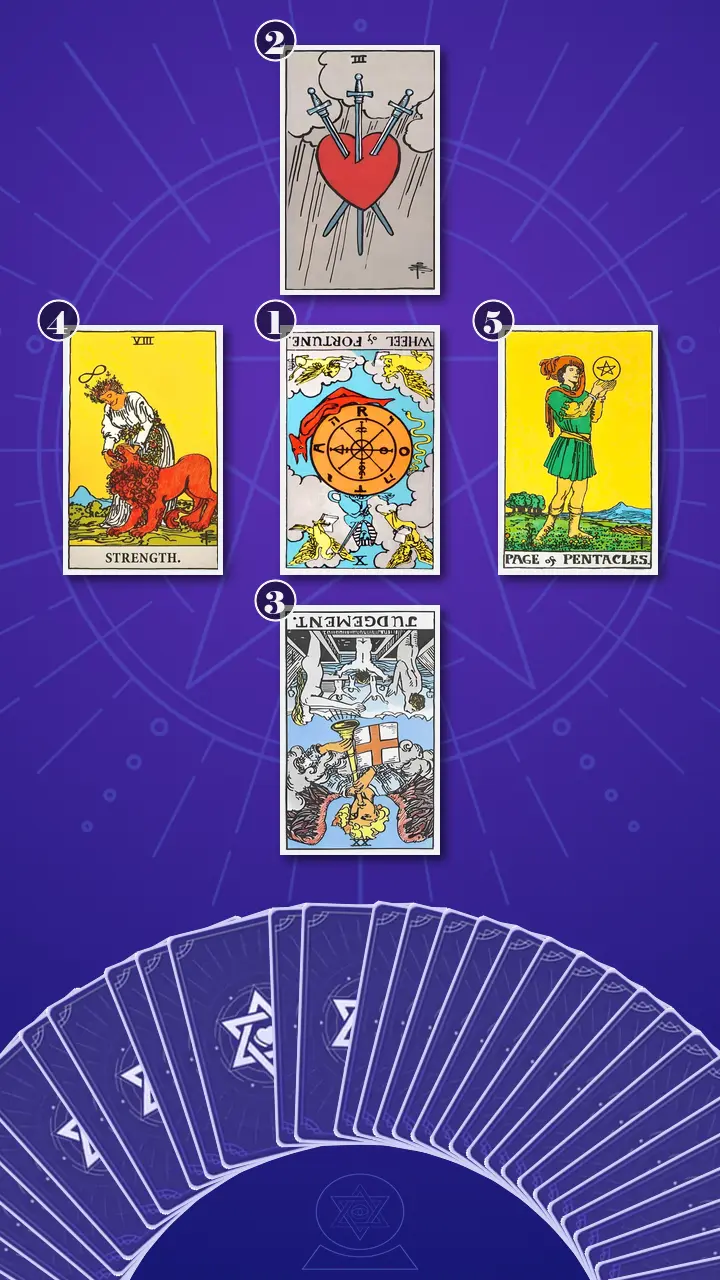
For this career crossroads, I chose The Shadow Spread, a five-card tarot spread designed for inner excavation rather than prediction. For anyone wondering how tarot works in a situation like this, the cards give us structured images and questions. They do not guarantee an offer, identify a divinely correct month, or replace practical judgment. They help us place a vague pattern where we can examine it from several angles.
The Shadow Spread is especially useful here because the issue is not a comparison between two defined jobs or a forecast of market timing. It traces a causal chain: the visible explanation, the wound that activates it, the protected fear underneath, the inner resource that can meet the fear, and the grounded practice that can turn insight into evidence.
I placed the first card at the center as the visible shadow, Maya's observable habit of labeling postponement as bad timing while leaving the next attempt undefined. Above it would sit the activating wound, the remembered disappointment that makes a new role feel connected to the old one. Below it would be the protected fear, the belief that another no could become a judgment of her worth. To the left, I would look for an integrating resource. To the right, I would look for one conscious action.
This is where card meanings in context matter. The same tarot card can describe a different lived pattern depending on the question, the position, and the person's actual circumstances. The Shadow Spread would let us move from the sentence Maya could explain to the fear she had not yet been able to say, without treating either as a fixed identity.
The Wheel That Would Not Stop Turning
The Visible Shadow: A Calendar Waiting for Permission
Now I turned over the card representing The visible shadow: Maya's observable pattern of labeling repeated postponement as bad timing while leaving the next attempt undefined. It was the Wheel of Fortune, in reversed position.
The large wheel in the image turns beyond any single figure's command, while the four fixed winged creatures at the corners continue reading. I connected that contrast to Maya's 10:40 p.m. kitchen table. She was scanning hiring forecasts, seasonal reports, peer announcements, and market commentary as though the whole employment cycle had to settle before one small action could become reasonable.
In this position, the reversed energy showed a blockage reinforced by overcorrection. Real uncertainty had expanded into a total stop signal. A weak hiring statistic could matter, but it did not automatically mean that Maya could not choose one plausible role, schedule a review, or submit while remaining in her current job. She was monitoring the entire wheel for permission instead of identifying the limited agency available inside its motion.
I told her, "Bad timing may be real, but it has become too total to test." Then I used the scene she had described: watching a live TTC arrival board and refusing to move until every delay disappeared, even though the board was designed to keep changing.
Maya gave a short, bitter laugh instead of nodding. "That is uncomfortably specific," she said. "I am not avoiding it; I am waiting until the market improves. But I have not decided what would count as good enough." Her fingers stopped above the mug, and her eyes moved from the card to the Calendar reminder she had already shifted twice.
I did not treat her reaction as resistance. I said, "Good. Specificity gives us something to work with, and it does not erase the truth that conditions matter. We can ask which condition must genuinely change and which condition would simply make exposure feel nicer." The tension in her shoulders stayed, but the explanation had become observable rather than unquestionable.
The Activating Wound: The Rejection That Autocompleted the Present
Now I turned over the card representing The activating wound: the remembered disappointment from the previous attempt that makes each new opportunity feel emotionally continuous with the old one. It was the Three of Swords, in upright position.
The pierced red heart hung against gray clouds and falling rain. I connected it to the moment Maya opened a new content design application and remembered the exact subject line of an earlier rejection before she had even compared the new role's requirements with her experience. The role, team, reviewer, and circumstances were different, but the old no had arrived first.
The upright energy was painful clarity, but it was also concentrated and unprocessed. The card did not predict another rejection. It showed how a previous result still pierced the present decision. The blockage came from treating research as emotionally neutral when the browser tabs were giving her a respectable place to put an old wound she had not directly named.
I said, "This is a different role, but your body is already reading the old no." The sentence landed more quietly than the Wheel. Maya's breath paused, her jaw tightened, and her hand pressed briefly against the center of her chest as if checking whether the feeling had really returned.
She looked down at the Three of Swords. "I want another chance without having to feel like a beginner again," she said. I heard the longing inside the disappointment. I also heard why another market article felt easier: it offered analysis without requiring her to stand in front of a new evaluator.
I let the pain remain specific. "The last search gave you information about several applications and interviews," I told her. "It did not give you a permanent forecast, and it did not tell us what this role will do. We can acknowledge the sting without allowing it to become current evidence for everything." Maya rubbed the rim of the cold mug, and the tightness in her face softened by one degree.
The Protected Fear: When an Invitation Becomes a Trial
Now I turned over the card representing The protected fear: the belief that another disappointing result could become evidence of inadequate worth or judgment. It was the Judgement, in reversed position.
The trumpet in the image should be a call to rise and respond, but reversal made the invitation feel like a summons to court. I connected it to the job alert Maya genuinely wanted. Before she drafted the application, her inner voice had already begun the verdict: "If they say no, maybe the portfolio is weak; if the portfolio is weak, maybe I am not actually good enough."
The reversed energy was the main blockage in the spread. Reflection had hardened into self-condemnation. Instead of reviewing one attempt for useful feedback, Maya reread old rejection messages as evidence about her overall ability, imagined criticism of every case study, and archived drafts before anyone could evaluate them. The fear was not only that the outcome might hurt. It was that the outcome might be allowed to name her.
I use a diagnostic lens I call Gravity Well Identification. It helps me ask which habit or environment is exerting an obsolete downward pull on someone's evolution. I did not label Toronto rent or a cautious labor market obsolete; those were real forces that deserved respect. The gravity well was the habit of turning one disappointing result into a permanent account status, then using open-ended research and portfolio perfectionism to avoid allowing later evidence into the record.
I asked, "When you imagine sending one strong application and receiving another no, what are you afraid that would prove?" Maya's breath held. Her gaze went unfocused as if an old rejection email had opened behind her eyes. Then her jaw worked once, and she whispered, "That I was overestimating myself. That the problem is me."
I answered carefully, "An outcome can evaluate the attempt without evaluating your worth." I watched her take that sentence in. It did not produce instant relief. It produced a more honest discomfort, the kind that appears when a protective explanation stops being able to hide the fear it has been carrying.
When Strength Put Her Hands Back on the Lion
The Integrating Resource: Calm Hands at the Lion's Mouth
The room changed when I reached for the fourth card. I heard the radiator click once and stop, and for a moment the apartment seemed to hold its breath with us.
Now I turned over the card representing The integrating resource: the form of compassionate courage needed to remain present with uncertainty without postponing or forcing action. It was the Strength, in upright position.
The RWS image shows a woman with calm hands at a lion's mouth, a white robe, a floral garland, and an infinity symbol above her head. She is not overpowering the animal, and she is not pretending the animal is harmless. Strength is a balance between force and surrender. For Maya, the lion was the surge of exposure that arrived when the application moved from an abstract possibility to a real task.
I explained my Cognitive Spiral Mapping approach. I traced the sequence on a clean page: an old rejection triggers a prediction, the prediction sends Maya into market research, research creates temporary relief, the relief encourages a date change, and the absence of new evidence makes the original fear feel even more accurate. The spiral was not proof that she was incapable of moving. Feeling stuck could be a necessary orbital slingshot phase, pressure gathering before an intellectual breakthrough. But a slingshot only changes trajectory when there is a bounded release; endless circling becomes shelter.
I asked her to picture the familiar scene without demanding confidence first: "At 10:40 p.m., the role is still open, the tea is cold, and your cursor is nowhere near Submit. You read one more market forecast, move Friday to next month, and feel relief arrive before the frustration does."
I placed my finger beside Strength and said, You do not need a risk-free moment to prove you are ready; choose one brave, bounded retry, as Strength meets the lion with steady hands rather than force.
I let the sentence settle, then said, Perfect timing has been protecting your worth from a test; one bounded retry can give you information without getting to define you.
For a second, Maya froze. Her breath stopped halfway in, and her index finger hovered above the table as though it had lost the next instruction. Then her eyes went unfocused; I could see the old rejection replaying somewhere behind them, the subject line filling the new role's blank space. Her jaw tightened, and one hand closed around the mug without lifting it. When I asked her to stay with the distinction, she looked back at Strength. A slow breath left her chest. Her shoulders dropped a fraction, her fingers loosened, and the corner of her mouth moved before the rest of her face could decide whether relief was safe. "So I can be exposed without making it a verdict," she said, almost too quietly. The relief was real, but it brought a brief, dizzying blankness: if the old protection no longer made the decision, the next choice belonged to her. I let that responsibility be gentle rather than dramatic.
Then I asked, "Now, use this new perspective to look back at last week: was there a moment when one bounded retry could have made you feel different?"
Maya looked toward the laptop. The screen had not changed. The hiring market had not changed. The role had not become guaranteed. What had shifted was the meaning she was asking the next attempt to carry. This was the first step from apprehensive, shame-tinged over-preparation toward compassionate courage, grounded participation, and steadier self-trust under imperfect conditions.
One Pentacle, Not the Whole Hiring Market
The Grounded Practice: A Single Card Moved Into This Week
Now I turned over the card representing The grounded practice: one bounded, learning-oriented retry that separates practical timing considerations from identity-level judgment. It was the Page of Pentacles, in upright position.
The Page studies one pentacle at eye level in a cultivated green field, with distant mountains still unfinished beyond it. I connected that image to a realistic vacancy, one relevant portfolio change, one scheduled review, and one submission boundary. The Page is not performing mastery for the entire career landscape. The Page is learning through contact with one material task.
The upright energy brought balance and Earth after the earlier mental spirals. It did not promise that Maya would receive an offer. It offered something more honest and immediately useful: an observable experiment. She could select one role, make one evidence-based revision, and record what the process taught her without using the result as a referendum on her identity.
I said, "You do not need to hold the whole market. Hold one workable opportunity." Then I shrank the visual field from every saved job to one Notion card moving from Saved to This Week. "One role, one relevant edit, one review, then information," I added.
Maya reached for her phone and opened the Notion career-pivot board with columns for Saved, Researching, Portfolio Update, and almost nothing under Submitted. She did not move a card immediately. She read the role again, checked the salary and core requirements, and wrote one sentence about the relevant case study. That pause mattered. It was no longer an attempt to force certainty. It was a conscious check of whether the opportunity respected her actual boundaries.
I reminded her that beginner-minded effort did not mean accepting poor pay, unsafe conditions, unreasonable workload, or a role that violated her needs. The Page of Pentacles asks for contact with reality, not self-abandonment. A role could be declined for a named practical reason. It simply could not remain indefinitely in the fog of an unspecified later month.
Finding Clarity Through One Workable Orbit
When I gathered the five cards together, the story became clear without becoming simplistic. The Wheel of Fortune reversed showed how Maya monitored an unstable hiring cycle and treated movement outside her control as a reason to stop. The Three of Swords showed the old rejection still piercing the present. Judgement reversed revealed the hidden leap from "that attempt did not work" to "the problem is me." Strength offered compassionate courage, and the Page of Pentacles gave that courage a small, observable place to land.
That was why the postponement loop kept surviving. Disappointment activated the fear that another result could define her worth. Research, comparison, and portfolio refinement reduced the immediate risk of evaluation. The resulting relief felt like proof that waiting had been wise, but waiting also produced no new evidence, skill feedback, or corrective experience. The unchanged situation then appeared to confirm that trying was still unsafe.
I named the cognitive blind spot plainly: Maya had been treating emotional relief as evidence of strategic accuracy. She had also been confusing preparation with readiness and allowing one hiring result to judge the whole self. The transformation direction was not from fear to fearless action. It was from waiting for proof that the timing was safe to scheduling one bounded retry whose purpose was learning rather than proving personal worth.
I then introduced my Orbit Expansion Strategy, a macro-perspective exercise I use when someone feels caught inside a cognitive gravity well. I asked Maya to zoom out far enough to name the genuine constraints, zoom in tightly enough to choose one workable role, and give that role a defined amount of momentum. After the attempt, she would collect evidence and update the next orbit. She did not need to control the whole cycle before moving one degree inside it.
I have spent years looking at cycles with people who believed a pause meant failure. I know the orbital image can be comforting, but I keep it accountable to the material world: rent still has to be paid, applications still take time, boundaries still matter, and no card can promise a hiring outcome. Tarot becomes useful when it helps a person see a pattern clearly enough to make a choice that remains their own.
- Run the Timing-Is-Context Check.Before opening another Glassdoor, LinkedIn Jobs, or Reddit thread, use your phone note at the usual kitchen table and make two columns: "Must Be True" and "Would Feel Safer." Spend ten minutes sorting the conditions you keep citing, then use one credible source for a maximum of fifteen minutes. Within seven days, give the specific role a clear status: apply, intentionally decline for a named reason, or schedule one bounded review.If your chest feels too tight, use the five-minute version: name one condition that genuinely must change and one that has quietly become permission to wait. Close the research tabs when the timer ends.
- Book a Steady-Hands Session.On one evening this week, open one saved role at the kitchen table, type "I am afraid this result will mean..." and "For this session, it is allowed to mean only..." in a blank note, then set a thirty-minute phone timer. Work only on that application until the timer ends, without rebuilding the entire portfolio. The aim is to stay present with one concrete task and gather information.A hard stop is part of the practice. If thirty minutes feels too exposed, open the role, name the fear, and write the next physical action for five minutes. You may pause when the exercise stops being useful.
- Use the One-Role, One-Revision, One-Review Rule.Move one realistic vacancy from Saved to This Week in Notion, Notes, or a paper list. Make one evidence-based portfolio change that directly serves its core requirements, record the change, and book one twenty-minute final review in your calendar within the next seven days. Submit when that review ends, then note three pieces of data: time spent, what felt difficult, and one adjustment for next time.Text one trusted friend, "I am doing one learning attempt this week. Please ask whether I completed the session, not whether it worked." If the role fails your salary, safety, workload, or other real boundaries, decline it clearly rather than treating boundaries as fear.
I watched Maya write the three rules beside her portfolio. The page did not solve her career. It gave her a way to distinguish timing as context from timing as command, and feedback from verdict. That distinction was the actionable advice. The next step could be small enough to begin and bounded enough to remain hers.

A Week Later: The Quiet Proof
Four days later, I received a message from Maya: "One role, one revision, one review. I submitted." She had slept through the night, then woken with the old thought, what if I am wrong, still there. This time she smiled, opened her calendar, and left the next review where she had scheduled it.
I did not read her message as proof that the application would succeed. I read it as the first evidence that she could allow an attempt to exist without asking it to define her. The cards had not submitted the application. Maya had, while the market remained imperfect and her chest still knew how to tighten.
That was her Journey to Clarity: not a final answer, but a change in the question. Instead of asking when conditions would become safe enough to protect her worth, she could ask what one honest, bounded action might teach her. The person asking the question remained the author of the decision.
When your cursor nears Submit and your chest tightens, calling it bad timing can feel safer than letting another outcome seem capable of naming your worth. You do not have to dismiss practical constraints, and you do not have to force yourself into a dramatic leap. You can hold one workable opportunity while the larger cycle keeps moving.
If one attempt were allowed to be information rather than proof, what small part of it can you imagine trying?