Finding Clarity in the 1:12 a.m. Slack Glow
If you're a late-20s agency person who can manage everyone else's timelines but goes completely silent the second a follow-up Slack lands after one missed deliverable, this will probably feel painfully familiar. Jordan, a 27-year-old junior project coordinator in Toronto, booked my Zoom session with one question: why do I stop eating, sleeping, and replying after missing a deadline?
When her camera came on, I could see the remains of the exact kind of night she meant. It was 1:12 a.m. in her small rental kitchen downtown. Slack was still open on her laptop. The microwave had just clicked off beside the same pasta she'd reheated twice. The light on her face was blue and mean; the coffee in her mug had that burnt, stale smell of something reheated past the point of comfort.
'I know disappearing makes it worse,' she said, looking at three half-written updates on her screen. 'I just can't make myself hit send. If I reply before I have a fix, it feels like I'm admitting I'm incompetent.' Then, softer: 'Once I'm late, my whole body acts like I'm in danger.'
I believed her immediately. What she was describing was a mistake-triggered shutdown after missing a deadline at work, and her body was carrying every second of it. The shame in her wasn't abstract. It sat in her like a smoke alarm wired straight into her stomach—shrill, invisible, impossible to negotiate with. I could see it in the tight jaw, the knotted belly she kept pressing with her palm, the wired stillness of someone who hadn't eaten enough and definitely hadn't rested enough.
I told her, 'What you're describing isn't just poor time management. You want to repair the missed deadline and reply, but another part of you is terrified of what facing it will expose. So tonight, let's make a map for the fog and find the cleanest path back to clarity.'

Choosing the Compass: A Five-Card Cross for Why You Go Silent After a Work Mistake
I asked her to plant both feet on the floor, take one slow breath, and say the question out loud once. Then I shuffled slowly at my desk, not as theater, but because the hands need something steady when the nervous system is running hot.
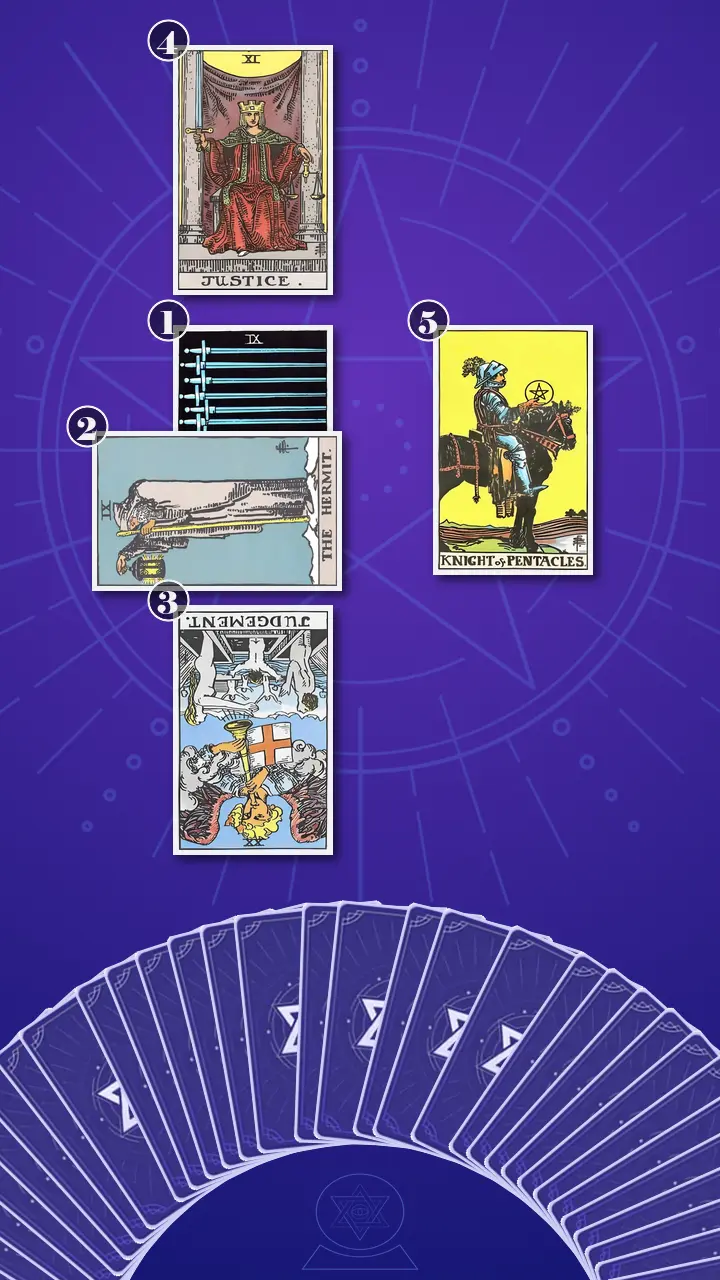
For a question like this, I use a Five-Card Cross tarot spread. It's one of the clearest ways I know to understand why someone goes silent after a work mistake. Instead of drowning the moment in ten different angles, this spread separates the visible shutdown pattern, the coping move that makes it worse, the deeper fear underneath it, the corrective perspective, and the next embodied step. This is how tarot works when it is most useful for feeling stuck, career crossroads, and decision fatigue: card meanings in context, not abstract fortune-cookie language.
I told her what I was looking for. The center card would show the shutdown itself: not eating, not sleeping, not replying. The crossing card would show the defensive move that intensifies it. The card underneath would reveal why one late task feels identity-threatening. The card above would offer the reframe. The card to the right would show the next grounded repair step.
Reading the Map of the Missed Deadline Shame Spiral
Position 1: The Night Alarm
I turned over the card representing the visible shutdown pattern named in her question. Nine of Swords, upright.
I didn't need to stretch for the meaning. This was Jordan at 2:40 a.m., refreshing Slack, rereading the missed timestamp in her head, and polishing explanations while her actual body got shakier and less functional. The work issue was real, yes—but her mind had turned it into an overnight emergency, the way one browser tab auto-plays worst-case scenarios until the whole laptop sounds like danger.
In energetic terms, this was excess Air: too much thinking, none of it useful. Thought had stopped being a tool and become a punishment chamber. 'This is the part,' I told her, 'where you are not even solving it anymore. You are just staying loyal to the panic.' Her mouth twitched into a bitter little laugh. 'Wow,' she said. 'That's accurate enough to be rude.' Even as she said it, her hand went to her chest, as if some part of her felt relieved to have the midnight version of herself recognized instead of judged.
Position 2: Silence in a Responsible Outfit
Next came the card representing the coping move that intensifies the spiral: retreating from contact and trying to handle the fallout alone. The Hermit, reversed.
Reversed, the Hermit's lantern doesn't light the path; it narrows into private, hidden information. I told Jordan this looked exactly like the moment on Line 1 when she sees the follow-up Slack, flips her phone face down, and tells herself silence is the mature choice because she's still 'working on it.' In real life, though, that private regroup becomes a mini-exile. It's like closing Slack to get clarity and accidentally building a bunker instead. The team has less information, she has more shame, and now the problem includes a communication gap on top of the task itself.
This was blocked wisdom: solitude turning into disappearance. 'Silence feels protective for an hour and expensive for the next two days,' I said. She stared at the card and whispered, 'I really do call it being responsible when I'm actually hiding.' Her shoulders lifted toward her ears and then loosened a fraction, the way people do when a defense finally gets named without being mocked.
Position 3: The Inner Verdict
The third card was the foundation: the deeper fear and self-judgment that make a late task feel like a threat to identity rather than a manageable mistake. Judgement, reversed.
This is one of the hardest cards to receive in a work-shame reading, because it shows the exact moment a practical miss becomes a character sentence. I told her this was like opening a simple message—any update on this?—and hearing it not as a project question but as a notification blast through the nervous system: now they know what you really are. The task was late, but her body heard accusation. That is why the mouth goes dry, the chest goes hot, the hands hover over the keyboard and refuse to land.
I asked her, 'If they know you're late, they'll think you are... what?' She didn't answer right away. Outside my studio window, a siren passed and then the room went strangely still. Finally she said, 'Unreliable.' Then, after a swallow: 'And kind of... fake. Like I'm only organized until I'm not.' That was the true root. LinkedIn competence culture, polished agency energy, the whole beautiful-Notion-dashboard version of adulthood—one slip, and her inner voice turned it into a full performance review of her worth.
When Justice Held the Sword Upright
Position 4: The Antidote
When I turned the fourth card, even the call seemed to quiet down. This was the position offering the central reframe that interrupts the shame spiral and points toward proportion, accountability, and self-respect. Justice, upright.
Whenever Justice appears in a reading like this, my mind flashes to the jury room in 12 Angry Men: the heat, the certainty, the way emotion keeps trying to pose as evidence until one person starts separating fact from assumption. Before I said anything else, I used one of my favorite Einstein-style thought experiments—the kind that changes the frame so the hidden law becomes visible. I asked Jordan, 'If the most reliable coworker you know missed the exact same deadline and sent a short update before she had the full fix, would you decide she had no worth? Or would you think she was late and handling it?'
She blinked. 'I'd think she was late and handling it.'
At 1:12 a.m., with Slack still open and dinner untouched beside you, it can honestly feel like replying before you have the full fix would expose you more than the missed deadline itself.
This missed deadline is not proof that you are fundamentally unreliable; hold the sword upright, balance the scales, and answer the real issue with proportionate action.
The spiral is not proof that you care more. It is what happens when a work problem gets mistaken for a worth problem. A missed deadline is a problem to communicate, not a character reference.
Jordan went completely still. First came the freeze: her breathing paused and her fingers hovered above the mug like a loading icon. Then came the cognitive hit: her eyes slipped past my camera, unfocused, as if replaying every unanswered Slack and every draft apology she'd ever tried to perfect into innocence. Then the feeling broke through, but not as instant relief. 'But doesn't that mean I've been putting myself on trial every single time?' she said, sharper now, angry in the way people get when clarity arrives a second before compassion does.
'Yes,' I said. 'And that anger makes sense. You built a survival system around not being seen mid-mistake. But Justice isn't asking you to be softer with facts. It's asking you to stop using facts as weapons.' I had her open her Notes app and type three lines, each under twelve words: Fact. Story. Next Step. The fact: 'I missed the deadline.' The story: 'This proves I'm unreliable.' The next step: 'Send the update by 10:15.' I told her that if her chest spiked or her hands went numb, she could stand up, drink some water, and send the shorter version later rather than perfecting the longer one. She was allowed to stop after that first contact. Her face changed as she wrote. The tight line of her jaw eased. One shoulder dropped, then the other. Her exhale came out shaky, almost disbelieving, the kind that leaves a person a little lightheaded because the panic room door has opened and now there is space where there used to be pressure.
I asked her, 'Now, with this new perspective, think about last week. Was there a moment when this would have changed how your body felt?' She nodded immediately. 'The commute. 8:46. I could've sent two sentences instead of turning the whole train ride into a trial.' That was the hinge of the reading: from shame-driven disappearance and self-punishment to grounded repair and restored self-trust.
Position 5: One Boring, Solid Calendar Block
The final card translated the insight into an immediate recovery style: one steady, practical next step that repairs trust without self-erasure. Knight of Pentacles, upright.
I loved seeing him here. After all that air-heavy panic, this card brings Earth back into the room. Not a redemption montage. Not a heroic all-nighter. Just tea or toast, water by the laptop, one honest message, one 25-minute work block, one follow-up when promised. Less dramatic comeback scene, more one calm calendar block.
'Reliability comes back through boring acts, not dramatic self-punishment,' I told her. The Knight's horse is standing still for a reason. Recovery is deliberate pacing, not frantic speed. Jordan gave the smallest real smile of the session. 'That,' she said, 'I think I can actually do.'
From Courtroom Brain to Repair Brain
Seen together, the spread told a very clean story. Nine of Swords showed the visible collapse: missed deadline, no dinner, no sleep, no reply. The Hermit reversed showed the coping move: disappearing and calling it responsibility. Judgement reversed showed the root fear: one late task becoming evidence that she was fundamentally unreliable. Justice cut through the distortion by separating fact from self-attack. Then the Knight of Pentacles turned that clarity into grounded repair: food, water, a message, a manageable chunk of work. In other words, the reading moved her from courtroom brain to repair brain.
The blind spot was not the deadline itself. It was the belief that repair had to be earned through suffering. Jordan had been treating self-punishment like proof of accountability. The real shift was simpler and braver: move from treating a missed deadline as proof of personal failure to treating it as a signal to communicate, reset the body, and make one concrete repair step. That is proportionate accountability. Your body does not have to earn the right to be fed before you send an update.
Because her mind kept blending receipts with fanfiction, I borrowed another studio habit of mine and gave her a tiny Da Vinci-style note structure: put the fact on one line, the meaning your panic is adding on the next, and the next visible move underneath. When the page is separated, the nervous system often follows.
Your Next 48 Hours
- Build the Two-Sentence Repair Update.Save a note titled 'Late Update' with three lines: Fact / Impact / New timing. Within 30 minutes of noticing a miss, send the shortest honest version in Slack or email, even if you do not have the full fix yet.If timing is still unclear, use the placeholder version first: 'I'm behind on this and reviewing the fastest realistic timing now. I'll update you again by 11:00 a.m.'
- Use the Snack Before Send rule.Before you reopen the thread, eat something low-effort—toasted bread, yogurt, a banana with peanut butter, soup—and put water beside the laptop.The bar is intentionally low. Half a sandwich counts. One glass of water counts. Regulation is part of repair, not a reward for it.
- Do one 25-minute repair block.After the message is sent, set a timer and complete only the next 25-to-60-minute piece of work that visibly moves the task forward.Turn Focus mode off for 15 minutes, answer the oldest work ping before social media, and let one completed chunk matter more than a perfect recovery fantasy.
Jordan looked at the list and said, 'But what if I can't do all of that when I'm really in it? Sometimes even five minutes feels impossible.' I shook my head. 'Then we go smaller. One line counts. One sip of water counts. Repair starts before you feel fully ready.' That was the whole point: not becoming a different person by morning, but interrupting the spell early enough that the night stopped owning her.

A Week Later: The Quiet Proof
Five days later, she messaged me: 'Sent the update before I had the full fix. Ate toast. Slept. Woke up with the old what-if-they-think-less-of-me thought—but this time I made tea and sent the next check-in anyway.'
I sat with that for a moment after reading it. The deadline had still been missed. The work still needed repair. But she had crossed the real threshold: from self-punishment to self-respect, from disappearing to practical repair. That is what a journey to clarity often looks like in real life—less cinematic certainty, more honest contact and steadier hands.
When one missed timestamp makes your stomach drop and your whole body go quiet, it can feel like you have to earn the right to reply before anyone sees you being imperfect. But the moment you separate the fact from the story, the sword is already back in your hand.
If you treated the miss as something to address rather than something to hide, what would your smallest honest next message sound like?
This story is adapted from psychological research, written so that those in a similar struggle can see their own pattern in it — and find their next step clearly.These insights are not a substitute for professional psychological, medical, legal, or financial advice.
Learn more about our Journey to Clarity.
How did this insight land for you?
🫂 This Resonates Deeply
🌀 Living This Story
✨ Now I See Clearly
🌱 Seeing New Possibilities
🧰 Useful Framework
🔮 The Confirmation I Needed
💪 Feeling Empowered
🚀 Ready for My Next Step
Author Profile
 AI
AI“I’ve always felt our lives are films currently in production. As an artist, I know that when you feel stuck, it’s often because you’ve bravely stayed in a painful scene for just a little too long. I’m not here to coldly analyze you. I want to sit closely with you, look at those difficult moments with profound empathy, and gently hand you the pen so you have the courage to write your next beautiful act.”
In this Study Tarot Reading :
Core Expertise
Service Features
Also specializes in :
Explore Related Patterns:
Avoidance CopingJordan flips her phone face down and tells herself silence is responsible because she is still working on it. The story is precise about the disguise: withdrawal presents itself as mature private repair. Avoidance Coping fits because silence lowers the immediate emotional exposure while increasing the real-world cost. For a short while, not replying protects her from the shame of being seen without a fix. Over time, the team has less information, the missed deliverable becomes a communication problem too, and Jordan is left alone with more panic. This pattern is central to the question because the shutdown is not random; it has a function. You avoid contact to reduce threat, but the avoided contact is also the first repair move. Naming the coping mechanism helps you see that the protective move and the expensive move are the same move.
Freeze ResponseJordan's body goes quiet after the missed deadline: dinner sits untouched, sleep disappears, Slack stays open, and her fingers hover above the keyboard without landing. The visible pattern is not laziness or poor time management; it is a threat response that turns a work update into something her nervous system treats as unsafe. The freeze happens because replying would make the mistake visible before she has repaired it. In that state, the brain chooses stillness over contact, not because stillness solves the problem, but because it briefly reduces exposure. You can see the defense in the gap between what Jordan knows and what she can do: she knows disappearing makes it worse, yet her body behaves as if sending the message would confirm danger. Freeze Response fits because the story shows shutdown across behavior, body, and relationship at the same time. The missed deliverable triggers silence, the silence protects her from being seen mid-mistake, and the team receives less information while shame grows louder. The pattern to audit is the moment your body mistakes communication for threat and chooses immobilization instead of proportionate repair.
Perfectionism-Driven AvoidanceJordan says she cannot make herself hit send before she has a fix, because replying earlier feels like admitting incompetence. That sentence is the core rule of the pattern: visibility is only safe after competence has been restored. Perfectionism-Driven Avoidance fits because the avoidance is powered by an impossible standard for repair. She is not merely trying to do good work; she is trying to avoid being seen while the work is still messy. The missed deadline becomes intolerable because it exposes the gap between the polished professional image and the unfinished reality of the task. The relational cost is clear. While Jordan privately works to become acceptable enough to respond, the team receives less information and the silence becomes part of the problem. You can use this label to track the hidden contract underneath the shutdown: if I cannot respond perfectly, I should not respond yet.
Self-AccountabilityJordan's repair plan is deliberately plain: name the missed deadline, send the shortest honest update, eat something, drink water, and complete one manageable work block. The story makes accountability practical instead of theatrical. Self-Accountability fits because the repair does not require self-erasure or a dramatic all-nighter. It asks for contact with reality: what happened, who needs to know, what can be done next, and when the next check-in will happen. You can see the psychological shift from proving remorse through suffering to rebuilding trust through specific action. This pattern directly answers the deadline shutdown because it restores agency without using shame as fuel. The missed task still matters, but it no longer gets to define the whole self. Accountability becomes a sequence of grounded behaviors, not a verdict you have to survive before you are allowed to respond.
Shame-Driven DelayJordan has three half-written updates on her screen, but none of them leave the draft stage. The block is not a lack of language; it is the shame attached to sending any message that does not already contain a complete fix. Shame-Driven Delay fits because the delay protects her from a specific kind of exposure. If she replies before solving everything, the message feels like evidence that she is incompetent, unreliable, or fake. The delay becomes a defense against being seen in an unfinished state, even though it creates exactly the communication gap she is afraid will make her look worse. You can see the trap in the way accountability gets fused with self-punishment. Jordan acts as if she has to suffer, polish, and prove innocence before she is allowed to communicate. The pattern to name is not ordinary procrastination; it is a shame loop where repair is postponed until the self feels worthy enough to be visible.
Anxiety SpiralJordan keeps refreshing Slack, rereading the missed timestamp, and drafting explanations while her body becomes less capable of doing the repair she wants to do. The thinking looks productive from the outside, but inside the story it has stopped creating options and started replaying danger. Anxiety Spiral describes this because the attention loop keeps feeding itself. The late task creates alarm, the alarm narrows her focus onto the timestamp and the follow-up message, and the narrowed focus makes the missed deadline feel even more urgent and identity-threatening. You are not watching a person solve a project problem; you are watching thought become a punishment chamber. This pattern matters because Jordan's question is not just why she misses sleep or food, but why her whole system locks onto the mistake after it happens. The spiral convinces her that more mental rehearsal equals more accountability, when the actual repair requires less rumination and one clearer contact step.
Reality TestingJordan's corrective move begins when she writes three separate lines: fact, story, and next step. The fact is that she missed the deadline; the story is that this proves she is unreliable; the next step is to send the update by a specific time. Reality Testing fits because it interrupts the cognitive fusion between event and identity. Instead of accepting the panic interpretation as truth, Jordan compares it against a fairer standard: if a reliable coworker missed the same deadline and sent a short update, would that erase their worth? The answer gives her mind a proportionate frame to work inside. This upright pattern matters because it shows the way out of the shutdown without denying the mistake. You are not asked to pretend the deadline does not matter; you are asked to stop treating the panic story as evidence. Once the fact and the meaning are separated, the body has a clearer path back to action.
Self-Judgment LoopJordan's inner process turns a practical miss into a trial. The late task becomes the charge, the Slack thread becomes the evidence, and her own mind starts arguing that she is fundamentally unreliable. Self-Judgment Loop fits because the story shows self-attack repeating as a substitute for repair. Jordan stays awake, stops eating, drafts apologies, and treats the intensity of suffering as if it proves she cares enough. The problem is that the verdict keeps restarting, so punishment consumes the energy that could have gone into communication. The shift in the reading is powerful because it separates accountability from prosecution. You can acknowledge the fact without using the fact as a weapon against your whole identity. This label gives the pattern a clean edge: the moment responsibility turns into an internal courtroom, repair gets delayed and self-trust erodes.
CatastrophizingJordan hears a simple follow-up Slack as something much larger than a project question. The message asks for an update, but her nervous system translates it into exposure: now they know what you really are. Catastrophizing fits because the cognitive jump is disproportionate to the actual event. A missed deliverable becomes imagined proof of professional failure, social judgment, and identity collapse. The brain is not just predicting a consequence; it is escalating the meaning of the mistake until the body reacts as if the whole self is under threat. This pattern explains why the physical reaction is so intense. If the mind treats one late task as a total verdict, then eating, sleeping, and replying no longer feel like basic regulation; they feel unavailable until the imagined disaster is neutralized. The useful audit question is where the story leaves the facts and starts building a worst-case courtroom around them.
Imposter SyndromeJordan names the deeper fear directly: if people know she is late, they will think she is unreliable and kind of fake. The missed deadline does not simply threaten her schedule; it threatens the professional identity she has been trying to maintain. Imposter Syndrome fits because competence in the story feels conditional and fragile. Jordan can manage everyone else's timelines, but one visible miss makes her feel as if her organized self was only a performance. The follow-up Slack becomes a spotlight on the gap between the polished agency persona and the ordinary reality of making a mistake. This pattern helps explain why the shutdown arrives with shame instead of simple stress. You are not only afraid of consequences; you are afraid the consequence will reveal that you never truly belonged in the competent role. The work of clarity is separating a real miss from the false verdict that the miss exposes your whole self as fraudulent.
Explore Related Struggles:
Clarity-Exposure SplitJordan has Slack open at 1:12 a.m., three half-written updates on screen, and the practical message she needs to send stops at the edge of the keyboard. She is not avoiding the deadline because she does not understand the task; she is stuck because a partial update before a full fix feels like stepping into visibility without protection. You can feel the split in her sentence: if she replies before she has a fix, it feels like admitting she is incompetent. The work problem asks for clean information, but her body treats early clarity as exposure, so the very message that would reduce damage becomes the move that feels most dangerous. This is why the reply freezes even when she knows silence makes it worse. The path back is not a perfect explanation; it is a smaller kind of truth that can survive being seen before everything is fixed.
Inner Tribunal LockJordan hears any update on this as more than a project question. The late task turns into a character sentence, and the Slack thread becomes a private courtroom where a missed deliverable is used as evidence that she is unreliable or fake. You can see the lock when the same fact would be judged differently for a coworker. Someone else would be late and handling it, but Jordan becomes the accused, the witness, and the jury all at once, replaying every unanswered message as if the only acceptable outcome is total innocence. The struggle is not that accountability exists; it is that accountability has been fused with a verdict on identity. Once the fact is separated from the story, the missed deadline can return to its real size: a work issue that needs repair, not a trial of your worth.
Recovery-Action SplitJordan keeps trying to earn the right to recover after the problem is fixed, even though the story shows her repair capacity collapsing in real time. The toast, water, short update, and 25-minute work block matter because they put body regulation and work repair back in the same sequence. You can feel the split whenever care sounds like a delay rather than part of the solution. Eating before reopening the thread feels suspicious, sleeping feels undeserved, and a short message before the full fix feels incomplete. The struggle is the false separation between getting steady and getting responsible. Repair starts before you feel fully ready because the steadier body is what makes the next honest action possible.
Self-Erasure ReliabilityJordan’s kitchen shows the cost before she names it: untouched pasta, stale coffee, no sleep, and a body pressed tight around a missed deadline. She treats food, rest, and comfort as things that have to wait until she has suffered enough to be allowed back into contact. You can feel the bargain underneath the silence. If she denies herself care, stays awake, and keeps polishing the apology, the deprivation starts to look like proof that she takes the miss seriously. Self-Erasure Reliability is the point where reliability gets measured by how much of the self is erased in the attempt to repair. The cleaner move is proportionate accountability, where your body is allowed to be fed before the update and basic care becomes part of repair instead of a reward after it.
Panic Productivity TrapJordan is busy all night, but the busyness is not moving the task forward. Refreshing Slack, rereading the timestamp, polishing explanations, and staying awake create the feeling of effort while her body becomes shakier and less able to act. You can see how panic disguises itself as productivity here. The mind keeps generating scenarios and sentences, but the output never becomes food, sleep, a message, or a focused block of work. The trap is that panic feels morally serious, as if staying in the spiral proves care. In reality, it spends the capacity needed for repair, which is why one small grounded action can do more than another hour of mental punishment.
Explore Related Emotions:
Accountability DreadJordan sees the follow-up Slack, flips the phone face down, and tells herself silence is the mature choice because she is still working on it. The story is precise about the trap: what looks like responsibility from the inside becomes a mini-exile from the outside. Accountability Dread captures the fear that appears when repair requires contact before completion. You want to do the right thing, but the first honest update feels like stepping into judgment without armor, so the body chooses concealment even while the mind knows it will cost more later. The dread is not laziness or indifference. It is the pressure of being visible while unfinished. Once that pressure is named, accountability can become smaller and more proportional: a fact, an impact, and a next timing instead of a full trial of your worth.
Imposter Exposure FearJordan can manage everyone else's timelines, but one missed deliverable makes her feel like she is only organized until she is not. Her own words sharpen the emotional charge: unreliable, fake, incompetent. Imposter Exposure Fear belongs here because the missed deadline threatens the image she has been working hard to maintain. You are not only afraid that someone will notice a task slipped; you are afraid they will treat the slip as the real version of you finally showing through. That fear turns ordinary workplace visibility into a spotlight. The follow-up Slack does not just ask for timing; it seems to ask whether your competence was ever real. Once that is the perceived risk, disappearing can feel like the only way to keep the mask from being inspected.
Shame SpiralJordan says she knows disappearing makes it worse, but she cannot make herself hit send because replying before having the full fix feels like admitting she is incompetent. That sentence is the center of the Shame Spiral: the practical update becomes a confession booth, and every unsent draft adds another layer of self-accusation. The story keeps showing the same conversion process. A missed deliverable becomes unreliable, unreliable becomes fake, and fake becomes the private verdict she is trying to avoid by staying silent. You are not just reacting to lateness in this emotional weather; you are trying to survive the feeling that one visible mistake will expose something unacceptable about you. That is why the silence feels protective for an hour and expensive for the next two days. Shame offers the illusion of control by making you punish yourself first, but it also blocks the ordinary repair that would actually reduce the damage.
Verdict DreadA simple 'any update on this?' does not land as a project question for Jordan. It hits like a notification blast through the body, as if the team is about to find out what she really is. Verdict Dread names the feeling of waiting to be sentenced by ordinary evidence. You can miss one timestamp and still experience the moment as if your entire reliability, adulthood, and professional identity are being brought into review. The dread gets heavier because the internal court has already started before anyone else speaks. By the time a coworker asks for timing, you may already be defending your worth against an imagined ruling. Separating the fact from the story is what gives you back a place to stand.
Deadline Doom SpiralSlack is still open at 1:12 a.m., the pasta has been reheated twice, the coffee has gone stale, and Jordan is staring at three unfinished updates instead of sending one. The missed deadline has not stayed in its lane as a work problem; it has taken over the room, the body, and the night. Deadline Doom Spiral fits because the story shows a deadline miss turning into a fast-expanding internal emergency. You can know the practical next step and still feel locked inside the loop of rereading, explaining, and bracing, as if every minute without a perfect fix adds more proof against you. The emotional logic is not that you do not care enough. It is that caring has become fused with alarm, so the body sacrifices food, sleep, and contact in an attempt to outrun the exposure. Naming the spiral gives you a cleaner distinction between the real deadline problem and the extra punishment your mind builds around it.
Performance FreezeJordan's hands hover over the keyboard, her mouth goes dry, her chest goes hot, and the reply still does not go out. The body is positioned at the edge of action, but action cannot land because the update feels like a public test of competence. Performance Freeze names the exact locked state between knowing and doing. You can understand that replying would help, even rehearse the message in your head, and still feel unable to move because the act of sending has become charged with exposure. The freeze is especially strong here because Jordan is not waiting for information only; she is waiting to feel safe enough to be seen before the fix is complete. That makes the first message feel heavier than the whole task, even when the message is only meant to reopen contact.
Survival Mode FatigueThe food is there, the mug is there, the laptop is there, and Jordan still cannot shift into eating, resting, or replying. Her kitchen has all the objects of normal recovery, but the body is behaving as if basic care has to wait until the danger passes. Survival Mode Fatigue fits because the story shows depletion inside high alert. You are not calmly choosing to skip dinner or stay up late; your body is being recruited into an emergency response around a work mistake, and every ordinary need starts to feel secondary to getting safe again. That fatigue has a specific texture here: wired stillness, stale coffee, untouched pasta, and the shaky effort to keep thinking when thinking has stopped helping. The emotion asks to be recognized as body-level exhaustion under pressure, not as a moral failure to manage the night better.
Cautious Self-TrustJordan does not promise a total transformation by morning. She says the boring, solid step is something she can actually do, and a few days later she proves it in a small way: update sent, toast eaten, sleep recovered, next check-in made. Cautious Self-Trust fits because the trust is not naive. The old thought still appears in the morning, asking whether people think less of her, but it no longer cancels the next move. This emotion matters because it shows a different kind of confidence from perfection. You start trusting yourself not because you never miss, but because you can return to contact, care for the body, and take the next honest step while the residue of fear is still present.
Grounded AgencyJordan types three short lines in Notes: the fact, the story her alarm is adding, and the next step. The page becomes a place where the missed deadline, the self-attack, and the repair move no longer have to occupy the same sentence. Grounded Agency fits because the story moves from fog to sequence. You do not have to solve the whole identity threat before acting; you only have to locate the next honest move that is small enough to send. The agency is grounded because it stays physical and immediate: water beside the laptop, one message, one work block, one promised follow-up. It gives you leverage without demanding that you feel fully calm first.
Quiet Self-RespectFive days later, Jordan sends the update before she has the full fix, eats toast, sleeps, wakes up with the old thought, makes tea, and sends the next check-in anyway. Nothing about the deadline is magically erased, but the way she treats herself inside the repair has changed. Quiet Self-Respect fits because the shift is not loud confidence or a dramatic comeback. It is the steadier choice to communicate without self-erasure and to feed the body before the task has been fully redeemed. The emotional significance is in the sequence. You can still hear the old 'what if they think less of me' thought and not hand it the controls. Self-respect shows up as honest contact, basic care, and the refusal to make suffering the entry fee for accountability.
Explore Related Contexts:
Career Visibility ParalysisJordan flips the phone face down, keeps the updates private, and calls the silence responsibility because she is still working on it. In practice, the retreat removes her from the team conversation at the exact moment the role requires a visible coordination move. Career Visibility Paralysis fits because the blocked action is not the task itself. It is being seen mid-mistake. The junior coordinator role depends on status updates, timing signals, and shared information, but the missed deadline makes visibility feel like professional exposure rather than ordinary accountability. You can see the cost in the story's own sequence. The team has less information, Jordan has more private pressure, and the original deadline problem grows a second layer through the communication gap. The repair begins when visibility is reduced to one small honest contact instead of a full public defense of competence.
Junior Role Legitimacy ScrutinyJordan is a 27-year-old junior project coordinator in an agency environment, and one late deliverable immediately attaches itself to the question of whether she is competent. She says that replying before she has a fix feels like admitting incompetence, then names the deeper workplace label she fears as unreliable and fake. Junior Role Legitimacy Scrutiny fits because the missed task is being processed inside a role where credibility is still under construction. The polished agency-worker image, the LinkedIn competence culture, and the organized-adult performance all make one slip feel like evidence in a larger status review. For you, the key is separating a task failure from a role verdict. A junior role can require repair without requiring self-erasure. The concrete move is to protect credibility through visible, proportionate communication, not through disappearing until the work can be presented as if nothing went wrong.
Response Time PressureJordan has three half-written Slack updates on her screen and still cannot hit send. The message is short enough to write, but the timing of the response has become loaded because she believes replying before the full fix will expose incompetence. Response Time Pressure is the external stage holding the pattern together. A work channel is asking for contact before certainty, while the missed timestamp makes every minute of silence look more consequential. You are not just dealing with procrastination here. You are dealing with a workplace communication norm where a delayed response becomes part of the problem. That pressure explains why the body maintenance drops out of the frame. Food, sleep, and reply all get treated as if they must wait until the perfect fix exists. The repair path starts when the update is allowed to be partial, honest, and time-bound enough to reopen the exchange.