Keeping the Chat Green After Tension, Then Asking One Honest Question

The Green Status Light at 11:36 p.m.
If your Notes app contains the direct version but your message thread contains a meme, a heart, and 'all good,' you already know the draft-and-delete cycle of wanting honesty while protecting belonging. I recognized it the moment Jordan sat across from me in my Toronto reading room.
At 11:36 p.m., Jordan had been leaning against their condo kitchen counter, the fridge humming into the blue phone light while the radiator clicked somewhere behind them. I could picture the scene from the way they described it: one hand holding a warm phone, one thumb deleting the sentence 'I do not think we are actually okay,' then replacing it with a restaurant meme and a heart.
'I keep saying we are fine because I do not know what happens after I tell the truth,' Jordan said. 'I want an honest relationship, but I keep choosing the version of peace that leaves me alone with the question.'
I heard the contradiction clearly: wanting honesty while preserving the appearance that everything was fine. The dread of relational disruption was not an abstract idea in that room. It sat in Jordan's throat like a swallowed key, tightened their jaw, and pressed restlessly behind their sternum whenever the conversation came close to what actually needed saying.
'You are not failing at honesty because you are trying to protect something important,' I told them. 'But the performance of peace can keep the question alive. Let us use the cards as a clear, grounded map of your choices and the observable pattern, not as a verdict on someone else's private mind. Our Journey to Clarity begins by finding the smallest place where the truth can move.'

Choosing a Relationship Tarot Spread for Honest Communication
I asked Jordan to place both feet on the floor, take one ordinary breath, and hold the question without trying to solve the entire relationship in advance. I shuffled slowly while they focused on the last unresolved exchange. The purpose was simple: to move attention from the imagined replies inside the phone to the actual question in front of us.
For this relationship tarot reading, I chose the Relationship Spread · Context Edition. A general life audit would have scattered the focus across work, identity, money, and the future. This five-position relationship spread was more precise because Jordan was asking about the gap between two people, honest communication, and the habit of restoring normality after tension.
I also explained an ethical adjustment. The second position would not pretend to reveal what the other person secretly felt. It would examine only observable relational feedback: an offer to talk, a question such as 'Are we okay?', a pause, a change in routine, or a missed opening. The fifth position would not predict whether the relationship would survive. It would identify one self-directed next interaction Jordan could choose.
I placed the cards in a cross. The first card would show Jordan's current stance and contribution to the pattern. The second would show the observable signal or opening reflected back by the interaction. The central card would describe the shared emotional weather. Above it, the fourth card would identify the fear-based restriction keeping the pattern in place. Below it, the final card would become a communication bridge: one grounded move toward real information.
This is how tarot works in this reading. The symbols give shape to what is difficult to see while it is happening, and the spread gives the reflection an order. The cards do not take agency away from the person asking. They help the person notice what they already know, distinguish facts from fears, and decide what they are willing to do next.
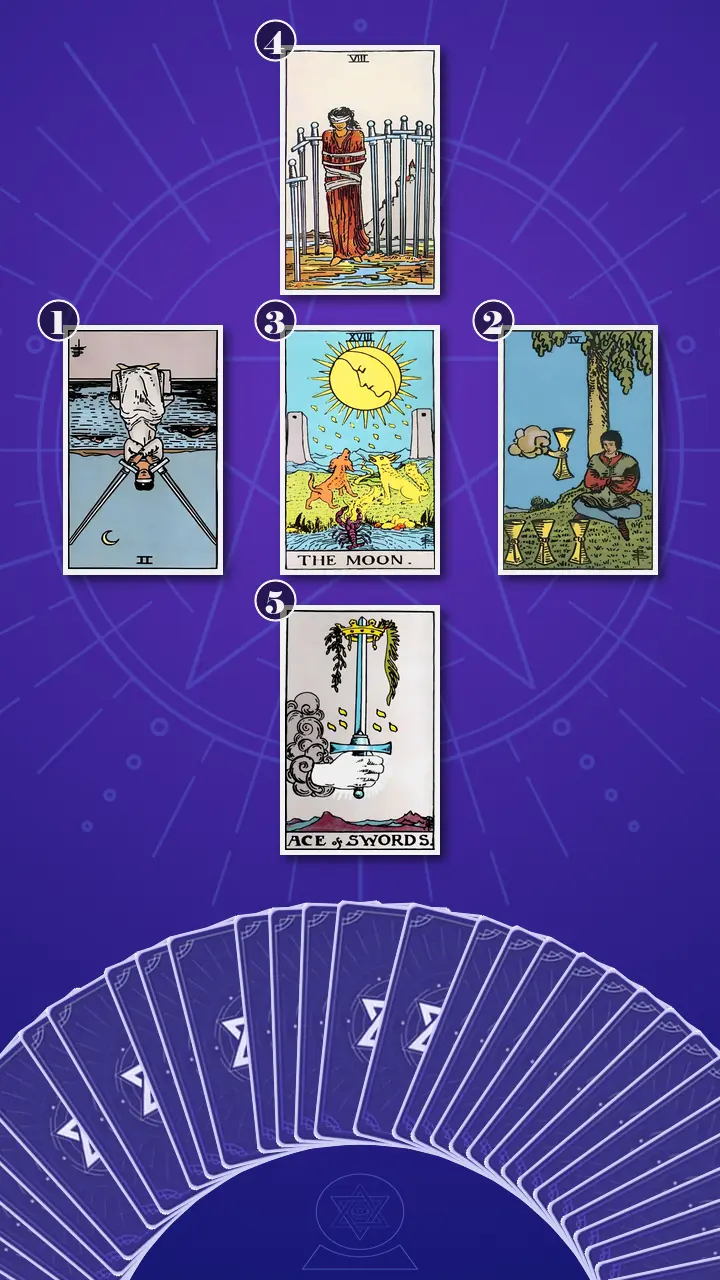
Reading the Weather Between Two People
The Crossed Swords of a Normal Reply
Now turning is the card for position one: the querent's current stance and contribution to the pattern, specifically how acting fine protects them from naming what they want to know.
Two of Swords, in reversed position. I saw the blindfold first, then the two swords crossed defensively over the figure's chest. In reversal, the air element is not absent; it is blocked and overworked. Jordan has perception. They notice the pause, the wording change, the unfinished feeling. What has become impossible is keeping all that information sealed behind a casual response.
The modern scene was exact. At 11:36 p.m., Jordan's Notes app held a candid paragraph beginning, 'I have been acting fine, but I actually feel...' Their chat lit up with a routine dinner question. They closed the draft, answered casually, and felt the immediate relief of restoring the normal tone. The relief did not last. It became the familiar pressure of knowing the real issue was still waiting.
'This is an internalized stalemate,' I said. 'You are holding opposing fears in place so tightly that the honest sentence cannot move. The reversed Two of Swords does not call you indifferent or dishonest. It shows avoidance becoming an active attempt to control relational risk.'
I returned to the image of Jordan switching from the unsent Notes paragraph to the casual message on the TTC. Their private rule sounded like this: 'I know what I want to say, but first I need to know exactly how they will take it.' That rule protected belonging in the short term, while resentment and uncertainty accumulated underneath. The performance of peace could keep the question alive precisely because it made the interaction look settled.
Jordan did not nod. Their thumb stopped moving, their breath paused, and their fingers hovered above the phone. Then their gaze shifted away from the card, as if replaying the kitchen scene and the message they had actually sent. Finally, a long breath left their chest, followed by a small, bitter laugh.
'That is too accurate,' they said. 'It is also a little brutal.'
'I hear that,' I replied. 'I am not asking you to abandon your protective instinct. I am helping you see its cost clearly enough to choose its next size. You do not have to send every unresolved grievance in one intense message. This week, one sentence is enough to prove that the stalemate is no longer invisible.'
The Cup That Did Not Arrive Perfectly
Now turning is the card for position two: the observable relational signal or missed opening that the interaction reflects back, without claiming access to the other person's private thoughts.
Four of Cups, in upright position. The seated figure beneath the tree leans away from three cups already on the ground while a fourth cup is offered from a cloud. The water energy here is withdrawn rather than flowing. The issue is not that no contact exists; it is that an imperfect opening can be overlooked when attention is fixed on the complete reassurance that has not arrived.
I brought Jordan to a specific moment: at 10:14 a.m. on Sunday in a busy Queen West cafe, milk steamed behind the counter and a spoon tapped against ceramic. The other person had asked, 'Are we okay?' Jordan's shoulders rose. Their mouth went dry. They answered, 'Yeah, just tired,' and changed the subject to weekend plans.
'The Four of Cups does not tell me what that person secretly meant,' I said. 'It shows what was observably offered: a broad question and a possible opening. It also shows your attention measuring everything the question did not guarantee. You wanted the reassurance to arrive in exactly the form that would make honesty feel safe, and because it did not, you treated the opening as unusable.'
Jordan became very still and looked down at the card. 'They did ask me,' they said.
'Yes,' I said. 'Noticing that does not make you responsible for using every opening immediately. It simply gives you better information about the pattern. An honest partial answer can preserve the opening without forcing the entire conversation: I am not fully okay about earlier, and I need a little time to put it into words.'
Jordan rubbed the rim of their water glass once, then let their hand rest on the table. The movement was small, but the defensive distance in their posture softened. The available cup did not become a promise. It became something more useful: a real moment of contact that did not need to arrive perfectly to count.
The Moon in the iMessage Thread
Now turning is the card for position three: the shared dynamic between the two people, focusing on how uncertainty and indirect communication maintain the appearance that everything is fine.
The Moon, in upright position. The Moon does not confirm a hidden betrayal, a secret intention, or a guaranteed ending. It describes incomplete visibility. Its path between two towers, the dog and wolf at the water's edge, and the crayfish rising from the pool create a landscape where memory, instinct, fear, and observation can mingle before anyone asks for direct information.
I described the modern translation: Jordan waits for the 504 streetcar while traffic hisses over wet pavement. A short reply appears with a period instead of the usual emoji. There is a ten-minute delay. By the next stop, they have created several possible explanations for the change in tone, but the simple question remains unsent. The relationship thread has become a dim path navigated through punctuation, read receipts, and pauses.
'I do not know what this means, so my mind is generating every meaning at once,' Jordan said, repeating the thought I had written in the margin.
'Exactly. The Moon is a shared emotional weather system, not a confirmed fact. A period is a period. A pause is a pause. The meaning may matter, but it has not yet been gathered. Clarity begins where fact and fear stop sharing one sentence.'
I placed two small slips of paper beside the Moon. On one I wrote What happened. On the other I wrote What I am predicting. I asked Jordan to separate the observable detail from the feared interpretation and then turn one prediction into a checkable question. The path between the towers was no longer a demand to decode every shadow. It was a route toward asking.
Jordan's chest tightened before their shoulders dropped by a fraction. They looked toward the rain-dark window, then back at the cards. 'So I can notice that the message felt different without deciding that it proves they are leaving.'
'Yes,' I said. 'You can respect the signal without making it carry more information than it actually has. A direct question can tell you more than another hour spent interpreting the typing bubble.'
The Swords Around the Send Button
Now turning is the card for position four: the central blockage, specifically the core fear and self-imposed mental restriction that make honesty feel more dangerous than continued uncertainty.
Eight of Swords, in upright position. The blindfolded figure is bound inside a ring of swords, yet the distant castle remains visible beyond them. The energy is blocked air: thought has tightened into a rule about what movement is allowed. For Jordan, the rule was that honesty could begin only after perfect timing, perfect evidence, and perfect wording had guaranteed that belonging would remain intact.
The image became a phone screen surrounded by imagined replies: too needy, too dramatic, bad timing, too vague, likely to make them leave. Jordan had six versions of the same message. One sounded cold, one too emotional, one too long, and one too soft to say anything real. Every draft seemed capable of causing damage, so silence began to look like the only responsible option.
'I can handle uncertainty better than I can handle being rejected for asking about it,' Jordan said quietly.
'That is the exact restriction this card makes visible,' I said. 'You are treating uncertainty about the response as proof that the conversation cannot be started. The situation may genuinely be difficult. At the same time, the belief that you have no acceptable move adds another layer of confinement.'
Jordan's jaw tightened. Their hand closed around the phone, then loosened. First came the bodily freeze: a held breath and a thumb suspended above the send button. Then came the cognitive replay: their eyes went unfocused while the imagined consequences moved through every version of the draft. Finally, a rough exhale left them, not because the fear had vanished, but because the rule had become visible.
'You do not need perfect wording to ask an answerable question,' I told them. 'The goal is not perfect safety. The goal is usable honesty, a bounded request, and enough room for the actual response to become information.'
When the Ace of Swords Made Room for an Answer
The room seemed to quiet as I moved to the card below the Moon. Even the radiator's clicking receded behind the clean pause that arrives when a conversation stops circling its own fear.
Now turning is the card for position five: a self-directed next interaction, one honest and concrete action Jordan can try without predicting or deciding the relationship's outcome.
Ace of Swords, in upright position. The hand emerging from the cloud holds one vertical sword, crowned at the tip and framed by distant mountains beneath a clear sky. The air element is restored to balance. The sword is not aggression. It is discernment: a line separating what happened, what Jordan fears, and what Jordan wants to ask.
The modern scene was the simplest card translation. Jordan replaces the six-paragraph draft with one precise message: 'I have been acting normal, but I still feel unsettled about how our conversation ended. Could we talk about what happened?' The sentence names an experience, makes no claim about the other person's motives, and creates a question that can receive an actual answer.
At this point I used my signature Decision Timing Calibration. I asked whether the urge to make a high-stakes choice was coming from stable relational information or temporary situational friction: the late hour, the tight jaw, the activated phone, the pressure to settle the entire future before sleeping. The repeated unresolved question was a stable variable worth addressing. The demand to decide the whole relationship immediately was temporary friction. Calibration changed the size of the next move. Jordan did not need a final judgment. Jordan needed one accurate sentence and one direct question.
At 11:36 p.m., your Notes app holds the honest paragraph while your chat shows a dinner question and a meme. Your throat is tight, but the relationship looks calm from the outside, which is exactly why the silence can pass as peace. Jordan had been trying to make the outcome safe before speaking.
You do not need to keep the surface calm by staying silent; name one clear truth and let the raised sword separate what you know from what you fear.
Jordan's first response was not relief. Their brows drew together and their fingers tightened around the edge of the phone. 'But does that mean I was wrong for making this so complicated?' The question carried a brief flash of anger, followed by the familiar urge to retreat. First, their breath stopped and their thumb froze above the screen. Then their gaze lost focus as they replayed the kitchen, the cafe, the period at the end of the text, and the six unsent drafts. The feared meanings did not disappear, but they no longer filled the entire frame. Finally, their hand opened, their shoulders lowered, and a shaky breath moved through their chest. The release held a trace of dizziness, the vulnerability of seeing a clear path and realizing that the next choice belonged to them. I watched their eyes grow bright without asking them to turn the moment into certainty.
'Now, use this new angle to look back at last week,' I asked. 'Was there a moment when this insight could have made you feel different?'
Jordan thought about the cafe question and the message with the period. 'I could have said I was not fully okay,' they answered. 'That would not have solved everything. But it would have stopped me from pretending I had no information at all.'
That was the bridge. The Ace of Swords moved Jordan one step from relational dread and self-silencing toward bounded honesty, response-based clarity, and grounded self-trust. The card did not promise a kind response or decide whether the relationship could hold the truth. It returned the next honest move to the person who had to live with it.
From Performing Peace to Finding Clarity
When I laid the five cards together, the story became coherent. The reversed Two of Swords showed Jordan using ordinary contact to control the risk of an honest conversation. The Four of Cups showed an imperfect opening that could be missed when complete reassurance was required first. The Moon placed both people inside uncertainty, where punctuation and pauses could carry more weight than direct words. The Eight of Swords revealed the rule beneath it all: no honest sentence was allowed until it could guarantee belonging. The Ace of Swords offered a different structure, one that converted honesty into information rather than a verdict.
Jordan was not lacking care. They were carrying the diplomacy reflex from their early-career project coordination work into their private life, keeping the status light green because changing it to amber seemed likely to trigger a difficult meeting. But a relationship is not made clear by keeping every indicator green. The unresolved item continues running in the background, and the longer it stays archived, the more dangerous it feels to open.
The cognitive blind spot was treating the absence of a guaranteed safe response as proof that there was no acceptable way to speak. The transformation direction was narrower and more practical: replace automatic reassurance with one specific, non-accusatory truth followed by one direct, answerable question. Then allow the actual response, including its words, actions, and follow-through, to become information.
'One truth. One question. Then notice the response,' I said. 'You are not required to decide the entire relationship before you have gathered the next piece of real information.'
I gave Jordan three small practices. Each one was designed to be started in ordinary life, with no dramatic confrontation and no requirement to send anything before they were ready.
- The seven-minute one-truth draftOn one evening this week, open Notes and set a seven-minute timer. Write three lines: what I observed, what I felt, and what I want to ask. Use one concrete incident, then shape it into: 'I have been acting fine, but I actually feel ___ about ___. Could we talk about ___?'Read it aloud once and remove any claim about the other person's motives. The smallest version is only the first line, and you do not have to send the note that day.
- The Fact-Fear SplitAfter one ambiguous text or tense exchange, make two phone-note headings: what happened and what I am predicting. Add no more than three bullets under each, then turn one prediction into a checkable question such as, 'You have seemed quieter since Tuesday; have you noticed that too?'Take three ordinary breaths and name the body cue you notice, whether it is a tight throat, clenched jaw, raised shoulders, or pressure in the chest. This exercise does not dismiss intuition; it shows which part needs direct information.
- The Orbital Pause StrategyIf a late-night surge makes you want to send a long message or decide the relationship immediately, use my calculated 72-hour pause. Save the one-truth draft, choose a calendar time to review it, and then decide whether to invite a fifteen-minute conversation tonight, tomorrow, or later. The pause is for timing, not indefinite avoidance.If the message is already clear and the situation is safe, you may act sooner. If contact carries a risk of retaliation, coercion, emotional harm, or physical harm, choose distance and outside support instead of direct confrontation.
The version Jordan rehearsed with me was intentionally bounded: 'I have been acting normal, but I still feel unsettled about how our conversation ended. Could we talk about what happened? Is there a time tonight or tomorrow when we could talk for fifteen minutes?'
I asked Jordan to record the response without deciding what it meant too quickly. Was there listening, defensiveness, curiosity, avoidance, repair, or follow-through? The response would not define Jordan's worth. It would help Jordan decide what could be addressed next and what boundary might be needed.
'You remain allowed to pause,' I added. 'Honesty is not a moral performance, and directness is not automatically safer than silence in every situation. Your agency includes choosing when to speak, whether to speak, and who can support you while you work out what is true.'

A Different Orbit Begins with One Message
Four days later, I received a message from Jordan: 'I used the seven-minute draft. I sent one sentence and one question. They said we could talk tomorrow at seven. I still feel sick, but at least I am not solving it alone in Notes.'
That night, Jordan sat alone in a Queen West cafe with a cooling coffee. The next morning they slept a full night, then woke with one old thought: 'What if I am wrong?' Their throat tightened, but this time they smiled and got on with the day.
That was the first small proof of a different orbit. The relationship had not been magically repaired, and Jordan had not received a guaranteed future. They had done something more honest and more useful: they had stopped treating uncertainty as a command to stay silent and allowed a real response to enter the picture.
I have spent a decade guiding people through their personal cycles, and I still believe a low tide is not a personal failure. But the cards did not rescue Jordan from the crossroads. They gave Jordan a way to see the crossroads clearly enough to choose. The shift was from self-silencing to honest contact, from decoding clues to gathering real information, and from outcome control to grounded self-trust.
Many of us know the moment when the throat tightens, the casual reply gets sent, and protecting the feeling of belonging means carrying the unresolved truth alone. Sometimes clarity is not the final answer about a relationship. Sometimes it is the first clean line through the fog, drawn by the person who has been waiting for permission to speak.
If one precise sentence did not have to decide the whole relationship, what small truth might you feel curious enough to name?