The 11:43 p.m. Bullet Point That Felt Like a Verdict
It’s after dinner in Toronto and you tell yourself you’ll update “one bullet”—then it’s past midnight, you’ve made 47 micro-edits, and you still haven’t submitted a single application.
Taylor said it like a confession and a defense at the same time, settling into the chair across from me. She was 29, sharp, competent, the kind of person who keeps a tidy calendar and a slightly untidy heart when it comes to career stuff.
She described a scene I’ve heard in different cities and different accents, but always with the same blue-light sting: 11:43 PM, condo kitchen counter, under-cabinet light buzzing like a tiny fluorescent judge. Laptop open to her resume. Phone warm in her hand. A job post in one tab, LinkedIn profiles with her target title in another, and her PDF export sitting there like an exhibit she couldn’t stop reopening.
“I’m not procrastinating,” she said, jaw set like she was bracing for impact. “I’m improving it. I just need the right wording and then I’ll apply.”
Her shoulders were creeping upward as she spoke, like her body was trying to protect her neck from something invisible. The feeling she carried wasn’t just nerves—it was like trying to swim through gray syrup while someone kept changing the rules of the pool. Every time she read a requirement, her stomach dropped; every time she changed a verb, she got a two-second hit of relief… then the doubt rushed back in.
“You want to move forward in your career with confidence,” I said, keeping my voice steady and human, “but you’re editing like one more rejection would be a final verdict on you.”
She looked down, then back up, irritated at herself in that familiar way—like she was both the student and the harshest teacher.
“Let’s do what we came here to do,” I added. “Not more pressure. Not a motivational speech. Just a map. Today is a Journey to Clarity: we’ll figure out what old rejection is still steering your resume, and what your next step looks like when your resume becomes a tool again—not a courtroom.”

Choosing the Compass: The Transformation Path Grid (6)
I asked Taylor to take one slow breath—nothing mystical, just a clean transition out of “midnight spiral mode.” While she held her question in mind, I shuffled the deck the way I used to reset my own nervous system before the opening bell on a trading floor: one deliberate action to signal, we’re switching from noise to signal.
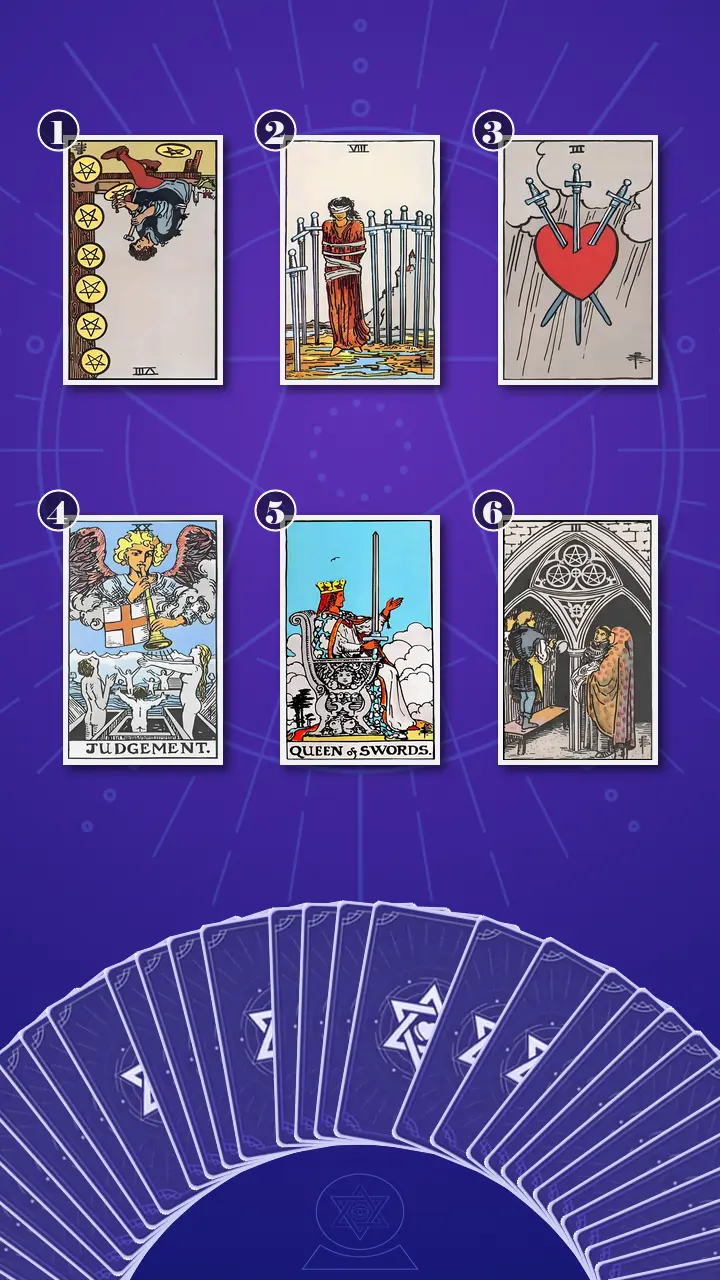
“For this,” I said, “I’m using a spread called the Transformation Path Grid (6) · Context Edition.”
And for you reading this: a resume problem looks practical, but Taylor’s question—what old rejection still steers my career moves?—demands a tool that connects behavior to the emotional root, then converts insight into a bounded plan. A quick three-card pull can give advice, but it often misses either the wound that created the loop or the practical constraint that breaks it. This six-card grid is built like a before/after storyboard: it shows the stuck pattern, the mental bind, the original hurt, then the reframe and the next steps.
Here’s the structure I promised Taylor before we flipped anything:
“The first card will show your present resume behavior—the visible loop. The second will name the main internal block that keeps it running. The third goes underneath it all: the old rejection that still drives the strategy. Then we’ll drop to the turning point—your catalyst—and finish with a one-week approach and the integration that keeps momentum going.”
Reading the Map: The Loop, the Bind, and the Old Email You Don’t Open
Position 1 — Present resume behavior: the most visible stuck loop
“Now flipped,” I told her, “is the card representing present resume behavior: the most visible stuck loop in how you’re editing and preparing.”
Eight of Pentacles, reversed.
The image is a craftsperson bent over a bench, hammering one coin at a time—diligence turned into something hunched and compulsive when reversed.
And in modern life, it’s painfully specific: It’s 10:58 PM and you’re hunched over your laptop like your resume is a craft project you can perfect into safety. You export the PDF, reopen it immediately, change one verb, re-check spacing, and convince yourself you’re being ‘disciplined.’ The work looks like progress, but it’s really a way to delay the vulnerable step: letting someone else react.
Taylor gave a tight laugh—quick, bitter, and accurate. “Okay. That’s… rude,” she said, and then, softer: “Also my life. My file is literally resume_final_FINAL_v3.pdf.”
I nodded. “This card isn’t calling you lazy. It’s calling the loop what it is: misdirected effort. Earth energy—work, output, craft—is here, but reversed it’s not feeding momentum. It’s feeding control.”
“You’re treating the resume like a verdict on self-worth,” I continued, “instead of a communication tool. And the more you micro-optimize, the more your body tightens—jaw, shoulders, stomach—because the real moment you’re avoiding isn’t the bullet. It’s the click that invites a yes or no.”
Position 2 — The main internal block: the belief that keeps the loop running
“Now flipped is the card representing the main internal block: the belief or mental constraint that keeps the loop running.”
Eight of Swords, upright.
The blindfold always gets me. Not because it’s dramatic, but because it’s familiar: the feeling of being surrounded by consequences, even when the rope is loose enough to step out of.
In Taylor’s life it translates cleanly: You’re staring at your resume with the feeling that there’s one correct version and if you don’t find it, you’ll be dismissed. So you keep adding context, extra bullets, extra buzzwords—trying to close every possible loophole. The result is you can’t choose a clean narrative, and the longer you stare, the more frozen you feel.
“This is the rule-card,” I said. “The unspoken laws you’re obeying. Like: ‘I must cover every gap.’ ‘I must sound impressive.’ ‘I must be impossible to reject.’”
Taylor’s fingers went to the edge of her water bottle and spun the cap once, not opening it, just spinning—restless hands needing something to do. Her eyes stayed on the card.
“If you’re writing to pre-empt criticism,” I added, “you’ll end up sounding like you’re hiding. Not because you are hiding—but because fear makes you write like a defendant.”
The energy here is blockage: not a lack of skill, but a belief that there’s only one acceptable option. When your mind is trapped in “one safe version,” editing becomes an attempt to find the magic combination that prevents pain. But pain isn’t prevented by formatting. It’s prevented by fit.
Position 3 — The old rejection still driving the strategy
“Now flipped is the card representing the old rejection still driving the strategy: what wound or message got internalized.”
Three of Swords, upright.
The classic pierced heart under gray rain. No euphemisms. No “positive spin.” Just the truth that something once cut, and you learned a survival tactic from it.
I watched Taylor’s throat move as she swallowed. Her posture didn’t collapse, exactly—she just went still, like someone turned the volume down in the room.
I described what the card was pointing toward, carefully, like you name a bruise without pressing it: A memory flashes—an interview that went ‘great’ and then silence, or an email that felt colder than it needed to. You don’t just remember disappointment; you remember the meaning you attached to it. Now, every resume line becomes defensive: you write like you’re trying to prove you deserve to try, not like you’re showing what you can do.
Her gaze flickered away from the table for a second, as if her brain had pulled up a screenshot. “It was a ‘final round,’” she said. “They said they went with someone who had ‘a clearer narrative.’”
There it was—the sentence that keeps echoing in modern corporate life. Not you’re bad, but your story isn’t clean enough. In a world of six-second scans and LinkedIn milestones, that kind of rejection can stick like a label.
“That wasn’t a verdict on your worth,” I said. “It was data about alignment and storytelling under pressure. But your nervous system filed it as: ‘Not chosen means not enough.’ That’s why your resume edits feel like they’re happening in a courtroom.”
She exhaled, slow and heavy. The rain on the card felt like the weather in her chest. And I didn’t rush to sunshine it away.
When Judgement’s Trumpet Cut Through the Tabs
Position 4 — The turning point insight: what reframes the past and unlocks change
When I reached for the fourth card, the air in my office shifted in that quiet way it does before something important lands. Outside the window, a streetcar bell rang—clean, bright, almost like punctuation.
“Now flipped,” I said, “is the card representing the turning point insight: what reframes the past and changes how you approach the resume now.”
Judgement, upright.
Judgement is often misunderstood as condemnation. In practice, it’s the opposite: it’s a call to honest review without self-cruelty. The trumpet isn’t a scolding—it’s a signal. One clear note that cuts through the feed, the templates, the comparison spiral.
Setup (the moment you know too well): Taylor was right back at that 11:46 PM feeling—resume PDF open again, rewriting the same bullet like it’s a courtroom statement. Her mind was stuck on one question: How do I make them not reject me? As long as that’s the question, every edit becomes an appeal to the past.
Stop writing as if you’re appealing an old verdict; answer the call, and let Judgement’s trumpet organize your story into one clear direction.
I let the sentence sit. No extra explaining. Just space.
Taylor’s reaction came in a chain—three small movements that told the truth more than words could.
First: a physical freeze. Her breath paused halfway in, and her fingers stopped fidgeting with the bottle cap like someone had hit “hold.”
Second: the mind catching up. Her eyes unfocused for a second, not glazed—more like she was replaying the rejection, then rewinding to all the nights she tried to edit her way out of it. I could almost hear the internal bargaining: But if I stop perfecting, I’m exposed.
Third: the release. She exhaled, and her shoulders lowered by a full inch. Not magically relaxed—more like she’d been carrying a backpack she forgot was heavy. Her eyes went wet, not dramatic, just honest.
“But if I do that,” she said, voice thin with the edge of fear, “doesn’t it mean I was… wrong before? Like I wasted all that time?”
“It means you were surviving,” I answered. “You built a strategy to avoid re-feeling a specific pain. That’s not stupidity—that’s protective intelligence. Judgement isn’t asking you to shame your past self. It’s asking you to re-evaluate and choose the present.”
This is where my old life on Wall Street always flashes through: contracts, term sheets, the difference between a story and a structure. A resume is closer to a prospectus than a diary—it’s not here to contain your whole identity. It’s here to make a clear, testable claim.
“Here’s a frame I use,” I told her, pulling in my Human Capital Valuation lens—the way I price skills the way markets price assets. “Your resume isn’t a plea. It’s a pricing model. It answers: What can you reliably deliver, and what’s the proof? When you write like you’re appealing an old verdict, you inflate the disclaimers and bury the value. Judgement says: strip the disclaimers, state the value in present tense, and let the right market respond.”
I slid her a pen. “Now, with this new perspective, can you think of a moment last week—maybe when LinkedIn made your stomach drop, or when you hovered over ‘Submit’—where this could have changed how you felt?”
She nodded once, slow. “Yesterday. I saw someone I went to school with announce a promotion. I immediately thought, ‘I’m behind,’ and opened my resume to make it sound more senior.”
“That’s the old verdict trying to steer,” I said. “And this card is the pivot: from rejection-driven perfectionism and defensive self-presentation to present-tense clarity and values-based self-trust. Not certainty. Not perfection. Just authorship.”
Position 5 — One-week edit-and-apply strategy: the clean editing blade
“Now flipped is the card representing your one-week edit-and-apply strategy: the most helpful practical mindset and boundary for your next revision cycle.”
Queen of Swords, upright.
This is the editor-queen. Sword raised: discernment. Hand open: fairness. The energy is balance—clean cuts without self-punishment.
In Taylor’s real life, it looks like this: You edit like an editor. One-page rule. One target role. You cut ‘defensive’ lines that exist only to explain you, and you park them in a Cut List doc so you don’t feel erased. The resume gets clearer, and your brain gets quieter—because you’re making choices instead of trying to be un-judgeable.
She sat a little straighter, like her spine recognized the idea of boundaries. “That sounds… calmer,” she admitted. “Like something I could do without hating myself.”
“Exactly,” I said. “Clarity beats coverage. The Queen isn’t trying to win every argument. She’s trying to be understood by the right person in ten seconds.”
Position 6 — Integration: momentum after ‘good enough’ through real humans
“Now flipped is the card representing integration: how to keep momentum after the resume is ‘good enough,’ including support and feedback loops.”
Three of Pentacles, upright.
A worksite. A shared plan. Skill becoming visible through standards and collaboration.
Translated: Instead of perfecting in private, you put the resume into a real feedback loop: one trusted peer, one mentor, one informational chat. Your confidence starts coming from evidence—‘people understood me quickly’—not from the temporary relief of a sharper adjective at midnight.
The energy is healthy Earth: measurable progress, witnessed competence, reps that build trust. Momentum is built by submissions, not by micro-tweaks.
The One-Week “Verdict-to-Tool” Rewrite Plan (Actionable Next Steps)
I leaned back and gave Taylor the whole story the cards were telling—cleanly, like a debrief after a long week.
“Here’s the pattern,” I said. “In the present (Eight of Pentacles reversed), you’re working hard but the work has turned into compulsive busywork—because it protects you from exposure. Underneath that (Eight of Swords), there’s a mental law: there is one safe version and you must find it. Underneath that law is the real driver (Three of Swords): a rejection that got filed as identity—‘not you’—instead of filed as data—‘not this fit, not this story, not this timing.’”
“Then Judgement interrupts the loop. It’s the trumpet that shuts down the comparison-notifications in your head and asks: What are you answering to now? Once you choose a direction, the Queen of Swords gives you the editing style—reader-first, bounded, decisive. And Three of Pentacles puts it back into the world: real feedback, real reps, real people.”
The cognitive blind spot I wanted her to see was simple but brutal: she’d been using editing to chase emotional safety—as if enough polish could prevent pain. But safety in a job search doesn’t come from a rejection-proof document. It comes from a repeatable process, clear fit-testing, and a story you can stand behind even if someone says no.
“Your transformation direction,” I said, “is the shift from ‘I must prevent rejection’ to ‘I will communicate value clearly and let the right fit respond.’ That’s how you get traction at a career crossroads without burning out.”
- The 15-Minute Judgement Reset (Present-Tense Pitch)Once this week, set a 10–15 minute timer. Open a blank note titled “My Present-Tense Pitch.” Write exactly 3 sentences: (1) the role/title you’re targeting, (2) the kind of problems you solve, (3) one proof you’re proud of. No formatting, no bullets, no ATS hacks.If your chest tightens and you start bargaining (“just one more tweak”), label it “verdict mode,” and stop anyway. You’re practicing authorship, not forcing productivity.
- The 45-Minute Queen of Swords Clarity Pass + Cut ListDo one single 45-minute edit session with a timer. Keep only bullets a stranger could understand in 10 seconds (action + scope + result). Anything you remove goes into a separate “Cut List” doc (a parking lot), so your brain doesn’t feel like you’re deleting your worth.Make one hard rule: no font/spacing tweaks after exporting. Midnight anxiety doesn’t get a vote. Save, export, close the laptop.
- One Real Human Loop (10-Second Scan Question)Send the exported PDF to one trusted person (kind, practical, safe) and ask one question only: “After 10 seconds, what do you think I do / what role am I going for?” Then apply to one role using the good-enough version—same week.If you dread the send, do it anyway and mute notifications for 30 minutes. You’re building evidence that you can survive being seen.
I also gave her a small, very corporate-friendly constraint—because I know how quickly “clarity” can get hijacked by overthinking: “Pick one title for seven days. Not forever. Just one week. That’s your trumpet signal. It stops the LinkedIn algorithm from rewriting your identity every time you scroll.”
It’s basically a mini version of my Transition Roadmapping approach—career changes as an IPO prep cycle: you don’t rewrite the entire company every night; you choose a positioning statement, tighten the prospectus, and then you take it to market. A job search is a market process. You need reps, not rumination.

A Week Later: Quiet Proof, Not Perfect Certainty
Eight days later, Taylor sent me a message. No long paragraph. Just a screenshot: a PDF titled Taylor_Resume_ProductOps.pdf—no “final_FINAL”—and beneath it, a sent email thread with one simple line: “Could you do a 10-second scan and tell me what role you think I’m targeting?”
She added: “I applied to one role. I didn’t reopen the PDF after exporting. I felt like I was going to crawl out of my skin for five minutes… and then it passed.”
That’s what clarity looks like in real life. Not fireworks. A quiet boundary held at midnight. A submission made with a slightly shaky hand. A nervous system learning, by repetition, that a “no” is information—not a definition.
When you’re rewriting the same bullet at midnight, it’s rarely about the bullet—it’s the fear that one more “no” would confirm a story about you that you’re exhausted from carrying.
If you stopped treating your resume like an appeal of an old verdict for just one week, what would you choose to say—clearly, simply, and in the present tense?
This story is adapted from psychological research, written so that those in a similar struggle can see their own pattern in it — and find their next step clearly.These insights are not a substitute for professional psychological, medical, legal, or financial advice.
Learn more about our Journey to Clarity.
How did this insight land for you?
🫂 This Resonates Deeply
🌀 Living This Story
✨ Now I See Clearly
🌱 Seeing New Possibilities
🧰 Useful Framework
🔮 The Confirmation I Needed
💪 Feeling Empowered
🚀 Ready for My Next Step
Author Profile
 AI
AI“I spent years in the intense, high-stakes world of Wall Street. I know exactly how isolating and heavy the weight of uncertainty can feel in the dead of night. I use strategic, commercial logic not to be cold, but to protect you from unnecessary friction. Think of me as a fellow traveler who has walked the same rocky path—offering sharp but deeply supportive wisdom to help you clear the fog and confidently win your narrative back.”
In this Career Tarot Reading :
Core Expertise
- Power Dynamic Deconstruction: Decrypting hidden agendas and leverage points in upward management and cross-departmental negotiations.
- Transferable Asset Pricing: Objectively auditing and pricing your core skills for cross-industry pivots, stripping away corporate gaslighting.
Service Features
- The Leverage Mapping Protocol: A tactical breakdown to identify your true bargaining chips before your next performance review or salary negotiation.
Also specializes in :
Explore Related Patterns:
Productive ProcrastinationTaylor's late-night resume session starts as a practical task and turns into 47 micro-edits with zero applications sent. The behavior looks productive because she is technically working, but the function is defensive: each tiny edit buys a few seconds of relief while delaying the exposed moment where another person can respond. That is the core mechanism of Productive Procrastination. You are not avoiding the task by doing nothing; you are avoiding the emotionally risky part by doing safer adjacent work. The resume becomes a controlled surface where verbs, spacing, and file names can be managed, while the actual uncertainty of being evaluated stays outside the room. The old rejection still steers the process because it taught the nervous system to treat submission as a verdict rather than a step in a market test. Once that link is visible, the pattern becomes workable: the goal is not to shame the editing, but to stop letting busywork impersonate movement.
Rejection SensitivityTaylor's final-round rejection left behind a specific sentence: they chose someone with a clearer narrative. The painful part was not only losing the role; it was the meaning her system attached to it, turning a hiring decision into a private rule that says a messy story makes her easy to dismiss. That is why ordinary resume cues start behaving like threat signals. A job requirement, a LinkedIn profile, or a single bullet point gets filtered through the expectation of rejection, and the mind tries to prevent pain by scanning for every possible weakness before anyone else can find it. Rejection Sensitivity fits here because the old no is still shaping the present edit. You are not simply afraid of feedback; you are bracing for feedback to confirm an identity-level fear. Naming the pattern helps separate the actual application process from the old verdict your body keeps preparing to hear.
Defensive OverexplainingTaylor keeps adding context, extra bullets, and buzzwords because the resume is no longer just a summary of her value. It has become a defensive document, built to answer imagined objections before a recruiter has even read the first line. Defensive Overexplaining shows up when clarity gets replaced by pre-emptive self-protection. The old rejection taught her that an unclear narrative could cost her a chance, so the mind overcorrects by trying to close every loophole. The result is a resume that may contain more information, but carries the emotional posture of someone arguing for permission to be considered. You can see the pattern in the courtroom language running through the story: verdict, defendant, appeal, proof. The psychological shift is to stop using explanation as armor and return the resume to its real job: making a clear, testable claim about what she can deliver.
Explore Related Struggles:
Approval-Safety FusionEvery tiny resume edit gives Taylor a brief hit of relief, then the doubt returns and asks for one more adjustment. Extra bullets, added context, and sharper buzzwords become attempts to seal every possible opening where criticism might enter. You can see safety getting attached to approval before any application is even submitted. The resume is being asked to do something no document can do: guarantee that being evaluated will not hurt. Approval-Safety Fusion is the bind where a yes starts to feel like protection and a no starts to feel like danger. You end up writing for invulnerability instead of fit, because approval has been loaded with the job of making you feel safe.
Identity Verdict LockTaylor keeps returning to the resume at night as if every bullet carries more weight than a bullet should. The old final-round rejection did not stay in the past as one hiring outcome; it became a frame that makes each new application feel like a fresh hearing on whether she is enough. You can see the lock in the way career movement and self-definition get fused. A cleaner narrative is no longer just a recruiter preference or positioning issue. It becomes the condition for feeling legitimate enough to be considered. That is why the resume stops acting like a tool and starts acting like a verdict. You are not only choosing words for a job search; you are trying to keep an old sentence from becoming the final story about you.
Wound-Compass FusionThe sentence about needing a clearer narrative keeps steering Taylor long after the interview ended. It shows up when she sees a peer promotion, when she tries to sound more senior, and when she rewrites the same resume line to avoid touching the old sting directly. You can feel the compass distortion in how the next move is chosen. Instead of asking what role fits her current value, the resume process keeps asking how to prevent the old rejection from happening again. Wound-Compass Fusion names that hidden navigation problem. The past pain is no longer only remembered; it becomes the directional system that tells you where to aim, what to exaggerate, and what kind of visibility feels too risky.
Clarity-Exposure SplitTaylor is not avoiding the resume; she is staying inside it. The file gets cleaner, the verbs get sharper, and the PDF keeps reopening, but the point where clarity has to meet another person's response keeps getting postponed. You can see the split because the thing that would make the resume useful also makes it exposed. A clear story can be understood quickly, but being understood quickly means someone can also say yes, no, or not this fit. Clarity-Exposure Split captures that friction. You are pulled toward a cleaner professional story, then pulled back into private control the moment that story becomes visible enough to be evaluated.
Protection-Progress SplitTaylor's late-night editing has motion, discipline, and visible effort, but it keeps stopping before the application leaves her laptop. The resume becomes a protected room where she can keep working without crossing into the uncertainty of a real response. You can feel the split in the way effort serves two opposing jobs. One part of the work wants traction, but another part uses the same work to delay the moment where someone else gets to react. Protection-Progress Split names the lock inside that contradiction. You are not standing still because you lack drive; you are using drive to build a shield at the exact point where progress would require exposure.
Inner Tribunal LockTaylor reads her own resume with the posture of someone bracing for impact. The file becomes a courtroom, each bullet becomes evidence, and the imagined criticism arrives before any hiring manager has seen the document. You can hear the tribunal in the way she writes to defend herself. Instead of making a clear claim about what she can deliver, she tries to answer every possible objection in advance. Inner Tribunal Lock names that internalized hearing. You are not only editing a professional summary; you are trying to win a case inside your own head before you allow the outside world to respond.
Perfect Readiness TrapTaylor keeps staring at the resume as if there is one correct version hiding somewhere inside the file. Each job requirement and each LinkedIn milestone tightens the standard, so readiness moves farther away the longer she tries to reach it. You can feel the trap in the timing. Action is postponed until the resume feels safe enough, but the search for safety keeps generating new reasons that it is not ready yet. Perfect Readiness Trap names the point where preparation stops serving movement and starts replacing it. You are trying to become ready enough to avoid pain, but the version of readiness being chased keeps expanding faster than your ability to act.
Explore Related Emotions:
Exposure DreadThe job post, LinkedIn profiles, and exported PDF are all open, but the application is not sent. You can stay near the opportunity for hours as long as the resume remains private, because the vulnerable moment is not the wording; it is letting another person react. Exposure Dread gathers around that submit click. The document becomes a threshold where being seen could become being dismissed, so your body keeps choosing one more edit, one more check, one more delay before the outside world gets a vote.
Verdict DreadAt 11:43 p.m., the PDF is open on the kitchen counter, reopened after every export, while one more verb change briefly lowers the pressure before it comes back. The file stops behaving like a document and starts acting like evidence, because the old 'clearer narrative' rejection taught your system to treat an employer's response as a ruling on the self. Verdict Dread names the inner weather that forms when a practical career move gets loaded with the possibility of final judgment. You are not simply editing for quality; you are trying to make the document impossible to reject, and that turns every bullet into a place where your worth has to defend itself.
Not-Enough PanicThe final-round rejection did not land as a clean piece of market feedback; the phrase 'clearer narrative' stuck like a label. Every new application now carries the old translation underneath it: not chosen becomes not enough, and the resume starts absorbing pressure that belongs to a single hiring decision. Not-Enough Panic is the sharp internal alarm that makes every requirement feel like proof you are already behind. You keep adding context and senior-sounding language because the deeper fear is not that one bullet is weak; it is that another no might confirm a story about you that you are tired of carrying.
Shame SpiralYou look down, then back up, irritated at yourself in the split role of student and harshest teacher. The resume loop does not just stay on the screen; it turns inward, making the continued need to edit feel like evidence that you should have solved this already. Shame Spiral names the way self-correction starts feeding on itself. You try to protect yourself from another rejection, then judge yourself for needing protection at all, which makes the next edit feel less like refinement and more like self-punishment disguised as professionalism.
Cautious Self-TrustEight days later, the file is named Taylor_Resume_ProductOps.pdf, with no final_FINAL attached, and the email asking for a 10-second scan has been sent. Your hand can still feel shaky, but the action happens anyway, which is the important difference. Cautious Self-Trust is the fragile steadiness of letting 'good enough' be real enough to test. You do not need total confidence before submitting; you need enough trust to let a no become information instead of a definition.
Clarity ReliefWhen the Judgement line lands, your fingers stop fidgeting, your breath catches, and then your shoulders lower by an inch. The shift is not dramatic certainty; it is the relief of seeing that the resume has been carrying the wrong job. Clarity Relief arrives when the document returns to being a tool instead of a courtroom. With one title, one present-tense pitch, and one clean scan question, your mind gets a shape it can work with, and the pressure stops spreading into every corner of your identity.
Optimization FatigueForty-seven micro-edits after dinner create the appearance of discipline, but the body never gets the deeper release of actually moving forward. Each verb change gives a tiny hit of control, then the doubt returns and asks for another adjustment. Optimization Fatigue is the drained state that comes from trying to polish your way into safety. The resume keeps improving at the surface while your inner bandwidth gets thinner, because the goal has quietly shifted from communicating value to preventing every possible criticism.
Explore Related Contexts:
Career Visibility ParalysisTaylor has the job post open, the target-title profiles open, and the resume file exported, yet the external action never happens. The visible work is real, but it keeps circling the private document instead of crossing into the public market where an employer can respond. That is why Career Visibility Paralysis fits the story so tightly. You are not dealing with a lack of competence or a missing productivity hack; you are watching a career move stall at the exact point where skill has to become visible to other people. The old final-round feedback about needing “a clearer narrative” turns visibility into a risk, so each bullet gets treated as a shield before the resume can function as a signal. The pressure point is structural: modern hiring compresses candidates into quick scans, profile comparisons, and simplified narratives. In that environment, the resume stops feeling like a tool for fit-testing and starts acting like a public identity test. The path back to agency is not more private polish; it is a bounded move into visibility where the document can be tested, understood, and adjusted from real evidence.
Evaluation Pressure LoopTaylor describes editing as improvement, but the scene keeps showing a harsher structure: the PDF is reopened like an exhibit, the job requirements feel like changing rules, and another rejection seems capable of becoming a final verdict. The resume is being prepared under the pressure of evaluation before any recruiter has touched it. Evaluation Pressure Loop fits because the external hiring environment has become a repeating assessment chamber. You are dealing with job descriptions, six-second scans, LinkedIn comparisons, and a remembered final-round critique that all converge on the same demand: be clear enough, impressive enough, and safe enough to avoid dismissal. The loop is not solved by adding more effort to the same channel. Taylor needs a way to distinguish useful standards from imagined surveillance, then turn the resume back into a communication tool. That distinction restores agency because it makes evaluation something to engage with strategically, not something to obey endlessly in private.
Performance Defense ModeTaylor keeps changing verbs, reopening the PDF, and adding context because the resume is being written for an imagined critic rather than a specific reader. The old phrase “a clearer narrative” has become an external standard she keeps trying to satisfy before anyone has even seen the new version. Performance Defense Mode captures the job-market stage she is standing on: every line has to prove, explain, and pre-empt. You can see the structure in the way she writes to close every possible loophole, as if a clean value claim would leave her exposed. The resume becomes less like a pitch and more like a defense brief. The outside pressure matters here. Hiring systems reward compressed clarity, visible confidence, and fast pattern recognition, while giving candidates limited feedback when they miss the mark. Under that pressure, Taylor’s agency gets redirected into defensive self-presentation. The useful shift is not to become untouchable; it is to stop letting an old evaluation design the whole communication strategy.
Safe Visibility TrialTaylor’s later message shows a different external setup: one exported PDF, one trusted person, one 10-second scan question, and one application sent without reopening the file. The resume is still being exposed to judgment, but the exposure is bounded and intentional. Safe Visibility Trial captures the constructive stage the story builds toward. You are not asked to become endlessly public or perfectly confident; you are creating a small, controlled channel where the work can be seen by a real human without turning the whole job search into a public referendum. That structure matters because it replaces imagined evaluation with specific feedback. A trusted scan, a clear question, and a single application give Taylor evidence that can update the resume without letting fear take over the process. Visibility becomes something she can practice rather than something she has to survive all at once.
Version 1 Release CycleTaylor’s one-week plan gives the resume a release boundary: one target title, one 45-minute clarity pass, one exported PDF, and no reopening the file for font or spacing tweaks. Eight days later, she sends a cleanly named Product Ops resume and applies to one role. Version 1 Release Cycle names the practical outer container that makes career movement possible. You are treating the resume like a market-facing draft with a testing period, not a permanent identity document that must be perfected before it can leave the laptop. The structure protects agency because it limits the revision window and forces the document to meet reality. Feedback, submissions, and role fit can then do their job. The career move becomes iterative rather than self-prosecuting, which is exactly what breaks the old rejection’s control over the next step.
LinkedIn Performance LoopTaylor has LinkedIn profiles with her target title open beside the job post, and later a school peer’s promotion announcement sends her straight back into making the resume sound more senior. The platform is not just background noise; it actively changes the standard she thinks she has to meet before she can apply. LinkedIn Performance Loop names the external comparison stage in the story. You are seeing career information arrive as public proof of other people’s progress, compressed into titles, milestones, and polished announcements. That display pushes Taylor to perform readiness rather than test fit. The loop has a modern shape: each scroll supplies another benchmark, and each benchmark invites another private revision. The practical agency move is not to pretend the platform has no effect; it is to limit how much authority the feed gets over positioning, seniority, and timing while the resume is being prepared for real use.