Twelve Journal Tabs, a Thesis Heading, Then 187 Words on the Page
The 9:15 p.m. Thesis Research Loop
If you are a thesis-stage graduate student in Toronto who can spend an entire protected writing block inside Google Scholar and Zotero, productive procrastination may look exactly like being busy all day with nothing you can send. That was the pattern Maya brought into our consultation after her supervisor asked for pages rather than another progress update about her reading.
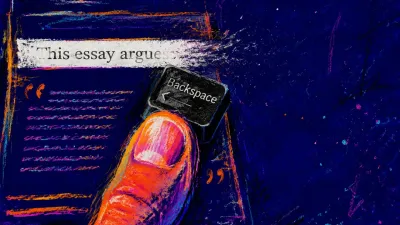
When Maya joined my video call at 9:15 on a Tuesday evening, she was sitting at a small kitchen table in her Toronto apartment. Twelve journal tabs crowded one side of her screen; a thesis section containing only a heading waited on the other. Her coffee had gone cold, the radiator clicked behind her, and blue light caught the tired shine in her eyes as her fingers moved between the university database, Zotero, and the blank document.
"I just need one more source before this argument is solid," she said. Then she looked at the tab bar and gave a small, defeated shrug. "Except I said that three papers ago. I am working all day, but I have nothing I can actually send."
She had planned to draft part of her literature review, but the moment she noticed an unresolved citation, she opened another search. Private research felt safer than making a visible, debatable claim. By the end of the evening, her reference library had grown while her sendable word count had not. She wanted to write, yet she also felt compelled to remove every possible uncertainty before allowing a sentence to exist.
What she called dread looked less like an emotion than wet concrete settling across her shoulders while a current still flickered through her hands, pushing them towards one more tab. The heavier her body became, the faster her fingers searched.
"I do not hear laziness in this," I told her. "I hear a skilled researcher using the safest tools available when writing begins to feel personally exposing. We are not here to shame that protection or to predict your academic future. We are here to understand the loop clearly enough that you can choose what happens next. Let us make a map of the fog, then find one step you actually control."
Choosing the Four-Layer Insight Ladder
I invited Maya to place both feet on the floor, let her hands rest away from the keyboard, and take one unforced breath. I shuffled slowly while she held a specific question in mind: "Why do I keep researching instead of drafting my thesis?" The pause was not a mystical performance. It was a transition from reacting inside the pattern to observing it.
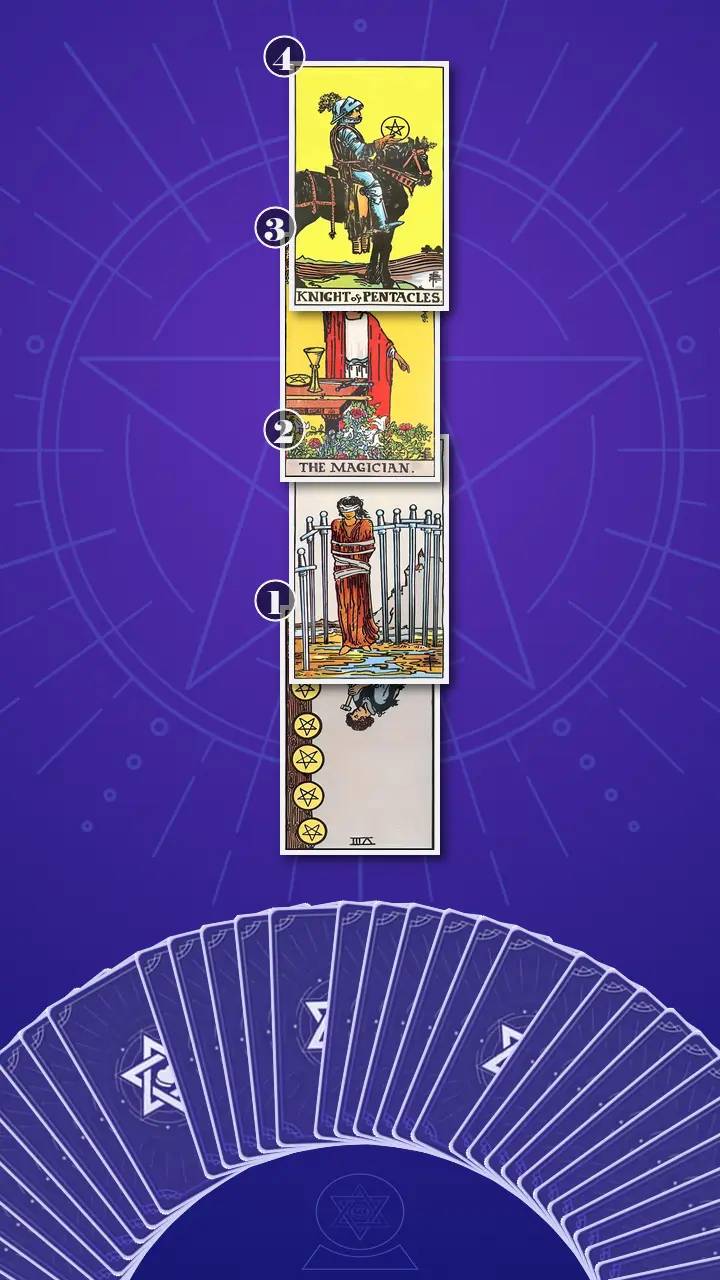
I chose the Four-Layer Insight Ladder tarot spread, a four-card surface-root-transformation-integration structure. For anyone wondering how tarot works in a consultation like this, I use the cards as an external map of attention. Their symbols help us examine subconscious patterns and test interpretations against real behaviour; they do not dictate an outcome.
This spread was a precise fit because Maya's problem was a self-reinforcing system. Uncertainty triggered more research. Research offered short-term relief from visible judgment. The missing pages then made her feel even less prepared, which triggered another search. A larger predictive spread would have added noise. The Four-Layer Insight Ladder gave me the smallest map capable of showing the whole loop.
The first position would reveal the observable research habits consuming her writing time. The second would identify the rule and fear maintaining those habits. The third, the key position, would show how to interrupt the research-before-writing condition. The final card would turn that shift into a bounded routine. In other words, I was not asking the cards whether Maya would finish. I was asking what structure she could change in order to begin.
Reading the Loop Without Calling It Laziness
Position 1: The Craft That Lost Its Destination
"What I am turning over now is the card representing the observable form of your thesis research bottleneck," I said. "It shows the respectable research behaviours that consume writing time while leaving the draft unchanged."
The card was the Eight of Pentacles, reversed.
I pointed to the craftsperson repeating the same carving motion, the finished pentacles mounted in a tidy row, and the town waiting in the distance. "This is not an image of someone who refuses to work. It is an image of skilled effort that has become disconnected from its intended destination."
At 9:15 p.m., Maya was still working hard, just as the card suggested. She had corrected Zotero metadata, refined database searches, and highlighted three new papers during a block reserved for drafting. Those were legitimate academic tasks, but the thesis section on the other side of the screen had received no complete sentence. Her search history demonstrated effort; it could not give her supervisor an argument to respond to.
I read the reversed Earth energy as both a blockage and an overcorrection. The drive to practise, organise, and improve was not deficient. It had become excessive in the safest part of the workflow. Another tag, another abstract, another highlighted PDF: each repeated carving motion produced a measurable artefact while postponing the less controllable act of choosing what the evidence meant.
"The question is not whether tonight's work was real," I said. "It was. The question is whether it produced the object your thesis now needs."
Maya gave a short, bitter laugh. "That is so accurate it feels a little brutal. I did a four-hour study-with-me session on Sunday, and apparently I spent all four Pomodoros cleaning Zotero duplicates."
I let the humour stay in the room without turning it against her. "Then the card is not accusing you. It is helping us distinguish effort from direction. Research feels safe because no one can critique a search history. A draft makes your thinking visible, and visibility is where the protective part of this pattern wakes up."
She looked from the card to her open document. Her fingers stopped tapping, although her thumb still rubbed the side of her mug. "I worked for hours," she said quietly, "so why is there still nothing I can send?"
I placed the first card lower in the vertical line. The reversed Eight had shown the labour. The next card would show the rule giving that labour permission to repeat.
Position 2: The Permission Setting Hidden Behind One More Source
"What I am turning over now is the card representing the belief and underlying fear that convert ordinary thesis uncertainty into procrastination," I said. "This is the mechanism maintaining the stagnation lock."
The card was the Eight of Swords, upright.
I drew Maya's attention to the blindfold, the loose bindings, and the incomplete wall of swords. "The restriction feels real from inside it, but the image also contains an opening. The issue is not that you have no notes, no sources, or no analytical skill. The issue is that one route has stopped feeling legitimate: writing a provisional claim before every uncertainty has been resolved."
In Maya's daily life, that restriction appeared at sentence level. She would type half a claim, notice that one citation might be missing, and treat the uncertainty as proof that drafting had to stop. Her notes, outline, sources, and document were already open, but the internal rule, "I cannot draft until the literature feels complete," made the route between those resources appear locked.
The card showed Air in excess until thought became an enclosure. Analysis, normally one of Maya's strengths, was being asked to perform an impossible protective task: remove every chance of criticism before a reader could see the work. The result was not greater intellectual freedom. It was a narrowing of available action.
I laid the two Eights side by side for a moment. "One repeats the labour. The other explains why repetition feels necessary. The loop sounds like this: If I keep working, I can avoid choosing. If I avoid choosing, I cannot be wrong yet."
Looking at the cards, I briefly remembered standing in an unfamiliar metro station during my travels, studying a perfect route on my phone while my feet remained planted on the platform. The image gave me the clearest language for Maya's pattern. "It is like trying to finish the entire map before taking the first step. Every unanswered question redraws the route, so the journey never technically begins."
Here I used a lens I call Draft Paralysis Deconstruction. I offered it as a hypothesis, not a diagnosis. Sometimes perfectionism works like a document permission setting installed by a subconscious security system: Drafting remains locked until Research equals Complete. The setting is designed to protect the writer from criticism, but research has no natural completion state. The protection therefore becomes permanent unless the rule is changed.
"Think about the last time one missing citation sent you back to a database," I said. "What was the full chain underneath it?"
Maya's breathing paused. Her gaze moved past the screen as if she were replaying a library afternoon; then her jaw tightened before gradually releasing. "Until I know whether that newer study exists, I cannot make the claim. If I make it badly, my supervisor will question it. And if she questions it..." Maya swallowed. "Maybe she realises I am not as capable as she thinks."
"So the missing citation is not carrying only an evidence question," I said. "It is carrying a verdict about belonging. That is too much weight for one citation to hold."
I made the distinction carefully. "A supervisor can question the logic of a paragraph without answering the question of your worth. An imperfect claim is not a verdict on your ability. It is a handle for revision."
Her shoulders did not relax yet, but her hands became still. I could see the interpretation landing with a sting: the search was not merely information gathering, and recognising its protective function meant acknowledging how frightening visible work had become.
When The Magician Put the Draft Back on the Table
The radiator behind Maya gave one final click and fell quiet. The room seemed to pause with it. Between the two confining Eights and the next position, the spread had a visible threshold, as if the cards themselves were asking what might happen if Maya stopped looking at what was missing and looked instead at what was already within reach.
Position 3: The One Working Claim
"What I am turning over now is the card representing the key shift," I said. "It shows what can interrupt the research-before-writing rule and restore your ability to turn existing knowledge into a provisional argument."
The card was The Magician, upright.
I pointed to the four suit tools arranged on the table, the raised wand, and the hand directed towards the ground. "The Magician does not wait for another object to appear. Intention becomes material through the tools already present. On your desk, those tools are your notes, selected sources, analytical judgment, outline, and word processor."
I translated the card directly into Maya's screen. She could close the database without declaring the research finished, place her outline and two relevant notes beside one thesis heading, and write, "My current claim is..." She could add a supporting sentence, mark one unresolved point with [NEEDS EVIDENCE], and leave the paragraph intact. The draft would then reveal whether another search was genuinely necessary.
The Magician's energy was balanced and coordinated. Fire supplied the willingness to initiate. Water allowed discomfort to be present without controlling the session. Air returned to its proper role of clarifying a claim rather than enclosing it. Earth gave the claim a visible form. This was focused agency and resource sufficiency, not a promise that the first version would be correct.
At 9:15 p.m., her database tabs were still multiplying while the section stayed blank. Her shoulders had gone heavy, yet her fingers kept moving because one more download felt safer than one sentence her supervisor could question. She was trying to eliminate the risk before making anything visible.
At that point I brought in my Performance Anxiety Decoupling lens. I asked Maya to imagine two channels on a mixing desk. One channel measured the quality of the paragraph in its current version. The other carried her core worth as a scholar and a person. Feedback was allowed to move the first channel. It was not qualified to move the second.
"Your draft is a work object, not a biography," I said. "A weak sentence can need revision without proving that its writer is weak. You are not short on sources; you are short on a page that can tell those sources where to go."
I let The Magician's message become completely plain. "You do not earn permission to draft by finishing the literature. The draft is what turns what you already know into the next precise research question."
The draft is not waiting for perfect certainty; it begins when you arrange the tools already on The Magician's table into one working claim.
I stopped speaking. The cursor in Maya's untouched document continued blinking at the edge of the screen.
Her breath caught, and for a second I saw anger arrive before relief. "But does that not mean I have been doing this wrong for months?" she asked. "I have spent so much time on those papers. If the answer was to write first, then what was all that work for?"
"The work was not fake, and the research is not worthless," I said. "It built knowledge you can now use. We are not putting your past self on trial. We are noticing that a strategy which once helped you learn has become a strategy for avoiding exposure. The question is not whether you should have known better. The question is whether the same strategy still gets to run tomorrow's writing block."
First, Maya went completely still, with her fingers suspended a centimetre above the trackpad. Then her eyes lost focus and moved slightly from side to side, as though she were replaying every recent evening that had ended with more PDFs and no pages. Her pupils widened when she glanced at the notes already filling her screen. The anger softened into grief for the time she felt she had lost; her eyes reddened, and she pressed her lips together before a shaky breath escaped. Finally, her shoulders lowered. Her hands opened on the table, palms up, but the release left a brief, exposed blankness in her face. Clarity had removed the excuse of not having enough material, and with that relief came responsibility. "So I could write something bad tonight," she said, her voice quieter and almost incredulous, "and that could still be real progress." A small laugh followed, equal parts annoyed and relieved. "That feels obvious now, which is honestly rude."
"Now, using this new perspective, think back to last week," I invited. "Was there a specific moment when this insight could have changed how the situation felt?"
"Thursday in the library," she said. "I deleted a claim because I could already hear a possible objection. If I had treated the claim as a question instead of evidence about whether I belong, I think I would have left it there. I could have written [NEEDS EVIDENCE] and kept going."
"Exactly," I said. "The new sentence is: I do not have every source, but I do have enough to test this one claim. The draft is a question-generating tool, not the reward for complete certainty."
I named the shift so she could recognise it beyond the session. This was a first movement from dread-driven over-researching and fear of visible imperfection towards focused agency, draft-led curiosity, and confidence built through revision. It did not require her to feel fearless. It required only enough separation between her worth and the paragraph to let the paragraph become editable.
Position 4: The Routine That Does Not Need a Breakthrough
"What I am turning over now is the card representing action and integration," I said. "It shows how this shift can become a bounded drafting-first practice while research remains selective and purposeful."
The final card was the Knight of Pentacles, upright.
I focused on the single pentacle held steadily in both hands, the motionless horse, and the cultivated fields stretching behind it. "The Knight is not dramatic. The card does not ask you to recover lost time with a heroic weekend or a punishing daily streak. It protects one defined unit of work and repeats it at a pace your actual life can hold."
In Maya's week, that could mean beginning two or three chosen work blocks with 150 words before opening a database. When the paragraph exposed an evidence gap, she would record the exact question in a three-column list and research only that question after the drafting block. She would finish by leaving one restart prompt in the document, such as, "Next, explain why Source B complicates this claim."
I read the Knight's upright Earth as balance: practical effort had regained a destination. The sequence no longer ran research, research, research, guilt. It became draft, identify, research selectively, revise. The internal instruction changed with it: "It does not need to be brilliant today; it needs to exist so tomorrow's research has a job."
"Which blocks in your real calendar could hold twenty minutes of drafting before any database opens?" I asked.
Maya checked her calendar rather than inventing an ideal schedule. "Wednesday morning at the library and Saturday afternoon at the cafe. Maybe Friday, but I do not want to turn this into another tracker I can fail."
"Then do not make Friday part of the agreement," I said. "Two blocks are enough for an experiment. The Knight values reliability, but reliability includes choosing a load you can carry."
She saved the two blocks with one heading attached to each. Her movements were slower now. Instead of building a new productivity system, she was assigning existing knowledge a place to become visible.
Draft First; Let the Gap Earn the Search
When I read the four cards as one story, the logic was coherent. Maya's research skill had helped her reach the thesis stage, but it had also become her safest default whenever a claim invited judgment. The Eight of Pentacles reversed showed that skilled work circling away from the deliverable. The Eight of Swords revealed the hidden condition that kept the circle closed: Research must feel Complete before Drafting can unlock. The Magician restored the resources already on the table, and the Knight of Pentacles gave those resources a modest, repeatable direction.
The core contradiction was not research versus irresponsibility. It was Maya's genuine wish to produce thesis pages colliding with her wish to eliminate uncertainty before making her thinking visible. The fantasy of a finished map protected her from taking a potentially wrong turn, but it also kept her at the station.
I offered her a different central image: a provisional claim as Ariadne's thread. One sentence would not solve the entire maze of the literature review. It would create a line she could follow, test, revise, and use to decide which corridor deserved investigation. Arrangement, not further accumulation, would reveal the next research need.
The cognitive blind spot was the belief that feeling uncertain meant being unprepared. In thesis work, uncertainty can also mean that an argument is finally becoming specific enough to test. The transformation direction was therefore clear: move from researching until certainty arrives to drafting one claim from existing notes before opening any new source.
The Inner-Critic Mute Protocol for the Next Writing Block
I translated the reading into two small experiments. I called the first one the Inner-Critic Mute Protocol. Muting did not mean forcing the critical voice to disappear. It meant preventing that voice from controlling Maya's hands before the paragraph existed. Critique could leave comments for revision; it could not automatically redirect the browser to Google Scholar.
- Run the Eight-Minute One-Claim Launch. At the start of the next writing block, Maya will minimise her browser, set an eight-minute phone timer, and open one real thesis heading. Before drafting, she will write, "Feedback on this paragraph can change the paragraph; it cannot define my worth." She will then type, "My current claim is..." and add one sentence beginning, "The evidence I already have suggests..." If a gap appears, she will insert [NEEDS EVIDENCE: exact question] and continue rather than searching. Keep the paragraph private and the existing tabs in a saved session. If eight minutes feels too exposing, stop after two minutes or one 25-word claim. The smaller version still counts.
- Build a Knight of Pentacles Evidence-Gap List. Maya will schedule two 20-minute drafting-first blocks this week, each attached to one section heading. Beside the draft, she will keep a three-column note labelled Question, Evidence Needed, and Priority. After each block, she may spend no more than ten minutes researching the highest-priority gap, then leave a one-line restart prompt inside the document for the next session. This is an energy budget, not a moral streak. On a low-focus day, reduce the block to five minutes or 50 words. Research stops when the named gap is answered; unrelated papers go on a later list.
"Draft first; let the gap earn the search," I told her. "These are experiments, not rules you owe me or the cards. You remain free to adjust them, stop them, or decide that a different boundary works better. Tarot has made the pattern visible. You are the person who decides what to do with that visibility."

A Week Later: The Quiet Proof in 187 Words
A week later, my phone lit up with a short message from Maya. "I tried the eight minutes under the section I kept avoiding. I hated the first two sentences, but I did not delete them. I used [NEEDS EVIDENCE] twice and ended up with 187 words. One of the gaps was already answered in a paper I had saved three months ago."
She had also sent her supervisor a 150-word block labelled, "Provisional: feedback requested on the logic, not the prose." The reply did not certify the paragraph as perfect. It identified one unclear connection and one useful source already present in Maya's bibliography. For the first time in weeks, the feedback reduced the research field instead of expanding it.
She slept through that night. In the morning her first thought was still, "What if the claim is wrong?" She smiled, opened the document, and revised the claim instead of opening Google Scholar.
I did not see that as a miraculous cure for thesis paralysis, and I did not credit the cards with writing those words. Maya had produced the evidence of change herself. The reading had helped her separate a paragraph from a verdict, but she was the one who closed the database, tolerated the unfinished sentence, and gave revision something real to hold.
When I think back to our Journey to Clarity, I remember that clarity did not arrive as certainty. It arrived as a different relationship with uncertainty: existing notes became usable, a provisional claim became survivable, and research became a tool for answering questions exposed by the draft rather than a gatekeeper controlling whether the draft could begin.
If your cursor is blinking beside an unfinished claim and your shoulders are already reaching for another tab, I hope you remember The Magician's table. A private search may feel safer than a visible sentence, especially when criticism of the sentence seems capable of judging whether you belong. But noticing that hidden verdict means you are no longer completely inside it.
If one provisional claim were allowed to be a question rather than a verdict on your ability, which sentence would you be curious to place on The Magician's table first?