The 10:43 p.m. Edit Spiral
If the hardest part of the application is not writing the resume but being seen through it, I usually know exactly what kind of reading I am walking into.
When Maya appeared on my screen, she was still at the small condo kitchen table where the spiral usually happened. It was 10:43 p.m. in downtown Toronto. Her tea had gone cold beside the laptop, the fan pushed warm air against her wrists, and a streetcar hummed past the window while one bullet point glowed on the screen like it had become the only sentence in the world.
She told me she had promised herself two applications before bed. Instead, she had changed one line from supported to led, pulled the top margin tighter by a hair, reopened the same posting three times, and then closed the tab without submitting. That was the perfectionism-procrastination loop in plain sight: a resume kept in endless edits instead of actual applications getting sent. Her shoulders were nearly level with her ears. She leaned toward the screen as if the PDF might decide whether she deserved a better role.
'I know it is good,' she said, rubbing one thumb against the edge of her trackpad, 'but I do not know if it is good enough. Other people seem to hit submit so easily.' The anxiety around her felt like trying to get through a TTC turnstile while carrying a sheet of glass: one wrong angle, and everything would clang. She wanted to apply for new roles, but feared that an imperfect resume would expose her as not good enough.
I nodded. 'That makes sense to me. Your nervous system can call it danger when it is really visibility. And a lot of smart people hide inside edits because edits feel safer than being seen. So let us not shame the pattern. Let us map it. Tonight is not about forcing confidence; it is about finding clarity.'

Choosing the Corridor: A Situation-Obstacle-Advice-Outcome Spread
I asked her to put both feet on the floor, turn her phone face down, and take one unhurried breath before I shuffled. I do this not for theatrical mystery, but because the body needs a threshold when the mind has been sprinting in circles.
For resume perfectionism before hitting submit, I often use a Situation-Obstacle-Advice-Outcome spread. If you have ever wondered how tarot works with something as specific as job application anxiety, this is one of my favorite examples: I use the cards less as fortune-telling and more as a clean pattern map.
This four-card structure suits the question because it does not waste motion. It tracks the whole logic chain with almost archaeological economy: what is happening on the surface, what pressure is hidden underneath it, what inner shift interrupts the loop, and what grounded action looks like once that shift is real. The point here is not to predict whether a recruiter replies. The point is to understand why movement stalls right at the threshold.
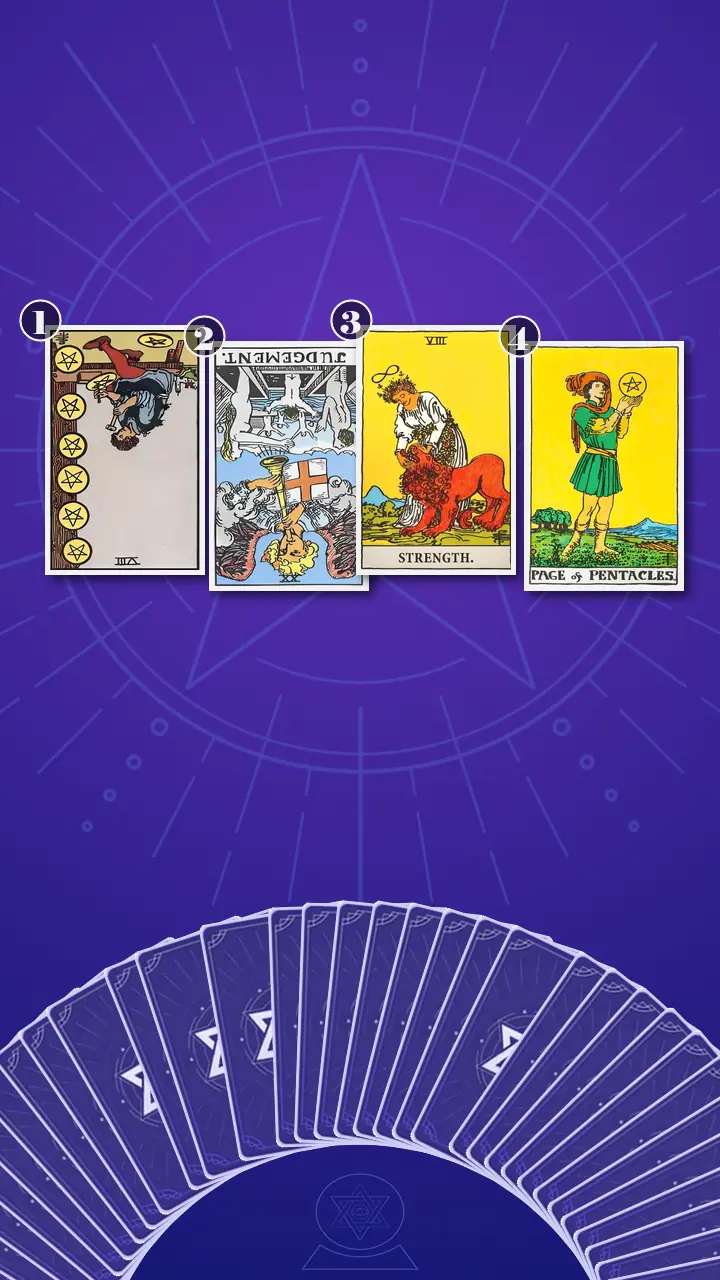
I told Maya exactly what I would be looking for. The first card would show the visible symptom: the over-editing loop itself. The second would reveal the main obstacle: the fear and self-judgment beneath it. The third would hold the antidote: the wiser stance that restores self-trust. The fourth would show the likely outcome when she acts from practice rather than self-trial. Laid in a straight line, the spread forms a narrowed corridor opening into a path.
Reading the Narrow Corridor
Position 1: Work That Looks Like Progress
I turned the first card and said, 'Now I am opening the position that presents the visible symptom: the concrete over-editing loop that keeps the application from being sent.' The card was the Eight of Pentacles, reversed.
In an upright state, this is skill, repetition, craft, and honest work. Reversed, that same work energy tips into excess and loses proportion. In modern life, it looks exactly like Maya at 10:30 p.m. with a solid-enough resume open, changing the same bullet three different ways, nudging spacing, renaming files, and telling herself it still counts as progress while the application tab sits there untouched. It is like color-coding a Notion job tracker for an hour instead of sending one application from it.
I explained that the Earth energy here was blocked by too much labor on the wrong layer. The worker in the card is bent over one pentacle while the town remains in the distance. That image fit her night routine perfectly: productive-looking edits replacing actual career movement. 'The real question,' I told her, 'is not whether the change improves clarity. It is whether the change gives relief for five minutes.'
She gave a short, bitter laugh. 'That is painfully accurate.' Her fingers tapped once against the table and then stopped. I smiled. 'Good. Then we are looking at a ritual, not a character flaw.'
Position 2: When Review Becomes Self-Trial
I turned the second card. 'This position reveals the main psychological obstacle: the underlying fear and self-judgment that make the resume feel like a test of worth.' The card was Judgement, reversed.
This is where the reading went from recognizable to precise. In modern terms, this card is the moment the submit button stops meaning send and starts meaning present your worth for inspection. No recruiter has opened the file yet, but in Maya's mind the jury is already seated. It has the private logic of a tiny Black Mirror episode: a normal interaction gets mistaken for a score on your value.
When I see Judgement reversed, I often think back to my archaeological work with small civic shards from the ancient world—fragments used in public decisions, objects no larger than a palm that still carried the force of a verdict. Humans have always had a talent for loading small things with enormous judgment. That was the sensation in this card. Maya was no longer treating her resume as a tool for opportunity. She was treating it like courtroom evidence.
'If they can see the weak line,' I said, 'then in your mind they can see the weak you. That is why this feels so personal.' The energy here was contracted and prosecutorial. Review had become self-trial. A normal hiring process had turned into an imagined referendum on whether she deserved more.
Her hand froze halfway to the cold mug. Then her gaze slipped off to the side, unfocused, as if a dozen late-night tabs were replaying behind her eyes. When she finally looked back, her voice had gone small. 'That is exactly it. I read the post again and again like there is going to be one hidden line that says I am allowed.'
'Yes,' I said. 'And that is why more editing never settles it. The document is being asked to do something no document can do. A resume is an introduction, not a verdict.'
When Strength Took the Mouse Back
Position 3: The Antidote
When I reached the third card, even through a screen I felt the atmosphere change. A streetcar rattled by outside her window, then the kitchen fell briefly still. This was the hinge of the entire reading: the position that identifies the core antidote, the inner attitude that loosens perfectionism and restores self-trust. I turned the card over. Strength, upright.
This card does not promise fearlessness. It offers regulated courage. In daily life, it looks exactly like Maya feeling the adrenaline spike before clicking apply, noticing the urge to reopen the file, and choosing not to let that body alarm make the decision for her. The energy here is balanced rather than blocked: fear is present, but it is no longer in charge.
I told her I was going to use a lens I call Emotional Historiography. In archaeology, the crucial question is rarely just what an object is; it is which layer it belongs to, and what older world it was built for. This habit of over-editing belonged to an older inner era of self-protection, one in which being reviewed felt dangerously close to being reduced. Strength marks the historical turning point. It is not a coup. It is a constitutional change inside the self. The inner prosecutor stops ruling alone.
Late at night, with cold tea beside the keyboard and the same bullet point open again, it can honestly feel like one imperfect line might tell the truth about your whole career.
Stop fighting the lion of self-doubt by polishing one more line; meet it with gentle courage, then let the document go.
I let the sentence sit between us for a beat.
The resume does not need to prove who you are. It only needs to be clear enough to leave your hands.
For a moment, Maya did not relax at all. First came the freeze: her breath paused and her fingers hovered over the trackpad without moving. Then came the mental replay: her eyes lost focus, not on me, not on the cards, but somewhere just beyond the laptop, as if Tuesday night had come back in full detail. Then the emotion finally broke through—but not as relief. 'But does that mean I have been doing this wrong the whole time?' she asked, a little angry, a little embarrassed, and very human.
'No,' I said. 'It means you have been using editing as armor. Armor is not stupidity. It is protection. But it is heavy, and it cannot walk into the room for you.' I watched her jaw loosen by degrees. One shoulder dropped, then the other. She drew in two slower breaths, and with them came that strange, slightly dizzy softness that arrives when someone realizes the burden they were carrying may not actually be part of their identity.
'Now,' I asked her, 'with this new angle, think back to last week. Was there a moment when this would have changed the feeling?' She gave a softer laugh. 'Tuesday. Exactly Tuesday. Nothing about the resume was changing anymore. I just wanted certainty.'
'Exactly,' I said. 'Strength does not give certainty. It gives steadiness before certainty arrives. Clarity beats self-proof.'
Position 4: Practice Over Proof
I turned the last card. 'This position shows the grounded direction forward: how the energy looks when you act from practice rather than self-trial.' The card was the Page of Pentacles, upright.
This is Earth returned to health. The same work energy that was distorted in the first card comes back in a simpler, more useful form. In modern life, it looks like Maya sending one thoughtful application, logging it in a Notes app or spreadsheet, and treating the response as data rather than destiny. It is like shipping version one and learning from real feedback instead of rewriting in private forever.
I pointed out the visual dialogue across the spread: many pentacles fussed over in the first card, one pentacle held clearly in the last. 'That is the whole story,' I told her. 'You are moving from scattered proof-gathering to focused enoughness. One real application teaches more than ten private rewrites.'
She nodded, slower now. The heat had gone out of her face. 'So the goal this week is not the perfect resume,' she said, trying the sentence on. 'It is one solid send.'
'Yes,' I told her. 'That is the real movement here—from harsh self-editing and fear of judgment to clear-enough action and steadier self-trust under visibility.'
From Private Polishing to the Clear-Enough Send
When I stood the four cards together, the story became almost elegantly simple. First came the visible loop: blocked work masquerading as diligence, the resume edited past usefulness. Beneath it sat the real knot: fear of being judged so intensely that an ordinary application felt like a public review of worth. Strength changed the emotional logic of the whole spread. The answer was not more discipline, more advice threads, or another midnight pass through the bullet points. The answer was compassionate courage strong enough to let vulnerability exist without obeying it. From there, the Page of Pentacles returned the matter to earth: one application, one lesson, one next step.
The blind spot was subtle but decisive. Maya had been measuring progress by how polished the document looked, not by how many applications actually left her hands. She thought more editing created more safety. In fact, it preserved the fear by keeping her hidden from real-world feedback. The transformation direction was clear: move from trying to prove your worth through a flawless document to sending a clear, honest application that is allowed to be good enough.
Because I have spent much of my life studying old civilizations, I do not like merely telling people to stop a ritual. Rituals endure because they give fear a container. So I suggested what I call an Ancient Ritual Conversion: keep the structure, but change what it serves. Instead of the old rite of avoidance, we build a small modern rite of release.
- The 25-Minute Edit CapPick one saved role this week and create a comparison blackout window by closing LinkedIn, Reddit, and every extra tab. Leave only the resume and the job description open. Set a 25-minute timer for one edit pass only. When the timer ends, submit immediately or stop for the night without opening a second pass.The mind will insist that 25 minutes is not enough. That is exactly why it works. The goal is not a flawless resume; it is interrupting the ritual. No revenge-editing after midnight.
- The No-Courtroom Resume RulePut a sticky note on your laptop that says, 'This document introduces me. It does not grade my worth.' Right before you apply, take a body-before-submit pause and name what is actually present: anxiety, shame, hope, or fear of being ignored. Then list only three factual matches from your real experience. If your mind jumps to what rejection would mean about you, say out loud, 'Not hearing back is information, not identity.'If talking back to the inner prosecutor feels awkward, read the line silently in your Notes app. You do not need to feel profound. You only need to interrupt the script.
- The One-Application Learning LoopCreate a tiny log in Notes, Notion, or a spreadsheet with four columns: date, role, sent yes or no, one thing learned. Aim for one to three solid applications this week rather than one mythical flawless one. At the end of the week, review the pattern before making one small resume tweak.Lower the bar until it is almost boring. The log is for observation, not self-surveillance. One real application teaches more than ten private rewrites.

A Week Later: The Quiet Proof
Six days later, I received a message from Maya just after lunch. 'Used the timer. Closed LinkedIn. Sent one before I could make final_v9. Then sat alone in a coffee shop for twenty minutes feeling proud and slightly sick.' I smiled when I read it. That was exactly the kind of evidence I hoped for: not a transformed life, not a dream offer by Friday, just one honest act completed while still feeling vulnerable.
To me, that was the real proof. This Situation-Obstacle-Advice-Outcome tarot spread had not removed uncertainty from her career. It had done something better. It had helped her stop turning the application into a verdict on worth and start treating it as an introduction strong enough to travel without her standing guard over it.
Sometimes the tightest part of the job search is not the work itself but that sharp, chest-braced moment when one unfinished PDF starts to feel like proof of whether you deserve more. If that is where you are tonight, I want to say this gently: noticing the loop is already a form of movement.
If your resume only had to introduce you, not defend you, what would clear enough to send look like for you this week—the version before the extra midnight pass, the one your hovering hand almost trusts?
This story is adapted from psychological research, written so that those in a similar struggle can see their own pattern in it — and find their next step clearly.These insights are not a substitute for professional psychological, medical, legal, or financial advice.
Learn more about our Journey to Clarity.
How did this insight land for you?
🫂 This Resonates Deeply
🌀 Living This Story
✨ Now I See Clearly
🌱 Seeing New Possibilities
🧰 Useful Framework
🔮 The Confirmation I Needed
💪 Feeling Empowered
🚀 Ready for My Next Step
Author Profile
 AI
AI“Having spent a lifetime at Cambridge and on archaeological digs, I’ve witnessed the rise and fall of countless civilizations. Please know that your current struggles are not a permanent fate, but merely a necessary fracture before rebuilding. I won't lecture you; instead, I invite you to sit with me in the ruins, using a patient, historical perspective to gently dust off the true, enduring value hidden beneath your temporary doubts.”
In this Love Tarot Reading :
Core Expertise
Service Features
Also specializes in :
Explore Related Patterns:
Certainty SeekingMaya eventually names the turning point herself: nothing about the resume was really changing anymore; she just wanted certainty. That line exposes the loop with unusual precision. The extra edits are no longer about improving the document; they are attempts to make uncertainty disappear before she takes action. Certainty Seeking turns preparation into a psychological safety ritual. Each tweak offers five minutes of relief because it feels like risk is being reduced, but the core uncertainty remains untouched: no resume can guarantee approval, protection from rejection, or proof of worth. The mind keeps asking for one more pass because it mistakes emotional certainty for readiness. You do not have to feel certain before you apply. The pattern loosens when the goal changes from 'make this impossible to judge' to 'make this clear enough to send.' That shift lets action happen while uncertainty is still present, which is exactly where job applications usually live.
Conditional Self-WorthMaya says she knows the resume is good, but she cannot tell whether it is good enough. That small gap becomes enormous because the submit button has stopped meaning 'send this document' and started meaning 'let someone inspect whether I deserve more.' Conditional Self-Worth shows up when a normal task is made to carry identity-level proof. In Maya's case, the resume becomes courtroom evidence: if the line is weak, the mind treats that as evidence of a weak self. This is a cognitive distortion, but it feels persuasive because it links external evaluation to personal value. You can see why more editing never settles the fear. The document is being asked to deliver a verdict it cannot deliver. Once the resume is returned to its actual role as an introduction, not a judgment of worth, the action can become smaller, cleaner, and less fused with identity.
Perfectionism-Driven AvoidanceMaya's late-night resume session keeps producing visible effort: one bullet gets rewritten, a margin gets tightened, the same posting gets reopened, and the tab still closes without an application being sent. The behavior looks like diligence from the outside, but inside the scene it functions as protection from the moment her work has to become visible. That is the core mechanism of Perfectionism-Driven Avoidance. The standard of 'good enough' keeps moving because the real fear is not a typo or a weaker verb; it is the possibility that an imperfect document could expose an imperfect self. Editing becomes a defense mechanism that gives temporary relief while preserving the deeper anxiety around being evaluated. You are not dealing with laziness in this pattern. You are dealing with a polished avoidance loop, where the safest-feeling action is the one that keeps you preparing instead of submitting. The psychological shift is to separate useful refinement from fear maintenance, so the resume can be clear enough to leave your hands without being forced to prove your worth first.
Self-Judgment LoopBefore any recruiter opens the file, Maya's mind has already seated the jury. The application is no longer a professional introduction; it becomes a self-trial where every line is scanned for evidence against her. Self-Judgment Loop explains why the editing keeps restarting. When the inner prosecutor is running the process, every revision is cross-examined instead of accepted as useful enough. The problem is not that Maya lacks standards; it is that review has turned prosecutorial, so the mind keeps searching for the flaw that could convict her. You break this pattern by changing the role of review. A resume pass can check for clarity, relevance, and accuracy, but it cannot decide whether you are allowed to want more. When review stops acting like a courtroom, the document can return to being a tool.
Visibility AvoidanceMaya is not simply stuck on wording; she is stuck at the point where the resume would leave the private screen and enter someone else's view. The story makes that threshold visible in the closed tab, the hovering hand, the cold tea, and the feeling that one weak line might reveal a weak self. Visibility Avoidance is the defense mechanism underneath that stall. The mind treats exposure as danger, so it chooses a safer-looking activity that keeps the self hidden: editing, rereading, polishing, guarding the file. The resume becomes armor, but armor cannot apply for the role. You can work with this pattern by naming the real threat cue. The fear is not only 'Is my resume clear?' It is 'Can I tolerate being seen before I feel fully protected?' Once that distinction is clear, submission becomes a visibility practice rather than a trial of your entire identity.
Permission SeekingMaya rereads the job post as if it might contain one hidden line that finally says she is allowed. The posting becomes more than information; it becomes an imagined authority that could grant or withhold permission to act. Permission Seeking turns a decision point into an external authorization hunt. Instead of asking whether the resume is clear enough and relevant enough, the mind keeps searching for a signal that removes the risk of choosing. This keeps Maya suspended between competence and action. You can interrupt the pattern by separating eligibility from permission. The job description can tell you what the role asks for; it cannot tell you whether you are allowed to try. That permission has to come from the side of you willing to act without a guarantee.
Productive ProcrastinationMaya's night is full of effort, but the effort is pointed sideways. She changes verbs, adjusts spacing, rereads the role, and can honestly tell herself she is working, while the only action that would move the process forward remains untouched. Productive Procrastination is the loop where a task-adjacent activity borrows the emotional legitimacy of progress. It feels cleaner than avoidance because something is being done, but the behavior protects the exact fear the task is supposed to face. In Maya's case, private polishing becomes a controlled substitute for public submission. You can spot this pattern by asking whether the action produces movement or just relief. If the edit improves clarity, it serves the application. If it only calms the fear for a few minutes and resets the same loop, it is procrastination wearing a work costume.
Explore Related Struggles:
Performance-Worth FusionThe resume becomes heavier than a resume in Maya's hands. One weak line starts to feel like it could reveal a weak self, and the submit button stops meaning send and starts meaning present your value for inspection. The document is no longer just carrying her experience. It is being forced to carry proof that she deserves the next role. Performance-Worth Fusion is the lock that forms when a normal output becomes fused with identity. You keep editing because the stakes have quietly moved from clarity to self-defense. The resume cannot satisfy that demand, because no bullet point can prove a whole person. It can only become clear enough to represent you and leave your hands.
Inner Tribunal LockBefore any recruiter opens the file, Maya is already standing inside an imagined courtroom. The job posting gets reread like a legal code, the resume becomes evidence, and one imperfect sentence feels capable of convicting her. You can feel how early the judgment arrives. It appears before the application is even sent. Inner Tribunal Lock names the structure where external review is replaced by an internal verdict system. You are not simply preparing to be evaluated. You are pre-living the judgment and trying to win the case through another edit. That is why the loop does not calm down after a better sentence. The judge it is trying to satisfy is already inside the room.
Perfect Readiness TrapMaya says the resume is good, but that does not release her. The harder question is whether it is good enough, and that phrase keeps moving the finish line. Even when the document has stopped materially changing, the feeling of readiness still has not arrived, so another private pass seems necessary. Perfect Readiness Trap captures the point where preparation becomes a condition that can never be met. You are not waiting for basic competence anymore. You are waiting for a sensation of total clearance before you act. The trap is that real applications always involve some exposure, so the demand for perfect readiness quietly becomes a demand to stay unsubmitted.
Protection-Progress SplitThe reading does not treat Maya's editing as stupidity or weakness. It names it as armor. That matters because the behavior has a protective logic. As long as the resume stays in revision, she does not have to face the exposed moment after sending, when the outcome is no longer under her control. Protection-Progress Split is the tension between the part of you trying to move forward and the part trying to keep you hidden from impact. The protective move works for a few minutes, but it blocks the very progress it was meant to make safer. You stay guarded at the keyboard, while the opportunity remains on the other side of the send button.
Visibility-Execution SplitMaya starts the night with a clear external goal, two applications before bed, yet the movement collapses right at the point where the resume would be seen. The work does not disappear. It redirects into one line, one margin, one reopened posting, and then a closed tab. You can recognize the split because the body is still acting, but the action no longer carries the application forward. Visibility-Execution Split names that threshold where being seen and taking action become wired together in the wrong direction. The closer the resume gets to leaving your hands, the more the system brakes. The struggle is not laziness or lack of ambition. It is the moment when execution starts to feel like exposure, so private refinement becomes the only kind of movement that still feels survivable.
Self-Editing ExhaustionMaya's night is full of motion, but almost none of it reaches the outside world. The same bullet changes shape, the margin tightens, the file name mutates, and the posting opens again. Around her, the tea goes cold and her shoulders climb toward her ears. You can see the cost of the loop in the body before you even count the unsent applications. Self-Editing Exhaustion is what happens when revision becomes an energy sink instead of a craft process. You keep working, so it looks like discipline from the outside, but the effort keeps returning to the same private surface. The struggle is the slow drain of treating every small edit as the doorway to safety, while the actual doorway remains the application leaving your screen.
Explore Related Emotions:
Imposter Exposure FearMaya says she knows the resume is good, but she does not know whether it is good enough. Then the logic tightens: if they can see the weak line, they can see the weak you. Imposter Exposure Fear is not about the resume needing one more polish. It is the dread that a tiny flaw will reveal a larger disqualification, so you keep scanning for the line that could betray you because the document has become a proxy for whether you are allowed to want more.
Not-Enough PanicHer shoulders are nearly level with her ears while one bullet point glows on the screen like it has become the only sentence in the world. The body is reacting as if a workable PDF has turned into a fragile object that could expose too much. Not-Enough Panic is the sudden inner surge that says good is not enough unless it is unattackable. It turns a solid resume into something you keep protecting, because sending it would mean trusting that imperfect evidence can still be honest enough.
Verdict DreadMaya changes supported to led, tightens the margin, reopens the posting three times, and then closes the tab without submitting. The application has stopped being a practical send and has become a private hearing where one imperfect bullet seems capable of deciding whether she deserves the role. Verdict Dread names the body-braced feeling that arrives before any recruiter has even responded. You can see why editing feels safer than applying: as long as the file stays under your control, the imagined judgment never has to arrive in the real world.
Visibility PressureAt the kitchen table, the hardest part is not writing the resume but being seen through it. The glowing PDF becomes a threshold: clicking apply would let a stranger form an impression without you standing beside every sentence to defend it. Visibility Pressure names the squeeze of wanting movement while your body treats exposure as too much contact. You keep editing because each tweak delays the moment when the work has to leave the private room and meet the outside world.
Certainty HungerMaya looks back at Tuesday and says nothing about the resume was changing anymore. She just wanted certainty. Certainty Hunger shows up when revision is no longer about clarity but about trying to make uncertainty disappear before action. You keep editing because the mind wants a guarantee of safety, but the only information that can answer the next question lives after the send.
Performance FreezeHer hand freezes halfway to the cold mug, her breath pauses, and her fingers hover over the trackpad without moving. The stall is not abstract; it arrives in the exact place where intention would have to become action. Performance Freeze is the suspended second where wanting and moving stop speaking to each other. You may still want the role, and you may even know the resume is good, but the body tries to pause the whole scene before visibility can happen.
Cautious Self-TrustMaya tries on the sentence that the goal this week is not the perfect resume, but one solid send. That wording matters because it gives her a standard she can actually inhabit without pretending the old pressure has vanished. Cautious Self-Trust is not grand confidence; it is the small inner permission to let clear enough count. You begin trusting the part of you that can make a bounded decision, even while the old urge to reopen the file is still nearby.
Permission AnxietyMaya rereads the posting again and again like there is going to be one hidden line that says she is allowed. The job description becomes less like information and more like a gate she keeps asking to open. Permission Anxiety is the feeling that there must be some external line that authorizes your next move. It keeps the cursor hovering because submitting would require acting before the imagined gatekeeper has said yes.
Regulated CourageMaya feels the adrenaline spike before clicking apply and notices the urge to reopen the file. The turning point is not that the body becomes fearless; it is that the body alarm no longer gets the final vote. Regulated Courage is the steadiness that lets fear be present without handing it the mouse. You do not need a fearless version of yourself to apply; you need enough body-level steadiness to send the document before the loop reopens.
Shame SpiralWhen the reading reframes editing as armor, Maya does not immediately relax. She asks whether that means she has been doing this wrong the whole time, a little angry, a little embarrassed, and very human. Shame Spiral names that inward spin where a useful insight briefly turns into another accusation against the self. You keep editing because the same force that wants improvement can start using every imperfection as proof that you should have known better.
Shame ReliefWhen Maya hears that editing has been armor, her jaw loosens by degrees and one shoulder drops, then the other. The story does not make the loop noble, but it stops making the loop proof that she is broken. Shame Relief arrives when the pattern stops looking like a character flaw and starts looking like an old form of protection that has become too heavy. You get a little space from the accusation, which makes it possible to change the ritual without attacking yourself.
Explore Related Contexts:
Career Visibility ParalysisThe hardest line in Maya's night is not the bullet point itself; it is the moment the resume has to be seen by someone outside the kitchen table. She leans toward the PDF as if it might decide whether she deserves a better role, and the submit button becomes an exposure threshold. The structural pressure comes from visibility being mistaken for total appraisal. You are facing a career move where the document is supposed to introduce your experience, yet the process makes each imperfect phrase feel like it could reveal too much. Career Visibility Paralysis fits because the blockage sits at the point where private preparation becomes public contact. The work may be ready enough, but the stage of being evaluated by strangers turns the doorway into a freeze point.
Evaluation Pressure LoopBefore any recruiter opens Maya's file, the story has already built a courtroom around the resume. She rereads the posting for a hidden line that says she is allowed, and one weak sentence starts carrying the force of a verdict. The pressure is not just personal doubt; it is an external evaluation system being imported into the room before the system has even responded. You are dealing with a hiring process where unclear standards, imagined comparison, and the risk of rejection make a simple submission feel like a formal review of value. Evaluation Pressure Loop names the way review keeps feeding more review. Because the document is treated as evidence, every edit creates a new reason to inspect it again, and the application cannot move until the loop is interrupted.
Job Application ParalysisMaya promised herself two applications before bed, but the evening became a closed circuit of one bullet point, a tightened margin, repeated posting checks, and a tab closed without submitting. The external structure is a job market doorway that only counts movement when an application leaves the laptop. You are not seeing a lack of effort; you are seeing effort trapped on the wrong side of the gate, where craft keeps absorbing the action it was supposed to support. That is why the resume edit becomes so sticky. The application process is asking for a send, but the available behavior keeps producing safer private revisions, leaving real employer feedback unreachable.