Sending Stable Portfolio v1: From Imagined Judgment to Real Feedback

Finding Clarity in the 11:40 p.m. Portfolio Loop
I met Jordan, a 27-year-old UX and product designer in Toronto with credible projects, a fixed-term contract, and a portfolio that had been “basically done” for months. Yet whenever an application required a portfolio link, they opened Figma instead. The intro suddenly needed rewriting. The projects needed reordering. The thumbnail that had worked yesterday became impossible to defend.
At 11:40 on the Tuesday night of our video session, a blue-white portfolio page glowed behind Jordan in their small apartment. An unsent product-design application waited in the next tab. The laptop fan whined; the radiator clicked against the quiet; Jordan's palm rested on a computer that had gone warm from another evening of revisions. I watched them replace a thumbnail, rewrite the opening sentence for the fourth time, and drag the deadline reminder into tomorrow.
“It is basically done,” Jordan told me, rubbing one side of their jaw, “but it is not ready to represent me yet. I keep finding things a hiring manager could question.”
I heard the contradiction immediately: Jordan wanted the portfolio to create contact, stability, and a more durable career, but the moment it asked them to become visible, they retreated into another contained design problem. Their apprehension felt like standing at a subway door with a hand on the button while the train gathered speed behind them. The body was preparing for impact even though nothing had happened yet.
This was not a shortage of discipline. Jordan had done an enormous amount of work. It was portfolio perfectionism functioning as visibility paralysis: polishing offered temporary control over the possibility of criticism, silence, or being misunderstood. The file was moving; the portfolio was not.
“I am not here to tell you to just ship it,” I said. “The financial stakes are real, and your craft matters. I want us to find out which edits protect the reader's understanding, which edits protect you from exposure, and where a completion line could exist without asking you to abandon either quality or self-respect. Let us make a map of this fog.”

Choosing the Shadow Spread as Our Map
I asked Jordan to place both feet on the floor, loosen their hands, and take one slower breath while holding a single question: “Why do I keep polishing my portfolio instead of sharing it?” I shuffled slowly, not as a supernatural performance, but as a transition from the frantic editor tab into a more deliberate form of attention.
I chose a five-card Shadow Spread. For anyone wondering how tarot works in a situation like this, I do not use the cards to predict whether a recruiter will approve of the work. I use the spread as a structured cognitive mirror. Its positions separate a visible behavior from the fear beneath it, the protection strategy maintaining it, the resource that can integrate it, and the practical action through which the insight can be tested.
That structure made the Shadow Spread more suitable than a broad Celtic Cross. Jordan was not choosing between several equally defined career paths. They were asking a focused “why” question about one repeating completion bottleneck. A smaller spread could follow that loop without surrounding it with unnecessary layers.
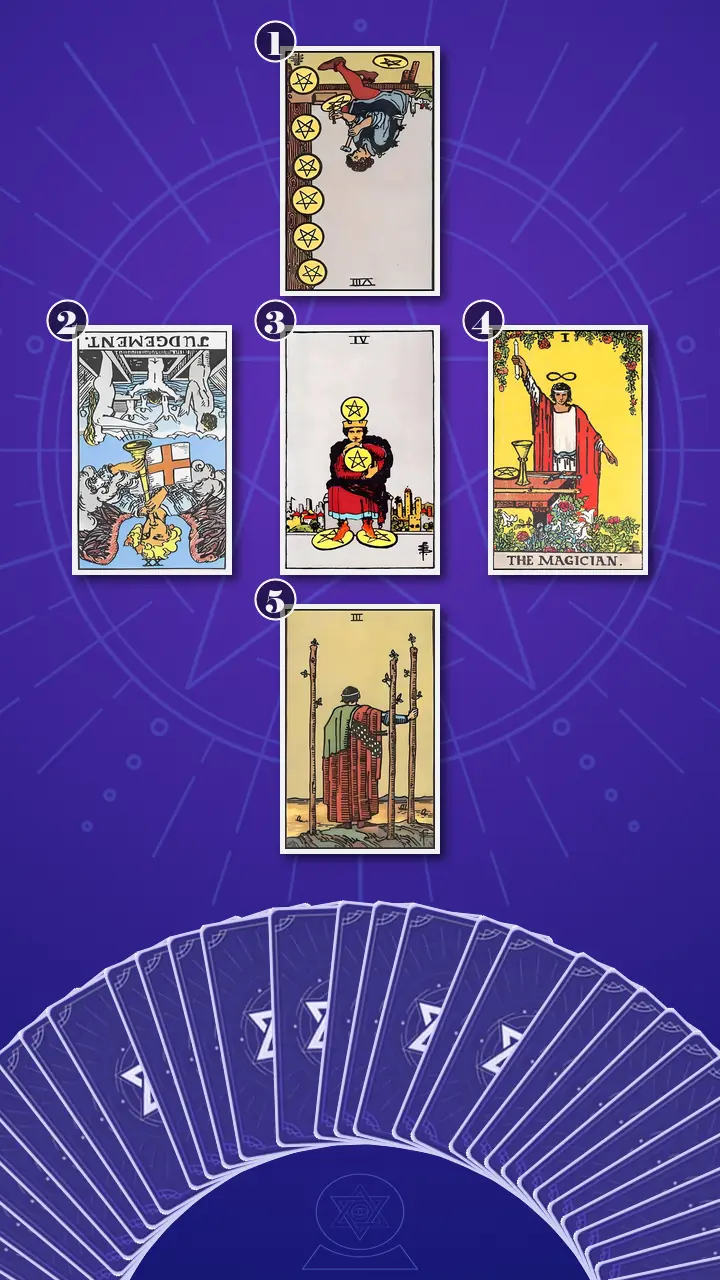
I laid the cards in a compact cross. The first position would show the visible editing behavior replacing publication. The second would reveal the feared verdict beneath that behavior. The center card would expose the protective grip keeping the work private. The fourth, our bridge, would identify the capacity Jordan could use now. The final card would turn the reading into a limited real-world experiment.
“None of these cards gets to make the decision for you,” I told Jordan. “They can help us identify the pattern, but you remain the person who decides what is ready, who sees it, and when the next scene begins.”
The Workbench at 400 Percent
Position 1: The File Is Moving, but the Portfolio Is Not
I first turned over the card representing the visible portfolio completion bottleneck: the repeated editing behaviors and contracted effort that had replaced sharing. It was the Eight of Pentacles, reversed.
In the Rider-Waite-Smith image, a craftsperson bends over the pentacle currently beneath their tools while a long row of completed pentacles already hangs nearby. A town waits in the distance. Upright, this Earth energy can describe useful practice, patience, and incremental skill. Reversed here, its energy had become blocked by excessive repetition. Jordan's attention remained fixed on the one object still being revised while the larger body of finished work never reached the town.
I brought the card directly into Jordan's Tuesday night. The nearly complete case study was open beside the unsent application. One thumbnail changed. The opening sentence received a fourth rewrite. Readable spacing moved by a few pixels. The work looked responsible because effort was happening, but the relevant test was no longer “Can I improve this?” Almost any artifact can be changed indefinitely. The test was “Will this edit help a reviewer understand my role, my decision, or the outcome enough to justify delaying contact?”
“The last time an application asked for your link,” I asked, “what did you open instead of pasting it?”
“The hero image,” Jordan said. Then they gave one short, bitter laugh. “That is so accurate it is almost cruel. I was technically working for two hours, but nothing left the tab.”
I did not use that recognition to shame them. I pointed to the completed pentacles. “The card is not insulting your standards. It is asking whether craftsmanship has crossed into productive-looking avoidance. Your effort is real. The question is whether the effort still serves the portfolio's purpose.”
Jordan's fingers stopped rubbing their jaw. They looked past the pentacle being worked and counted the finished ones on the card.
Position 2: When a Portfolio Request Becomes an Internal Courtroom
I next turned over the card representing the hidden fear beneath publication: the expectation that external evaluation could become a verdict on Jordan's professional worth. It was Judgement, reversed.
The angel's trumpet should be a call to rise, respond, and enter a new phase. In reversal, Jordan was still hearing the call, but its energy had become blocked and distorted. A request for a portfolio link landed like a notification that instantly opened an internal courtroom. No hiring manager had commented, yet the harshest possible review was already being rehearsed as if it were evidence.
I asked Jordan to finish a sentence without making it polished: “If they notice this one weak choice, they will decide I am...”
Jordan inhaled shallowly. “Not a real product designer. Like I can make something look thoughtful, but I do not actually understand the work.”
I separated the two layers on a note beside the spread. “This project outcome needs more context” was an observation about an artifact. “I am not a real designer” was an identity verdict unsupported by that observation. A critique of the page is not a verdict on the person.
I thought of how an algorithm can be trained on a narrow, anxious data set and then repeat the same recommendation until repetition begins to resemble objectivity. Jordan's inner reviewer had been trained almost entirely on anticipated rejection. Judgement reversed did not prove those predictions true. It revealed how a useful call to participate had been converted into self-punishment.
Jordan's breathing paused. Their gaze drifted from the card as if they were replaying a string of unsent applications, then returned to the trumpet. When they exhaled, their shoulders lowered by a fraction.
“Whose standard is speaking when you dismiss a coherent version before anyone has seen it?” I asked. “And is that voice reviewing the work, or prosecuting you?”
Position 3: The Link Clutched Against the Chest
I then turned over the card representing the protective strategy maintaining the manifestation gap: retaining control by keeping completed work private and indefinitely revisable. It was the Four of Pentacles, upright.
The figure presses one pentacle against the chest while two more pin both feet to the ground. A city stands behind them, available but held at a distance. The card's Earth energy can provide sensible protection and conservation. In this position, however, holding had become excessive. The same grip that preserved control over the portfolio's meaning also prevented movement, exchange, and useful feedback.
I asked Jordan about the last person who had offered to review the site. They described a former colleague at a Queen West coffee shop saying, “Send it over tonight.” Jordan had copied the URL into a message, noticed one project they wanted to update, and left the link unpasted. Keeping it private preserved every possibility. No one could question it, misunderstand it, or ignore it. No one could use it to start a conversation either.
“While it stays private, I can still control what it means,” Jordan said quietly.
“Yes,” I replied. “That control gives real short-term relief. I am not going to criticize you for reaching for relief when rent, contract dates, and job applications raise the stakes. But the tradeoff matters: private potential cannot create public contact. Quality control has quietly become control over exposure.”
Jordan pressed their thumb into their palm, held it there, and then released it. I watched recognition arrive with a trace of grief. The strategy that had kept them from feeling judged had also kept willing colleagues, recruiters, and peers outside the gate.
When The Magician Lowered the Wand
Position 4: Every Necessary Tool Was Already on the Table
The room seemed to change as I turned over the card representing the resource for integration: using existing skills and clear intent to turn preparation into one bounded, shareable artifact. The radiator behind Jordan went quiet. I placed The Magician, upright, to the right of the guarded Four of Pentacles.
All four suit tools were already arranged on the Magician's table. One hand raised the wand toward intention; the other pointed down toward material form. This was balanced energy: Air could define what the portfolio needed to communicate, Water could make room for the vulnerability of being seen, Fire could initiate contact, and Earth could hold an ethical, functional completion standard.
At 11:40 p.m., Jordan had been adjusting a thumbnail that already worked while an application remained unsent. The laptop was warm, their jaw was tight, and a useful evening had disappeared into one more revision. The Magician did not ask them to feel completely certain. The card asked them to stop viewing the portfolio at 400 percent zoom and coordinate the credible projects, clear decisions, working links, design judgment, and willing contacts already visible on the whole page.
As an artist, I recognized the editing-room danger immediately. I have seen a meaningful piece remain in post-production because one more adjustment feels safer than letting another person encounter it. A life can do the same. A person can bravely remain in a painful scene until the scene starts pretending to be the whole film.
I used what I call Narrative Fork Analysis. I laid Jordan's options out as competing plotlines. In the first, “The Permanently Preparing Designer,” every evening contained responsible-looking close-ups: a cleaner thumbnail, a stronger sentence, a better template. The plot felt safe because no external verdict could enter it, but the protagonist never met the audience, gathered evidence, or grew beyond private control.
In the second plotline, “The Working Designer in Public,” Jordan chose three criteria, released one stable cut to a limited audience, and learned from what actually returned. That plotline was more daunting because it contained an inciting incident: someone else got to respond. It also served the deeper character arc Jordan said they wanted, from imagined judgment toward participation-based confidence.
This was also Safe-Choice Sabotage Recognition. The endless revision path looked like the logical, high-quality choice. Its hidden function, however, was to prevent the inciting incident altogether. Naming that function did not make Jordan's care fake. It helped us see that a strategy can be intelligent, protective, and no longer suited to the next act.
Stop treating readiness as a verdict you must earn; choose one workable version, share it deliberately, and let The Magician's tools become work in the world.
I let the sentence remain between us before putting its practical meaning into one final line.
Readiness is not a verdict you earn; it is a boundary you set so your existing work can finally make contact with the world.
For a second, Jordan did not move. Their breath stopped halfway in, and their fingers hovered above the trackpad as if the cursor itself had frozen. Their pupils widened. Then their gaze slipped away from the screen, and I could almost see the remembered evenings moving behind their eyes: the saved applications, the promised links, the pages named Final, Final v2, and final actual. Their mouth tightened.
“But doesn't that mean I have been wrong this whole time?” they asked, sharper than before. “That I wasted months?”
“No,” I said. “It means polishing protected you when being evaluated felt inseparable from being judged as a person. We can respect why that scene existed without asking you to live in it forever.” Jordan's eyes reddened slightly. Their fist loosened, their shoulders dropped, and a long breath left their chest. Relief arrived first, followed by a brief, unsteady blankness: if readiness could be defined, then they would have to choose the definition.
I stayed with that new vulnerability instead of rushing past it. “Now, with this new perspective, think back to last week. Was there a moment when this insight could have changed how you felt?”
Jordan returned to the coffee-shop message. “I could have sent the link and asked whether my role was clear. I did not need them to approve my whole career.”
That was the breakthrough: a move from contracted apprehension and imagined judgment toward bounded visibility, curiosity, and confidence built through participation. It was not certainty. It was the first distinction between a functional point of contact and a final proof of worth.
I offered an eight-minute version of the Magician's gesture. Jordan could open a blank note rather than the portfolio editor, name one case study, write exactly three observable conditions that would make it clear enough to share, and choose one relevant person or application that could receive it. No editing during those eight minutes. Working links, truthful claims, privacy, confidentiality, mobile readability, and accessibility still counted; cosmetic refinements did not. If the exercise became too activating, Jordan could stop after one criterion and one possible recipient. The boundary belonged to them.
Position 5: Letting One Ship Leave the Shore
I finally turned over the card representing the embodied next step: allowing the portfolio to circulate within a limited audience so real feedback could replace imagined judgment. It was the Three of Wands, upright.
A figure watches ships already moving across open water while three planted wands preserve a stable base. The Fire energy was active but measured. This was not a reckless public launch or an instruction to expose confidential work. It was a bounded expansion: one stable URL, a relevant destination, a defined question, and enough distance from the editor to observe what returned.
I translated the card into Jordan's actual week. They could send the same stable portfolio link to one recruiter, the former colleague who had already offered to help, or one trusted design peer. They could record concrete responses such as a reply, a question, an interview request, or no response yet. They would not reopen the editor that evening. The next revision would happen after seven days or three specific responses, whichever came first.
“This is not the final verdict,” Jordan said, studying the ships. “It is the first useful signal.”
“Exactly,” I replied. “Share the version that can teach you what polishing cannot.”
Jordan named the former colleague as the first possible recipient. Their voice was still tentative, but the audience was no longer an undefined mass of hiring managers waiting to expose them. It had become one consenting person, one case study, and one answerable question. Tarot had not removed uncertainty. It had reduced an endless identity test to an observable experiment Jordan could accept, adjust, or stop.
The Completion Line That Could Hold
I drew the five cards together into one story. The Eight of Pentacles reversed showed how genuine craftsmanship had become trapped in repetition. Judgement reversed revealed the internal verdict driving that repetition. The Four of Pentacles showed why withholding worked in the short term: privacy preserved control. The Magician coordinated existing resources around one purpose, and the Three of Wands carried a stable version into limited circulation.
The underlying loop was now clear. Jordan feared that one weak sentence or ambiguous outcome would be treated as evidence that they lacked professional worth. Editing reduced that fear for an evening. But every unsent link removed the chance to receive useful information, which left the portfolio untested and made it feel even less ready. At 400 percent zoom, each pixel looked urgent; the whole body of work and its actual purpose disappeared beyond the screen.
The cognitive blind spot was not simply “I need better work.” It was the assumption that the completion standard would remain stable as soon as the portfolio improved enough. In reality, the standard kept expanding because its hidden job was to prevent exposure. The transformation direction was therefore specific: move from polishing until sharing feels emotionally safe to defining three observable completion criteria, releasing one bounded version, and using selective real-world feedback to guide a later revision.
I turned the reading into three next steps. I kept them small because Jordan did not need a dramatic reinvention. They needed one piece of evidence that a different plotline could begin.
- The 24-Hour Protagonist PivotWithin the next 24 hours, open a blank phone note for eight minutes. Name one case study, write three observable completion criteria, and identify one relevant recipient. For example: Jordan's role is clear; one significant decision is understandable; the outcome or learning is supported. This micro-action belongs to the more authentic but daunting plotline, and it does not require opening Figma or sending anything yet.If three criteria feel overwhelming, write one criterion and one possible recipient. The purpose is to interrupt analysis paralysis, not force a launch.
- The Three-Criterion Portfolio FreezeDuring one lower-fatigue window this week, set a forty-five-minute timer and review only that case study against the three criteria. Put every unrelated typography, thumbnail, template, or copy idea into a v1.1 list. When the timer ends, take ten separate minutes to check links, mobile readability, alt text, confidentiality, truthful claims, and contact details. Label the result stable v1 and close the editor.Essential function and ethics remain non-negotiable. Cosmetic preference does not get to move the completion line during this pass.
- The One-Question Bounded Visibility TestSend stable v1 to one former colleague, recruiter, or design peer who is relevant and willing to look. Ask one question: “Would you have ten minutes this week to tell me whether my role and key decision in this case study are clear? I am not looking for a full redesign review.” Record the date, audience, question, and observed response. Schedule the next revision for seven days later or after three concrete responses.Do not reopen the editor immediately before or after sending. If no reply arrives, log “no response yet” rather than converting silence into a verdict.
I reminded Jordan that these were not commands from the cards. They could use a private share link, choose a low-stakes application, reduce the audience to one person, or stop after defining the criteria. The Magician's agency was not pressure to perform. It was the ability to choose a purpose, coordinate the tools already available, and retain authorship over the experiment.
A Stable v1 in the Morning Light
A week later, I received a message from Jordan. They had completed the eight-minute note, run the forty-five-minute pass on Saturday morning, and sent stable v1 to the former colleague from the coffee shop. The message contained one question about whether Jordan's role and central product decision were clear.
The colleague replied that both were understandable and asked for more context around one project constraint. Jordan logged that as a specific observation instead of treating it as evidence that the entire portfolio had failed. They placed the possible addition in the v1.1 list, left the live page alone that evening, and pasted the same stable URL into one relevant application.
They slept through the night. Their first thought in the morning was, “What if it was a mistake?” Then, they told me, they smiled, made coffee, and left the live version alone.
I did not call that a solved career or a permanent cure for perfectionism. I called it proof of movement. Jordan had shifted from private control toward limited circulation, from rehearsing imagined judgment toward collecting observable feedback. The cards had supplied a map and language; Jordan had drawn the completion line, sent the message, and authored the next scene.
That was the heart of this Journey to Clarity. Clarity did not arrive as certainty that every reviewer would respond well. It arrived as the knowledge that a coherent portfolio could function as a bridge rather than a verdict, and that Jordan could revise after contact without surrendering their worth to any single response.
When your cursor reaches Publish and your jaw locks, it may be because one imperfect page no longer feels like a page; it feels like evidence someone could use to decide whether you are worth taking seriously. Noticing that shift already begins to separate the work on the screen from the person sitting in front of it.
If one coherent cut of your work could leave The Magician's table as a point of contact rather than a final verdict, who would you feel curious about letting see it first?