The 8:47 p.m. Switchboard: Relational Overfunctioning in a Loyalty Triangle
Jordan, a 29-year-old creative-agency project coordinator in Toronto, told me she could manage a client crisis without blinking. Yet one clipped reply between her partner and a relative could send her checking the family group chat, the weekend seating plan, and everyone's mood at once. She received separate messages about the same awkward conversation and immediately became the translator, mediator, and logistics person. If stepping back felt like betrayal, I told her, she might be caught in a peacekeeping cycle rather than simply trying to help.
She described one Tuesday at 8:47 p.m. Her partner was filling the kettle while a critical family message lit up her phone. Jordan turned the screen face down, carried it into the small bathroom, and locked the door. The exhaust fan hummed above her; cold tile pressed through her socks; the phone felt warm in her palm as she drafted three softer versions of a reply. Outside, the kettle clicked off. Inside, her shoulders stayed raised as if she were physically holding apart two walls.
“If I don't explain what they meant, this will get worse,” she said. “I know it isn't technically my argument, but I'll still deal with the fallout.” Her tension sounded less like ordinary worry and more like a smoke alarm wired to punctuation: one sharp sentence, one delayed reply, one full stop instead of an emoji, and her whole body prepared for impact. She wanted to preserve both love and belonging, but feared that stepping back would allow the conflict to damage both relationships.
I let the silence settle before I answered. “You think you're preventing a fight, but you're also becoming the place where everyone else's feelings are processed. You are not failing at love because you're tired of being the communication system. Let's use this reading to draw a map of the fog, not to predict who will behave well, but to find the part of this pattern that is genuinely yours to change.”

Choosing the Compass: The Relationship Triangle Spread
I invited Jordan to lower her shoulders, feel the chair beneath her, and take one unforced breath while I shuffled. I do not use this pause to manufacture mystery. I use it as a threshold between reacting to a problem and observing it clearly.
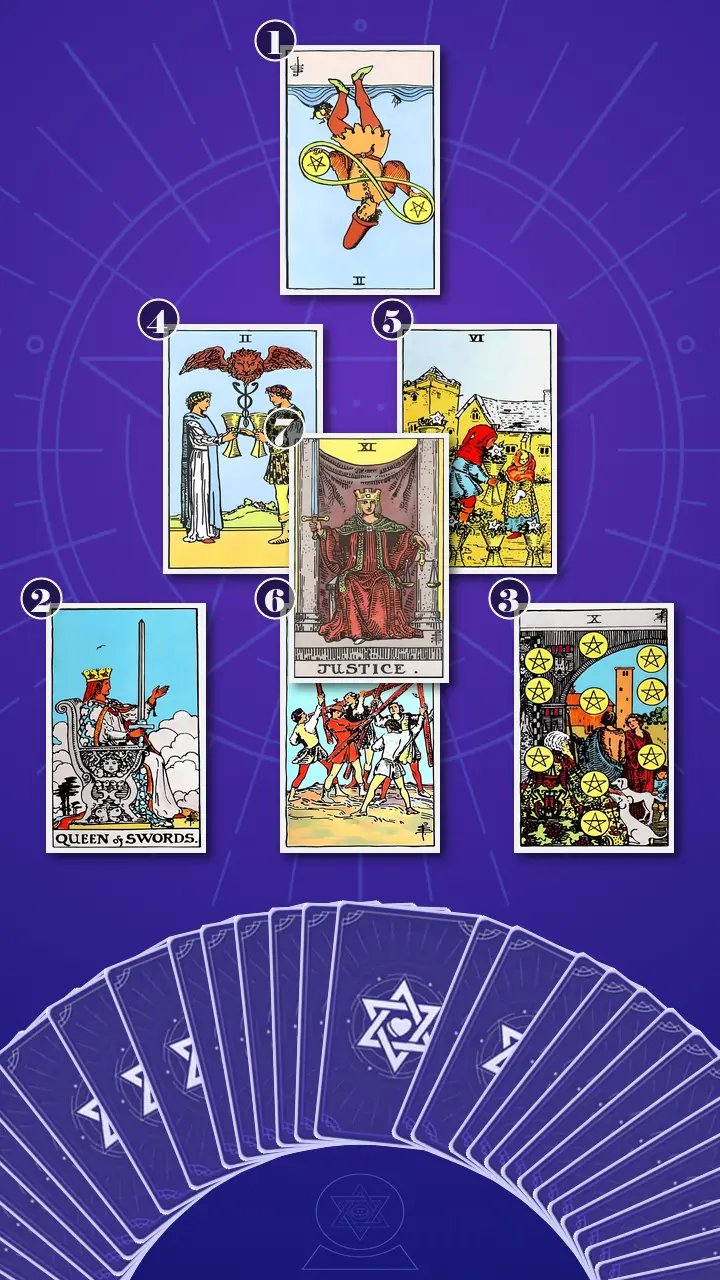
I chose the Relationship Triangle Spread, a seven-card tarot framework for partner-family conflict, divided loyalty, indirect communication, and relationship triangulation. This is how tarot works best in a situation like Jordan's: not as a verdict about another person's hidden motives, but as an objective visual map of roles, bonds, pressures, and available choices.
I placed Jordan's role at the top of a large triangle, her partner's visible relational energy at the lower left, and her family's at the lower right. Along the edges, three cards would show what she was protecting in her partnership, what she was preserving in her family bond, and what belonged to the partner-family relationship itself. The final card would sit in the centre, where it could reveal the principle capable of redistributing the pressure. I would trace the outer loop first, then move inward. A broader spread might have supplied more history, but this one answered the more important question: who was connected to whom, and where had Jordan quietly accepted work that was not hers?
Following the Lines Around the Triangle
Position 1: Two Message Threads Inside an Infinity Loop
I turned the card representing Jordan's observable peacekeeping behaviour: relaying messages, managing tone, and trying to hold both relationships in balance. It was the Two of Pentacles, reversed.
I showed her the two pentacles caught inside an infinity-shaped loop and the figure leaning unevenly while ships rose and fell behind him. In Jordan's life, the image became dinner cooling in the kitchen while she switched between a family group chat and a partner text, rewriting both sides into language she hoped nobody would reject. The issue was not that she had two important relationships. It was that she had become the permanent scheduling, translation, and emotional follow-up system between them.
I read the reversal as both excess and blockage: too much reactive management, followed by too little room for her own feelings, plans, or opinions. The loop was precise. A message arrived. Jordan softened it, explained the sender's intentions, proposed a compromise, and felt a brief drop in pressure. Then the next notification arrived, and the relief itself reinforced the belief that her intervention had prevented disaster.
“If I let them speak directly, one of them might say something that can't be taken back,” Jordan said, repeating the thought that usually drove her into the bathroom with her phone. I asked her what happened after she successfully prevented the visible fight. She looked down at the card. “I feel useful for about ten minutes. Then I get annoyed that nobody notices what I just did.”
She gave a short, bitter laugh. “That's so accurate it feels a little brutal.”
“I hear that,” I said. “The card is not accusing you of creating the conflict. It is showing the cost of the role you use to survive it. Your care is real. The question is whether every activated feeling actually requires your participation, or whether it activates the belief that you must keep everything from falling.”
Position 4: The Partnership That Needs Two Cups, Not Three
Following the first side of the triangle, I turned the card representing what Jordan was trying to protect in her partnership and why family conflict felt personally consequential. It was the Two of Cups, upright.
I pointed to the two figures exchanging cups at equal height. I read this as balance through reciprocity rather than balance through one person carrying more. Jordan wanted her partner to feel chosen and understood, but she often tried to prove loyalty by managing the family's response. The card offered a different modern-life scenario: a direct two-person conversation in which Jordan asked what support her partner actually wanted before assuming she had to control what happened next.
“You may be trying to protect the relationship by becoming a third cup,” I said, “the container that catches your partner's hurt and your family's reaction. But the card shows two people speaking at the same level. You can care about both sides without becoming the place where both sides go instead of speaking.”
I saw Jordan's fingers stop circling the rim of her water glass. She told me that she often apologised for a relative before asking her partner what would help. “I think I confuse supporting my partner with fixing the entire situation,” she said.
Position 2: The Sword and the Open Hand
I turned the card representing her partner's visible relational energy as Jordan experienced it, without claiming access to the partner's private thoughts or motives. It was the Queen of Swords, upright.
I read the Queen as direct, articulate, and boundary-aware. Jordan described her partner saying, “I'm not comfortable being spoken to that way again.” The sentence was calm and specific, yet Jordan heard it as the opening note of a family rupture. She immediately added context, interpreted the relative's intentions, and tried to make the concern sound less serious.
I placed my finger between the Queen's vertical sword and her open hand. “Firm content and relational openness can coexist,” I said. “Directness is not automatically punishment. Sometimes you are softening a sentence because it is genuinely harmful. Sometimes you are softening it because clarity makes your body expect rejection.”
This was the first place I began what I call a Communication Dissonance Audit. I listened beneath the words for a mismatch in emotional tempo. Jordan's partner tended to speak in a clean, present-tense beat: this happened, this affected me, this is my limit. Jordan's family bond carried a slower rhythm of history, tradition, and implied meaning. Jordan accelerated between them, trying to remix both rhythms into one track before anyone heard the dissonance.
“A mismatch in tempo can be uncomfortable,” I told her, “but it does not automatically mean the relationship is breaking. It may simply mean two adults need to hear each other without you editing the audio.”
Position 6: A Room Can Be Uncomfortable Without Becoming an Emergency
Along the bottom edge, I turned the card representing the partner-family tension Jordan repeatedly tried to regulate and, crucially, what belonged to those parties rather than to her. It was the Five of Wands, upright.
I saw five people holding five wands, each moving with energy but without a shared direction. I read the card as friction, competing priorities, and uncoordinated communication, not inevitable catastrophe. In Jordan's daily life, it was a family dinner near Queen Street West where a relative made a blunt comment about the weekend plan. Her partner's fork stopped halfway to their mouth. Cutlery tapped against plates, the espresso machine hissed, and Jordan reached for her water glass while changing the subject before either person could answer.
I used my Reactive De-escalation Mapping to identify the specific high note that activated her. It was not open shouting. It was the half-second pause after the comment, the moment when nobody was smiling and Jordan could not yet predict the ending. Her nervous system treated that unfilled beat as proof that she had to become the referee.
“The Five of Wands is like a group project where everyone is holding the same whiteboard marker and nobody has agreed who owns the decision,” I said. “But each figure is still holding a wand. You do not have to grab all five. A room can be uncomfortable without being an emergency.”
I saw her breath pause, her eyes lose focus as she replayed the restaurant, and then her shoulders lower by a fraction. “I changed the subject before I even knew whether my partner wanted to respond,” she said. “Everyone got through dessert, but I was furious on the TTC home.”
“That resentment makes sense,” I said. “The peace depended on invisible labour nobody had agreed to share. Conflict can affect you without becoming your assignment. If the people holding the wands never organise their own exchange, your intervention may lower the immediate volume while keeping the underlying dissonance intact.”
Position 3: The Family Archway and the Weight of Belonging
I turned the card representing the family's relational energy as Jordan experienced it, especially the weight of continuity, belonging, and established patterns. It was the Ten of Pentacles, upright.
I showed her the elder beneath the archway, the multiple generations, and the pentacles embedded across the family scene. I read the arch as both shelter and accumulated weight. Jordan was rarely responding only to the current disagreement. She was imagining what one uncomfortable birthday, changed tradition, or early departure might mean for years of shared rituals and her place in the family picture.
She told me that before difficult gatherings, she sometimes scrolled through photos from older celebrations. When her partner wanted to leave early, she felt a drop in her chest and began offering alternatives before anyone had asked. I heard the hidden equation: if the present scene changed, perhaps belonging itself was becoming unstable.
“Loyalty does not have to mean maintaining everyone's comfort,” I said. “The history is real, and so is your affection. But one disagreement does not contain the entire family structure, even when your body reacts as though the whole archway is cracking.”
Position 5: The Helpful Version of Jordan Who Arrives First
I turned the card representing the history Jordan was trying to preserve with her family, including roles learned through long familiarity. It was the Six of Cups, upright.
I read the flower-filled cup as genuine care, but I also drew her attention to the unequal height of the two figures. Around family, Jordan automatically became the helpful, composed person who noticed discomfort and made the room easier. That role may once have helped her remain connected. Now it arrived before her adult self had time to decide whether it still fit.
“This card is the old family script you can recite before anyone has spoken,” I said. “It is like running a familiar app in the background because it came preinstalled. The app may have served you once, but it is now draining the battery while your present relationships are trying to use the same system.”
Jordan's hand tightened around the glass, then released. “I know exactly who I become,” she said. “The reasonable one. The person who keeps the celebration moving. I don't even know what I think until I'm home and irritated.”
I told her the card was not asking her to reject her history or become indifferent to family. It was asking her to notice when affection turned into automatic service. She could honour the bond without reopening the childhood job of keeping every room pleasant.
When Justice Lowered the Room's BPM
Position 7: From Endless Juggling to Stable Scales
Only the centre remained. I turned the card representing the integrating principle Jordan could use to replace automatic mediation with fair responsibility and clear boundaries. It was Justice, upright.
The room seemed to quiet around it. I could hear the small clock near my cards and the faint movement of traffic outside. Justice sat still between two pillars, holding balanced scales at eye level and an upright sword in the other hand. After the unstable motion of the reversed Two of Pentacles, that stillness felt almost confrontational.
I read the card in an ordinary, usable context. Jordan could care about her partner and family while refusing to carry complaints between them. She could use the same standard with both sides: “I care about this, but I will not relay the message. Please speak to them directly.” The scales did not ask whose feelings deserved to win. They asked whether responsibility had been distributed accurately.
I watched Jordan return to her old equation: if she did not produce the correct interpretation, direct speech might become rupture, and rupture might prove she had failed to keep love safe. Justice challenged the equation without denying how frightening it felt to release control.
You do not have to juggle everyone else's reactions; let each person hold their side of the scales, and use Justice's upright sword to name what is yours and what is not.
I let the sentence remain in the air. Then I added:
Justice does not ask you to care less. It asks you to stop confusing care with carrying. Fairness begins when each person is allowed to own their words, their repair, and their relationship with the other person.
I saw Jordan's breath stop first. Her fingers remained suspended above the glass as if her body had frozen between reaching and retreating. Then her eyes moved away from the table, unfocused, while I imagined her replaying every softened text, altered dinner plan, and apology offered on someone else's behalf. Her brow tightened before her eyes reddened. “But doesn't that mean I was wrong this whole time?” she asked, and I heard a brief edge of anger beneath the hurt. Her shoulders did not relax immediately. One hand closed, opened, and then rested flat against her thigh. Finally, a long breath left her chest, unsteady but audible.
“No,” I said. “It means the strategy worked in the short term. You reduced visible tension and protected bonds you valued. It also created a cost you can no longer ignore. Finding clarity does not require you to shame the version of yourself who learned to keep the lines connected. It lets you give that version a more accurate job description.”
After ten years of working with sound and emotional rhythm, I have learned that interference often means two distinct signals are being forced through the same channel. Increasing the volume does not restore clarity. Separating the channels does. My Communication Dissonance Audit showed me that Jordan's task was not to make her partner and family speak at the same tempo. It was to stop using her own nervous system as the mixing board for both.
I compared Justice to the project trackers Jordan used at work. “Imagine adding an owner column to the conflict,” I said. “Your feelings, limits, requests, and decisions can carry your name. Their wording, apology, interpretation, and repair cannot. Peace is not the same thing as everyone being comfortable with you in the middle.”
Her face softened, but the relief brought a new vulnerability with it. “If I stop doing it, they might both be upset with me,” she said.
“They might have feelings about the boundary,” I answered. “Justice does not promise that accurate responsibility will produce immediate comfort. A boundary is not a technique for controlling their response. It is a clear statement of your participation. That is why this is not about choosing your partner over your family, or your family over your partner. It is about no longer choosing yourself as the permanent location of their conflict.”
I invited her to use the new perspective on the previous week. “Think back to one moment when this insight could have made you feel different. Not perfect, just different.”
Jordan returned to the restaurant pause. “I could have let my partner answer,” she said quietly. “I could have taken a sip of water and waited. Even if it stayed awkward, I wouldn't have had to decide the ending before either of them spoke.”
I asked her to write one recent conflict and circle only what belonged to her: her feeling, her limit, or her request. She did not have to send anything. If the exercise increased the tension in her body, she could stop after one item and ground herself. The purpose was observation, not a trial about who was right.
I named the emotional shift I could already see. This was not a leap from conflict to certainty. It was a first movement from hypervigilant peacekeeping and guilt-driven mediation toward proportionate responsibility, direct support, and steadier connection without chronic resentment. The cards had not made the decision for her. They had given her a structure in which her own judgment could become audible again.
The Justice Owner Check: Actionable Next Steps
I gathered the outer cards into one coherent story. The Six and Ten of Pentacles showed why belonging carried so much weight: Jordan had learned that being helpful and composed protected a larger family structure. The Two of Cups showed the real partnership she wanted to preserve, while the Queen of Swords showed that direct language could be clear without being cruel. The Five of Wands revealed conflict that was messy but not automatically catastrophic. At the top, the reversed Two of Pentacles showed what happened when Jordan tried to manage all of it personally. Justice did not ask her to become less loving. It asked her to replace constant motion with a consistent standard.
I identified her cognitive blind spot plainly: she had been treating equal comfort as fairness and extra effort as safety. Each successful intervention appeared to prove that she was necessary, even though it also prevented the other adults from practising direct communication. The transformation was not becoming a better mediator. It was moving from automatically translating everyone to stating one clear boundary, speaking for herself, and letting each person own their words and relationships.
I offered three small experiments rather than one dramatic confrontation:
- The Syncopation Pause and One-Sentence BoundaryWhen either your partner or a family member brings you a complaint about the other, put the phone down or let your hands rest. For three seconds, listen to one stable sound in the room and allow your emotional BPM to lower. Then say or text: “I care about this, but I'm not going to carry the message. Please talk to them directly.” Use it once without adding an explanation unless you genuinely want to share one.Start with a low-stakes issue and write the sentence in your Notes app beforehand. If the full wording feels too intense, begin with: “I'm going to step out of the middle here.”
- The Ten-Minute Justice Owner CheckAfter the next tense exchange, open a note with two columns: “Mine to Say” and “Theirs to Handle.” Put only your feelings, limits, requests, and decisions in the first column. Put their wording, apology, interpretation, and relationship repair in the second. Stop after ten minutes.Use the exact text from one recent message if the categories feel abstract. Do not send the list to anyone; it is an observation tool, not a case file or a judgment about who is right.
- The Direct Support QuestionDuring a calm ten-minute conversation, ask your partner: “When conflict with my family comes up, what support do you actually want from me?” Listen for one specific request and choose one support action that does not involve translating messages. Ask a family member a separate version only if you want to, without reporting either person's answer to the other.Have the conversation after dinner or during a quiet walk, not while the group chat is active. If it turns into speculation about another person's motives, return to the support question or end the conversation when it stops being respectful.
I reminded Jordan that these were experiments in shared ownership, not tests she could fail. A conflict could affect her without becoming her assignment. She could pause, revise her wording, or leave a conversation that became insulting. Setting a boundary did not guarantee a better response from anyone else; it simply stopped making their response the measurement of whether she was allowed to have a limit.
“Let the person who owns the words own the conversation,” I said. “Your next step is not to solve the loyalty triangle. It is to create one small interruption in the relay cycle and notice what becomes possible when your name is no longer in every owner column.”

A Week Later: Three Seconds of Room
Six days later, I received a message from Jordan. A family member had sent her a complaint about her partner after a scheduling disagreement. Jordan had felt her shoulders rise and had already started drafting an explanation. Then she used the Syncopation Pause. She listened to the kettle for three seconds, deleted the explanation, and sent the shorter boundary instead.
The response was not warmly enthusiastic. The family member replied that direct contact would feel awkward. Jordan felt guilty and nearly reopened the conversation, but she checked her two columns. The awkwardness belonged to the people who needed to speak; her own task was to be respectful and consistent. She made tea and returned to the evening she had almost surrendered to emotional follow-up.
She slept through the night. In the morning, her first thought was, “What if I made it worse?” Then she smiled, made coffee, and left the two adults to continue their own conversation.
I did not read that as a magically resolved family system. I read it as quiet proof of agency. Jordan had remained caring without becoming the communication channel. Tarot had helped her see the pattern, but she had made the pause, chosen the sentence, and tolerated the discomfort. The Journey to Clarity was not a promise that conflict would disappear. It was the moment she could hear her own rhythm without carrying every other voice inside it.
If you are the one lying awake with two message threads open, shoulders tight and stomach braced, I want you to remember why carrying everyone else's conflict can feel safer than risking the discovery that love cannot be controlled into staying intact. Noticing that fear does not make you disloyal. It means you are beginning to distinguish care from carrying.
If one message could stay with the person who actually needs to hear it, what small amount of room might return to your evening during the three-second pause before you decide whether that notification truly belongs in your channel?
This story is adapted from psychological research, written so that those in a similar struggle can see their own pattern in it — and find their next step clearly.These insights are not a substitute for professional psychological, medical, legal, or financial advice.
Learn more about our Journey to Clarity.
How did this insight land for you?
🫂 This Resonates Deeply
🌀 Living This Story
✨ Now I See Clearly
🌱 Seeing New Possibilities
🧰 Useful Framework
🔮 The Confirmation I Needed
💪 Feeling Empowered
🚀 Ready for My Next Step
Author Profile
 AI
AI“Through ten years of sound energy research, I’ve found that when we struggle, it's usually just our internal rhythm falling out of sync under pressure. I know firsthand the frustrating helplessness of wanting to move forward but feeling paralyzed. Without overwhelming theories, I want to be the soothing background track that helps you recalibrate, turning your heavy burdens back into a light, effortless, and harmonious melody.”
In this Love Tarot Reading :
Core Expertise
- Communication Dissonance Audit: Diagnosing arguments not by the words spoken, but by the fundamental mismatch in emotional tempo and frequency.
- Reactive De-escalation Mapping: Identifying the specific 'high notes' of defensive anger that shatter the emotional safety of the connection.
Service Features
- The Syncopation Pause: A 3-second acoustic grounding technique to interrupt an escalating argument, lowering the emotional BPM before permanent damage is done.
Also specializes in :
Explore Related Patterns:
Conflict AvoidanceJordan drafts three softer replies behind a locked bathroom door, dilutes her partner's calm limit, and changes the subject during the restaurant pause before anyone can answer. You can see conflict avoidance in the reflex to remove discomfort at its first visible sign, even when nobody has shouted and no outcome has been established. Editing the moment creates immediate quiet, so your nervous system records avoidance as successful protection. The cost appears later: the original disagreement remains intact, the other people lose the opportunity to speak for themselves, and the frustration you prevented in public returns as private resentment. The deeper mechanism is not a preference for politeness; it is the learned equation that visible tension signals relational danger and therefore must be neutralised before it can develop.
Defensive OverfunctioningJordan receives separate messages about the same disagreement and immediately starts translating tone, managing logistics, and processing both sides' reactions. At dinner she changes the subject before either adult can respond, and in the bathroom she drafts three softer replies while her own evening waits outside the door. You can recognise defensive overfunctioning when care is converted into extra labour whenever tension appears. The brief drop in pressure after each intervention acts as negative reinforcement: visible conflict decreases, so taking over feels necessary and effective. Yet the unresolved issue returns through another message, while usefulness gives way to resentment because nobody sees the work you absorbed. The pattern does not mean you caused the conflict; it shows how doing more than your share became a defence against the uncertainty of letting other adults manage their own relationship.
Family Role RegressionAround family, Jordan automatically becomes the reasonable, composed person who notices discomfort and keeps the celebration moving. She scrolls through older family photos before difficult gatherings and often reaches home before discovering what she actually thought. You can see family role regression when an established version of you takes control faster than your present-day judgment can evaluate the situation. The old role offers continuity because usefulness and emotional control have become associated with secure belonging. Under pressure, repeating that role feels safer than introducing an adult limit that might change the familiar family scene. Recognising the regression does not require rejecting your history or affection; it creates enough reflective distance to ask whether the role still fits the current relationship and whether the room genuinely needs you to manage it.
Guilt-Driven People-PleasingJordan says that stepping back feels like betrayal, even while recognising that the argument is not technically hers. After she sends a respectful boundary, the family member's discomfort triggers guilt and nearly pulls her back into explaining. You can recognise guilt-driven people-pleasing when another person's disappointment is treated as evidence that your limit was unkind or disloyal. Mediation reduces that guilt quickly because everyone receives proof that you are attentive, helpful, and still connected. The relief comes at the price of making other people's comfort the test of whether you are allowed to step out of the middle. A boundary may leave someone awkward or disappointed without becoming a moral failure; tolerating that distinction allows care to remain voluntary instead of being compelled by guilt.
Relational HypervigilanceOne clipped reply sends Jordan checking the group chat, the seating plan, and everyone's mood, while punctuation and response timing become signals to decode. At dinner, the half-second when nobody smiles activates her before either person has chosen what to say. You can recognise relational hypervigilance in this continuous monitoring of small interpersonal cues for advance warning of rejection or rupture. Scanning can create a temporary sense of preparedness, but it narrows attention around threat and leaves little room for neutral or manageable explanations. An ambiguous silence begins to feel like evidence rather than missing information, so your intervention arrives before reality can develop. The monitoring is intended to protect connection; in practice, it keeps your body and attention organised around conflicts that may not require your action.
TriangulationJordan's partner and relative send her separate accounts of the same awkward interaction, and she becomes the person who interprets, softens, and carries each side's meaning. At the restaurant, she interrupts the direct exchange before either person can answer. You enter a triangulated position when two people's tension is repeatedly routed through you instead of being addressed within their own relationship. Standing in the third position can feel protective because it lowers the immediate emotional volume and gives you a concrete job. It also prevents the other adults from practising direct communication while making their awkwardness dependent on your availability. The useful audit is not whether you care about the outcome, but whether your care requires you to become the route through which every complaint, explanation, and repair must travel.
CatastrophizingA full stop instead of an emoji, a delayed reply, or one uncomfortable pause leads Jordan to imagine words that cannot be taken back and relationships damaged for years. When a changed tradition or early departure feels capable of cracking the whole family structure, you are no longer responding only to the present interaction. Your mind has compressed multiple possible outcomes into the most threatening one. Catastrophizing turns intervention into an apparent emergency response: if the projected rupture feels certain, translating and controlling the exchange seems proportionate. That prediction can remain untested because mediation prevents you from observing whether the other adults could tolerate friction, clarify intent, or repair a mistake themselves. Separating discomfort from disaster restores more realistic options without requiring you to pretend that the relationship does not matter.
Boundary DiscernmentSix days later, Jordan deletes the explanation she has already started and sends a shorter message stating that she cares but will not carry the complaint. She then checks two ownership columns and leaves the other adults' wording, awkwardness, and repair outside her assignment. You can see boundary discernment in the ability to separate what affects you from what requires your participation. This is more precise than emotional withdrawal because Jordan remains available for her own feelings, limits, requests, and chosen forms of support. The boundary does not attempt to control whether either person approves of it; it clarifies where her responsibility ends so their direct relationship can exist. When you distinguish care from carrying, connection no longer requires your name to appear in every communication role.
Cognitive DissonanceJordan feels useful for about ten minutes after preventing a fight and then becomes resentful that nobody noticed the work. When the cost of mediation is named, she asks whether that means she was wrong the entire time. You can hear cognitive dissonance in the collision between two conclusions: carrying the conflict proves that you are loving, while carrying it also removes your voice and repeatedly harms your own sense of fairness. Maintaining the mediator role temporarily protects the familiar self-image of being helpful and loyal, even as resentment supplies contradictory evidence. The tension can produce more explaining, more intervention, or harsh self-judgment because updating a long-held belief feels destabilising. A more workable interpretation is that the strategy reduced tension in the short term and now requires revision; recognising its cost does not invalidate the care that originally motivated it.
Explore Related Struggles:
Autonomy Guilt BindJordan explicitly says that stepping back feels like betrayal, and after sending one respectful boundary she nearly reopens the conversation when her relative finds direct contact awkward. The boundary gives her room to choose her participation, but the resulting discomfort immediately makes that room feel morally unsafe. You become caught when autonomy appears to require proving that you care less. One part of you wants each adult to own their words, while another treats their disappointment as evidence that you have failed at loyalty. The bind loosens when guilt is recognized as a reaction to changed participation rather than a verdict on the legitimacy of your limit.
Boundary CollapseJordan becomes the translator, mediator, logistics coordinator, and emotional follow-up system as soon as tension appears. Her partner's hurt, her relative's intentions, their wording, and the possible repair all enter her space, while her own opinion often does not emerge until the exchange is over. The boundary collapses when being affected by a conflict becomes indistinguishable from being assigned to resolve it. You can no longer locate where support ends and ownership begins, so other people's responsibilities expand until they displace your plans, feelings, and limits. Restoring the distinction does not require indifference; it allows care to remain yours while their messages, interpretations, and repair remain theirs.
False Responsibility LoopEach message starts the same sequence: Jordan softens the wording, explains the sender's intentions, proposes a compromise, and feels a brief drop in pressure. She knows the argument is not technically hers, yet every quiet outcome seems to confirm that she prevented something worse. When you repeatedly receive relief after taking responsibility, the relief can lock responsibility onto you even though the underlying conflict remains with other people. You end up carrying outcomes you cannot fully control, and the next disagreement appears to demand the same intervention. The loop becomes visible when short-term quiet is separated from actual ownership and lasting repair.
Inherited Repair BurdenAround her family, Jordan automatically becomes the reasonable, composed person who notices discomfort and keeps the celebration moving. The role activates so quickly that she often does not know what she thinks until she is home, after the room has been stabilized for everyone else. An inherited repair burden forms when a familiar way of maintaining connection keeps assigning you work before your present-day judgment can enter the scene. Care is still genuine, but it arrives already attached to an old job description: absorb the tension, preserve the ritual, and delay your own response. Naming the inherited assignment creates room to decide which acts of care still belong to you now.
Monitoring-Safety FusionA clipped reply sends Jordan checking the group chat, the seating plan, and everyone's mood, while a full stop or half-second silence prompts her to act before anyone else has responded. At dinner, she changes the subject during the pause itself, deciding the likely ending before either adult has spoken. When monitoring becomes fused with safety, you cannot simply notice a tense signal; you feel required to manage the outcome attached to it. Language, timing, and facial pauses become instructions to intervene, even when no rupture has occurred. Distinguishing an uncomfortable cue from an established emergency gives you enough space to observe what actually happens before assigning yourself a task.
Performative HarmonyJordan hides a critical message in the bathroom and drafts three softer replies, then later changes the subject before her partner or relative can answer at dinner. Everyone gets through dessert, but the disagreement remains untouched and Jordan leaves furious about the invisible work that produced the calm. When harmony depends on your editing, redirection, and silence, the peaceful surface conceals an unresolved exchange while making your labor disappear from view. You are present as the system that keeps the room comfortable but absent as a person with your own reaction. Recognizing that visible quiet can coexist with unfinished conflict lets you evaluate peace by shared responsibility rather than by whether nobody objects in public.
Triangulated BelongingJordan receives separate messages from her partner and relatives, then becomes the translator, mediator, and logistics coordinator between them. Both relationships matter to her, so every disagreement places love for her partner and belonging within her family on the same narrow middle ground. When you occupy that middle, staying connected can begin to feel conditional on keeping the two sides connected to each other. You are pulled to protect both bonds without being able to control either one, creating a loyalty triangle in which stepping aside appears to endanger your own place. Seeing the triangle clearly allows you to remain part of both relationships without serving as the permanent route between them.
Explore Related Emotions:
Approval AnxietyJordan hears her partner say, "I'm not comfortable being spoken to that way again," and immediately begins adding context and softening the concern. Later, when she considers leaving the two sides to communicate directly, her first objection is that both may become upset with her. Approval Anxiety emerges when your own limit is measured against the possibility of disappointing more than one important person at once. In Jordan's triangle, maintaining acceptance on both sides has become closely tied to remaining helpful and easy to receive. Naming that expectation makes room to ask whether disapproval signals actual relational danger or simply another person's discomfort with changed participation.
Boundary GuiltJordan explicitly knows that the disagreement is not technically hers, yet stepping back feels like betrayal. Six days later, she sends a respectful request for direct communication, receives an unenthusiastic reply, and almost reopens the conversation to make the other person's awkwardness disappear. When care has repeatedly been expressed through carrying, a boundary can feel like wrongdoing even when it distributes responsibility accurately. Boundary Guilt names the internal penalty you may experience for declining work that was never solely yours. Seeing that penalty clearly allows you to evaluate the limit by its fairness rather than by whether everyone immediately approves of it.
Cautious Self-TrustThe family member does not respond warmly to Jordan's new boundary, and the familiar urge to explain returns immediately. She checks the owner columns instead, keeps the boundary intact, and notices the next morning's question without treating it as proof that she made the wrong choice. Cautious Self-Trust grows when you allow your own assessment to remain credible without immediate external approval. Jordan is not certain that the interaction will unfold comfortably. She is beginning to trust that respectful participation can still be valid when other people would prefer the older arrangement.
Enmeshed ResentmentSeparate complaints about the same conversation arrive in Jordan's inbox, and she becomes translator, mediator, and logistics coordinator before anyone has agreed that this is her role. She successfully keeps dinner moving, but the calm remains at the table while she carries anger onto the TTC ride home. Enmeshed Resentment develops when you remain emotionally fused with other people's exchanges while privately objecting to the amount of work required from you. The resentment is not evidence that your care is false. It registers the mismatch between how much of the relationship system you are carrying and how little choice, recognition, or reciprocity accompanies that work.
Grounded AgencySix days later, Jordan feels her shoulders rise and sees that she has already begun drafting an explanation. She listens to the kettle for three seconds, deletes the draft, sends one respectful boundary, and returns to the evening she would previously have surrendered to emotional follow-up. Grounded Agency is present because the choice remains hers even while discomfort continues. You do not need to control the response in order to act from a clear understanding of your role. Jordan's pause restores a practical form of authorship: she can care, state her participation, and leave the other adults' words and repair under their own names.
Hypervigilant AnxietyA clipped family message at 8:47 p.m. sends Jordan into the bathroom with her phone, where she drafts three softer replies while her shoulders remain raised. At dinner, even the half-second between a blunt comment and someone else's response is enough to make her reach for the subject-changing move before either adult has spoken. When punctuation, pauses, and facial shifts all feel like early warning signals, you can become watchful long before there is an actual emergency. Hypervigilant Anxiety names that braced inner weather. Recognising it creates a crucial distinction between noticing tension and accepting responsibility for controlling its outcome.
Regulated CourageJordan's shoulders rise before she has made a conscious decision, and the softer explanation is already taking shape on her screen. She does not force the physical reaction to disappear. She stays with one stable sound for three seconds and then sends the shorter sentence without padding it against every possible objection. Regulated Courage is the capacity to make a deliberate choice while your body still expects relational consequences. You are not required to feel fearless before allowing other adults to own an awkward conversation. The courage lies in creating enough internal room to choose your participation instead of automatically obeying the first alarm.
Relational Catastrophe DreadAt the Queen Street West dinner, Jordan sees her partner's fork stop and changes the subject before the silence can reveal what either person intends to do. A changed plan or early departure does not remain one uncomfortable event in her mind. It rapidly expands into a possible fracture running through her partnership, family history, and place in the shared picture. Relational Catastrophe Dread is the feeling that a manageable disagreement may become irreversible damage if you do not intervene immediately. The dread explains why peacekeeping feels less like a preference and more like emergency prevention, even when the available facts show only friction between adults who still have choices of their own.
Usefulness-Based Belonging FearAround family, Jordan automatically becomes the reasonable person who notices discomfort and keeps the celebration moving. She can change the subject, offer alternatives, and apologise for someone else before she has had enough time to discover what she herself thinks. Usefulness-Based Belonging Fear appears when your secure place in a relationship feels connected to the service you provide inside it. If being helpful has long protected connection, stepping out of the role can feel like risking your place in the family picture. Naming that fear lets you examine whether belonging can remain intact when your contribution becomes chosen, limited, and visible rather than automatic.
Control FatigueDinner cools while Jordan switches between two message threads, rewriting each side into language she hopes the other will accept. Every successful intervention produces about ten minutes of usefulness before another notification, scheduling issue, or tonal ambiguity restarts the same monitoring loop. Control Fatigue is the exhaustion of trying to produce relational safety through continuous adjustment. You may be highly capable and still become depleted when the task has no stable endpoint and depends on predicting other adults' reactions. The fatigue helps expose an important limit: constant management can lower the immediate volume without giving you durable control over either relationship.
Unseen Effort GriefAfter Jordan softens the messages, changes the dinner subject, and manages the follow-up, everyone else experiences a smoother interaction. Her contribution disappears into that smoothness. She feels useful briefly and then notices that nobody has seen the evening, attention, and emotional precision required to produce it. Unseen Effort Grief is the ache of giving substantial care that becomes visible only when you stop providing it. The feeling points beyond a wish for praise. It reflects the loss of time, voice, and reciprocity inside a role whose success depends on making its own cost invisible.
Conflict HangoverEveryone gets through dessert after Jordan changes the subject, but she remains furious on the TTC home. After the later messaging conflict, the question of whether she made things worse returns as her first thought the next morning, even though the conversation has already been handed back to the people involved. A Conflict Hangover is the emotional residue that remains after visible tension has passed. When you take responsibility for anticipating every consequence, the exchange can continue occupying your body and attention long after the shared room is quiet. Recognising the residue helps separate being affected by conflict from being appointed to finish it.
Explore Related Contexts:
Family Script PressureBefore difficult gatherings, Jordan scrolls through photographs of older celebrations and then arrives as the reasonable person who notices discomfort, offers alternatives, and keeps the event moving. When a relative later sends her a complaint about her partner and says direct contact would feel awkward, that familiar role is actively recruited again. A family script becomes external pressure when other people continue routing present-day problems through the role you have historically performed. The expectation may remain largely unspoken, but it is reinforced each time your mediation preserves the gathering and saves someone else from initiating a difficult conversation. This helps explain why the peacekeeping feels automatic and socially costly to interrupt. You can recognize the history behind the role without treating that history as a permanent job description, leaving room to participate in the family as an adult with limits rather than as its default conflict manager.
Triangulated Family MediatorJordan receives separate messages about the same awkward interaction, rewrites each side into softer language, and changes the subject at dinner before her partner or relative can answer. Even six days later, a relative still sends the complaint to Jordan instead of contacting her partner directly. When two adults repeatedly use you as the route to each other, you are no longer offering occasional support; you have been placed inside a communication triangle. Your short-term interventions lower the visible tension, but they also let both sides postpone direct ownership of their wording, limits, and repair. The recurring peacekeeping is therefore anchored in an external relationship structure, not simply in how much you care. Seeing the triangle clearly gives you a point of agency: you can remain connected to both relationships without continuing to serve as the permanent channel between them.
Emotional Labor ImbalanceJordan checks the family group chat, monitors the seating plan, edits three versions of a reply, apologizes for a relative, changes the subject at dinner, and manages the follow-up after everyone else has moved on. Her own evening, plans, and opinions are repeatedly displaced by work that remains largely invisible to the people benefiting from it. The imbalance lies in how responsibility is distributed. You may be surrounded by several adults with equal access to words and direct contact, yet one person ends up carrying the monitoring, interpretation, logistics, and repair required to keep every interaction smooth. Naming that workload makes the external arrangement visible. It allows you to distinguish freely chosen care from an unshared service role and to assess which parts of the relational work can be returned to the people whose conflict created it.