When the Therapist Friend Deletes the One Sentence They Need
I often meet the late-twenties city friend who can untangle a twelve-minute voice note before bed but cannot send, “Can you talk tomorrow?” Jordan, a 27-year-old non-binary UX designer in Toronto, arrived at my virtual table carrying that exact contradiction.
Jordan told me what had happened at 11:40 the previous night. They had sat on the edge of their bed while the radiator clicked and the last streetcar sounds thinned below the condo window. Their phone felt warm in both hands, and their eyes stung as they listened to a friend's voice note for the second time, drafted a careful reply, and offered three useful next steps.
Then Jordan typed, “Could you talk for a few minutes tomorrow?” Their throat seemed to close like elevator doors while their chest held the emergency brake. They pictured their friend feeling trapped, deleted the request, and sent a heart reaction instead.
“I know exactly what to say when it's someone else's problem,” Jordan said. “But by the time I can talk about my own stuff, I've already handled it alone. Why am I always my friends' therapist but afraid to need them back?”
I heard more than simple reluctance in the question. Jordan wanted to remain dependable, but they were paying for that identity by keeping their own difficult days off-screen. Being useful can feel safer than being known. The problem is that usefulness can secure a role in a friendship without allowing the whole person to enter it.
“I don't think your care is the problem,” I told them. “I think care has become the one character you're permitted to play. I want us to look at how that role protects you, what it costs you, and how you might try one small act of reciprocity without surrendering your boundaries. We're not searching for a verdict about your friends. We're drawing a map through the fog.”

Choosing the Bridge: A Relationship Spread for Friendship Reciprocity
I invited Jordan to place both feet on the floor, loosen their grip on the phone, and take one unforced breath. I shuffled while they held a focused question: “What keeps me in the listener role, and what would mutual support look like in practice?” The pause was a psychological threshold, not a supernatural performance. It gave the nervous system time to stop answering every hypothetical at once.
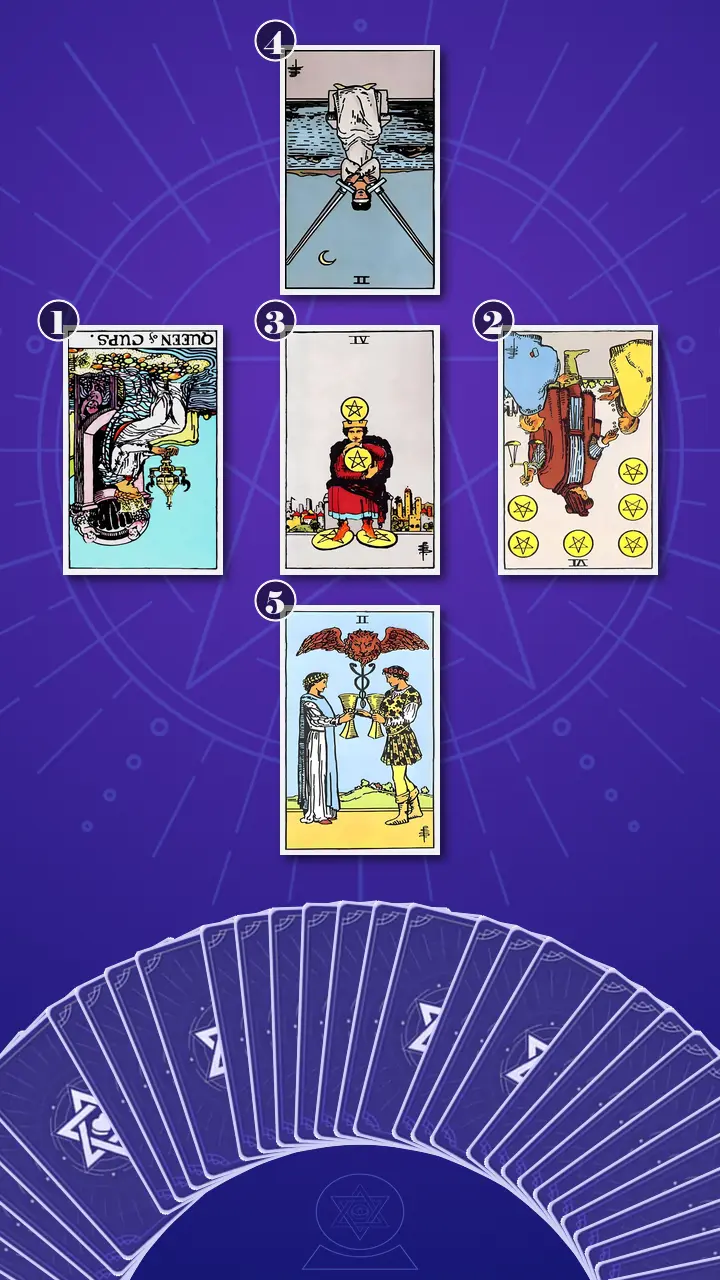
I chose the five-card Relationship Spread · Context Edition. For anyone wondering how tarot works in a friendship reading, I use the cards as structured prompts that separate role, expectation, underlying protection, communication pattern, and possible practice. This focused spread offered enough context to examine emotional reciprocity without adding the unrelated layers of a larger Celtic Cross.
I arranged the cards like a bridge crossed by a plumb line. The first card would show Jordan's visible role as the default listener. The second would examine what Jordan expected friends could return, without pretending I could access anyone else's private thoughts. The centre card would reveal the protective foundation. Above it, the fourth would expose the communication stalemate. Below it, the fifth would ground the reading in one present-tense practice of mutual care.
I also made my boundary clear: tarot could not promise that every friend would respond well, and I would not use it to label anyone loyal or disloyal. Card meanings in context can make a pattern easier to see. Jordan would remain the person deciding which friendships to test, what to disclose, and when to stop.
The Sealed Cup and the Invisible Ledger
Position 1: The Listener Who Never Closes Their Support Queue
I began with the position representing Jordan's current role as the default listener and the overextended caregiving behaviour keeping that role in place. I turned over the Queen of Cups, in the reversed position.
The card showed a figure absorbed in an ornate, lidded cup. I brought Jordan back to 11:40 p.m.: the twelve-minute voice note, the thoughtful summary, the practical next steps, and the deleted sentence. The polished draft resembled the Queen's closed vessel. It contained rich emotional material, but none of Jordan's feelings could move from the container into the relationship.
I read the reversed energy as an excess of receptivity flowing outward and a deficiency of that same care flowing inward. Jordan's empathy was real. The blockage appeared when they treated unlimited availability as proof of love and personal need as a service interruption. In UX terms, they were conducting careful user research on everyone else's emotional experience while marking their own data “not ready to share.”
“I know what they need, so let me stay with that,” I said, voicing the pattern I could see. “What I need can wait. That's not a lack of emotional intelligence. It's emotional intelligence recruited to keep you out of view.”
Jordan gave a short laugh with no amusement in it. Their thumb rubbed the edge of their phone case. “That's so accurate it's almost rude,” they said. “I tell myself I'm being caring. I don't ask whether I actually have the capacity.”
“The care is still caring,” I replied. “We don't have to insult one of your strengths to notice that it has been overextended. The useful question is whether each response comes from genuine capacity or from fear that you must stay indispensable.”
Position 2: The Friendship Spreadsheet Nobody Else Can See
I moved to the position examining the support Jordan imagined friends were able or willing to return. The card was the Six of Pentacles, reversed.
I emphasized that this card could not tell me what Jordan's friends secretly thought. It showed the exchange Jordan expected before making a direct request. Jordan recalled standing on the Line 1 platform at St George station while train brakes shrieked and damp wool sharpened the crowded air. A friend had written, “You can always call me, by the way.” Jordan had typed, “Thanks, I might take you up on that,” remembered one six-hour reply delay, and changed the message to, “All good now lol.”
The reversed Six showed reciprocity in a state of blockage and distortion. The scales had become an invisible friendship spreadsheet: the friend's workload, previous response time, Jordan's level of distress, and every favour exchanged were calculated privately. Giving felt controlled. Receiving felt over budget.
“They are busy. This isn't serious enough. They replied late last time. I should be able to handle it,” I said, letting the calculation gather speed before stopping it. “Those may be understandable predictions, but they are not the same thing as observable availability. An unasked question cannot give you reliable evidence.”
Jordan's breath paused. Their gaze moved away from the cards as if replaying an old chat, and then their shoulders shifted by a fraction. “So I've been treating silence after a question I never asked as an answer.”
“Yes,” I said. “A delayed reply can still matter, especially if unreliability becomes a pattern. But one delay is not a complete performance review of the friendship, particularly when no time frame or type of support was named.”
Position 3: The Grip That Protects and Immobilizes
I returned to the centre, the position revealing the foundation beneath Jordan's pattern: the fear that needing support could threaten belonging and the effort to preserve safety through control. I turned over the Four of Pentacles, upright.
The figure clutched one pentacle over the chest while two more pinned both feet. I asked Jordan about the difficult performance conversation they had mentioned. They described sitting in a glass office phone booth at lunch, the ventilation humming while cold coffee left a metallic taste. They had written three versions of a message to a trusted friend, removed every sentence that sounded visibly upset, and sent a meme.
The Four's Earth energy was not deficient. It had hardened into excess. Control protected Jordan from being misunderstood, refused, or seen differently, but it also prevented movement. Their emotional permissions were set to view-only, and even approved contacts could not collaborate.
“The grip that protects your place can also keep you outside the exchange,” I said. “What does your body believe it might lose if you loosen that grip by one sentence?”
I flashed back to an editing suite where I had once watched a beautiful scene become bloodless after every imperfect pause was cut away. The footage looked composed, but the human truth had disappeared. Jordan's drafts carried the same risk: each revision made the message more manageable and less able to communicate what support was actually needed.
Jordan's fingers tightened around their mug, held for a moment, and then released. “I think I could lose the version of me they like,” they said. “The calm one. The person who doesn't make things complicated.”
I nodded. “Then withholding is doing a real job. It protects a place you value. We can respect why you learned the strategy without pretending it still gives you the closeness you want.”
Position 4: Nineteen Reply Scenarios and No Actual Reply
I turned to the position exposing the central challenge: withholding a request, receiving short-term relief, and treating the resulting loneliness as proof that asking would not be safe. The Two of Swords appeared reversed.
I asked Jordan to picture the previous Sunday at 9:07 p.m. Rain had tapped the condo window, the refrigerator motor had started behind an untouched bowl of pasta, and the phone screen had cast blue light across the counter. Jordan had changed “I need to talk” to “No worries if not,” then to “It's not a big deal,” and finally to nothing.
The reversed card showed Air in overload. The mind was running nineteen possible reply scenarios in separate browser tabs, trying to find wording that could guarantee a zero-risk response. Like the communication avoidance in Normal People, both sides of the relationship were being managed inside one person's head. The blindfold turned predictions into apparent facts, while the crossed swords protected the vulnerable centre from any new information.
“Perfect wording isn't available because language cannot control another person's capacity,” I said. “Usable clarity is available: one need, one time frame, and room for an honest answer.”
Jordan looked at the open chat on their phone. “So the goal isn't to explain the entire performance meeting perfectly. It's just to ask whether they can listen.”
“Exactly. The missing element in this spread is Fire, the small initiated action that lets insight become evidence. Reciprocity starts with a request, not a silent test.”
When the Two of Cups Met Jordan at Eye Level
Position 5: Two People, Two Cups, No Permanent Therapist
The room seemed to quiet as I reached the grounded integration point, the position identifying the practice needed for transformation: one clear, bounded request that allowed care to move in both directions without forcing either person into a role. A streetcar bell sounded faintly through Jordan's window, distinct against the softer rain. I turned over the Two of Cups, upright.
Two figures stood at equal height, each holding a separate cup. I read this as Water in balance: not unlimited access, not compulsory availability, and not one person dissolving into another's needs. The modern-life version was simple. Jordan could say exactly what kind of support would help, allow a friend to accept, decline, or suggest another time, and participate as a peer rather than the friendship's permanent emotional specialist.
This was where I used what I call my Sidekick Syndrome Diagnosis. It is not a mental-health diagnosis, and it does not assume that a friend group has acted maliciously. It is my way of identifying the restrictive character a group has come to expect: the clown, the organizer, the peacekeeper, or, in Jordan's case, the therapist. The role had been rewarded because it kept everyone comfortable. Jordan had also kept performing it because a familiar supporting role felt safer than entering the scene with an unscripted need.
The Two of Cups offered a visual rewrite. Jordan did not have to abandon empathy or seize the emotional spotlight. They only had to step down from the therapist's chair and meet one friend at eye level. Two autonomous people could name need and capacity without either becoming the other's project.
I could see Jordan still caught inside the demand to make the correct decision: disclose and risk changing the friendship, or stay quiet and preserve a role that already left them lonely. Both outcomes were still being rehearsed privately, with no room for a real second person to enter.
You do not have to earn closeness by holding every cup alone; make one honest, bounded request and let the Two of Cups represent support moving both ways.
Reciprocity starts when you replace the silent test with one clear request and let the other person answer for themselves.
I let the silence remain.
For one beat, Jordan stopped moving. Their breath caught before it could become an exhale, and their fingers hovered above the phone as if the deleted message had reappeared. Their eyes lost focus, widened slightly, and then returned to the two equal figures. Their shoulders began to drop, but the release brought a flash of anger with it. “But doesn't that mean I've helped create this?” they asked, their voice low and suddenly sharp. “Does it mean I was wrong about my friendships the whole time?” I watched their jaw tighten, their eyes brighten, and one hand close before slowly opening again. “It means the strategy protected you from uncertainty,” I said. “It does not make the loneliness your fault, and it does not prove every friend is available. It means the old scene cannot provide the evidence needed for the next one.” Jordan swallowed. A shaky breath finally left their chest, followed by a small, almost embarrassed laugh. The relief was real, but so was the exposed feeling of realizing that a clear path would ask something of them.
“Now, with this new perspective, think back to last week,” I said. “Was there a moment when this insight could have made the situation feel different?”
Jordan returned to the St George platform and the message saying, “You can always call me.” “I could have asked whether they had ten minutes after work,” they said. “I would have known what they actually meant instead of deciding for them.”
I set a ten-minute timer and invited Jordan to draft: “Do you have ten minutes tomorrow to listen? I don't need fixing, and it's okay to suggest another time.” I asked them to remove every line that called the need silly or unimportant. They could send it, save it, shorten it to a two-minute check-in, or stop if the exercise felt too intense. The experiment remained theirs.
Then I asked them to imagine an honest answer: “I have ten minutes after seven. Do you want listening or advice?” Jordan read the words aloud. “Their answer belongs to them,” they said slowly. “Making the request doesn't make me too much.”
I named the transition carefully. This was not sudden certainty about every friendship. It was the first movement from earning belonging through emotional usefulness toward trusting clear, consensual reciprocal care. Jordan was moving from being useful to being known, while keeping both people's boundaries intact.
The Role Resignation Act: A Ten-Minute Way Back Into the Friendship
I drew the five cards into one coherent story. The reversed Queen showed Jordan's care flowing outward while their own experience remained sealed. The reversed Six showed them expecting imbalance and consulting an invisible ledger instead of making an explicit request. The Four revealed why: control protected the dependable identity they believed secured belonging. The reversed Two of Swords showed that perfect-wording paralysis could postpone exposure but could not resolve loneliness. The Two of Cups opened the sealed single vessel into two separate cups raised between equals.
The cognitive blind spot was not simply “my friends do not support me.” It was treating the absence of a response to an unasked need as reliable evidence, then using that imagined evidence to justify more overfunctioning. Jordan had also mistaken scheduling for inconvenience and a single response for a verdict on their worth.
The direction was not dependence, total disclosure, or equal emotional labour measured minute by minute. It was a two-way practice in which care could be requested clearly, offered with consent, and received without forcing either person to surrender agency. Because no Wands had appeared, I told Jordan that the cards could identify the pattern, but only their chosen action could introduce the missing Fire.
Resigning From the Character Without Leaving the Cast
I call my intervention The Role Resignation Act. It is a conversational pivot, not a dramatic announcement. Jordan would resign from playing the permanent therapist in one specific interaction, then offer a simpler role: friend, peer, person with both care and limits. They did not need to confront the group chat, reveal everything, or prove that the friendships were secretly perfect. They only needed one scene with a different line.
- Send the One-Sentence Reciprocal Ask.This week, choose one trusted friend and send: “Do you have ten minutes tomorrow to listen? I don't need advice, and another time is completely okay.” Place a ten-minute calendar block beside the request, then put the phone face down for five minutes and get a glass of water instead of watching the typing indicator.Tip: Keep the genuine opt-out, but remove phrases such as “this is stupid” or “ignore me.” Consent makes the exchange more trustworthy. A no, delay, or scheduling change is information about current capacity, not a verdict on your worth.
- Practice Capacity Before Caretaking.When the next emotionally heavy voice note arrives, wait ten minutes before replying. Choose one honest option: “I can listen,” “I can help problem-solve,” or “I can't do this tonight.” If needed, send: “I care about this, but I only have energy for a short reply tonight. Can we pick it up tomorrow?”Tip: Try the practice for one week. When someone checks on you, pause before using humour, a GIF, or another question. Give one truthful sentence first. You control how much you disclose, and a capacity statement does not obligate you to explain why your bandwidth is limited.
“A clear ask lets both people keep their agency,” I told Jordan. “Your task is not to force reciprocity. Your task is to stop completing both sides of the friendship inside your own head.”

A Week Later: The Reply Was Information, Not a Verdict
Seven days later, I received Jordan's screenshot of the ten-minute ask. Their friend had replied, “Tomorrow is packed, but Thursday at seven works. Listening or advice?” After the call, Jordan slept through. At dawn, “Was I too much?” still arrived first. They smiled, then made coffee without reopening the chat.
Jordan told me the reschedule would previously have felt like soft rejection. This time, they let it mean what it said: Thursday at seven. The conversation did not solve their work problem or transform the entire friend group. It gave them ten minutes of being visible while another person remained free, honest, and present.
I did not credit the cards with producing that response. The spread had made Jordan's pattern visible, but Jordan supplied the missing action. They chose the friend, wrote the sentence, tolerated the five quiet minutes after sending, and allowed the answer to belong to someone else. The pen had returned to their hand.
I know that when a conversation finally turns toward us, the throat can tighten and the chest can brace. Many of us become suspended between wanting to be known and fearing that the need itself could cost us our place. If that happens to you, I hope you remember the movement from one sealed cup to two open ones. Not certainty. Not guaranteed availability. Just a clear invitation that lets reality enter the friendship.
I will leave you with the question I would place beside your own Two of Cups: if you allowed one trusted friend to meet you for just ten honest minutes, what small, specific request would you want to let them answer for themselves?
This story is adapted from psychological research, written so that those in a similar struggle can see their own pattern in it — and find their next step clearly.These insights are not a substitute for professional psychological, medical, legal, or financial advice.
Learn more about our Journey to Clarity.
How did this insight land for you?
🫂 This Resonates Deeply
🌀 Living This Story
✨ Now I See Clearly
🌱 Seeing New Possibilities
🧰 Useful Framework
🔮 The Confirmation I Needed
💪 Feeling Empowered
🚀 Ready for My Next Step
Author Profile
 AI
AI“I’ve always felt our lives are films currently in production. As an artist, I know that when you feel stuck, it’s often because you’ve bravely stayed in a painful scene for just a little too long. I’m not here to coldly analyze you. I want to sit closely with you, look at those difficult moments with profound empathy, and gently hand you the pen so you have the courage to write your next beautiful act.”
In this Friendship Tarot Reading :
Core Expertise
- Clique Power Dynamics: Deconstructing the subtle jealousy, micro-aggressions, and implicit hierarchies hidden within tight-knit friend groups.
- Sidekick Syndrome Diagnosis: Identifying how your friend group has boxed you into a specific, restrictive role (e.g., the clown, the therapist) to maintain their status quo.
Service Features
- The Role Resignation Act: A creative conversational pivot designed to gracefully but firmly refuse your assigned 'character' during your next group interaction.
Also specializes in :
Explore Related Patterns:
Emotional Self-CensorshipJordan deletes "Could you talk for a few minutes tomorrow?", removes every sentence that sounds visibly upset from another message, and eventually replaces a request with a meme or a heart reaction. Each edit reduces the immediate risk of feeling exposed, but it also removes the information a friend would need in order to respond with care. You can remain socially present while becoming emotionally unavailable to the very people you hope will notice you. Emotional Self-Censorship describes the protective habit of filtering out your need so thoroughly that others receive a polished signal of competence instead of an actionable invitation to support you.
Hyper-IndependenceJordan says that by the time they can discuss their own problems, they have already handled everything alone. Deleting requests and repeating "I should be able to handle it" preserves control, but it also prevents trusted friends from becoming part of the support process while support could still matter. Self-reliance becomes Hyper-Independence when needing another person feels more dangerous than carrying the strain without them. You may experience competence as protection from rejection or changed expectations, even as that protection keeps reinforcing the belief that you are the person who gives care but should not require it.
Perfectionism-Driven AvoidanceJordan writes three versions of a message, removes every sentence that sounds upset, and later changes "I need to talk" into two disclaimers before deleting it entirely. The nineteen imagined reply scenarios are an attempt to find language that can guarantee understanding, availability, and freedom from rejection before any real interaction begins. When you require a request to be perfectly safe before sending it, refinement becomes a defense against exposure rather than a route to clarity. Perfectionism-Driven Avoidance offers short-term relief through one more edit, but the impossible standard of zero relational risk ensures that your need remains untested and unsupported.
Rescuer IdentityJordan listens to a twelve-minute voice note twice at 11:40 p.m., writes a careful summary, and offers three useful next steps before deleting the sentence that would reveal their own need. The caregiving is genuine, but it also keeps them in the competent and indispensable position where closeness can be managed without risking how a friend might respond to their vulnerability. When usefulness becomes the safest route to belonging, you may keep earning your place through emotional labor while the part of you that needs care stays off-screen. Rescuer Identity names that repeated defense: not caring too much, but relying on the helper role to avoid the uncertainty of being known and supported as an equal.
Mind ReadingJordan pictures a friend feeling trapped before sending the request and uses one six-hour reply delay to forecast what future support will be available. The prediction feels considerate, but it quietly converts uncertainty into an apparent fact and lets Jordan complete both sides of the conversation alone. When you assume another person's limits without asking, your fear of burdening them can masquerade as accurate knowledge about their capacity. Mind Reading keeps the friendship protected from an imagined uncomfortable answer, but it also blocks the real answer that could confirm, revise, or complicate your expectation.
Boundary DiscernmentJordan drafts a ten-minute request that specifies listening rather than advice and explicitly allows the friend to suggest another time. They also practice checking whether they can listen, problem-solve, or decline an emotionally heavy conversation before automatically taking responsibility for it. Boundary Discernment lets you separate a valid need from an entitlement to another person's immediate availability. By naming your request and leaving the response open, you protect both people's agency while creating a real pathway for support to move in either direction.
Relational ScorekeepingOn the St George platform, Jordan weighs a friend's workload, a previous six-hour delay, the seriousness of the problem, and every favor exchanged before deciding whether to accept the invitation to call. The private calculation creates a sense of control, but it turns receiving care into a transaction that must be justified before the other person is allowed to name their actual capacity. When you keep an invisible ledger, giving can feel safe because you control the expenditure while receiving feels like crossing an uncertain budget. Relational Scorekeeping protects you from feeling indebted or excessive, yet it can make mutual care impossible by treating support as a balance-sheet decision instead of a negotiated human exchange.
Secure VulnerabilityJordan sends one honest sentence without calling the need stupid, unimportant, or easy to ignore, then tolerates the quiet period before the friend answers. The eventual ten-minute call allows Jordan to be visible while the friend remains free to define timing, capacity, and whether they can offer listening or advice. Secure Vulnerability does not require total disclosure or certainty that another person will respond exactly as hoped. You reveal enough truth for connection to become possible while keeping the request specific, consensual, and compatible with both people's boundaries.
Reality TestingJordan sends the request and receives a concrete answer: tomorrow is packed, but Thursday at seven is available. Instead of translating the reschedule into soft rejection, they let it remain scheduling information and use the friend's stated capacity as evidence. Reality Testing interrupts the habit of treating imagined responses as completed conversations. You create clearer relational evidence when you ask a bounded question, observe the answer, and resist converting a delay, limit, or alternative time into a global verdict on your worth.
Explore Related Struggles:
Care-Liability FusionJordan pictures a friend feeling trapped, decides the problem is not serious enough, and experiences receiving support as if it were already over budget. Before anyone can answer, the need has been converted into a potential cost for the other person. You may want care while treating the act of asking as evidence that you are imposing. That fusion makes even a bounded request feel dangerous, because another person's limit can start to resemble a verdict on your legitimacy rather than ordinary information about their current capacity.
Caretaker Role LockJordan answers a twelve-minute voice note with a careful summary and three practical next steps, then deletes the one sentence that would let a friend support them. The listener role is not just something they do; it has become the permitted position from which they enter the friendship. You can become locked in that position when providing care secures your place but needing care appears capable of threatening it. The role keeps you useful and predictable while blocking peer-level exchange, so closeness depends on remaining in the therapist's chair rather than arriving as a whole friend.
Low-Maintenance Worth LockJordan removes every sentence that sounds upset and sends memes or heart reactions because they fear losing the calm, uncomplicated version of themselves their friends like. Being low-impact has become an admission price for remaining securely recognizable. You can preserve a familiar place by making yourself easy to accommodate, but the relationship then encounters only an edited surface. The lock forms when worth feels contingent on needing very little, so ordinary visibility begins to feel capable of changing the friendship itself.
Support Access SplitA friend tells Jordan, 'You can always call me,' yet Jordan changes their answer to 'All good now lol' and decides what support is available before asking. The relationship may contain an access point, but Jordan's need never reaches it. You are caught between wanting support and protecting yourself from a response you cannot control. Completing both sides of the exchange privately offers short-term protection, but it also leaves you unable to discover who can meet you, when they can do it, and what kind of care they can honestly offer.
Utility-Belonging FusionJordan says they might lose the version of themselves their friends like: the calm, uncomplicated, dependable person. Their care has become evidence that they deserve a place, while their difficult days remain outside the visible friendship. You become trapped when belonging feels safest only while you are useful. The deeper bind is not generosity itself, but the possibility that stepping out of service mode could make your place less secure, allowing being needed to substitute for being mutually known.
Vulnerability Containment StrainJordan writes three versions of a message after a difficult performance conversation, removes every sentence that sounds visibly upset, and sends a meme. Their need is not absent; it is contained so tightly that the final message can no longer carry it into the friendship. You may feel the pressure of wanting to be known while editing away every signal that would make being known possible. Containment preserves a composed surface, but it also turns a request into a sealed draft, leaving vulnerability active in your body and unavailable to the relationship.
Evidence DisconnectionJordan treats one six-hour reply delay, nineteen imagined response scenarios, and the silence following unsent messages as evidence of what friends can offer. Predictions occupy the place where another person's actual answer would need to be. You stay locked when the strategy designed to avoid rejection also prevents new information from arriving. No request produces no response, and that empty space can then seem to confirm the prediction, until a clear ask allows reality to interrupt the private forecast.
Explore Related Emotions:
Cautious ReceptivityJordan lets “Thursday at seven” mean Thursday at seven, then accepts the friend's question about whether listening or advice would help. The response is neither immediate nor unlimited, but it creates an actual route through which support can reach them. You can receive care without converting another person's boundary into rejection or requiring them to become permanently available. Cautious Receptivity names Jordan's emerging ability to let support in at the scale genuinely offered, while preserving the right of both people to name capacity honestly.
Cautious VulnerabilityJordan drafts one sentence asking for ten minutes of listening, includes a genuine option to suggest another time, and removes every phrase that calls the need silly. They can send it, save it, shorten the check-in, or stop, so openness does not require surrendering control over disclosure. You can make one truthful part of yourself visible while keeping the doorway bounded. Cautious Vulnerability captures that measured movement: the body still braces and the outcome remains uncertain, but the need is no longer erased merely because another person must be allowed to answer it.
Certainty HungerJordan runs nineteen possible reply scenarios, weighs a friend's workload and previous response time, and keeps revising the message in search of wording that cannot produce a bad outcome. The private calculation grows so detailed that prediction begins to stand in for an actual answer. You may be trying to secure certainty before risking contact, even though another person's capacity cannot be known without allowing them to speak. Certainty Hunger names the restless demand for guaranteed safety behind the perfect wording. It keeps the mind busy because a definitive forecast feels easier to hold than an honest, uncontrollable response.
Compassion FatigueAt 11:40 p.m., Jordan listens to a twelve-minute voice note for the second time, composes a careful response, and offers three useful next steps while their own eyes sting. Their capacity is spent refining someone else's difficult experience, yet the sentence that would acknowledge their own difficult day is removed from the exchange. You can care deeply and still feel depleted by a role that rarely pauses to include your limits. Compassion Fatigue fits here because the emotional drain does not come from indifference; it grows when genuine empathy is repeatedly extended without checking whether there is enough room left for you.
Conditional Belonging FearAfter writing three versions of a message about a difficult performance conversation, Jordan removes every sentence that sounds visibly upset and sends a meme. They later identify what the editing protects: “the calm one,” the person friends like because they do not make things complicated. You can feel securely placed in a friendship role while remaining unsure whether the whole of you would be equally welcome. Conditional Belonging Fear captures the pressure beneath Jordan's dependability: if usefulness appears to secure your place, an unscripted need can feel capable of changing the terms of belonging.
Defensive LonelinessJordan repeatedly changes a direct request into “All good now lol,” a meme, a heart reaction, or nothing. Each substitution prevents an uncomfortable response from arriving, but it also keeps the difficult part of Jordan's life outside the friendship. You may gain short-term protection by withdrawing the question before anyone can answer it, yet the same protection leaves you alone with what you wanted to share. Defensive Loneliness describes that enclosed inner weather: isolation produced not by a proven absence of care, but by a shield that blocks refusal and support at the same time.
Dependency ShameJordan types, “Could you talk for a few minutes tomorrow?” and immediately feels their throat close and chest brace. Before the friend can express any limit, Jordan imagines trapping them, deletes the request, and replaces it with a heart reaction. You are not simply evaluating whether the timing is convenient when needing someone feels like evidence that you have become too demanding. Dependency Shame names the inward sting attached to having a need at all: the sense that receiving care could make you burdensome, less competent, or harder to keep close.
Exposure DreadJordan's body locks when a request appears on the screen, and every sentence that makes them look visibly upset is edited away. A meme can be sent because it preserves the familiar surface; a direct need feels capable of changing how the friend sees them. You are facing more than uncertainty about whether someone has ten minutes when visibility itself feels dangerous. Exposure Dread names the braced anticipation of being seen differently once composure slips, especially when the dependable version of you has become central to how the relationship currently works.
Mutuality HungerJordan can untangle a long voice note, identify practical next steps, and remain available as the default listener, yet their own difficult days stay off-screen. Usefulness secures participation in the friendship without giving the whole person a reliable way to enter it. You may not be asking for unlimited access or perfectly equal emotional labour; you may be longing for one experience of care moving back toward you with consent. Mutuality Hunger captures the unmet wish beneath Jordan's question: to be encountered as a peer who can both offer and receive, rather than as the friendship's permanent emotional specialist.
Performative CalmJordan turns “I need to talk” into “No worries if not,” then “It's not a big deal,” and finally nothing. In another moment, three honest drafts are stripped of visible upset until only a meme remains. You can look composed while using that composure to keep your needs from becoming relationally real. Performative Calm does not make Jordan's steadiness fake; it identifies the extra job that steadiness has acquired. The smooth surface now protects a valued identity while the throat, chest, and clenched hand carry what the edited message cannot show.
Reciprocal WarmthJordan's friend replies, “Tomorrow is packed, but Thursday at seven works. Listening or advice?” The eventual call gives Jordan ten minutes of being visible while the other person remains free, honest, and present. You can feel cared for without either person dissolving into the other's needs. Reciprocal Warmth grows here from a concrete exchange between peers: one person names the support they want, the other names available capacity, and neither must become the permanent therapist or the permanent project.
Clarity ShockJordan realises they have been treating silence after a question they never asked as an answer. Their body stops, their breath catches, and the insight brings a flash of sharpness as they ask whether they have helped create the role that leaves them lonely. You can see your participation in a pattern without accepting blame for every outcome inside it. Clarity Shock captures the exposed force of that recognition: the old strategy protected Jordan from uncertainty, but it could never provide evidence about who was actually available. Seeing that distinction returns choice while leaving each friend's response genuinely unknown.
Vulnerability HangoverA week after sending the request and completing the call, Jordan wakes to “Was I too much?” before any calmer interpretation arrives. The friend was present, the boundary held, and the conversation happened, but Jordan's internal review continues after the vulnerable act is over. You can receive a good-enough response and still feel exposed by having let someone witness a need. Vulnerability Hangover describes that lingering after-effect: the urge to inspect the interaction for evidence that you overreached, even when the observable exchange respected both people's freedom and limits.
Cautious Self-TrustJordan chooses the friend, specifies ten minutes, asks for listening rather than fixing, and puts the phone down instead of watching the typing indicator. They do not know the answer in advance, but they remain the person deciding what to disclose and what the eventual response can reasonably mean. You can trust yourself to handle an honest answer without first controlling it. Cautious Self-Trust reflects Jordan's narrow but meaningful confidence that they can ask, preserve their limits, and gather real evidence without turning one friend's capacity into a verdict on their worth or every friendship they have.
Cautious ReliefJordan's shoulders begin to lower, a closed hand slowly opens, and a shaky breath finally leaves their chest when the pattern becomes clear. After the later call, they sleep through and make coffee without reopening the chat, even though “Was I too much?” still appears at dawn. You do not need complete certainty for the body to register that it has stopped carrying both sides of the interaction alone. Cautious Relief fits because the easing is real but limited: one request produced usable information and a moment of support, while the larger friendship landscape remains available for continued observation.
Explore Related Contexts:
Care Reciprocity TestJordan drafts a specific message asking one trusted friend for ten minutes of listening, with permission to suggest another time. A week later, the friend replies that tomorrow is packed but Thursday at seven works, then asks whether Jordan wants listening or advice. The response is neither unlimited access nor rejection; it is concrete information about available care. A Care Reciprocity Test begins when you let another person answer a real request instead of evaluating the friendship through a request that remains unsent. The test is not whether the friend responds instantly or performs perfect emotional labor. It is whether need and capacity can both be stated without either person losing agency. This creates evidence that private forecasting cannot supply. An acceptance, decline, delay, or alternative time can show you how the friendship handles visibility, negotiation, and limits. The purpose is not to force equal exchange in every conversation, but to learn whether support can move in both directions when you place a clear cup on the table.
Free Therapy FriendAt 11:40 p.m., Jordan listens to a twelve-minute voice note twice, writes a careful response, and supplies three useful next steps. When their own sentence appears, 'Could you talk for a few minutes tomorrow?', it is deleted and replaced with a heart reaction. The friendship receives Jordan's attention, interpretation, and practical support while Jordan's need never reaches another person. You may recognize this external role when other people's difficult moments routinely arrive as legitimate assignments, but your own difficult moments are treated as interruptions to the service you provide. Free Therapy Friend names a social position rather than a judgment about anyone's intentions: the group has access to your emotional skill, while the fuller person behind that skill remains largely off-screen. The structural issue is the permanence of the assignment. Once dependability becomes the main reason your place feels secure, each new disclosure reinforces the therapist chair and makes peer-level reciprocity harder to test. Seeing the role clearly gives you room to decide when to listen, when to set capacity, and when to enter the friendship with a need of your own.
Friendship Boundary ResetJordan is invited to resign from the permanent therapist role in one specific interaction, not to leave the friendship or confront the entire group. Their new position is simpler: a friend who can care, name limited bandwidth, request ten minutes of listening, and accept an honest reschedule. The proposed capacity check also gives Jordan three legitimate responses to the next heavy voice note: listen, help problem-solve, or say they cannot do it that night. A Friendship Boundary Reset changes the terms of participation without demanding a dramatic relational verdict. You are no longer required to prove care through constant availability, and the other person is not required to prove loyalty through immediate access. Both people receive a defined role, a real choice, and enough information to coordinate. The reset remains a transition because one different conversation cannot rewrite an established group role by itself. Repeating bounded exchanges can reveal which friendships adjust to your fuller presence and which continue to rely on the old assignment. That knowledge supports deliberate choices about where you offer care and where you seek it.
Low-Maintenance Friendship PressureJordan changes 'I need to talk' into 'No worries if not,' then 'It's not a big deal,' and finally nothing. After a trusted friend says, 'You can always call me,' Jordan remembers one six-hour delay and sends 'All good now lol.' They also describe the version of themselves they believe friends prefer: calm, dependable, and unlikely to make anything complicated. You can be under Low-Maintenance Friendship Pressure even when nobody has issued an explicit rule. The pressure takes shape when a particular version of you has been repeatedly rewarded, making humor, competence, and self-containment the easiest ways to preserve your place. Your needs then undergo more screening than anyone else's before they are allowed into the relationship. This does not prove that every friend expects silence or has capacity whenever you ask. It shows that the friendship currently lacks enough direct evidence to separate an actual boundary from an anticipated penalty. A small, bounded request allows you to discover whether the low-maintenance contract is genuinely enforced, selectively present, or open to renegotiation.