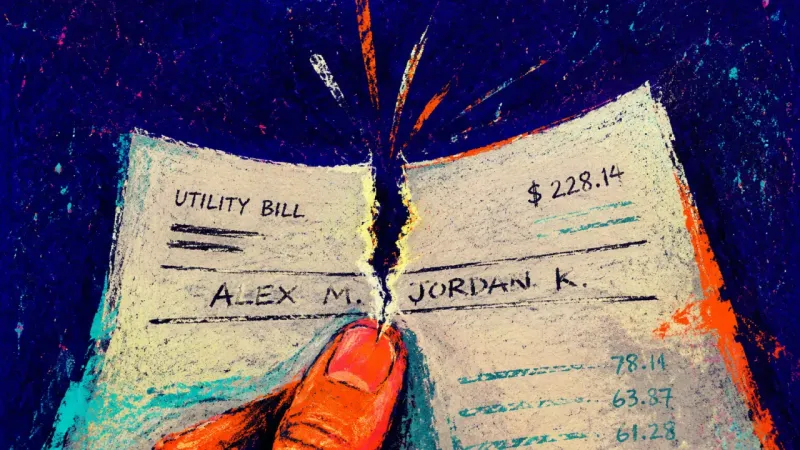
The 8:42 p.m. Autopay Ping
You reread the same billing line item three or four times, screenshot it “just in case,” and still can’t hit send on the one text that would clarify it—because you’re stuck in perfect-text paralysis.
Jordan (name changed for privacy) sat across from me with her phone facedown on the table like it was a small animal that might bite. She’s 29, an account manager at a fast-moving tech company in Toronto—someone who can write a polished client email in two minutes, who can slide through meetings on muscle memory. But her shoulders were held a little too high, like she was bracing for a Slack notification that never stopped.
She told me the scene like she’d lived it a thousand times.
“It was 8:42 on Tuesday,” she said. “I was on the couch, TTC streetcar noise faint through the window. My phone buzzes—auto-pay for internet—and his name is still there. It’s just a bill, but it feels like my stomach drops through the floor.”
I could almost hear the fridge hum from her apartment, that soft domestic sound that makes a room feel safe—until it doesn’t. The glow of a banking app in a dim room has a particular harshness. It’s not bright like daylight; it’s bright like being interrogated by your own screen.
Jordan kept going, embarrassed and precise: open the bank app, zoom in, reread the same line item four times. Screenshot. Draft a message to the billing company. Delete. Draft a message to her ex. Delete. Then scroll Instagram, mutual friends’ Stories, anything to numb out while her mind ran its own court case.
“I hate that one tiny reminder can pull me right back,” she said. Her fingers went to her throat without thinking, pressing lightly like she could hold the feeling in place. “If I ask for clarity, I’ll look like I still care. And I don’t trust my read on people anymore.”
The distrust in her didn’t sound like drama. It sounded like a smoke alarm that couldn’t tell toast from a fire—loud, urgent, exhausting. In her body it wasn’t abstract; it was a tight band across her chest and a throat that felt too narrow for a full breath, followed by that elevator-drop in the stomach that makes you grip your phone harder as if it’s the only railing.
I nodded, letting her pace set the room. “We’re not here to judge you for being human,” I said. “We’re here to figure out what old trust wound gets activated by something as boring as a bill—so you can get your clarity back without having to become a private detective.”
“That would be…nice,” she said, and her voice cracked on the last word like it surprised her.

Choosing the Compass: The Horseshoe Spread for Finding Clarity
I asked her to take one slow breath with me—not as a mystical ritual, but as a gear shift. When the nervous system is sprinting, you can’t read anything cleanly, not a text, not a memory, not a Tarot card. I shuffled slowly, the soft rasp of cardstock steadying the space the way rain steadies a window.
“Today,” I said, “we’ll use a Horseshoe Spread.”
For anyone reading who’s ever Googled how tarot works and felt skeptical: spreads are just structured questions. This one is compact and practical—perfect for a breakup admin trigger like this—because it moves in a clean arc: past influence → present behavior → hidden driver → obstacle → environment → advice → likely direction. It doesn’t overcomplicate a solvable situation, but it does separate the trigger (the bill) from the story (the wound) and the real block (the communication stalemate).
I pointed to the arc as I laid the cards down. “The first card shows what set the stage—what taught your system to doubt itself. The middle cards show what’s happening now and what you’re not fully seeing. And the advice card—that one is our turning point. It’ll show how to act with boundaries before you have a perfect story.”
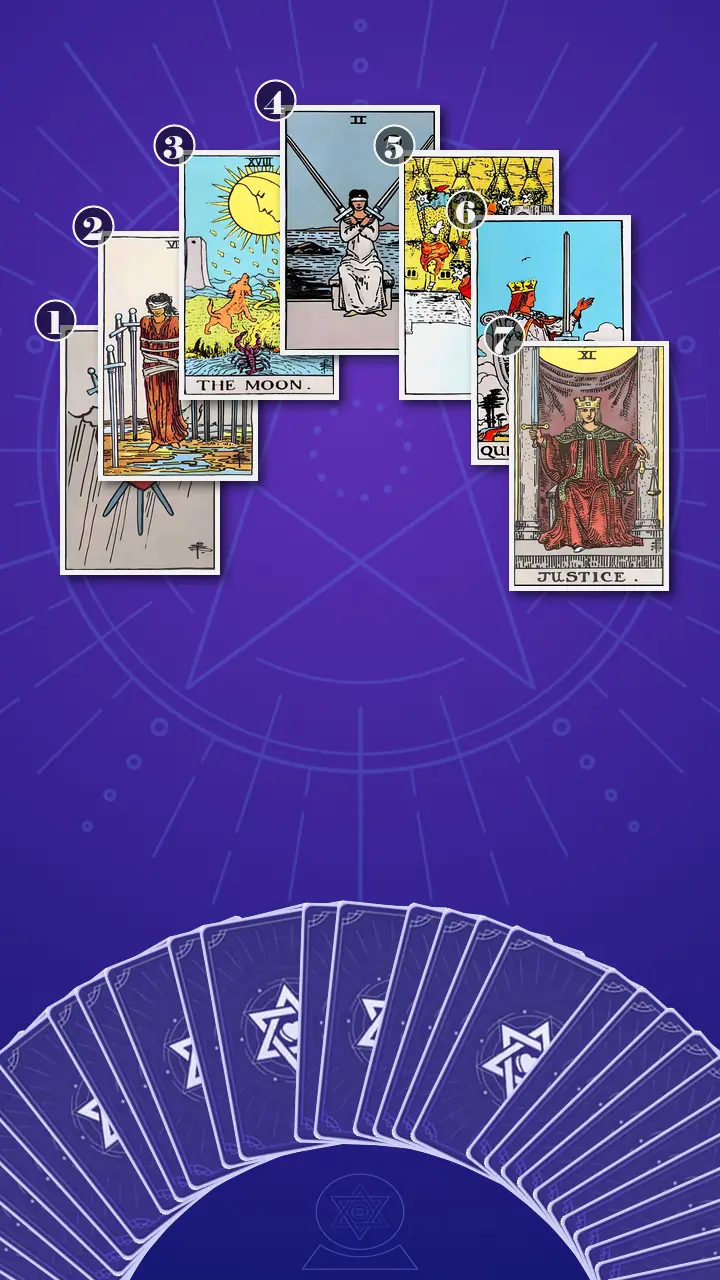
Reading the Arc: From Old Weather to the Current Loop
Position 1 — The memory that primes today’s trigger
“Now flipping over,” I said, “is the card that represents what earlier relational experience taught you to doubt your own read on people, and how that memory primes today’s trigger.”
Three of Swords, upright.
The image is almost too on-the-nose: a red heart pierced clean through, rain falling under a gray sky. In this position it’s not “your ex was evil.” It’s “your nervous system learned a particular lesson about trust.” This is heartbreak as weather—how a storm can roll in from one small cloud.
I connected it to her life exactly as it shows up: “You’re back in that specific emotional weather: the moment you realized you weren’t getting a clean explanation. Now a neutral admin artifact—a shared internet line item—hits the same bruise, and your brain treats it like court evidence.”
The energy here is not subtle. It’s excess pain-memory: a past puncture that still signals, Watch for the blade.
Jordan let out a small laugh that didn’t reach her eyes. “Okay,” she said, a little bitter. “That’s…too accurate. Like, even reading that feels kind of…mean.”
“I hear you,” I said. “And I don’t read it as mean. I read it as honest. Your system learned, ‘Tenderness can turn sharp without warning,’ and it’s been trying to prevent a repeat ever since. That’s not weakness. That’s a protection response that hasn’t gotten updated.”
Her shoulders dropped a millimeter, not relief yet—more like recognition.
Position 2 — The bill-trigger hijacking your thoughts right now
“Now flipping over,” I said, “is the card that represents the concrete, observable way the bill-trigger is hijacking your thoughts and behavior right now.”
Eight of Swords, upright.
I described it the way her life already described it: “You’re standing in your kitchen with the fridge humming, phone in hand, rereading the bill line item three or four times. You open your banking app, then Notes, then Messages, drafting three versions of a text that all feel like traps: too cold, too needy, too ‘still attached.’ Your options exist, but your mind has you blindfolded—so you freeze and call it ‘waiting until I’m calm.’”
This card is the nervous system turning uncertainty into a no-win maze. The energy is blocked agency: the bindings look tight, but they’re actually loose. The cage is mostly thought.
As I spoke, I used the echo technique I’ve learned to trust—the “screen recording” style—because for people like Jordan, naming the exact clicks is more soothing than vague reassurance.
“It’s like having fourteen tabs open for ‘research’,” I said, “and none of them solve the actual problem. Or staring at a drafted Slack message for twenty minutes because one wrong word feels like it’ll blow up your whole day.”
Jordan’s mouth pressed into a line. She nodded once—tight, tense. “Yeah,” she said quietly. “That’s exactly the loop.”
I let one sentence land cleanly between us, a pivot I use often because it separates shame from reality: A bill is data. Your nervous system turns it into a story.
Position 3 — The old trust story you’re treating as fact
“Now flipping over,” I said, “is the card that represents the old trust story running underneath the surface that you’re treating as fact in the moment.”
The Moon, upright.
The Moon is not about lies; it’s about fog. Under fog, every shape becomes suspicious because your brain hates incomplete information. The energy here is excess projection: meaning being poured into blank space.
I kept it modern and concrete: “In the dark, the billing portal becomes a symbol machine. ‘Why is their name still here?’ turns into ‘What else did I miss?’ and then into ‘I can’t trust my judgment.’ You start scanning for clues—mutual friends’ Stories, old message threads, even the tone you imagine they’d respond with—because uncertainty feels like danger, not just unknown.”
I watched her eyes as the words landed. First, a micro-freeze—her breath held for a beat. Then her gaze went slightly unfocused, like her mind was replaying old moments on a loop. Then she let out a half-laugh that sounded like being caught.
“I really do turn nothing into a whole narrative,” she said.
“Of course you do,” I replied. “Because you learned that missing something once had consequences. The Moon says: you’re not looking at facts, you’re looking at silhouettes. And silhouettes are easy to fear.”
As a Jungian psychologist, I often think of this as a projection moment—like stained glass in a church: the light is real, but the colors come from the window. The bill is the light. The story is the stained glass you inherited from that old heartbreak. If the window is all ‘betrayal’ and ‘I look naive,’ the same light will always look like a warning.
Position 4 — The specific mental/communication block
“Now flipping over,” I said, “is the card that represents the specific mental/communication block that keeps you from getting clean clarity and closure.”
Two of Swords, upright.
This is the card of performing neutral. Crossed swords over the chest. Blindfold. Calm sea with rocks near shore—the kind of calm that costs you your jaw muscles.
I gave her the exact translation her week already speaks: “You decide: ‘I’m not going to say anything. I’m above it.’ Outwardly, you keep your day moving—meetings, errands, replies. Internally, you’re clenched: you rehearse both sides of the conversation, imagine how you’ll look if you ask, and keep choosing ‘not now.’ The stalemate becomes the obstacle: you’re protecting your image at the cost of your peace.”
The energy here is deficiency honesty-with-self: you’re not lacking strength; you’re withholding contact. It’s a guard posture that blocks relief.
I let a little humor cut through the perfectionism—gentle, but direct, like a friend who’s not going to let you drown in your own drafts: The perfect text is just anxiety in a nicer font.
Jordan exhaled, a real one. “I thought not bringing it up was strength,” she admitted. “But it’s draining.”
“Exactly,” I said. “Silence can look calm. Inside, it’s a stalemate that taxes your nervous system all day.”
Position 5 — The outside world keeping the past emotionally alive
“Now flipping over,” I said, “is the card that represents how the outside world keeps the past emotionally ‘alive’ even when you’re trying to move on.”
Six of Cups, reversed.
Reversed, this is memory with gravity—nostalgia that doesn’t feel sweet, just sticky. The energy here is excess backward pull, fed by systems that don’t care about your healing: auto-renewals, shared logins, algorithmic “On This Day” reminders, mutual friend posts that drop into your feed at exactly the wrong time.
“The outside world keeps reopening the tab,” I said. “You click ‘just to check,’ and suddenly you’re ten minutes deep in old photos or last-seen vibes, telling yourself it’s curiosity—while your nervous system is actually chasing familiarity.”
Jordan’s thumb made a tiny tapping motion on the table, like she was trying to refresh a page that wouldn’t load.
“This card also has a warning,” I added carefully. “Sometimes, to prove you’re moved on, you might overcorrect—block, delete, purge everything—then the next unavoidable reminder hits even harder. We’re looking for a middle path: admin boundaries and emotional closure that don’t require a scorched-earth moment.”
When the Queen of Swords Spoke: Clean Boundaries Without Decoding
Position 6 — The best approach: speak and act from self-trust
I paused before turning the next card. The room felt quieter—not because anything dramatic happened, but because we’d arrived at the turning point. On the canals where I grew up, there’s a moment when your boat clears a narrow corridor and the water opens. You can feel the shift in your chest before you can explain it.
“Now flipping over,” I said, “is the card that represents the most empowering way to speak, set boundaries, and act so you rebuild self-trust without needing a perfect story first.”
Queen of Swords, upright.
This is clarity with a spine. Raised sword, open hand. Not aggression. Not silence. A fair, adult contact.
“Here’s the modern version,” I told her, using the exact scenario her life is asking for: “You treat this like a clean admin task with self-respect built in. You send a calm message that doesn’t audition for emotional closure: ‘Hey — I’m separating the billing for X so it’s clean going forward. Can you confirm whether you still have access to the account / whether you want to transfer it by Friday?’ Clear facts, clear request, clear next step. No subtext. No apologizing for needing clarity.”
I watched the reflex rise in her—the instinct to argue with the idea before it could help her.
Setup (the moment before the switch): At 8:47 PM, under that warm phone glow on her couch, she wasn’t just seeing a bill. She was trapped in “If I do this wrong, I’ll look stupid again.” She was trying to achieve certainty about someone else’s intentions to protect herself from feeling exposed.
Delivery (the sentence that cuts through):
Not "I have to figure out what this means about them," but "I can state what’s true and what I will do next"—like the Queen of Swords who raises a clear blade and keeps an open hand.
For a second, Jordan didn’t move. Her face went still in that way people get when a truth hits too close to the ribs. Then the reaction chain unfolded—slow, honest, human: her breath caught high in her chest, her eyes widened slightly, then her gaze dropped to the table as if she needed the wood grain to anchor her back in the room. Her shoulders—always up, always ready—slid down like a heavy coat being unhooked. Not all the way. Enough to feel the difference.
And then, unexpectedly, she got angry. Not at me—at the idea of how long she’d been suffering.
“But… if that’s true,” she said, voice sharper, “doesn’t it mean I’ve been doing it wrong? Like I’ve been wasting so much time trying to ‘read’ him.”
I didn’t rush to soothe it away. “That anger makes sense,” I told her. “It’s the part of you that knows you deserved clarity sooner. And here’s the thing: the Queen of Swords isn’t saying you were wrong. She’s saying you were protecting a wounded heart with the tools you had: vigilance, documentation, perfect wording.”
“Now we upgrade the tools,” I continued, bringing in the frame that’s most natural to me—my Bridge-Corridor Theory. “In Venice, bridges connect two solid points. Corridors trap you between walls. Your rumination is a corridor: you pace in it until you’re exhausted. A Queen of Swords message is a bridge: it connects fact to next step in one clean crossing. Two sentences. Two ends. No corridor.”
Her eyes watered—not a dramatic cry, more like the body releasing pressure it didn’t admit it was holding. She inhaled, slower this time, and her voice softened.
“Oh,” she said. “I can just…state the facts.”
“Yes,” I said. “And I want you to feel how different that is in your body.”
“Right now,” I asked her, “with this new lens—think back to last week. Was there a moment when this could’ve helped you feel different? A moment when you were about to screenshot, or draft, or scroll for clues?”
She nodded, wiping under one eye with the side of her finger. “Sunday night,” she said. “I did the whole Interac history search thing. Like it would tell me something.”
“That’s the exact moment,” I said, “when you don’t need more evidence. You need a boundary.”
And I gave her the reframe out loud, because sometimes the nervous system needs to hear it in someone else’s voice before it can become yours: Clarity isn’t a confession. It’s a boundary.
The Scales Settle: Justice and the End of “Interest Payments”
Position 7 — What becomes possible when you choose fairness over certainty
“Now flipping over,” I said, “is the card that represents what becomes possible when you choose clarity and fairness (to yourself) over chasing certainty about your ex’s intentions.”
Justice, upright.
Justice is the clean ledger. Scales and sword. Not punishment—alignment. The energy here is balance: facts and feelings held at the same time, without letting either hijack the decision.
“This is like you deciding what’s fair—financially and emotionally—and acting like your peace is a real line item,” I said. “You update the subscription owner, remove names where you can, and stop letting random reminders run your evening. You don’t need a perfect story about them; you need a consistent standard for you.”
I heard my old cruise-ship training voice in my head for a moment—those long transoceanic nights when travelers would come to me because the sea was calm but their insides weren’t. In the middle of the Atlantic, you learn quickly: you cannot control the ocean, but you can choose your heading. That’s Justice. That’s the Queen of Swords. Heading over weather.
“There’s a phrase I want to give you,” I told Jordan. “Because your brain is paying more than money here.”
Stop paying interest on an old chapter.
Her lips parted like she was about to argue, then she didn’t. She just nodded—grounded, quieter than before.
From Insight to Action: A Fair-to-Present-Self Plan You Can Actually Do
I gathered the whole story the spread had told us into one thread, because this is where Tarot becomes practical.
“Here’s the arc,” I said. “A past heartbreak (Three of Swords) taught your system that uncertainty equals danger. So when a mundane reminder shows up (Eight of Swords), you go into a proof-seeking loop—checking, screenshotting, drafting, freezing. Underneath, The Moon is running the old trust story: ‘If I don’t decode this, I’ll be fooled again.’ Two of Swords keeps you performing neutral—protecting your image while your peace leaks out. And the world keeps feeding it with reminders (Six of Cups reversed).”
“Your cognitive blind spot,” I added gently, “is thinking that if you can find the perfect interpretation, you’ll finally feel safe. But the transformation direction is different: you build safety by choosing what’s fair and true for you, then acting on it—without mind-reading.”
“In other words,” I said, “we’re moving from hyper-vigilant meaning-making and self-doubt to steady self-trust and boundary-led clarity. From vigilance to discernment.”
Then I gave her next steps—small, specific, boring on purpose. I used my Lace Communication Method here, the way artisans on Burano lace an edge: tight, simple stitches that hold, without extra frill. Precision isn’t cold. Precision is kindness to your future self.
- The Two-Sentence Queen DraftOpen Notes and write a message that is only two sentences: (1) one fact, (2) one request with a deadline. Example: “Hey — I’m separating billing for X so it’s clean going forward. Can you confirm by Friday whether you want to transfer the account or if you’re okay with me removing your name?”If you start wordsmithing, set a 5-minute timer and stop when it ends—remember, the perfect text is just anxiety in a nicer font.
- The 7-Minute Facts–Request–Boundary NoteBefore you send anything, do a 7-minute note: (1) copy the exact line item as it appears, (2) write the one admin question you need answered, (3) write your boundary/next step (what you’ll do if you get no response).If your chest tightens, take one breath and pause—the goal is clarity, not pushing through flooding. You can leave the draft for tonight.
- One Admin Boundary ResetThis week, pick one system to clean: change account ownership, remove a name where possible, update autopay details, or cancel and re-subscribe under your own login—like cleaning up messy Google Drive permissions.Keep it tiny: one account, one login, one checkbox. You’re not erasing the past—you’re reducing surprise notifications that ambush your nervous system.

Ownership, Not Certainty
A week later, Jordan messaged me. Not a paragraph. Not a spiral. Two lines—like she’d practiced her own bridge.
“Sent the two-sentence message,” she wrote. “Also changed the account owner. My throat still did the thing, but I didn’t screenshot anything.”
She added one more detail that felt like the real victory: “I slept.”
Clarity didn’t arrive as fireworks. It arrived as a quieter body and a shorter loop. Clear boundaries. Clean facts. A small, steady trust in her own perception.
And yes—there was still vulnerability in it, because being a person means you don’t get to delete your history like a playlist. The difference is you don’t have to let history run your evening anymore.
Clear but still a little tender: She slept through the night, then woke up with the first thought, “What if I handled it wrong?”—and this time, she noticed the thought, exhaled once, and got out of bed anyway.
That’s what I call a real Journey to Clarity: not certainty about someone else, but ownership of your own standard.
When their name shows up on something as boring as a bill and your throat tightens anyway, it can feel like you’re choosing between staying “unbothered” and risking the old fear that needing clarity means you can’t trust yourself.
If you didn’t have to decode their intentions tonight, what’s one simple boundary-with-facts move that would feel fair to your present self?

Every reading at AceTarot is a journey to connect with inner wisdom and empower the path ahead. This reading shared here is a psychological mirror, not a private record—crafted to reflect universal emotional loops and help restore personal clarity. Please note that these insights do not replace professional psychological, medical, legal, or financial advice, and should not serve as the sole basis for major life decisions.
Learn more about our Journey to Clarity.
How did this insight land for you?
🫂 This Resonates Deeply
🌀 Living This Story
✨ Now I See Clearly
🌱 Seeing New Possibilities
🧰 Useful Framework
🔮 The Confirmation I Needed
💪 Feeling Empowered
🚀 Ready for My Next Step
Author Profile
AI Giulia Canale
956 readings | 527 reviews
“Having traveled across cultures... I've learned that what we often lack isn't a simple answer, but a moment of being truly understood. I use a Jungian psychological lens to help you deconstruct your subconscious patterns—not to prove anything, but to be the gentle companion who helps you unravel your knots, free of judgment, so you can reconnect with your inner wisdom.”
In this Love Tarot Reading :
Core Expertise
- Attachment Loop Diagnosis: Logically decoding whether your relationship friction is driven by an anxious-avoidant trap or deep-seated insecurity.
- Shadow Projection Analysis: Identifying the unacknowledged fears or unmet childhood needs you are unconsciously projecting onto your partner.
Service Features
- The Projection Detachment Exercise: A structured psychological journaling prompt to separate your partner's actual behavior from your triggered internal narrative.
Also specializes in :
Explore Related Patterns:
Analysis ParalysisJordan rereads the billing line, screenshots it, drafts and deletes messages, and still cannot send the one text that would clarify the account. The striking detail is that she can write polished client emails in minutes, so the block is not a lack of communication skill; the ex-related context turns wording into emotional risk management. Analysis Paralysis shows up when the mind tries to make action safe by perfecting the interpretation first. For you, the tell is that a clean admin question becomes a wording maze where every version feels like evidence of still caring, being naive, or getting it wrong again.
Certainty SeekingThe ex's name on the internet bill quickly becomes more than an account detail: 'Why is their name still here?' turns into 'What else did I miss?' and then into 'I can't trust my judgment.' That sequence shows the old wound clearly, because the mind is trying to prevent being blindsided by reaching for a perfect explanation. Certainty Seeking is the attempt to feel safe only after another person's hidden intentions have been decoded. For you, the shift is not forcing yourself to be unbothered; it is noticing when you are demanding total certainty from someone else's interior life before allowing yourself one fair next step.
HypervigilanceJordan's phone is facedown like it might bite, her shoulders stay braced, and a routine auto-pay ping creates the body feeling of a threat response. The bill is boring on the surface, but her nervous system reads it through the older lesson that tenderness can turn sharp without warning. Hypervigilance is protective scanning that has lost scale. It tries to keep you from missing the next sign, but it also makes every neutral signal feel urgent; the psychological audit is to ask whether you are responding to present data or to a smoke alarm trained by an older relational injury.
Relational Baggage LoopAn ex's name appearing on a bill, shared account residue, mutual friend posts, and algorithmic reminders all keep the old chapter emotionally available. The present trigger is small, but it lands on the same place as the earlier experience of not getting a clean explanation. Relational Baggage Loop describes old relationship data being reused as a present-day threat model. For you, the reaction is not only about the bill; it is about the remembered version of reality where missing one sign had consequences and self-trust started to feel unsafe.
ProjectionThe billing portal becomes a symbol machine: a name on an account starts carrying betrayal, missed warning signs, and the fear of looking naive. The story gives the cleanest image for it: the bill is the light, while the old heartbreak is the stained-glass window coloring what Jordan sees. Projection here is not about making things up on purpose; it is the mind using older emotional material to interpret incomplete present data. For you, clarity starts when you separate the light from the window: the bill from the meaning your history is pouring into it.
Boundary DiscernmentJordan's two-sentence message and account-owner change turn the whole trigger into something concrete: one fact, one request, one deadline, and one next step. The shift is not coldness; it is self-respect made operational. Boundary Discernment lets you act before you have a perfect story about the other person. It asks what is true, what you need, and what you will do next, so clarity becomes a standard you can practice rather than a confession you have to extract from someone else.
Compulsive CheckingJordan rereads the banking line, screenshots it, searches Interac history, and scrolls mutual friends' Stories as if another small piece of data will settle the feeling. The behavior looks practical, but the function is emotional: each check briefly promises safety without requiring the vulnerable step of direct clarification. Compulsive Checking keeps the loop alive because every new data point creates another interpretive opening. For you, the pattern is active when collecting evidence starts replacing the boundary move that would actually change the situation.
Self-SilencingJordan decides she is not going to say anything and performs being above it while staying internally clenched. The silence looks composed from the outside, but inside it keeps the conversation rehearsing all day and turns one account question into a private stalemate. Self-Silencing protects the image of being unbothered by keeping the need for clarity out of contact. For you, the cost is that the unsaid request does not disappear; it becomes internal noise until a boundary is stated plainly enough for your nervous system to stop carrying the whole exchange alone.
Reality TestingThe sentence 'A bill is data. Your nervous system turns it into a story' gives Jordan a way to separate the observable line item from the threat meaning attached to it. The Facts-Request-Boundary note keeps that separation practical by asking for the exact line item, the one admin question, and the next step. Reality Testing does not dismiss the body reaction or force fake calm. It holds feelings and facts in the same room, then checks whether the conclusion is supported before behavior follows; for you, that is how a trigger becomes information instead of instructions.
Explore Related Struggles:
Analysis ParalysisJordan keeps gathering, refining, and rehearsing around a problem that only needs a small factual move. The bill line is read three or four times, saved as a screenshot, turned into draft messages, and then left unresolved while Instagram and old social traces take over the room. You can see how the thinking starts to impersonate safety. Every possible text becomes too cold, too needy, or too attached, so the mind keeps producing more versions instead of allowing one clear request to exist. The loop feels productive because it has clicks, drafts, and evidence, but it keeps her agency suspended. Analysis Paralysis fits because the block is not a lack of intelligence or options. It is the point where interpretation multiplies faster than action, and the need to get the wording perfectly safe becomes the very thing that keeps you exposed to the trigger longer.
Betrayal-Closure LockThe bill is ordinary on the surface, but Jordan does not experience it as ordinary. Her ex's name on the account pulls her back to the moment when she did not get a clean explanation, and the present question starts carrying the weight of an older unfinished story. You can hear the lock form in the way one admin detail turns into a trial about trust. 'Why is their name still here?' becomes 'What else did I miss?' and then becomes 'I can't trust my judgment.' Closure is wanted, but the route to closure passes through the same wound that made clarity feel unsafe in the first place. Betrayal-Closure Lock names the structure where an old rupture keeps controlling the terms of the present. You are not only asking what happened with the bill; you are trying to make sure you will never be caught off guard again, which makes every unfinished detail feel bigger than the detail itself.
Clarity-Exposure SplitJordan has a concrete admin reason to ask about the internet bill, but the moment her ex's name appears, the message stops being only a message. The phone turns into a threshold: sending the text could bring clarity, yet it could also make her feel seen in a way she is trying hard to avoid. You can feel the split in the exact sequence of actions. She rereads the line item, screenshots it, drafts and deletes, then scrolls for distraction while the one clean request remains unsent. Her system is not confused about what the next step is; it is caught between needing facts and fearing what needing facts might reveal. Clarity-Exposure Split names that bind. You are not simply avoiding communication; you are carrying a structure where asking for clarity feels like confessing attachment, weakness, or poor judgment. The work begins when clarity becomes a boundary-led action instead of a verdict on whether you are still affected.
Internal Authority CollapseJordan says the quiet part directly: she does not trust her read on people anymore. Once the bill appears, the present facts lose authority, and the imagined subtext starts to feel more real than the line item itself. The story shows her looking outside herself for a verdict. Banking details, old messages, mutual friends' Stories, and imagined tones all become possible judges of what is true. Meanwhile, her own standard for what is fair and what she needs gets pushed to the edge of the room. Internal Authority Collapse fits because the old trust wound has shaken the place she usually decides from. You are not just unsure what the bill means; you are unsure whether your own perception is allowed to be enough to choose a clean next step.
Performative IndependenceJordan keeps the day moving, answers messages, handles work, and presents as someone who is above bringing it up. Under that surface, the unsent text keeps taking up space, and the silence becomes a performance that costs more than it protects. You can see the reversal in how composure turns into containment. Not saying anything looks like dignity from the outside, but inside it becomes clenched rehearsals, imagined reactions, and a throat that tightens around the request she is not allowing herself to make. Performative Independence fits because the central strain is not independence itself. It is the pressure to appear untouched while still needing a basic boundary, leaving you to manage the trigger alone so no one can accuse you of caring.
Rumination EntrapmentJordan's evening becomes a loop of reading, saving, drafting, deleting, checking, and scrolling. None of these moves are random; each one tries to create enough certainty to make the next step feel safe, but every pass through the loop gives the old story more room to keep running. The bill does not stay as a single line item. It expands into mutual friends' Stories, old threads, imagined responses, and the court case in her head. The repair attempt starts draining the same clarity it was supposed to restore. Rumination Entrapment names the point where thinking stops being a bridge and becomes the corridor she paces until she is exhausted. You are trying to solve the trigger by reviewing it from every angle, but the way out only appears when the loop is interrupted by a boundary-led action.
Wound-Compass FusionJordan's old trust wound does more than react to the bill; it starts directing the whole decision. It tells her that documentation, decoding, and perfect wording are safer than a simple boundary, even when the practical path is already visible. You can see the compass swing away from the present. The current question is about account access and billing cleanup, but the inner rule says she must understand the ex's intention first or risk looking naive again. That rule makes certainty feel like a prerequisite for action. Wound-Compass Fusion names the moment the past becomes the navigation system. You are not choosing from the present standard of what is fair and clear; you are being routed by an old injury that keeps mistaking vigilance for self-protection.
Explore Related Emotions:
Ambiguity DreadThe banking portal becomes hardest to look at when it gives too little information. A name on a bill is not a full story, yet the blank space around it becomes loud enough that mutual friends' Stories, old threads, and imagined replies start filling in the gaps. Ambiguity Dread fits the way uncertainty becomes physically charged here. You are not reacting to a known outcome; you are reacting to the fog around it. The missing explanation feels more threatening than the bill itself, so the mind starts building a whole courtroom around one line item just to avoid sitting with the unknown.
Betrayal AcheAt 8:42, a routine internet autopay line still carries the ex's name, and Jordan reads it like a small sharp object inside a domestic evening. The bill is neutral data, but her body remembers a past moment when she did not get a clean explanation, so the present detail lands on an older bruise. Betrayal Ache fits because the pain is not only about the charge or the account. It is the raw sting of having learned that tenderness can turn sharp without warning, then watching an ordinary admin artifact reactivate that lesson. You are not being asked to relive the whole relationship; the emotional work is naming the exact place where a boring line item still feels like proof that trust once broke.
Hypervigilant AnxietyThe phone sits facedown like it might bite, her shoulders are too high, and the banking app gets checked, zoomed, screenshotted, and checked again. The story keeps returning to a body on alert: chest tight, throat narrow, stomach dropping, hand gripping the phone like a railing. Hypervigilant Anxiety names the smoke-alarm quality of the loop. You are not simply looking for information; your system is trying to prevent being blindsided, so every blank space starts demanding investigation. The cost is that even a bill begins to feel like an emergency signal, and clarity gets delayed by the effort to inspect every possible angle first.
Intuitive Self-DoubtJordan says the quiet part directly: she does not trust her read on people anymore. The bill turns into a chain of interpretations, from 'why is their name still here?' to 'what else did I miss?' to 'I can't trust my judgment.' Intuitive Self-Doubt is the old wound running under the admin problem. You can still see facts, but your confidence in your own perception has been scratched up by a previous unclear ending. Instead of asking for the one piece of information she needs, she starts auditing herself, as if the real danger is not the account but the possibility that her inner read will fail her again.
Cautious Self-TrustA week later, Jordan sends the two-line message, changes the account owner, and notices that her throat still reacts while her behavior no longer follows the old script. The next morning, the thought 'what if I handled it wrong?' appears, and she gets out of bed anyway. Cautious Self-Trust fits because this is not a grand, flawless confidence. It is a small trust that can coexist with leftover tenderness. You are rebuilding belief in your perception by acting from facts, not by forcing the body to feel perfectly safe first.
Clarity ReliefAfter the account is handled, the victory is almost plain: no screenshot, a shorter loop, and sleep. The relief arrives through fewer moving parts rather than a dramatic answer about the ex. Clarity Relief names the quiet drop in pressure when facts, boundaries, and next steps finally line up. You do not get relief because every uncertainty disappears; you get it because the situation stops owning the whole evening. The story's emotional center shifts from decoding someone else to having enough clean information to return to yourself.
Grounded AgencyAt the turning point, the message becomes two sentences: one fact and one request with a deadline. Jordan stops trying to decode the ex's intentions and starts naming what is true, what she needs confirmed, and what she will do next. Grounded Agency is the felt shift from pacing in the corridor to crossing the bridge. You do not need a perfect interpretation to take a fair step. The body may still tighten, but the action is no longer run by the old loop; it is run by a clean standard that belongs to the present self.
Exposure DreadBefore Jordan can send a practical message, the imagined audience arrives: too cold, too needy, too still attached, too stupid again. The text is not just a text anymore; it becomes a place where she might be seen wanting clarity. Exposure Dread names the vulnerable edge underneath the communication freeze. You can know the request is reasonable and still feel your throat close around it because asking makes your care visible. The wound is not only 'can I trust them?' but 'what will it say about me if I need an answer?'
Performative CalmShe keeps the day moving through meetings, errands, and replies, while internally rehearsing both sides of a conversation she keeps postponing. On the outside, silence can pass as being above it; inside, the stalemate keeps pulling energy from the rest of the evening. Performative Calm is the emotional weather of looking composed while paying for that composure in private. You can appear unbothered and still be locked in a full internal negotiation. The story shows how protecting an image of neutrality can become more draining than the clean, bounded contact she is avoiding.
Nostalgia Loop AnxietyThe past does not return dramatically; it returns through auto-renewals, shared logins, mutual friend posts, and the reflex to check old photos or last-seen signals. The outside world keeps reopening the tab at exactly the wrong time. Nostalgia Loop Anxiety fits because the loop is not sweet remembering. It is a sticky backward pull where familiar traces keep the body scanning for meaning. You may tell yourself it is curiosity, but the story shows a nervous chase for old context long after the present task has become simple: separate the account and reduce the surprise triggers.
Explore Related Contexts:
Post-Breakup Admin EntanglementJordan sees her ex's name still attached to the internet autopay at 8:42 p.m., then rereads the charge, screenshots it, and cannot send the one message that would clarify the account. The external trigger is small, but it has a practical handle: a former relationship is still embedded in billing ownership, account access, and a recurring payment system. That is why the bill hits harder than an ordinary notification. The breakup is not only sitting in memory; it is still present in the admin layer of her life, where names, logins, and payment settings decide who can enter the room without physically being there. For you, this context points to the difference between decoding an ex's intentions and reclaiming the infrastructure around your present life. A clean next step is not an emotional confession; it is an ownership move, turning a vague relational signal into account access, billing control, and a dated request.
Breakup Closure LimboJordan names the old moment as the time she realized she was not getting a clean explanation, and the shared internet line item drops her straight back into that unfinished zone. She wants to ask a simple question, but the message becomes loaded with the fear that asking will make her look like she still cares. The limbo is created by the gap between a practical need and an unresolved relational ending. The bill asks for confirmation; the old story turns confirmation into exposure, so silence starts looking like control while the loose end keeps charging emotional rent. For you, this context clarifies why the trigger feels bigger than the bill. Closure is not arriving through a perfect interpretation of what the ex meant; it starts when the practical question is allowed to be practical, with enough boundary to keep the old dynamic from setting the terms.
Algorithmic Breakup ExposureThe story explicitly names auto-renewals, shared logins, algorithmic “On This Day” reminders, and mutual friend posts as systems that keep reopening the tab. After the billing ping, Jordan scrolls mutual friends' Stories and old digital traces, not because the feed has answers, but because the feed keeps the relationship available. This is an external platform problem as much as a personal memory problem. Digital systems do not know that a name, photo, login, or reminder has social weight; they recycle old material on engagement logic, and the timing can drag a finished chapter back into the room. For you, the useful move is to treat exposure as something you can structure, not something you have to interpret every time. Muting, separating accounts, changing ownership, and reducing reminder surfaces are not dramatic gestures; they are environmental design for a cleaner present.