When Complete Closure Delayed Living: Choosing One Bounded Task

Finding Clarity in the 10:47 p.m. Scroll
I began with a sentence I had been hearing beneath many breakup-admin consultations: “You are the Toronto operations coordinator who can keep a workday moving, then lose the entire evening to one shared-account email the moment the rent or subscription reminder lands: that is breakup admin, not a lack of effort.”
When Alex (name changed for privacy) sat across from me, I noticed the evidence before I heard the explanation. She showed me a photo of two half-packed boxes on the floor of her Toronto rental, a laptop open to a shared-account spreadsheet, and a draft lease email waiting beside an unread message. At 10:47 p.m., she had meant to cook and prepare for work, but the laptop fan kept humming, the phone felt warm in her palm, and her chest tightened whenever she tried to close a tab.
“How do I rebuild daily life when breakup admin keeps me stuck?” she asked. “I cannot start the next chapter while there are still loose ends from the last one. I keep saying I am almost done, but the finish line moves every time someone sends another message.”
I could hear grief underneath the task-chasing, and uncertainty underneath the grief. The overwhelm had become a hallway made of unfinished forms, messages, payment details, and boxes, with every door labelled handle this first. I told her that I would not ask the cards to predict what her former partner might do or hand down a verdict about how quickly she should move on. “We can use them as a clear thinking tool,” I said. “Let’s draw a map of what is happening, find the smallest place where your attention can return to you, and begin this Journey to Clarity without pretending the loose ends are not real.”

Choosing a Six-Card Map for a Life in Limbo
I invited Alex to put both feet on the floor, take one slow breath, and name the practical question beneath the emotional noise: what would help her rebuild an ordinary week while accounts, lease details, messages, money, and belongings remained unresolved? I shuffled slowly while she focused on that question. For me, this is the useful ritual: a deliberate pause that moves the mind from reacting to observing.
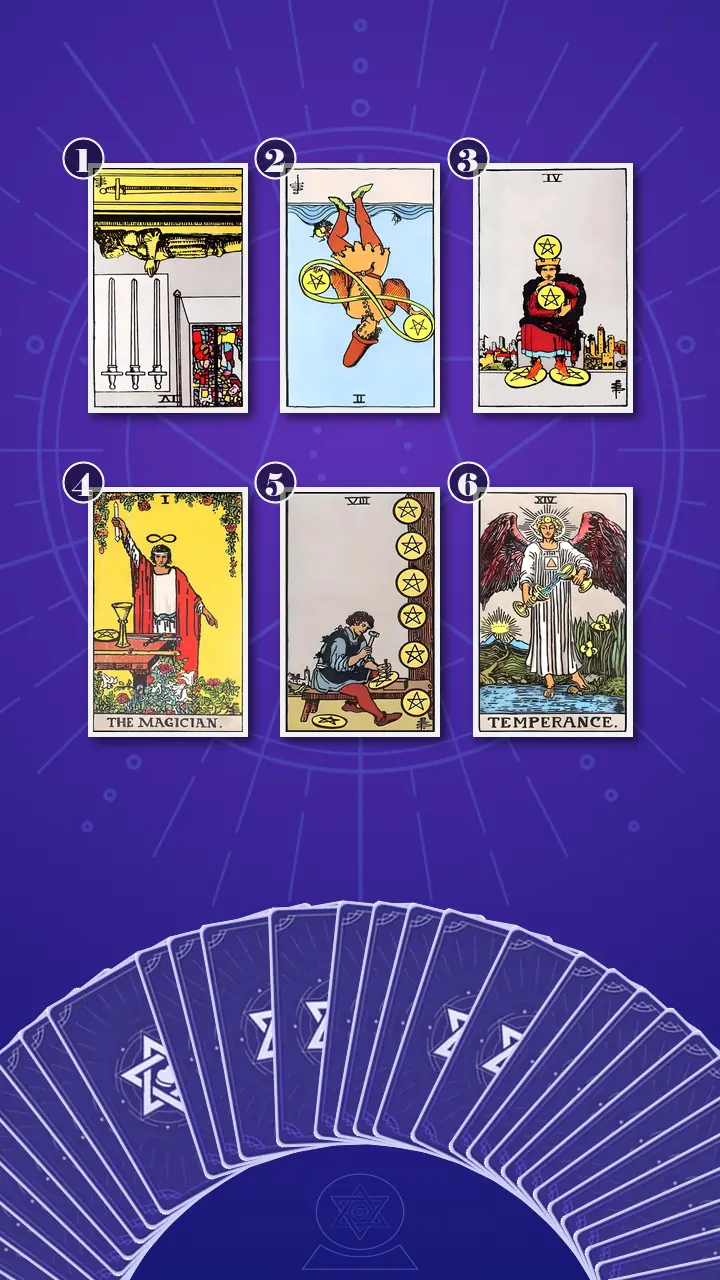
For a reader wondering how tarot works in a situation like this, I chose the Transformation Path Grid (6) · Context Edition. It is a six-card tarot spread for systemic deconstruction rather than prediction. The structure lets me look at the visible symptom, the active blockage, the deeper safety need, the catalyst, the repeatable action, and the integration that can follow. It is small enough to stay focused on one real-life problem, but complete enough to show why the same pattern keeps repeating.
The first card would show the current symptom: how interrupted rest and repeated checking were appearing in daily life. The second would expose the active blockage, the juggling loop that kept every practical tie urgent. The third would look underneath the paperwork for the safety need being protected. Then the fourth would identify a catalyst, the fifth a practical rebuilding practice, and the sixth a sustainable rhythm in which administration could coexist with a life that belonged to Alex.
This mattered because a Past-Present-Future reading might make the situation sound like a timeline that simply had to be endured. The Transformation Path Grid showed something more useful: a living system. Unfinished breakup logistics triggered survival mode; survival mode kept every detail active; the resulting neglect of meals, rest, work preparation, and personal plans made life feel even less manageable. The cards could help us see where agency could be recovered inside that system.
The Map Opens Under the Unfinished Tabs
The Rest That Would Not Rest
I began by opening the position called Current symptom: reveal the observable daily-life behavior created by Survival Mode, including interrupted rest, repeated checking, and breakup administration displacing ordinary routines. The card was the Four of Swords, in reversed position.
In the RWS image, the stone figure lies in a fixed resting position beneath three mounted swords, while a single sword rests below. I read the reversed energy as blocked recovery: too much mental alertness, too little restorative stillness. The body is technically horizontal, but the mind has not been given a defined stopping point.
In real life, this looked exactly like the scene Alex had brought into the room. At 10:47 p.m., she would lie down with the phone beside her pillow, reopen the shared-account email, reread the lease draft, and return to the belongings list instead of sleeping. The practical tie might be real, but the repeated checking turned recovery into another work shift. The question was not whether the detail mattered. The question was whether it needed access to that exact hour.
I asked, “When a shared-account message appears while you are trying to sleep or prepare for work, what do you do first, and what ordinary need gets postponed?”
Alex gave a short, bitter laugh. “Damn, this is exactly what happens. I am not just missing the person; I am still organizing my entire evening around the last account, message, payment, or box.”
I let the laugh have its truth without turning it into a diagnosis. “Your body may be treating rest as irresponsible because the practical story has no official final page yet,” I said. “That does not mean you are failing at recovery. It means we need a boundary around when the detail is allowed to be handled.” Her mouth tightened, then softened, and she rubbed one thumb across the edge of her phone without opening it.
When Every Tab Became the Loudest Task
I moved to the position called Active blockage: expose how Post-Breakup Admin Entanglement becomes a self-reinforcing juggling loop that keeps every detail urgent and prevents stable prioritization. The card was the Two of Pentacles, in reversed position.
The figure in the card keeps two pentacles moving inside an infinity-shaped loop while rough water and distant ships shift behind him. Reversed, that energy becomes excess adjustment and deficient prioritization. It is not a lack of capability. It is the exhausting belief that every moving part must remain active at the same time for the day to stay safe.
I translated the image into the Toronto browser-tab scene: Google Sheets, Gmail, the bank app, and the belongings list all open while dinner stayed untouched. A new notification reset the entire priority order. The lease became urgent, then the transfer, then the subscription, then the box labelled decide later. Alex was keeping everything moving because choosing one thing felt dangerous, but all that motion was leaving no stable place for her.
“I am keeping everything moving because choosing one thing feels dangerous,” she said slowly. “But all this motion is leaving no stable place for me.”
I nodded. “Exactly. The loudest task is not necessarily the highest priority. A task can be important without becoming the organising principle of your entire day.” I told her that the next chapter did not require every old tab to be closed first. “You can be responsible without making the breakup your full-time job.”
Alex stopped tapping her foot. Her breath paused, her eyes moved briefly toward the laptop as if she could see all four tabs at once, and then her shoulders lowered by a fraction. The recognition was not cheerful; it had the weight of discovering that busyness had been functioning as a protective ritual.
The Pentacle Held Against the Chest
I then opened the position called Underlying root: examine the Existential Drift beneath the practical tasks, especially the fear that loosening control over shared resources or arrangements will threaten safety. The card was the Four of Pentacles, in upright position.
The figure presses one pentacle against the chest, stands on two more, and balances another on the crown. Behind him, a city sits at a distance. The energy here was not blocked because Alex was doing something wrong. It was concentrated through holding. Money details, access information, receipts, keys, boxes, and familiar arrangements had become measurable proof that life was still controllable.
I asked her to imagine the apartment after I removed the labels from the card. Every receipt, login, key, and box remained available just in case. “If I keep this detail close, I can feel prepared,” I said. “If I loosen my grip, I might discover that I have no safety left.” I placed the two possibilities beside each other without forcing either one away.
Alex’s jaw tightened first. Her fingers closed around the phone, then went still. Her gaze lost focus as if she were replaying the moment she had saved a screenshot of a transfer instruction for the second time. Finally, she exhaled through her nose and said, “I think I am holding onto some of it because releasing it feels like admitting I have no idea what comes next.”
“That makes sense,” I said. “The protective impulse is understandable. We are only asking it to become more precise. Which detail genuinely protects a present-day need, and which one remains active mainly because uncertainty feels unbearable?”
My Jungian lens is useful here because I am not interested in shaming the behaviour at the surface. I want to understand what the behaviour is guarding. The task may be practical, while the meaning attached to it is existential: if I can keep every resource accounted for, perhaps I can prove that my life is still manageable. But the same grip that once created security can begin to define the whole household.
When the Magician Put One Tool on the Table
The radiator clicked once, and the room seemed to make space around the next card. I slowed down before touching it because this was the hinge of the reading, the point where the map could move from description into choice.
I opened the position called Key trigger: identify the available resource, boundary, or focused choice that can interrupt Survival Mode without requiring complete administrative closure. The card was The Magician, in upright position.
The Magician stands over a table displaying a cup, pentacle, sword, and wand. One hand raises the wand while the other directs attention downward, and the infinity symbol above the figure suggests sustained focus rather than frantic multitasking. In the key-trigger position, the upright energy was focused agency, resourcefulness, practical self-trust, and the willingness to begin with what was already available.
The modern translation was precise. Instead of treating every document as another emergency, Alex could select one bounded move: close one shared subscription, send one clear lease question, or identify the next contact for one transfer. The spreadsheet, calendar, a written finish line, and a trusted friend’s presence could be tools. They did not have to become invitations to keep every possibility open.
I brought in my Psychological Bandwidth Audit at this point. Before asking why Alex could not focus, I looked at what her subconscious anxiety and unresolved stress were already spending before the workday began: the chest bracing at every notification, the energy lost to rereading, the mental rehearsal of neutral replies, the attention consumed by switching between tabs. A task might take ten minutes, but the hidden preparation around it could drain an entire evening.
“The audit shows me that your bandwidth is arriving pre-spent,” I said. “That is different from being lazy or disorganised. The useful question is not how to become capable enough to handle everything. It is how to stop handing every possible issue access to the same limited reserve.”
Setup. At 10:47 p.m. in your Toronto rental, the laptop shows a shared-account spreadsheet, the lease email is still a draft, and two boxes wait beside you. You meant to cook and prep for work, but the phone feels more urgent than your own evening.
You do not need to finish every breakup-admin thread before you are allowed to live; use the Magician's table of available tools to choose one bounded action and make today workable.
Alex’s breath caught halfway in. For a moment, she did not move at all; her fingers hovered above the phone, her pupils widened, and the blue light from the screen caught the stillness in her face. I watched the thought travel through her rather than rush to explain it away. Her shoulders slowly dropped, and the hand gripping the phone opened one finger at a time. Her eyes grew bright, not with a dramatic release, but with the strain of being seen accurately. Then she gave a small, shaky laugh. “So I can stop without proving that I have handled it perfectly?” Her voice was quiet, and the question carried both relief and the unfamiliar vulnerability of having a choice. I said yes, while keeping the choice hers.
“Now, use this new perspective to remember whether there was a moment last week when this insight could have made things feel different,” I asked.
Alex looked at the unfinished lease email. She remembered a Thursday evening when she had skipped dinner to rewrite a message that was already clear enough. The memory did not become evidence against her. It became a place where a boundary might have changed the shape of the night.
I told her that the Magician was not granting permission from outside her life. The card was reflecting a capacity already present: the ability to choose one task, one limit, and one tool. This was the first crossing from survival-mode vigilance and fear-driven overchecking toward bounded agency. The old hallway of forms had not vanished, but one door was no longer labelled handle everything before you rest.
The Workbench of One Honest Checkmark
Practice Before Closure
I opened the position called Action plan: translate rebuilding daily life into a small repeated practice that restores agency while some breakup-admin details remain unresolved. The card was the Eight of Pentacles, in upright position.
The card shows a craftsperson seated at a workbench, concentrating on one pentacle while the others are arranged nearby. I read the upright energy as grounded repetition, visible progress, and competence developed through practice. It offered no dramatic emotional finish line. It showed one focused action, followed by another, until a new rhythm became familiar.
In daily life, this could look like handling one practical item in a defined window and then cooking the same simple dinner, laying out work clothes, taking a short walk, or returning to a personal project. The point was not to prove that the breakup had been handled properly. The point was to let one self-directed action happen while the story remained partly open.
I also used my Compensatory Routine Decoding lens. When Alex kept checking late at night, I did not reduce it to poor discipline or call it a character flaw. I asked what the routine was compensating for. If the whole day had been organised around responsibility to the breakup, revenge bedtime procrastination could become a small, delayed attempt to reclaim personal time, even if the chosen activity was another hour of checking and scrolling. The habit was coping with a life that had not left enough room for her.
Alex pressed her lips together. “But I do not have twenty-five spare minutes,” she said. “Some nights I barely have ten. By the time I finish work, the admin has already expanded.”
“Then ten minutes is the honest version,” I said. “Or five minutes to identify the next action without opening the account. The limit is not a test you can fail. It is a way to make the task proportionate again.” She nodded, and this time the movement looked less like agreement with a verdict and more like testing whether the idea could fit inside her real life.
Two Cups on the Calendar
I opened the position called Integration: describe the sustainable daily rhythm in which practical closure, rest, personal identity, and future-oriented choices can coexist. The card was Temperance, in upright position.
The angel pours water between two cups, with one foot on land and one in water. A path leads through the landscape toward a distant mountain. The upright energy was measured balance, patience, and integration. I did not read it as a promise that every breakup detail would resolve soon. I read it as the possibility of holding necessary administration alongside meals, sleep, friendships, preferences, grief, and curiosity.
“Temperance asks what proportion of the week belongs to practical closure,” I said, “and what proportion must belong to rebuilding a life beyond the former relationship. The cups do not need to become one cup. They need a measured handoff.”
Alex glanced down at the six cards. “It feels almost too ordinary,” she said. “A calendar block and dinner do not sound like a new life.”
“A new life rarely announces itself as one,” I replied. “Sometimes it first appears as an evening that contains two different kinds of truth: one unresolved transfer and one meal you chose because you wanted it. Your calendar can hold loose ends without handing them the whole week.”
Her shoulders settled into the chair. She still looked tired, and I could see that the clarity had not erased the fear of making a mistake. But her hand moved away from the phone and toward the blank sheet of paper I had placed beside the cards. That small movement was the integration beginning: practical responsibility still present, personal preference allowed back into the room.
A Calendar That Can Hold Loose Ends
When I read the six cards together, I saw a coherent system. The Four of Swords reversed showed the past relationship continuing through an interrupted night: the phone beside the pillow, the lease draft, the account message, the body unable to recover. The reversed Two of Pentacles showed that the unfinished practical ties then became a juggling loop, with whichever task was loudest taking priority. The Four of Pentacles revealed why the loop felt so compelling: holding every receipt, login, box, and possible future use seemed to protect safety and identity.
The Magician interrupted that structure by placing the tools on one table. The Eight of Pentacles made the interruption repeatable through small practice, and Temperance gave the practice a humane proportion. The story was not that Alex needed to become less careful. It was that care had been allowed to expand until it occupied every room.
The cognitive blind spot I named was this: Alex had been treating complete administrative closure as a prerequisite for living, as though an open detail were proof that her life had failed to restart. The key shift was to complete one bounded practical task while deliberately restoring one daily routine independent of the breakup. That is how survival-mode vigilance can begin changing into a self-directed rhythm.
To make the shift practical, I introduced my Ego Unplugging Protocol. At the end of an admin window, Alex would separate her worth from the output of the task. She would close the relevant tab, note the next legitimate step if one existed, and say, “My value is not waiting for a reply, and tonight’s unfinished detail is not a score for my life.” The exercise was a mental boundary, not a demand to stop caring. It interrupted delayed-return anxiety, especially the tendency to keep checking because another person or institution had not responded yet.
I wrote the next steps as actionable advice small enough to test, revise, or pause. They were not instructions for becoming completely healed. They were a way to return one corner of the day to its owner.
- Bounded Closure WindowThis week, place one 25-minute breakup admin window in Google Calendar. Choose one item only, such as cancelling one shared subscription or confirming one Interac e-Transfer, and write the exact finish line on paper before opening anything: send the email, save the confirmation, or identify the next person to contact. When the window ends, close the relevant tab and spend the next ten minutes making toast, showering, or setting out work clothes.If twenty-five minutes feels too activating, use ten minutes or identify only the smallest next action. Do not open related tabs just because they are available. You may stop, reschedule, or ask a trusted person to sit nearby without giving them access to private accounts.
- Two-Anchor RebuildFor seven days, choose two daily anchors: one basic routine before work, such as coffee and a piece of fruit, and one fixed admin window after work. Put both anchors in the same calendar view as the breakup tasks, and keep all other details in one holding list rather than moving them between active tabs. After the admin window, use the Ego Unplugging Protocol to separate your self-worth from what was completed or what reply has not yet arrived.Choose anchors that are realistic rather than impressive. Missing one does not require restarting the week. A five-minute anchor still counts because the goal is a workable rhythm, not a new productivity metric.
- Practice Before ClosureAfter one admin window, complete one repeatable personal routine at roughly the same time for three evenings: cook a simple dinner, take a short walk, read ten pages, or work briefly on a project that has nothing to do with the former relationship. Track only whether the routine happened, using one honest checkmark in a Notes app.Measure completion, not mood or emotional readiness. On a difficult day, use the low-effort version. Stop before the routine turns into another performance standard, and let repeated practice matter even when the whole breakup story remains open.
I reminded Alex that the goal was not to eliminate all uncertainty before she allowed herself to live. It was to distinguish a necessary next task from the wider urge to keep every detail active. One bounded choice could be real progress even when the whole story was still open.

A Week Later, the First Clear Space
A week later, I received a message from Alex: “I closed the shared subscription in ten minutes. Then I made pasta before checking anything else. I still had the thought that I might have missed something, but I ate breakfast before opening Gmail.”
Her change was clear but fragile: she closed one account, ate pasta alone, and still woke with the question, “What if I missed something?” The difference was that breakfast came before Gmail. The old fear arrived, but it no longer got the first appointment.
I did not read that message as proof that the breakup was solved. I read it as the first visible evidence of ownership. The Six-card Transformation Path Grid had not made the decision for Alex; it had helped her see the relationship between interrupted rest, overchecking, control, deliberate choice, repeated practice, and balance. She was the one who chose the task, set the boundary, and made room for dinner.
That was the Journey to Clarity: not a perfect ending, but a movement from survival-mode vigilance toward bounded agency and a self-directed daily rhythm. The practical ties could still require attention. They simply no longer had automatic ownership of the entire day.
When one more lease message tightens your chest and pushes dinner, sleep, and tomorrow’s plans aside, it can feel safer to keep holding the breakup together than to risk moving before every detail is secured. You can be responsible without making the breakup your full-time job.
If one unresolved detail could sit outside tonight’s bounded admin window, what small part of the evening might you be curious to give back to yourself: a warm meal at your kitchen counter, a quiet TTC ride without drafting replies in your head, or one choice that has no place in the old relationship?