The 10:42 p.m. Text That Triggers Rejection Sensitivity
You read “We should hang soon” and immediately feel that chest-tight drop—then you start drafting replies like you’re writing ad copy for your own likeability.
Jordan sat across from me on a video call from her Toronto condo bedroom, duvet half-kicked off like she’d been fighting with it. The phone glow had been on her ceiling earlier—she told me that part with a small, embarrassed laugh—because at 10:42 p.m. she’d opened the iMessage thread, scrolled up, scrolled up again, then opened her calendar like it could prove she was “busy anyway.” The blue light stung her eyes. The room was too warm. And the city noise outside was the kind that makes silence feel louder.
“It’s one sentence,” she said, palms pressed together in front of her, “and it ruins my whole mood. Like… is it breadcrumbing or am I anxious? I can’t tell if I’m being intuitive or just triggered.”
I watched her shoulders creep up toward her ears as she quoted the message again: “We should hang soon :).”
The dread in her wasn’t abstract. It was physical—like a tight chest wrapped in shrink wrap, and a stomach-drop that made her want to fold inward, even while she kept her voice casual. Wanting to take it as genuine interest versus fearing it’s a polite brush-off. Warmth versus pride. Connection versus the urge to disappear first.
“I get it,” I said, keeping my voice low and steady. “We’re not going to predict what they ‘really mean.’ We’re going to map what happens in you—so you can stop living inside decoding mode and start choosing clarity. Think of this as a Journey to Clarity: we’ll turn that one sentence from a verdict into information.”

Choosing the Compass: The Four-Layer Insight Ladder Tarot Spread
I asked Jordan to take one slow breath—not as a mystical ritual, just a nervous-system gear shift—and to hold the exact question in mind: “What past taught me to read ‘We should hang soon’ as rejection?”
As she exhaled, I shuffled and laid out the Four-Layer Insight Ladder · Context Edition. I like this spread when the real issue isn’t “Which option should I choose?” but “Why does this one tiny cue hit like a threat?”
For anyone reading who’s ever Googled “is ‘we should hang soon’ a brush-off”: this is how tarot works best in texting confusion. We move from the surface stimulus → your automatic meaning → the old template it’s echoing → the deeper wound underneath → the reframe → one grounded next step. Minimal cards, maximum clarity.
“We’ll read straight down,” I told her, “like descending from the notification banner into the body’s memory—then climbing back out with a cleaner script.”
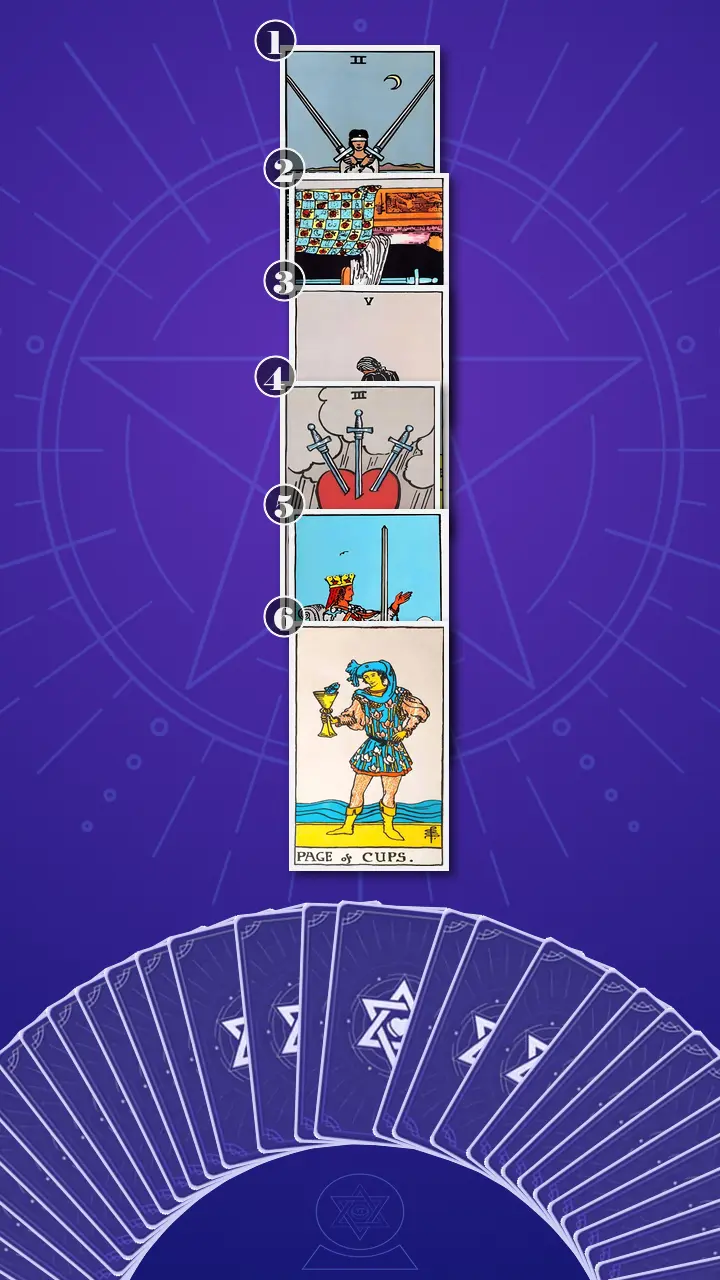
Reading the Map: What Your Nervous System Does With ‘Soon’
Position 1 — The immediate trigger (the text + the pause)
“Now turning over is the card representing the immediate trigger and what is actually happening in the moment,” I said.
Two of Swords, upright.
In modern life terms, it’s painfully literal: You’re on your couch after work, Slack finally quiet, and the text comes in: “We should hang soon.” You stare at it like it’s a trick question. You want to reply warmly, but your body goes rigid—so you do nothing, because doing nothing feels like you can’t be rejected for trying.
This card is freeze as self-protection. The energy isn’t “wrong”—it’s blocked. The blindfold and crossed arms show a nervous system hitting airplane mode right when you need a single, clear sentence. Nothing is decided yet, but your body acts like it already is.
I mirrored what I saw in her story, slow and specific: “Thumb hovering. Message left on read. Calendar opened like a shield. And the loop is: ‘If I suggest a day and they dodge it, I’ll feel stupid… so I won’t suggest a day.’”
Jordan let out a small laugh that had no joy in it. “That’s… brutal,” she said, still smiling like she wanted to pretend it didn’t sting. “But yeah. That’s exactly it.”
Position 2 — Your automatic translation (the instant story your mind assigns)
“Now turning over is the card representing your automatic translation: the instant story your mind assigns to the ambiguity,” I said.
Nine of Swords, reversed.
The scenario is the one Jordan had practically memorized: It’s late, lights off, and you’re replaying the chat like it’s CCTV footage. You check timestamps, look for the typing bubble, and convince yourself their vagueness is a quiet no. To stop feeling exposed, you consider waiting hours to respond—then you feel sick with anxiety anyway.
Reversed here, the energy is internalized—a private courtroom you run at 1 a.m. where you’re both prosecutor and defendant. This is the draft-and-delete loop that feels like “research,” but functions like self-harm.
I said, “Let’s do what I used to do on a trading desk when the screen was screaming: separate signal from noise. In your Notes app, it’s Facts vs. Stories.”
“Facts: they said ‘We should hang soon.’ There’s a smiley. That’s it. Stories: ‘They’re fading me.’ ‘I’m embarrassing.’ ‘If they wanted to, they would.’”
Her eyes dropped to the lower left of her screen, like she was watching herself do it. “And then I go ‘cold mode’ to feel in control,” she admitted. “I’ll delay for hours like it’s a power move. But I’m just… spiraling.”
“One rewrite max—then send,” I said, not as a command, but as a handrail.
Position 3 — The past pattern being echoed (the learned template behind ‘soon’)
“Now turning over is the card representing the past pattern being echoed: the learned template that taught you what ‘soon’ supposedly means,” I said.
Five of Cups, upright.
Here’s the translation: A new person says “soon,” and your brain immediately pulls up that one situationship who sounded enthusiastic but never locked anything in. The past disappointment overlays the present like a filter, so you start reacting to an old person in a new conversation.
This is grief as a preset. The energy is sticky: your attention keeps returning to the spilled cups—the letdowns you can name instantly—while the two standing cups (the times people did show up) become harder to feel when you’re triggered.
I kept my voice gentle. “You’re not dramatic—you’re interpreting with an old template. One person didn’t follow through… and your nervous system turns that into: therefore no one will.”
Jordan swallowed, throat moving like she was pushing down a memory. “There was someone,” she said quietly. “So many ‘soon’s. So many ‘next week’s. And then… nothing.”
Position 4 — The core wound underneath (what rejection would ‘prove’ about you)
“Now turning over is the card representing the core belief/wound underneath: what rejection would ‘prove’ about you,” I said.
Three of Swords, upright.
The modern-life scenario hits fast: You feel the sting before you even think: the phrase “hang soon” hits the part of you that expects to be the one waiting. Your fear isn’t just ‘they’re busy’—it’s ‘if I show interest and nothing happens, it proves I’m not wanted.’
This card’s energy is raw clarity. Not because it says “you will be rejected,” but because it names what the body is protecting: a heartbreak-shaped bruise that ambiguity keeps pressing on.
I slowed down. “That sting isn’t you being ‘too much.’ It’s your brain trying to prevent a rerun of being left hanging.”
Jordan blinked hard, jaw clenching then releasing in a tiny tremor. “It’s so dumb,” she whispered.
“It’s not dumb,” I said. “It’s learned.”
Position 5 — The key reframe (the antidote that restores self-trust)
I glanced at the next card and felt the room shift—like the air got cleaner. “We’re turning over the most pivotal card in this reading,” I told her.
Queen of Swords, upright.
The scenario is simple and almost boring—which is exactly why it’s medicine: You stop trying to decode tone and you ask for a real plan in one line. Not as a test, not as a chase—just clean communication: “I’d love to. Thu after 7 or Sat afternoon?” If they’re into it, it moves forward. If they aren’t, you learn quickly without spiraling.
Jordan’s typical loop was right there between pride and longing: she wanted to look chill to protect herself, but the “chill” was costing her sleep and self-respect.
Stop treating vagueness as a verdict, start asking for clarity—and let the Queen of Swords cut cleanly through the fog with one respectful, direct line.
There was a beat of silence where even the hum of her condo felt far away.
The shift isn’t “be fearless.” It’s this: clarity is not neediness—it’s self-respect and emotional hygiene.
I watched the three-step reaction move through her in real time: first a tiny freeze—her breath caught, like her body didn’t want to let the idea in. Then her eyes unfocused for a second, as if replaying every time she’d tried to “act indifferent” and called it boundaries. Then the exhale came—slow, shaky, shoulders dropping like someone had unhooked a weight from her collarbones.
“But if I say that,” she pushed back, heat rising into her cheeks, “doesn’t it make me… the one who cares more?”
That flash of anger was protective, not petty. I nodded. “That’s the Three of Swords talking—trying to prevent the old pain.”
Then I brought in the lens I’m known for: on Wall Street, we didn’t survive by guessing. We survived by setting clean terms. “Think of this as Negotiation Alchemy,” I said. “Not manipulation—structure. You’re not asking for reassurance. You’re asking for logistics. Your BATNA—your best alternative to a negotiated agreement—is your own Friday night peace. When you send one clear option, you’re not chasing; you’re collecting data.”
“And here’s my other framework,” I added, “Influence Credit Scoring. If someone responds to clear invitations with clear follow-through, they’re higher credit. If they dodge specifics twice, the credit is low. That’s not a verdict on your worth—it’s a rating on the reliability of the connection.”
I leaned forward. “Now, use this new angle and look back at last week. Was there a moment when you treated ‘soon’ like a closed door—when it was really just missing information?”
Jordan’s eyes widened, then softened. “Yeah,” she said. “I… I basically punished them for not being specific by going quiet. And then I told myself the silence proved they didn’t care.”
“That’s the old script,” I said. “The Queen offers a new one.”
Position 6 — A grounded next step (warm action that creates clarity)
“Now turning over is the card representing a grounded next step: one small action that creates clarity without overexposing you,” I said.
Page of Cups, upright.
The scenario is warmth with training wheels: You send a message that sounds like you (not like a strategy): light, warm, and specific. You offer one concrete option and let the response be information, not a referendum on your worth.
This card’s energy is balanced: open-hearted, but not over-invested. It’s the shoreline—your edge of comfort. You’re not diving into the deep end. You’re taking one step closer to honest connection.
“Warm + specific beats chill + vague,” I said. “The Page is the part of you that can be sincere without making it a performance.”
Jordan nodded, slower this time. The tension in her forehead eased. “That… actually feels doable,” she said. “Like I can send one sentence and not make it mean my whole life.”
The One-Question Clarity Rule: Turning Tarot Insight Into a Text You Can Send
Here’s the story your spread told, in plain language. The Two of Swords showed the freeze: you protect your heart by pausing, rereading, and refusing to move the conversation forward. The Nine of Swords reversed showed what happens next: your mind does the conversation for you at 2 a.m., gathering “evidence” from timestamps and Instagram like it’s a stock ticker. The Five of Cups named why it’s so charged: an old follow-through failure became your default lens. The Three of Swords named the tender core: you fear ambiguity will prove you’re not wanted. Then the Queen of Swords offered the turning point: treat vagueness as missing information, not a verdict. And the Page of Cups brought it back to human scale: one warm, schedule-able invitation.
The cognitive blind spot is this: you keep trying to think your way into safety, but the thing that actually creates safety is clean information. Silence feels like boundaries, but in this pattern it often functions like a test—one that starves you of clarity.
The transformation direction is simple and brave: shift from interpreting vagueness as rejection to treating it as missing information and asking for one concrete plan. Vague isn’t rejection. Vague is missing information.
Here are your next steps—small, practical, and designed for the exact moment your nervous system wants to go into airplane mode:
- Send the Two-Options Invite (10-minute window)Within 10 minutes of seeing “We should hang soon,” copy/paste: “I’d love to. Are you free Thu after 7 or Sat afternoon?” (If you want warmth, add one human detail: “I’ve been craving a low-key catch-up.”)One rewrite max—then send. Save two go-to options in Notes (weekday evening + weekend daytime) so you don’t have to invent language while activated.
- Do a 30-second Facts vs. Stories SplitOpen Notes and write 3 facts (what they literally said/did) and 3 stories (what you fear it means). Then choose one action: send the clear ask, or pause intentionally.If your brain insists you need more evidence, label it “mind-reading,” and return to the one-question script.
- Use my “Cocktail Party Algorithm” to keep it warm and cleanPhase 1: Warm opener (“I’d like that.”). Phase 2: Specific offer (two options). Phase 3: Easy out (“If neither works, tell me what does.”). It’s friendly, not performative—and it invites reality.After you hit send, put your phone face-down and do a 2-minute reset (water, stretch, balcony). Your job is to regulate, not refresh.

A Week Later: Clarity, Not Certainty
A week later, Jordan messaged me a screenshot. One sentence she’d sent—no essays, no “haha totally!” placeholder. Just: “I’d love to. Thu after 7 or Sat afternoon?” Under it, her follow-up: “My hands were shaking a little, but I did it. I put my phone down and walked to Loblaws like a normal person.”
She didn’t tell me it led to a rom-com ending. She told me something better: she slept through the night. In the morning, the first thought still flickered—What if I’m wrong?—but this time she noticed it, exhaled, and didn’t obey it.
That’s the real Journey to Clarity: not forcing certainty, but building enough self-trust to ask one clean question and tolerate the answer—whatever it is.
That chest-tight moment isn’t just about the text—it’s the part of you that learned ambiguity can turn into being left behind, so you try to stay safe by caring quietly.
If you let “soon” be missing information instead of a personal verdict, what’s one small, self-respecting question you’d feel okay sending—just to find out what’s real?
This story is adapted from psychological research, written so that those in a similar struggle can see their own pattern in it — and find their next step clearly.These insights are not a substitute for professional psychological, medical, legal, or financial advice.
Learn more about our Journey to Clarity.
How did this insight land for you?
🫂 This Resonates Deeply
🌀 Living This Story
✨ Now I See Clearly
🌱 Seeing New Possibilities
🧰 Useful Framework
🔮 The Confirmation I Needed
💪 Feeling Empowered
🚀 Ready for My Next Step
Author Profile
 AI
AI“I spent years in the intense, high-stakes world of Wall Street. I know exactly how isolating and heavy the weight of uncertainty can feel in the dead of night. I use strategic, commercial logic not to be cold, but to protect you from unnecessary friction. Think of me as a fellow traveler who has walked the same rocky path—offering sharp but deeply supportive wisdom to help you clear the fog and confidently win your narrative back.”
In this Friendship Tarot Reading :
Core Expertise
- Reciprocity ROI Analysis: Objectively measuring the emotional give-and-take in your core friendships to identify asymmetrical, high-drain relationships.
- Sunk-Cost Decoupling in Loyalty: Separating the 'ten years of history' from the current reality of a one-sided, demanding friendship.
Service Features
- The Friendship Downgrade Strategy: A calculated tactical approach to gradually and decently de-escalate a toxic friendship into a low-maintenance acquaintance without triggering dramatic conflict.
Also specializes in :
Explore Related Patterns:
Freeze ResponseJordan’s thumb hovering over the message, the thread left on read, and the calendar opened “like a shield” show a body-level pause before any clean choice can happen. She wants connection, but suggesting a real day would make the possibility of being dodged feel too immediate. The defense is not laziness or indifference; it is action shutdown under perceived social threat. Doing nothing briefly protects her from the exposed feeling of trying, yet it also keeps her trapped inside the same uncertainty that triggered her. Freeze Response fits because the story repeatedly shows the nervous system choosing stillness as safety. You can feel the logic of it: if you do not move the conversation forward, you cannot be clearly rejected for moving toward someone first.
Protest BehaviorJordan admits she goes “cold mode” and delays for hours like it is a power move, even while she is spiraling. Later she recognizes that she basically punished the other person for not being specific by going quiet, then used the silence as proof they did not care. The mechanism is a protective bid for control inside relational uncertainty. Instead of asking directly, the withdrawal becomes a test: if they pursue, maybe she matters; if they do not, the old rejection story feels confirmed. Protest Behavior fits because the silence is not neutral distance. It is a defensive move designed to reduce exposure, regain leverage, and make the other person resolve the uncertainty, even though it ultimately keeps Jordan further from clarity.
Rejection SensitivityJordan’s chest-tight reaction to “We should hang soon” is not built from the sentence alone. The message is vague, but her body reads the ambiguity as a possible repeat of being left hanging, so the nervous system moves faster than the facts. The psychological mechanism is a threat-based interpretation loop: a small cue becomes evidence of a larger verdict before the other person has actually clarified anything. You can see it in the instant translations, “They’re fading me,” “I’m embarrassing,” and “If they wanted to, they would,” where missing information gets converted into rejection data. Rejection Sensitivity fits because the story keeps returning to one question: what past taught you to treat ambiguity as proof that you are unwanted? The pattern is not about being “too much”; it is about a learned defense that tries to prevent another relational sting by scanning for it early, even when the present evidence is incomplete.
Relational Baggage LoopThe old situationship with “so many ‘soon’s” and “so many ‘next week’s” gives the current text its emotional charge. A new person sends a vague invitation, but Jordan’s mind pulls up the previous person who sounded interested and then disappeared from the plan. The mechanism is a relational template: past disappointment becomes the filter through which present ambiguity is processed. Instead of reading the current message as incomplete information, the nervous system overlays the old pattern and starts responding to the earlier letdown inside a new conversation. Relational Baggage Loop fits because the story is explicitly asking what the past taught her. The loop is not just remembering an old hurt; it is letting that old follow-through failure decide what “soon” means now, before the present person has had the chance to become real data.
Assertive CommunicationJordan’s turning point is the one-line reply: “I’d love to. Thu after 7 or Sat afternoon?” The sentence matters because it stops treating the vague text as a hidden verdict and turns it into a simple logistics question. The mechanism is assertive communication as emotional hygiene. You express interest without performing indifference, and you ask for a concrete plan without making the other person responsible for your self-worth. Assertive Communication fits because the story’s resolution is not certainty; it is a cleaner channel for reality to answer. The direct line gives you information faster, protects your self-respect, and breaks the old loop where silence pretends to be safety.
Compulsive CheckingJordan scrolling up the thread, checking timestamps, looking for typing bubbles, and treating Instagram clues like a stock ticker shows the mind trying to turn ambiguity into certainty. The phone becomes a tool for emotional regulation, not just communication. The mechanism is compulsive checking: repeated evidence-gathering gives a short hit of control while keeping the nervous system activated. Each scan promises clarity, but because the core question requires a real response from the other person, the checking cannot actually resolve it. Compulsive Checking fits because the behavior is visible, repeated, and self-reinforcing. You are not simply curious about a text; you are trying to make the uncertainty stop by reviewing tiny signals that were never designed to carry that much meaning.
RuminationJordan replaying the chat at night and drafting replies as if she is writing ad copy for her own likeability shows a thought loop taking over the decision. The message is short, but the mental review becomes huge. The cognitive mechanism is rumination: the mind circles the same limited evidence, hoping that one more pass will make the ambiguity feel safe. Instead, the loop becomes a private courtroom where every possible meaning is argued, and the body stays braced for rejection. Rumination fits because the story’s pain is not only the text itself; it is the repeated thinking that follows it. You keep trying to think your way into safety, but the thing that would create actual safety is cleaner information, not another hour inside the same mental loop.
Reality TestingJordan’s Facts vs. Stories split names exactly what is confirmed and what her fear is adding. The confirmed data is small: they said “We should hang soon” with a smiley. The painful meanings are the extra layer: “They’re fading me,” “I’m embarrassing,” and “If they wanted to, they would.” The mechanism is reality testing: separating observable evidence from threat-based interpretation before choosing a response. It does not require pretending the fear is irrational; it simply refuses to let the fear become the only source of truth. Reality Testing fits because the story is about turning a verdict back into information. You stop obeying the first anxious translation and create one clean experiment: ask for a specific plan, then let the response tell you what is actually real.
Explore Related Struggles:
Clarity-Exposure SplitJordan knows the cleanest move is one ordinary line: 'I would love to. Thu after 7 or Sat afternoon?' Her body freezes at the point of sending it because asking for logistics would create information, but it would also reveal that she cares enough to ask. You get caught between needing clarity and wanting to stay unexposed. The unsent reply protects pride for a few hours, but it also keeps you inside the fog, where the other person's vagueness gets to feel more powerful than your own ability to ask. The shift is not about forcing yourself to be fearless. It is about letting a small, respectful question separate real availability from imagined rejection, so your need for clarity no longer has to feel like emotional overexposure.
Vigilance-Connection SplitThe message lands as both invitation and threat: Jordan wants to answer warmly, but her chest tightens, her stomach drops, and the urge to disappear first arrives before she can type one clean sentence. Connection and self-protection activate in the same breath. You move toward the possibility of closeness while scanning for the moment it might turn into rejection. That vigilance is trying to keep you from being blindsided, but it also makes ordinary ambiguity feel like a room you need to escape. The split starts loosening when warmth and structure are allowed to coexist. You can be open without overextending, and you can ask for a real plan without handing the other person control over your emotional ground.
Wound-Compass FusionJordan hears 'soon' and her mind pulls up the person who kept saying 'soon' and 'next week' until nothing happened. The current message stops being a single text and becomes a rerun cue, as if the new conversation has already inherited the old person's failure to follow through. The struggle sits in the way memory starts doing the job of present evidence. You are not simply reacting to vagueness; you are negotiating with an old template that learned to treat soft enthusiasm as the first stage of being left waiting. Clarity returns when that older example is allowed to inform you without becoming the whole map. One present-tense question can test this connection without letting the past run the entire room.
Chosen-Worth BindJordan names the core fear directly: if she shows interest and nothing happens, it will prove she is not wanted. That turns a scheduling gap into something much heavier than logistics; the other person's follow-through becomes a scoreboard for her desirability. You are carrying the message as if it can deliver a verdict on your worth. When the reply is vague, your body does not only hear 'no plan yet'; it hears the possibility of being the one who waited, cared, and was not chosen. The cleanest counter-move is to let the response rate the reliability of the connection, not the value of the person asking. A concrete invitation can reveal whether someone can meet you in real time without making their answer the measure of your lovability.
Low-Maintenance Worth LockJordan admits she goes into cold mode and delays for hours like it is a power move. Under that performance is the fear that a direct question will make her the one who cares more, so acting chill becomes the costume she wears to avoid looking exposed. You make yourself low-maintenance at the exact point where a normal relational need wants to be named. The problem is not that you want a plan; it is that wanting a plan starts to feel like losing status, leverage, or self-respect. A warm, specific line does not make you needy. It ends the performance and gives the connection a chance to show its actual shape, while letting your dignity come from clean self-expression rather than strategic emotional hiding.
Monitoring-Safety FusionJordan scrolls up through the thread, checks the timing, opens her calendar like it can prove she is busy anyway, and replays the message until the phone becomes a research device. Every tiny signal is asked to answer the question the text itself did not answer. You try to feel safe by monitoring harder. The loop can look rational because it gathers details, but those details do not become clarity; they keep you close to the screen and far from the one action that could produce new information. Safety starts shifting when observation stops pretending to be a substitute for contact. One direct, low-pressure question gives reality a chance to respond, while endless checking only lets uncertainty keep refreshing itself.
Explore Related Emotions:
Ambiguity DreadThe phone glow on the ceiling, the scroll back through the iMessage thread, and the calendar opened like a shield all orbit one missing detail: "soon" has no date attached. Your body treats that empty space as if it already contains the answer, so a vague but friendly sentence starts to feel like a threat-shaped gap. Ambiguity Dread names the pressure that builds when missing information gets mistaken for rejection. The past "soon" messages that led nowhere have trained your attention to scan vagueness for danger, and reclaiming agency starts with separating what was actually said from the story your body is bracing against.
Rejection ChillHer shoulders creep up, the chest tightens, the stomach drops, and the warm reply never leaves the thumb-hovering stage. The body moves first, shrinking the whole interaction into a held breath before the mind has enough facts. Rejection Chill names that sudden cooling of contact, where going quiet feels safer than being visibly interested. It is not indifference; it is a protective freeze that tries to keep you from feeling exposed, even though it also keeps you from receiving clear information.
Relational FogJordan keeps asking whether this is breadcrumbing, intuition, or an old template taking over, because the present message is no longer standing alone. The old situationship with all its "soon" and "next week" promises has been laid over the current conversation like a filter. Relational Fog is the inner weather of not knowing which signal belongs to now and which one belongs to the past. It matters here because clarity does not come from guessing harder; it comes from noticing the overlay and giving the current person one clean chance to be specific.
Verdict DreadThe line that lands hardest is not simply "they might be busy"; it is the thought that if you show interest and nothing happens, it will prove you are not wanted. That is why a casual text starts carrying the weight of a courtroom, with you waiting for the message to rule on your desirability. Verdict Dread fits the moment where logistics stop being logistics and become a referendum on self-worth. When you can name that leap, you get a cleaner choice: ask for information without letting the answer define your value.
Clarity HungerThe rereading, calendar checking, Facts vs. Stories split, and one-line script all point toward the same need: the nervous loop wants clean information. Guessing keeps the system spinning, while one concrete question gives the situation a shape you can actually respond to. Clarity Hunger is not about demanding certainty from another person. It is the pull toward language, logistics, and self-respect after too much time spent decoding tone in the dark.
Guarded LongingUnder the pause, there is still a real wish to take the message as genuine interest. The conflict is that warmth wants to move forward while pride wants to disappear first, so the longing has to travel with armor on. Guarded Longing names the soft reach inside the defensive posture. The two-option invite matters because it lets you stay warm without overexposing yourself: you offer contact, keep your edge, and let the response become information.
Micro-Performance ShameDrafting replies like ad copy for your own likeability turns one text into a tiny public-relations campaign. Every word starts to feel like evidence for whether you are too eager, too available, too much, or not enough. Micro-Performance Shame fits because the pressure is not only about getting a reply; it is about managing how your desire appears. Naming it helps you move from editing yourself for approval to sending a sentence that sounds human, specific, and self-respecting.
Performative CalmShe keeps her voice casual, considers waiting hours as a power move, and recognizes the old habit of acting indifferent while calling it boundaries. The outside presentation is chill, but the inside is busy trying to control how much caring is visible. Performative Calm names the strain of looking unbothered when the interaction is clearly touching something tender. In this story, the performance protects pride for a moment, but it also costs sleep, warmth, and the simple right to ask a direct question.
Explore Related Contexts:
BreadcrumbingA past connection kept saying 'soon' and 'next week' without ever locking in a real plan, and then the thread went nowhere. That history matters because the current message is not entering a blank social field; it is landing on a phrase that previously carried attention without follow-through. The external structure here is a dating exchange where warmth is offered in language, but commitment is withheld in logistics. You are not simply reacting to a word; you are recognizing a pattern where suggested interest can keep someone emotionally available while never requiring the other person to make an actual plan. Breadcrumbing fits because the pain point is not the absence of interest, but the intermittent hint of it. The story shows why one vague sentence can feel loaded: it resembles a past setup where small signals kept the door open while real availability never arrived.
Mixed Signal LimboThe text gives Jordan a friendly cue and a dead end at the same time: 'We should hang soon' comes with a smiley, but no actual plan. She opens her calendar as if being busy could protect her, yet the message still contains too little information to act on cleanly. Mixed signal limbo captures the suspended quality of the exchange. You are not dealing with a clear invitation or a clear rejection; you are dealing with a cue that keeps possibility alive while withholding the specific information that would let the situation move. That limbo is why the story becomes a loop of scrolling, rereading, checking timestamps, and delaying a reply. The external problem is the ambiguity of the signal itself: it asks you to respond as though something is happening while leaving you to supply the meaning of what is happening.
Situationship AmbiguityJordan is looking at a message that sounds warm but does not define anything: no date, no time, no next move beyond 'soon.' That lack of structure leaves her trying to work out whether she is being invited closer, kept on standby, or politely managed at a distance. Situationship ambiguity is the external stage because the connection has enough emotional charge to matter but not enough agreed structure to stabilize expectations. You are left reading tone, timing, smileys, and silence because the relationship container itself has not made the rules clear. The story keeps returning to this undefined position: wanting to reply warmly, fearing the other person may dodge, and trying to appear chill so the imbalance is not visible. The issue is not that a schedule has not been set yet; it is that the social position behind the message is unclear enough to make every small cue feel like evidence.
Direct Communication TrialJordan eventually sends one plain line: 'I’d love to. Thu after 7 or Sat afternoon?' The move is small, but it changes the structure of the exchange from tone-reading to plan-making. Direct communication trial fits because the story is not presenting directness as an already mastered skill. You are watching someone test a cleaner social rule in real time: ask for concrete information, offer a reasonable path forward, and let the response show whether the connection can meet you there. The trial matters because it restores action without demanding certainty. Instead of waiting inside a vague phrase, Jordan creates a simple logistical opening and gives the other person a chance to respond with equal clarity.