The Waiting-for-Closure Trap at 10:47 p.m.
If you are a late-twenties Toronto creative who can revise a product flow all day but keeps deleting one honest text at night, you may already know slow-fade anxiety by muscle memory.
I met Maya in my consultation room on a wet Thursday evening. She worked as a content designer at a digital product studio, and at 10:47 p.m. most nights she reopened an iMessage thread, typed “I’ve noticed things feel different lately,” deleted it, and checked the other person’s Instagram Story instead. She described the phone as warm in her palm, the radiator ticking against the quiet apartment, and the blue light stinging her tired eyes.
She told me, “I keep telling myself one more week will make it obvious. I don’t want to ask for clarity and sound demanding. Nothing officially ended, so why does it already hurt?”
I could hear the contradiction beneath the careful wording: she wanted to understand what the slow fade was asking her to stop postponing, while continuing to postpone the direct response that might make the change real. Her uncertain longing moved through her like a loading spinner that kept turning just long enough to make closing the tab feel premature. Each notification tightened her chest; each vague reply dropped her energy through the floor.
“You don’t have to prove that this connection has ended before you’re allowed to respond to how it is affecting you,” I said. “We can look at the pattern without inventing motives or forcing a dramatic decision. Today, our Journey to Clarity is simply about drawing a map through the fog and giving your own observations a fair hearing.”

Choosing a Compass for Slow-Fade Uncertainty
I asked Maya to take one slow breath and hold the question in plain language: What is this slow fade asking me to stop postponing? Then I shuffled deliberately. The small ritual was a transition from checking signals to examining them, a way to focus the mind rather than summon a fixed future.
For this reading, I used The Shadow Spread, a focused five-card cross. It suits relationship uncertainty because it examines the visible pattern, the trigger that activates it, the protective fear underneath, the capacity hidden inside the pattern, and the practical next step. In other words, it lets tarot work as a structured cognitive tool. It gives card meanings in context without pretending that a card can issue a verdict about another person’s intentions.
I explained the route before turning anything over. The center would show the visible shadow, the left card the activating trigger, and the lower card the hidden protective root. To the right, we would find the reclaimed gift, and above the center, the integration step: a clear observation, conversation, or boundary that could help healing move in the present.
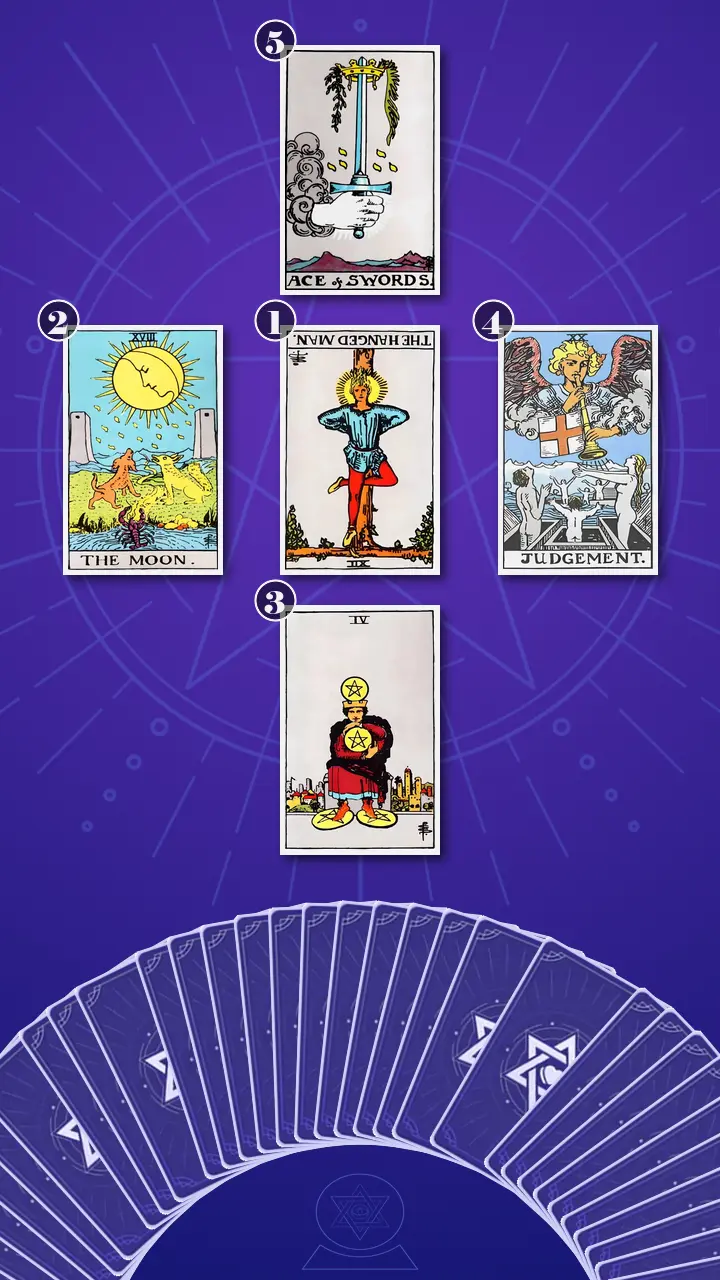
The Cross Where Waiting Takes Shape
The Hanged Man Reversed: When a Pause Becomes a Calendar
“Now I’m turning over the card for the visible shadow, the way your response to the slow fade is currently expressing suspended healing.” The card was The Hanged Man, in reversed position.
I pointed to the single bound foot and the inverted body. At 10:47 p.m., Maya typed a clear check-in, deleted it, saw an unrelated notification, and moved her private deadline from tonight to the weekend. The halo suggested that reflection had already given her enough perspective to describe what had changed. Reversed, the energy was no longer a useful pause. It had become a blockage, an arrangement built around staying unavailable to her own answer.
“I keep telling myself I’m waiting for more information,” I said, “but what I’m actually doing is moving the date each time I feel afraid of what the information might confirm. Waiting longer is not the same as healing.” I also named the overcorrection risk: she did not need to send a long ultimatum to recover control. Two factual sentences would be more useful than a message carrying every unsaid feeling.
Maya gave a short, bitter laugh. “That is painfully accurate. It’s like I’ve turned patience into a personality trait.” Her fingers rubbed the edge of her phone, and her stomach dropped before she looked back at the card.
“I’m not judging the waiting,” I told her. “It protected hope for a while. I’m asking whether it is still producing perspective, or whether it is quietly consuming your evenings.”
The Moon Upright: A Transit Board With No Arrival Time
“Now I’m turning to the activating trigger, the reduced contact and incomplete signals that restart the cycle.” The Moon appeared upright.
On her morning commute, Maya combined a delayed reply, an affectionate message from three weeks earlier, and a new Instagram Story into several competing narratives. I compared The Moon’s narrow path between two towers to a transit board that says delayed without giving an arrival time. The observable facts were limited; her mind kept supplying the rest: maybe the other person was genuinely busy, maybe Maya had come on too strong, maybe the old warmth still counted as evidence that everything could return.
The Moon’s energy was ambiguous rather than dangerous. It explained why one more clue felt irresistible, but it did not require her to stay indefinitely inside the uncertainty. “Ambiguity explains why you feel unsure; it does not require you to stay on hold,” I said. Maya nodded slowly and remembered the last time a Story view had restarted a whole evening of analysis. Her gaze moved from the moonlit path to the phone lying face down beside her.
Four of Pentacles Upright: The Weekend Held Against the Chest
“Now I’m turning over the hidden protective root, the fear and belief keeping the shadow pattern in place.” Four of Pentacles appeared upright.
The image showed a pentacle pressed over the figure’s chest and two coins pinning the feet. I saw the connection to Maya’s Friday nights: leaving an evening unplanned, delaying a friend’s dinner invitation, and keeping the old message thread close because giving that time to anything else would make the change feel real. The energy was protective and rigid. It offered temporary security by holding tightly, while quietly restricting friendship, rest, and emotional movement.
“If I release the space, I’m admitting the connection may not come back,” Maya said. She inhaled and held the breath; her eyes drifted toward the blank blocks in her calendar; then her hands tightened around the phone before opening again. “Hope can be sincere and still be expensive,” I said. “The question is not only what you might lose by naming the change. It is also what continued holding is already costing you.”
When Judgement’s Trumpet Asked for a Response
Judgement Upright: The Call That Was Already Heard
The room seemed to narrow when I placed the fourth card on the right. Outside, a streetcar bell sounded through the rain, clear and brief, as if the city had supplied its own punctuation.
“Now I’m turning over the reclaimed gift, the capacity that can interrupt postponement without requiring certainty about the other person.” The card was Judgement, in upright position.
The trumpet and the figures rising from grey coffins changed the posture of the spread. Judgement was not an external announcement about whether Maya belonged to this person. It was the return of honest self-assessment and responsive agency. The recognition had already arrived; the next question was whether she would answer it.
For a moment, I remembered the Wall Street desks where I had once watched a position stay open long after its original thesis stopped earning anything. I do not use that memory to turn a relationship into a balance sheet. I use it to protect people from unnecessary friction. My Resource Readiness Assessment asks whether the internal resources match the external timing: Does Maya know what she has observed? Can she make room for either response? Does she have a boundary and support in place? My Strike Timing Calibration then separates a strategic hold from a costly delay. A chosen seven-day window to prepare is holding. Moving the date whenever a new Story appears is drift.
At 10:47 p.m., the thread is open again: the draft disappears, the other person’s Story keeps playing, and another evening stays unplanned. Maya calls it patience, even as her chest tightens around the possibility that the pattern has already changed.
I let the silence sit for a beat, then said, “Waiting longer is not the same as healing; answer Judgement's trumpet by naming what has changed and choosing the next boundary that respects your present reality.”
Then I gave the insight its simplest form: “The slow fade does not need to become a dramatic ending before its changed participation becomes real enough for you to respond.”
For a second, Maya froze. Her thumb hovered above the phone, her pupils widened, and her eyes lost focus as if an old message thread were replaying behind them. Her jaw tightened next. “But if I let the pattern count, does that mean I was wrong to hope?” I told her that hope was not the error; postponing her own needs indefinitely was the part she could now reconsider. Her fingers closed around the phone, then slowly released it. Her shoulders lowered, her eyes grew bright, and a shaky breath left the centre of her chest. She put both feet on the floor and opened a blank note. Relief arrived with a brief, dizzying emptiness. Clearer agency meant she no longer had to wait to be released, but she did get to choose how to respond.
“Now, use this new angle to remember last week,” I invited. “Was there a moment when this insight might have allowed you to feel differently, even before you knew what the other person intended?”
This was the first movement from suspended hope, notification anxiety, and anticipatory grief toward self-authorized clarity, self-respect, and renewed emotional movement. The call was not their final verdict. It was Maya allowing her own recognition to count as information.
Ace of Swords Upright: One Clean Line Through the Noise
“Now I’m turning to the integration step, the practical expression that converts recognition into present-tense movement.” Ace of Swords appeared upright.
I showed Maya the single sword held against an open sky. The distant mountains remained difficult, but they were visible. For someone who spent her workday refining UX microcopy, the modern translation was direct: several paragraphs of contradictory stakeholder comments could become one usable line. Ace of Swords did not solve the other person’s motives. It gave Maya language precise enough to support a choice.
“You do not need to prove their motive,” I said. “You can clearly name the pattern and decide what you will do with it. Clarity can be one honest sentence, not a complete explanation.” Maya opened Notes, shortened her draft, and read it aloud: “I’ve noticed our contact and plans have become less consistent lately. Are you still interested in continuing this connection?” She did not have to send it that night. Saving the sentence was already a bounded action.
From the Loading Spinner to a Life That Moves
When I laid the five cards together, their story became coherent. The Hanged Man reversed showed a useful pause stretched into an indefinite suspension. The Moon showed how delayed replies and social media fragments fed competing stories of hope and fear. Four of Pentacles revealed the protective bargain beneath it: preserve the possibility, and belonging might remain untouched. Judgement opened the closed posture, while Ace of Swords translated recognition into words.
The blind spot was not simply that Maya lacked information. It was the belief that information would become usable only after the other person supplied a complete explanation. The effect on her chest, attention, calendar, and healing was already observable. The transformation direction was from waiting for the slow fade to resolve itself to naming the changed participation and choosing one boundary or conversation within seven days.
“I want to give you a plan for the waiting period,” I said. “I call it The Strategic Holding Pattern. It is not indefinite availability dressed up as patience. It is a tactical micro-plan with a short clock, a clear purpose, and an exit into your own decision. You can prepare without monitoring.”
- Run the seven-minute Fact, Story, Choice checkOn one evening this week, set a seven-minute timer in Notes. Under Fact, write one observable change in the contact pattern. Under Story, write the explanation you keep revisiting. Under Choice, name one response within your control this week.Keep each heading to one sentence. If seven minutes feels too activating, write only the factual observation and close the note.
- Draft the two-sentence clarity check-inIn Notes, write one factual observation and one honest question or need: “I’ve noticed our contact and plans have become less consistent lately. Are you still interested in continuing this connection?” Remove motive claims, choose a daytime window, and decide your follow-up boundary before sending.Use a roughly 40-word cap. Sending is optional, and if contact feels unsafe or simply wrong for you, the private-boundary version is complete on its own. Mute the thread for one hour afterward.
- Reclaim one tentative eveningChoose one Friday or Saturday block being held for a possible late invitation and put a concrete plan in Google Calendar with a start time, location, and end time. Make it a plan with yourself or a friend, and do not cancel it for an unconfirmed maybe.Treat this as reclaiming one calendar block, not issuing a permanent verdict. Start with thirty minutes and use Do Not Disturb with the phone out of reach.
These are next steps, not tests of maturity. Maya could ask directly, set a private boundary, or do neither until she felt ready. The point was to stop letting an absent answer make every decision by default.

The Calendar Became Hers Again
Five days later, I received a message from Maya. “I did the seven minutes. Fact: daily contact became brief replies and no concrete plan for three weeks. Story: I’m being left because I’m not enough. Choice: I’m going to dinner Friday, and I’m not cancelling for a maybe.” She had also edited her check-in down to two sentences and chosen whether to send it from a steadier place.
She slept a full night after writing the note. At breakfast, the first thought was still, “What if I’m wrong?” This time she smiled, not because the answer was certain, but because uncertainty no longer had her entire calendar.
I did not treat that message as proof that the tarot had changed her future. The cards had offered a clear structure; Maya had supplied the honesty, the boundary, and the movement. That is the real Journey to Clarity: not obtaining perfect closure, but moving from guarded hope to responsive agency while grief and relief are still allowed to coexist.
When a connection goes quiet without ending, the hardest part can be feeling your chest tighten at every notification while one part of you protects hope and another knows your life is being arranged around an absence.
If you let what you have already noticed count, what might you be ready to name, in one sentence, just for yourself?
This story is adapted from psychological research, written so that those in a similar struggle can see their own pattern in it — and find their next step clearly.These insights are not a substitute for professional psychological, medical, legal, or financial advice.
Learn more about our Journey to Clarity.
How did this insight land for you?
🫂 This Resonates Deeply
🌀 Living This Story
✨ Now I See Clearly
🌱 Seeing New Possibilities
🧰 Useful Framework
🔮 The Confirmation I Needed
💪 Feeling Empowered
🚀 Ready for My Next Step
Author Profile
 AI
AI“I spent years in the intense, high-stakes world of Wall Street. I know exactly how isolating and heavy the weight of uncertainty can feel in the dead of night. I use strategic, commercial logic not to be cold, but to protect you from unnecessary friction. Think of me as a fellow traveler who has walked the same rocky path—offering sharp but deeply supportive wisdom to help you clear the fog and confidently win your narrative back.”
In this Timing Tarot Reading :
Core Expertise
- Resource Readiness Assessment: Objectively evaluating if your internal assets match external market timing before a major pivot or launch.
- Strike Timing Calibration: Calculating the optimal node for decisive action versus strategic holding based on ROI.
Service Features
- The Strategic Holding Pattern: A tactical micro-plan for the 'waiting period', turning anxious stagnation into high-ROI resource preparation.
Also specializes in :
Explore Related Patterns:
Certainty-Gated Self-SilencingAt 10:47 p.m. most nights, Maya writes the sentence that would name the change, deletes it, checks Instagram, and moves her private deadline again. Waiting protects her from sounding demanding and from confronting what a direct answer might confirm, but it also keeps her own observation out of the conversation. When you require the other person's complete explanation before your experience is allowed to guide you, certainty becomes a permission gate for self-expression. Certainty-Gated Self-Silencing describes how an understandable wish to avoid a premature conclusion can turn into indefinite silence, leaving the absent answer to decide by default. The postponed step is not necessarily sending a message; it is allowing yourself to name what has changed and choose a response that does not require external authorization.
Internal ValidationMaya recognizes that the reduced contact and its effects on her attention, body, and calendar are already observable, then writes one factual change and chooses to keep her Friday dinner. She does this without claiming to know the other person's motive or waiting for a final verdict from them. When you give your own accurate observations evidential weight, you can respond to present conditions without pretending that your interpretation is infallible. Internal Validation means your needs and boundaries do not remain suspended until someone else confirms that the situation is serious enough. The postponed permission is permission to let what you have already noticed count, even while the larger explanation remains incomplete.
Loss AversionMaya leaves Friday evenings open, delays a friend's dinner invitation, and keeps the old message thread close because giving that time to something else would make the change feel real. Her statement that releasing the space would mean admitting the connection may not return identifies the protective bargain directly. When you preserve a possibility by continuing to reserve time, attention, and emotional availability, the anticipated loss can become more influential than the present cost. Loss Aversion explains why an unconfirmed maybe can feel safer to protect than a confirmed part of your own life. The pattern does not make hope irrational; it reveals when protecting hope has started to restrict friendship, rest, and the freedom to arrange your calendar around what is actually available.
Boundary DiscernmentMaya puts Friday dinner in her calendar and decides not to cancel it for an unconfirmed possibility. She also keeps two legitimate options available: send a factual check-in, or set a private boundary without contacting the other person. When you distinguish your availability from someone else's uncertain participation, a boundary can respond to the pattern without trying to control its explanation or outcome. Boundary Discernment allows you to decide what access a maybe receives to your time while leaving the other person free to make their own choice. The postponed action is therefore larger than one message: it is deciding what level of uncertainty your present life will continue to organize itself around.
Uncertainty ToleranceAt breakfast five days later, Maya still thinks, "What if I'm wrong?" but she has kept her dinner plan and stopped giving uncertainty control of her entire calendar. She can acknowledge reduced contact without deciding exactly why it happened, and she can allow grief and relief to coexist. When you can leave another person's motive unresolved while making a choice about your own participation, uncertainty stops functioning as a command to remain on hold. Uncertainty Tolerance is not forced confidence or emotional detachment; it is the capacity to act without first eliminating every unanswered question. That capacity lets you prepare for either response while continuing to live in the present.
RuminationOn her morning commute, Maya combines a delayed reply, an affectionate message from three weeks earlier, and a new Instagram Story into competing explanations about busyness, rejection, personal error, and possible reconnection. Later, another Story view restarts the same analysis for an entire evening. When you repeatedly reorganize limited facts into new narratives, thought can feel like preparation even when no interpretation can supply the missing information. Rumination keeps the relationship psychologically active by revisiting what each fragment might mean, while postponing the separate question of how the current pattern is affecting you. The useful shift is from solving an unknowable motive to identifying which facts and choices remain available now.
Compulsive CheckingMaya repeatedly reopens the message thread, abandons her draft, and checks the other person's Instagram Story, with one Story view capable of restarting an entire evening of analysis. Each check promises a new piece of information, but the fragments remain too ambiguous to settle the question. When you monitor messages and social media for the clue that will finally make action feel safe, checking can create movement without producing clarity. Compulsive Checking is maintained by the short-lived possibility that the next signal will resolve the uncertainty, followed by renewed analysis when it does not. Seeing that loop makes it possible to separate information gathering from attention that is being repeatedly captured without changing your available choices.
Explore Related Struggles:
Avoided ClosureAt 10:47 p.m., you type "I've noticed things feel different lately," delete it, and check the other person's Instagram Story instead. The draft moves you toward the connection's present reality, while the deletion returns you to indirect evidence, so the same phone movement keeps recognition and postponement alive. You then move "one more week" to the weekend whenever the next piece of information might confirm what you have already noticed. Closure becomes conditional on the other person supplying a complete explanation, even though the changed participation is already affecting your evenings. The slow fade is asking you to let the pattern count before a final announcement arrives.
Hope-Agency SplitYour calendar shows the split before any final conversation does. You leave Friday night unplanned, delay a friend's dinner invitation, and keep the old message thread close so the connection can still return. Hope preserves possibility, but the same preservation hands an absent reply authority over your time and next move. You do not need to discard hope in order to recover agency. You can let the connection remain uncertain while choosing a plan, a private boundary, or a factual question within your control. The postponement is the point where hope begins making decisions by default.
Closure-Belonging SplitWhen you say, "If I release the space, I'm admitting the connection may not come back," the blank calendar blocks do more than hold time. They become a way to keep belonging symbolically intact, because using Friday for a friend or for rest would make the changed participation feel real. You are not being asked to prove that the connection meant nothing. The bind is that naming what has changed can feel like giving up the place it occupied. You can honor what was genuine while allowing your current calendar and boundaries to reflect what is actually happening.
Unseen Cost BindEach delayed reply, old affectionate message, and Story view sends you back to the same open thread. Meanwhile, your chest tightens, your attention is pulled into analysis, and a Friday invitation is held back; the price of preserving a possibility is already visible in time, rest, friendship, and focus. You can measure that cost without turning it into a verdict about the other person's motives. Reclaiming one evening or saving a two-sentence check-in makes the tradeoff observable: continued holding is not neutral when it keeps your life arranged around an absence.
Explore Related Emotions:
Self-Betrayal AcheMaya says she does not want to sound demanding, so she deletes the honest check-in and waits for an official ending to authorize a response. You can see the painful split between knowing what you have noticed and treating your own needs as valid only after the other person confirms the change. Self-Betrayal Ache is the inward sting of leaving your reality unheard in order to preserve the possibility of belonging. The next boundary is not punishment or pressure; it is a way to let your observations and needs participate in the decision.
Slow Fade DreadAt 10:47 p.m., Maya types a direct sentence, deletes it, and checks the other person's Story instead. The delayed reply, the old affectionate message, and the quiet thread keep the connection present without giving you a stable point to stand on, so each notification carries more weight than the available facts can hold. The chest tightening and the energy drop make the slow fade a lived experience rather than a label for someone else's behavior. You are being asked to let the changed participation count before a formal ending arrives, so your response can come from what you have observed instead of from a verdict about the other person's motives.
Standby Mode AnxietyEach night Maya moves the private deadline from tonight to the weekend, then lets another Story reopen the question. The loading-spinner image captures a state in which your time is technically available but your attention is already assigned to a reply that has no arrival time. That suspended schedule explains why waiting can feel active while quietly consuming your evenings. You can give the pause a purpose and an exit, rather than allowing every new fragment to decide when you are permitted to move.
Cautious Self-RespectFive days later, Maya writes Fact, Story, and Choice, then decides she will go to dinner Friday and will not cancel for an unconfirmed maybe. The choice treats your time as real even while the answer remains uncertain, which is the concrete form respect takes here. Cautious Self-Respect does not require closing the door or denying hope. It asks you to stop making your needs wait for permission and to choose a boundary that matches the participation you can actually observe.
Grounded AgencyAfter her hands tighten around the phone, Maya releases it, opens a blank note, and turns several paragraphs into one clear question. You do not need access to the other person's motives to choose what you will say, what you will wait for, or what you will do with either response. Grounded Agency grows when a bounded action replaces passive monitoring. A private boundary, a daytime check-in, or a reclaimed dinner can all return the next decision to your hands without forcing a dramatic ending.
Quiet KnowingThe halo on the Hanged Man suggested that reflection had already given Maya enough perspective to describe what changed, and Judgement returned the same recognition as a call she had already heard. You have more information than a new Story can provide because your repeated observations are themselves part of the record. Quiet Knowing is not certainty about another person's mind. It is the steady recognition that your experience is usable information, giving you permission to name the pattern before a perfect explanation appears.
Anticipatory GriefShe says nothing officially ended, yet it already hurts, and she worries that naming the change will confirm the connection may not come back. You are meeting the shape of a loss before another person has supplied a final sentence, which is why hope and sorrow keep occupying the same space. Anticipatory Grief does not decide what the other person intends. It identifies the cost of waiting for certainty before acknowledging what has already changed, allowing you to respond to the present without treating hope as a mistake.
Guarded LongingMaya keeps the old message thread close and leaves a Friday night unplanned because releasing that space would make the possible change feel real. Your wish for the connection to return is still alive, but it is being carried behind a protective grip that keeps other plans from fully arriving. That combination of desire and guardedness gives the longing its ache. You can respect what the connection has meant without making your whole calendar prove that hope is still justified.
Relational FogOn her commute, Maya combines a delayed reply, an affectionate message from three weeks earlier, and a new Story into competing explanations. You are left with a small set of observable facts and a large field of possible meanings, which makes the next clue feel necessary even though it cannot settle the whole picture. Relational Fog names the mental weather created by incomplete contact without assigning motives to the other person. Once the fog is recognized as part of the experience, you can separate fact from story and make one present-tense choice without waiting for every possibility to disappear.
Deferred Life GriefBlank calendar blocks, a delayed dinner invitation, and another evening kept open for a possible message show where the uncertainty has travelled. The relationship is no longer confined to the phone; it is taking time from rest, friendship, and the ordinary plans that would otherwise give your week shape. Deferred Life Grief names the sadness of watching your own days gather around an absence that has not been formally named. Reclaiming one evening does not issue a permanent verdict; it lets your life become available to you again while the outcome remains unresolved.
Clarity ReliefWhen Maya puts both feet on the floor, opens a blank note, and lets a shaky breath leave her chest, her shoulders lower even as a brief emptiness arrives. Later she sleeps a full night and smiles at the thought that uncertainty no longer owns her entire calendar. Clarity Relief comes from no longer needing to be released by someone else's answer before responding to your own evidence. The relief can coexist with sadness, and its practical signal is simple: your attention and time begin moving again.
Explore Related Contexts:
Breakup Closure LimboMaya says that nothing officially ended, yet she repeatedly types a check-in, deletes it, and moves her deadline from tonight to the weekend. The missing declaration has become an informal gate that prevents the observable change from counting until the other person supplies a complete explanation. You are left in Breakup Closure Limbo when a connection no longer operates as it did but has not been clearly closed or renewed. The structural issue is not merely missing information. It is that another person's absent answer is being allowed to determine when you may update your own boundaries, calendar, and participation.
Slow FadeDaily contact has contracted into brief replies with no concrete plan for three weeks, while Instagram Stories continue to offer small signs of presence. That uneven participation creates a relationship environment in which access remains visible but mutual engagement is no longer reliable. You do not need to establish the other person's motive before treating the changed participation as meaningful information. A Slow Fade names the external problem precisely because the connection is withdrawing by degrees, leaving you to decide what level of consistency is sufficient for your time, access, and continued availability.
Direct Communication TrialMaya turns the recurring deleted draft into two factual sentences that name less consistent contact and ask whether the connection is continuing. She saves the wording, reads it aloud, and later edits it from a steadier position without making claims about the other person's motive. A Direct Communication Trial begins when observation is given a legitimate route into the relationship instead of remaining private monitoring. You are testing whether clear information can circulate between two people, while retaining the option to decide privately if sending does not fit your boundary. The value of the trial lies in establishing your own communicable position, not in controlling the response.
Strategic Dating BoundaryBefore sending anything, Maya decides on a daytime window, a follow-up limit, and a Friday plan she will not cancel for an unconfirmed possibility. She also retains a private-boundary option, so her next step does not depend on obtaining cooperation from the other person. This is a Strategic Dating Boundary because it converts an undefined relationship environment into specific terms for your own access, time, and participation. The boundary does not require a dramatic confrontation or certainty about someone else's intentions. It gives you a stable position from which either a reply or continued silence can become usable information.
Strategic Pause WindowThe consultation gives Maya a seven-day window with a Fact, Story, Choice note, a concise draft, and a defined exit into either conversation or private action. Five days later, she has used the note and made a Friday plan rather than extending the deadline in response to another Story. A Strategic Pause Window is externally structured time for preparation, not open-ended availability. You know what the interval is for, when it ends, and which decision returns to you at that point. Those limits allow a pause to support deliberate action while preventing ambiguous digital contact from continually rewriting the schedule.
Algorithmic Breakup ExposureOn her commute, Maya combines a delayed reply, an affectionate message from three weeks earlier, and a new Instagram Story into competing accounts of the relationship. At night, a Story view or unrelated notification reopens the same thread and can move her private deadline again. Digital platforms keep the other person visible without requiring them to communicate their present level of participation. Algorithmic Breakup Exposure describes that external arrangement, where recurring content preserves access to fragments of someone while offering no dependable relational answer. You can treat platform activity and direct participation as different categories of evidence, reducing the feed's authority over your next decision.