Finding Clarity in the 11:48 p.m. Flirtation Replay
I knew the pattern before Alex had finished the first minute: a twenty-something hybrid creative in a high-rent city who could explain every signal in one flirtation, yet turned a friend's question, "What do you actually want?" into another episode of situationship overthinking.
At 11:48 p.m. in their small Toronto apartment, blue chat light washed over the duvet while the radiator hissed and a neighbour's bass pulsed faintly through the wall. Alex held a warm phone in one hand, scrolled back to the sweetest part of the exchange, and opened Notes with the other. They typed, "I think I want something real," felt their chest draw tight and their fingers begin to twitch, deleted the line, then returned to the final emoji as if its expression might have changed since the night before.
"I can explain the punctuation, the response time, and why I think the emoji was warmer than it looked," Alex told me. "I just can't finish the sentence about what I want."
Longing moved through them like a song playing from the apartment next door: warm enough to pull them toward the wall, muffled enough that they could never be certain of the words. The remembered chemistry was real, but so was the apprehension that naming a desire might make the possibility smaller, expose a mismatch, or reveal how much that brief connection had mattered.
"It isn't that the moment meant nothing," I said. "It is that replaying what it meant to them has started replacing the harder sentence about what it means to you. You know their punctuation better than your own position."
Alex gave a quick, breathless laugh. "That's uncomfortably accurate."
I told them I was not going to predict whether the other person wanted a relationship, decode an emoji by supernatural means, or turn uncertainty into a warning. Tarot is most useful here as an objective cognitive tool. It can show us how attention is organised, where a protective pattern began, and which choices remain available. "Let's make a map of the fog," I said, "then you can decide where, if anywhere, you want to walk."

Choosing the Ladder Out of the Loop
I invited Alex to place both feet on the floor, take one unforced breath, and hold the question without trying to improve it: "Why do I keep replaying one flirtation instead of naming what I want?" I shuffled slowly. The pause was not a mystical performance. It was a way to move from reflexive checking into deliberate attention.
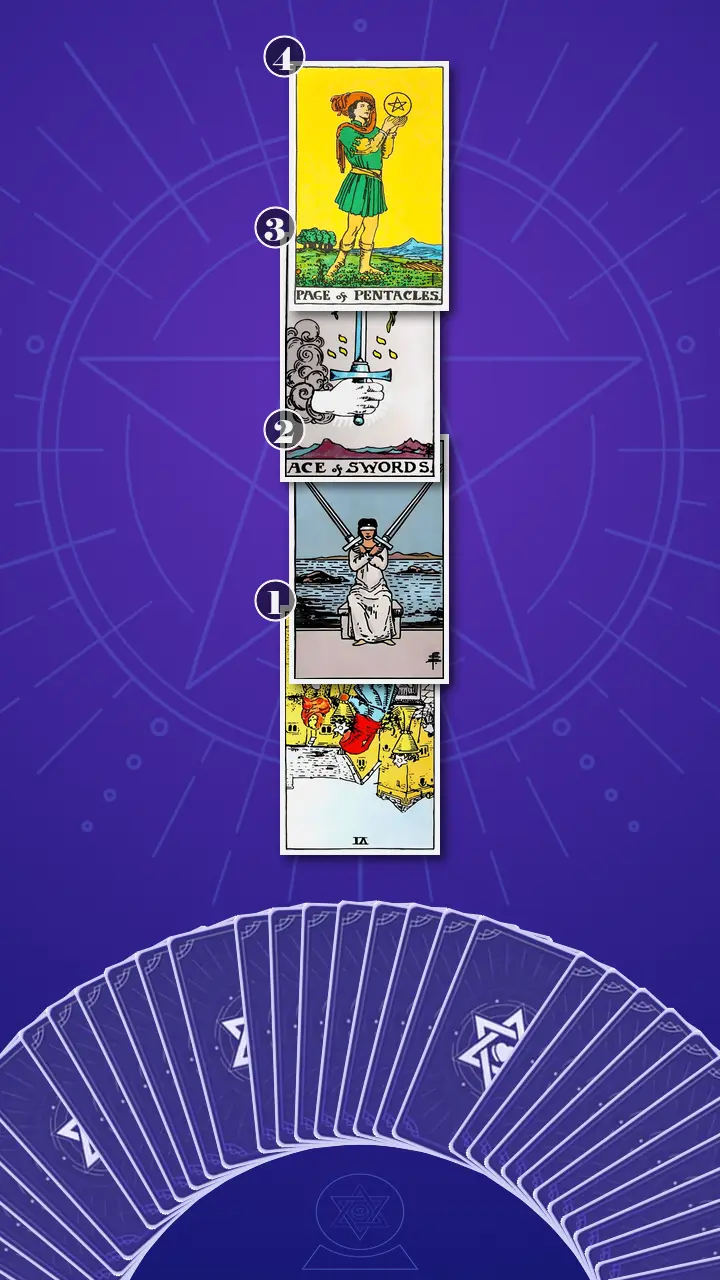
I chose the Four-Layer Insight Ladder, a four-card tarot spread designed to move from a visible behaviour to its root, then to a clarifying intervention and a practical experiment. A relationship spread would have risked centring the other person's motives, which neither Alex nor I could know. A larger Celtic Cross would have introduced more variables than this question required. The real issue was internal: romantic ambiguity had become shelter from self-definition.
The first position would show the present-state layer, the observable message replay loop. The second would expose the root layer, especially the fear protected by keeping opposite interpretations alive. The third would identify the transformation from decoding signals to naming a self-referenced desire. The fourth would ground that insight in one proportionate next step.
I arranged the cards as a vertical ladder, one above the next. The lower cards would show where Alex's attention had been circling; the upper cards would offer a way to climb without pretending we could see the entire future. This is how tarot works at its most responsible: the card meanings in context help a person inspect a pattern, but the cards do not take ownership of the decision.
The Sweetest Scene in the Highlight Reel
Position 1: Six of Cups, Reversed
Now I turned over the card representing the present-state layer: the visible habit of rereading messages, reconstructing the flirtation, and substituting memory analysis for a statement of present desire. It was the Six of Cups, in reversed position.
In the Rider-Waite-Smith image, a child offers another child a cup filled with white flowers inside an enclosed courtyard. Five more flower-filled cups keep the sweetness contained within the scene. Reversed, that emotional water is blocked and overextended. Memory is no longer visiting to offer information; it is circulating inside a closed system.
"This looks like your 11:48 p.m. routine," I said. "You scroll to the sweetest section of the chat and feel the same warm rush, even though no new contact has occurred. The look, the joke, and the final emoji have become a streaming highlight reel. It felt real, so part of you hopes that inspecting it once more will make it tell you what is real now."
I compared the card to an algorithm trained on one emotionally charged data point. Each revisit counted as engagement, so the system kept serving the same memory. The vividness increased, but the available evidence did not. Genuine warmth and present-day compatibility were being treated as if they were the same category of information.
Alex's lips pulled into a brief, bitter smile. Their thumb rubbed the edge of the phone case, stopped, then pressed hard against it. "That is too accurate," they said. "Almost a little brutal. I have been treating the best moment like it is still happening."
"Tender patterns can still be costly," I replied. "Rereading is not irrational. It preserves a place where the possibility has not yet been refused, contradicted, or defined. But the card asks a precise question: the last time you reopened the chat, what were you hoping an old message would tell you that you had not yet said about yourself?"
Alex stared at the flowers on the card. "That I was allowed to want more than what happened."
I let that answer remain uncomplicated. The Six of Cups reversed did not tell Alex to erase the thread, block the person, or claim the flirtation meant nothing. That would merely reverse the defence, replacing idealisation with denial. The work was to separate remembered sweetness from current information while preserving the honest desire the memory had activated.
Position 2: Two of Swords, Upright
Now I turned over the card representing the root layer: the inner conflict and underlying fear that used ambiguity to prevent desire from meeting a reality check. It was the Two of Swords, upright.
The figure's eyes are covered. Two swords cross over the chest, while rocky water and a crescent moon wait behind them. Air, the element of thought, is present in excess but functions as a blockage. Instead of helping Alex articulate one personal truth, analysis is being used to maintain a guarded stalemate.
Alex described the group chat they jokingly called their "emotional support department." One friend had written, "They were obviously into you." Another had answered, "Honestly, it was probably casual." Alex had built a convincing case for each interpretation, then sent the screenshots to a third friend to break the tie.
"The two swords are those two browser tabs," I said. "One says, 'It meant something.' The other says, 'It meant nothing.' Both are playing at full volume while the tab called 'What I want' stays unopened."
The contradiction was more protective than it first appeared. If the flirtation definitely mattered, Alex might feel pressure to act. If it definitely meant nothing, they might have to grieve the imagined future. By holding both stories with equal force, they could postpone both outcomes.
"If I keep both explanations open," Alex said slowly, "I don't have to risk saying what I want."
Their breath paused. Their gaze moved away from the cards as if a recent group-chat conversation were replaying somewhere beyond my shoulder. Then their crossed arms loosened by a fraction, and a low exhale left their chest.
"Exactly," I said. "The explanations look like opposites, but they perform the same job. They delay self-definition. Ambiguity keeps every possibility open, including the possibility of never choosing yourself."
I have excavated sites where later walls were built directly over older foundations. From the surface, the structures appeared unrelated. Once the soil was removed layer by layer, their shared alignment became unmistakable. Alex's conflicting theories worked the same way. They looked different above ground, but both rested on one buried belief: if the desire were named and not reciprocated, caring would become evidence of foolishness or insufficient worth.
That was the cognitive blind spot maintaining the loop. More evidence about the other person could refine the theories, but it could not answer a self-referenced question. Alex did not need to know exactly what the flirtation meant before admitting what kind of connection would work for them now.
When the Ace of Swords Drew One Clean Line
Position 3: Ace of Swords, Upright
Now I turned to the card representing the transformation layer: the shift from decoding another person's signals to naming one clear desire without requiring certainty about reciprocity. The room seemed to contract around the quiet click of the card against the table. It was the Ace of Swords, upright.
A hand rises from a cloud holding one vertical sword. A crown encircles its point; distant mountains stand beneath an open sky. The air element that had been immobilised in the Two of Swords was now balanced and directed. Two defended explanations had become one clean line of discernment.
I described the card in language Alex used every day. It was like a clean Figma alignment guide appearing through a crowded canvas of duplicated frames and overlapping comments. The guide did not tell Alex what the other person intended. It simply showed which layer belonged to Alex.
At 11:48 p.m., the chat was open again and the phone was warm in their hand. Alex had typed, "I want something real," deleted it, and returned to the final emoji as though the symbol could answer on their behalf. They had been demanding certainty about the connection before granting legitimacy to their own desire.
I call the method I used next Cognitive Stratigraphy. On an archaeological dig, a striking surface artifact may attract immediate attention, but it rarely explains the entire site. I treated the final emoji as the surface artifact and invited Alex to look beneath it.
The first layer was the trigger: seeing the message, the Story, or the unanswered thread. Beneath that sat the working explanation: "I need more data before I can know what I want." Under that was the protective fear: "If I name the desire, it may meet a mismatch." At the foundation lay the obsolete belief holding the structure together: "If it is not returned, then caring proves I was foolish or less worthy."
Once that foundation was visible, I placed the Ace of Swords between the past belief and the present facts. A mismatch could describe availability, timing, intention, or compatibility. It could not retroactively make Alex's desire shameful.
The replay is not proof that the moment contains your answer; write one clean "I want" sentence and let the Ace of Swords separate present truth from remembered signals.
I allowed the sentence to settle before making its boundary explicit.
Clarity is not proof that they want you back. It is the moment you stop making their response the permission slip for your own desire.
First, Alex stopped breathing. Their fingers remained suspended above the phone, and their eyes widened slightly as if the familiar sequence of message, draft, deletion, and return had frozen halfway through. Then their focus moved beyond the table. I watched recognition travel across their face as they mentally replayed the fluorescent office kitchenette, the silent Instagram Story, and the drop in their stomach that had immediately become, "I was foolish for caring." Only then did the release arrive: their jaw unclenched, their shoulders lowered, and a shaky breath escaped with something between a laugh and a sigh.
Relief did not arrive alone. Their eyes grew wet, and for a moment they looked almost irritated. "But doesn't that mean I have been asking the wrong question this whole time?" they said. "Like I did all this to myself?"
"No," I said. "It means analysis protected you from an exposure you did not yet feel ready to tolerate. A defence is not a moral failure. We are simply noticing that its cost now exceeds its usefulness. With this new perspective, can you remember a moment last week when the insight might have changed how you felt?"
Alex returned to the office kitchenette in their account. They had seen the person's Story under buzzing fluorescent lights, felt warmth followed by a drop in the stomach, and immediately begun analysing the post. "I could have said, 'I want mutual interest that becomes clear through consistent contact,'" they told me. "Then the Story would just have been a Story. It wouldn't have had to decide whether I was ridiculous."
"That is the crossing," I said. "You can want this without knowing whether they can meet you there. A desire does not become embarrassing just because it is not reciprocated. Clarity is a self-description, not a prediction about them."
This was not a leap from uncertainty to perfect confidence. It was the first movement from absorbed longing and ambiguity-protected apprehension toward honest self-definition. The new vulnerability was real: once Alex had a position, reality could answer it. But reality would be providing information about fit, not issuing a verdict on Alex's worth.
Position 4: Page of Pentacles, Upright
Now I turned over the card representing the integration layer: the practical experiment through which clarity could be embodied without demanding a complete answer about the connection. It was the Page of Pentacles, upright.
The Page holds one pentacle at eye level and studies it with steady attention. Cultivated fields lie behind them; distant mountains remain, but they do not have to be crossed tonight. Earth energy appears here in balance. It takes the Ace's clear sentence and gives it a modest, repeatable form.
"This is not a dramatic confession card," I said. "There is no fire in this spread, and that matters. You are not being pushed toward urgency, pursuit, deletion, closure, or a romantic verdict. The Page asks you to keep one written 'I want' sentence visible for seven days and observe what it changes."
I pictured Alex pinning a private note before reopening the chat or using a dating app. The daily observation could be as small as, "I wanted consistency, and tonight I was seeking familiar warmth rather than new information." Like the Page studying one pentacle, Alex would hold one honest thing in view instead of trying to map the entire relationship.
"So this is a beta test," Alex said, the product designer in them returning to the room.
"Exactly. A seven-day beta test for self-knowledge. You do not need the whole relationship mapped. You need one honest thing you can observe."
Their shoulders lowered again, this time without the same sharpness of surprise. They saved the sentence in Notes while I watched: "I want mutual interest that becomes clear through consistent contact." They read it once, did not edit it, and placed the phone face down.
"That feels exposed," they said.
"Exposed is not the same as endangered," I replied. "You are allowed to close the note, soften the wording, or decide that no communication is appropriate. You do not need a romantic verdict; you need one honest next data point."
Restoring the Map Without Rebuilding the Fantasy
Taken together, the Four-Layer Insight Ladder told a coherent story. The Six of Cups reversed showed one warm exchange preserved inside a replay circuit. The Two of Swords revealed why the circuit remained active: opposite interpretations protected Alex from naming a desire that could meet a mismatch. The Ace of Swords separated present truth from predictions about another person. The Page of Pentacles turned that truth into a small practice that could be observed rather than defended.
The spread's environments formed their own progression. Alex began in the Six of Cups' enclosed courtyard, moved to the Two of Swords' guarded shoreline, met the Ace beneath an open sky, and arrived on the Page's cultivated ground. The way out was not unlimited new evidence. It was one reliable line of self-knowledge, like Ariadne's thread held through a maze of branching interpretations.
I also offered Alex what I call Ruins Restoration Thinking. A fragmented inner landscape does not prove that a person is broken. On an excavation, a fracture can reveal how a structure was built and where later repairs failed. Alex's exhaustion was not permanent fate; it marked a transition between an old strategy, borrowing meaning from another person's signals, and a newer capacity to define desire from within.
The central blind spot was the belief that naming desire automatically created an obligation to act, confess, or risk everything. It did not. Private clarity could come first. Communication, closure, a boundary, or no immediate action could be considered afterward. The transformation was from decoding to self-description, then from self-description to a proportionate choice.
The Trigger Excavation and the Seven-Day Beta
- Run the three-minute Trigger Excavation. Before reopening the chat this week, open Notes and write one sentence under each prompt: "What I know happened...", "What I am guessing...", and "What I want now is..." Keep the full exercise to three minutes and do not send or decide anything afterward. If the exercise feels too exposing, complete only the final five words or use a softer sentence such as "I want more clarity." This is private data, not a commitment.
- Keep one desire statement for seven days. Pin an "I want" sentence of fifteen words or fewer. Read it once before opening a dating app or revisiting the thread, then notice for ten seconds whether your chest, jaw, stomach, or hands tighten, soften, or go still. Add one line at the end of the day: "Today this desire made me notice..." Treat the note as an observation, not a pass-fail test. Hide it behind Face ID, use initials, or record only a daily check mark if privacy or energy is limited.
- Choose one proportionate next data point. During one ten-minute Sunday window, list three options in rising intensity: "do nothing for now," "set a private boundary," and "ask one clear question." Circle only the option that supports the desire and your present stability. If you draft a message, leave it unsent overnight; sending remains optional. Do not jump from private clarity to a dramatic declaration, block, or demand for closure. A smaller step, including moving the app off the home screen for one evening, is still a valid experiment.
I asked Alex to choose only the first two practices for the coming week. The third would wait until their desire had been held long enough to feel like a position rather than an emergency. Small steps mattered because the goal was agency, not performance.

A Week Later, the Quiet Proof
A week later, Alex slept through the night. Their first morning thought was still, "What if I'm wrong?" But they smiled, read the pinned sentence once, and left the old chat closed.
The message they sent me later was brief: "The sentence still feels true. I haven't contacted them. I just stopped asking the thread to tell me whether I'm allowed to want it." They had also noticed that one new dating-app conversation felt easier to assess when it was not being forced to compete with a perfect highlight reel.
Nothing had been magically solved. The ambiguous flirtation remained ambiguous, and Alex still felt a bittersweet pull when certain songs or Stories brought it back. The difference was that the memory had become one piece of information rather than the sole container for possibility.
I have spent enough time among ruins to distrust declarations that every fracture must disappear before a life can continue. Restoration begins when a person can distinguish the enduring structure from the material that no longer supports it. The cards did not choose for Alex. They helped Alex see the choice that replaying had kept out of view.
When wanting someone makes your chest tighten, it can feel safer to keep rereading their signals than to name a desire that might not be returned. At least the unfinished version cannot yet suggest that caring made you less worthy. But noticing that bargain already places you beyond the beginning of the loop.
So I leave you with the same clean line the Ace offered Alex: if your desire could be true without needing anyone else's response to validate it, what is the smallest honest sentence you would let yourself keep this week?
This story is adapted from psychological research, written so that those in a similar struggle can see their own pattern in it — and find their next step clearly.These insights are not a substitute for professional psychological, medical, legal, or financial advice.
Learn more about our Journey to Clarity.
How did this insight land for you?
🫂 This Resonates Deeply
🌀 Living This Story
✨ Now I See Clearly
🌱 Seeing New Possibilities
🧰 Useful Framework
🔮 The Confirmation I Needed
💪 Feeling Empowered
🚀 Ready for My Next Step
Author Profile
 AI
AI“Having spent a lifetime at Cambridge and on archaeological digs, I’ve witnessed the rise and fall of countless civilizations. Please know that your current struggles are not a permanent fate, but merely a necessary fracture before rebuilding. I won't lecture you; instead, I invite you to sit with me in the ruins, using a patient, historical perspective to gently dust off the true, enduring value hidden beneath your temporary doubts.”
In this Introspection Tarot Reading :
Core Expertise
- Cognitive Stratigraphy: Treating sudden emotional triggers as 'surface artifacts', systematically digging down to locate their foundational trauma or obsolete belief system.
- Ruins Restoration Thinking: Reframing fragmented identities and chronic mental exhaustion as a necessary phase of profound internal transition.
Service Features
- The Trigger Excavation Exercise: A logical framework to trace a current, disproportionate emotional reaction back to its original 'epoch', separating the past from the present.
Also specializes in :
Explore Related Patterns:
Borrowed Certainty LoopAlex asks punctuation, response time, an emoji, two friends, and then a third friend to settle what the flirtation meant. Each external source is briefly positioned as the authority that might resolve the uncertainty, yet every answer creates another interpretation to compare rather than a stable conclusion. When you borrow certainty from signals or other people's opinions, the relief lasts only until the next ambiguous cue appears. The deeper issue is that an external answer is being asked to perform an internal task: authorizing what you want. Borrowed Certainty Loop describes this repeated outsourcing of self-trust, where more input keeps the question active because none of it can establish your personal relational standard for you.
Certainty-Gated Self-SilencingAlex types “I think I want something real,” feels their chest tighten, deletes the line, and returns to the other person's emoji. The sequence shows that the obstacle is not an inability to form a desire; the desire is already available, but expressing it even privately is made conditional on first obtaining certainty about reciprocity. When you require proof of another person's position before permitting your own position to exist, uncertainty becomes a gate in front of self-expression. The gate can never fully open because ambiguous messages cannot deliver the certainty being demanded. Certainty-Gated Self-Silencing names this loop: you mute a valid preference until external evidence makes vulnerability feel risk-free, while the muting itself keeps you dependent on further evidence.
IntellectualizationAlex can explain the punctuation, response time, and apparent warmth of the final emoji, yet the sentence beginning with “I want” is repeatedly deleted. The two opposing theories about the flirtation create the appearance of rigorous thinking, but both direct attention away from the same emotionally exposed position. When you turn desire into a signal-decoding problem, analysis can function as a defence against vulnerability. You remain mentally busy and may even become more articulate about the other person, but the complexity keeps your own preference at a distance. This is Intellectualization because thought is being used to manage emotional exposure rather than to clarify what the available facts can actually answer.
Internal ValidationAlex saves the sentence “I want mutual interest that becomes clear through consistent contact,” reads it without editing, and keeps it visible for seven days. The statement remains true even though Alex does not contact the other person and receives no new answer about the flirtation. When you allow a preference to stand without external approval, desire becomes self-knowledge rather than a bid for permission. Internal Validation is operating here because the other person's response no longer determines whether your standard is legitimate. You can still revise the statement as you learn more about yourself, but you do not have to erase it merely because someone else may be unable or unwilling to meet it.
Potential HoardingAlex keeps two incompatible explanations open at once: the flirtation may have meant something, or it may have meant nothing. Reopening the chat protects both possibilities from a present-day reality check, allowing the connection to remain emotionally available without requiring action, acceptance, or grief. When you preserve every interpretation, ambiguity can become a storage system for unrealized futures. The payoff is protection from having to narrow the field; the cost is that your present desire remains suspended alongside the imagined possibilities. Potential Hoarding captures this mechanism because keeping the future undefined becomes more important than determining which kind of relationship would genuinely work for you now.
Uncertainty ToleranceA week later, the flirtation remains ambiguous, Alex has not contacted the person, and the old chat stays closed. At the same time, the sentence about wanting mutual interest and consistent contact still feels true, so clarity is no longer postponed until every relational unknown has been eliminated. When you can hold your desire beside an unanswered question, uncertainty stops functioning as an emergency that must be solved through checking. Uncertainty Tolerance does not mean pretending the outcome is irrelevant; it means allowing reality to remain incomplete without abandoning your position. A future mismatch can then provide information about fit, timing, or availability instead of erasing the legitimacy of what you want.
Nostalgia LoopAt 11:48 p.m., Alex scrolls back to the sweetest part of the exchange and inspects the final emoji even though no new contact has occurred. Each return recreates the warmth of the flirtation, giving an old scene the felt immediacy of present evidence while preserving a possibility that has not yet been defined or refused. When you use memory this way, replaying is doing more than helping you remember. It becomes a closed emotional feedback loop in which vividness increases but information does not. That is the mechanism of a Nostalgia Loop: the highlight remains active enough to postpone the more exposing task of deciding what you want in the present.
Shame BindingWhen Alex imagines that the desire may not be returned, the possible mismatch is translated into “I was foolish for caring” or evidence of insufficient worth. The same translation appears after seeing the person's Story and in the bodily tension that precedes deleting the desire statement. When you bind caring to a potential verdict on your worth, silence becomes a way to avoid anticipated shame. The problem is no longer only whether the connection is mutual; it is whether wanting it will be used as evidence against you. Shame Binding names this mechanism because vulnerability, rejection, and self-condemnation become fused, making continued analysis feel safer than acknowledging that a desire can be valid without being reciprocated.
Boundary DiscernmentAlex separates “I want something real” from any claim about what the other person wants. They are also given permission to keep that clarity private, communicate later, set a boundary, take no immediate action, or choose another proportionate step rather than treating self-knowledge as an obligation to make a dramatic declaration. When you distinguish your desire from another person's intention, each side of the relationship regains its proper ownership. Boundary Discernment is present because your standard, choice, and pace belong to you, while their availability and response belong to them. This separation supports reciprocity: you can look for mutual interest expressed through consistent contact without forcing either person to supply a predetermined outcome.
Reality TestingBefore reopening the chat, Alex is asked to write what is known, what is being guessed, and what is wanted now. That separation prevents an old emoji or a new Instagram Story from being treated simultaneously as an observable event, a reliable statement of intent, and a judgment about Alex's worth. When you distinguish evidence from interpretation, you restore the limits of what a signal can tell you. Reality Testing does not require dismissing the chemistry or declaring the flirtation meaningless; it allows the warmth to remain real without promoting it into proof of present compatibility. That distinction gives you enough cognitive distance to make a choice from current information rather than from the emotional force of a remembered scene.
Explore Related Struggles:
Ambiguity DependenceAlex keeps two opposite interpretations open at the same time: the flirtation mattered, or it was only casual. When friends disagree, Alex develops a case for each side and seeks another tie-breaker, leaving their own answer outside the discussion. Each interpretation appears to offer clarity, but both preserve the same shelter. Declaring that the moment mattered could create pressure to act, while declaring that it meant nothing could collapse the imagined future. Uncertainty keeps both consequences at a distance and lets the connection remain undefined. When ambiguity becomes the condition under which you are allowed to keep wanting, uncertainty stops being an unanswered question and starts governing your access to your own position. The way forward begins with recognizing that you can define what would work for you without first resolving what another person intended.
Clarity-Exposure SplitAt 11:48 p.m., Alex types, "I think I want something real," feels their chest tighten and fingers twitch, deletes the line, and returns to the emoji. The movement toward clarity is immediately met by a physical and behavioural retreat. The sentence would not determine what the other person wants, but it would make Alex's own position harder to hide from. Once the desire has words, a mismatch can become visible and the flirtation can no longer hold every possible future without contradiction. You can encounter the same split when clarity feels less like private knowledge and more like stepping into judgment. Naming what you want creates exposure, but it does not create an obligation to confess, pursue, or force an outcome. It gives you a stable point from which reality can provide information about fit rather than a verdict on your worth.
Desire-Agency SplitAlex deletes a private "I want" sentence even though nobody else can see it. The draft is treated as the beginning of a chain that might require confession, pursuit, closure, or an immediate decision about the flirtation. That imagined chain removes the space between self-knowledge and action. If identifying a desire is made equivalent to acting on it, staying undefined can seem like the only way to retain control over timing, communication, and risk. You recover agency by separating those stages. A desire can be privately true before you decide whether to communicate, wait, set a boundary, or take no immediate action. Naming it does not surrender choice; it gives your later choices a clearer reference point.
Desire-Shame BindAlex looks to an old message for proof that they are "allowed to want more than what happened." Beneath the signal analysis sits a stricter rule: if the desire is named and not returned, caring might become evidence that they were foolish or insufficiently worthy. That rule makes reciprocity responsible for more than relational fit. The other person's availability is asked to validate the legitimacy of Alex's desire, so a possible mismatch threatens to become a judgment about the person who wanted. When you can only respect a desire after someone else confirms it, wanting becomes inseparable from anticipated shame. Seeing the bind restores an important distinction: another person's response can reveal availability, timing, intention, or compatibility, but it cannot retroactively make your desire humiliating or invalid.
Analysis ParalysisAlex can explain the punctuation, response time, and emotional temperature of the final emoji, then construct convincing cases for two incompatible interpretations. Even after circulating screenshots among friends, they still cannot finish the sentence about what they want. The analysis is detailed, but its tool is pointed at the wrong question. More interpretation may refine a theory about the other person; it cannot establish Alex's own standard for mutuality, consistency, or commitment. Thinking therefore produces motion without a usable position. You remain stuck when every new clue is required to resolve a question only self-definition can answer. Analysis becomes clarifying again once it is assigned a proportionate job: separating what happened from what you are guessing, while leaving the statement of what you want under your own authority.
Rumination EntrapmentAlex repeatedly scrolls to the sweetest section of the chat, returns to the same final emoji, and later turns an Instagram Story into another round of interpretation. The emotional vividness renews each time, but no new contact or relational evidence enters the system. Replaying feels active because it restores warmth and produces more thoughts. Its output is circular: attention is spent, the memory becomes more prominent, and the original uncertainty remains intact. The thread is repeatedly asked to answer a present question using information that has not changed. When you are caught in that circuit, the struggle is not that the remembered moment was unreal. It is that revisiting has begun to replace present-tense orientation. You can preserve what mattered while declining to treat renewed intensity as new evidence.
Then-Now SplitAlex treats the best moment of the flirtation as though it is still unfolding. The look, joke, and final emoji retain genuine warmth, yet they are also asked to establish what is available now despite the absence of new contact. Past chemistry and present compatibility are different categories of information. When they collapse into one another, the intensity of a memory can appear to confirm consistency, mutual intention, or future potential that the current relationship has not demonstrated. You do not need to dismiss the past to restore the timeline. The memory can remain evidence that something affected you, while current behaviour determines what the connection can support now. That separation lets remembered sweetness inform your desire without allowing it to impersonate present reciprocity.
Explore Related Emotions:
Cautious VulnerabilityAlex saves the desire sentence without editing it, places the phone face down, and admits that the private act feels exposed. Nothing has been sent, no declaration has been made, and no response is being demanded; the exposure comes from allowing an honest preference to exist where Alex can see it. When you name what you want while preserving the right to pause, vulnerability becomes bounded rather than all-consuming. Cautious Vulnerability holds both truths: clarity makes reality more available, and you still retain control over timing, communication, and distance. The seven-day note gives that openness a proportionate container, allowing you to practise honesty without turning it into an emergency.
Desire AnxietyAlex can explain the punctuation, response time, and emotional temperature of the final emoji, but their chest contracts when they try to finish one sentence about what they want. Typing the desire makes it feel immediately consequential, so deletion offers a quick return to analysis, where the other person's signals can carry the risk instead. When you experience a preference as though it automatically creates an obligation to confess, pursue, or face a verdict, wanting itself begins to feel unsafe. Desire Anxiety captures the tension between knowing what would feel meaningful and fearing what that knowledge might expose. A private "I want" sentence restores an important distinction: your desire can be valid information before it becomes any kind of decision.
Guarded LongingLonging reaches Alex like the neighbour's song through the apartment wall: warm enough to draw them closer, muffled enough to keep the words uncertain. Their chest tightens when they type, "I think I want something real," and deleting the line returns them to a version of the connection that can still be felt without being clearly defined. When you keep desire close but indistinct, you preserve its tenderness while limiting its exposure to mismatch. Guarded Longing is the feeling of caring from behind that protective distance, where the pull remains real but your own position stays difficult to touch. Naming the desire privately does not force action; it gives the feeling a shape that belongs to you rather than to the replay.
Nostalgia Loop AnxietyAt 11:48 p.m., Alex scrolls to the sweetest part of the exchange, returns to the final emoji, and receives the same emotional rush without any new contact. The replay makes the moment more vivid, but it cannot update what is true now; attention keeps circulating through a closed archive while the present-day question remains unanswered. When you revisit an emotionally charged memory for certainty it cannot contain, recollection starts carrying the pressure of decision-making. Nostalgia Loop Anxiety names that unsettled combination of warmth and vigilance: the moment feels too meaningful to release, yet each replay confirms that it still cannot define your current needs. Separating remembered chemistry from present information lets the memory matter without allowing it to govern your position.
Retroactive Rejection DreadUnder the office kitchenette's fluorescent lights, Alex sees the person's Story, feels warmth followed by a drop in the stomach, and immediately arrives at, "I was foolish for caring." The feared outcome is larger than discovering a mismatch: Alex imagines present unavailability reaching backward and changing what their earlier tenderness says about them. When you let another person's response become a verdict on whether your caring was reasonable, uncertainty can feel safer than an answer. Retroactive Rejection Dread is the fear that nonreciprocity will not merely disappoint you but will humiliate the version of you who hoped. Recognizing that compatibility and personal worth answer different questions protects the meaning of your desire without requiring a preferred outcome.
Borrowed Warmth AcheThe phone is warm in Alex's hand, and the sweetest section of the old chat still produces a real rush even though no new contact has occurred. That preserved warmth fills the apartment at night, but it arrives from a closed exchange rather than from present reciprocity, leaving Alex emotionally held by something that cannot respond. When you borrow comfort from an earlier moment, the comfort and the absence travel together. Borrowed Warmth Ache names the tenderness of returning to what once felt mutual while sensing that memory cannot provide current consistency. You do not have to discredit the warmth to notice its limits; doing both lets the past remain meaningful without making it the sole container for future possibility.
Cautious Self-TrustAlex reads the pinned sentence once, leaves it unchanged, and reports a week later that it still feels true. They have not contacted the other person, yet the statement helps them assess a new dating-app conversation without forcing it to compete with the old highlight reel. When you return to your own position without demanding that uncertainty disappear first, trust develops through repetition rather than bravado. Cautious Self-Trust is the quiet sense that your preference can remain credible even when another person's intentions are unknown. Each time you consult the sentence instead of the thread, you strengthen your ability to use desire as information rather than as a referendum on your worth.
Bittersweet ReleaseA week later, Alex sleeps through the night, reads the pinned sentence once, and leaves the old chat closed. Songs and Stories can still bring back the pull, but the memory has become one piece of information rather than the only place where romantic possibility seems to live. When you release a replay without denying that it mattered, the movement carries tenderness as well as space. Bittersweet Release is not erasure, forced closure, or a claim that the chemistry was unreal; it is the easing that comes when warmth no longer has to prove compatibility. That shift lets you carry what was meaningful while giving present connections room to be assessed as they actually unfold.
Clarity ReliefWhen Alex says, "I want mutual interest that becomes clear through consistent contact," their jaw unclenches, their shoulders lower, and a shaky breath finally leaves. The sentence does not resolve the flirtation, but it ends the demand that an emoji answer three different questions at once: what happened, what the other person intended, and what Alex wants now. When you separate those categories, your body no longer has to hold every uncertainty as one problem. Clarity Relief is the release that comes from discovering that self-knowledge does not require complete relational evidence. The other person's position can remain unknown while your own preference becomes visible, usable, and open to revision on your terms.
Explore Related Contexts:
Chemistry to Consistency TestAlex writes, "I want mutual interest that becomes clear through consistent contact," keeps the sentence for seven days, and notices that a new dating-app conversation becomes easier to assess. A brief experience of chemistry is no longer being asked to prove ongoing compatibility by itself. The Chemistry to Consistency Test is the relational transition from valuing a spark to observing what follows it. You do not need to discount attraction or demand an immediate commitment; you can examine whether interest becomes mutual, communication becomes sustained, and the developing connection meets the standard you have already named.
Nostalgia Timing TrapAlex scrolls to the sweetest part of the exchange, recreates its warmth, and admits to treating the best moment as though it were still happening. Songs and Stories can reactivate the same pull, but every return increases vividness without adding current evidence about contact, availability, or compatibility. That mismatch between emotional immediacy and social timing creates a Nostalgia Timing Trap. You can preserve the fact that the chemistry mattered while assigning it the correct evidentiary role: the memory can reveal what kind of connection you value, but it cannot establish what relationship exists now.