The 11:40 p.m. Red-Flag Rationalization Loop
I met Maya (name changed for privacy) after a client-facing day had already trained her to smooth over everyone else's ambiguity. She told me she could write a flawless recap for a difficult client, but after a dating interaction left her feeling small, she could not keep one plain sentence on her own screen: Can we talk about what happened?
At 11:40 p.m. in her rented Toronto bedroom, I watched the blue light from her iPhone catch on a half-empty glass of water while the radiator clicked beside the window. Her phone had gone warm in her palm. She had drafted the direct question, opened Apple Notes, and written three generous explanations instead: maybe work was intense, maybe the comment was a joke, maybe she had sounded demanding. She noticed the red flag, prepared to name it, explained it away, and let the connection keep its meaning for one more night.
"Nothing is terrible on its own," she said. "I just keep feeling worse." Her throat had tightened while she typed; then the feeling dropped into her stomach after she chose the softer reply. To me, it sounded like trying to read a message through a rain-streaked window, then blaming herself because the letters would not stay still.
I did not hear a lack of empathy in her. I heard a fear that honest discernment would turn a meaningful connection into a loss. "You do not have to decide what this person is," I told her. "Today, we are only going to make a map of what keeps happening to you inside this connection, so you can find some clarity without abandoning your own experience."

Choosing the Compass: A Problem-Cause-Solution Tarot Spread
I asked Maya to put both feet on the floor, take one unforced breath, and hold the question in mind: why did she keep explaining away red flags that drained the meaning from the relationship? Then I shuffled slowly. For me, that small ritual is not about producing a prophecy. It gives the mind a clean threshold between the scrolling, drafting, and replaying, and the act of looking at a pattern directly.
I chose a three-card Problem-Cause-Solution tarot spread. It was the right relationship red-flags tarot spread for a tightly framed why-question: the first card would show the visible behavior, the second the psychological protection underneath it, and the third a constructive response. A larger spread could have supplied more detail, but it might also have created more material for Maya to analyse. This reading needed a clear sentence, not seven more tabs.
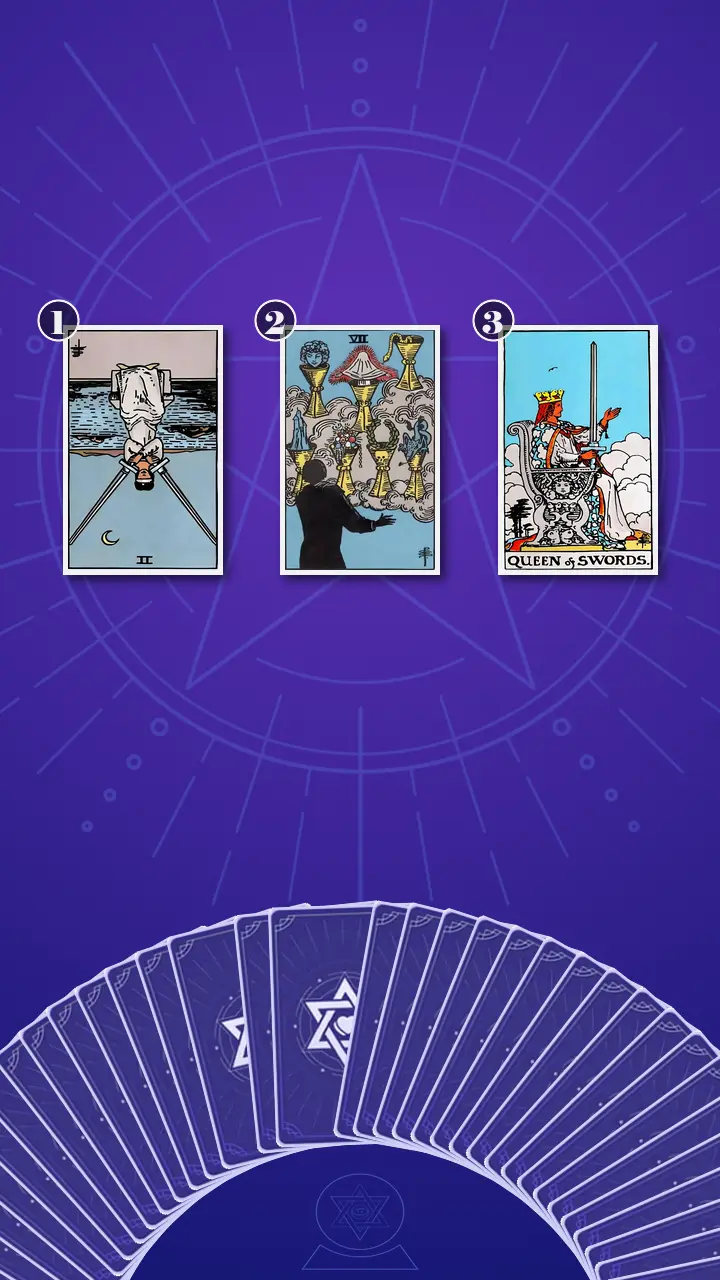
I laid the cards in a horizontal line. On the left, we would look at the moment she saw a warning sign and left her response unchanged. In the center, we would examine why possible motives became more authoritative than her own impact. On the right, we would find the principle that could turn discernment into a self-directed boundary.
Reading the Map: From the Unsent Draft to the Cloud of Context
The Draft That Became a Blindfold
I turned over the first card. "Now turning this card, which represents the diagnosis-level behavior: noticing a red flag, generating indecision, deleting the direct question, and leaving your response unchanged." It was the Two of Swords, reversed.
I pointed to the blindfold and the two swords crossed across the figure's chest. "This is blocked discernment, but not because you do not know enough. The red flag is already visible. The reversal shows that the truce is becoming hard to maintain." In Maya's life, the blindfold was the iMessage draft she kept open without letting its contents become consequential. The crossed swords were two truths held painfully together: this hurt me and it must not count.
The card's Air energy was congested. Her intelligence, normally useful in her agency work, had become a shield held over her chest. I named the overcorrection risk, too: ending the stalemate by demanding a complete explanation in one heated conversation could pull her straight back into a debate about motives. For this card, the smaller move was enough: record what happened, what it did to her, and what she needed before considering why it happened.
Maya gave a short laugh that did not quite reach her eyes. "That is too right. Almost mean."
"I do not think the card is calling you unreasonable," I said. "I think it is showing the price of having to become your own defense attorney every time something lands badly. One incident can be unclear. A repeated impact is information." I watched her thumb stop rubbing the edge of her phone case, though her shoulders stayed lifted.
Seven Browser Tabs in the Clouds
I turned the center card. "Now turning this card, which represents the psychological mechanism beneath the behavior: protecting hoped-for meaning and belonging by multiplying possible explanations for what has been observed." It was the Seven of Cups, upright.
A dark figure faced seven cups suspended in clouds. I told Maya that I saw her Apple Notes list in the image: work stress, bad timing, a misunderstood joke, fear of intimacy, her own tone, an exhausting week, some context she had not yet discovered. Seven browser tabs, each offering a plausible reason for the same behavior, until the number of possibilities began to feel like proof that no conclusion was fair.
"If I can find one more explanation," Maya said quietly, looking at the clouded cups, "I will not have to call it a pattern."
That was the card's blockage. Its Water energy was not wrong, and neither was her capacity to imagine another person's inner world. But it had become diffuse, overflowing the part of the conversation that required evidence. I asked her to place the concrete fact outside the cloud: what was said, what happened next, and what her body did. Her jaw loosened for a second, then set again.
"Context can explain a behavior; it cannot cancel its impact," I said. "More explanations are not the same as more evidence." I have travelled enough between cultures and languages to know that context matters. It can soften a story, deepen it, and prevent us from making lazy judgments. But in a close relationship, context becomes a hiding place when it is used to make your own experience disappear.
Maya stared at the card for a while. Her breathing became almost inaudible, her eyes lost focus as if replaying a recent date, and then a small breath left her through her nose. "I have been treating every possible reason as kinder than the fact that I feel worse after I see them."
I nodded. "That is not a failure of kindness. It is a protective loop. You have been trying to preserve what the connection once meant by keeping the present from having a vote."
When the Queen of Swords Put Down One Clear Line
The Antidote Is Not Coldness
The room seemed to settle when I reached for the final card. Even the radiator had paused between clicks. "Now turning this card, which identifies the key transformation: separating observable pattern and impact from speculative motive, then expressing a specific self-directed boundary." It was the Queen of Swords, upright.
I showed Maya the Queen's visible eyes, one upright sword, and open left hand. This was disciplined Air after the Two's defensive Air and the Seven's flooding Water. The Queen did not shut out context. Her open hand received it. But her sword did not allow every possible explanation to receive equal weight. She asked a cleaner question: what has been demonstrated, what has it changed for me, and what participation do I choose now?
Before I named the heart of the card, I could see Maya return to the familiar 11:40 p.m. scene: the direct message open, her throat closing, three explanations filling Apple Notes, then the scroll back to an affectionate exchange because preserving the meaning felt safer than testing it. She was caught in the old demand to make a perfectly fair decision before allowing herself even a small response.
You do not need to rescue the connection with another explanation; name the pattern, choose a boundary, and let the Queen's upright sword separate evidence from hope.
For a moment, Maya did not move. Her breath stopped high in her chest, and the fingers around her phone seemed to forget how to unclench. Then her gaze drifted past the cards, not away from them, but toward some memory playing behind them. I saw the realization arrive first as a narrowing around her eyes, then as color gathering along her lower lids. Her shoulders dropped one cautious inch. She pressed her lips together, shook her head once, and said, "But does that mean I was wrong about everything? Was I just making it up?" The question had a flash of anger in it, followed by grief.
"No," I told her. "It means you are allowed to update your participation when new information repeats. Something can have felt real and still not be working now. You do not have to prove someone is bad to change your participation." She exhaled, longer this time, but there was a slight unsteadiness in it, the light dizziness of putting down something heavy and realizing her hands were empty. "Now, with this new perspective," I asked, "can you think of a moment last week when this would have let you feel differently?"
She looked down at the Queen again. "When they cancelled for the third time. I could have said, 'I understand work gets busy, and I am not going to keep holding my evenings open for plans that do not happen.' I would have felt sad, but not like I had to build a case first."
This was the shift from contracted confusion and fear of losing belonging toward steadier self-trust and grounded relationship discernment. I used a framework I call Fear-Driven Logic Decoupling: I separated Maya's authentic desire from the fear hiding inside her decision matrix. Her desire was not to punish anyone. It was to have a connection where plans, needs, and repair could be taken seriously. The fear-driven logic said that unless she could explain the other person's motives generously enough, she would be responsible for destroying the bond. Once we put those two voices side by side, the false equation became clear: empathy did not require self-erasure.
The Queen gave her an inner sentence I wanted her to keep: I can understand why it happened, and I still do not want to keep participating in this version of it. That was not a verdict. It was Context Without Erasure, and it was a way of letting the pattern, not the panic, shape her next step.
The Pattern-Impact-Boundary Check
I gathered the three cards into one story. The Two of Swords reversed showed the known fact held behind a defensive draft. The Seven of Cups showed why the fact kept getting buried under sympathetic theories. The Queen of Swords offered a different order of operations: pattern before motive, impact before self-cross-examination, then a boundary that belonged to Maya rather than a judgment she needed the other person to accept.
The cognitive blind spot was subtle. Maya had been treating a complete explanation of someone else's inner world as the price of trusting her own outer-world evidence. But a connection's meaning should not depend on her making the evidence disappear. Because the spread had no Pentacles or Wands, I wanted to add grounding and follow-through deliberately: a written fact, a small choice, a boundary she could practice without forcing a final outcome.
- The Observed-Impact-Need NoteWithin five minutes of the next interaction that leaves you tense, open Apple Notes and write one sentence under: "Observed," "Impact," and "Need." Keep it private for 24 hours before deciding whether it supports a conversation, a changed plan, or simply your own record. If it helps, ask one trusted friend to read only those three sentences and tell you what they hear happened.A private record is not an accusation. If three headings feel too big, write one line: "The part I know happened is..."
- The One Clear Sentence RuleDraft one boundary for the next repeated pattern: "When X keeps happening, I notice Y in myself, and I am going to Z." Read it aloud alone, remove any defense of the other person's character, and decide whether you want to say it, send it, revise it, or keep it as a private guide.The sentence only needs to describe your participation. You can pause or seek support instead of communicating directly if you expect pressure, retaliation, or feel unsafe.
- The Shadow Choice ExperimentFor 48 hours, write on paper the feared choice in its smallest form: "I am choosing to treat this repeated pattern as meaningful enough to change one plan." Do not send a message or make a permanent decision. Notice every argument that appears against the sentence, then label each one "fact," "possible motive," or "fear of loss." Choose one modest participation change, such as keeping your evening intact or waiting before replying.This is not an ultimatum or a breakup exercise. It lets the subconscious show its defense mechanisms on paper, where you can meet them without obeying them.
I told Maya that the Shadow Choice Experiment was not meant to make her dramatic. It was meant to reveal the hidden emotional bills attached to every option. Continuing exactly as before had a cost: the tight throat, the late-night search spiral, the gradual hollowing-out of her own trust. Taking one small boundary step had a cost, too: uncertainty, sadness, and the risk of learning more clearly what the connection could hold. Naming both costs made the decision less like a moral trial and more like an honest choice.

A Week Later, the Quiet Proof
Six days later, I received a message from Maya. She had used the three headings after another vague cancellation. Under Observed, she wrote that the plan had changed at the last minute for the fourth time. Under Impact, she wrote that she felt herself rearranging her life and then pretending she did not mind. Under Need, she wrote that she needed plans she could trust enough to organize her week around.
She did not send a long explanation. She wrote one line: "When plans keep changing at the last minute, I feel less able to trust the connection, so I am going to stop holding evenings open without confirmation." Then she went to meet a friend she had almost cancelled on before. Later, she told me she still woke the next morning with the thought, What if I am wrong? But this time she recognized it as fear asking for certainty, not proof that her boundary was unfair.
I saw that as the first real evidence of her Journey to Clarity. The cards had not decided the relationship's future, and I had not handed Maya a verdict. We had made room for grief, context, and tenderness, while returning authority to the person who had to live inside the connection: her. The Queen's clarity was not the absence of feeling. It was the decision to let feeling become information instead of an argument against herself.
When you leave a conversation with your throat tight, reopen the sweet messages to prove it still meant something, and fear that naming what hurt will leave you without the belonging you thought you had, remember that the confusion may be the cost of protecting the connection's meaning from the evidence.
If you let one clear observation stand without solving the other person's motives, what small choice about your participation might feel a little more honest this week?

Every reading at AceTarot is a journey to connect with inner wisdom and empower the path ahead. This reading shared here is a psychological mirror, not a private record—crafted to reflect universal emotional loops and help restore personal clarity. Please note that these insights do not replace professional psychological, medical, legal, or financial advice, and should not serve as the sole basis for major life decisions.
Learn more about our Journey to Clarity.
How did this insight land for you?
🫂 This Resonates Deeply
🌀 Living This Story
✨ Now I See Clearly
🌱 Seeing New Possibilities
🧰 Useful Framework
🔮 The Confirmation I Needed
💪 Feeling Empowered
🚀 Ready for My Next Step
Author Profile
AI Giulia Canale
956 readings | 527 reviews
“Having traveled across cultures... I've learned that what we often lack isn't a simple answer, but a moment of being truly understood. I use a Jungian psychological lens to help you deconstruct your subconscious patterns—not to prove anything, but to be the gentle companion who helps you unravel your knots, free of judgment, so you can reconnect with your inner wisdom.”
In this Choice Tarot Reading :
Core Expertise
- Fear-Driven Logic Decoupling: Separating authentic desire from the subconscious fear of failure in your decision matrix.
- Hidden Cost Deconstruction: Identifying and quantifying the unstated psychological 'emotional bills' attached to each option.
Service Features
- The Shadow Choice Experiment: A 48-hour paper exercise to intentionally 'choose' the most feared option, forcing your subconscious to reveal its true defense mechanisms and breaking the paralysis.
Also specializes in :
Explore Related Patterns:
Conflict AvoidanceThe sentence "Can we talk about what happened?" appears on Maya's screen, but she deletes it and sends a softer reply while leaving her participation unchanged. Avoiding the direct question lowers the immediate risk of disagreement, disappointment, or discovering that the connection cannot hold an honest conversation. When you protect short-term relational calm by withholding what needs to be named, conflict avoidance can convert one uncomfortable conversation into ongoing ambiguity. The defense reduces immediate exposure, but it also prevents you from learning whether the relationship can respond to your experience with seriousness and repair.
Loss AversionMaya lets the connection keep its meaning for another night, reopens affectionate messages after being hurt, and continues holding evenings open through repeated cancellations. The immediate possibility of losing the bond feels more consequential than the accumulating costs to her schedule, clarity, and self-trust. When you preserve a draining arrangement because acknowledging the evidence could convert hope into loss, loss aversion is influencing the decision. The pattern does not prove that the connection lacks meaning; it shows how fear of losing that meaning can make ongoing costs feel easier to tolerate than one honest update to your participation.
Motivated ReasoningMaya says that one more explanation would spare her from calling the repeated behavior a pattern, and she returns to affectionate messages after an interaction leaves her feeling worse. The desired conclusion that the connection still carries its former meaning begins to determine which information receives attention and which information is discounted. When you evaluate evidence according to the conclusion you are hoping to preserve, your reasoning can remain intelligent while becoming directionally biased. Motivated reasoning does not mean the compassionate explanations are impossible; it means they are being given more authority than repeated behavior because accepting the pattern would threaten belonging and hope.
RationalizationAt 11:40 p.m., Maya replaces one direct question with three benign explanations: work may be intense, the comment may have been a joke, or she may have sounded demanding. Each explanation is plausible in isolation, but together they perform a defensive function by turning a visible red flag back into unresolved ambiguity. When you require every generous motive to be ruled out before your experience can count, explanation stops being neutral context and becomes rationalization. It protects the connection from an uncomfortable conclusion in the short term, while leaving you to absorb the same impact without changing your participation.
Self-GaslightingAfter repeated cancellations and a bodily sense that each interaction is leaving her worse, Maya asks whether she was wrong about everything or had been making it up. Earlier, the same scrutiny appeared when she moved from what was said to whether she had sounded demanding, shifting the burden of doubt from the event onto her own credibility. When you repeatedly treat your perception as the least trustworthy part of the evidence, self-questioning becomes self-invalidation. Self-gaslighting can keep you searching for a level of proof that ordinary boundaries do not require, even when the observable pattern and its impact have already repeated.
Boundary DiscernmentAfter the fourth last-minute change, Maya says she will stop holding evenings open without confirmation and then keeps a plan with her friend. The boundary addresses her schedule and participation without claiming certainty about the other person's character or motives. When you separate what someone may mean from what you are willing to keep participating in, boundary discernment replaces the demand for a perfect verdict with a proportionate choice. You can leave room for context while still treating repeated impact as meaningful information about what your time, trust, and involvement require.
Self-AbandonmentMaya keeps rearranging her life, pretends she does not mind, and nearly gives up a plan with a friend while repeated cancellations remain unresolved. At the same time, imagined context for the other person receives more authority than her own need for reliable plans. When you preserve connection by repeatedly removing your time, impact, and preferences from the decision, accommodation becomes self-abandonment. The pattern is not defined by caring about someone else's circumstances; it appears when that care consistently requires your own experience to disappear before the relationship can continue.
Reality TestingSix days later, Maya records the fourth last-minute cancellation under Observed, Impact, and Need, then recognizes the next morning's "What if I am wrong?" as fear rather than new evidence. She does not eliminate uncertainty about the other person's motives; she changes the weight assigned to facts, impact, speculation, and fear. When you let an observation remain valid without solving another person's inner world, reality testing restores proportion to the decision. Context can still be considered, but it no longer cancels repeated evidence or turns every self-directed boundary into a verdict that must be proved beyond doubt.
Explore Related Struggles:
Ambiguity DependenceEach time the direct question stayed in Apple Notes, another browser tab of explanation appeared. Work stress, bad timing, a joke, your own tone, and context you had not found yet kept the conclusion suspended while the same connection continued to leave you feeling worse. The loop makes uncertainty do a protective job. As long as one more motive remains possible, the repeated impact never has to become decisive, and you can postpone the risk of learning what the relationship can actually hold. Your later note separated observed, impact, and need, so possibility could remain possible without being promoted above what had happened.
Empathy-Impact SplitAt 11:40 p.m., you had already written the plain question, then replaced it with explanations about work, timing, the joke, and your own tone. Those explanations gave the other person's possible intent more room than the fact that your throat tightened and you felt worse after replying softly. You can hold compassion for context and still let impact remain evidence. The split appears when understanding another person becomes a reason to overrule what the interaction did to you, leaving care available for them while your own experience waits outside the decision. Clarity here is not a harsher judgment; it is allowing context and impact to exist without one erasing the other.
Truth-Connection SplitWhen you drafted "Can we talk about what happened?" the sentence threatened more than a difficult conversation. You feared that naming the red flag honestly could turn a meaningful connection into a loss, so reopening affectionate messages felt safer than testing what the connection could hold. That puts truth and belonging on opposite sides of the same choice. A connection can have felt real and still fail to work in its current form; updating your participation does not require proving that the past was false. The clear line you eventually wrote gave honesty a place inside the relationship decision instead of making silence the price of keeping its meaning.
Guilt-Evidence FusionAfter the third cancellation, you could have said you would stop holding evenings open, yet the decision first had to pass an imagined trial about whether you were being fair. You treated a generous explanation of the other person's motives as the price of trusting your own record, as though changing your participation might make you responsible for destroying the bond. That fuses two different questions. The evidence can be incomplete while your choice about your time remains legitimate, and a boundary is not a verdict on another person's character. When you let the repeated change in plans count without building a case, you recover authority over your participation without needing certainty about intent.
Relational Boundary DriftAfter plans changed at the last minute again and again, you rearranged your life and pretended it did not matter, continuing to hold evenings open until confirmation became its own condition. The boundary did not disappear in one dramatic moment; it drifted each time the connection's hoped-for meaning received priority over the week you were actually living. That drift lets the relationship set the terms of your availability while your needs remain private and provisional. The sentence you sent, that you would stop holding evenings open without confirmation, moved the boundary back into your hands without demanding a permanent verdict. A small change in participation made the pattern visible and gave your time a voice.
Explore Related Emotions:
Belonging AmbivalenceYou said honest discernment might turn a meaningful connection into a loss, then returned to an affectionate exchange after the direct message stayed unsent. The movement keeps belonging and self-protection on opposite sides of the same decision, so naming what hurts can feel larger than the immediate incident. That divided pull explains why a generous explanation can feel safer than a clear response. You can value what the connection meant and still decide what version of participation your present life can hold; the meaning does not have to be preserved by making the current cost disappear.
Evidence AnxietyApple Notes filled with work stress, bad timing, a misunderstood joke, your tone, and an exhausting week after the direct question was already available. Each explanation offers a fairer story about the other person, but the accumulating possibilities also make the observable event feel too unstable to trust. When you treat a complete account of someone else's motives as the entry fee for using your own evidence, uncertainty becomes a heavy demand rather than an open question. Letting the repeated impact stand does not make you unfair; it gives your judgment something firmer than another plausible tab to rest on.
Self-Betrayal AcheAt 11:40 p.m., you drafted "Can we talk about what happened?" and then replaced the direct question with three generous explanations. Your throat tightened while you typed, and the sensation dropped into your stomach after you chose the softer reply, leaving your own impact present in the body but missing from the decision. When the same loop appears through repeated cancellations and the urge to reopen affectionate messages, you are carrying the pain of making your experience smaller so the connection can keep its old meaning. You do not need to prove the other person is bad to let what happened count; recording the impact gives your participation back to you.
Relational FogYour own description was a message seen through a rain-streaked window, with the letters refusing to stay still while you blamed yourself for not reading them cleanly. The direct event is visible, yet context, hope, and bodily response keep changing its apparent weight. After the third cancellation and again after the fourth, the difficulty is not that you lack more possible reasons. It is that the relationship has become hard to read without losing contact with what happens inside you. One stable record of observed event, impact, and need gives the fog an edge you can navigate.
Cautious Self-TrustSix days later, you wrote under Observed, Impact, and Need that the plan had changed for the fourth time, that you kept rearranging your life, and that you needed plans you could trust enough to organize your week around. You then sent one sentence about no longer holding evenings open without confirmation. When "What if I am wrong?" returned the next morning, you recognized it as fear asking for certainty rather than proof. That recognition lets you update your participation while uncertainty is still present, which is a quieter form of trust built from repeated evidence and a boundary you can actually keep.
Clarity ReliefAfter you separated pattern and impact from speculative motive, the room seemed to settle and your exhale lengthened. The three headings and the one clear sentence gave the experience a shape that did not require another late-night search through explanations. The relief is not a verdict about the other person or a promise about the relationship. It comes from allowing one observable fact to guide one small choice, so your feeling can function as information instead of being cross-examined out of existence.
Explore Related Contexts:
Ignored Red FlagsMaya notices a comment that leaves her feeling diminished, drafts a direct question, and then replaces it with explanations about work, timing, humour, and her own tone. The same sequence returns when plans are cancelled repeatedly, leaving the observable event present but unable to change how she participates. That arrangement places the relationship's possible meaning above the record of what keeps happening. You are not required to establish a complete account of another person's motives before letting a repeated impact count as information. Treating the pattern as real enough to guide one small boundary restores a decision-making role to your own evidence.
Last-Minute Dating PatternThe plans change at the last minute for a third time and then a fourth, while Maya keeps her evenings available and rearranges other parts of her life around dates that do not happen. Each cancellation is given a new explanation, so the scheduling pattern never receives the same weight as the hope attached to it. Repeated unreliability is not only a calendar problem when it determines whose time remains flexible and whose commitments are treated as movable. You can distinguish a possible reason for one cancelled plan from the practical record created by a recurring pattern, then decide what access to your time remains workable.
Relationship Boundary NegotiationAfter another vague cancellation, Maya writes down the observed change, its impact on her week, and what she needs from plans before she sends a single clear line. She does not ask the other person to accept a diagnosis of their motives; she states that she will no longer hold evenings open without confirmation. This creates a relationship conversation with a defined boundary around her time rather than an endless argument over intent. You can keep room for context while making your participation conditional on the practical reliability the connection demonstrates.