The Text That Felt Like a Contract
If “Should we book it tonight?” hits your group chat and you instantly go into calendar-tab / Maps-tab / budget-tab mode—hello micro-commitment anxiety.
Jordan sat across from me with their phone face-down on the table, like it was radiating heat through the wood. They’re 28, Toronto-based, a product marketing specialist with that particular hybrid-job posture: shoulders slightly forward, mind still half in Slack even on a personal call.
They described Thursday, 8:47 p.m. in their condo living room: laptop open on the coffee table, the group chat glowing, “Can you confirm by tomorrow so we can book?” They’d been flipping between Google Maps, their calendar app, and a Notes doc literally titled “Pros/Cons.” Screen brightness making their eyes ache. The phone warm in their palm. Their jaw locked so hard it felt like a clamp. And under it all—this chest-drop sensation, like the second the trip became real, the air in their weekend got thinner.
“I want to go,” Jordan said. “I just don’t want to feel locked in.”
I watched their fingers do the restless thing—thumb rubbing the edge of their case, like they could sand down the pressure by friction alone. Wanting to commit to a simple weekend trip vs fearing that saying yes will lock you in and you’ll regret losing control of your time. That contradiction has weight. It sits in the body before it becomes a thought.
I nodded, slow. “We’re not going to force you into a personality transplant where you suddenly love uncertainty,” I said. “But we can figure out what story your nervous system is obeying—and how to make a ‘yes’ feel breathable. Let’s try to find clarity by giving the fog a map.”

Choosing a Map for the Group-Chat Spiral
I asked Jordan to take three slow breaths—not as a mystical thing, just as a gear shift. Then I shuffled, steady and unhurried, the way I learned to do on long transoceanic cruises where people would come to me at midnight with their hearts in their hands and the ocean doing its endless, indifferent rhythm outside.
“Today,” I said, “I’m going to use an original four-card spread called the Four-Layer Insight Ladder · Context Edition.”
If you’ve ever Googled “tarot spread for commitment anxiety about making plans,” this is exactly that kind of tool: small enough to stay grounded, structured enough to actually answer the question without drifting into prediction.
Here’s why it fits this situation: Jordan isn’t asking, “Which trip is best?” They’re asking, “What past story makes my commitment anxiety spike?” This spread traces a clean arc—current reaction → root story → integration → next step—so we can move from the surface freeze (the group chat paralysis) down to the deeper association, then back up into an actionable, low-stakes plan.
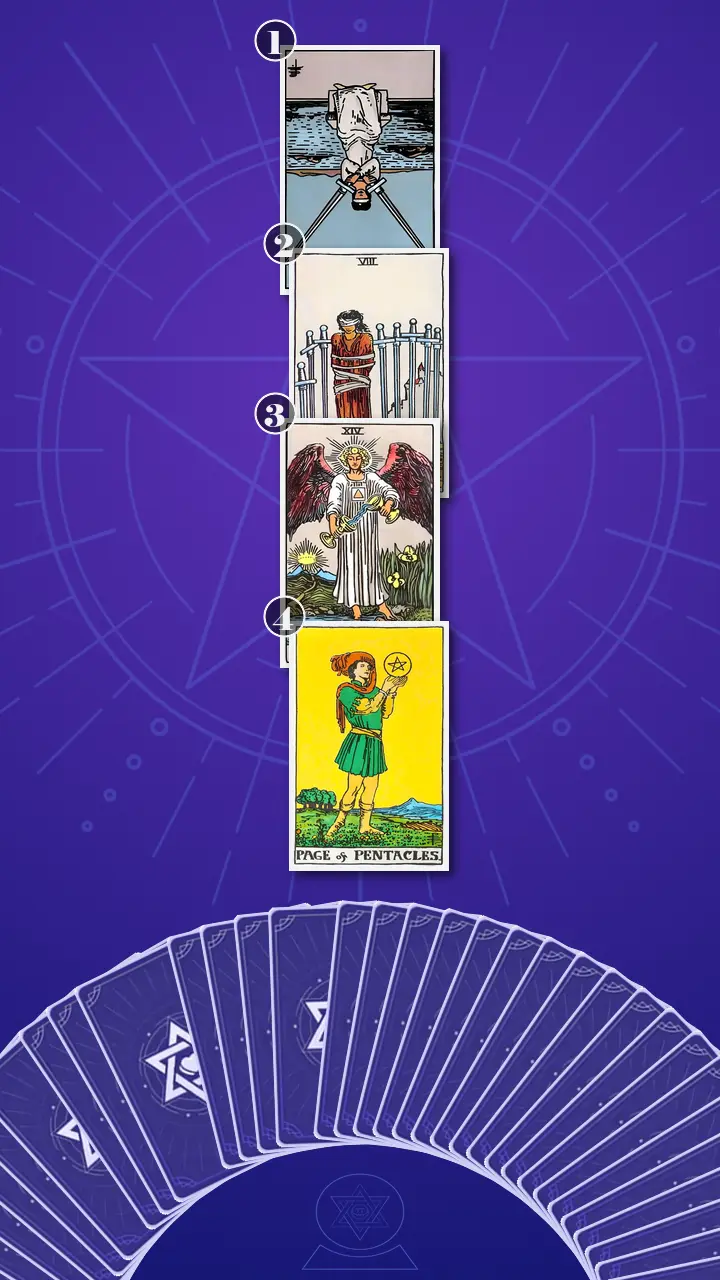
I told Jordan what to expect as I laid the cards in a vertical line like a ladder: “The first card shows the present-moment spike—what happens in your body and behavior when booking becomes real. The second goes underneath it: the past story your nervous system learned. The third is the bridge, the medicine—what dissolves the trap narrative without forcing certainty. The fourth is the next doable step within a week.”
Reading the Freeze: Two Blindfolds in a Bright Screen Glow
Position 1: The present-moment spike
Now we turn over the card that represents The present-moment spike: the exact behavior and mental block that appears when the weekend trip shifts from idea to commitment.
Two of Swords, reversed.
In modern life, this looks painfully specific: you’re staring at a group chat message—“Can you confirm by tomorrow so we can book?”—and you physically can’t type a clean answer. You keep reopening your calendar like it’s evidence in court, trying to prove to yourself you’re allowed to say yes. Your thumbs hover, you draft something vague (“maybe”), delete it, and default to silence.
That’s the Two of Swords reversed energy as a blockage. Upright, the Two can be a calm pause—neutrality as protection. Reversed, neutrality becomes a hiding place that starts to hurt. The blindfold isn’t peace. It’s pressure. The crossed swords aren’t “I’m considering my options.” They’re “I’m bracing for impact.”
Jordan let out a short laugh—small, sharp, almost embarrassed. Then their breathing stopped for a beat. Their eyes flicked to the side like they were seeing themselves on a screen. Finally, they exhaled through their nose, slow and unwilling. “That’s… exactly what I do,” they said. “Which is kind of brutal to hear out loud.”
“Brutal, but not moral,” I replied. “This is a nervous system reflex, not a character flaw.”
Position 2: The past story underneath the spike
Now we turn over the card that represents The past story: the learned association that makes commitment feel like restriction, and why your nervous system reacts so fast.
Eight of Swords, upright.
Somewhere in your past, commitment got coded as captivity: once you agree, you’re expected to endure it, be pleasant, and not change your mind. So when a weekend trip becomes concrete, you don’t just think about logistics—you imagine being socially stuck: having to match everyone’s energy, not being able to rest, not being able to renegotiate without shame. Your brain treats “booking” like giving up your voice.
This is Eight of Swords energy as perceived restriction: a fence made of assumptions. The classic image has loose bindings—meaning the trap is maintained as much by fear and prediction as by reality. But the body doesn’t care that the ropes are loose. It hears “confirm” and reacts as if the knots are already tied.
Here’s the Jungian detail I always listen for: what archetype is watching you when you imagine changing your mind? In my work, I call it Stained Glass Decoding—the way our psyche projects shapes onto a situation the way colored light hits a wall in patterns. The weekend trip isn’t just a trip; it becomes a stained-glass scene where “The Reliable One” is being judged by “The Inner Critic,” and the verdict is shame.
Jordan’s fingers tightened around their water glass. Their shoulders rose slightly, like they were bracing to defend themselves in a trial that hadn’t started yet. “It’s like… if I say yes and then I’m tired, I can’t be human about it,” they said. “I have to perform being fine.”
“Exactly,” I said. “The past story isn’t ‘travel is bad.’ It’s ‘once I say yes, I lose agency.’”
When Temperance Spoke: Turning Contracts into Containers
Position 3: The key integration
Before I turned the third card, the room got noticeably quieter—like even the city outside decided to lower its volume. This is the heart of the Four-Layer Insight Ladder: the bridge card, the integration point.
Now we turn over the card that represents The key integration: the inner reframe that dissolves the trap narrative without forcing certainty.
Temperance, upright.
Temperance is the turning point because it doesn’t demand a dramatic leap. It offers a middle way: design a plan that can breathe. In real life, it looks like this: instead of trying to feel 100% sure, you build in a late start, a solo decompression walk, a budget cap, and a clear return time—so you’re not promising infinite availability. The weekend becomes a blended plan you can actually inhabit: fun that doesn’t cost your nervous system its sense of control.
Temperance is balance—but not aesthetic balance, not “perfectly optimized weekend.” It’s regulation. It’s pacing. It’s “one foot on land and one foot in water,” meaning: grounded enough to feel safe, flexible enough to stay alive.
And this is where my Venetian brain always goes—my Bridge-Corridor Theory. In Venice, you’re constantly moving between islands, but you don’t do it by leaping across open water. You cross bridges. A good bridge has rails. It has width. It has a clear beginning and end. It doesn’t steal your freedom; it gives you passage. A commitment without boundaries is like stepping onto a bridge with no rails while someone rushes you from behind—you’ll freeze, not because you hate the destination, but because your body is protecting you from falling.
Jordan’s eyes stayed on the card like they were trying to memorize it. I could tell their mind wanted to argue—wanted to demand certainty, to reopen ten tabs. So I slowed down and gave them the setup their nervous system needed:
It’s Thursday night, the group chat says “Should we book tonight?” and your finger hovers over the reply box. You’re flipping between Calendar, Maps, and a Notes app pros/cons list—like clicking “Book” will erase every other possible weekend version of you.
Stop treating a weekend yes like a life sentence; choose a paced, boundary-led yes and let Temperance’s steady pour turn pressure into something you can hold.
I let that sentence sit between us—no rushing to soften it, no over-explaining. A pause, like the quiet after a wave hits the side of a ship.
Jordan’s reaction came in layers. First: a physiological freeze—their lips parted slightly, and their breath caught high in their chest. Second: the cognitive seep—their gaze unfocused, as if replaying a memory of every time they’d said “maybe” and watched a plan dissolve. Third: the emotional release—their shoulders dropped, not dramatically, but enough that their hoodie collar shifted. They swallowed, jaw unclenching like they’d been holding a secret between their teeth.
“Wait,” they said, and there was irritation in it—an unexpected edge, like a door that stuck before it opened. “But if I need boundaries for a yes… doesn’t that mean I’ve been doing it wrong? Like I’ve been… failing at being normal?”
I shook my head. “No. It means you’ve been trying to say yes with zero structure,” I said, calm. “And your nervous system treated that as danger. Temperance isn’t a judgment. It’s a design principle.”
I leaned in slightly. “If your ‘yes’ doesn’t include your boundaries, your nervous system hears it as a cage. A balanced container turns commitment back into choice.”
They blinked fast, eyes a little glossy but not spilling. “That’s… allowed?” they whispered, like the permission itself felt suspiciously generous.
“It’s allowed,” I said. “And it’s practical.”
Then I asked the question that anchors the insight into lived reality: “Now, with this new frame—container instead of contract—can you think of a moment last week where this would have changed how you felt?”
Jordan stared at the table for a second, then nodded once, slow. “Tuesday. My friend said, ‘One night in Prince Edward County?’ and I started asking for ten details because I didn’t know how to say yes without… disappearing.” They looked up. “If I’d just said, ‘I’m in, but I need Saturday morning chill,’ I wouldn’t have spiraled.”
That was the shift in real time: from micro-commitment anxiety and group-chat freeze to boundary-led commitment and self-trust. Not a personality overhaul. A bridge being built where there used to be open water.
The Page of Pentacles and the One-Step Checkout Flow
Position 4: The next doable step
Now we turn over the card that represents The next doable step: a concrete, low-stakes commitment action that builds self-trust within one week.
Page of Pentacles, upright.
This card is the antidote to “I need to solve the entire weekend before I reply.” The Page doesn’t do grand gestures. The Page does one real thing, with both hands on it.
In modern life: you send a clear, contained message—“I’m in—max budget $250, I need a chill Saturday morning, and I’m home by 6 p.m. Sunday.” Then you do one grounded action immediately: add the calendar hold, transfer a small amount into a “weekend” fund, or book one refundable stay.
This is Page of Pentacles energy as Earth: not certainty, but follow-through. Not perfect hypotheticals, but a single stepping stone that proves to your nervous system, “We can do this without getting trapped.”
Jordan exhaled, almost a laugh but softer this time. “One refundable step beats twenty perfect hypotheticals,” they said, like they were trying the sentence on for size.
“Exactly,” I replied. “You’re not committing to a whole identity. You’re committing to one small action you can keep.”
From Insight to Action: The Boundary-Led Yes You Can Send Tonight
When I looked at the ladder as a whole, the story was painfully coherent: Two of Swords reversed showed the present-day freeze—neutrality turned into pressure, the “maybe” fog, the draft-and-delete loop. Eight of Swords explained why it spikes so fast: an old rule that says commitment equals captivity, that changing your mind equals shame, that you’re not allowed to be human once you say yes. Temperance opened the system again by reframing commitment as a container—a bridge with rails—so your autonomy can travel with you. And Page of Pentacles grounded it into Earth: one practical step that builds self-trust.
The cognitive blind spot here is subtle: you’ve been treating a weekend plan like a permanent loss of freedom, so you try to think your way into certainty before you move. But certainty isn’t the missing ingredient—structure is. The transformation direction is clear: from contract language to container language; from all-or-nothing to a time-bound experiment with boundaries and an exit ramp.
To make this actionable, I offered Jordan a simple framework from my own toolkit—my Lace Communication Method, inspired by Burano lacemaking. Lace isn’t made by one big yank. It’s made by small, precise stitches that hold shape without turning into a net you can’t breathe through. Your boundary-led yes should be one clean stitch, not a five-paragraph defense.
- The 10-Minute Boundary-Led YesWithin 10 minutes of reading “Can you confirm by tomorrow?”, send one matter-of-fact text with a clear yes + one boundary (time or pace or budget). Example: “I’m in if we leave after 10am and I’m home by 6pm Sunday.”Expect your brain to scream “This is awkward.” Keep it neutral—like you’re stating booking constraints, not asking permission. If you freeze, pick only one boundary and send the five-word version.
- Build the “Soft Container” in Your CalendarAdd a calendar hold labeled “Trip (soft container)” and include two buffers: 1 hour before departure and 2 hours after return for decompression.Those buffers are not indulgent—they’re the rails on the bridge. They prevent resentment later and lower booking anxiety now.
- One Reversible Booking MoveDo one concrete step today: set a max budget (e.g., “$250 all-in”) or book one refundable stay using the free-cancellation filter.One tab only, one decision only. If your jaw tightens, take three slow breaths and stop after this single action—no bonus research.

A Week Later: The Quiet Proof of Self-Trust
A week later, Jordan messaged me: “I sent the boundary-led yes. Nobody got mad. We booked something refundable. I put ‘Trip (soft container)’ in my calendar and it weirdly made my chest stop doing the drop thing.”
They added, almost as an afterthought: “I still woke up the next morning and thought, ‘What if I regret it?’ But I didn’t spiral. I just adjusted Saturday morning to be solo, and it felt… doable.”
That’s what a real Journey to Clarity often looks like: not the disappearance of fear, but the presence of a structure that lets you move anyway. In this Four-Layer Insight Ladder · Context Edition spread, the cards didn’t tell Jordan what to do with their weekend. They showed them why “book it tonight” feels like a trap—and how a paced, bounded yes turns planning back into choice.
When a simple weekend plan flips from “fun idea” to “book it tonight,” it can feel like your chest is being asked to sign away your only sense of control—so you freeze, not because you don’t want the trip, but because you don’t trust that you’ll still be allowed to choose once you say yes.
If you let your next “yes” include one clear boundary (time, budget, pace), what would you want that boundary to be—so the plan feels like a container you can breathe inside, not a cage?
This story is adapted from psychological research, written so that those in a similar struggle can see their own pattern in it — and find their next step clearly.These insights are not a substitute for professional psychological, medical, legal, or financial advice.
Learn more about our Journey to Clarity.
How did this insight land for you?
🫂 This Resonates Deeply
🌀 Living This Story
✨ Now I See Clearly
🌱 Seeing New Possibilities
🧰 Useful Framework
🔮 The Confirmation I Needed
💪 Feeling Empowered
🚀 Ready for My Next Step
Author Profile
 AI
AI“Having traveled across cultures... I've learned that what we often lack isn't a simple answer, but a moment of being truly understood. I use a Jungian psychological lens to help you deconstruct your subconscious patterns—not to prove anything, but to be the gentle companion who helps you unravel your knots, free of judgment, so you can reconnect with your inner wisdom.”
In this Love Tarot Reading :
Core Expertise
- Attachment Loop Diagnosis: Logically decoding whether your relationship friction is driven by an anxious-avoidant trap or deep-seated insecurity.
- Shadow Projection Analysis: Identifying the unacknowledged fears or unmet childhood needs you are unconsciously projecting onto your partner.
Service Features
- The Projection Detachment Exercise: A structured psychological journaling prompt to separate your partner's actual behavior from your triggered internal narrative.
Also specializes in :
Explore Related Patterns:
Boundary DiscernmentJordan's relief arrives when the yes becomes specific: a max budget, a chill Saturday morning, a solo decompression walk, and a clear return time. The commitment stops being an open-ended social demand and becomes a container with visible edges. Boundary Discernment is the adaptive mechanism here. It is not avoidance and it is not over-control; it is the ability to separate genuine willingness from the fear of disappearing inside someone else's plan. By naming time, pace, and budget constraints, Jordan keeps agency inside the commitment rather than trying to recover it afterward. This pattern directly answers the past-story spike because the old rule says a yes removes choice. A boundary-led yes updates that rule. For You, the psychological move is to stop treating boundaries as evidence that the plan is wrong and start treating them as the structure that makes the plan inhabitable.
Commitment AvoidanceJordan says they want to go, but the second the weekend trip becomes real, the confirmation text starts to feel less like logistics and more like being locked in. The clearest past story is the rule that once they agree, they are expected to endure the plan, stay pleasant, and not change their mind without shame. That rule turns commitment into a perceived agency threat. Instead of treating a yes as a flexible choice, Jordan's nervous system reads it as a contract where their future needs will no longer count. This is why a simple booking prompt creates the urge to delay, over-question, or stay vague: avoidance protects them from the imagined moment where they will be socially stuck and unable to renegotiate. Commitment Avoidance fits here because the issue is not a lack of desire for the trip. You can want the experience and still avoid the commitment structure if your mind has learned to equate yes with captivity. The pattern begins to loosen when the yes includes boundaries, because the decision stops meaning self-erasure and starts meaning chosen participation.
Freeze ResponseJordan's thumbs hover over the reply box, a vague 'maybe' gets drafted and deleted, and silence becomes the default response. The body is already involved: locked jaw, chest drop, stopped breath, and the phone face-down like it is giving off heat. That is the logic of a Freeze Response in everyday form. The decision is not processed as a normal preference question; it is processed as a threat to future autonomy. When the nervous system reads 'confirm by tomorrow' as 'you will not be allowed to change your mind,' action narrows into stillness. This pattern matters because You may mistake the freeze for indecision or irresponsibility when it is actually a protective reflex. The way out is not forcing a faster yes, but reducing the perceived threat by adding a clear boundary, a time limit, or a reversible next step so the body can register movement as safe enough.
Relationship Performance AnxietyJordan names the core social pressure with unusual precision: if they say yes and then feel tired, they cannot be human about it; they have to perform being fine. The trip becomes a stage where 'The Reliable One' is being watched by an Inner Critic, and the feared consequence of having needs is shame. Relationship Performance Anxiety fits because the commitment spike is tied to maintaining an acceptable social role. Jordan is not only deciding whether to travel; they are imagining the obligation to match everyone else's energy, stay agreeable, and avoid disappointing the group after the plan is booked. For You, the pattern is the belief that being easygoing is the price of belonging. That belief makes every yes heavier than it needs to be. The corrective move is to let the relationship see a cleaner version of reality: interest plus limits, enthusiasm plus rest, participation without pretending to be endlessly available.
Analysis ParalysisJordan's first move after the group chat asks for confirmation is not to answer but to open Calendar, Maps, a budget tab, and a Pros/Cons note. The behavior looks productive on the surface, but it functions as a pressure valve: as long as there is one more detail to check, the actual commitment can be postponed. The psychological mechanism is decision protection through over-analysis. Jordan is trying to think their way into a level of certainty that a small social plan can never fully provide. The more the weekend feels like a possible loss of control, the more research becomes a substitute for agency rather than a support for it. Analysis Paralysis fits because the stuck point is not ignorance. Jordan has enough information to send a bounded reply, but the mind keeps demanding more proof before movement is allowed. For You, the audit point is whether planning is clarifying the choice or quietly becoming the place where the choice gets avoided.
Certainty SeekingJordan keeps reopening the calendar, checking maps, weighing budget constraints, and building a Pros/Cons document before sending a basic group-chat answer. The hidden demand is that the plan must feel fully resolved before they are allowed to commit. Certainty Seeking is the cognitive loop underneath that demand. The mind tries to eliminate regret in advance, but the weekend cannot offer the kind of total future-proofing Jordan is asking from it. Because the real fear is lost agency, no amount of tab-switching can create the emotional safety they are looking for. For You, this pattern shows up when 'I need more information' quietly means 'I need a guarantee that I will not regret this.' The shift is to replace total certainty with a bounded experiment: one clear yes, one non-negotiable boundary, and one reversible action that proves commitment can still contain choice.
Explore Related Struggles:
Agreement-Agency SplitJordan does not reject the weekend; they reject the feeling that "I'm in" becomes a contract. The clearest line is the old rule underneath the spike: once they say yes, they lose agency. You can see a normal booking request turn into a scene where future rest, renegotiation, and changing your mind seem to disappear. That is why the pressure lands before the logistics are even solved. Calendar tabs and budget tabs cannot soothe a deeper equation where agreement equals surrender. The struggle is the split between wanting to participate and needing proof that your voice will still exist after you commit. When a yes has no built-in boundary, the body treats it like a handover of control. The work is not forcing yourself to become more spontaneous; it is separating agreement from self-abandonment so commitment can become a choice you remain inside, not a door that locks behind you.
Commitment Threshold StrainThe group chat does not become intense while the trip is still an idea; it becomes intense when someone asks, "Can you confirm by tomorrow so we can book?" You can see the threshold in Jordan's body: the jaw clamp, the chest drop, the phone face-down on the table, the reply box that stays empty. Commitment Threshold Strain lives in that exact shift from possibility to confirmation. Before the booking point, the weekend can stay flexible and imagined. At the threshold, every loose option seems to collapse into one chosen path, and the body starts treating a small plan like a loss of future movement. The struggle is not that no option is appealing. Jordan wants to go. The strain comes from crossing a line where a yes feels bigger than the plan itself, as if one message could turn the whole weekend into something they must endure rather than something they can inhabit.
Social Exit ParalysisJordan imagines the booked trip as a place where they might have to match everyone's energy, lose rest, and renegotiate only at the cost of shame. The fear is not simply being away for the weekend; it is being socially stuck once the plan begins. Social Exit Paralysis shows up when the exit ramp disappears before anything has even happened. A group chat confirmation becomes loaded because it seems to close the door on later adjustment. You can want the people, the place, and the fun while still freezing at the thought of having no graceful way to pause or change pace. The boundary-led yes works because it restores a visible door inside the plan. A late start, solo Saturday morning, budget cap, or clear return time tells the body that participation does not require social captivity. You are not refusing connection; you are making connection survivable enough to choose.
Self-Erasure ReliabilityJordan names the past story with painful precision: once they agree, they are expected to endure it, be pleasant, and not change their mind. The weekend stops being a trip and becomes a stage where The Reliable One has to keep performing, even if they get tired. Self-Erasure Reliability forms when dependability is treated as proof that you can suppress your limits. You can hear it in the sentence, "I have to perform being fine." The problem is not ordinary follow-through; it is the hidden cost of becoming reliable by removing your own needs from the plan. That role makes every yes feel risky because it seems to require a version of you with no fluctuating energy, no need for quiet, and no right to revise the terms. The pressure eases only when reliability includes truthful limits, so being dependable no longer means disappearing inside the commitment.
Freedom-Structure ConflictThe turning point comes when the weekend is redesigned with a late start, a solo decompression walk, a budget cap, and a clear return time. Jordan's body does not need the trip to vanish; it needs the commitment to stop swallowing every available edge of time, energy, and choice. Freedom-Structure Conflict appears because total openness and total commitment both feel unsafe in different ways. With no structure, the yes feels like a cage. With no yes, the desire to join the trip has nowhere to go. The workable path is a container that protects freedom instead of replacing it. That is why "I'm in, but I need Saturday morning chill" changes the whole system. The boundary does not weaken the commitment; it gives the commitment a shape the body can trust. You are not choosing between freedom and follow-through. You are learning to build a plan where both can coexist.
Certainty-Safety FusionJordan moves from Calendar to Maps to budget to a Notes doc titled "Pros/Cons," not because the weekend needs that much data, but because the answer does not feel safe yet. The calendar gets reopened like evidence in court, as if enough checking could prove that a yes will not become a trap. Certainty-Safety Fusion turns total clarity into a prerequisite for movement. You can see the trap in the draft-and-delete loop: the mind keeps asking for one more piece of proof before the body is allowed to act. But the real fear is not unresolved logistics; it is whether future agency will still be available after the message is sent. No amount of research can guarantee how every hour of the weekend will feel. That is why the loop produces more tabs instead of relief. Safety starts to return when the plan gains structure, because a bounded yes gives the body something more useful than perfect certainty: a way to move without abandoning control.
Explore Related Emotions:
Anticipatory ShameBefore anyone has criticized Jordan, their body is already preparing for judgment. They picture saying yes and later being tired, needing quiet, or wanting to adjust the plan, then feeling as if they have failed the role of the easy, reliable person. That imagined verdict arrives early. The shoulders rise, the fingers tighten, and the booking message becomes a preview of future shame rather than a neutral invitation. You are not just deciding whether to travel; you are bracing for the possibility of being seen as difficult if your needs show up later. Anticipatory Shame names that preloaded social sting. It is the feeling of being judged before the situation has even happened, and in this story it is exactly why a boundary-led yes matters: it gives your needs a place in the plan before shame has to speak for them.
Autonomy Loss DreadThe group chat asks for a simple confirmation, but Jordan's mind jumps past logistics into a future where rest, renegotiation, and changing their mind may no longer be available. Booking the weekend starts to feel like handing over the controls to everyone else's pace. The past story underneath the spike is explicit: once they say yes, they imagine they are expected to endure it, stay pleasant, and not be human about their limits. That learned association turns commitment into a perceived loss of voice, even when the actual plan is still adjustable. Autonomy Loss Dread captures the fear that a choice will stop belonging to you after you make it. In Jordan's case, the dread softens when the yes includes a budget cap, a clear return time, and solo space, because those details prove that choosing the trip does not require abandoning self-direction.
Commitment ClaustrophobiaJordan's phone is face-down on the table, the group chat is waiting for a booking answer, and their body reacts as if the device is radiating pressure through the room. Their jaw locks, their chest drops, and the air around the weekend seems to thin the second the plan becomes real. That physical contraction shows why the anxiety spikes around commitment rather than around the trip itself. A yes does not land as a preference; it lands like a door closing. You can want the experience and still feel your body brace against the imagined loss of breathing room. Commitment Claustrophobia names the inner weather of that moment: the fear that saying yes will shrink your space, trap your time, and make it harder to return to yourself. The story points toward agency because the pressure eases when commitment is redesigned as a container with boundaries instead of a contract with no air.
Cautious Self-TrustA week later, Jordan has sent the boundary-led yes, booked something refundable, and put "Trip (soft container)" in the calendar. Nobody gets mad, and the chest-drop sensation eases enough for them to notice that the plan feels doable. This trust is built through evidence, not hype. Jordan still has the thought that they might regret it, but they do not collapse into the old spiral. They adjust Saturday morning to be solo, which proves that a yes can be revised without becoming a trap. Cautious Self-Trust captures that quiet proof. You are not forcing yourself to love uncertainty; you are learning that your choices can include limits, repair, and room to stay connected to yourself.
Contained OverwhelmJordan does not become instantly carefree after the reading. They still wake up wondering, "What if I regret it?" but the feeling no longer takes over the whole system because the trip now has a soft container: a refundable booking, a calendar hold, a solo Saturday morning, and a clear return point. The overwhelm is still present, but it has edges. Instead of spilling into ten tabs and a silent group chat, it is held by practical limits that protect time, money, pace, and recovery. You can feel uncertain without having to let uncertainty run the plan. Contained Overwhelm names this more workable state. It is the difference between being flooded by a decision and having enough structure to carry the feeling while still moving.
Performance FreezeJordan's thumbs hover over the reply box, draft a vague maybe, delete it, and leave the chat unanswered. At the same time, they keep reopening the calendar, Maps, and a Pros/Cons note, as if enough checking could produce a response that no one could question. The freeze is not empty indecision. It is the pressure of needing the answer to perform well: clear enough to satisfy the group, safe enough to protect their time, and polished enough to avoid future regret. The reply box becomes a tiny stage where the wrong sentence could expose too much need. Performance Freeze fits because the body stalls when the choice feels socially loaded. The way through is not more tabs or a perfect explanation; it is a contained message that lets you act without making the yes prove your entire competence as a person.
Explore Related Contexts:
Bounded Commitment TrialJordan's workable yes has rails: a late start, a solo decompression window, a budget cap, a clear return time, and a refundable booking option. Those are not excuses or over-explanations; they are the terms that let a real commitment exist without swallowing the whole weekend. This context shows the constructive path inside the story. You do not need to wait until you feel perfectly certain before replying; you need a commitment shape that includes your limits. When the yes has boundaries, it stops acting like a contract of unlimited availability and becomes a container you can actually inhabit.
Capacity-First ReliabilityA week later, Jordan sends the boundary-led yes, the group books something refundable, and nobody gets mad. That follow-up matters because it proves reliability did not require Jordan to erase their own capacity; the plan still moved forward after they named what they could actually do. You are allowed to be dependable without becoming endlessly available. In this story, the healthier social role is not the person who says yes to everything and manages the fallout later; it is the person who gives the group usable information early enough for everyone to plan around real limits.
Commitment Cliff EdgeThe booking text lands on Thursday night while Jordan is switching between Maps, Calendar, and a Pros/Cons note, and the simple question of whether to book starts acting like a one-way gate. You can see the external structure clearly: a social plan moves from casual idea to confirm-by-tomorrow, while the available options feel reduced to a total yes or a vague retreat. The spike is not about the destination; it is about a commitment format that makes your time feel non-negotiable once the plan becomes real. When the weekend has no visible buffers, exit ramp, or permission to renegotiate, saying yes starts to resemble surrendering control of your own schedule, so the reply box becomes the place where movement stalls.
Social Performance LoopJordan names the old rule directly: if they say yes and then get tired, they cannot be human about it; they have to perform being fine. That sentence turns the weekend trip into a social role problem, because the pressure is not just to attend, but to stay pleasant, low-maintenance, and fully available once the yes has been given. This is the past story that makes the booking message spike. You are not reacting only to travel logistics; you are reacting to an external script where changing your needs can be treated as letting people down. The friend plan becomes a stage where reliability is measured by how well you hide fatigue, hesitation, or the need to renegotiate.