Ghosting After Intimacy: A Boundary Without One More Message

Closure After Ghosting: The Chat That Stayed Open
I met Alex with a careful research brain, a half-finished Notion timeline, and one final text saved in drafts because closure obsession had started to feel like the only way to prove the connection was not disposable. As a 28-year-old UX researcher in Toronto, Alex was used to turning messy signals into patterns.
At 12:40 a.m., Alex lay beneath a thin duvet in a downtown-adjacent apartment, reopening the final conversation. Blue phone light cut across the wall, the radiator clicked in the quiet, and the screen felt warm against their palm. Their thumb hovered over the draft that said, Can we talk one more time?, then scrolled back to the first affectionate messages as if the missing explanation had been buried between two old heart emojis.
When I asked what had brought them in, Alex looked up from the phone and said, Why do I chase closure after intimacy ends in ghosting? They wanted the intimacy and its harm to be acknowledged, but the only answer available was silence. They had begun rereading timestamps, checking whether the person was active on Hinge or Instagram, drafting another calm-sounding message, and sending screenshots to friends for interpretation.
I could see betrayal-driven longing moving through the room like a browser tab pinned open for emotional proof: refreshing showed the same old page, but closing it felt like deleting the history. Beneath the tight chest, clenched jaw, restless fingers, and stomach drop was anger, grief, and shame, all asking the same impossible thing. I told Alex, I hear that you want the story honored and the ending made clear. I am not going to turn the silence into a prophecy or speculate about the person who is not here. Let us make a map of what is knowable, what hurts, and what boundary can return your attention to you.

Choosing a Map for an Unanswered Ending
I asked Alex to place both feet on the floor, take one slow breath, and name the question without trying to solve it. I shuffled at an unhurried pace. The preparation was a psychological threshold, a way to move from the glowing phone and its endless cues into a shared examination of the pattern.
For anyone wondering how tarot works in a reading like this, I use the cards as an objective symbolic language and a structured cognitive tool. My Jungian lens treats the images as mirrors for patterns already active in the psyche, not as proof of another person's hidden intentions and not as a fixed prediction. The cards give us a disciplined set of questions; Alex remains the person who decides what is true, useful, and actionable.
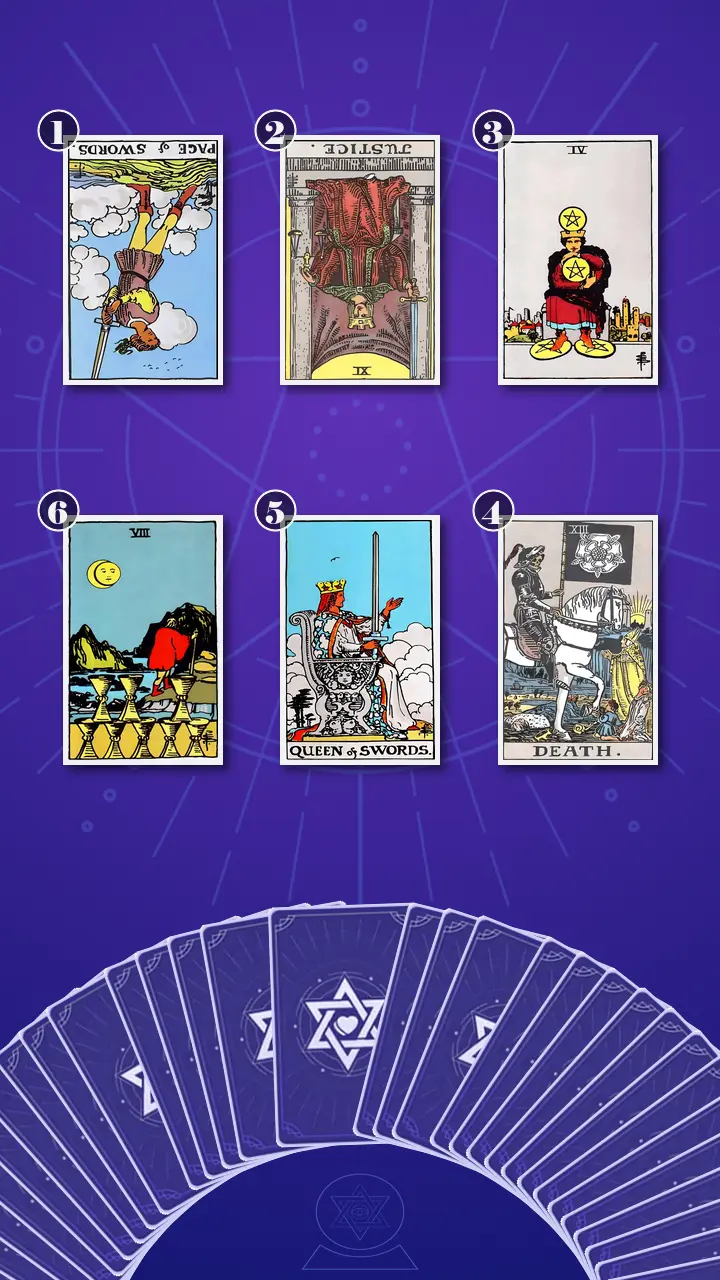
I chose the Six-card Transformation Path Grid - Context Edition because the question was not really asking me to read the absent person's mind. A classic Relationship Spread might center someone who was not present and invite speculation. A Shadow Spread could expose a hidden belief but would not map the whole sequence from trigger to checking, brief relief, renewed hurt, and more checking. A Celtic Cross would add breadth where Alex needed a precise map. This six-card tarot spread follows the loop economically: visible behavior, blockage, root attachment, transformative trigger, practical boundary, and integration.
I explained that the first card would show the observable closure-chasing behavior; the second would identify the unfairness and missing verdict keeping it active; the third would reveal what the grip was protecting. The fourth would be the hinge, asking whether an ending could be real without mutual acknowledgment. The fifth would translate clarity into a boundary, and the sixth would show how to move emotionally while allowing the unanswered gap to remain visible.
Reading the Evidence Without Becoming It
Position 1: The Watcher in the Wind
Now revealed was the card representing the observable closure-chasing behavior and contracted mental energy: reopening the chat, monitoring digital cues, drafting follow-ups, and searching for a decisive clue. It was the Page of Swords, in reversed position.
At 12:40 a.m., Alex lay in bed with the final conversation open, checked whether the person had been active, and scrolled back to the first affectionate messages. The screen offered fragments but no dependable answer. The Page's raised sword became a draft message, a reread, and another attempt to turn vigilance into closure. The Page looking over their shoulder was the physical equivalent of Alex switching between the message thread, active status, and old texts, mistaking a growing pile of fragments for movement.
Reversed Air was not a warning that something terrible was about to happen. It was blocked and misdirected mental energy. Curiosity had become surveillance; observation had become a way to preserve contact. I used my Attachment Loop Diagnosis here, asking whether Alex's relationship friction was being driven by an anxious-avoidant trap or by a triggered insecurity, while refusing to diagnose the absent person or invent motives. The pattern I could actually see was simpler: a reminder triggered the urge, checking created a brief sense of action, and the lack of new information renewed the injury.
I asked, I am gathering evidence, but what new information arrived? Alex's thumb froze above the screen. Their eyes went unfocused as though the bedroom had become a replay of the last conversation. Then they gave a small, bitter laugh and said, That is too accurate. Almost cruel. I let the reaction stand for a moment before answering, The checking is not foolish, and it is not evidence that you were disposable. It is a temporary control strategy. Noticing the urge before obeying it gives you information the profile cannot give you.
Position 2: The Private Courtroom
Now revealed was the card representing the central Betrayal-Closure Lock: the belief that an unfair disappearance could not count as complete until the other person explained or acknowledged it. It was Justice, in reversed position.
Alex had turned the last exchange into a private case file, arranging screenshots, timestamps, promises, punctuation, and the exact point where replies stopped. The search for fairness made sense after ghosting after intimacy; being left without a closing conversation could hurt without being minimized. Yet reversed Justice showed the scales stalled in midair. The perfect explanation, apology, or confession had become a condition for emotional movement, leaving an unavailable person in charge of the verdict.
The sword and scales also described the way Alex's professional strengths had entered the rupture. Their Figma comments, Notion research boards, and carefully labeled screenshots were useful at work. Here, the same precision had become a Google Doc courtroom where every exhibit waited for a witness who would not appear. I said, The unfairness is something you can name as an impact. The other person's motive is something you may never be able to verify. Those two truths do not have to be solved by the same document.
Alex's mouth tightened. Their index finger traced the edge of the phone, then stopped, and their shoulders rose as if preparing to argue a case. If they explain it, then I can finally know what this meant, they said. I asked what that explanation would have to prove. After a pause, Alex answered, That I did not imagine the intimacy. That it mattered to them too. That I was not just easy to leave. The wince that followed held anger, grief, and the shame of needing acknowledgment from someone who had chosen not to offer it.
Position 3: The Grip That Called Itself Proof
Now revealed was the card representing Possessive Attachment as the root mechanism: the attempt to retain access and control so the ghosting would not confirm a fear of being disposable. It was the Four of Pentacles, in upright position.
Alex kept the chat visible, the screenshots saved, and the person's profile only a few taps away, telling themself they were preserving the record. The phone had become a small object of emotional security, held close enough to feel like a passcode to a room that was no longer accepting visitors. The upright Four of Pentacles showed Earth in excess: the grip protected Alex from the immediate shock of loss, but it also pinned their attention in place and made release feel dangerously similar to erasure.
I brought in my Shadow Projection Analysis with care. I was not going to manufacture a childhood explanation or claim to know why the other person disappeared. I was looking for the unacknowledged fear that Alex's mind had placed inside the silence. The shadow was not They secretly know my worth and refuse to say it. It was the more painful story: If they do not acknowledge what happened, their withdrawal proves I am disposable. A missing reply could limit what Alex knew about the other person; it could not establish Alex's value.
I asked, When you imagine archiving the chat, what feels most threatened: the memory, the meaning of the intimacy, your sense of control, or your sense of worth? Alex's hand tightened around the phone, then slowly opened. The meaning, they said first. Then, quieter, Maybe my worth is hiding inside that answer too. I said, The intimacy can be real even when the ending is incomplete. Alex looked at the unarchived thread as though it had become both less powerful and more honest.
When Death's White Horse Started Moving
Position 4: The Ending That Did Not Need a Signature
The room grew very still as I reached the card that would interrupt the pattern. Now revealed was the card representing the transformative trigger: recognizing that the connection could be over without a mutually authored ending, and that acknowledging finality would not erase the intimacy. It was Death, in upright position, the Catalyst of the spread.
Death upright does not predict literal death, a dramatic return, or any event outside Alex's control. It marks a transition: a form has ended, and emotional energy can begin moving into another form. The advancing white horse stood in direct contrast to the Four of Pentacles figure, who could not move because every point of contact was being guarded. The white rose on the black banner gave me the exact image I needed: preserve the truth that something mattered while releasing the demand for continued access to the person who could not provide a goodbye.
At 12:40 a.m., Alex was back in bed, phone warm against their palm, rereading the affectionate opening beside the unanswered ending. Their chest tightened as they asked for one more clue, caught between honoring what happened and closing the tab that kept it alive. The question was no longer whether the past mattered, but whether the past had to remain digitally open in order to count.
Closure is not extracting one last answer from silence; it is naming the ending yourself and letting Death's white horse carry your attention forward.
I let the sentence remain between us, then said, The ending can be real without their explanation. Closure begins when you stop asking an unavailable person to certify that the intimacy mattered and let one boundary speak for what their silence cannot provide.
Alex's thumb stopped above the screen, and for one beat their breath disappeared. Their shoulders stayed lifted, as if an answer might still arrive through force. Then their eyes moved past the card and went unfocused; I could see the opening messages, the last intimate night, and the friend's sentence about silence replaying behind their face. Their jaw tightened. But does not that mean I was wrong to want an answer? they asked, anger arriving before tears. I told them no: wanting accountability was reasonable; outsourcing worth to an unavailable reply was the trap. The anger thinned into a long, uneven exhale. Their fist loosened around the phone, shoulders lowered, and their eyes reddened without collapsing into a performance of being fine. For a moment, relief made them look almost dizzy, as if the room had gained space faster than their body could map it. I asked, Now, use this new perspective to remember whether there was a moment last week when this insight might have let you feel different.
Alex remembered Tuesday, when the active-status dot had appeared just before a meeting and they had spent twenty minutes revising a message instead of entering the room. I could have put the phone across the room, they said. Not because I stopped caring. Because I already knew I was waiting for a person who was not participating.
At this point, I brought my Attachment Loop Diagnosis back to the center. I was not asking whether the absent person had an anxious or avoidant attachment style; the cards could not answer that, and it was not Alex's work to solve it. I was checking where the loop could be interrupted: trigger, monitoring, brief contact, renewed rejection. Death supplied the interruption. The emotional transformation was beginning as a small movement from seeking an external verdict toward authoring closure through verified facts, self-protective boundaries, and grief with uncertainty still present.
Position 5: The Sword and the Open Hand
Now revealed was the card representing the practical response: separating facts from imagined motives and choosing one boundary around contact, checking, or digital access that did not require cooperation from the absent person. It was the Queen of Swords, in upright position.
The Queen's upright sword did not ask Alex to become cold. It asked them to cut through unsupported stories. Her open hand kept that precision from becoming retaliation. This was balanced Air: clear enough to name what happened, compassionate enough to admit that it hurt, and independent enough to choose an action without staging it as a test designed to provoke a reply.
I showed Alex the beginning of my Projection Detachment Exercise. I asked them to write three lines: what the other person actually did, what Alex was inferring about the motive, and what the triggered internal narrative was saying about Alex's worth. The exercise did not decide which imagined motive was correct. It separated another person's observable behavior from the story fear had projected into the gap.
Alex picked up a pen and wrote, They stopped replying after we became intimate. Under it, they wrote, I do not know why. Beneath that came, I am afraid the silence means I was disposable. Their breathing changed before their expression did. They glanced at me, almost wary of the simplicity. I said, Your boundary does not need their signature. They nodded, but kept the pen moving.
Position 6: Leaving While the Cups Remain
Now revealed was the card representing cognitive and emotional integration: allowing the intimacy to have mattered while redirecting attention away from an unavailable source of closure. It was the Eight of Cups, in upright position.
The cloaked figure walked away from eight standing cups beneath an uncertain moon. Nothing in the image claimed that the cups were empty or worthless. The visible gap between them looked like the unanswered gap in Alex's story: real, painful, and not large enough to prevent movement. The Eight of Cups did not demand that Alex erase the connection, forgive the ghosting, or announce that they no longer cared. It offered emotional departure without a complete account of what happened.
I asked, What can you honor without continuing to monitor it? Alex looked at the cards, then at the phone lying face down between us. I can honor that it was intimate, that I wanted more, and that the way it ended hurt me, they said. I do not have to keep checking their profile to keep those facts alive. Their hand reached toward the phone, paused, and moved instead toward the notebook. The unanswered gap remained visible, but it was no longer the only place their attention could go.
The One-Page Ending I Could Author
When I laid the six cards side by side, the story became coherent. The reversed Page searched backward through digital fragments. Reversed Justice gave that search a moral purpose, waiting for an unavailable witness to declare the ending fair. The Four of Pentacles revealed the protective grip beneath both cards: if access remained, perhaps the intimacy could not be rewritten as proof of disposability. Death interrupted the static hold. The Queen of Swords gave the interruption language and a boundary, and the Eight of Cups carried that clarity into emotional movement.
The cognitive blind spot was not that Alex cared too much. It was the belief that more contact with the source of the wound would provide the evidence needed to recover from it. Checking offered temporary control and continued connection, but it postponed grief and made every nonresponse feel like a fresh verdict. The key shift was from seeking an external verdict in the other person's response to creating a Self-Authored Closure Record from verified facts, emotional impact, and one boundary Alex could enact alone.
I told Alex that this was the practical purpose of the Six-card Transformation Path Grid - Context Edition. It did not tell them what the absent person secretly felt, whether they would return, or how quickly Alex should heal. It mapped the present behavior, the Betrayal-Closure Lock, the possessive root, the transformative threshold, the boundary, and the next emotional terrain. The cards were not the authority over Alex's life. Alex was.
I offered three small experiments. Each one could be paused, reduced, or revised. None required another message, an accusation, or a permanent decision.
- The three-line checking urge logFor seven days, whenever Alex notices the impulse to check the profile or reopen the chat, they will open a note titled Before I Check and record what happened just before the urge, the first body feeling, and one action that protects their attention for the next ten minutes. They will place the phone face down and start the timer before opening anything.When writing feels too difficult, three words are enough, such as after work, lonely, text. The goal is to count urges noticed, not to interpret what each urge says about the relationship.
- The Projection Detachment ExerciseAt home or during a lunch break, Alex will make a two-column closure record in Notes or Google Docs: What I can verify and What I cannot make them explain. They will add three observable facts, one sentence about the emotional impact, and one question that must remain unanswered for now. Imagined motives will be labeled unknown, not quietly promoted to fact.The second column does not need to become satisfying. Alex does not need to send the document to anyone. They will choose one digital boundary from the first column, such as muting the profile for one commute or removing the chat from pinned messages.
- Meaning Without AccessBefore bed, Alex will write the sentence, This mattered to me, and it ended without a closing conversation. They will keep it in the private closure record, then archive or mute the chat for one chosen block of time and redirect that checking block toward one reciprocal hour with a friend, a meal, a walk, or an ordinary plan that gives something back.Start with one hour or one evening instead of forever. The boundary is protection for attention, not punishment, superiority, revenge, or a test. If it needs revision, revise it without turning revision into renewed contact.

A Week Later, the Room Had More Air
A week later, I received a message from Alex: I archived the chat for one evening and slept through the night. I still woke up thinking, What if I am wrong? Then I made coffee and went to work anyway. They had not claimed to feel finished. They had simply created one stretch of morning in which the other person's silence was not the first thing they touched.
I pictured the difference from that first night: not a grand breakthrough, not forced indifference, just a phone resting farther away while Toronto came fully into the room. The unanswered ending still had a gap in it. Alex had preserved the meaning without preserving constant access, and that was the first evidence that emotional movement could coexist with uncertainty.
In our Journey to Clarity, the tarot did not extract an apology or reveal a hidden motive. It helped Alex see the checking loop, name the fear beneath it, separate facts from projections, and choose a boundary that could be enacted without permission. The querent, not the cards and not the person who disappeared, remained the author of what came next.
When intimacy ends in silence, the tight chest and the hand reaching for the phone can hold two truths at once: the story deserves to be honored, and another person's withdrawal does not get to write your worth. The intimacy can be real even when the ending is incomplete.
If you let the intimacy remain real without keeping the chat open as its witness, what small boundary around your phone might feel like a little more room tonight?