The 8:56 p.m. “On This Day” Spiral
If you’re a London marketing manager who can run a Monday meeting like it’s nothing, but one “On This Day” notification can wreck your whole evening—welcome to the nostalgia spiral.
Taylor told me the moment like it was a scene her body had memorized. 8:56 p.m. on a Tuesday in her London flat. She was still in work clothes, one heel kicked off, the radiator clicking like it had opinions. The overhead light was slightly too bright—the kind of bright that makes your own thoughts feel louder.
Her phone buzzed: On This Day. She tapped it. The screen glow warmed her palm. And her throat tightened like she was about to speak—out loud—to a person who wasn’t there. She said, “I told myself it was just a memory. But my thumb was already heading for the WhatsApp thread.”
I watched her hands while she spoke. Restless. A little too quick, like they were trying to get to the answer before her heart caught up. What she was asking me wasn’t “Should I text my ex?” Not really. It was deeper, sharper: “What past love pattern is replaying? Why does a single clip make me feel like the past is unfinished—and like I’m about to repeat it?”
The longing in her wasn’t soft and romantic. It was physical—like trying to swallow with a tight throat, like standing on an escalator that suddenly moves the wrong direction. And under it, the quiet fear she couldn’t quite say without hating how it sounded: letting go might mean losing proof that she was lovable.
“Okay,” I said, gentle but steady, the way I speak to someone who’s already been hard on herself all week. “Let’s not make this about willpower or shame. Let’s make it about clarity. We’ll take what your nervous system is doing seriously, and we’ll give you a map for what to do the next time the algorithm tries to hand you the past like a gift.”

Choosing the Compass: How the Celtic Cross Works for a Pattern Replay
In my café, I’ve watched people reach for a second coffee for reasons that aren’t about caffeine. Sometimes it’s comfort. Sometimes it’s focus. Sometimes it’s a way to stay seated in a feeling without admitting that’s what they’re doing.
Tarot, for me, works the same way. Not as fate. As focus.
I asked Taylor to take one slow breath—not to “clear energy,” but to let her body arrive in the room. I shuffled slowly, the familiar sound like cards whispering against each other, and I told her, “We’re going to look at the Celtic Cross spread today.”
For anyone reading along: the Celtic Cross is a classic fit for questions like “why does this keep happening?” because it separates the trigger from the unconscious root, the recent imprint from the current story, and—most importantly—the integration pathway from the compulsive loop. It’s one of the clearest ways to explore card meanings in context without turning the reading into a prediction about a specific person’s behavior.
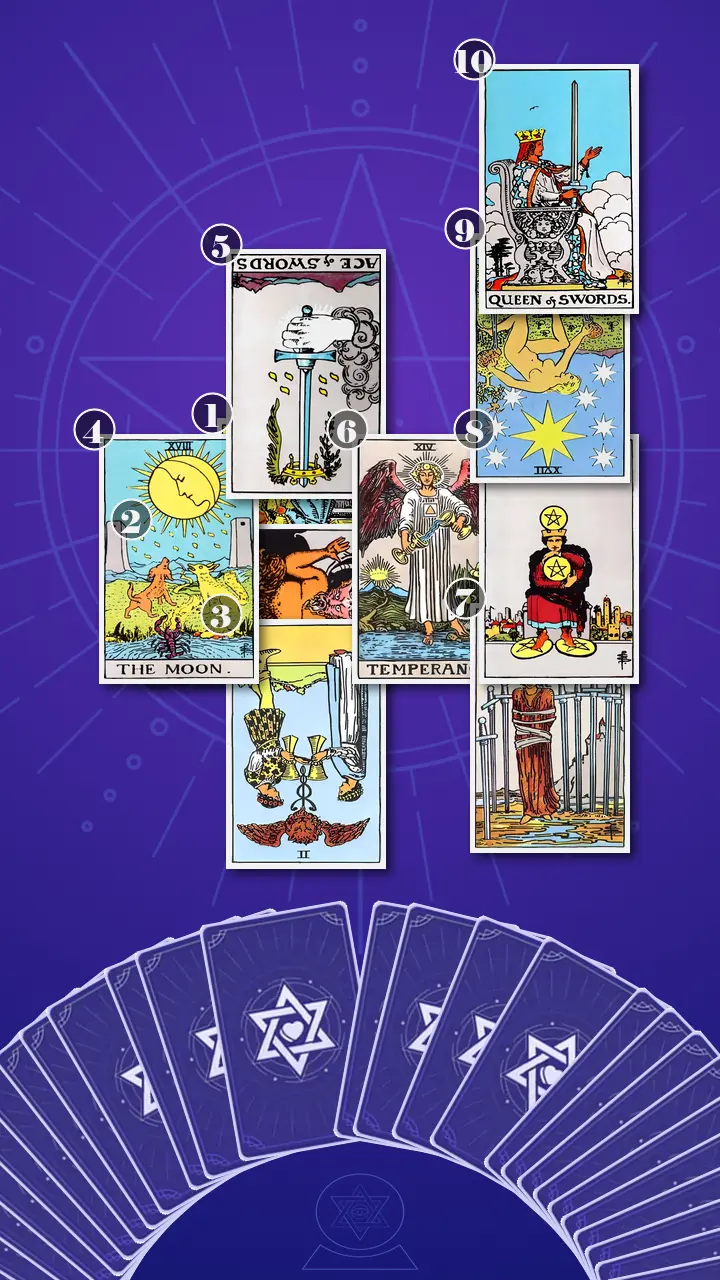
I pointed to the center of the layout as I built the cross. “This first card is the present trigger—what the ‘On This Day’ memory activated in you right now. This crossing card shows what has its grip on you, what makes it hard not to reenact. And this card on the right—near future—shows the shift that’s available, the next phase you can choose.”
Reading the Map: Highlight Reels, Chains, and the Need to Make It Make Sense
Position 1: The present trigger—what the “On This Day” memory activated
“Now I’m turning over the card that represents the present trigger—what the ‘On This Day’ memory activated in you right now,” I said.
Six of Cups, reversed.
I tapped the image lightly. “This is the card of nostalgia and emotional time-travel. Reversed, it’s not a gentle ‘aww, remember.’ It’s selective. Like your phone’s On This Day feature is an auto-playing highlight reel that skips the hard scenes.”
And I used the translation that always lands with people living inside a scroll: “It’s like you get the notification, and the curated memory arrives wrapped like a little present—a sweet cup of flowers. Your brain treats it as evidence: ‘See? It was real. It mattered. It could’ve worked.’”
Then I gave her the split-screen that I could already see playing behind her eyes.
“Part of you is like: I just want to feel close for one minute. And another part of you knows: that minute is expensive. One minute becomes forty. Deliveroo bag on the floor, tea going cold, screen glow in your face, and suddenly you’re deep in the thread like it’s research.”
Taylor let out a sharp exhale—and then she did something that surprised her. She laughed. Small. Embarrassed. Bitter at the edges.
“That’s… so accurate it’s kind of cruel,” she said, but her eyes were wet in that way that isn’t crying yet—just recognition.
I nodded. “It’s not cruel. It’s clean. And it’s normal. The algorithm is designed to hand you sweetness first. But here’s the line I want you to borrow this week: A memory isn’t a map back. It’s data. Not direction.”
Position 2: The repeating pattern’s grip—what makes it hard not to reenact
“Now I’m turning over the card that represents the repeating pattern’s grip—what makes it hard to stay in the present and not reenact the bond,” I said.
The Devil, upright.
People hear “Devil” and tense up, expecting a moral lecture. I don’t read it that way. I read it like I read the dessert case in my café: you’re not weak for wanting the thing. But you do need to know what the wanting is doing to you.
“This is compulsion,” I told her. “Not because you’re dramatic. Because something in this attachment loop gives you a hit: closeness, control, reassurance. The Devil is an app with infinite scroll. It isn’t a character flaw—it’s a design. And it keeps you hooked.”
I pointed to the loose chains. “See how they’re not even tight? This is the part where you could stop, but you don’t. ‘Just one minute.’ ‘Just a quick check.’ And suddenly you’ve given the past your whole nervous system.”
Taylor went still. Her shoulders rose toward her ears without her noticing. Her phone, sitting face-down on the table, might as well have been vibrating.
Position 3: The underlying love pattern—the foundational dynamic beneath the surface
“Now I’m turning over the card that represents the underlying love pattern—the foundational dynamic that keeps replaying beneath the surface,” I said.
Two of Cups, reversed.
“This is the part most people don’t want to admit,” I said softly. “Because it doesn’t match the highlight reel.”
I used the modern translation exactly as it is in real life: “This is like remembering the chemistry and the ‘specialness,’ but forgetting how often you had to initiate, interpret, or wait for basic clarity.”
Reversed, the Two of Cups isn’t “no love existed.” It’s “the exchange wasn’t balanced.” Energy-wise, this is blockage—mutuality trying to happen, but the channel is uneven. One person over-functions: soothing, explaining, waiting, proving. The other stays slightly out of reach.
Taylor’s jaw clenched, then loosened. “I hate that I hear that and I instantly know what you mean,” she said.
“That’s the diagnosis,” I replied. “Not a verdict. And it matters because if the foundation wasn’t mutual, then reaching back for closure is like trying to renovate a building that never had stable plumbing.”
Position 4: Recent past imprint—what the earlier relationship taught your nervous system to expect
“Now I’m turning over the card that represents the recent past imprint—what the earlier relationship taught your nervous system to expect,” I said.
The Moon, upright.
“This is the maze,” I said, and I traced the winding path between the towers. “Ambiguity. Mixed signals. Projection. The Moon is when intuition and anxiety wear each other’s clothes.”
In modern terms: decoding WhatsApp timestamps like tea leaves. Reading emoji punctuation like a prophecy. Feeling like you’re in a “Normal People” episode where the intensity seems meaningful, but the day-to-day reality is fog.
Energy-wise, the Moon is excess—too much meaning-making, too little daylight. It trains your nervous system to expect that love is something you solve, not something you receive.
Taylor’s eyes drifted to the window as if she could see her old self on that path. The café’s espresso machine hissed behind the counter at exactly the wrong moment—an environmental co-conspirator, making the room feel briefly surreal.
Position 5: Conscious story—the explanation you’re trying to make true about the past
“Now I’m turning over the card that represents the conscious story—the explanation you’re currently trying to make true about the past,” I said.
Ace of Swords, reversed.
She didn’t even wait for me to finish. “That’s the Notes app,” she said, half-laughing.
“Exactly,” I replied. “This is blocked clarity. It’s the fantasy that if you find the perfect sentence, you’ll finally know what it meant. But the sword can’t cut cleanly through the clouds, so you keep swinging.”
I let it sound like her internal monologue—tight, listy, treadmill-fast:
“If I say it like this… If I soften it… If I sound casual… If I don’t mention the memory… If I mention it but not too much…”
Energy-wise, this is deficiency in truth. Not because you don’t know the truth—because you keep demanding a truth that comes with zero discomfort. And that kind doesn’t exist.
I paused, because this is where shame usually tries to sneak in.
“Clarity isn’t a mood,” I said. “It’s a practice.”
When Temperance Poured Between Two Cups
Position 6: The shift that’s available—what can interrupt the replay next
I felt the reading gather itself the way a room quiets just before a song changes. “Now I’m turning over the card that represents the shift that’s available—what can help you interrupt the replay in the next phase.”
Temperance, upright.
Setup—because I wanted to name the exact trap before offering the door out of it.
You know that moment when your phone lights up with “On This Day,” and suddenly you’re back there—warm, sad, and weirdly urgent—like if you don’t do something right now, you’ll lose your chance to make the story make sense.
Not ‘one more replay will give me closure,’ but ‘I can blend love and truth like Temperance pouring between cups—and choose a calmer next step.’
I let the sentence hang. No fixing. No rushing. The espresso grinder in the back went silent, and for once the quiet didn’t feel like pressure—it felt like space.
Reinforcement came in layers, the way real insight does. First: her body.
Her breathing stopped for half a beat. Her fingers froze mid-fidget, hovering over the edge of her sleeve. Then her gaze softened—not happy, not relieved exactly, more like something unhooked. The tight line at her mouth broke, and she swallowed, slow, like she was letting herself taste a truth she’d been spitting out for months.
“But if I don’t text,” she said, and her voice thinned, “it feels like I’m admitting I wasn’t chosen.”
There it was—the hidden underlayer.
“I hear that,” I said. “And I’m not going to argue with your longing. Temperance doesn’t argue. Temperance integrates. It says: you can miss it and still not reopen it.”
This is where my café brain becomes my tarot brain. I’ve made coffee for twenty years, and one thing is always true: when you stir too fast, you get foam and chaos. When you let grounds settle, you can see what’s actually in the cup.
That’s my Conflict Sedimentation lens. We don’t “fix” the feeling by shaking it harder. We let it settle long enough to see: what’s sweetness, what’s sediment, and what’s just caffeine pretending to be love.
“Set a 7-minute timer,” I told her. “Put your phone face-down—better yet, in another room if you can. On paper, write two lines: (1) ‘What I loved:’ three specific moments. (2) ‘What I paid:’ three specific costs. If your body tightens, pause and just breathe. You can stop at any time. Only after the timer ends do you decide whether to open the chat thread.”
Her reaction came as a three-step chain, so subtle you’d miss it if you were only listening to words: (1) shoulders dropping a centimeter; (2) eyes going unfocused, replaying something private; (3) a long, shaky exhale that sounded like oh.
“I can do that,” she said. “That’s… a third option.”
“Exactly,” I replied. “This is the shift from trying to get certainty from the past to building self-trust through one present-day boundary and one present-day choice. That’s how you move from being hijacked to having agency.”
After the Pour: The Chain, the Blindfold, and the Boundary Voice
Position 7: Your role in the loop—the reflex you default to when triggered
“Now I’m turning over the card that represents your role in the loop—the self-belief you default to when you’re triggered,” I said.
Eight of Swords, upright.
“This is the blindfold moment,” I said. “The second the memory hits, your options collapse into two: text or suffer. That’s the trap. The Eight of Swords is perceived powerlessness.”
In modern life: the warm phone in your palm, shoulders tense, throat tight, and a thought that sounds like a fact—I can’t move on until I get closure from them.
Energy-wise, it’s blockage in agency. The bindings are loose. The gap is there. But the brain doesn’t look for gaps when it’s chasing reassurance.
I asked her, “What choice would you make today if you didn’t need their response to validate it?”
She blinked hard, as if the question changed the lighting in the room. “I’d stop giving them my evenings,” she said quietly.
Position 8: The context—habits and cues that keep the past loud
“Now I’m turning over the card that represents the context—habits, environment, and cues that keep the past accessible and emotionally loud,” I said.
Four of Pentacles, upright.
“This is the grip,” I said. “Control impersonating safety.”
In Taylor-language: keeping the chat archived. Keeping the photos. Keeping access one tap away because deleting feels like losing—even when keeping it costs your peace.
Energy-wise, it’s excess in guarding. You hold so tightly that nothing new can reach you. And then you interpret the lack of newness as proof the past was your only real option.
Position 9: Hopes and fears—the tender stake underneath it all
“Now I’m turning over the card that represents hopes and fears—what you’re scared letting go might mean about love and your future,” I said.
The Star, reversed.
This one always lands like a quiet ache. “This isn’t only about them,” I told her. “This is: What if I don’t get that kind of love again? Or worse—what if moving on means settling?”
I gave her the metaphor gently, like placing a cup down instead of slamming it: “Comparison is a hope leak. A present date can feel ‘grey’ only because you’re holding it next to a curated highlight reel.”
Then, in second-person—because sometimes it’s the only way to say the truth without flinching: “You’re not missing a person. You’re testing whether hope is still allowed.”
Taylor nodded once, slow. Her eyes dropped to the table. “Yeah,” she said. “It’s like… if that was my last shot at real love.”
“It wasn’t,” I said, not as a promise about the future, but as a truth about how humans work. “But your nervous system needs evidence. Receipts, not hype.”
Position 10: Integration—the healthiest response to future memory-triggers
“Now I’m turning over the card that represents integration—the healthiest way to respond to future memory-triggers without reenacting the past,” I said.
Queen of Swords, upright.
Her face changed before she spoke. Something in her liked this card. Not because it was cold—because it was clean.
“This is you with boundaries that don’t debate,” I said. “Tender and clear. The Queen of Swords is self-respect with an open sky.”
I kept it script-like, on purpose—because this is where people need language, not poetry.
“You can say: ‘I miss it, and it still wasn’t mutual.’ You can say: ‘If it needs decoding, it isn’t steadiness.’ You can set Do Not Disturb like it’s not a punishment, but a policy.”
And I watched her posture shift: chin lifting, spine longer. Not performative confidence—just the body remembering it has a choice.
The One-Page Boundary Menu: Actionable Advice for the Next Trigger
Here’s the story the spread told, start to finish: a sweet memory (Six of Cups reversed) hits like a gift, and immediately the compulsion engine turns on (The Devil). Underneath, the original bond wasn’t as mutual as the highlight reel makes it feel (Two of Cups reversed), but your nervous system learned to treat ambiguity as meaning (The Moon). So your mind tries to think its way into peace—drafting, editing, decoding (Ace of Swords reversed). The bridge out isn’t more analysis or contact. It’s regulation and integration first (Temperance), so you can see your options again (Eight of Swords), loosen the grip of “just in case” access (Four of Pentacles), rebuild hope with real evidence (Star reversed), and speak to yourself with clean, dignified boundaries (Queen of Swords).
The cognitive blind spot here is subtle: you’ve been treating the past as the judge of your worth. Like if you can get the right explanation—or the right response—you’ll finally be allowed to move on. The transformation direction is the opposite: boundary-first clarity. One present-day boundary. One present-day choice. Self-trust built in small reps.
So I gave Taylor three next steps—small enough to start, specific enough to work.
- The Temperance Pause (Regulate first, decide second)When “On This Day” hits, do one regulating action before touching the chat thread: make tea, take a quick shower, or walk to the end of the street and back (no headphones—just breathing).Expect resistance (“this is dramatic”). Make it smaller: the 2-minute version counts. If you slip and check, don’t punish yourself—restart at the next moment.
- Two-Column Reality Check (What I loved / What I paid)Open Notes (or, better, paper) and write two columns: “What I loved” (3 specific moments) and “What I paid” (3 specific costs) before deciding whether to contact anyone or open the archived chat.Set a 7-minute timer. Stop when it ends, even if it’s incomplete. The goal isn’t a perfect list—it’s interrupting the highlight reel with reality.
- Queen of Swords Boundary Draft (A one-sentence policy)Write one clear rule you can live with for 7 days—e.g., “No ex-profile checks after 9 p.m.” Then change one cue: move Instagram off your home screen or set a Screen Time limit you won’t override in bed.If a hard boundary feels too intense, choose a softer version: mute instead of block; move photos to Hidden instead of deleting. Your attention is a boundary, too.
Before she left, I pulled her an espresso—because in my world, you don’t do hard emotional work on an empty cup. I told her one more thing, from my other signature lens, Relationship Stage Diagnosis: “Right now, your longing is like an espresso shot—strong, concentrated, fast. Temperance teaches you how to add water and time, like turning it into an Americano. Same coffee. Different impact on your body.”
A Week Later: Ownership, Not Certainty
A week later, Taylor messaged me at 7:18 a.m. It wasn’t a paragraph. Just: “On This Day popped up. I did the tea + walk first. Wrote ‘What I loved / What I paid.’ Didn’t open the thread. I still missed it, but I didn’t reopen it.”
It was a small proof, not a perfect ending. She told me she slept a full night, then woke up with the first thought still there—What if I’m wrong?—but this time she sat up, exhaled, and smiled like she’d remembered something important: she didn’t need the past to give her permission to be okay.
That’s what a real Journey to Clarity looks like in everyday life. Not a dramatic purge. Not a sudden certainty. Just steadiness you can repeat.
When a single “On This Day” clip can tighten your throat and make your thumb reach for the chat thread before you’ve even decided, it’s not that you’re ‘not over it’—it’s that letting go still feels like it would erase the only proof you were worth choosing.
If you didn’t need the past to validate you today, what’s one small boundary or choice you’d try—just for the next 24 hours—to protect your attention like it matters?
This story is adapted from psychological research, written so that those in a similar struggle can see their own pattern in it — and find their next step clearly.These insights are not a substitute for professional psychological, medical, legal, or financial advice.
Learn more about our Journey to Clarity.
How did this insight land for you?
🫂 This Resonates Deeply
🌀 Living This Story
✨ Now I See Clearly
🌱 Seeing New Possibilities
🧰 Useful Framework
🔮 The Confirmation I Needed
💪 Feeling Empowered
🚀 Ready for My Next Step
Author Profile
 AI
AI“For twenty years, I’ve listened to stories unfold over the warm aroma of coffee. I don’t believe life’s complexities always require grand theories to be solved; often, we just need a safe place to tidy up our reality. I don’t offer high-minded preaching—just grounded, heartfelt insights to help you regain your sense of control amidst the clutter of daily life.”
In this Love Tarot Reading :
Core Expertise
- Daily Friction Deconstruction: Stripping away dramatic accusations to locate the mundane, mechanical breakdowns in your shared daily routine.
- Emotional Clutter Sorting: Separating actual relationship incompatibility from the stress of household chores, fatigue, or external life pressure.
Service Features
- The 24-Hour Micro-Boundary Reset: A highly pragmatic exercise to establish one non-negotiable physical or time boundary in your shared space to instantly reduce friction.
Also specializes in :
Explore Related Patterns:
Anxious AttachmentTaylor's urgency around the old WhatsApp thread sits on top of a relationship pattern where she had to initiate, interpret, wait, and prove while the other person stayed slightly out of reach. That imbalance matters because her body learned to treat closeness as something she had to chase and decode. Anxious Attachment fits this story because the trigger activates a need for reassurance that feels bigger than the present moment. The memory does not just say 'I miss them.' It starts to say 'If I do not reach back, maybe I was not chosen, and maybe being chosen was the proof that I was lovable.' You can see the pattern soften when Taylor asks what she would choose if she did not need their response to validate it. That question does not erase longing, but it breaks the attachment reflex that turns another person's reply into the measure of self-worth.
Closure ChasingTaylor's trigger narrows the whole evening into a false choice: text or suffer. The story keeps showing her trying to make the past produce a clean ending, whether through the WhatsApp thread, the Notes app, or the hope that the right sentence might finally explain what happened. Closure Chasing is the pattern because the desired contact is not only about reconnecting. It is an attempt to make discomfort disappear through one final response, one perfect explanation, or one piece of proof that the relationship mattered. The problem is that the original bond is described as uneven, ambiguous, and not fully mutual, so the place she is asking for closure is the same place that trained the uncertainty. You can miss someone and still recognize that their response is not a reliable source of truth. The story's shift toward boundary-first clarity matters because it moves the authority for closure back into Taylor's present-day choices rather than leaving it with an old thread.
Compulsive CheckingTaylor's body reacts to the notification before her reflective mind has time to participate: tight throat, warm phone, thumb already moving toward WhatsApp. The story makes the checking physical and automatic, especially when 'just one minute' becomes forty minutes inside the thread. Compulsive Checking fits because the behavior is not about information alone. The old chat offers a quick hit of closeness, control, and reassurance, but the relief is unstable, so the urge to check can regenerate as soon as another cue appears. Keeping the thread, photos, and access one tap away keeps the loop frictionless. You are not looking at a lack of willpower here. The checking functions like a micro-ritual for regulating uncertainty, and that is why the boundary work is so concrete: phone face-down, a timer, a walk, a written reality check. The goal is to put space between the cue and the check so agency can come back online.
Intermittent ReinforcementTaylor describes a past bond shaped by ambiguity, mixed signals, and the constant work of interpreting timestamps, emojis, silence, and tone. The story also says the other person stayed slightly out of reach while she over-functioned through soothing, explaining, waiting, and proving. Intermittent Reinforcement fits because unpredictable closeness can become more gripping than steady closeness. When reassurance arrives inconsistently, the nervous system may start treating every signal as potentially important, and that makes the old thread feel charged long after the relationship itself has ended. You can feel the residue of that reinforcement when a single On This Day clip makes the past feel actionable again. The spell breaks only when Taylor stops asking the archive for the next signal and starts building self-trust through one regulated, present-day choice.
Nostalgia LoopTaylor's thumb moving toward the WhatsApp thread before she has made a conscious choice is the clearest behavioral anchor here. The On This Day notification does not simply remind her of an ex; it reactivates a whole sensory sequence of throat tightness, screen glow, restless hands, and the feeling that the past is suddenly unfinished. That is the mechanics of a Nostalgia Loop: selective recall turns a memory into a live emotional cue, then the body seeks contact with the archive to recover closeness, control, or proof. The loop is not romantic softness. It is a feedback system where a sweet image narrows attention, skips the costs, and makes re-entry feel urgent. You can see why the story keeps separating what she loved from what she paid. The intervention is not to shame the longing, but to interrupt the highlight reel long enough for reality testing to return. When Taylor later misses the memory without opening the thread, the loop is still present, but it no longer owns the next action.
IdealizationTaylor's On This Day memory arrives like a curated highlight reel, and the story is explicit that it skips the hard scenes. It foregrounds chemistry, specialness, and emotional warmth while pushing aside how often she had to initiate, interpret, wait, and ask for basic clarity. Idealization fits because the mind is not simply remembering; it is editing. The sweet parts become evidence that the relationship could have worked, while the costs become background noise. That split makes the past feel more coherent and more precious than the lived relationship actually was. You do not have to reject the good memories to stop idealizing them. The two-column practice works because it lets affection and evidence sit on the same page: what was loved, and what was paid. That gives the memory back its full shape.
Boundary DiscernmentTaylor's healthiest response is not to pretend the memory means nothing. The story gives her language that can hold both realities at once: 'I miss it, and it still wasn't mutual,' and 'a memory is data, not direction.' That is a boundary with emotional range, not a shutdown. Boundary Discernment fits because the central skill is separating feeling from action. Missing the past does not require opening the thread, and tenderness does not require giving the old bond another evening. The boundary is not punishment; it is a policy for protecting attention when the nervous system is suggestible. You can see the pattern become real a week later when Taylor does the tea and walk, writes what she loved and what she paid, and does not open the thread. She still misses it, but she no longer treats missing it as an instruction.
Certainty SeekingTaylor's mind moves quickly toward the answer: the right message, the right tone, the right explanation, the phrasing that might finally make the past make sense. The Notes app becomes a visible version of the mental loop, with each sentence trying to reduce uncertainty without forcing her to feel the discomfort underneath. Certainty Seeking fits because the behavior is driven by the wish for a clean truth that does not hurt. Instead of letting ambiguity be part of the data, the mind keeps searching for a formulation that will make contact feel safe, closure feel guaranteed, and moving on feel unquestionably correct. You can see why the reading redirects her from analysis to practice. Clarity is not treated as a mood that arrives after the perfect thought; it becomes a boundary, a timer, a walk, and one choice made before the old thread gets to take over.
Explore Related Struggles:
Ambiguity DependenceTaylor does not describe a steady bond; she describes timestamps, emoji punctuation, mixed signals, and the habit of interpreting what should have been clear. The older relationship taught her body to search for love inside uncertainty, as if decoding were a form of connection. You can feel the dependency in the way ambiguity keeps producing movement. Instead of receiving steadiness, she initiates, waits, explains, and tries to make the signal mean something stable. The fog becomes familiar enough that a clear boundary can feel strangely flat compared with the chase for meaning. The past love pattern replaying here is the confusion of intensity with mutuality. You regain leverage when you stop treating unclear access as emotional depth and let steadiness count as evidence, even when it is quieter than the old suspense.
Chosen-Worth BindThe moment Taylor says that not texting feels like admitting she was not chosen, the old relationship stops being only a person from the past. It becomes a verdict machine. The memory, the thread, and the possible response all start carrying a question they cannot fairly answer: whether she was worth choosing. You can see the bind in how letting go feels less like ending contact and more like losing proof. That makes the trigger so sticky: reaching back promises evidence, while staying present asks her to trust a worth that the past did not certify cleanly. The struggle is not that she misses someone. It is that the memory has been loaded with authority over her self-worth. Clarity begins when she can miss the bond without letting it decide what her value was.
Closure DeficitThe past feels unfinished the second the memory appears, and Taylor's mind starts reaching for the thread, the perfect sentence, the explanation that would make the whole thing settle. Closure is placed outside her body, as though one more response from the old bond could authorize her to move on. You can see why the loop keeps renewing itself. If the only acceptable ending is a painless truth from the other person, then every trigger becomes a fresh chance to ask again. The Notes app, the archived chat, and the imagined message all become tools trying to do work they cannot complete. The struggle is the gap between wanting the story to make sense and needing the past to provide the permission slip. The shift begins when you build closure through a present-day choice: one pause, one boundary, one decision that does not wait for their reply.
Idealization-Reality SplitThe On This Day memory offers sweetness first, while the uneven exchange has to be remembered on purpose. Taylor can immediately access the chemistry and specialness, but she has to slow down to name the initiating, waiting, interpreting, and proving that came with it. That split is what makes the replay convincing. One part of the story is vivid, warm, and instantly available; the other part is factual but less seductive, sitting in the cost column until she chooses to look. Without both sides, the past starts looking like a lost answer instead of a mixed reality. You are not asked to hate what was good in order to leave it alone. The real work is holding love and truth in the same frame, so the beautiful scenes no longer erase the price you paid to stay near them.
Nostalgic Belonging LockThe On This Day clip arrives as a sweet, curated flash, and Taylor's thumb is already moving toward the WhatsApp thread. The memory does not behave like a neutral archive; it behaves like a doorway back into a version of closeness that feels warmer than the present moment. You can see the lock in the missing footage. The highlight reel preserves chemistry, specialness, and the sense that it mattered, while the hard scenes have to be deliberately written back in through the What I loved / What I paid check. Nostalgia becomes powerful because it offers belonging without requiring the relationship to be mutual again. The struggle is the pull to treat remembered closeness as a place you can still live. Agency returns when the memory becomes data instead of direction, something you can honor without letting it reopen the old room.
Boundary Ambiguity LockTaylor is not fully reopening the relationship, but she is not fully closing the access either. The chat stays archived, the photos stay kept, and the path back remains one tap away, which lets the old bond stay close enough to interrupt an ordinary evening. The ambiguity sits in the boundary itself. Keeping access feels safer than deleting, muting, or moving the cues, but the cost is that her attention remains negotiable every time the phone lights up. The relationship is over in the room, yet still operational in the interface. The struggle is not solved by a dramatic purge. It starts with a boundary clear enough for the next 24 hours: no profile checks after 9 p.m., a hidden folder, a screen limit, or a phone placed in another room before the thread gets a vote.
Explore Related Emotions:
Ambiguity DreadTaylor's earlier relationship taught her to decode rather than receive: WhatsApp timestamps, emoji punctuation, mixed signals, and intensity that seemed meaningful while daily reality stayed foggy. Love became a maze she had to solve instead of a steadiness she could rest inside. Ambiguity Dread fits because the old uncertainty is not just confusing; it carries threat. You are pulled back into the same weather whenever a memory appears, because the body remembers that unclear signals once felt like the place where love had to be earned.
Certainty HungerTaylor tries to make the past make sense through tiny forms of control: drafting the perfect sentence, decoding timestamps, reading punctuation, and testing whether one more explanation could make the old fog finally clear. The thinking is fast and list-like, but it never lands because the thing she wants is a truth with no discomfort in it. Certainty Hunger fits because the emotional engine is not simple curiosity. You are watching the mind reach for a clean formula where the relationship offered mixed signals, hoping that if the wording is exact enough the body will stop needing reassurance.
Closure DreadThe question under Taylor's should I text impulse is sharper: why does one clip make the past feel unfinished, and why does reaching back feel like the only way to finish it? Her Notes app scripting, her thumb moving toward the thread, and the thought that she cannot move on until they answer all circle the same unfinished door. Closure Dread fits because the old bond is no longer just missed; it has become a gatekeeper for permission. You can see how the demand for a clean ending turns into pressure in the body, as if not receiving one more response would leave the whole relationship suspended and your own next step unauthorized.
Mutuality HungerThe reading names a pattern Taylor instantly recognizes: remembering the chemistry while forgetting how often she had to initiate, interpret, wait, soothe, explain, and prove while the other person stayed slightly out of reach. The old exchange was not empty, but it was uneven. Mutuality Hunger fits because the ache is aimed at being chosen back with equal steadiness. You are not only missing a person; you are reaching for the feeling of a bond where effort, clarity, and care move in both directions without one side carrying the whole channel.
Not-Enough PanicWhen Taylor says that not texting feels like admitting she was not chosen, the replay exposes its tenderest stake. Letting go feels dangerous because it seems to threaten the only proof that she was lovable, as if the past has been appointed judge over her worth. Not-Enough Panic fits because the trigger turns absence into self-measurement. You can see how a memory stops being a memory and becomes a verdict-shaped pressure: if they do not answer, if the thread stays closed, some scared part of you worries that the original non-choice was true.
Relational UrgencyThe notification turns a quiet Tuesday evening into a now-or-never moment: warm, sad, weirdly urgent, with her hands moving too quickly and the phone seeming loud even face-down. One minute of closeness threatens to become forty minutes inside the thread before her present-day self has caught up. Relational Urgency fits because the replay compresses time. You can feel how the past demands immediate action, as if waiting even a few minutes would mean losing the chance to recover closeness, control, or reassurance.
Bittersweet ReleaseTaylor's breakthrough is not that she stops missing the relationship. She says it plainly: she still missed it, but she did not reopen it, and earlier she learns the sentence I can miss it and still not reopen it. Bittersweet Release fits because the emotion keeps love and truth in the same cup. You can feel the tenderness of keeping the meaningful parts without letting them become instructions, allowing the old attachment to be honored without being re-entered.
Pattern Recognition CalmTaylor laughs with wet eyes when the highlight-reel pattern is named, not because it is funny, but because it is clean. The line a memory is data, not direction gives her a way to look at the replay without obeying it. Pattern Recognition Calm fits because the body does not need instant certainty to feel a little less hijacked. You can feel the shift from being inside the loop to seeing its edges, where the same memory still matters but no longer gets to command the entire evening.
Cautious Self-TrustA week later, Taylor gets another On This Day prompt, makes tea, walks first, writes what she loved and what she paid, and does not open the thread. The old thought still appears in the morning, but she sits up, exhales, and remembers she does not need the past to authorize her next choice. Cautious Self-Trust fits because this is not triumphant detachment; it is a small, repeatable proof. You are watching trust rebuild through one protected boundary at a time, where the win is not never missing it, but not handing the feeling the steering wheel.
Cautious HopeWhen Taylor admits it feels like that relationship might have been her last shot at real love, the reading does not answer with hype. It asks for receipts: small evidence, present-day boundaries, and a future no longer measured only against a curated highlight reel. Cautious Hope fits because the hope here is careful, not shiny. You are not being asked to pretend the future is easy; you are being shown how one grounded choice can make room for the possibility that love is still allowed without reopening the old thread.
Explore Related Contexts:
Access as Proof PressureTaylor says that not texting feels like admitting she was not chosen, and the story keeps returning to the same physical objects: the archived chat, the saved photos, the thread one tap away. Access becomes more than convenience; it becomes a receipt she can hold when her sense of being lovable feels up for review. That pressure makes deletion, muting, or even not opening the thread feel like losing evidence. You are not only deciding what to do with old messages; you are negotiating whether proof of past closeness is allowed to stop functioning as proof of present worth. Access as Proof Pressure fits because the external archive is carrying an emotional job it cannot actually perform. The boundary work is about moving proof out of the chat thread and back into present-day choices, so keeping access is no longer mistaken for keeping value.
Algorithmic Memory ExposureAt 8:56 p.m. in her London flat, Taylor does not go looking for the past first; her phone buzzes and hands it to her. The On This Day feature turns an old relationship into a present-tense interruption, with the screen glow, archived WhatsApp thread, and one-tap access all arriving before she has decided what she wants to do. That makes the pattern bigger than willpower. You are dealing with a digital environment that can reintroduce intimate material at the exact moment your guard is down, packaging it as a sweet memory while stripping out the surrounding cost. The external cue creates a forced reentry point into a bond that was supposed to stay in the past. Algorithmic Memory Exposure fits because the replay starts with platform timing, not a planned reconnection. The practical question becomes how to build a buffer between the notification and the next action, so the memory can be treated as data rather than a route back.
Breakup Closure LimboTaylor's hand is already moving toward the WhatsApp thread while the real question underneath is why the past feels unfinished. The urge is not simply to say hello; it is to get one more sentence, one more reaction, or one more explanation that might make the story finally settle. That keeps you in a limbo where movement depends on a response from the person connected to the wound. The present evening becomes organized around whether the old thread will open, and the choice narrows into text or suffer even though other options exist. Breakup Closure Limbo fits because the relationship has ended in practical terms, but the meaning of it is still being negotiated through digital access. The work is not to force certainty from the ex; it is to separate closure from contact so your next step can belong to the present.
Mixed Signal LimboThe old relationship taught Taylor to treat ambiguity as a task: decode the timestamp, weigh the emoji, reread the delay, and keep interpreting until the bond starts to make sense. The story names the imbalance clearly: one person over-functions while the other remains slightly out of reach. That is an external relational setup, not just a private habit. When clarity is scarce and intensity is high, you are pushed into a role where love feels like something to solve instead of something you can receive in plain daylight. The replay happens because the old environment trained attention to chase signals rather than mutuality. Mixed Signal Limbo fits because the pattern under the nostalgia is not pure romance; it is an uneven channel of contact, waiting, and interpretation. Seeing that structure gives you a way to ask a sharper question: whether the bond offered steadiness, not whether the chemistry was real.
Past Relationship IdealizationThe memory arrives as a highlight reel that skips the hard scenes: the chemistry, specialness, and proof that it mattered are foregrounded, while the waiting, interpreting, and uneven exchange are pushed out of frame. That selective frame matters because you are not comparing the present to the whole relationship. You are comparing it to a curated clip with the costs edited down. In that setup, even a current date can look grey beside a past that has been polished by distance and algorithmic timing. Past Relationship Idealization fits because the replay is not just missing someone; it is treating the sweetest fragments as the most reliable evidence. The pattern becomes clearer when the loved moments and the paid costs are placed side by side instead of letting the highlight reel set the terms.