Waiting for Family Acknowledgment: Choosing Contact Based on Behavior

Waiting for a Family Apology at the Locked Door
I often recognize this consultation before anyone names it: if you are an early-career Toronto renter who can coordinate a nonprofit project but still spends Sunday night revising one unsent family message, your Sunday Scaries may be less about Monday and more about the apology you are still waiting to receive. That was Alex, twenty-nine, sitting at her kitchen table at 8:47 p.m. with a family thread open beside a cold mug of tea. The radiator clicked. Wet traffic hissed beyond the window. She edited the same boundary message for the sixth time, her fingers restless above the screen and her chest tightening around every sentence.
Alex could manage project deadlines, stakeholder emails, and a full TTC commute, but one family message pulled her back into an older room. 'If they would just say what happened, I could stop explaining myself,' she told me. 'Stepping back feels like giving up on the version of my family I am still waiting to meet.' I heard the core contradiction clearly: she wanted the family to admit the betrayal, yet she needed to step back without that admission. Her longing felt like standing outside a locked family room with one hand on the doorknob, unable to leave because she believed someone inside had to name what happened first.
I did not tell Alex that a family confession was coming, or that distance was the only correct answer. I told her, 'We can look at what the cards show about present behavior, your capacity, and the permission you keep sending outward. Our goal is not to force an ending. It is to draw a map through the fog so you can choose your next level of contact with your own hands.'

Choosing a Map for Family Boundaries
I asked Alex to put her phone face down, take one slow breath, and name the question without polishing it. Then I shuffled at an ordinary pace. The point was focus, not supernatural control: a small transition from reacting to the family thread to observing the pattern it had activated.
I chose the Relationship Spread · Context Edition, a six-card relationship tarot spread for family boundaries, unresolved betrayal, and chosen space. I explained this to Alex and to anyone reading along because how tarot works matters here. The cards would not predict whether her family would apologize, diagnose anyone's motives, or decide the future of the relationship. They would give us a structured way to compare memory with present behavior, hoped-for acknowledgment with controllable action, and longing with personal capacity.
The first position would show Alex's present emotional stance, especially the way she kept reopening the past. The second would show the observable relational field, without pretending to know what her family privately thought. The center would expose the closure lock. Beneath it, we would identify the exact acknowledgment still being awaited. The final two positions would move toward a self-owned boundary and a reviewable form of space. I wanted the layout to feel like a doorway: the old family story above, the threshold in the middle, and Alex's choices below.
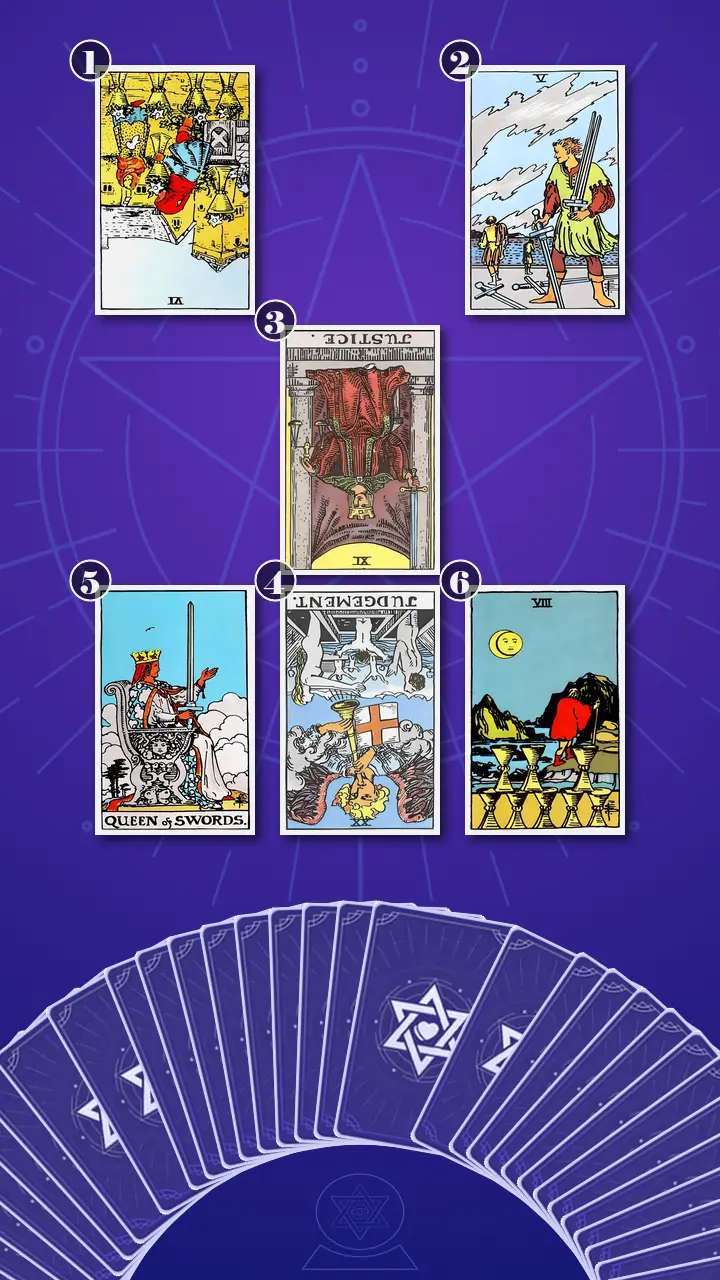
The Cards That Kept Returning Her to the Hallway
The Archived Thread and the Child's Cup
Now I was turning over the card for Alex's present emotional stance: reveal the observable pattern of rereading family exchanges, holding the past open, and waiting for acknowledgment, as shaped by Inner Child Fixation. It was the Six of Cups, reversed.
The child offering a flower-filled cup caught my attention first. The other cups stood behind the children, stored but still visible, while the old stone building held the scene in an earlier time. In modern life, this was Alex at 8:47 p.m. on Sunday, rereading the same archived family exchange and editing an unsent boundary as though the right wording could recover an earlier emotional promise: that when something hurt her, her family would notice, believe her, and repair it. The reversed card placed that memory in the present-position slot, where remembering had become a gatekeeper for today's decision.
This was contracted Water, turned backward toward childhood history. The blockage was not that Alex remembered too much or loved too little. It was that the old emotional contract remained active every time a birthday invitation, shared photo, or group-chat update appeared. The flower-filled cup resembled another carefully composed explanation offered back to the past. The cups behind the children resembled the screenshots and memories she kept as unfinished emotional business. I invited her to ask, 'If I look one more time, maybe I will find the sentence that changes what the past means. What decision am I postponing while I look?'
Alex gave a short, bitter laugh. 'That is too accurate. Almost cruel.' I let the silence remain kind rather than turning her reaction into proof. Her thumb rubbed the edge of her phone, her jaw tightened, and then her shoulders lowered by a fraction. I said, 'The card is not telling you to erase the past or abruptly block every reminder. It is showing how reopening the same exchange can make a present boundary wait for an old scene to be repaired.'
The Argument That Could Not Become Repair
Now I was turning over the card for the observable relational field: show how present family interactions communicate conflict, defensiveness, distance, or repair, without claiming to know the family's private thoughts or guaranteeing a particular outcome. It was the Five of Swords, upright.
The central figure gathered several swords while two figures walked away beneath a gray, unsettled sky. The image gave shape to the modern scenario Alex knew well: she sent a carefully reasoned message, received a defensive reply disputing one detail, and spent the evening constructing a better response. Even if she proved the disputed point, nobody felt repaired. She was simply more activated than before. This was excess Air, sharp and overextended, turning contact into a contest over whose version counted.
I kept the interpretation observable. I did not need to call anyone cruel, incapable, or permanently unwilling to change. I asked what actually happened after Alex named her experience: denial, silence, a topic change, defensiveness, curiosity, or respect. The Five of Swords showed the aftermath of an exchange in which winning a point could still leave everyone diminished. Her carefully drafted message was not failing because it lacked intelligence. It was being asked to create repair in a field where the conversation repeatedly became a debate.
Alex placed her phone screen-down on the table. 'I keep thinking there must be one version they cannot dismiss,' she said. I watched her look toward the window, as if the wet street might offer a neutral witness. I told her, 'The question is not whether you can produce a stronger argument. The question is what level of contact lets you remain truthful to yourself when the argument does not create accountability.'
The Private Courtroom of Reversed Justice
Now I was turning over the card for the central closure lock: expose how the Betrayal-Closure Lock turns accountability into an external courtroom and makes Alex's right to step back depend on the family's admission. It was Justice, reversed.
Alex's Notes app had become a legal brief. Dates, quotations, screenshots, and possible witnesses sat beneath a neutral title such as Timeline, because a neutral title made the emotional weight easier to carry. The scales became her repeated weighing of evidence. The upright sword became the argument she kept sharpening for a court that could not reliably grant the recognition she wanted. Reversed Justice showed an imbalance in authority: the family's verdict had been assigned the power to measure her memory, her worth, and her right to respond.
This was the major blockage, an externalized discernment loop. Alex knew what happened, then immediately asked whether someone else could still explain it away. I thought of a short film I once worked on as an artist. Our continuity log could establish which version of a scene had been filmed and protect the integrity of the edit, but it could not make another actor admit that the scene had landed painfully. Evidence could clarify the record. It could not force a confession. I felt the old lesson return as I looked at the reversed scales.
Alex's breathing stopped first, just for a beat, and her fingers hovered above the phone as though another screenshot might rescue her. Then her eyes lost focus and moved across an invisible sequence of messages: the date, the wording, the reply, the silence afterward. Finally, a long breath left her chest, but it carried anger with it. 'I know what happened,' she said. 'But what if they can still explain it away?' I answered, 'Their admission is not the source of your right to respond. It may matter deeply, and you may still grieve its absence, but your boundary does not have to wait for a verdict from the people you are trying to observe.'
The Trumpet She Was Waiting to Hear
Now I was turning over the card for the acknowledgment still being awaited: identify the emotional meaning beneath the desired admission, especially the wish to hear that the betrayal mattered and that Alex was worth believing. It was Judgement, reversed.
The winged figure's trumpet became the notification Alex kept expecting. The figures rising with raised arms looked like the dramatic recognition she imagined would release the old story. Reversed Judgement did not guarantee a confession, and it did not tell us that one was impossible. It showed a delayed reckoning, a call to recognition that had been placed outside her own authority. Alex was not waiting only for factual agreement. She was waiting to hear, 'What happened was real, it harmed you, and you did not deserve to be dismissed.'
I described the kettle-boiling scene she had told me about. She would put her phone face down on the kitchen counter, check it three times before the water boiled, and wonder whether the next notification might finally contain something real. Her hand tightened around the mug. 'You can want the apology and stop organizing your life around its arrival,' I said. 'Those two truths can exist together. Wanting acknowledgment does not make you weak, and choosing a boundary does not erase the part of you that still wishes the family had responded differently.'
Alex's eyes shone, but she did not cry. She looked relieved for one second, then disappointed by the relief, as though even relief might be evidence that she was abandoning someone. I asked her to write the exact sentence she wanted to hear, without adding an explanation beneath it. When she read it back, the words were less about winning a factual dispute than about being told she mattered. The hidden need had become visible.
When the Queen of Swords Took Back the Blade
The Upright Sword and the End of the Trial
The room changed as I reached the fifth position. The radiator clicked once, and then the apartment seemed unusually quiet. Now I was turning over the card for the self-owned boundary: translate the transformation from external validation to clear discernment into a boundary Alex can state without using distance to force the family's confession. It was the Queen of Swords, upright, the bridge and catalyst of the spread.
The Queen's upright sword, raised hand, direct gaze, and butterfly-carved throne gave me the exact image I needed. Her clarity was not coldness, punishment, or revenge. In modern life, she was Alex replacing four paragraphs of evidence with one sentence: 'I am not available for conversations that deny what happened, so I will end the call if that begins.' She was naming what she had observed, what she could participate in, and what action remained hers if the pattern continued.
I used my Family Casting Analysis at this point. I was not assigning Alex's family a diagnosis or claiming to know anyone's motives. I was identifying the forced role Alex had been rehearsing inside the old family script: the Witness, part evidence keeper and part prosecutor, responsible for producing enough exhibits before the scene could be admitted. The role had made her competent at explaining pain and powerless at deciding what access she could offer.
I also used my Narrative Enmeshment Diagnosis, which asks whether an adult's personal story has been pulled into completing an older family plotline. I was not assuming a parent's intention. I was noticing the plotline Alex seemed to be carrying: keep the family room intact, keep explaining, and do not leave until everyone agrees the scene was fair. The Queen of Swords offered a different role. Alex could honor the younger self who needed to be believed without asking that younger self to negotiate endlessly for recognition.
Alex had spent Sunday night refining a message, woken with the same tight chest, and called the problem wording. Each draft tried to make denial impossible. The draft was carrying a boundary, a courtroom, and the hope that a perfect explanation would finally prove she mattered.
Stop treating family admission as the gate to closure, and use the Queen of Swords' upright blade to separate what you know from what you wish they would validate, then name the contact boundary that follows.
For several seconds, Alex did not nod. Her breath stopped halfway in, and her fingers curled against the edge of the table. Her gaze went unfocused, as if she were replaying every paragraph she had deleted. Then her shoulders dropped; one fist opened, finger by finger, and her eyes grew bright. 'But if I stop waiting,' she said, her voice suddenly carrying anger beneath the tremor, 'doesn't that mean I was wrong to wait?' I told her that waiting had been an understandable attempt to protect the meaning of what happened. It simply could not remain the condition for her next choice. She exhaled from somewhere deep in her chest, not with complete relief but with the dizziness of finding an open path where she had expected another locked door. I asked, 'Now, use this new view to remember last week. Was there a moment when knowing your own boundary was enough to make one small decision differently?'
That was the first movement from waiting for an external family verdict toward grounded self-trust and deliberate, reviewable distance. Closure changes when your truth stops returning to the family for approval. Your boundary is not a closing argument. It is a clear description of what you will participate in and what you will do when that condition is not met.
The Traveler Who Did Not Erase the Cups
Now I was turning over the card for closure through chosen space: show how Alex can practice stepping back and integrate grief without treating the card as a prediction or as a command to end contact permanently. It was the Eight of Cups, upright.
The cloaked figure walked away from eight stacked cups beneath the moon, with mountains ahead and uncertainty in the distance. The cups remained visible. Love, history, disappointment, and unfinished grief did not vanish because the figure moved. In present life, the card looked like Alex muting the family group chat for seven days, delaying replies by twenty-four hours, and observing what changed in her body and attention. It was chosen space, not a permanent estrangement command.
This was Water moving again, but no longer turned backward. The Queen's disciplined Air had given feeling a direction. I told Alex, 'Space can be information, not a sentence.' She could choose a contact experiment, review it, change it, or stop it. The point was not to test whether anyone chased her or apologized. The point was to learn what happened when her attention was no longer organized around monitoring for a confession.
Alex imagined the Saturday coffee-shop scene: winter light on the window, milk steaming behind the counter, her thumb hovering over the mute setting. Her chest tightened and her shoulders softened at the same time. 'I am not deciding forever,' she said. 'I am making enough room to hear what contact does to me.' I nodded. The sadness was real, but it was no longer being used as evidence that the space was wrong.
The One-Sentence Threshold
I read the six cards as one story. The reversed Six of Cups showed Alex facing an old emotional contract, returning to childhood memory whenever the present demanded a choice. The Five of Swords showed how current exchanges could become contests over whose version counted. Reversed Justice turned that contest into a private courtroom, and reversed Judgement made the awaited admission feel like a trumpet that had to sound before she could move. Then the Queen of Swords returned the blade of discernment to Alex. The Eight of Cups gave that clarity a reviewable direction.
The whole pattern was like putting a boundary behind two-factor authentication when the verification code was sent to the people whose response you were waiting to receive. Alex was not necessarily confused about what happened. She was treating family acknowledgment as the missing login permission. The cognitive blind spot was believing that a boundary had to be validated before it was legitimate. The key shift was from making family admission the condition for stepping back to documenting what she knew, naming a clear limit, and choosing contact according to present behavior and personal capacity.
I told Alex that the cards did not hand her a verdict about reconciliation, forgiveness, low contact, or permanent distance. They gave her a way to notice the difference between what she knew, what she wished the family would admit, and what she could do next. That distinction moved the story from repetitive longing through grief and anger toward a first, imperfect act of self-trust.
For the next steps, I gave her small experiments rather than a dramatic confrontation. Each one could begin privately, and none of them required her to disclose more than she wanted to disclose.
- Make the self-owned verdictSet a ten-minute timer in the Notes app one evening and create two columns titled 'What I Know Happened' and 'What I Wish They Would Admit.' Under the first, add one present-tense observation about current contact. Under the second, write the exact acknowledgment you long to hear. Keep the record private and do not turn it into a message.When the urge to add every screenshot arrives, stop at ten minutes. Put both feet on the floor if your chest or stomach tightens. The minimum version is one sentence in each column, and the exercise does not obligate you to confront anyone.
- Rehearse the out-of-character lineUse my Script-Flipping Rehearsal for three minutes in your apartment or on a private walk. Practise saying, 'I am not available for conversations that deny what happened, so I will end the call if that begins.' If direct contact feels safe and workable, use the sentence at the next low-stakes family call or gathering, then end the conversation without adding an evidence brief.The purpose is not to force a confession. If direct communication is unsafe or impractical, rehearse the line privately and enact it through a delayed reply, a declined invitation, or a muted notification. A brief boundary can be warm without becoming a debate.
- Try reviewable spaceChoose one seven-day contact experiment: mute the family group chat, wait twenty-four hours before replying, or take no calls after 8 p.m. Add a calendar reminder titled 'What did the space show me?' During the week, record what happened in your body, how much rehearsal occurred, and whether you had more capacity for work, rest, or friendships.Name the end date in advance so the experiment does not feel like a lifetime contract. Do not use the space to test whether anyone chases or apologizes. At the review point, you choose whether to continue, change, or stop.

A Quiet Proof on the TTC
A week later, I received a message from Alex while I was making coffee. 'I did the two columns,' she wrote. 'I muted the chat for seven days, and yesterday I waited before replying instead of trying to make my answer impossible to criticize. I still felt guilty, but I had enough attention left to take a walk after work.'
At a Saturday coffee shop, she turned off the family notifications and felt the quiet arrive. It was lighter, but not clean: she still missed the family she hoped to meet, and her thumb hovered over the muted thread before she put the phone back in her bag.
I thought of that as her first evidence, not evidence for a case against anyone, but evidence that her own observation could guide a choice. The Queen of Swords had not made the uncertainty disappear. She had helped Alex stop handing the pen back to the family every time she felt afraid of being misunderstood. In this Journey to Clarity, Alex remained the person who decided what the next scene would contain.
When your chest tightens over another ordinary family message, sometimes what hurts most is not only what happened, but the fear that leaving without their admission would mean you were never worth believing. The Six-card Relationship Spread · Context Edition cannot provide the family verdict, but it can help separate the old story from present behavior and turn insight into actionable advice.
If your own clear observation counted as enough for one small choice, what kind of space would you be curious to try this week: a seven-day mute, a delayed reply, or a quiet boundary that lets you leave the locked family hallway without pretending the room never mattered?