Why Rest Waited for Month-End: Testing a Stop Point Before Completion

Why Rest Keeps Waiting for the Month-End Target
I recognize the pattern when a manager, client, or teammate sends one more request during the final five workdays: Alex, a 28-year-old client success coordinator at a growing Toronto software company, keeps Slack open past the agreed stop time because logging off feels less like a boundary and more like admitting she did not do enough.
At 8:47 PM on a Tuesday in Alex's small apartment, I watched the laptop glow beside the couch as she refreshed the shared performance dashboard and dragged a planned dinner below the client follow-up list. Her phone was warm in her palm, the radiator clicked beneath the window, and her shoulders had climbed almost to her ears. The red metric had not changed, but her eyes kept returning to it.
She looked at me and said, 'Rest can wait until the number is green.' Then she asked the question that had brought her to my table: 'Why do I keep postponing rest to hit every month-end target?' She wanted to be reliable and keep her performance steady, but she also needed to stop before every target was complete. Her calendar had become a tug-of-war between proving she could carry the month and admitting that carrying it this way was costing her.
Her exhaustion was not an abstract mood. It was like a phone stuck at three percent battery while an invisible hand kept opening new apps: tight shoulders, dry eyes, restless evening energy, and heavy limbs when one month rolled into the next. I know that helplessness firsthand, the maddening feeling of wanting to move forward while every action seems to press harder against a wall.
I told Alex that I did not hear a lack of discipline in the room. I heard an internal rhythm falling out of sync under pressure. I wanted the cards to give us a clear, practical map of the pattern, not a verdict about her future. Together, we would begin a Journey to Clarity by separating unfinished work from the story her tired body had been forced to tell about her worth.

The Grid That Could Hold a Loop
I invited Alex to take one slow breath and name the question without trying to improve it. I shuffled gradually, letting the movement serve as a transition from the glowing dashboard to the table in front of us. There was nothing she needed to perform for the cards; the point was to make the problem specific enough to examine.
For this reading, I chose the Transformation Path Grid (6) · Context Edition, a six-card work-rest tarot spread for month-end work stress and work-rest balance. This structure fits because Alex was not facing one isolated decision. She was caught in a repeating loop: an unfinished target led to guilt, guilt led to longer hours, longer hours led to depletion, and depletion made the next month feel like proof that she had to push harder.
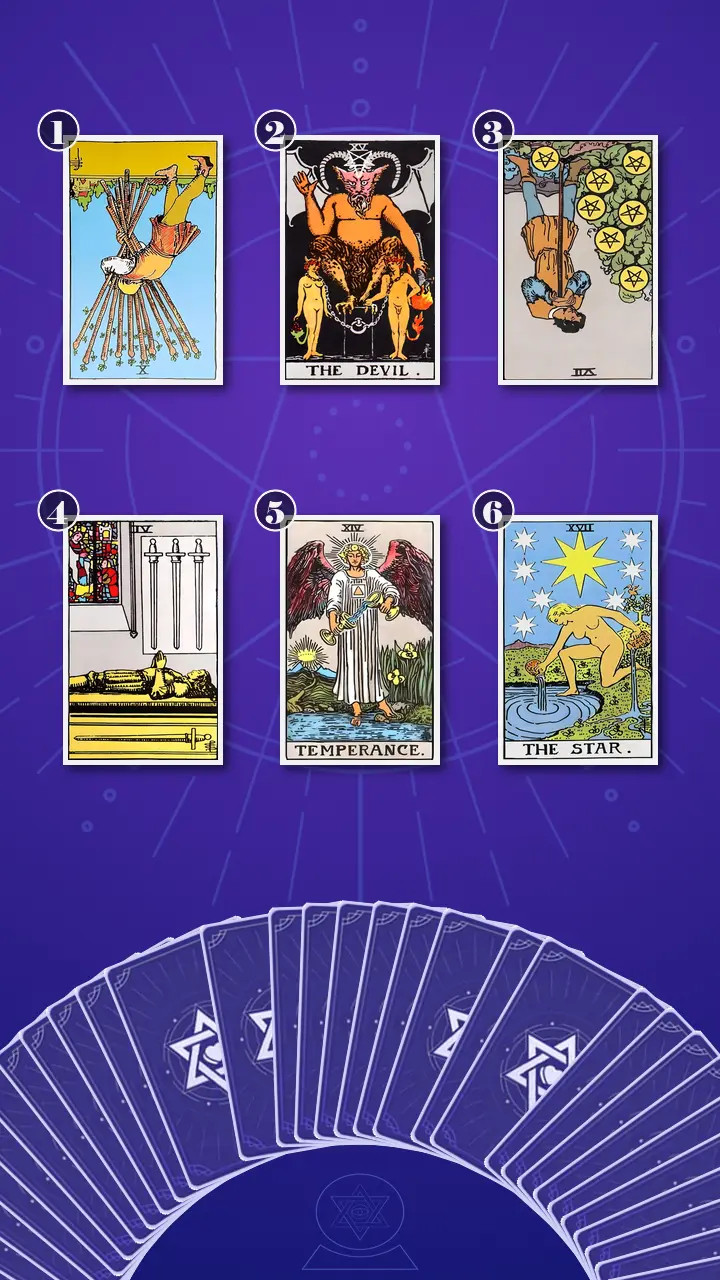
The top row would diagnose the loop. The first position would show the observable month-end pattern, the second would reveal the blocking rule that kept rest postponed, and the third would examine the underlying driver beneath the visible behavior. The lower row would turn toward change: the fourth position would identify a small interrupting pause, the fifth would translate the insight into actionable advice, and the sixth would show the integrating perspective Alex could test in the next cycle. The cards were reflective prompts rather than forecasts, and the final direction would remain hers to evaluate.
The Weight of One More Thing
The Wands Hiding the Evening
I turned over the card for the presenting condition: the observable month-end pattern of extended hours, delayed breaks, too many open tasks, and the contracted energy of the final workdays. The card was the Ten of Wands, in reversed position.
In the RWS image, a figure bends beneath a bundle of ten wands, the face hidden and the road ahead blocked, even though a town is visible in the distance. I read that blocked view in Alex's modern life as the laptop beside the couch, the dashboard open, and one more client request accepted after sign-off. Dinner and the evening walk were still technically on her calendar, but everything she was carrying personally had hidden the route to them.
The reversed energy showed an Excess of responsibility, a Deficiency of clear limits, and a Blockage in forward view. Responsible effort had tipped into self-imposed overload. Every new task looked small enough to carry, yet the bundle made it impossible to see which task was actually next and which could wait until the next work block. I asked Alex which responsibility could be paused, shared, or given a named stopping point before the dashboard turned green.
Alex did not nod. She gave a short, bitter laugh and rubbed the edge of her sleeve between two fingers. 'That is too accurate,' she said. 'Almost rude.'
I smiled gently. 'The card is describing the load, not judging the person carrying it. We can use it as an inventory. A burden becomes more workable when it has an owner, a next step, or an end to the work block.' Her fingers stopped worrying the sleeve, though her gaze stayed on the hidden face of the figure.
The Chain Behind the Green Metric
I moved to the card for the blocking loop: the force that kept rest postponed, especially the belief that output had to be complete before stopping was permitted and the temporary relief created by continuing. I turned over The Devil, in upright position.
The RWS figures are attached to the Devil's pedestal by loose chains. In Alex's workday, the chain looked like a red Salesforce or shared Google Sheets metric acting as a judge whose verdict refreshed every few minutes. A Slack notification arrived after the agreed sign-off, and Alex marked herself active again. Nothing physically forced her to keep working, so she could say, 'I can log off whenever I want.' But the repeated promise had narrowed which choice felt safe.
I named the rule plainly: complete the target, then earn rest; stop first, and risk proving that she lacked discipline or worth. The Devil's energy here was a Blockage created by attachment to a fear-based agreement. It was not a prediction of something bad, and it did not mean Alex was trapped forever. It showed how a choice can look voluntary while the same consequence is imagined every time. I asked, 'If you stopped now, what exact consequence do you believe would follow in the next five minutes?'
Alex went quiet. Her thumb hovered above her phone while the Slack badge blinked, then her eyes lost focus as if she were replaying several month-ends at once. Finally, she said, 'I am calling this a choice, but I already know what I am allowed to choose.' Her shoulders lowered by a fraction.
I let the silence stay kind and ordinary. 'That sentence is the useful discovery,' I said. 'We are not trying to shame your ambition or pretend workplace pressure is imaginary. We are finding the exact rule so you can decide whether it is a fact, a habit, or a bargain fear keeps renewing.'
The Harvest She Kept Digging Up
I turned over the card for the underlying driver: the Delayed Gratification pattern and the fear that incomplete performance could become evidence of lost worth. It was the Seven of Pentacles, in reversed position.
The RWS worker pauses beside a growing plant, hoe in hand, assessing the pentacles before the harvest is complete. I connected that pause to Alex leaning toward the monthly dashboard and judging an entire period by the numbers that had not yet turned green. She changed priorities, chased quick wins, and added late-night tasks because gradual client progress felt invisible until it produced a final metric. Refreshing the dashboard was like digging up a seed every ten minutes to check whether it had grown.
The reversed energy carried an Excess of impatience, a Deficiency of trust in gradual development, and a Blockage in fair evaluation. Alex was asking a developing result to provide an immediate harvest, then treating the missing harvest as a verdict. I asked which result she was judging as a failure simply because it still needed a next-care step.
She leaned back, looked toward the window, and pressed her palm against her stomach. 'I can be patient with a client account,' she said. 'I just do not trust slow progress when it is supposed to say something about me.' I heard the deeper fear underneath the metric, and I offered one sentence for her to keep: 'A target can be unfinished without becoming a verdict.'
The Pause That Did Not Change the Number
Four of Swords and the Planned Walk
I turned over the card for the key trigger: the smallest intentional interruption that could break the cycle before the final target was complete. The card was the Four of Swords, in upright position.
The RWS figure rests in a quiet chamber, with three swords mounted above and a stained-glass window adding a measured thread of light. I read the image as a deliberate maintenance window, not collapse and not escape. For Alex, it could be ten minutes with the phone and laptop in another room, a walk around the block, or a quiet seat by the apartment window before the final dashboard review.
The upright energy was Balance through intentional suspension. The unfinished data would remain exactly where it had been, but Alex's attention would no longer be pressed against the screen. I called the pause part of the work itself: 'The pause is not outside the work; it changes the conditions in which the work continues.' Then I offered her the line, 'Nothing is finished, but I am allowed to become unavailable for ten minutes.'
Alex's breath left her in a slow, audible stream. Her hand moved away from the imaginary phone, and she pictured the first block of her postponed evening walk. For the first time, she could imagine a pause that was defined, reversible, and hers, rather than a reward she had to earn or a disappearance she needed to defend.
When Temperance Blended the Calendar
The Two Cups on the Same Schedule
The room seemed to narrow around the next card. Even the radiator's clicking faded into the background as I turned over the card for actionable rebalancing: a concrete rhythm of effort, a protected stopping point, and a good-enough threshold. The card was Temperance, in upright position.
In the RWS image, an angel blends water between two cups, standing with one foot on land and one in water while a path leads toward distant mountains. I saw the practical translation immediately: one calendar block for the month-end target and another for a protected meal, walk, or offline pause. Neither need had to purchase permission from the other. The upright energy was Balance, expressed through proportion, adjustment, and integration.
I used my signature Tempo Misalignment Audit here. When someone describes pushing against a wall, I check whether their psychological and executive BPM are out of sync under pressure. Alex's ambition was running at a sprint while her daily capacity, after weeks of carrying every open task, was moving at a much slower beat. The wall was not a character flaw. It was friction between the pace she demanded and the capacity her actual evenings could provide.
I brought Alex back to 8:47 PM on that Tuesday: the laptop glowing beside the couch, dinner and the walk moved below a red dashboard, and her shoulders tightening as she promised once again that rest would begin when the number turned green. The loop had made completion feel like the only safe exit.
Stop treating completion as the permission slip for rest; use a measured rhythm of effort and pause, like Temperance blending two cups into a sustainable flow.
I let the sentence settle, then put the core message into even plainer language: Rest is not a prize you unlock after the target is complete. Pacing is part of pursuing the target without using exhaustion as evidence that you are disciplined or valuable.
Alex's fingers stopped above the phone. For one beat, her breathing disappeared and her pupils widened against the screen's red reflection. Then her gaze drifted past me, replaying the last three workdays: the cancelled dinner, the reopened laptop, the walk moved below another client request. A long breath finally left her chest. Her shoulders dropped, her fist opened against her knee, and her jaw loosened. A flash of anger crossed her face before her eyes grew wet. 'But if I stop before it is done, does that mean I got it wrong?' she asked. I heard the grief of having negotiated with the same rule for months, along with the relief of seeing its shape. I told her the effort was real; the bargain was the part we could test. Then I asked, 'Now, using this new perspective, can you recall a moment last week when this insight might have made the next choice feel different?'
She remembered a Tuesday night when a client reply had arrived at 9:18 PM and she had reopened the entire priority list instead of writing a handoff. The number had moved slightly upward, but the relief had lasted only until she noticed another metric. Her expression held both recognition and a small, unsteady grief. I did not ask her to celebrate. I asked what a ten-minute pause before that reply might have allowed her to see.
This was the first visible movement from guilt-driven month-end overwork and recurring exhaustion toward self-trusting effort-and-rest pacing. Temperance did not erase the targets or promise an easy next month. It gave Alex a way to hold ambition and recovery in the same plan and review the result without turning the experiment into a verdict on her worth.
The Star Beyond the Tracker
I turned over the final card for integration: how Alex could begin a new month with rest and self-trust already included, rather than waiting for perfect completion or exhaustion to authorize a reset. It was The Star, in upright position.
The RWS figure pours water onto the land and into a pool beneath one large star and seven smaller stars. I read the two streams as attention returned to both the work and the person doing the work. In Alex's life, that meant opening the new month's tracker with a realistic workload and a recovery rhythm already visible in the calendar, rather than letting a fresh list erase what the previous cycle had cost.
The upright energy was Balance moving toward renewal and openness. The Star did not promise a green dashboard, perfect performance, or immunity from month-end pressure. It offered a wider internal reference point: steady progress could count while it was still developing, and the dashboard could provide information without becoming Alex's only compass.
Alex looked from the Star to the blank space beside the cards. Her face was tired, but the tight line around her mouth had softened. 'I could start the next month without pretending the last one never happened,' she said. I heard possibility in the sentence, but also the careful vulnerability of someone who had just removed an old certainty and had not yet built a replacement.
The Written Stopping Point
I gathered the six cards into one story. The Ten of Wands showed the visible load: every open task carried personally, every break moved down the list, every evening narrowed by the next request. The Devil revealed the binding rule that made continued availability feel like freedom. The Seven of Pentacles showed the root: Alex was digging up gradual growth to demand an immediate harvest, then using the unfinished result as evidence against herself.
Four of Swords supplied the interruption. Temperance turned that interruption into a repeatable rhythm. The Star widened the view so a new month could contain both present capacity and future progress. Alex had been trying to pull open a flower before its season, forcing visible results and carrying the previous month's strain into the next one. The cards suggested tending the full cycle instead: effort, pause, review, and continuation.
The cognitive blind spot was not that Alex failed to care enough. It was that she treated pressure as evidence of care and exhaustion as evidence of discipline. She also gave the dashboard authority to answer a personal question it could never measure: whether she was valuable. The key shift was concrete: replace the rule that rest comes only after the target with a protected pre-deadline stop point and a written good-enough threshold for one monthly target.
For the practical part, I used my Execution Rhythm Calibration to locate the exact friction points where Alex's ambition was out of sync with her daily capacity: the open tracker, the last client follow-up, the missing handoff, and the meal or walk that disappeared whenever the metric stayed red. Then I offered my Syncopation Reset, a three-day tempo adjustment experiment that broke the forced routine into smaller, more harmonious beats. It was an experiment, not a new identity and not a promise that workload conditions would magically change.
I wrote the three beats on a clean page and kept each one deliberately small:
- Beat One: The pre-deadline pauseOn one of the final three workdays, schedule a 10-minute phone-free block before the last dashboard review. Put the phone and laptop in another room, take the first block of the planned Toronto walk, or sit by the apartment window. Notice three sensory details, then write one genuinely urgent task and one task that can wait.Call it an offline pause, not a reward. If ten minutes feels impossible, begin with five and make the exit cue visible.
- Beat Two: Put the load somewhereOn that same evening, list every open task on paper or in Notion. Choose one client follow-up that can be completed in 15 minutes, write its next action in one sentence, and send a concise Slack or email handoff stating what is done, what remains, and when it will be reviewed.The thought that a stopping point is irresponsible is part of the pattern. Test the boundary with one task instead of trying to redesign the whole month.
- Beat Three: Put two cups on the calendarAt the next weekly review, choose one monthly target and define a good-enough threshold in observable terms, such as all priority-one accounts contacted. Add a protected 20-minute meal or walk and one written sign-off time beside that target, then test the plan for one reporting cycle.Decide the stopping point before fatigue arrives. Review what happened afterward, but do not turn the result into a verdict on your discipline or worth.
I reminded Alex that a manager's expectations, staffing, rent, and client realities still mattered. A private mindset change could not solve an unreasonable workload by itself. What she could do was make one boundary observable, communicate the next step, and collect honest information about what changed when rest entered the plan before completion.

A Week Later, the Quiet Proof
Four days later, Alex texted me: 'I took the ten-minute pause with the dashboard still red and sent the handoff.' The next morning, 'What if I'm wrong?' still appeared. She smiled, drank her coffee, and left the laptop closed for ten minutes.
That was the first evidence, not that her life had been solved, but that the old permission loop was no longer the only available rhythm. Alex had chosen the experiment. The cards had supplied images and questions; she had supplied the boundary, the communication, and the decision to evaluate effort without making exhaustion testify on behalf of her commitment.
For anyone trying to understand how tarot can help with month-end stress, the six-card Transformation Path Grid offers a reflective route from overload to pacing: name the burden, identify the binding rule, notice the impatient harvest, protect a pause, define a good-enough threshold, and carry self-trust into the next cycle. That is finding clarity as a practice, not waiting for a perfect metric to grant it.
When the tracker stays red and your shoulders lock, it can feel safer to keep moving than to risk discovering that stopping before the target says something about your worth. That feeling deserves curiosity, not a verdict.
If rest could sit beside the unfinished number without having to defend your discipline, what is the smallest two-cup moment of that possibility you can imagine this month?