When Privacy Feels Like Rejection: Asking for Connection, Not Access
When a Closed Door Sounds Like Rejection
“When they say private, I hear not you.” Maya said it at 10:40 on a Tuesday night, sitting in the blue light of her phone in a shared Toronto apartment. Her partner had asked for one hour alone and closed the bedroom door. Through our video call, I could hear the refrigerator humming and faint TTC noise leaking through the window while her fingers hovered over three versions of the same follow-up question.
The phone looked warm against her palm. Her shoulders had climbed toward her ears. She had already checked the online indicator twice, even though she knew it could tell her only that her partner was online, not what the relationship meant.
“I know asking again makes it worse,” she told me. “But not asking feels unbearable. If we are close, why should there be things I cannot know?”
Maya spent her workdays as a hybrid UX designer, interpreting partial Figma comments, Slack dots, and feedback that arrived without enough context. That professional reflex followed her home. An unanswered message became an unfinished field her mind felt compelled to complete. Fear of rejection moved through her like a smoke alarm reacting to toast: the sound was real, loud, and physical, but it could not identify the source or prove the house was burning.
I could hear the contradiction clearly. She wanted secure closeness with her partner, yet ordinary privacy felt like personal rejection. She was trying to protect connection through repeated questions, digital checking, and demands for certainty, even as those moves made the room feel less safe for both people. It was the privacy-as-rejection loop in its most recognizable form.
“I am not going to tell you that your need for reassurance is wrong,” I said. “I also will not use tarot to decide that your partner is secretly withdrawing. I want us to separate what happened from the story your alarm attached to it. Let us give this fog a map and find the part of the next scene that you can actually write.”
Choosing the Bridge: A Six-Card Relationship Spread
I asked Maya to put both feet on the floor and take three ordinary breaths. I shuffled slowly while she held one question in mind: “Why do I keep treating my partner's privacy like rejection?” The breathing and shuffling were not mystical tests. I used them as a deliberate transition from reacting to observing.
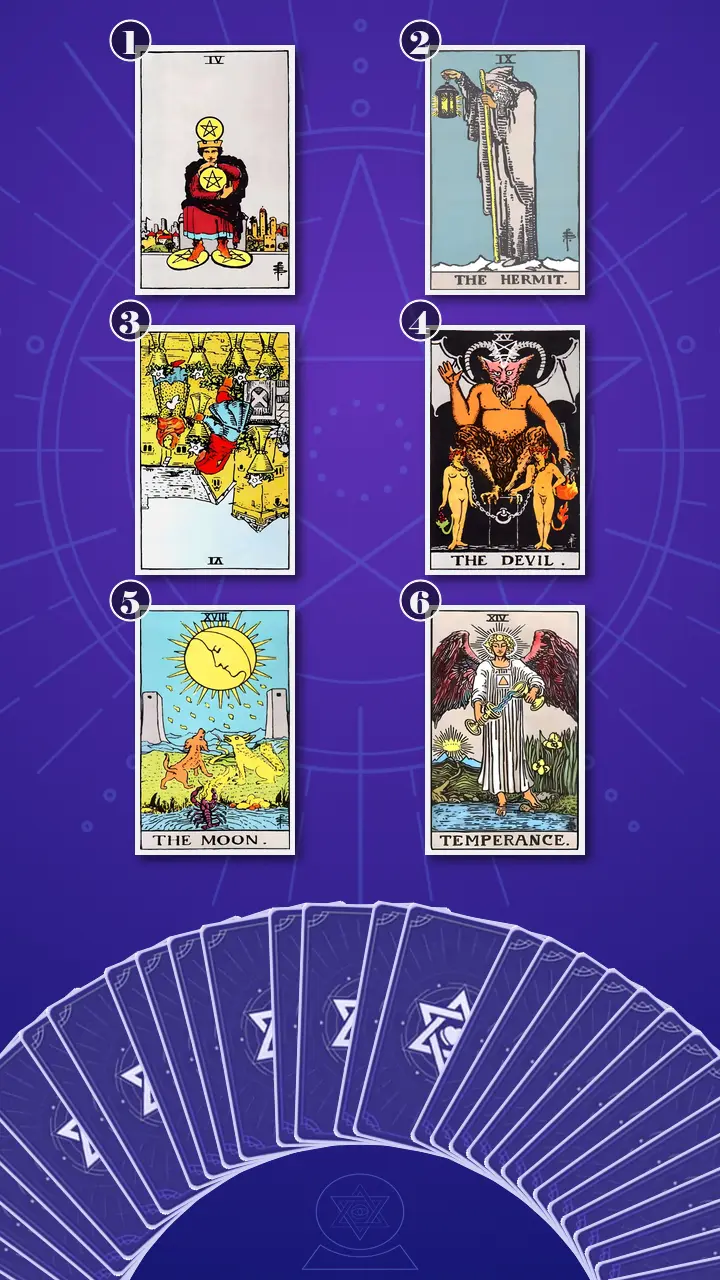
I chose a six-card Relationship Spread arranged as a three-row grid. For anyone wondering how tarot works in a relationship reading, I treat the cards as a symbolic map of interpretations, behaviors, and available choices. I do not treat them as surveillance equipment for another person's private thoughts.
This spread suited Maya's question because it could follow one clean chain: her observable stance, her partner's stated boundary, the earlier emotional material beneath her reaction, the interaction loop happening now, the central blind spot, and a constructive way forward. A ten-card Celtic Cross would have added more material than the question required. Six positions were enough to map privacy, reassurance seeking, projection, and boundary-aware intimacy without pretending to know what Maya's partner had not said.
The upper pair would show grip and space. The middle pair would reveal memory and compulsion. The final pair would place fear-based interpretation opposite integration. Visually, the spread resembled a bridge built in three spans: two people at the entrance, the repeating mechanism in the center, and a negotiated crossing at the far end.
Grip and Space in the Same Apartment
Position 1: The Hand Around the Phone
I began with the position representing Maya's observable stance when privacy was activated: the repeated reassurance seeking, information checking, and attempt to make closeness secure through certainty. I turned over the Four of Pentacles, upright.
The figure pressed one pentacle against the chest while pinning two more beneath the feet. I asked Maya to notice the posture before assigning any moral meaning to it. The body on the card was not casually holding something valuable. It was braced around it.
“This is the 10:40 scene,” I said. “Your partner has clearly asked for one hour alone. You keep the boundary conversation open, check the online indicator, and draft another question because one more detail promises to settle your chest. Your need for security is valid. The card is questioning the grip you use to obtain it.”
I read the upright Earth energy here as an excess. Security had contracted into control. The phone, the timestamp, and the missing detail had become relationship permissions that Maya wanted set to full access, as though one locked folder meant the entire account was being closed.
“What reassurance do you actually need before the request turns into another investigation?” I asked.
Maya did not nod. She gave a short, bitter laugh and looked away from the screen. “That is too accurate. Kind of brutal.”
I let the silence hold for a moment. “The image is direct, but I am not using it to shame you. A protective strategy can make sense and still have a cost. Access can feel like safety without actually creating security. We are looking for a different strategy, not putting you on trial.”
Her jaw shifted. One hand remained around the phone, but the other opened on her knee.
Position 2: The Lantern Behind the Door
Now I turned the position examining the partner's stated request for privacy and observable boundary behavior, without claiming access to hidden motives. The card was The Hermit, upright.
I pointed to the solitary figure holding a lantern forward on a snowy height. The figure was alone, but not erased. The lantern suggested intentional reflection, not automatic emotional disappearance.
“In your apartment, the observable sentence is, ‘I need an hour to think, then I can talk,’” I said. “The Hermit asks us to work with that stated boundary. Solitude may help someone hear their own thoughts before returning to a difficult conversation. It is not proof of that motive, and it is not proof of rejection either. The honest next move is clarification, not mind-reading.”
The Hermit's energy looked balanced in this position: enough withdrawal for self-contact, with a lantern that still implied orientation and eventual communication. I made the ethical distinction explicit. Privacy is not automatically healthy, and it is not automatically suspicious. Its meaning has to be understood through observable conduct, consent, consistency, and negotiated agreements.
“What has your partner actually asked for?” I said. “And what could you request without requiring the private content?”
Maya looked at the closed door behind her. “They usually do tell me how long they need,” she said more quietly. “I just stop believing the time means anything once I feel shut out.”
I watched her eyes return to the lantern. The first distinction had landed: a boundary could be real without being a verdict.
When Today's Door Opens an Older Archive
Position 3: The Six of Cups Reversed
Now I turned the position identifying the familiar emotional template beneath Maya's reaction, including the earlier meanings being replayed in the present. I revealed the Six of Cups, reversed.
The flower-filled cups belonged to a familiar courtyard, a place where old emotional material could feel almost indistinguishable from home. Reversed, the card showed Water caught in a blockage: memory was not simply informing the present; it was flowing backward into it and adding its weight.
“When your partner says, ‘I am not ready to share that private conversation,’ your mind opens every earlier folder marked distance, unanswered message, friendship, or exclusion,” I said. “The present boundary becomes responsible for the whole archive. That is why your body's reaction can be much larger than the sentence in front of you.”
I asked her to complete three lines aloud: “This happened now. It reminds me of ____. My body is reacting as if ____ is happening again.”
Maya swallowed before answering. “This happened now: they asked for an hour. It reminds me of times when I found out too late that people had already moved on. My body is reacting as if I am being quietly removed again.”
Her breathing paused. Her gaze slipped past the cards as though an old sequence were replaying somewhere beyond my screen. Then her fingers tightened around the phone and slowly relaxed.
I did not ask her to disclose more history than she wanted. The useful distinction was already visible. A current request had activated an earlier meaning, but resemblance was not identity. I invited her to make two short lists whenever this happened: What happened now and What this reminds me of. The first list would protect present evidence. The second would give the older hurt a name without forcing today's partner to answer for the entire archive.
Position 4: The Autoplay Argument
Now I turned the position mapping the present pursuit-tension-rejection loop, the mechanism through which Maya's attempt to prevent distance repeatedly helped create the tension she feared. The card was The Devil, upright.
I kept my voice level. The Devil was not a verdict that Maya, her partner, or the relationship was toxic. In this position, the card represented a binding pattern that felt compulsory even though some capacity for choice remained. The chains around the two figures were loose. That detail mattered more than the darkness around them.
“This is the moment when you know another question will probably sharpen the conversation, but you send it anyway because the urge for certainty feels stronger than your awareness of the consequence,” I said. “The first question brings a brief drop in alarm. Your partner becomes guarded. Their tension then looks like evidence that privacy was dangerous, so your hand reaches for the phone again. Trigger, question, relief, tension, fresh proof, repeat. It behaves like an autoplay playlist.”
The reactive Fire here was in excess, while choice had narrowed into a blockage. Maya's inner line was simple: “If I can get one more detail, I can calm down.” The relief was real, but it expired quickly enough to demand another confirmation.
This was where I used my Toxic Script Identification lens. I saw Maya being automatically cast as the Investigator and her partner as the Guarded Witness. The more the Investigator pressed for proof, the more the Witness defended the boundary. The more the boundary was defended, the more suspicious the Investigator felt. I told Maya plainly that the script was destructive; that did not require labeling either person as a destructive human being.
I then audited the dialogue itself. “I need privacy” became “You are excluding me.” “I have already answered” became “Your fear does not matter.” “Why will you not tell me?” placed the partner in a position where reassurance and surrendering private content began to blur together. Each phrase triggered the next role before either person could say what they actually needed.
Maya pressed her lips together. “I knew it would make things worse, but I still needed to ask.”
“That sentence is the loose chain,” I said. “You can see the pattern and still feel pulled by it. The available choice is not to become perfectly calm. It is to interrupt one link between feeling the trigger and sending the next question.”
The Moonlight on a Line 1 Window
Position 5: When an Information Gap Becomes a Verdict
Now I turned the position exposing the central blind spot: an information gap was becoming evidence of rejection before fact, fear, and the terms of the boundary had been separated. I revealed The Moon, upright.
The winding path continued between two towers under partial light. A dog and a wolf reacted beneath the moon while something unfamiliar rose from the water. I read the Moon as uncertainty intensified by an excess of projection and a deficiency of factual Air. The alarm was emotionally real, but the picture remained incomplete.
Maya described a Line 1 ride home after work. Her message had remained unanswered while her partner appeared active on Instagram. She had held a cold metal pole, watched the subway tunnel flicker in the dark window, and read the same iMessage five times. One observable digital cue had become a complete story about secrecy, declining commitment, and being replaced.
“Your rejection story works like an algorithm filling in missing data with the prediction it has made before,” I said. “Every refresh teaches the algorithm that this is the result you want to see. More scrolling strengthens the recommendation without making it more accurate.”
I noticed something structurally important in the spread: no Swords had appeared. We had contracted Earth, emotionally charged Water, and two kinds of Fire, the Hermit's lantern and the Devil's reactive flame. Nothing in the cards automatically supplied the Air of precise language and cognitive separation. Maya would have to introduce that element consciously.
I gave her three questions: “What do I know? What am I imagining? What do I need to request directly?”
“I know they were online,” she said. “I imagined they were choosing everyone except me. I needed to ask when we could talk, not who they were talking to.”
Her eyes widened slightly at her own distinction. A boundary is a fact about space, not automatic evidence about worth. I could see that sentence giving her something firmer than the online indicator to stand on.
When Temperance Rewrote the Closed-Door Scene
Position 6: Two Cups, One Way Back
The refrigerator hum on Maya's side of the call stopped just as I reached for the final card. The apartment seemed to grow quieter around the closed door. Now I turned the position showing how she could interrupt the repetition by negotiating privacy and reassurance as two valid needs, using specific requests while tolerating limited uncertainty.
I revealed Temperance, upright, the bridge card of the reading.
The figure poured water between two separate cups, with one foot on land and one in water. Nothing in the image demanded that one vessel disappear into the other. The stream connected them because they remained distinct. I read this as balanced energy: emotional flow supported by grounded agreements, patient self-trust, and reciprocity that respected consent.
“In ordinary life, this could look like a calm Sunday conversation at your small dining table,” I said. “Either person can ask for an evening alone. Private messages do not have to be disclosed. The person needing reassurance can ask for a short confirmation of care or a realistic time to reconnect. Temperance does not remove all discomfort. It gives both needs a shared structure.”
I asked her to return to 10:40: the door closed, the thread open, the indicator checked twice, and three questions waiting. She wanted closeness, yet the search for proof was beginning to create the distance she feared. The old script offered only two roles: inspect or be excluded.
At this bridge card, I used my Dialogue Loop Auditing skill again, this time to rewrite rather than merely diagnose the scene. I placed the old and new translations side by side. “I need an hour alone” no longer had to receive the subtitle “You are no longer chosen.” It could be answered with: “I can respect the hour, and I need a clear way back to contact.” “That conversation is private” did not have to become “My worth is under review.” It could be followed by: “I do not need the details, but I would appreciate reassurance about us.”
You do not need total access to prove that you are loved; ask for reassurance while allowing separate space, like Temperance keeping two cups in relationship without collapsing them into one.
For one beat, Maya stopped breathing. Her fingers remained suspended over the phone, and her pupils widened as though the three drafted questions had appeared in the air between us. Then her focus drifted from the card to the closed door. I could almost see her replaying each moment when she had treated private space as a courtroom and herself as the person waiting for a verdict.
Her first release was not relief. Her face tightened. “But does that mean I have been wrong every time? That I caused all of this?” Her voice rose, then thinned at the end.
“No,” I said. “It means a strategy designed to protect you has sometimes produced a cost you did not intend. Your fear does not become shame just because we can now see the loop. You are responsible for your next response, not guilty for having a nervous system that learned to sound an alarm.”
Her fist loosened one finger at a time. Her shoulders dropped, but the release left her looking briefly unsteady, as if putting down a heavy bag had revealed how tired her arm was. Her eyes reddened. A long breath left her chest with a slight tremor.
“Now, with this new view, think back,” I said. “Was there a moment last week when this insight might have made you feel different?”
“Thursday,” she said after a pause. “They said they could not tell me what a friend had shared. I did not need the conversation. I needed to know we were okay and when we would reconnect. I just did not know those could be separate requests.”
I nodded. That recognition marked the first movement from digital hypervigilance and repeated reassurance seeking to boundary-aware closeness that could include privacy and individuality. It did not solve the entire relationship in one sentence. It gave Maya a place to stand while making a different choice.
Giving the Relationship Its Missing Air
I read the whole spread as one continuous movement. The Four of Pentacles showed Maya clutching information to hold the relationship still. The Hermit showed that a partner's stated solitude could have a legitimate function without telling us anything secret about their motives. The Six of Cups reversed revealed the emotional archive entering today's room. The Devil mapped the pursuit-tension-rejection loop. The Moon showed an incomplete picture being filled with a familiar fear. Temperance offered the unused resource: a measured exchange between two people who did not have to become one open file in order to stay connected.
The cards moved visually from clutching, to chaining, to pouring. I thought of Maya's life as a film still in production. She had bravely remained in a painful closed-door scene long enough to believe it was the whole story. My task was not to coldly review the footage or predict the ending. It was to show her where the repeated script appeared and hand the pen back.
The cognitive blind spot was precise: Maya was treating the intensity of her body's alarm as evidence that her rejection interpretation was accurate. The transformation direction was equally precise. Privacy could become information to discuss rather than evidence to prosecute. She could ask directly for connection, hear a boundary without chasing it, and decide whether the couple's actual agreements met her needs.
Because the spread contained no Swords, I told her our actionable advice would deliberately add Air: facts, labels, exact requests, and language that did not confuse reassurance with entitlement to private content.
Maya looked doubtful when I mentioned a pause. “But those twenty minutes are exactly when it feels like I could lose everything,” she said.
“Then the pause cannot be a test you have to pass,” I replied. “It is a small experiment in choice. You can begin with two minutes, stop if the activation rises, and return only if you choose. The goal is not to prove you need nothing. The goal is to discover whether your next sentence can come from your actual need instead of the old script.”
The Facts, Story, Request Reset
- Pause the Online-Status LoopAfter your partner has given a clear answer or asked for private time, set a 20-minute timer and place the phone face down on the kitchen counter. Do not check active status, timestamps, story views, or draft narrower versions of the same question. When the timer ends, decide freely whether another message is still necessary.Start with a two-minute version if twenty minutes feels too activating. This is a voluntary experiment, not a rule you must perform perfectly.
- Write Fact, Story, RequestIn the Notes app, write one observable sentence under each heading: “Fact: they asked for one hour alone.” “Story: I am no longer chosen.” “Request: could we reconnect at 11:30?” Keep the request specific, optional, and separate from any demand to see private content.Use only one sentence per heading. If writing increases distress, put the phone in another room, take three ordinary breaths, and return later only if you want to.
- Rehearse the Pattern Interruption ScriptDuring a calm ten-minute window, role-play the known trigger once. Replace “Why will you not tell me?” with: “I respect that this is yours to keep private. My alarm is up, and I would appreciate knowing when we can reconnect.” Then invite your partner to offer a workable time or another form of reassurance.A reconnection point is not guaranteed access. Keep the agreement mutual and voluntary; either person can suggest a different time, and both people retain the right to decide what communication arrangements they can accept.
I called the last practice the Pattern Interruption Script because it changed the scene at the exact line where both people usually fell into their automatic roles. Maya did not have to improvise a new relationship philosophy while her chest was tight and her hand was reaching for the phone. She needed one rehearsed sentence that asked for closeness without turning a private room into a crime scene.

Four Days Later: The Quiet Proof
Four days later, I received a message from Maya. Her partner had asked for time alone after work. Maya had put her phone face down, written three lines in Notes, and sent one request: “I do not need the details. Could you let me know when we can reconnect?” Her partner suggested midnight. Maya let the answer stand.
She told me the closed door still made her chest tighten. She checked the timer once, but not the online indicator. At midnight, they talked about their relationship rather than the private conversation. Nothing had become perfectly easy, and no card had guaranteed an outcome.
She slept through the night. Her first thought in the morning was still, “What if I got it wrong?” She smiled, made coffee, and did not reopen the chat.
I read that as the quiet proof of our Journey to Clarity. The cards had not created the change. Maya had noticed the old script, tolerated a small amount of uncertainty, and chosen a line that protected both connection and privacy. The pen was in her hand.
When a closed door makes your chest tighten and your hand reach for the phone, I hope you remember that you may be trying to protect your place in the relationship while fearing that the search for proof will leave you feeling even less chosen. Simply noticing that translation gives you a moment in which the next scene is not yet fixed.
If privacy could remain one Temperance cup while closeness kept a clear stream flowing back to the other, what would one small request for reassurance sound like in your own voice?