Interrupting the Borrowed-Success Loop With a 24-Hour Pause and Pilot

At 7:42, the Borrowed-Success Loop Opened Another Tab
I know this version of the Sunday Scaries: finishing a quarterly target, opening a promotion tracker before relief lands, and wondering whose finish line you are following.
Jordan, a 29-year-old Toronto product operations manager, joined my video call at 7:42 p.m. Rain tapped her apartment window; her laptop fan hummed beside a cold coffee. On-screen, she duplicated last quarter's green Notion page and renamed it “Director Track.”
She completed the target. She barely let herself register the flatness. She opened a new tab and chose a harder target.
Then she looked at me. “I keep calling it ambition, but I think I'm trying to make the last achievement worth it by chasing a bigger one. The next win is easy to defend in public; wanting it is harder to verify in private.”
I watched her jaw lock while one shoulder shifted restlessly toward her ear. Her palm settled over the weight behind her sternum. What she called disconnection seemed to fit her like a beautifully tailored coat lined with wet concrete: impressive from across the room, exhausting to carry from the inside.
“I know this is a good opportunity,” she said. “So why does accepting it feel like disappearing? And if I stop chasing it, what exactly do I have to show for all that effort?”
I heard pressure in the first question, grief in the second, and guilt underneath both. I also heard logic. Prestige had given her structure, income, credibility, and options. The problem was not that those things were shallow. The problem was that she had started treating them as proof that every next rung must still belong to her.
“You aren't failing to be grateful,” I told her. “The achievement may simply be answering a question you no longer ask. I won't use the cards to tell you to accept, decline, quit, or stay. Let's use them to make the pattern visible, separate real constraints from inherited assumptions, and draw a map through this fog.”

Choosing the Shadow Spread: A Map for the Scoreboard
I asked Jordan to take one slow breath and hold only the question, “Why do I keep pursuing wins that no longer feel like mine?” I shuffled while she closed the dashboard. The pause was not a mystical performance; it was a clean psychological transition from reacting to observing.
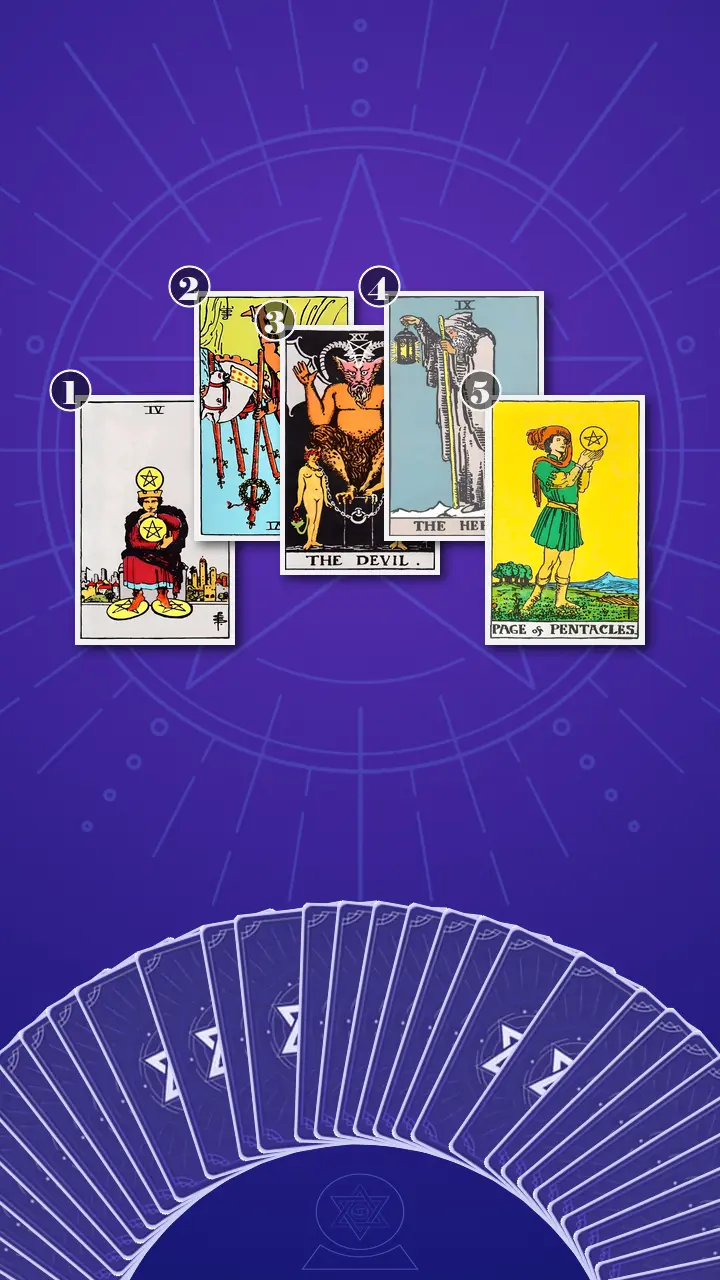
I chose The Shadow Spread, a five-card tarot spread designed to examine a visible behavior, its hidden driver, the attachment beneath it, the inner resource that can meet it, and one grounded next step. A ten-position spread would have widened the inquiry into areas we did not need. This five-card arc kept us close to the identity-level mechanism behind achievements that feel empty.
This is how tarot works in my practice: the images move an internal argument onto the table, where both of us can inspect it. Card meanings in context are reflective prompts, not forecasts. The deck would not make Jordan's career decision. It would help her notice which assumptions had been making the decision before she arrived.
I placed the cards in a shallow inward-facing arc. The first would show the visible pattern of replacing one win with another. The center card would identify the core attachment that made stepping away feel dangerous. The fourth would act as an inner compass, and the final card would turn that clarity into a small, observable experiment.
Reading the Grip Before the Chain
The Visible Pattern: Four of Pentacles Upright
Now I turned over the card representing the visible pattern: the Four of Pentacles, upright.
I pointed to the seated figure's closed posture, the coin pressed against the chest, and the two coins pinned beneath the feet. A city waited in the background, but the figure could not move toward it without loosening the arrangement that looked like security.
The energy here was Excess: too much protection, too much control, and too much identity weight placed on what had already been gained. The achievement itself was not the problem. The grip had become so contracted that preserving proof was blocking fresh choice.
In Jordan's life, the card looked almost embarrassingly literal. She kept completed promotion criteria pinned at the top of her Notion dashboard and built the next level directly on top of them. Removing the ladder felt less like editing a page and more like deleting years of discipline.
I gave the grip its inner voice: “I know I'm allowed to reconsider, but if I loosen my grip, then maybe the previous work meant nothing. Maybe I lose the version of me everyone understands.” The card was contrasting security with movement, and preserving proof with preserving agency.
Jordan let out a short laugh, but there was no amusement in it. Her fingers curled around the cold mug, her eyes dropped to the coins, and then her jaw tightened again. “That's so accurate it feels a little brutal,” she said. “I literally keep that page pinned because archiving it would look like giving up.”
I did not try to turn that recognition into a verdict. “Then we don't archive it tonight,” I said. “We only ask a cleaner question: which part of the goal are you protecting, and what one boundary would let you pause without surrendering your agency?”
The Hidden Driver: Six of Wands Reversed
Next I turned over the card representing the hidden driver beneath that grip: the Six of Wands, reversed.
The upright image is a victory parade: a laurel-crowned rider, a raised wand, and a crowd witnessing success. Reversed, its Fire became Blocked. Recognition still arrived, but it did not settle into stable confidence. The applause could reach Jordan's screen without reaching the part of her that needed ownership.
I asked her to return to the end of her last performance review. Slack praise was still warm on her phone when she boarded Line 1. Then the cold blue light of LinkedIn showed a former classmate's director announcement, and comparison overruled the review before the train reached Bloor-Yonge.
“I got the thing,” I said, giving the card its modern inner monologue, “so why am I already checking who got something bigger?”
Jordan exhaled through her nose and rubbed one thumb over the edge of the mug. “Five minutes,” she admitted. “Maybe less.”
“You are not failing to feel grateful,” I told her. “The achievement may simply be answering a question you no longer ask. Wanting recognition is human, and useful feedback still matters. This card is not asking you to reject praise or hide your work. It is asking why comparison has become more authoritative than your experience of doing the work.”
I let the image of the crowd remain between us. “Which of your current goals would still matter if nobody could see the result, praise it, or turn it into an announcement?”
Her first answer did not arrive. That silence mattered more than a polished one would have.
The Chain With a Cancellation Setting
The Core Attachment: The Devil Upright
Now I turned over the card representing the core attachment: The Devil, upright.
I always handle this card plainly. It is not a prediction of punishment, danger, or permanent entrapment. I showed Jordan the two figures, the elevated presence above them, and, most importantly, the loose collars around their necks. The image asks where an attachment has started to look more absolute than it is.
The energy here was an Excess of conditionality creating Blockage: one more title, then she could reconsider; one more salary marker, then she could ask what she wanted; one more visible win, then every sacrifice would finally be justified.
I described the Thursday-night version of the card. Jordan drafts a message declining another prestige project. She reaches the sentence explaining why, imagines her colleagues interpreting the choice as a lack of ambition, deletes the draft, and promises herself she can reconsider after the next review cycle. The deadline, salary implications, and workplace expectations are real. The bargain that her past only matters if she keeps producing public proof is assigned meaning.
The loose chain brought me back, briefly, to my years on Wall Street. On a trading desk, the most dangerous line in a weak position was often some version of, “We have already put too much into this to stop.” Capital already spent could explain the past, but it could not improve the future risk-reward structure. I remember thinking how easily a historical fact could disguise itself as a forward obligation.
I call the lens I used with Jordan Sunk Cost Neutralization. It does not erase time, money, emotion, or effort. It separates those investments from the opportunity cost of the next commitment. Her previous work could remain valuable as income earned, skills built, relationships formed, and evidence of capacity. None of that required her to purchase another rung she did not want.
“A chain can be partly real and still be looser than the story built around it,” I said. “What does the next title promise to protect you from believing about yourself?”
Her breathing paused. Her hand stopped moving around the mug. Then her gaze drifted away from the card as if she were replaying several late-night planning sessions at once. “That I wasted my twenties building the wrong thing,” she said quietly. “And maybe that I don't have value without the next thing.”
“Changing your interpretation of the route does not delete the miles you walked,” I replied. “It changes what those miles are allowed to mean now. Your past can become experience rather than a creditor.”
When the Hermit's Lantern Replaced the Stadium Lights
As I reached for the fourth card, the rain against Jordan's window softened. She turned her phone face down, and the desk lamp made a small circle of light beside her closed laptop. The room seemed to narrow from dashboards, Slack pings, and LinkedIn announcements to one quiet surface.
The Inner Compass: The Hermit Upright
Now I turned over the card representing the inner compass and the reading's central bridge: The Hermit, upright.
I showed Jordan the lantern held close to the figure's body, the staff supporting each careful step, and the mountain disappearing beyond the available light. This was Balance: deliberate solitude without isolation, self-trust without certainty, and patience without passivity. The Hermit did not need stadium lighting. The lantern revealed enough ground for the next honest step.
In modern life, the card looked like one evening with career feeds muted, the performance dashboard closed, and a blank notebook in place of another optimization podcast. Jordan would not be abandoning ambition. She would be lowering the crowd's volume long enough to hear which kind of effort still held personal meaning.
At that point, Jordan was mentally back at Sunday night: the laptop humming beside cold coffee, her chest heavy, the blank Director Track field somehow easier to face than the question of whether she still wanted the route. She wanted the correct answer before allowing herself a pause.
I used my Asymmetric Risk-Benefit Analysis to reframe that pause. Eight private minutes had a tightly capped downside: no resignation, announcement, disclosure, or permanent decision. Its potential upside was structurally larger because one honest criterion could prevent months of overcommitment. By contrast, automatically accepting another prestige project offered immediate approval but created an open-ended cost in time, energy, and identity.
“The Hermit's lantern offers enough light for one honest step, not a complete five-year plan,” I said. “A goal can be ambitious and still be borrowed. The pause is where you find out whose standard you are living by.”
The Hermit does not ask Jordan to chase another public win for proof of worth; it invites her to carry the lantern inward and choose the next step by a personally meaningful light.
I stopped speaking. The quiet after the sentence felt different from the quiet after the Six of Wands. It was not blank. It was making room.
Jordan's breath stopped first; her fingers remained suspended above the trackpad as if her body had frozen before her mind could catch up. Then her focus slipped beyond the screen. Her pupils widened, and I watched recognition move across her face while she replayed the Monday meeting in which she had said yes before the screen share ended. Her jaw released by a fraction. Moisture gathered along her lower eyelids. Finally, a breath rose from deep in her chest and left with a faint tremor. Her shoulders dropped, and both palms unfolded on the table. For a second, however, the release turned into anger. “But doesn't that mean I got all of this wrong?” she asked, her voice sharper than before. “That I spent years succeeding at somebody else's life?”
I did not rush to smooth away the anger. “No. It means a route that once gave you stability may no longer deserve automatic renewal. Earlier choices can have been intelligent for the person you were and still be open to review by the person you are. Updating your criteria is not a confession. It is authorship.”
I leaned toward the screen. “Now, with this new perspective, think back: was there a moment last week when this insight could have made you feel different?”
“The stretch assignment,” she said after a pause. “I thought my only options were to say yes and stay ambitious, or say no and look uncommitted. I could have asked for a day. I could have asked what the actual work would be.”
That was the pivotal movement in the reading: not from uncertainty to perfect confidence, but from achievement numbness and comparison pressure toward one act of self-trust. Jordan had not solved her career. She had begun moving from external proof to personal meaning, with enough discernment to let a chosen pace replace public urgency.
One Pentacle Instead of a Rebrand
The Grounded Experiment: Page of Pentacles Upright
Finally, I turned over the card representing the grounded experiment: the Page of Pentacles, upright.
The Page studies one pentacle with open attention. A cultivated field lies underfoot; distant mountains remain visible, but the figure is not trying to claim them all at once. The card returned the reading to Earth in a more spacious form. The Four had gripped several coins as proof. The Page examined one coin as information.
The energy was Balance through grounded curiosity. Jordan did not need to publish a career-pivot announcement, choose a new identity, or replace one grand plan with another. She could select one small systems project, give it a private work session, and observe whether the process held her attention, felt meaningful, and seemed sustainable.
“Do not announce a new identity,” I told her. “Run a small experiment. Open one project ticket, not a launch campaign for the new you.”
Jordan's mouth softened into the first unguarded smile of the session. She opened a plain notes page rather than the Director Track dashboard. “I can test whether something feels like mine before I turn it into another scoreboard,” she said.
“Exactly. Starting small is not evidence that the desire is unserious. It protects the experiment from having to perform before it has taught you anything.”
The Lantern Criterion and a 72-Hour Third Path
I drew the five cards together into one coherent story. Past effort had become something Jordan guarded. Because public recognition expired quickly, she reached for a larger target to restore the feeling of being on track. The Devil exposed the bargain underneath: if she stopped, she feared the work behind her would lose its meaning and her worth would become harder to prove. The Hermit changed the source of direction, and the Page offered a way to test that direction without making another prestige-sized promise.
The spread began and ended with Pentacles, so material effort, security, work, and tangible proof framed the whole journey. The reversed Fire of the Six of Wands showed motivation captured by comparison. Cups and Swords were absent, which reflected what Jordan's planning language had crowded out: directly naming how success felt and clearly defining the personal criterion by which a goal deserved her effort.
The core metaphor was a navigation app that kept rerouting her toward an old destination after she had begun questioning whether she wanted to arrive there. Her cognitive blind spot was treating previous investment as a mandate for future investment, while using increasingly sophisticated analysis on options she had never evaluated against her own values.
The transformation direction was precise: shift from using the next visible win as proof of worth to using a personal values check and a small experiment to decide which goals deserved continued effort. Jordan could keep ambition, money goals, and professional credibility. She could also add felt ownership and chosen limits to the decision matrix.
Two Small Tests for a Career-Sized Question
I wanted the actionable advice to remain smaller than the question, so we chose two practices that produced information without demanding certainty.
- The Eight-Minute No-Audience Check On one evening this week, sit at a quiet table, put the phone in another room, and set an eight-minute timer. Write the next visible win at the top of a blank page. Complete three lines: “If nobody knew, this would still matter because...”; “The part of the process I genuinely want is...”; and “A limit that would keep this choice mine is...” Circle one answer. Do not make a final decision that night. Tip: If eight minutes feels exposing or unrealistic, write only the goal and one honest sentence. Stop if the exercise becomes overwhelming. The purpose is to notice one criterion, not solve an entire career.
- The 3rd-Option Leverage Test Use the next 72 hours to challenge the false binary between Option A, accepting the prestigious path unchanged, and Option B, rejecting it or making an immediate pivot. First, list what each option protects, costs, and assumes. Then design a reversible Option C: ask for 24 hours, clarify the day-to-day scope, propose a narrower version, book one honest conversation, or run one 30-minute private task. After the test, rate attention, meaning, and sustainability from 1 to 5. Tip: Keep the experiment unannounced and check any genuine workplace deadline before requesting time. If 30 minutes is too much, use 10 minutes or one question. Stopping after the test is data, not a verdict on your character.
Neither practice required Jordan to quit, disclose more than she wanted, or reject useful recognition. They created leverage by delaying automatic commitment long enough for her own criteria to enter the room.

A Week Later: The Quiet Proof
Six days later, I received a message from Jordan. She had muted LinkedIn notifications, completed the eight-minute check, and circled the words “solving messy systems with people I trust.” When her manager followed up about the stretch assignment, she asked for 24 hours and requested a smaller pilot with clearly defined scope.
“I didn't quit, and I didn't automatically say yes,” she wrote. “I tested the part I thought I wanted. It held my attention. I still don't know whether I want the title, but now I know what question I'm actually answering.”
She added that she slept through the night, then woke with “What if I'm wrong?” as her first thought. This time she noticed it, smiled, and made coffee before opening her laptop.
For me, that was the quiet proof of our Journey to Clarity. The Shadow Spread had not rescued Jordan or chosen her future. It had made the borrowed-success loop visible enough for her to interrupt it. She supplied the honesty, set the limit, and took the next step. The authorship was hers.
When a good opportunity makes your jaw tighten and your chest go heavy, it can be frightening to admit that continuing may protect the meaning of your past effort while slowly making your present life feel less like yours. Even noticing that conflict means the old scoreboard is no longer operating without your awareness.
If nobody could see the result, what one-pentacle private beta would your own lantern still make you curious enough to try this week?