Finding Clarity in the 8:53 p.m. “Typing…” Pulse
If you’re a 20-something in a city like Toronto and an iMessage “typing…” bubble can wreck your nervous system in under ten seconds, you’re not imagining it—you’re living a micro-trigger loop.
Maya arrived at my café with her scarf still damp from late-winter slush, cheeks pinked by the wind off College Street. She chose the chair closest to the radiator like her body already knew it needed warmth. When she set her phone on the table, it landed with that too-careful gentleness people use when they’re trying not to show how much something matters.
“It’s stupid,” she said, but her voice didn’t match the word. “It’s literally… an iMessage bubble. But when it says typing… I stop breathing. Like—tight chest, hot face, everything. And when it disappears? I’m instantly rewriting my last text like I’m editing a legal document.”
Outside, a streetcar bell rang and a car splashed through a puddle. Inside, the espresso machine hissed and the air smelled like toasted sugar and dark roast. Maya kept her thumb hovering near the edge of her phone, not touching it, like it could bite.
“It feels like a test,” she added, eyes fixed on the blank screen. “If they’re typing and stop, I feel like I failed a test I didn’t know I was taking.”
I’d heard versions of this so many times—read receipts anxiety, “double texting discourse,” the shame that comes with wanting connection while trying to look effortless. But Maya’s panic had a specific texture: the kind that turns a normal pause into a verdict. The typing bubble turns a conversation into a performance review.
I watched her shoulders creep upward as she talked, as if bracing for impact. Her panic wasn’t an idea—it was physical, like trying to swallow with your throat halfway closed.
“Nothing about this is stupid,” I told her. “Your body is responding to uncertainty like it’s danger. Let’s make it less mysterious. We’re going to map the pattern—then we’ll find the exit. This is a Journey to Clarity, not a trial you have to pass.”

Choosing the Compass: The Transformation Path Grid (6)
I poured Maya a small cappuccino and kept mine as a straight espresso—my usual. The first sip is always a threshold: the moment the day narrows into something you can actually hold. I invited her to take one slow inhale through her nose, like she was smelling the coffee on purpose, not just drinking it while scrolling.
Then I shuffled my well-worn deck on the marble counter. Not as a performance—more like clearing a workspace. “We’re not here to predict what they will text,” I said. “We’re here to understand what happens in you when the screen gives you missing data.”
Today, we used a spread I call the Transformation Path Grid (6) · Context Edition. It’s a clean 2x3 grid—six cards that separate a fast loop into readable parts: the trigger, the mental script, the deeper wound… then the pivot, the practice, and the integrated outcome.
For a pattern as quick as “typing…” panic—cue → story → body spike → control attempt—six positions is the smallest structure that still gives clarity. It keeps us grounded in what you can actually change, without drifting into fortune-telling about someone else’s behavior.
“Here’s what to watch for,” I explained, more to you reading than to Maya. “Position 1 will show what the typing bubble activates in the first ten seconds. Position 3 touches the old rejection wound underneath. And Position 4—our turning point—shows the inner capacity that interrupts the loop in real time.”
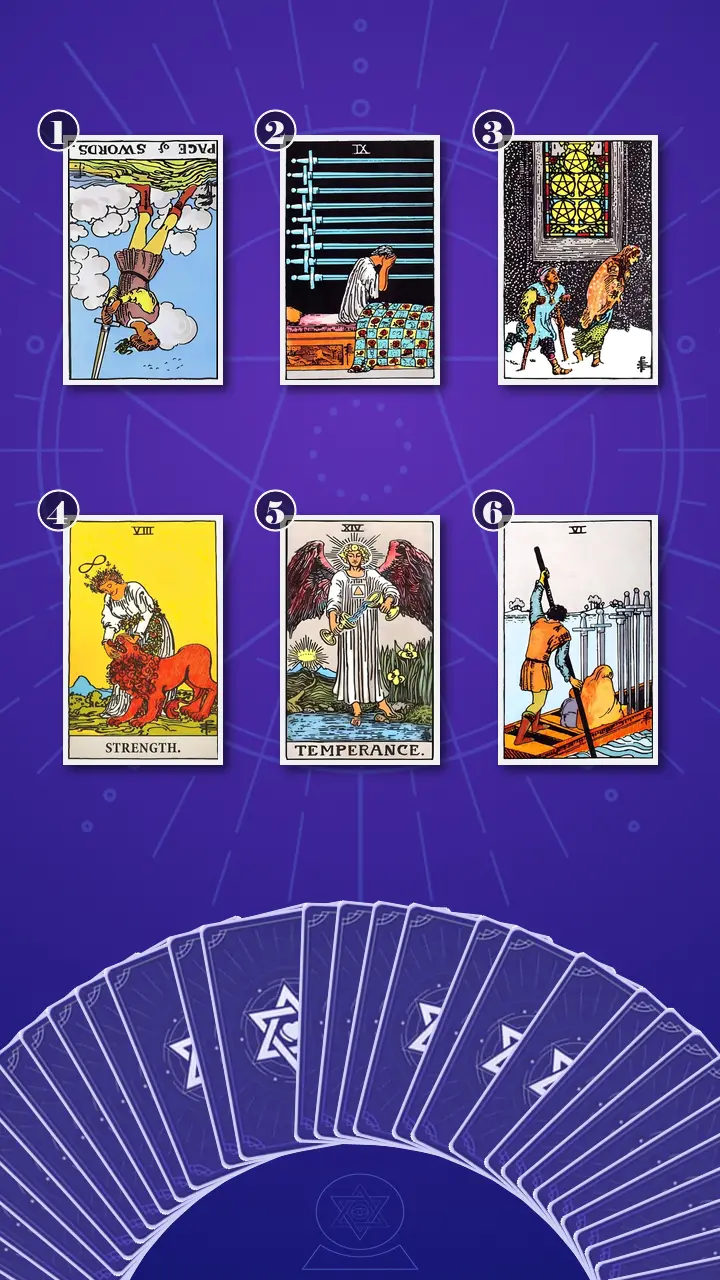
Reading the Map: Card Meanings in Context
Position 1 — The trigger in real life: what the “typing…” bubble activates in you in the first 10 seconds.
“Now turning over,” I said, “is the card that represents the trigger in real life—what the typing bubble activates in you almost instantly.”
Page of Swords, reversed.
This Page is the Scout—curious, quick, mentally sharp. Reversed, that sharpness becomes a threat-detector. I told Maya, “This is like you’re at your desk with a half-cold iced coffee and seventeen tabs open, and the second you see ‘typing…’ you stop being a person and become a monitor. You reread your last text, hover, scan—like you’re trying to intercept danger.”
In reversed form, the Page’s energy is blocked and excessive at the same time: too much vigilance, not enough true information. It’s the impulse to A/B test your own personality in real time—Should I sound witty? Softer? Cooler? Less available?—as if the “right wording” can guarantee safety.
Maya let out a small laugh that surprised even her—dry, a little bitter. “Okay,” she said. “That’s… too accurate. Like, kind of brutal?”
I nodded. “Brutal is often just clarity without padding. If your nervous system is sprinting, you’re going to treat a chat thread like a live security camera feed. It’s not because you’re ‘bad at dating.’ It’s because your brain thinks constant monitoring prevents pain.”
Her fingers tightened around her cup, then loosened. The tiniest sign of recognition—like a lock clicking half open.
Position 2 — Your immediate mental response: the rumination script that escalates the moment into panic.
“Now turning over,” I said, “is the card for your immediate mental response—the script that turns ambiguity into panic.”
Nine of Swords, upright.
“This is the part where it gets loud in your head,” I told her. “It’s late, you’re alone, and the moment the bubble disappears your mind builds a whole narrative arc—rejection, embarrassment, them telling a friend about you, you being ‘too much.’”
The Nine is not a single worry. It’s a wall. A wall of swords like intrusive push notifications—each one louder than the last.
In this card, the energy is excess Air: too much interpretation, too little grounding. You refresh the chat like it’s going to change reality. You draft a follow-up, delete it, draft again. Nothing has happened—yet your body is already reacting like it has.
I mirrored the thoughts the way they actually arrive—short, sharp, relentless:
What did I say?
Did I say too much?
Should I fix it?
Maya’s eyes flicked to her phone despite herself, like her attention had a magnet in it. Her jaw clenched, then she forced it loose. “It’s like I can’t stop,” she whispered.
“Because the Nine of Swords believes the pain can be prevented if you just think hard enough,” I said. “But here’s the reframe that starts to cut through it: A pause isn’t proof. It’s just missing data. The Nine treats missing data like a verdict.”
Her shoulders dropped a millimeter—an almost-invisible exhale. Deep emotional synchronization: seen, not shamed.
Position 3 — The rejection wound underneath: what you’re afraid the moment will prove about your worth or belonging.
“Now turning over,” I said, “is the card for the wound underneath—what you’re afraid this moment will prove about you.”
Five of Pentacles, upright.
The café windows were fogged from the heat inside, and for a second the card felt like it was borrowing that exact imagery: warmth behind glass, cold on the street.
“The real pain under the panic isn’t ‘what will they say,’” I told her. “It’s ‘what if this proves I’m outside again.’ A delayed reply feels like standing in the cold looking at warmth through glass—even if you have friends, even if you’re busy, one thread can make belonging feel conditional and scarce.”
The Five’s energy is deficiency: not enough felt-sense of safety and inclusion. That’s why the Page of Swords goes into surveillance mode. That’s why the Nine of Swords turns a pause into catastrophe. The stakes feel ancient, even when the trigger is modern.
Maya looked down at the table, then back up. “I hate how fast I assume I’m not chosen,” she said. The words landed heavy—but honest.
“That honesty,” I said gently, “is already a doorway back inside.”
When Strength Spoke: Soft Hands, Steady Breath
Position 4 — The key inner pivot: the capacity you can access that interrupts the rejection pattern in real time.
As I reached for the fourth card, the café noise seemed to shift. Not quieter, exactly—just farther away, like the room gave us a little more space. “We’re turning over the most important card in this reading,” I said. “This is the pivot point.”
“Now turning over,” I continued, “is the card that represents the key inner pivot—the capacity you can access that interrupts the pattern in real time.”
Strength, upright.
I showed Maya the image: the woman with calm eyes, soft hands on the lion. No wrestling. No domination. Just steadiness. “This is the moment you feel the spike and decide your next move is for you, not for the thread,” I said. “You put the phone down. You exhale on purpose. Your shoulders drop a fraction. You don’t try to outsmart the conversation—you steady your body first.”
Setup: You know that exact second: the bubble pops up, your breath freezes, and suddenly your whole evening is about decoding what a stranger’s thumbs mean. Your brain thinks if you solve it fast enough, you won’t feel the drop. Your body thinks you’re only safe when you know.
Delivery:
Stop treating the typing bubble as a verdict and start meeting the moment with Strength—soft hands, steady breath, and self-trust that doesn’t require instant reassurance.
I let the sentence sit between us like a warm cup you don’t rush. Maya went still in a three-part chain I’ve come to recognize as “truth landing”: first, a tiny freeze—her breath paused, fingers hovering above the phone without touching it. Second, her focus softened—eyes unfixed, like she was replaying a moment from last week in her mind. Third, release—her shoulders lowered and a shaky exhale escaped, more relief than sadness.
“I keep acting like I’m being graded,” she said, voice suddenly sharper with frustration. “But… I’m not. It’s just… silence. Missing data.”
“Exactly,” I said. “Strength doesn’t argue with the alarm. It turns down the volume. It’s nervous-system regulation disguised as courage.”
This is where my own craft always comes in—not as superstition, but as a practical metaphor I trust. “In my café,” I told her, “I read patterns in coffee grounds—Grounds Divination. When the cup is shaken, everything looks chaotic and you can ‘interpret’ anything. But when you let the grounds settle, the true pattern appears. Your mind right now is like a cup that keeps getting swirled by the typing bubble.”
“Strength,” I continued, “is choosing to let the grounds settle before you read the story.”
Then I asked the question that turns insight into a lived memory: “Now, with this new lens—can you remember a moment last week when the typing bubble showed up, and you could’ve met it with soft hands instead of surveillance?”
Maya blinked hard. “Wednesday,” she said. “I was in a meeting. My Apple Watch buzzed and I basically blacked out mentally. I drafted three replies in Notes. I didn’t hear half of what my manager said.”
“That’s the moment,” I said. “And this is the shift: from negotiating your worth through response timing to building steadiness inside your body first. Not perfection—capacity.”
In that breath, you could feel the emotional transformation beginning: from catastrophic forecasting to grounded self-trust; from feeling stuck in a digital spiral to finding clarity through embodied choice.
Position 5 — The practice that builds security: a balancing action you can repeat to change the communication rhythm.
“Now turning over,” I said, “is the card for the practice—what you can repeat to build a healthier rhythm.”
Temperance, upright.
Temperance always looks like an ordinary miracle: two cups, water moving between them, one foot on land and one in water. “This is ‘two-cup pacing,’” I told her. “You stop swinging between ‘fix it now’ and ‘act like you don’t care.’ You reply when you’re regulated, not when you’re panicking. And you let pauses exist without chasing them.”
The energy here is balance—not numbness, not overexposure. Measured vulnerability beats flooding or freezing.
Maya nodded, but then her brow tightened. “Okay, but… I genuinely don’t have time to do a whole mindfulness thing every time,” she said. “Like I’m at work. Or on the subway. Or with friends. I can’t disappear for ten minutes to breathe.”
That objection was real—and useful. “Good,” I said. “Then we won’t make it big. Temperance is small adjustments. Espresso shots, not gallon jugs.”
Position 6 — Integration: what a steadier texting/attachment experience looks like when the skill is applied.
“Now turning over,” I said, “is the card for integration—what a steadier experience actually feels like in your body and your evening.”
Six of Swords, upright.
“This is calmer waters texting,” I said. “Not ‘you never notice the bubble again.’ You still notice. You still have thoughts. But you’re not trapped inside them.”
The Six is the mind relocating. The energy is directed movement: Air that’s no longer storming, but steering. “It’s like you can see a typing pause and think, ‘I don’t know yet,’ and then return to your night without performing for certainty,” I said. “You carry your thoughts with you, but you don’t let them drive the route.”
Maya’s posture changed subtly—less hunched over the phone, more in her chair. As if she could imagine, for the first time in a while, closing the app without needing closure.
The One-Week “Screen-Isn’t-a-Verdict” Reset (Actionable Advice)
I pulled the whole grid together for her, like laying out the story the cards had been telling all along.
“Here’s the arc,” I said. “The Page of Swords reversed shows your trigger: hypervigilance—monitoring the thread for micro-signals. The Nine of Swords shows the escalation: your mind opens twelve tabs of worst-case scenarios and calls it ‘preparing.’ The Five of Pentacles shows why it hooks so hard: an old ‘outside looking in’ wound. Then Strength offers the pivot—meeting the adrenaline spike with soft hands. Temperance turns that pivot into a repeatable rhythm. And the Six of Swords is the lived outcome: calmer waters, not because the other person behaves perfectly, but because you do.”
Her cognitive blind spot was clear: she’d been trying to solve a body problem with a wording solution. “You’ve been treating uncertainty like something you must eliminate,” I said, “instead of something you can hold. The transformation direction is simple, but not easy: self-soothe first, then text. Shift from decoding digital cues for safety to practicing regulation before you respond.”
“And for the record,” I added, “this isn’t about tolerating genuinely unsafe behavior. It’s about not letting the spike drive your thumbs.” Don’t let urgency write your texts for you.
I offered her small, concrete experiments—because clarity without next steps is just a nice moment.
- Phone Face-Down + 5 BreathsFor one week, when you see “typing…,” place your phone screen-down and take 5 slow breaths (yes, even if they’re imperfect). Then look again and decide what you want to do.Set a 30-second timer so it stays realistic. If your brain says, “This is stupid, I need to know now,” that’s the cue the practice is working.
- A Neutral Alternate StoryRight after the breaths, name one neutral story: “They got interrupted,” “They’re thinking,” or “They’re multitasking.” Treat it like missing data, not a verdict.If it helps, use my Aroma Anchoring trick: inhale the smell of your coffee (or even your sleeve) on breath one, so your body links a scent to steadiness.
- Reply-From-Regulation Window (20–60 Minutes)When you’re triggered, choose a “middle rhythm” window: reply sometime within 20–60 minutes—neither instantly nor as a power move. If you reply, keep it to one clean sentence.Pre-plan the rule when you’re calm, not mid-spiral. Twenty minutes counts even if you still feel activated—Temperance is about consistency, not perfection.
She stared at the list like it was permission. “This feels… doable,” she said, and her voice had a different tone—less bargaining, more choice.

A Week Later: Calmer Waters, Not Perfect Certainty
Six days later, Maya sent me a message—short, like someone trying not to jinx progress.
“Saw the typing bubble. Put my phone face-down. Did the five breaths. Told myself ‘missing data.’ I still wanted to check like ten times, but I checked twice. Didn’t double-text. Also I could actually taste my coffee instead of just holding it.”
That’s the real proof: not a perfect relationship timeline, not suddenly becoming “chill,” but a measurable shift in agency. Clarity, in this kind of work, is often the quiet moment your shoulders soften and you realize you’re still in your own life.
It was light, and also a little bittersweet—the kind of change where you feel steadier, then notice how much you’d been carrying. She told me later she celebrated by sitting alone in a café for an hour, phone in her bag, just letting the world be loud without making it about her.
This was her Journey to Clarity: learning that the typing bubble is a cue, not a verdict—and that Strength isn’t force. It’s soft hands. It’s breath. It’s self-trust that doesn’t require instant reassurance.
We’ve all had that moment where a pulsing “typing…” bubble turns your chest tight and your mind loud—because you want closeness so badly, and you’re terrified a single pause will prove you weren’t chosen.
If you didn’t have to earn certainty from the screen tonight, what’s one tiny way you’d let your body lead first—one breath, one pause, one softer pace—before you decide what to text?
This story is adapted from psychological research, written so that those in a similar struggle can see their own pattern in it — and find their next step clearly.These insights are not a substitute for professional psychological, medical, legal, or financial advice.
Learn more about our Journey to Clarity.
How did this insight land for you?
🫂 This Resonates Deeply
🌀 Living This Story
✨ Now I See Clearly
🌱 Seeing New Possibilities
🧰 Useful Framework
🔮 The Confirmation I Needed
💪 Feeling Empowered
🚀 Ready for My Next Step
Author Profile
 AI
AI“For twenty years, I’ve listened to stories unfold over the warm aroma of coffee. I don’t believe life’s complexities always require grand theories to be solved; often, we just need a safe place to tidy up our reality. I don’t offer high-minded preaching—just grounded, heartfelt insights to help you regain your sense of control amidst the clutter of daily life.”
In this Personal Growth Tarot Reading :
Core Expertise
Service Features
Also specializes in :
Explore Related Patterns:
Anxious AttachmentThe panic around the typing bubble is tied to closeness, not just phone etiquette. Maya wants connection, but the second the screen goes uncertain, her body reacts as if the bond itself is at risk: breath frozen, chest tight, attention pulled toward the thread. Anxious Attachment shows up here as the need for quick relational certainty when ambiguity appears. The pause is not experienced as ordinary delay; it becomes a possible sign that she is not chosen, that warmth is behind glass, and that belonging can disappear without warning. For you, the pattern is the way reassurance starts to feel urgent when the relationship signal goes unclear. The exit is not pretending you do not care. It is building enough internal steadiness that you can want closeness without letting instant response timing become the only proof that you are safe.
Rejection SensitivityMaya's strongest reaction begins before any clear rejection has occurred: the typing bubble appears, disappears, and her body immediately treats the gap as evidence that she failed an invisible test. The story repeatedly shows her converting a tiny digital cue into a statement about whether she is chosen, wanted, or too much. That is the core mechanism of Rejection Sensitivity: ambiguous signals are filtered through an expectation of exclusion, so missing data starts to feel like proof. The thread becomes less like a conversation and more like a live referendum on belonging, which is why her chest tightens and her mind races before the other person has actually said anything. For you, this pattern is not about being dramatic or needy. It is an overactive rejection detector trying to protect you from the drop before it happens. The clarity comes from separating the cue from the verdict: a typing bubble can activate the wound, but it does not have the authority to define your worth.
CatastrophizingWhen the typing bubble disappears, Maya's mind does not stop at 'they paused.' It jumps into a whole story: rejection, embarrassment, being discussed, being too much. Nothing concrete has happened, but her nervous system is already responding as if the worst outcome has arrived. Catastrophizing is the cognitive mechanism that turns uncertainty into a threat forecast. The mind tries to protect you by preparing for pain, but it overshoots: a blank screen becomes a verdict, a pause becomes social danger, and a small moment starts carrying the emotional weight of abandonment. For you, the key audit question is not whether the fear feels real. It clearly does. The clearer question is whether the story has evidence, or whether your mind is using worst-case prediction as a form of control when the actual data is still missing.
Certainty SeekingMaya keeps trying to solve the moment by finding the exact right wording, the exact right timing, the exact right version of herself. The typing bubble gives her missing data, and her first move is to eliminate the uncertainty by monitoring, editing, and decoding. Certainty Seeking is the pattern of treating not-knowing as the real danger. It can look intelligent on the surface because it uses analysis, wording, and observation, but its emotional function is reassurance: if you can just decode the signal fast enough, maybe you will not have to feel the drop. For you, this pattern explains why the phone can become impossible to ignore. The goal is no longer communication; it becomes certainty extraction. The shift is learning to hold the unknown long enough that your next text comes from choice rather than an emergency need to make the ambiguity stop.
HypervigilanceMaya's attention locks onto the smallest available signals: the bubble, the pause, the disappearance, the wording of her last message. Her body tightens and her mind starts scanning the thread as if it were a live security feed. Hypervigilance is the defense mechanism underneath that scan. It is the belief that constant monitoring can prevent pain, even when the available information is too thin to interpret accurately. In the story, this defense makes her quick and alert, but it also traps her in a threat-detection loop where ordinary ambiguity keeps reading as danger. For you, the insight is that the scan is trying to protect you, but it cannot give you the safety it promises. Watching the bubble harder does not create more real data. It only keeps your nervous system organized around the possibility of rejection.
Reality TestingMaya's reset asks her to do something very specific after the spike: name one neutral alternate story. The pause might mean they got interrupted, they are thinking, or they are multitasking. The point is not to force optimism; it is to stop treating the rejection story as the only available interpretation. Reality Testing is the cognitive skill of separating evidence from interpretation. In the story, it gives Maya a way to check the thought without shaming the feeling. A pause can feel loaded and still remain inconclusive. For you, this pattern is where clarity becomes usable. The goal is not to talk yourself out of every fear. The goal is to ask whether the fear has data, whether another explanation exists, and whether your next move can wait until the screen is no longer being treated like a courtroom.
RuminationMaya does not just notice the typing bubble and move on. She rereads her own message, rewrites it like a legal document, drafts a fix, deletes it, and starts again. The loop keeps pulling her back into the same questions: what did I say, did I say too much, should I fix it? Rumination is the mental replay mechanism that mistakes more thinking for more safety. It feels productive because the mind is working hard, but the work is circular: the same data gets reprocessed again and again without creating actual clarity. For you, this pattern explains why the panic can last longer than the trigger itself. The screen gives one ambiguous cue, then the mind keeps manufacturing new angles to review. The exit starts when you stop treating mental repetition as evidence gathering and recognize it as a regulation attempt that has outlived its usefulness.
Self-SoothingMaya's turning point is concrete: the phone goes face-down, the breath slows, the shoulders drop, and the next move is no longer dictated by the thread. She does not wait until the fear vanishes; she creates a small gap between the trigger and the response. Self-Soothing is the adaptive pattern that interrupts the rejection loop at body level. Instead of trying to think her way out of a nervous-system spike, Maya gives the body a cue of safety first, then returns to the message with more choice. For you, this is the practical counter-pattern to panic texting. The screen may still activate the old alarm, but your body does not have to hand the phone over to urgency. One breath, one pause, one softer pace can be enough to prove that the cue is not in charge.
Compulsive CheckingMaya's phone keeps pulling her attention back, even when she is at work, in a meeting, or trying to stay present. The story makes the loop visible: check, interpret, draft, delete, check again, then feel briefly relieved or newly activated depending on what the screen does. Compulsive Checking is the behavioral expression of the uncertainty loop. The checking is not random; it is an attempt to regulate the body spike by finding a new piece of information. But because the cue is unstable, every check can restart the same alarm it was supposed to calm. For you, this pattern matters because it gives the loop a physical handle. Reducing the checks is not about willpower or acting chill. It is about interrupting the behavior that keeps feeding the nervous system more micro-signals to decode.
Explore Related Struggles:
Chosen-Worth BindThe typing bubble does not stay a neutral interface cue for Maya; it becomes a test she did not agree to take. When someone starts typing and stops, she immediately feels as if she has failed, even though the screen has only offered missing information. That is why Chosen-Worth Bind fits the center of the story. The pause gets converted into a judgment about whether she is wanted, whether she said too much, and whether she has slipped outside the warmth of belonging again. You can see the bind in how quickly the question moves from “What will they text?” to “What does this prove about me?” The struggle is not simply wanting a reply. It is the way your sense of being chosen gets attached to response timing, so one small digital delay can feel larger than the conversation itself. The path back begins when the pause can be held as missing data instead of evidence against your worth.
Evidence DisconnectionThe bubble disappears, and Maya’s mind immediately builds the missing scene: rejection, embarrassment, someone talking about her, proof that she was too much. Nothing has been said yet, but her body is already responding as if the verdict has arrived. Evidence Disconnection captures the break between what the screen actually shows and what the moment starts to mean. A pause is only incomplete data, but the loop treats it as a finished conclusion. That mismatch is why the conversation can feel like a performance review even when the other person has not delivered any clear feedback. For you, this struggle is the split between signal and story. The screen gives one small cue, and the inner system supplies an entire case against you. Clarity starts when you can separate the observable fact from the interpretation that rushed in to occupy it.
Monitoring-Safety FusionMaya’s hand hovers near the phone like the device might bite, and the moment “typing…” appears she starts rereading, scanning, and trying to intercept danger. The thread becomes a live security feed, and her attention keeps returning to it even while the café, the meeting, and her own body are asking for presence. Monitoring-Safety Fusion names the locked structure underneath that behavior. Checking is not just curiosity in this story; it becomes the way she tries to feel safe before the other person has actually said anything. The more uncertain the screen gets, the more her system reaches for surveillance as if enough observation could prevent rejection. You can feel the cost in the Wednesday meeting, where an Apple Watch buzz pulls her out of the room and into three drafted replies in Notes. The struggle is that safety gets outsourced to the next signal from the thread, so your agency narrows until the only move that seems available is to keep watching.
Rumination EntrapmentMaya drafts a follow-up, deletes it, drafts again, and refreshes the chat while the actual situation has not changed. The loop is visible because every action promises relief, but none of the actions can create the information she is waiting for. Rumination Entrapment fits because the mind keeps manufacturing work where there is no new evidence to process. The missing reply becomes a space her thoughts try to fill with explanations, corrections, and worst-case storylines, and each attempt to solve the uncertainty gives the cycle another turn. The story gives this struggle a concrete cost: she misses half of what her manager says because her attention is busy drafting three replies in Notes. For you, the core issue is not that you think too much in a vague way; it is that thinking becomes a closed room, and every imagined fix keeps you inside it a little longer.
Intention-Impact SplitMaya edits her last message like a legal document, as if the exact wording can make the next response safer. She asks whether she should sound witty, softer, cooler, or less available, trying to adjust the text until it can carry more control than a text can realistically hold. Intention-Impact Split belongs here because the action has a clear intention, but the tool does not match the problem. She wants to protect the connection, yet the revision process keeps her tied to the idea that perfect wording can manage another person’s timing, attention, or interest. The deeper friction is that your intention is care, but the impact can become self-erasure under pressure. You start negotiating your voice against an imagined reaction, and the message stops being a message; it becomes a small performance built to survive uncertainty.
Explore Related Emotions:
Conditional Belonging FearMaya names the deeper hit when she says she hates how fast she assumes she is not chosen. The typing bubble is small, but the meaning attached to it is much larger: one pause can make belonging feel conditional, scarce, and dependent on getting the exchange exactly right. The café scene frames this through warmth and exclusion. There is heat inside, cold outside, and the image of looking at warmth through glass mirrors the way one delayed reply can make connection feel near but not secure. Conditional Belonging Fear fits because the panic is anchored in the question of whether closeness can be withdrawn at any second. You are not reacting only to a message delay; you are feeling the ache of belonging that seems available only when someone else keeps confirming it in real time.
Grounded AgencyMaya's shift begins in a tiny physical sequence: phone down, breath on purpose, shoulders dropping a fraction before she decides what to do. The screen is still there, but it is no longer allowed to choose the next move for her. That matters because the pattern had been pulling her into urgency. The new rhythm creates a small internal gap where you can feel the spike without letting it drive your thumbs. Grounded Agency fits the steadier emotional weather of the integration arc. It is the felt sense that you can stay in contact with your body, choose your timing, and respond from yourself rather than from the pressure of the thread.
Hypervigilant AnxietyMaya's shoulders creep upward as she talks, her breath catches, and her thumb hovers near the edge of the phone without touching it. The body is already bracing before any message arrives, and the screen becomes something to watch for threat rather than a simple conversation tool. That physical alertness turns the chat thread into a monitoring station. You reread, scan, hover, and try to intercept rejection before it can land, even though the only visible fact is a typing bubble appearing and disappearing. Hypervigilant Anxiety fits because the main inner weather is not ordinary impatience; it is a state of constant emotional scanning. The uncertainty feels too charged to leave alone, so your attention locks onto tiny digital signals as if they could tell you whether you are safe, wanted, or about to be shut out.
Quiet Self-TrustBy the end, Maya can see the typing bubble as a cue instead of a verdict. She still notices it, still wants to check, and still feels the pull, but she can put the phone face-down, breathe, and let the moment settle before reading meaning into it. The emotional change is quiet rather than dramatic. You do not need to become perfectly chill or stop caring; you need enough trust in your own body to let uncertainty exist without treating it as an emergency. Quiet Self-Trust fits because the steadiness is internal and low-volume. The screen no longer has to provide instant reassurance before you can return to your coffee, your work, your friends, or your own evening.
Rejection ChillThe story gives the rejection feeling a clear temperature: warmth behind glass, cold on the street. When the delayed reply hits Maya, the pain underneath is not only about what someone will text; it is the sensation of being outside again. That chill arrives before the facts do. A pause becomes a small emotional weather change, making the other person's attention feel like a warm room you might not be allowed back into. Rejection Chill fits the sharp drop in the body when uncertainty turns into felt exclusion. You can still know, logically, that nothing has been decided, while your body reacts as if the door has already closed.
Verdict DreadMaya says the moment the typing bubble appears and vanishes, she feels as if she failed a test she did not know she was taking. A normal pause stops being neutral; it starts to feel like a hidden evaluation of her wording, timing, desirability, and place in the other person's attention. The story keeps returning to verdict imagery: the conversation becomes a performance review, missing data becomes proof, and a delayed reply feels like standing outside warmth behind glass. The emotional structure is built around judgment before evidence. Verdict Dread names the inner drop that happens when silence starts speaking louder than the message itself. You are not only waiting for a reply; you are bracing for the screen to confirm something painful about whether you are chosen, acceptable, or already outside.
Message DreadThe iMessage bubble can shift Maya's whole body state in under ten seconds: stopped breath, tight chest, hot face, and an immediate urge to rewrite the last text. The message has not arrived yet, but the interface already carries emotional weight. That is what makes the screen feel loaded. The bubble, the pause, the disappearance, and the blank thread become cues that pull your body into anticipation before there is enough information to interpret. Message Dread names the charged atmosphere around digital contact itself. You are not simply hoping for a reply; you are meeting the message space as a place where rejection might announce itself through timing, silence, or a tiny pulsing bubble.
Certainty HungerMaya refreshes the chat like it might change reality, drafts replies in Notes, and keeps trying to turn a pause into something readable. The screen is giving her missing data, and her body treats that gap as something that must be closed immediately. The deeper pull is toward certainty as a form of safety. If you could just know what the other person means, why they stopped typing, or what they are about to send, your body believes it could finally stand down. Certainty Hunger names that urgent craving for a fixed answer before the moment is ready to offer one. It is less about needing control for its own sake and more about wanting relief from the raw exposure of not knowing where you stand.
Relational Catastrophe DreadNothing has happened yet, but Maya's body reacts as if the relationship meaning has already collapsed. One disappeared typing bubble becomes enough for the mind to build a full narrative: rejection, embarrassment, being too much, being discussed, being quietly dropped. The emotional jump is the key. A small pause does not stay small; it expands into a future-facing story where the connection has already gone wrong and you are left trying to prevent damage that has not actually occurred. Relational Catastrophe Dread fits because the dread is relational, not abstract. The screen feels like it might announce a sudden loss of closeness, so your body prepares for an ending before the other person has even responded.
Shame SpiralWhen the bubble disappears, Maya's mind does not stop at wondering why. It builds a whole scene around rejection, embarrassment, being talked about, and being too much, then sends her back into editing mode as if the right sentence could repair her worth. The thread becomes a mirror that distorts quickly. You start A/B testing your personality in real time, asking whether you should sound cooler, softer, funnier, less available, or less intense. Shame Spiral fits because the ambiguity folds inward and turns into self-attack. The most painful part is not the missing reply itself; it is how fast the missing reply becomes evidence against you.
Performance FreezeMaya describes the typing bubble as a test, and her body follows that logic: breath paused, fingers hovering, evening narrowed around the phone. The conversation stops feeling mutual and starts feeling like a scene where she has to get the next move right. That pressure creates a freeze inside performance. You want to respond, but first you feel forced to calculate tone, timing, availability, and emotional exposure as if every choice will be scored. Performance Freeze names the stuckness that appears when connection starts to feel like an exam. You are not absent because you do not care; you are locked in place because caring has become something you feel you must disguise, manage, and perfect.
Explore Related Contexts:
Conditional Belonging PressureThe story gives the wound a concrete image: warmth behind glass, cold on the street. A delayed reply feels like standing outside again, even when Maya has friends, work, coffee, and a full life beyond the thread. One small pause starts carrying the question of whether she is chosen. Conditional Belonging Pressure shows up when access, timing, and attention become informal membership tests. The other person has not necessarily rejected you, but the structure of the exchange makes belonging feel scarce and revocable. That is why the typing bubble has so much force: it appears to hold the door between inside and outside. The reclaiming move is to stop letting one thread become the entire social room. You can still care about the reply while refusing to make it the only proof that you belong. That shift does not erase uncertainty, but it widens the field of evidence back to your whole life instead of a single disappearing bubble.
Dating Performance LoopThe story says the typing bubble turns a conversation into a performance review, and Maya immediately starts A/B testing her own personality. Should she sound witty, softer, cooler, less available? She is no longer just texting; she is trying to manage how she will be scored before the other person has even answered. That is the Dating Performance Loop: a romantic or flirtatious exchange becomes a stage where timing, tone, and restraint are treated as proof of worth. The pressure is social, not mystical. Modern dating culture often turns ordinary communication into a soft audition, especially when the rules are unspoken and the feedback is delayed. For you, the key is to notice when the thread has stopped being a conversation and become an evaluation room. A message can be edited for clarity, but your entire self does not need to be optimized for a bubble on a screen. That distinction restores agency before the performance loop starts deciding your next move.
Relationship Hypervigilance LoopMaya's thumb hovers near the phone, her shoulders creep upward, and the moment the bubble appears she begins rereading, scanning, and drafting possible repairs. The story describes her as becoming a monitor, not because a rejection has actually happened, but because the relationship thread has started to feel like a live security camera feed. A Relationship Hypervigilance Loop forms when digital connection becomes something you supervise instead of something you participate in. The loop keeps asking for one more scan, one more wording adjustment, one more check for danger. In the story, that loop follows Maya from the café into a work meeting, where one buzz is enough to pull her attention away from the person speaking in front of her. This label matters because the problem is not that you care too much. The external setup is a low-information, high-meaning communication channel that rewards constant checking without actually giving certainty. Naming the loop lets you move from surveillance back into choice: phone down, breath first, response later if you still want it.
Response Time PressureWhen the typing bubble disappears, Maya immediately rewrites her last text as if she is editing a legal document. The story also names read receipt anxiety, double texting discourse, and the shame of wanting connection while still trying to look effortless. The pressure gathers around timing: how long they take, how soon you answer, whether another message looks needy, and whether a pause means status has shifted. Response Time Pressure turns the clock around a conversation into a social scoreboard. You are not only responding to another person; you are responding to an unwritten set of rules about availability, restraint, desirability, and not seeming too invested. In that structure, even silence starts to feel active because the delay itself appears to carry judgment. The way out begins by separating timing from proof. A delayed reply can affect you, but it does not automatically define your position in the relationship. Once the pause is named as pressure instead of evidence, you have more room to decide whether to text, wait, or return to your evening without letting urgency write for you.
Timing Signal OverloadThe typing bubble appears, disappears, and then shows up again as the entire room seems to narrow around Maya's phone. Later, an Apple Watch buzzes during a meeting and she drafts three replies in Notes while missing half of what her manager says. The external trigger is not a full message or a clear rejection; it is a cluster of partial digital signals that demand interpretation before they contain real information. That is what makes this a Timing Signal Overload rather than ordinary texting stress. The platform gives you tiny cues, such as typing indicators, buzzes, read receipt discourse, and response gaps, but none of them can reliably tell you where you stand. When those signals arrive faster than clarity, the thread starts acting like a social radar system you feel pressured to monitor. The useful audit point is that the signal is real, but its meaning is not settled. You can treat the bubble as missing data instead of a verdict, which returns the decision point to your own pacing rather than the interface's pulse.
Low-Maintenance Dating PressureThe story names the shame of wanting connection while trying to look effortless, and Maya later recognizes the swing between fixing it now and acting like she does not care. Even the advice has to avoid becoming a performance: not instant replies, not a power move, but a middle rhythm she can actually live with. Low-Maintenance Dating Pressure is the social rule that says you should want closeness without appearing to need anything. It makes restraint look sophisticated and directness feel risky. Under that rule, the typing bubble becomes more than a tech cue; it becomes a test of whether you can stay desirable while pretending not to wait. This context gives you a cleaner target. The goal is not to become colder or more detached. The goal is to stop letting a culture of curated chill decide how much warmth you are allowed to show, then choose a response pace that protects both dignity and honesty.