Finding Clarity in the 48-Hour Replay Loop
You meet their parents once, and then spend the next 48 hours trying to figure out what every pause and polite smile actually meant—classic post-meeting-the-parents overthinking.
Taylor sat across from me at my little Italian café—warm wood tables, a pastry case that never stops fogging slightly at the edges, the espresso machine hissing like a patient old cat. Outside, Toronto did its thing: streetcar bell in the distance, winter light already fading even though it wasn’t that late.
She didn’t look messy. She looked like someone who could run a meeting, hit a deadline, keep a straight face in a boardroom. But her hands gave her away—fingers interlaced too tightly, thumbs rubbing the same spot as if they could sand the moment down.
“It’s embarrassing,” she said, voice low. “I can handle feedback at work. But one family dinner makes me weirdly small. Like I’m waiting for a vibe check score.”
She described the night after meeting her partner’s parents the way people describe a bad playlist they can’t stop: it starts, you hate it, you still let it run. She replayed the dinner conversation, re-read small comments for hidden meaning, and then swung hard between two protective extremes—over-explaining herself in follow-up texts, or going quiet to avoid being judged.
“I don’t know if they didn’t like me,” she said, “or if I’m just projecting.”
As she spoke, I noticed her breath. Not shallow exactly—more like she was holding it in reserve, bracing for a verdict that hadn’t been delivered. That tight chest, that subtle freeze. It wasn’t drama. It was a nervous system that learned long ago that family can mean evaluation.
“You’re not ridiculous,” I told her, gentle but direct. “And you’re not alone. Projection isn’t you being dramatic—it’s your nervous system trying to find safety in low light.”
I slid her a small glass of water—simple, grounding. “Let’s do what I do when someone orders coffee and says, ‘Make it perfect, but also I’m not sure what I like.’” I smiled. “We don’t guess. We taste. We gather data. We adjust. Today, we’re going to gather real data from your experience—so you can stop treating your own mind like a courtroom.”
“Okay,” she exhaled, like she’d been waiting for permission to stop performing even here. “I just… want clarity. What old family pattern am I projecting after meeting their parents?”

Choosing the Compass: The Celtic Cross · Context Edition
I invited Taylor to put both feet on the floor and take one slow breath—not as a ritual for the universe, but as a signal to her body: we’re safe enough to look. I shuffled slowly, the way I tamp espresso—steady pressure, not force. The point isn’t magic. The point is focus.
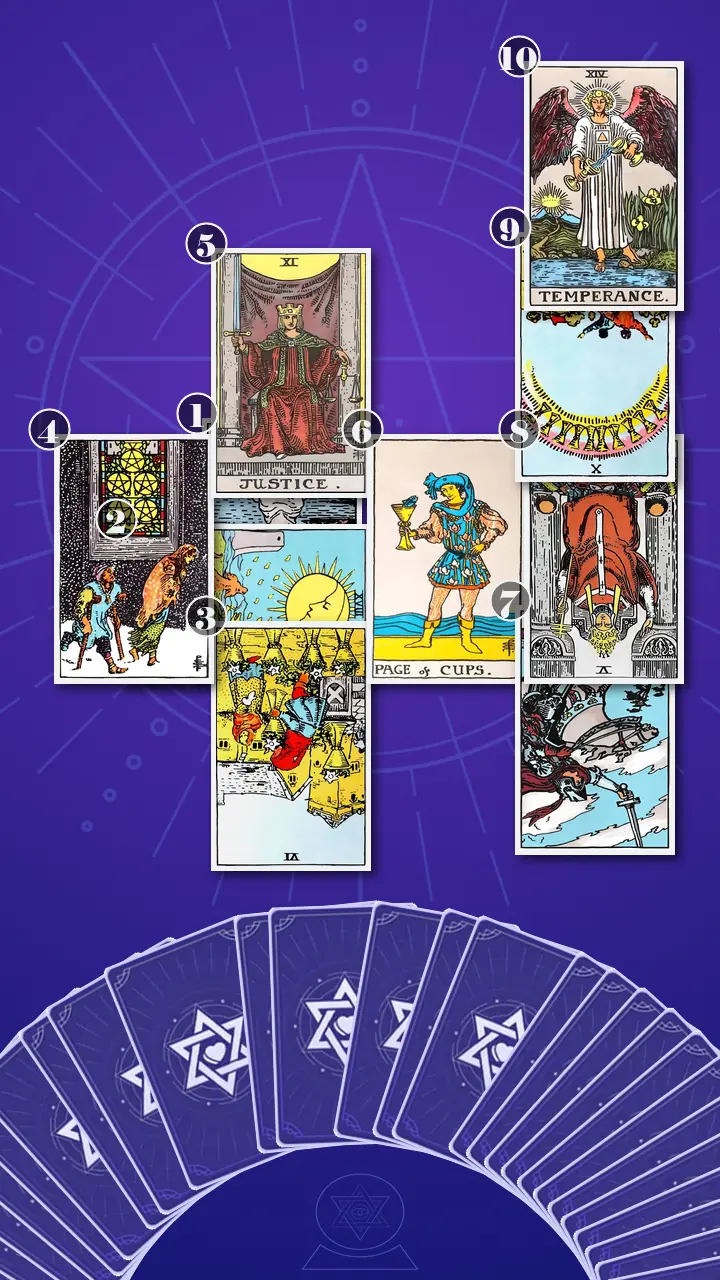
“Today,” I said, “we’ll use a spread called the Celtic Cross · Context Edition.”
And for you reading this: I chose it because this situation isn’t a simple yes/no prediction. Taylor’s question is about projection—a present-moment lens being distorted by an old family script. This spread is built for layered clarity: present lens → unconscious imprint → self-protective strategy → the environment as a mirror → integration. It’s like diagnosing a drink: not just ‘too bitter,’ but why it tastes that way and what to adjust.
“A few positions will matter most for us,” I continued. “The first card will show the projection lens you’re wearing right now. The third card goes to the family-of-origin imprint—what old pattern is getting activated. And the tenth—our outcome—shows what integration looks like when you blend clarity with calm self-regulation.”
Taylor nodded, still a little guarded, but present.
Reading the Map: How Tarot Works When You’re Stuck in the ‘What Did That Mean?’ Spiral
Position 1: The current projection lens — Two of Swords (reversed)
“Now I’m turning over the card that represents the current projection lens: what you’re assuming and how it’s shaping your perception right now.”
Two of Swords, reversed.
“This is like you’re on the couch after the dinner, toggling between iMessage and Notes, trying to decide what the parents ‘really thought’ based on fragments—half-smiles, pauses, the way someone said ‘nice to meet you.’ You keep yourself emotionally numb—blindfold energy—while your mind keeps swinging the swords: verdict A, verdict B, verdict A again. Instead of getting clearer, you get more mentally loud—and you’re tempted to send a carefully engineered text to control the narrative.”
I watched her eyes flick down like she could see her own phone screen in the tabletop grain.
“Reversed,” I said, “this card is Air energy that’s in excess—too much thinking, not enough clean input. It’s a blocked clarity that spills into mental overload. You’re trying to decide without data, because deciding feels safer than uncertainty.”
I leaned in a little, voice still kind. “And I want to name something very specific: the blindfold isn’t ignorance. It’s protection. You’re not ‘missing clues’—you’re bracing not to feel exposed.”
She let out a short laugh—small, bitter, almost embarrassed. “That’s… too accurate,” she said. “Like, it’s kind of brutal.”
“It’s only brutal if we use it to judge you,” I replied. “If we use it to understand you, it becomes useful.”
Position 2: The core challenge — The Moon (upright)
“Now I’m turning over the card that represents the core challenge: what makes this moment feel high-stakes and hard to read.”
The Moon, upright.
“This is the low-light problem,” I said. “You’re trying to read a family system in low light. You don’t have enough data, but your nervous system treats uncertainty like danger. A neutral follow-up—something as simple as ‘Had a good time today’—starts to feel like it’s hiding a subtext you’re responsible for decoding.”
The Moon is Water energy that’s not soothing here—it’s foggy. Not intuition, but fear wearing intuition’s clothes.
“See the dog and the wolf in the classic image?” I asked. “One part of you is the calm, social adult. Another part is the older survival response that hears ‘family’ and thinks, trial. The challenge isn’t that you’re ‘bad at reading people.’ The challenge is that you’re reading with your nervous system on high alert.”
Taylor swallowed. Her shoulders rose a millimeter and then dropped, like she noticed she’d been tensing.
“So… what do I do?” she asked. “Because it feels like I need to solve it.”
“We’ll get there,” I said. “But first, we find the old script.”
Position 3: Family-of-origin imprint — Six of Cups (reversed)
“Now I’m turning over the card that represents the family-of-origin imprint: the old pattern being activated and replayed through projection.”
Six of Cups, reversed.
“This is the ‘role swap’ card,” I said quietly. “On paper, you walk into their family space as a 29-year-old professional. But in your body, you can suddenly feel… younger.”
She nodded before I even finished, like her neck did it for her.
“Six of Cups reversed is the old template that isn’t sweet nostalgia,” I continued. “It’s an unresolved imprint. The card’s scene is a scripted exchange—like the rules are already written. Reversed, it often shows up as slipping into good kid mode: approval-seeking, shrinking, trying to be harmless to earn belonging.”
I offered her options instead of a label. “Do you recognize yourself as the good kid? The peacemaker? The invisible one—the one who avoids becoming a problem?”
Her eyes went slightly glossy, not in a dramatic way—more like the surface of a coffee when the crema breaks.
“Good kid,” she said. “And also… invisible one. I hate how young I feel in those moments.”
“That’s the key,” I said, and let it land without rushing. “Not because you are young. Because your nervous system is opening an old file.”
Six of Cups reversed is emotional energy that’s stuck backward—a pull into a past role when the present gets intense.
Position 4: Recent past — Five of Pentacles (upright)
“Now I’m turning over the card that represents the recent past: the old emotional memory this situation hooks into.”
Five of Pentacles, upright.
“This one is simple and heavy,” I said. “It’s the expectation of being outside warmth.”
I described the image in plain language: two figures in the cold, a lit window nearby—warmth visible, but not felt as accessible.
“In modern life, this looks like you bracing to be the outsider before anyone has actually excluded you,” I told her. “You’re scanning for inside jokes and family history stories and translating them as, ‘I’ll never be fully in.’”
Five of Pentacles is Earth energy in deficiency—a lack of felt support, a scarcity story about belonging.
Her hand went to the base of her throat like she could feel the ‘outside the window’ sensation there. “That’s exactly it,” she said. “It’s like… if I don’t fit with his family, what am I building my life around?”
“That question makes sense,” I said. “And it’s also a future-cast—your mind trying to create certainty by jumping ahead.”
Position 5: Conscious aim — Justice (upright)
“Now I’m turning over the card that represents your conscious aim: what you’re trying to achieve or prove after meeting the parents.”
Justice, upright.
Taylor’s mouth tightened in recognition. “Of course,” she said. “Of course it’s that.”
“Justice is the part of you that wants a clean debrief,” I said. “Truth. Fairness. Proportion. You want to stop spiraling and stop treating the dinner like a personal trial.”
Justice is clarity energy that can be balanced—but it can also become rigid if you use it as a verdict machine.
I glanced at her, then said one of my favorite lines for this exact moment: “Don’t turn ambiguity into a sentence. Treat it like a draft.”
Her eyes softened, just a little. Like something unclenched.
“Because right now,” I continued, “your mind is trying to write a final ruling with incomplete evidence.”
Position 6: Near-term direction — Page of Cups (upright)
“Now I’m turning over the card that represents the near-term direction: what changes when you soften the projection and allow new data in.”
Page of Cups, upright.
“This is your pivot point,” I said. “Not a big speech. Not a perfect follow-up. A small, warm moment.”
Page of Cups is Water energy in healthy flow—curiosity, emotional openness, a willingness to gather new information.
“Think: one sincere laugh when they tell a story. One curious question. One line like, ‘I was a little nervous—thanks for having me.’ That’s it. The fish in the cup is the symbol of new data you couldn’t have predicted if you stayed in your head.”
Taylor’s shoulders dropped a fraction. “Okay,” she said, a tiny smile appearing like a sunrise in slow motion. “I can do one small thing. I don’t have to fix everything tonight.”
Position 7: Self-positioning under pressure — Knight of Swords (reversed)
“Now I’m turning over the card that represents self-positioning: the role you slip into under pressure, and how it affects your voice and behavior.”
Knight of Swords, reversed.
“Here’s your swing,” I said. “When you feel unsafe, you try to solve it fast. You rehearse arguments in your head about what was rude or unfair, then feel compelled to fix it quickly with a sharp message or a defensive explanation.”
Knight of Swords reversed is Air energy in overdrive—reactive, urgent, absolute. And when you’re scared of being judged, urgency can masquerade as ‘being mature.’
“Then you overcorrect,” I added, “into silence. Total shutdown. Because at least silence can’t be misquoted.”
Taylor rolled her eyes at herself, but not cruelly—more like caught. “Yeah,” she said. “It’s either three paragraphs or nothing.”
“One honest sentence beats a three-paragraph defense,” I said, letting it be practical, not inspirational.
Position 8: The mirror — The Hierophant (reversed)
“Now I’m turning over the card that represents the mirror: what the partner’s family dynamic represents to you, and what it’s actually asking of you.”
The Hierophant, reversed.
“This is the rules-of-the-house panic,” I said. “You’re scanning for norms—what topics are safe, what counts as polite, what the ‘correct’ way is to be in their family—and then resenting that you’re scanning.”
The Hierophant reversed is tradition energy that feels like a trigger: it can pull you into a conform-or-rebel reflex. Either you adapt perfectly to belong, or you reject the whole thing to protect your independence.
“Both reactions are protective,” I said. “But neither is nuance.”
I tapped the table softly, like I do when I’m settling coffee grounds. “Here’s a line I want you to keep: Respect isn’t the same thing as self-abandonment. You can be respectful without disappearing. You can be different without turning it into a fight.”
She nodded fast. “Yes,” she said. “My brain makes it either ‘fit perfectly’ or ‘refuse everything.’”
Position 9: Hopes and fears — Ten of Cups (reversed)
“Now I’m turning over the card that represents your hopes and fears: the belonging story you’re most afraid will repeat.”
Ten of Cups, reversed.
“This is the highlight-reel trap,” I said. “The pressure of the ideal family moment.”
Ten of Cups reversed is emotional idealism in distortion—measuring real life against a perfect picture, then treating normal awkwardness as proof the whole future is shaky.
“This is when you see a friend post ‘Sunday dinner with the fam’ and your body does that drop,” I said. “Like you’re behind, like you failed, like everyone else got issued the belonging handbook and you didn’t.”
She glanced, almost reflexively, toward her phone on the table—as if even the notification silence could be interpreted.
“And this fear,” I added, “is what makes one awkward pause feel like a verdict.”
When Temperance Poured Between Two Cups
Position 10 (Key Card): Integration outcome — Temperance (upright)
I took a slower breath before I turned the last card. The café noise seemed to thin—just the low hum of the fridge behind the counter, the faint clink of a spoon in someone else’s cup. Even the street outside felt quieter, as if the city was giving us a moment.
“Now I’m turning over the card that represents the integration outcome: what becomes possible when you blend clarity with calm self-regulation.”
Temperance, upright.
“This is the bridge,” I said. “Moderation. Emotional regulation. Patient integration. One foot in feeling, one foot in reality.”
In my world, Temperance is also the barista’s truth: you don’t save a bitter shot by panicking and dumping sugar until it’s syrup. You save it with proportion. With small adjustments. With tasting, not guessing.
And this is where my café brain and my tarot brain are the same brain: I’ve watched thousands of cups settle. Coffee grounds fall to the bottom when you stop stirring. Not because you forced them, but because you gave the system time. I call it Conflict Sedimentation—letting the emotional impurities settle so you can see what’s actually in the cup.
Temperance isn’t a grand rebrand. It’s adjusting the slider: a little less mind-reading, a little more reality-checking.
Setup: I could almost see Taylor back in that moment—the night after the dinner. Phone warm in her hand. Chest tight. Notes app open like a post-mortem. Trying to locate the exact second she “failed.” She was trapped between wanting to understand what’s actually happening and fearing an old family pattern is coloring her perception.
Delivery:
Stop treating one awkward moment as proof you don’t belong; practice small, steady mixing of ‘what happened’ with ‘what you felt,’ like Temperance pouring between two cups.
I let the silence do its job.
Reinforcement: Taylor’s reaction came in layers—like steam rising, then clearing.
First, a physical freeze: her breath stopped mid-inhale, eyes fixed on the card as if it had said her full legal name.
Then the cognitive shift: her gaze unfocused for a second, like she was replaying the dinner but from a new angle—watching herself in “good kid mode,” watching the moment her shoulders pulled in, watching the instant she decided it counted forever.
Then the emotional release: she exhaled through her nose, long and shaky, and her shoulders finally dropped—so visibly that I felt it in my own chest. A tiny, disoriented laugh followed, softer than before. Not bitter this time. More like relief that also scared her.
“But if I stop treating it like proof,” she said, voice tight around the edges, “then… I have to sit in not knowing.”
“Yes,” I said gently. “For a few minutes. Not forever.”
I slid my notepad toward her. “Try it once, right now, or next time the loop starts: write two bullets—one under ‘Observed,’ one under ‘Inferred.’ Then take one slow exhale. If you still want to act, choose a single sentence reality-check to your partner. If you feel more activated while doing this, you can stop and come back later—pausing is part of the practice.”
She stared at the blank paper like it was both a relief and a responsibility.
“Now,” I asked, “with this new lens—can you think of one moment last week where your body shifted? Tight chest, held breath, jaw clench. What was the exact sentence right before that?”
She blinked, then nodded slowly. “His dad asked about my job. Twice. And the second time I… I felt twelve. Like it was a test.”
“That’s your projection cue,” I said. “The moment the past tries to vote as truth.”
Temperance, to me, is the move from bracing self-consciousness to grounded self-trust: not by forcing certainty, but by blending reality-checking with gentle regulation. That is how you stop reenacting a family script and start relating to a new system as it actually is.
The One-Page “Two Cups” Practice: Actionable Advice for Meeting Partner’s Parents Anxiety
I gathered the whole spread into one story, the way I describe a blend to someone who keeps ordering the wrong drink for themselves.
“Here’s what I see,” I told Taylor. “Your mind (Two of Swords reversed) is trying to make a clean call with the lights off (The Moon). That fog is getting powered by an older imprint (Six of Cups reversed): you learned early that belonging had a performance component—be agreeable, be harmless, don’t give people a reason to exclude you. And there’s an old ache of being outside warmth (Five of Pentacles) that makes any ambiguity feel like danger.”
“So you aim for Justice,” I continued. “Fairness, truth, proportion. You want the debrief. But under pressure you become the Knight of Swords reversed—either a fast, defensive fix, or total silence. And their family culture (Hierophant reversed) hits your conform-or-rebel reflex. Meanwhile, the Ten of Cups reversed holds this huge ideal—‘happy family belonging’—over your head like a scoreboard.”
“Temperance is the alternative,” I said. “Not performing. Not disappearing. Blending two truths—what happened and what you felt—then responding in proportion to what’s real.”
Your cognitive blind spot, I named gently, “is that you’re treating this dinner like a final evaluation, instead of a first data point. You’re trying to earn belonging in one night, in one performance, with one perfectly worded follow-up.”
Your transformation direction is clear: shift from mind-reading and performance to reality-checking + gentle self-regulation, then choose one small authentic action instead of a protective extreme.
“Let’s make it painfully practical,” I said. “Here are your next steps.”
- 6-Minute Observed vs Inferred NoteTonight, open Notes and write two headers: “What I observed” (only quotes/actions) and “What I inferred” (the story). Set a timer for 6 minutes and stop when it ends—even mid-sentence.If you feel pulled to keep writing to “solve it,” remind yourself: proportion is your protection. Stopping is part of the practice.
- One Reality-Check Text (Under 140 Characters)Text your partner one concise question before you act on your inference: “Quick check: did anything from last night feel off to you, or is my brain just looping?”If you start tone-policing the text, send the shortest version—or save it as a draft and revisit tomorrow. One honest sentence beats a three-paragraph defense.
- 90-Second Body Downshift Before Any DebriefBefore you debrief, put your feet on the floor, unclench your jaw, and exhale slowly like you’re fogging a mirror for 90 seconds. Then speak one sentence that starts with “I noticed…”If your chest tightens, that’s your cue to slow—not to think harder. Do the 90 seconds again if you need to.
- Temperance “Two Cups” Check-In (3 Bullets Each)Once this week, write two lines: (1) “What this reminds me of from my family,” and (2) “What is actually true in this situation so far.” Keep it to 3 bullets each.This is your Cup Bottom Divination—let the emotional grounds settle so you can see what’s actually in the cup, not just what you fear is there.
- Middle-Path Debrief (10 Minutes Max)Schedule a short debrief with your partner—set a 10-minute timer—then do a planned activity that brings you back to your life (shower, walk, one episode of a show).Your mind will want a final verdict. Don’t. Let it be a draft. You can gather more data later.

A Week Later: The Quiet Proof of Belonging Without Performance
Six days later, between the lunchtime rush and the late-afternoon lull, my phone buzzed behind the counter.
It was Taylor.
“I did the 6-minute note,” she wrote. “Observed vs inferred was… humbling. I sent the short text. He said nothing was off, and he appreciated that I asked instead of spiraling. Also—his mom texted him a recipe and said she hopes we can come again.”
Then a second message: “I still woke up with the ‘what if I’m wrong?’ thought. But I didn’t grab my phone. I breathed. It passed.”
That was Temperance in real life: not certainty, not perfection—just proportion. A new reflex forming.
When the night is over and you’re still replaying every sentence with a tight chest, it’s often not the dinner you’re trapped in—it’s the old fear that one ‘wrong’ moment means you don’t get to belong.
If you didn’t have to earn belonging in one dinner, what’s one small, honest thing you’d let yourself do next—just to gather real data, not to prove anything?
This story is adapted from psychological research, written so that those in a similar struggle can see their own pattern in it — and find their next step clearly.These insights are not a substitute for professional psychological, medical, legal, or financial advice.
Learn more about our Journey to Clarity.
How did this insight land for you?
🫂 This Resonates Deeplyx 1
🌀 Living This Storyx 1
✨ Now I See Clearlyx 1
🌱 Seeing New Possibilitiesx 1
🧰 Useful Frameworkx 1
🔮 The Confirmation I Neededx 1
💪 Feeling Empoweredx 1
🚀 Ready for My Next Stepx 1
Author Profile
 AI
AI“For twenty years, I’ve listened to stories unfold over the warm aroma of coffee. I don’t believe life’s complexities always require grand theories to be solved; often, we just need a safe place to tidy up our reality. I don’t offer high-minded preaching—just grounded, heartfelt insights to help you regain your sense of control amidst the clutter of daily life.”
In this Love Tarot Reading :
Core Expertise
- Daily Friction Deconstruction: Stripping away dramatic accusations to locate the mundane, mechanical breakdowns in your shared daily routine.
- Emotional Clutter Sorting: Separating actual relationship incompatibility from the stress of household chores, fatigue, or external life pressure.
Service Features
- The 24-Hour Micro-Boundary Reset: A highly pragmatic exercise to establish one non-negotiable physical or time boundary in your shared space to instantly reduce friction.
Also specializes in :
Explore Related Patterns:
Approval SeekingGood kid mode appears when the dinner stops feeling like a first meeting and starts feeling like an audition. You shrink, try to be harmless, and consider a perfectly engineered follow-up text because being easy to approve of feels safer than being fully present. Approval Seeking is the old strategy of securing belonging by managing other people's comfort with you. In this story, it is not vanity or weakness; it is a protective bargain learned in a family context where acceptance seemed tied to performance. The cost is that your own needs, pace, and personality get edited before anyone has asked you to edit them.
Certainty SeekingYour Notes app becomes a post-mortem, searching for the exact second you might have failed. The mind wants a clean ruling on whether the parents liked you, because an unfinished answer feels harder to tolerate than a painful one. Certainty Seeking is the attempt to turn ambiguity into control. It makes deciding feel safer than waiting for real data, so one awkward pause starts carrying the weight of the whole future. The useful shift is not forcing a positive story; it is letting the dinner remain a first data point instead of treating it like a final verdict.
Family Role RegressionWhen you can run a meeting and handle feedback at work, yet one family dinner makes your hands lock and your body wait for a 'vibe check score,' the present is being filtered through an older family role. The adult part of you is at the table, but the nervous system reaches for the 'good kid' or 'invisible one' strategy that once made approval feel safer. The clearest cue arrives when a question about your job makes you feel twelve. That is Family Role Regression, not because you are actually powerless, but because a current relationship moment pulls you back into a younger self-position. Seeing the role as a role gives you room to answer from the present instead of reenacting the old script.
Mind ReadingThe 48-hour replay loop turns pauses, polite smiles, and a casual 'nice to meet you' into evidence that needs decoding. With low data, your mind tries to protect you by filling in the gaps before anyone can reject you. Mind Reading shows up when uncertainty feels too exposed to leave alone. Instead of asking what was observed and what was inferred, the brain treats neutral family behavior as hidden judgment. The pattern can feel like intuition, but in this story it is fear dressed as certainty, and it keeps you reacting to an imagined verdict rather than the actual relationship in front of you.
Relationship Performance AnxietyWaiting for a vibe check score after dinner turns the family meeting into a stage. A first dinner starts carrying the pressure of proving that you can belong in your partner's future family system. Relationship Performance Anxiety shows up when normal awkwardness becomes evidence that the whole relationship might be unstable. The old family pattern is the belief that acceptance must be earned through a flawless performance. The clearer frame is that one dinner can provide data, but it cannot fairly measure your worth, compatibility, or future in one sitting.
Black-and-White ThinkingYour brain names the family's norms as a choice between fitting perfectly and refusing everything. The same split appears in communication, where the options collapse into a defensive explanation or total shutdown. Black-and-White Thinking narrows a complex relational moment into extreme roles, comply or rebel, belong or fail, speak too much or disappear. The pattern feels protective because extremes are easier to act on than nuance. Here, the middle path is psychologically important because respect does not require self-abandonment, and difference does not have to become a fight.
Defensive OverexplainingThe pressure point is the swing between three paragraphs and nothing. When you feel judged, a carefully engineered message promises control, while silence promises safety because it cannot be misquoted. Defensive Overexplaining is the communication defense that tries to outrun possible disapproval. It is not real clarity; it is a bid to pre-answer every objection before anyone has made one. In this story, the antidote is proportion, because one honest sentence gives the relationship real information while a three-paragraph defense keeps you trapped in the courtroom in your own head.
Explore Related Struggles:
All-or-Nothing BelongingTaylor does not treat the dinner like one early contact point with a family she barely knows. A pause, a repeated question about her job, or a slightly formal exchange starts carrying the weight of the whole future, as if one imperfect moment can decide whether she belongs at all. All-or-Nothing Belonging turns family acceptance into a binary gate. You either fit perfectly, read the room correctly, and secure the imagined future, or the whole structure begins to feel unsafe. The old pattern being projected is the belief that belonging is not built gradually through real contact; it is granted or withheld in a single verdict.
Approval-Safety FusionTaylor can run a meeting, handle workplace feedback, and keep a straight face in a boardroom, yet one dinner with her partner's parents turns into a 48-hour audit of every pause, smile, and text. You can see the old pattern in the way her body treats approval as the doorway to safety: hands locked, breath held, then the swing between a carefully engineered follow-up and total silence. The projected family script is not simply wanting to be liked. It is the learned equation that belonging must be secured by becoming agreeable, harmless, and easy to score well. When You carry that equation into a partner's family system, ordinary ambiguity starts to feel like a performance review, and your choices narrow to proving yourself or disappearing before anyone can judge you.
Inherited Role LockTaylor walks into the dinner as an adult with a full life, a career, and real competence, but the moment the family system comes into view, her body starts acting like it has opened an old file. She names it herself: good kid, invisible one, the version of herself who tries not to become a problem. Inherited Role Lock shows up when the present situation is no longer being met by the present self. You are not only meeting new parents; You are also carrying a role that once helped You move through family evaluation with less friction. The old role tells You to shrink, perform harmlessness, and wait for permission to belong, even when the current room has not actually asked that from You.
Inner Tribunal LockTaylor keeps replaying the dinner like evidence review: the pause, the smile, the wording of a follow-up, the second question about her job. Nothing in the story shows a clear rejection, yet her mind sets up a courtroom anyway and places her at the center of the case. Inner Tribunal Lock is the old family pattern of turning ambiguity into trial. You are not just wondering what happened; You are prosecuting yourself with fragments because a verdict feels easier to hold than uncertainty. The projected script says family spaces require defense, proof, and a final ruling, even when the present moment is still a draft.
Outsider Identity LockTaylor hears family stories, notices shared history, and starts translating normal inside-circle details into a private conclusion: I will never be fully in. The dinner has not excluded her, but her body is already positioned outside the window, close enough to see warmth and far enough to assume it is not available. Outsider Identity Lock is the old belonging wound hardening into a default location. You enter a new social space already half-prepared to be left out, so every unfamiliar reference becomes evidence instead of context. The projection is the assumption that distance means rejection, when the situation may simply be new, partial, and still gathering data.
Rumination EntrapmentTaylor spends two days rerunning the dinner without receiving much new information: the same comments, the same pauses, the same imagined subtexts moving between her phone, Notes app, and body. The loop looks active from the outside, but it does not move her closer to contact, clarity, or proportion. Rumination Entrapment is what happens when the search for safety gets trapped inside the search itself. You keep thinking because stopping would mean sitting in not knowing, but every extra replay makes the dinner feel more loaded than it was. The old family pattern is the belief that if You analyze the room hard enough, You can prevent exclusion before it arrives.
Explore Related Emotions:
Ambiguity DreadTaylor keeps trying to decide what the parents really thought even though the evidence is incomplete. A neutral message, a pause, or the tone of a polite smile becomes difficult to leave alone because the unanswered space feels too exposed. Ambiguity Dread is the fear that lives inside not knowing. For you, uncertainty is not simply inconvenient in this moment; it feels like a threat that must be solved before it turns into rejection, embarrassment, or proof that you misread everything. This emotion connects directly to the family pattern being projected. If an older environment trained you to monitor subtle shifts for safety, then a new family's unreadable signals can feel like low light on an old road. The work is not to force certainty, but to notice when your body treats uncertainty itself as the danger.
Approval AnxietyTaylor says she can handle feedback at work, but one family dinner makes her feel weirdly small, like she is waiting for a vibe check score. That contrast is important: competence is still there, but the family setting pulls her into a much younger emotional posture. Approval Anxiety is the feeling underneath that shrink. You are not just hoping for a pleasant first impression; you are sensing that acceptance might depend on being agreeable enough, harmless enough, and easy enough for the family system to approve. The projected old pattern is that belonging has to be earned through performance. Once that pattern is active, even neutral behavior from the parents can feel loaded, because your body is not only reading the room. It is trying to secure permission to exist comfortably inside it.
Belonging ShameTaylor recognizes herself as the good kid and the invisible one, then says she hates how young she feels in those moments. The body memory is precise: she walks into the family space as an adult, but something inside her drops into a smaller role. Belonging Shame comes from needing acceptance while feeling embarrassed by the strategies you learned to seek it. You want to be included, but the moment you notice yourself shrinking, smoothing yourself out, or trying to be harmless, the wish to belong starts carrying humiliation with it. This is not a moral failure or a lack of maturity. It is an old relational template becoming active in a new room. Naming the shame helps separate your present self from the role that once helped you stay acceptable.
Cautious Self-TrustSix days later, Taylor still wakes up with the thought that she might be wrong, but she does not grab her phone. She breathes, lets the spike pass, and allows one piece of real data to matter without turning it into a performance. Cautious Self-Trust fits because the change is modest and believable. You are not suddenly immune to old fear; you are beginning to trust that you can pause, check reality, and choose a response without surrendering to the replay loop. That feeling is essential to breaking the projected family pattern. Instead of treating your body alarm as the final truth, you start using it as information: a cue to slow down, separate observed from inferred, and relate to the present system as it actually is.
Performance FreezeTaylor can run a meeting, hit a deadline, and keep her composure in a boardroom, yet after one family dinner her chest tightens and she searches for the moment she failed. The contrast shows that this is not a global lack of capability; it is a specific freeze around being evaluated for belonging. Performance Freeze fits because her body treats the family setting like a stage where one wrong line could last forever. You can feel the pressure to be perfectly warm, perfectly appropriate, perfectly unproblematic, and then the system locks up under the weight of that demand. The old family projection is the belief that acceptance depends on staying flawless enough not to create discomfort. Once that belief is active, authenticity becomes difficult, because every spontaneous gesture has to pass through the fear of being judged.
Relational Catastrophe DreadTaylor moves from one dinner to the question, if she does not fit with his family, what is she building her life around. The emotional leap is huge, and the story shows her mind trying to make one awkward evening answer a much larger relational question. Relational Catastrophe Dread is the fear that a small signal means the whole structure is unsafe. You are not only wondering whether the parents liked you; you are feeling the future tilt because one family moment did not immediately provide secure belonging. This matters because the old pattern turns a first data point into a final forecast. The more the present is treated as proof, the less room there is for curiosity, repair, humor, or the ordinary awkwardness that comes with entering a new family system.
Relational FogTaylor moves between iMessage, Notes, memory, and inference, trying to decide what the parents really thought from fragments. The more she searches, the less clean the picture becomes, because the present dinner and the old family file start overlapping. Relational Fog names the confusion that forms when connection is filtered through past evaluation. You are trying to read real people in real time, but the room is filled with older meanings: family as trial, politeness as coded judgment, ambiguity as danger. This label is central to the question because projection often feels like perception while it is happening. The fog does not mean your instincts are useless; it means your system needs slower data before it can tell the difference between what happened and what got activated.
Relational WhiplashTaylor describes the swing clearly: after the dinner, she either wants to send a carefully engineered explanation or go completely quiet so she cannot be judged. You can hear the snap between reaching for repair and disappearing before anyone can misread her. Relational Whiplash captures the inner jolt of that movement. The old family pattern teaches the body that connection is not a steady space; it is something to manage quickly, then escape if the risk feels too high. One part of you rushes to correct the impression, while another part pulls the emergency brake. That instability matters because it shows where projection distorts the present. The partner's family becomes less like a new relationship system to learn and more like a pressure chamber where every response has to be perfectly timed or completely withheld.
Rulebook ShameTaylor scans for what topics are safe, what counts as polite, and what the correct way is to be in her partner's family. Then she resents the scanning, because part of her knows she is trying to solve an unwritten rulebook nobody officially handed her. Rulebook Shame captures that double bind. You feel pressure to decode the room perfectly, then feel exposed or small for caring so much about the rules. The shame is not only about failing the standard; it is about realizing how quickly you started searching for one. As an old family projection, this points to an environment where belonging may have depended on reading expectations before they were spoken. In the present, that can make a normal family dinner feel like a social exam with invisible grading criteria.
Self-Audit AnxietyTaylor tries to locate the exact second she failed, replaying the dinner as if there must be one hidden moment that explains everything. Her own mind becomes the courtroom, and she is both the person on trial and the person gathering evidence. Self-Audit Anxiety names the pressure of turning self-awareness into self-surveillance. You are not simply reflecting on how the dinner went; you are inspecting your tone, timing, warmth, restraint, and every possible misstep to protect yourself from a verdict that has not arrived. The projected pattern is that safety comes from catching your own mistakes before someone else does. That may have helped you navigate older family dynamics, but here it turns the present relationship into an internal audit instead of a living exchange.
Social Exclusion DreadTaylor imagines herself outside the warmth before anyone has actually pushed her out. The image of the lit window matters here: belonging is visible, close, and emotionally desirable, but it does not feel available enough to relax into. Social Exclusion Dread names the anticipatory ache in that posture. You start scanning inside jokes, family stories, repeated questions, and small pauses for signs that you are already on the wrong side of the glass. The fear arrives before the evidence does. In the context of her question, this is one of the clearest old family projections. The partner's parents become a screen for the older belief that one imperfect moment could prove you are not fully includable, even when the present situation is still open and unfinished.
Verdict DreadTaylor sits in the café with her fingers locked too tightly and her thumbs rubbing the same spot, while her breath stays held back as if a ruling is about to arrive. You can see the dinner still living in her body, not as a memory she is calmly reviewing, but as an unfinished evaluation she has not been allowed to leave. That is why Verdict Dread fits so closely. The partner's parents have not delivered a clear rejection, yet the silence around their pauses and polite smiles becomes a courtroom in her mind. You are watching an old family pattern turn ordinary ambiguity into the feeling of being assessed for acceptability. The dread is not about wanting everyone to like you in a shallow way. It is the specific fear that belonging can be granted or withdrawn after one wrong answer, one awkward pause, or one imperfect performance. Naming it gives the pressure a shape, so it can be questioned instead of obeyed.
Security HungerTaylor sees the possibility of family warmth, but it does not yet feel securely available to her. The ideal happy family image hangs over the dinner like a scoreboard, turning ordinary awkwardness into evidence that she may not get the kind of belonging she wants. Security Hunger is the ache for inclusion that does not have to be earned through constant adjustment. You are not asking for perfection from another family; you are wanting a felt sense that you can be present, imperfect, and still not lose your place. The projected old pattern is that warmth may be close but conditional. Once that expectation enters the room, even a recipe text or a repeated question can become emotionally oversized, because the deeper longing is for stable safety rather than a single positive signal.
Clarity ReliefTaylor exhales when the conversation shifts from guessing to gathering data, as if she has been waiting for permission to stop performing even in the café. The notepad, the water, and the slow breath create a smaller, steadier space than the replay loop in her head. Clarity Relief appears when the pressure to produce a verdict softens into the option to observe. You do not need to know everything immediately; you need enough separation between what happened and what your fear supplied. This relief matters because it shows the integration path beyond the old family projection. Once your mind is no longer treated like a courtroom, clarity becomes less about controlling the outcome and more about returning to proportion, evidence, and choice.
Cognitive OverwhelmTaylor replays the dinner conversation, rereads small comments for hidden meaning, and keeps toggling between possible interpretations as if enough mental effort will finally produce clean evidence. You can feel the mind accelerating while the actual amount of information stays painfully small. Cognitive Overwhelm shows up when thinking stops being clarifying and starts becoming noise. In this story, the old family pattern is not only fear of judgment; it is the learned belief that if you analyze every detail hard enough, you can prevent the pain of being caught off guard. The emotional cost is that your own mind becomes too loud to trust. Instead of helping you distinguish what happened from what you inferred, the replay loop turns every pause and polite smile into more material for pressure, self-surveillance, and exhaustion.
Explore Related Contexts:
Conditional Family BelongingYou describe 'good kid' mode, the 'invisible one,' and the urge to be harmless so nobody has a reason to exclude you. Those are not random reactions; they point to a learned rule that belonging has to be earned by staying easy to approve of. When that rule gets activated, a dinner with partner's parents can feel less like a social visit and more like a test of whether you still get to belong. The pressure is not just about their opinion; it is about an older family script that turns acceptance into something conditional.
Family Script PressureYou are stepping into a room where the correct way to act feels implied rather than spoken. That is why you keep scanning for what is polite, what is safe, and what one extra pause or smile is supposed to mean. The pressure comes from the script itself: a family setting that quietly assigns roles, cues, and standards without ever writing them down. In that kind of room, even a normal dinner can feel like you have to perform the right version of yourself to stay legible.