Swallowing Your Truth to Keep the Peace, Then Naming One Boundary

Swallowing Your Truth to Keep the Peace on the TTC
I met Maya and recognized the pattern before she had finished taking off her coat: a Toronto operations coordinator who said, 'Whatever works for everyone,' before checking her own calendar. At 8:42 PM on the TTC Line 1, she had typed, 'I do not want to host this weekend,' into Apple Notes. The phone felt warm against her palm; the carriage lights buzzed above her, and the train window kept throwing her reflection back at her. She deleted the sentence, sent, 'I am flexible, whatever works,' and watched the message leave.
When I asked what brought her in, Maya said, 'Why do I keep swallowing my truth to be everyone's peacekeeper?' She described the same sequence at work, with friends, and in dating: a tense Slack thread, a held breath, three softened drafts, an apology she did not owe, then a compromise offered before anyone had heard her actual preference. Her apprehension had the physical shape of a drawstring pulled tight around her throat, with her chest braced as if her voice might knock something over.
'I can bring it up later, once everyone has calmed down,' she told me. Then she looked down at her hands. 'But later keeps becoming never.'
I told her that keeping the peace had become a skill, not a character flaw, and that the skill had started charging her interest in loneliness and resentment. 'You did not become agreeable because you have no opinion; you became precise about hiding the cost of having one. We are not here to force a dramatic confrontation or predict who will stay. We are here to make the pattern visible, then let you choose one honest next step. That is our Journey to Clarity.'

Choosing the Compass: Relationship Spread · Context Edition
I invited Maya to place both feet on the floor, notice the chair supporting her, and take one slow breath without trying to make it perfect. I shuffled six cards while she held the question in mind. I use this small ritual as a transition from social scanning to deliberate attention, not as a test of fate.
Today, I used the Relationship Spread · Context Edition. This is how I use tarot: as a structured mirror and an objective cognitive tool that helps separate what happened, what the body registered, what the mind predicted, and what choice is available now. The cards do not decide what another person will do, and they do not make Maya responsible for preserving every relationship.
This spread fits people-pleasing, conflict avoidance, and honest communication because it separates the visible stance, the peacekeeper role, the surrounding relational field, the hidden cost, the communication advice, and a self-directed integration experiment. The first card would show the observable self-silencing behavior. The second would reveal the role Maya had learned to play. The central cards would map friction and its hidden cost. The fifth would offer a clear boundary, and the sixth would turn that insight into one small emotionally honest message.
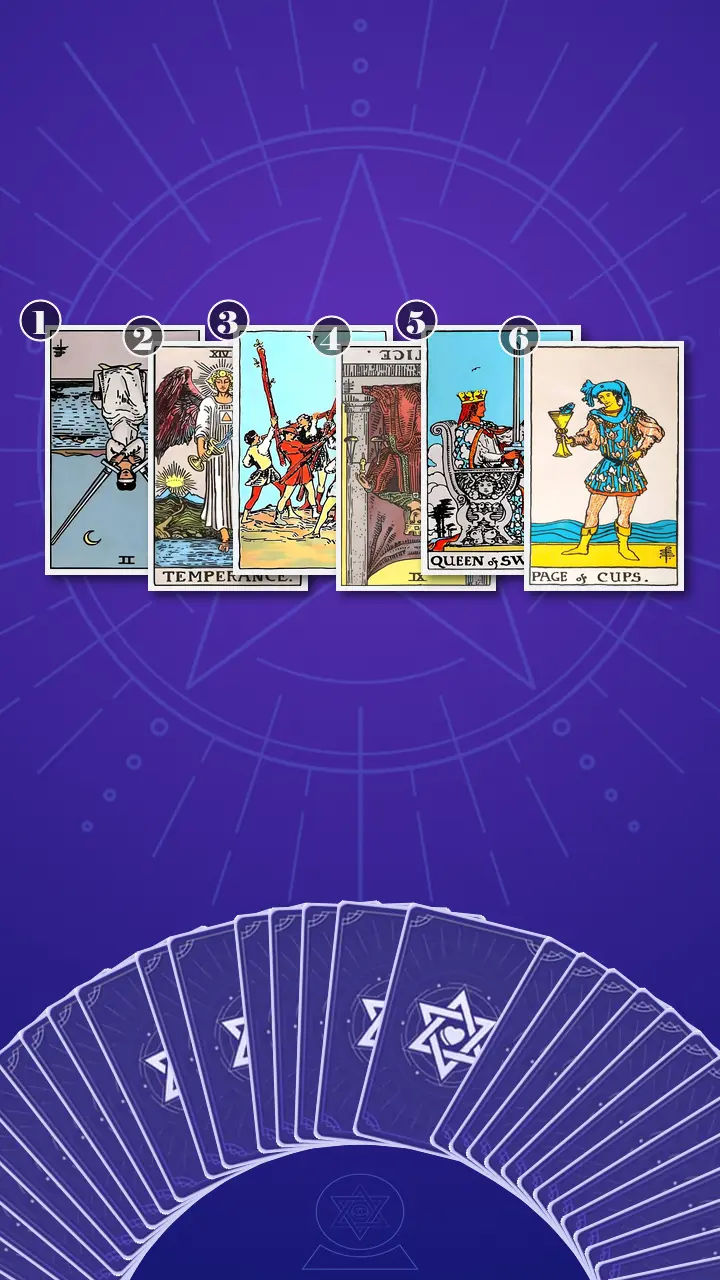
The Closed-Throat Map
Position 1: The Truth Stuck in Draft Mode
'Now turning,' I said, 'is the card representing the observable self-silencing behavior named in the diagnosis: agreeing, editing messages, or mediating before stating a personal position.' In the standard relationship position, this is the querent's present stance within the dynamic.
I turned over the Two of Swords, in reversed position.
The blindfold and crossed swords were almost a literal photograph of Maya's Notes app. She already knew what she wanted to say, but the honest version stayed behind the screen while the socially acceptable version went into the group chat. The two swords became the options she kept holding against her chest: speak and risk discomfort, or agree and keep the room calm. The reversed Air showed a blockage becoming visible through delayed replies, 'whatever works,' and resentment that arrived only after the conversation had ended.
'This is a decision stuck in draft mode,' I said. 'You are not missing information. You are running the sentence through an internal approval algorithm until nobody could object to it. The short-term quiet feels like safety, but it also means your actual answer never enters the room.'
Maya gave a small, bitter laugh. First, her breath paused and her fingers stopped moving against the mug. Then her gaze went unfocused, as if she were replaying the message she had deleted on the train. Finally, she exhaled through her nose and said, 'That is almost rude in how accurate it is.' I did not ask her to agree with the card. I said, 'Good. We can stay curious about the pattern without turning it into a verdict about you.'
The reversed Two of Swords also warned me against an overcorrection. Delayed honesty does not need to become one explosive message containing every stored grievance. The first opening is smaller: ten seconds, one preference, and no compromise until your own position has been heard by you.
Position 2: The Peacekeeper with Both Cups
'Now turning is the card representing the peacekeeper identity and the protective strategy you use to manage other people's comfort before naming your own position.'
The card was Temperance, in upright position.
I saw Maya at a Wednesday lunch in her creative office, listening to two coworkers complain about the same project from opposite sides. Her coffee went cold while she translated each complaint into language the other person could accept. She opened Google Docs and built a compromise before either coworker had asked what she thought. The angel pouring between two cups reflected a genuine relational talent: Maya could hear several needs at once and blend them into something workable.
But upright balance does not automatically mean mutual adjustment. In Maya's version, one cup contained everyone's preferences and the other was expected to keep receiving. The question was not whether she should stop caring about other people. It was whether her own ingredient was ever added to the mixture. Her shoulders remained slightly lifted when she said, 'Both points make sense,' because her opinion was still waiting outside the conversation.
As I looked at the quiet landscape behind Temperance, I thought of the Highland streams my family has watched for generations. A stream can receive water from several directions without becoming responsible for the weather above every hill. I told Maya, 'Your ability to translate is real. The practice now is to stop confusing translation with disappearance.'
She lowered her eyes to the two cups and rubbed her thumb over the mug's chipped rim. There was relief in being told that her peacekeeping was a strength, followed by a quieter recognition that a strength can still become expensive when only one person keeps adjusting.
Position 3: The Meeting Nobody Appointed You to Control
'Now turning is the card representing the interaction field around you: competing voices, disagreement, and the cues you read as a threat to belonging.'
I turned over the Five of Wands, in upright position.
The five figures raised their wands at different angles, creating a crowded field with no clear victor and no commanding center. I connected it to the 3:17 PM meeting Maya had described near King Street West. Five coworkers talked over one another about a launch deadline. The projector fan hummed, a pen tapped against the glass table, and Maya opened a blank document to consolidate the plan rather than say that she thought the timeline was unrealistic.
'This is visible friction,' I said. 'It is not automatically a catastrophe. Five people can have five priorities without the whole project, friendship, or family system being on fire. No one has appointed you to hold every piece still.'
Maya's internal sentence came out before I asked for it: 'If I add my view, I become one more problem to manage.' I placed a finger near the overlapping wands. 'That thought treats disagreement as evidence of rejection. The card offers another reading: different needs are present, and the information is still being negotiated.'
Her shoulders dropped by a fraction. She looked toward the window, then back at the card, and said, 'There was a meeting last month where nobody even asked me to fix it. I just volunteered before anyone could be disappointed.' The change was small but important. She was beginning to distinguish an actual request from the reflex to become the room's emotional project manager.
Position 4: The Private Fairness Ledger
'Now turning is the card representing the hidden cost and blind spot beneath the pattern: the unfair exchange created when other people's comfort counts as legitimate evidence but your truth is left off the scale.'
The card was Justice, in reversed position.
I brought her to the Sunday evening scene in her apartment. She had agreed to cover a friend's task because refusing felt awkward. The kettle clicked off, rain touched the window, and she opened a note listing every concession she had made. Her stomach dropped when she realized the agreement had been called fair because everyone else accepted it.
'I called it fair because nobody else objected,' Maya said quietly. 'But my limit was never part of the calculation.'
The reversed scales showed the distortion clearly. Maya was weighing other people's schedules, feelings, disappointment, and convenience while leaving her own time and capacity outside the frame. A compromise is not automatically fair when your need never made it onto the scale. The reversed sword also showed what happened afterward: instead of making her limit visible before agreeing, she kept a private prosecution file of every sacrifice.
I told her that the answer was not to build a more detailed case against the people around her. That would simply turn self-silencing into silent scorekeeping. The clearer move was to write, 'What is fair to me?' before accepting a request, then let the answer become part of the conversation.
Maya pressed one hand lightly against her stomach. Her face tightened first, then softened as she nodded. 'I keep waiting for people to notice what I have given up,' she said. 'But I keep making the agreement without telling them what it costs.' The loneliness in the sentence was precise, not theatrical. It was the loneliness of being excluded from her own fairness calculation.
When the Queen of Swords Let Clarity Set the Boundary
Position 5: The Antidote with an Open Hand
The room grew quieter as I moved to the card just right of center. 'We have reached the advice position, the place where the reading offers a truth-and-boundary practice that challenges the fear of disrupting everyone's peace.'
I turned over the Queen of Swords, in upright position.
The Queen's upright sword and raised open hand gave Maya the exact tension she needed: precision in the words, non-aggression in the delivery. I offered the sentence, 'I understand that this matters to you, and I am not available to take that on tonight.' It was not a punishment, a threat, or a demand that the listener agree. It was a complete piece of information.
This was where I used my signature Somatic Shadow Sensing. I do not use it to diagnose anyone. I use it as a way of noticing where chronic mental fatigue and unexpressed emotion have become physically trapped within the body's architecture. I asked Maya to observe her throat, jaw, chest, and hands as she imagined saying the sentence. Her throat tightened first; then her chest braced, as if clarity itself were an object she had to hold up for everyone else.
'Your body is showing you the old contract,' I said. 'It does not mean the sentence is wrong. It means your nervous system has learned to treat another person's possible reaction as your assignment. Clear is not cruel; clear is complete.'
At 8:42 PM, the direct sentence sat in Notes on the warm phone in Maya's hand. Her throat had tightened before anyone objected, yet she changed it to 'I am flexible, whatever works.' The quiet arrived, and with it the familiar loneliness of being the only person who knew what she meant.
Peace is not the same as silence; like the Queen of Swords' upright blade, I can name what is true and let clarity set the boundary.
For a moment, Maya's face went still. Her breath stopped halfway, and her fingers hovered above the edge of the card. Then her eyes lost focus as the five softened drafts seemed to replay behind them, each apology protecting the room while leaving her alone with the truth. A small flush rose beneath her eyes. Her jaw unclenched, her shoulders lowered, and the fist she had made in her lap opened one finger at a time. She let out a shaky breath that sounded almost like surprise. With the release came a brief, dizzying blankness, the vulnerability of realizing that a clear path still required her participation. She was not suddenly fearless. She was no longer mistaking fear for an instruction.
I asked, 'Now, use this new perspective to think back over last week: was there a moment when this insight could have made you feel different?'
Maya named a Saturday planning chat. She had wanted an afternoon meeting, had said any time worked, and then spent an hour trying to make the group choose the option she preferred without having to ask for it. 'I could have said the truth and let the pause belong to everyone,' she said.
I reminded her that the Queen of Swords was not asking her to become hard, cold, or permanently available for other people's disappointment. The key message was simpler: she did not have to trade honest speech for belonging. Respectful clarity would give her information about mutuality. It would show whether a connection had room for her full reality, without promising that every conversation would be comfortable.
This was the first real movement in the emotional transformation from hypervigilant social scanning and held-breath agreement to clear, respectful truth-telling, self-trust, and more mutual connection. The Queen did not remove uncertainty. She returned ownership of the next sentence to Maya.
Position 6: The Small Feeling That Enters the Room
'Now turning is the card representing the lesson and direction available from this dynamic: a one-week, self-directed experiment that lets one emotionally honest message enter a relationship without deciding the relationship's entire future.'
The final card was the Page of Cups, in upright position.
The fish emerging from the cup looked surprising but manageable, like an unexpected notification from Maya's own emotions that she could open instead of swipe away. I connected it to the message she had not yet sent: 'I felt overlooked in that conversation, and I would like to talk when we both have space.' The Page did not ask her to prove the feeling, predict the response, or negotiate the whole relationship in one paragraph.
Upright Water softened the Queen's Air into a human sentence. Clear boundaries could remain warm. Emotional openness could remain specific. I told Maya, 'Let the message be a low-stakes beta test for mutuality. Share one real piece of information and observe what the connection does with it. You are not deciding the outcome in advance.'
Maya smiled, then immediately reached for her phone before setting it back down. 'I want to send it now,' she said. 'But I also want to rewrite it until it becomes impossible to misunderstand.'
'That urge is part of the map,' I said. 'One fact, one feeling, one invitation. Then stop. A message does not need to contain your entire defense brief in order to be true.'
Finding Clarity in One Accurate Sentence
When I placed the six cards side by side, the story became practical. The Two of Swords showed a truth held in suspension. Temperance showed that Maya had a real talent for translating between competing needs, but had started treating her own needs as an ingredient that could be diluted. The Five of Wands showed the ordinary friction that triggered her scanning. Justice reversed revealed the hidden cost: she called silence fair because everyone else had accepted it. The Queen of Swords restored discernment, and the Page of Cups carried that discernment into a gentle, emotionally specific message.
The blind spot was not a lack of kindness. It was the assumption that immediate harmony proved safety, while another person's discomfort automatically became Maya's responsibility. I named the shift plainly: she could be considerate without making her silence the price of connection. Disagreement might still feel uncomfortable, but discomfort could become information about mutuality rather than proof of rejection.
Before we chose an action, I taught Maya my Grounding Transmutation Ritual. When rumination starts building a second meeting inside her head, she places both feet on the floor, presses her toes gently downward, names three things she can see, notices the temperature of a mug or the edge of a table, and takes one longer exhale. If the setting feels safe, she steps outside for ninety seconds and feels the ground beneath her shoes. The point is sensory and physical: to let excessive mental static discharge into contact with the earth, restoring bodily presence before another edited message takes over.
'Let one clear sentence arrive before the compromise does,' I told her. 'Choose a low-stakes place to practise. You remain in charge of whether you send, save, revise, or stop.'
- The Ten-Second Truth PauseBefore agreeing in one low-stakes group chat or conversation this week, pause for ten seconds and write, 'My actual preference is...' Then say only that preference first, such as, 'I would rather meet Saturday afternoon,' before offering any compromise. Afterward, record three words: what you said, what the other person did, and what your body felt.Use one slow exhale or a phone timer as the cue. Choose a restaurant, meeting time, or weekend plan rather than a high-stakes relationship issue. You can stop after naming the preference; the other person's reaction remains theirs to manage.
- The Fairness Scale CheckAt the next automatic yes, open a note titled, 'What is fair to me?' Write one concrete limit before confirming a work request, friend plan, or hosting task. Check whether the proposed arrangement includes that limit, then send one boundary such as, 'I can help for one hour,' 'I need two days to decide,' or, 'I am not available to host.'Draft the message in Notes, remove one apology, and wait two minutes before sending. If the situation feels unsafe, coercive, or materially risky, choose a safer context or seek practical support. You decide what information and access to share.
- One Fact, One Feeling, One InvitationChoose one feeling from the past week that you translated into logistics, such as, 'I felt left out,' 'I was disappointed,' or, 'I need more notice.' Use the Grounding Transmutation Ritual first, then send a short Page of Cups-style message to one reasonably safe person: 'I noticed I felt ___ when ___. I would like to talk about it when we both have space.'Set a ten-minute drafting limit and keep only one fact, one feeling, and one invitation. Do not predict the response or negotiate the entire relationship in the first message. You can save the message, send it later, or decide not to send it.
I asked Maya to choose only one practice for the first week. The goal was not to become direct in every conversation or to solve a lifelong pattern in one brave performance. The goal was to give her body one small experience of speaking before managing, then let that experience become evidence she could evaluate for herself.

A Quiet Proof in the Group Chat
Six days later, Maya sent me a message from a coffee shop near the subway. She had used the ten-second pause before replying to a Saturday group plan. Her Notes app contained one sentence: 'My actual preference is Saturday afternoon.' She sent it without the apology paragraph and placed her phone face down. A friend replied that Saturday afternoon worked, while another person chose a different time. Nobody asked Maya to mediate, and she did not volunteer to rewrite the plan.
She slept a full night, but woke with the familiar thought, 'What if they are annoyed?' This time she noticed it, smiled without arguing with it, and made coffee before replying.
That was not a perfect ending. It was better evidence: Maya had named a preference, allowed other people to have their own reactions, and remained present in her body while the group made its decision. The cards had not granted permission. They had helped her see the difference between a prediction and a fact, then she had chosen what to do with that clarity.
Our Journey to Clarity moved from scanning the room to naming a preference, from held-breath agreement to self-trusting communication. The peacekeeper did not need to disappear. She needed to become a participant in the relationship, with a voice, a boundary, and a feeling that could arrive before the compromise.
When you hold your breath, soften the message, and wait for everyone else to be okay before admitting you are hurt, the room may feel peaceful, but you are still the one carrying the truth alone. Noticing that is already a small form of finding clarity.
If you let one honest, respectful sentence exist without pre-managing the reaction, what would you be curious to notice about yourself and the connection?