Closing the Comparison Tabs and Returning to One Piece of Craft

Finding Clarity in the 10:40 p.m. LinkedIn Spiral
If you are a junior product designer who has opened LinkedIn after a long workday, seen a former classmate announce a promotion, and immediately checked your own portfolio, I suspect you will recognise the moment Maya described to me.
At 10:40 p.m. on a Tuesday, she had been halfway through a Figma case study in the kitchen of her shared Toronto flat. The fluorescent light buzzed above ten unfinished frames. Then a promotion post appeared, bright with reaction icons and congratulatory comments, and her phone began to feel hot against her palm.
“I can feel happy for her, and still immediately start building a case against myself,” Maya said. “I closed Figma, opened her profile, then three portfolios and my career spreadsheet. An hour later, I had done nothing except prove to myself that I was behind.”
As she spoke, I watched her jaw set before her voice changed. Comparative inadequacy did not sit in her mind as a neat thought; it moved through her like a metal ruler tightening across her chest, then travelled into restless fingers that wanted another tab, another salary range, another piece of evidence.
The contradiction was painfully clear. Maya wanted to witness other people's growth without diminishing her own, yet every visible milestone seemed to arrive carrying an invisible question: if they are moving, what does that say about me? In Toronto, where rent, independence, and career advancement were practically linked for her, the question did not feel purely emotional. It also sounded like a warning about stability.
“You can be happy for them and still feel the scoreboard switch on,” I told her. “We do not need to shame either response. I want us to see exactly how the scoreboard takes over, what rule keeps it running, and where you still have a choice. Let us make a map of this fog rather than asking the fog to predict your future.”

Choosing the Compass: The Five-Card Shadow Spread
I invited Maya to place both feet on the floor and take one slower breath while holding the question, “Why do I keep treating other people's growth as proof that I am falling behind?” I shuffled slowly, using the pause as a transition out of the browser-tab reflex and into deliberate attention. There was nothing supernatural that she needed to perform correctly.
I chose a classic five-card Shadow Spread. For anyone wondering how tarot works in a psychologically grounded consultation, I use the images as structured mirrors. With a Jungian lens, the shadow is not an evil force or a prediction of what will happen. It is a pattern that has become automatic, partly hidden, or difficult to question because it once offered some form of protection.
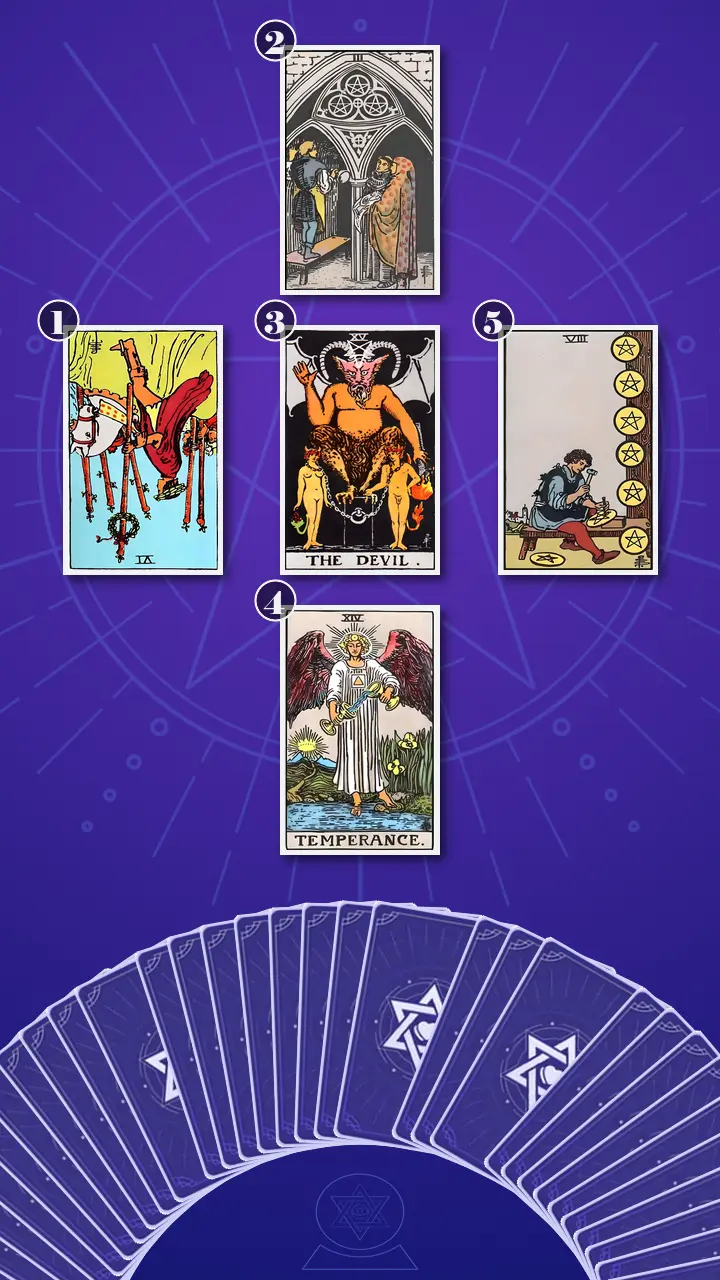
This spread was the smallest map that could preserve Maya's complete loop. The first position would show the comparison pattern in action. The second would identify the external mirror that activates it. The central card would expose the hidden rule about worth. The fourth would offer the corrective quality, and the fifth would translate that insight into a weekly behaviour under Maya's control.
I placed the cards in a cross, with the root at the centre. The layout looked like a compass: symptom to the left, trigger above, hidden attachment in the middle, medicine below, and integration to the right. A larger spread would have added context, but Maya did not need more data. She needed to understand what the data was being made to mean.
Reading the Scoreboard as a Pattern, Not a Verdict
Position 1: When Public Applause Becomes a Private Loss
Now I turned over the card representing the diagnosis in action: Maya converting another person's recognition into evidence that her own progress was inadequate. It was the Six of Wands, reversed.
I pointed to the inverted victory wreath and the crowd. In Maya's life, this was the moment a former classmate's LinkedIn promotion became a private loss. The classmate received visible congratulations; Maya reopened her project list, dismissed her quiet skill development as too ordinary to count, and considered adding several highly visible tasks before finishing the case study already in front of her.
I read the reversal as both a blockage and a deficiency. The healthy desire to be seen was not wrong, but Maya's access to inner recognition had become blocked. Confidence was being outsourced to an audience, so the absence of equivalent applause looked like evidence of failure. The excess appeared in the overcorrection: more posting, more polished presentation, and more visible work, even when those efforts took attention away from genuine development.
“When a public achievement appears, what do you immediately stop doing?” I asked. “And what sentence tells you that your work has suddenly become insufficient?”
Maya gave a short laugh, but there was no amusement in it. She pressed her thumb into the rim of her water glass and said, “That is so accurate it is almost rude. I stop whatever I was doing, and the sentence is, 'You should already have something bigger to show.'”
I let the bitter laugh stand without trying to turn it into instant positivity. The card was not accusing her of being jealous or ungrateful. It was showing how quickly recognition scarcity changed the instruction from “continue your work” to “prove that you deserve to be seen.”
Position 2: The Finished Portfolio and the Missing Version History
Now I turned over the card representing the recurring trigger: peers demonstrating visible skill, collaboration, recognition, or career development. It was the Three of Pentacles, upright.
I told Maya that this card mattered because it did not dismiss her perception. The peer's growth could be real. A polished case study, supportive collaborators, a clear presentation, and expertise recognised inside a professional community were all legitimate achievements. The comparison began when Maya placed that finished structure beside her own version history, client constraints, unanswered questions, and half-built frames as if the two sets of evidence were equally complete.
The Three of Pentacles carried balanced Earth energy here. It represented competence becoming visible through practice and collaboration. The problem was not an excess in the card; it was what happened when Maya's reversed Six of Wands converted someone else's craftsmanship into a universal ranking.
“Before your mind judged your whole timeline, what did you actually admire in the post?” I asked.
Her eyes moved away from the cards. For a few seconds, I could see her replaying the promotion post rather than the story she had built around it. “Her research storytelling,” she said. “She makes complicated decisions look clear. I did actually want to learn that. Then I somehow turned it into proof that I was bad at everything.”
I nodded. The distinction was small but important. She had seen one specific quality, then the scoreboard had expanded it into a global verdict. It was like comparing someone else's polished Figma prototype with every unresolved layer in her own file and calling the result objective.
The Browser Tabs That Behaved Like Loose Chains
Position 3: The Rule Nobody Officially Gave Her
Now I turned over the central card representing the mechanism beneath comparison: attachment to a ranked model of worth and the fear that another person's gain reduced Maya's value. It was The Devil, upright.
I told her immediately that I did not read The Devil as an omen, punishment, or sign that something bad was coming. In this position, I read it as a blockage created by excess attachment. The image showed a rule that felt absolute because it was familiar and repeatedly obeyed, not because it was true.
The loose chains around the figures were the crucial symbol. In Maya's daily life, those chains looked like LinkedIn tabs, alumni profiles, salary calculators, Behance portfolios, and a Google Sheet that had slowly acquired the authority of a manager. She kept refreshing because the scorecard briefly restored a sense of control. Yet each refresh pulled her farther from the work that could create real momentum.
“If I stop comparing, I might miss how far behind I am,” Maya said quietly.
I noticed her fingers close around the edge of the table. Her breathing paused; her eyes lost focus as if several late-night audits were replaying at once; then she released a low breath and loosened one hand. What she wanted was sustained attention to her craft. What she repeatedly did was interrupt that attention to rank herself. The temporary relief of research was helping to create the lost momentum she later treated as more evidence against herself.
Here I used my Limiting Belief Deconstruction audit, a diagnostic lens I bring to the self-protective mechanisms that often activate when someone is close to growing. I separated the loop into five parts: the trigger was a visible milestone; the hidden rule was “progress is scarce and ranked”; the protective action was urgent career research; the immediate payoff was control; the cost was an abandoned case study and renewed shame.
“The scoreboard feels factual because you keep feeding it data; that does not make its rule true,” I said. “A repeated metric can still be based on a false premise.”
Looking at the card, I thought about a pattern I had encountered across cultures: status symbols change, but borrowed authorities often speak with the same confident voice. In Jungian terms, the shadow-binder gains power when a learned rule is mistaken for natural law. Maya's browser tabs were available to close, but each refresh made the chains feel more official.
I asked, “When the information has stopped helping, what frightening conclusion are you trying not to feel?”
Her answer came after a long silence. “That I am becoming irrelevant before I have even had the chance to become good.”
I did not argue with the fear or reassure her with a promise about her career. I told her that the fear deserved to be heard as a fear, but it did not deserve promotion to the status of evidence. The loose chains preserved the most important fact in the reading: Maya still had agency, and recognising the mechanism was not the same as blaming herself for having developed it.
When Temperance Kept Both Cups
Position 4: The Medicine of Inspiration Without Self-Erasure
The radiator stopped clicking as I reached for the fourth card, and the room became unexpectedly still. A thin line of condensation moved down Maya's water glass while I turned over the card representing the key transformation from comparative scorekeeping to a balanced, self-directed pace. It was Temperance, upright.
I read this card as Balance: patient self-regulation, proportionate thinking, and the ability to hold two realities without forcing them into opposition. In Maya's life, Temperance was the moment she noticed a peer's milestone, separated admiration from self-judgement, and adjusted one part of her own plan without discarding the pace, constraints, or priorities that belonged to her actual life.
One cup held the specific skill she admired. The other held her own resources, commitments, unfinished process, financial reality, and chosen direction. The water between them represented filtering, not copying. She could keep a useful insight without importing the peer's entire timeline into her identity.
At first, Maya was still caught inside the demand to make the “correct” interpretation. If she felt envy, she assumed she was being unkind; if she admired the achievement, she assumed she had to imitate it; if she kept her own pace, she feared she was choosing denial. Temperance interrupted that false set of options.
I brought in my Imposter Syndrome Decoding lens to separate Maya's authentic potential from the fear of being found out as late, less talented, or less deserving. Her potential had observable evidence: the skills she was practising, the feedback she had applied, and the case study she kept returning to. The fear could speak, but it did not have to chair the meeting.
You do not have to empty your cup because someone else's is filling; Temperance asks you to blend inspiration with your own pace and keep both feet in your actual life.
For one beat, Maya did not move. Her breath stopped halfway in, her fingers suspended above the water glass. Then her gaze slipped past me and settled on the card as if she were replaying every promotion post that had made her abandon an evening. Her pupils widened; the muscles around her mouth tightened; a trace of colour rose beneath her eyes. “But doesn't that mean I have been doing this wrong for years?” she asked, the first words sharper than anything she had said before. I heard anger underneath them, followed by grief. I told her, “It means you found a strategy that offered control and now costs too much. Seeing that is not a verdict on your past self.” Her shoulders lowered slowly. The hand gripping the glass opened, one finger at a time. She exhaled with a small tremor, then gave a half laugh that sounded relieved and unsettled at once, as if putting down a heavy bag had left her briefly unsure what to do with her empty hands.
“Now, using this new perspective, think back: was there a moment last week when this insight might have made you feel different?” I asked.
Maya remembered a design review in which a colleague's research presentation had received careful praise. She had admired the colleague's narrative structure, then spent the train ride home searching advanced courses and rewriting her entire quarterly plan. “I could have kept the storytelling idea and left the rest,” she said. “I did not need to turn one good presentation into an emergency.”
I asked her to imagine the same feed with a different instruction. After one trigger, she could write two lines: “What I specifically admire is...” and “The one piece of my work I choose to return to is...” Then she could close the feed and spend ten minutes on only that piece. If writing made the reaction more intense, she could stop, leave the page blank, or step away from the trigger entirely. Continuing was never a test of discipline.
“Their milestone is information about their path, not a verdict on your worth,” I said. This was the key crossing in Maya's emotional journey: not instant confidence, but a first move from comparative inadequacy and compulsive scorekeeping toward grounded self-trust and self-directed pacing.
Position 5: One Pentacle, One File, One Return
Now I turned over the final card representing practical integration: a weekly practice focused on Maya's own craft, effort, and controllable evidence of growth. It was the Eight of Pentacles, upright.
I drew her attention to the craftsperson focused on a single pentacle while the town remained in the distance. In Maya's life, this was closing the comparison tabs, choosing one section of her case study, and applying one piece of feedback or clarifying one design decision before checking anyone else's portfolio.
I read the card as constructive, balanced Earth energy. It did not promise a promotion, public recognition, or a permanently comparison-free mind. It offered something more reliable: a repeatable unit of practice. Maya could measure whether she completed a section, applied feedback, clarified a decision, or learned something she could use again.
The Eight of Pentacles also answered the reversed Six of Wands. The reading had begun with wreaths displayed before a crowd and ended with hands absorbed in craft. Recognition was not rejected; it was moved out of the driver's seat. “A small piece of work still counts when nobody is clapping yet,” I told her.
Maya looked at the unfinished case study screenshot on her phone. This time, I did not see her open another portfolio for comparison. She named the research section and said, “That is the pentacle I keep walking away from.”
The Signal-to-Scoreboard Filter
When I drew the five cards together, I could see one coherent story. A learned rule had taught Maya to associate visible progress with worth. The reversed Six of Wands showed the symptom: someone else's applause became evidence that her quieter work did not count. The Three of Pentacles showed the honest trigger: peers were developing real skills, often with support and context she could not see. The Devil exposed the hidden attachment: Maya treated growth as scarce, ranked, and fast enough to prove value. Temperance restored proportion, and the Eight of Pentacles returned her attention to one piece of craft she could actually touch.
The elemental movement reinforced the same point. Blocked Fire began as urgent ambition and the wish to be seen. Earth then hardened into status metrics. Temperance introduced Water, creating enough emotional space to filter the trigger, and the final Earth card grounded that pause in practice. I also noticed that no Swords card appeared, despite Maya's intense analysis. To me, that absence was instructive: she did not need another round of comparative data. She needed a clearer frame for the data already in front of her.
Her blind spot was not simply that she compared herself. It was that she treated repeated data collection as neutral career research, even after it had become a ritual for managing fear. She was running on a treadmill while watching everyone else's distance counter; every glance interrupted her stride, and the interruption was then recorded as proof that she could not keep up.
The direction of change was specific: replace comparative timeline audits with one weekly measure of progress chosen by Maya. Not a new productivity leaderboard. Not a demand to feel generous about every announcement. One measure based on a skill, action, or value she could practise inside her real life.
Keep the skill you admire. Drop the timeline you borrowed.
When I suggested a ten-minute return to her case study, Maya raised a practical objection. “But on nights like Tuesday, I honestly feel as if I cannot spare ten minutes. I have already lost an hour, I am angry with myself, and then ten minutes sounds embarrassingly small.”
“Then ten minutes is not the minimum,” I replied. “The minimum can be putting the phone down, taking three breaths, and making no decision about your career that night. A tool that becomes another punishment is no longer serving you.”
- The Cognitive Reframing Protocol On Monday, Maya will write one self-chosen weekly measure at the top of a Notion page, such as “complete the research section of my case study.” When a peer milestone triggers the scoreboard, she will give herself two minutes to record four short lines: the observable fact, the scoreboard story, the useful signal, and one risk-managed next action. For example: “A classmate was promoted. My story is that I am late. I admire her research storytelling. I will revise one research slide for ten minutes.” On Friday, she will review only her chosen measure before opening LinkedIn. Keep each line to one sentence. This is a fear-to-data exercise, not a new performance tracker. If it increases distress, close the page and take distance from the post.
- The One-Pentacle Practice Maya will block one 25-minute session in her calendar and name the exact file and section in the event title. Before starting, she will close LinkedIn, salary calculators, alumni pages, and unrelated portfolios, leaving only the Figma file and one reference document open. When the timer ends, she will record one concrete note about a decision clarified, feedback applied, or question identified. On a difficult day, use the five-minute version: open the file, name the section, and improve one sentence, screen, or research insight. Stop when the timer ends if continuing would turn practice into punishment.
I told Maya that these were experiments, not moral obligations. She could adjust them, skip them, or decide that muting the feed was the kinder boundary on a particular day. Tarot had made the loop visible, but it did not get to command her. The next step belonged to her.
A Week Later: The Same Feed, a Different Instruction
Six days later, Maya sent me a short message from the TTC. A former classmate had posted a polished product launch, and she had felt the same first sequence: chest tightening, jaw setting, thumb moving toward the profile. The feeling had not disappeared.
This time, she opened the note instead of the portfolio tabs. She wrote, “I admire how clearly they explain trade-offs,” followed by, “I am returning to the decision section of my own case study.” At home, she set a ten-minute timer. Her phone cooled on the kitchen table while her hands returned to the keyboard.
She finished one screen and slept through the night. Her first thought the next morning was still, “What if I am late?” She noticed it, smiled once, and opened Figma before LinkedIn.
I did not read that as a solved life or a permanent victory over comparison. I read it as quiet proof of the real Journey to Clarity: the trigger arrived, the scoreboard switched on, and Maya discovered a small space in which she could choose the next instruction. The cards had offered a mirror. She was the one who returned her attention to the work.
If tonight someone else's applause tightens your chest and sends your hands toward a career spreadsheet, I want you to remember how easily their movement can feel as though it has taken something from you, even while part of you is still trying to build a life at its actual pace. Simply noticing that the scoreboard has switched on means it is no longer operating entirely outside your awareness.
If their good news could remain theirs, and you did not have to empty your cup to make room for it, what is the first small piece of your own craft you would let your attention touch?