The Tuesday Kitchen Where Everything Got Loud
Jordan came to me with a question that already sounded like a search-bar confession: spoiled groceries, full inbox, muted chat—why do I shut down? It was exactly the kind of overwhelm freeze, ordinary-task paralysis, and life admin shame that I reach for The Shadow Spread to untangle.
If you keep promising yourself a full reset on Saturday, then order takeout beside groceries you bought with good intentions and wonder why adulting feels weirdly impossible lately, you would have recognized them instantly. Jordan was 28, living alone in downtown Toronto, working a hybrid customer success job, fully capable of handling client conversations all day—and somehow unable to open their own inbox after 7 p.m. once the unread badge started to feel personal.
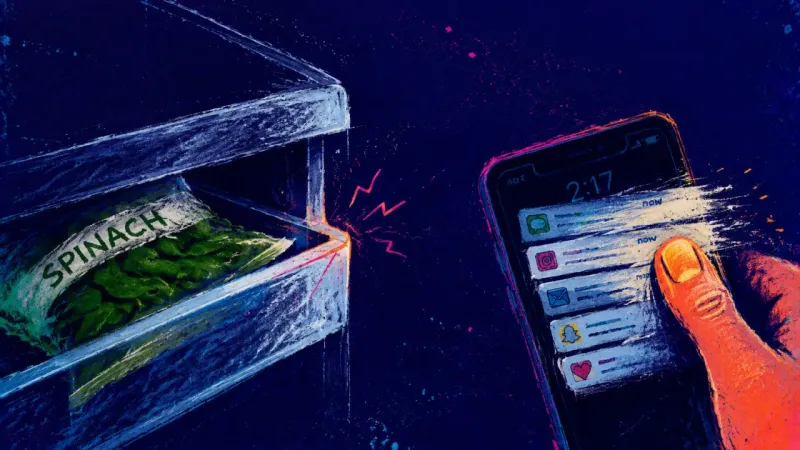
They described Tuesday at 7:40 p.m. so clearly I could practically hear it with them: a small apartment kitchen, an Uber Eats bag sweating onto the counter, soy and garlic hanging in the air, the low fridge hum, the cold LED light flattening everything blue. A bag of spinach had gone slick in the crisper. Six Slack banners stacked across their phone. Jordan cleared the notifications without opening them, half-closed the fridge door, and felt their shoulders shoot upward so fast it was like their body had heard a fire alarm before their mind had caught up.
“I know these are small tasks,” they told me, looking half annoyed with themselves and half tired of hearing themselves say it. “Which somehow makes me feel worse.”
I could already see the core contradiction at work: one part of Jordan wanted daily life to stay manageable and responsive; another part could not bear opening the backlog because it felt like opening evidence. Their overwhelm was not vague. It sat on them like wet winter denim—heavy, cold, and weirdly hard to peel off once it touched skin. Groceries, email, and messages had stopped being tasks and started behaving like witnesses.
I answered the way I always do when shame is trying to masquerade as a personality flaw. “Then we’re not here to bully the shutdown,” I said. “We’re here to understand its logic. Let me help us draw a map through this fog, and then we’ll find clarity one real contact at a time.”

Choosing the Map: The Shadow Spread for Overwhelm Freeze
I asked Jordan to put both feet on the floor and take one slow breath with me—in for four beats, out for six. That is one of the ways I work with sound. Not as a dramatic ritual, and definitely not as theatre. More as a nervous-system metronome. While I shuffled, I listened to the room settle: distant traffic below the window, the radiator’s small click, the whisper of card edges against my hands. Ordinary sounds can be excellent anchors when your mind is already running a worst-case trailer.
For this reading, I chose The Shadow Spread, a tight four-card layout I use when someone is not asking which option to choose, but why everyday life itself has started triggering avoidance. It’s one of the clearest tarot spreads for overwhelm freeze and backlog dread because it does not overload the person with more inputs. Instead, it moves in a straight line: visible symptom, hidden fear, healing resource, practical next step. A larger spread like the Celtic Cross can be powerful, but in a case like this it can accidentally recreate the very overwhelm we’re trying to understand.
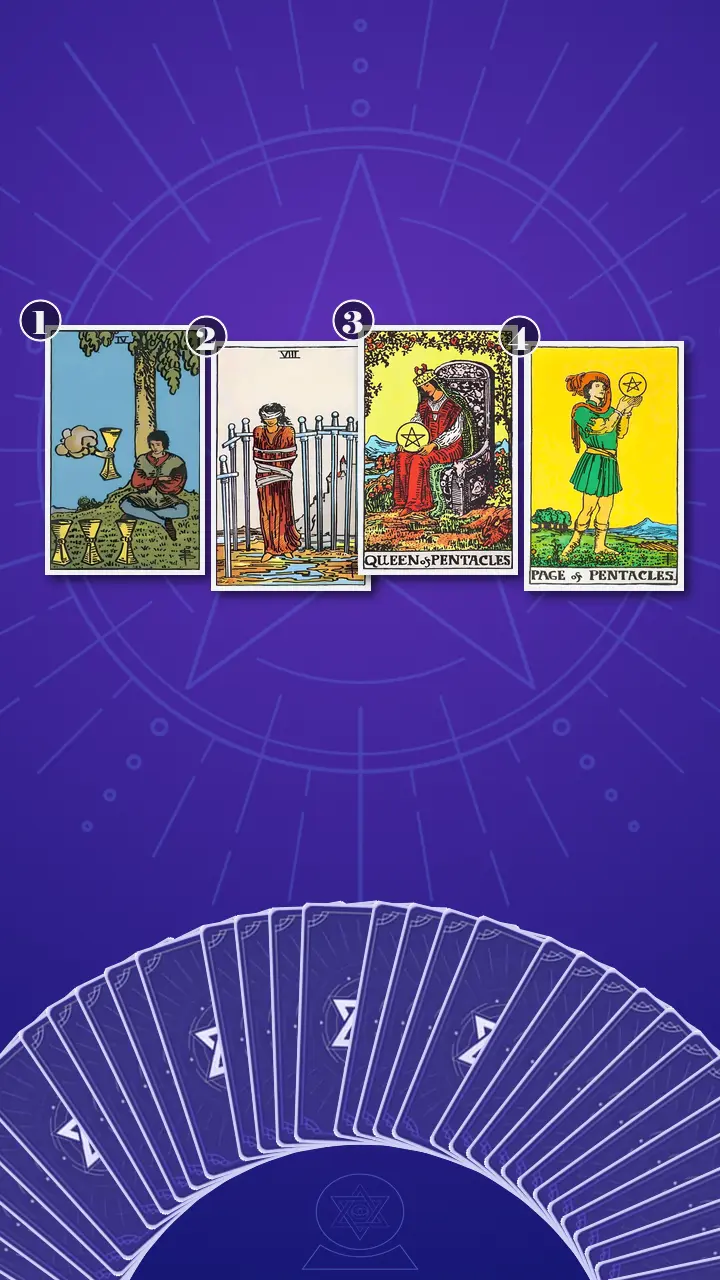
I told Jordan exactly what each position would do. The first card would show the visible shutdown pattern: what this looks like in the fridge, inbox, and muted chat thread. The second would reveal the shadow driver—the all-or-nothing mental story under it. The third, our key card, would identify the inner medicine: the quality that makes re-entry feel safe enough to begin. And the fourth would translate all of that into one small, concrete next step.
I laid the four cards in a line from left to right, like stations on a TTC route. I wanted the eye to travel steadily across them, not all at once. When someone is used to turning life into one giant blob called catching up, even the layout has to model manageable scale.
Reading the Row from Withdrawal to Re-Entry
The Phone Turned Face Down
I turned the first card. This position presents the visible shutdown pattern described in the case: disengaging from groceries, emails, and chats once they start to feel emotionally loaded.
Four of Cups, upright.
In modern life, this is the exact moment after work when you notice the wilted greens, the stacked notifications, and the easy reply sitting right there—but instead of touching any of it, you go emotionally offline. You swipe away the banners, close the fridge, and tell yourself you’ll deal with everything later, because distance feels safer than contact. The crossed arms on the card become the modern micro-gesture of turning the phone face down, clearing a banner without opening it, or leaving the fridge half-shut as if the door itself can hold back the feeling.
The energy here is a mix of deficiency and excess: not enough willingness to make contact, and too much protective withdrawal. That matters. It means the shutdown begins before the task is objectively big. The offered cup is still small, reachable, almost boring—and the body still says no. That’s why muted is not always indifference; sometimes it’s what overwhelm looks like on a phone screen.
I asked Jordan, “When did this most recently show up in a painfully ordinary moment—the fridge, the inbox, or the chat thread?”
They gave a quick laugh that landed with a bitter edge. “That is accurate enough to be rude,” they said. Their thumb rubbed the rim of their water glass, stopped, then rubbed it again. I watched the usual thing happen: recognition lowered defensiveness faster than reassurance ever could.
When One Email Becomes a Trial
I turned the second card. This position reveals the hidden fear and all-or-nothing mental story that keeps the shutdown cycle in place.
Eight of Swords, upright.
This is what it looks like when you preview an email or text and instantly imagine chain reactions: more replies, more tasks, more proof that you’ve let things slide. So you close the tab, bounce to Slack, then Notes, then the weather app, then Instagram Stories, and stay trapped in anticipation instead of reality—even though one small step is still available. The blindfold is backlog-previewing without reality-testing. The loose bindings are the fact that the situation feels more total than it actually is.
The energy here is pure blockage: air without movement. When I see this card, I don’t think lazy. I think overbound. After years in radio, I’ve learned that when feedback squeals in someone’s headphones, they often think the whole system is broken. Usually it isn’t. One level is just too high. Eight of Swords feels exactly like that: a mind acting like an algorithm that only serves worst-case previews before you’ve even opened the app.
I leaned in a little and said, “Backlog is a list, not a verdict. But your mind has been translating one unopened thing into a total judgment of your competence. Since when did opening one email become emotionally equivalent to standing trial?”
Then I asked the question this position always wants answered: “The last time you hovered over an unread message or saw spoiled food, what was the first sentence your mind started writing after the words if I open this…?”
Jordan’s reaction came in three quiet beats. First, their breathing paused, like their ribs had forgotten the next cue. Second, their eyes drifted off the cards and unfocused on the dark window, the way people look when a private memory starts replaying behind the face. Third, they exhaled through their nose and said, very softly, “If I open one thing, I lose the whole night.” Right after they said it, their jaw unclenched. That was the mechanism naming itself.
When the Queen Held a Single Pentacle
The Inner Adult Arrives
By the time I reached the third card, the atmosphere had changed. The first two cards carried that gray-blue screen-light feeling—withdrawal, narrowing, tab-switching panic. Then the warmer tones of the pentacles entered. The lamp at my side caught the gold on the card, and suddenly the row looked less like a panic loop and more like a way through. This position identifies the inner medicine needed to challenge the fear: grounded care, manageable scale, and self-worth not tied to catching up perfectly.
Queen of Pentacles, upright. This was the key card of the reading—the antidote.
Before I interpreted her directly, I used one of the tools that has become second nature to me through music therapy. I call it Music Pulse Diagnosis. I asked Jordan what they had been listening to lately—not because playlists predict fate, but because stress often tells the truth through tempo before it agrees to say anything useful in words.
They gave me a sheepish smile. “Focus playlists at work. Then kind of numb, bassy stuff on the commute home. And brown noise at night if my brain won’t shut up.”
That told me exactly what I needed to know. Their nervous system was living between two soundtracks: perform and disappear. Hyper-functional by day, emotionally offline by night. The Queen of Pentacles offered a third tempo entirely—steady, domestic, embodied, human. Not the polished TikTok Sunday reset montage. Not the crash. Just one real thing held close enough to care for. In modern life, she looks like throwing out the bad spinach, washing one dish, or sending one warm, honest message before your brain can turn the whole evening into a referendum on whether you’re a competent adult.
I brought Jordan back to the Tuesday-night version of themself: takeout on the counter, wilted spinach in the drawer, Slack lighting up the phone, and that instant thought that opening one thing would somehow cost the whole evening.
Your unread counts are not a moral verdict; hold one pentacle at a time, and let grounded care replace the crossed-arm freeze.
I let the sentence rest between us.
Jordan did not look relieved at first. Their reaction came in layers. First came the freeze: one blink, then another, like the meaning had landed faster than their emotions could sort it. Then came resistance, sharp and almost angry. “But if that’s true,” they said, voice tightening, “then I’ve been letting groceries and emails decide what kind of person I am.” Their fingers curled into the sleeves of their sweater. Then the deeper shift arrived. Their shoulders dropped. Their mouth pulled into the smallest, disbelieving half-smile. Their eyes went bright—not panicked, just a little wet with the strange dizziness that comes after setting down a weight you didn’t realize you’d been bracing against for months.
I nodded. “Yes. And that doesn’t mean you were ridiculous. It means your system has been trying to protect you from shame by avoiding contact. The Queen is the inner adult who replaces the harsh manager in your head. She doesn’t ask whether you deserve to re-enter. She asks what one concrete need is right in front of you.”
Then I gave them the practical half of the insight, because breakthroughs need handles. “What restores control is not a heroic catch-up. It is one small concrete contact that proves the backlog is a list, not a verdict.”
I used my Breath Soundtrack method right there: inhale for four beats, exhale for six, seven times—slow enough that the body stops treating every notification like a snare hit. Then I asked, “Now, from this new angle, was there a moment last week when this would have changed the feeling?”
Jordan swallowed and nodded. “My friend texted, hey, just checking in. I read it from the lock screen and muted it. If I had thought of it as one pentacle instead of a whole guilt spiral… I could’ve just said I was low bandwidth.”
That was the real turn in the reading: from shame-driven shutdown and anticipatory dread to grounded self-trust and steady re-entry. Not perfect confidence. Not a personality transplant. Just the first honest inch of self-trust returning. You do not need a full reset to make real contact.
One Proof Point, Not a Personality Overhaul
I turned the final card. This position translates insight into a practical re-entry step that rebuilds trust through one small completion.
Page of Pentacles, upright.
In real life, this is picking the easiest point of re-entry first: the low-stakes email, the one dish nearest the sink, the grocery item you can still save, the short message that says, “I’m late, but I do want to reply.” The Page studies one pentacle rather than juggling many. That is the exact behavioral shift Jordan needs: stop relating to the pile as a whole, and finish one actual task before deciding what any of the rest means.
The energy here is balanced beginner energy. No punishment sprint. No dramatic identity reboot by midnight. Just modest, repeatable effort. It reminds me of following one stop at a time on a transit map instead of demanding the whole route collapse instantly into your destination.
Jordan gave me the practical objection people often offer the moment a reading becomes real. “But some nights I honestly don’t even have five minutes. Work pings late, and then I’m already cooked.”
“Then we respect real capacity,” I said. “Five minutes is not a moral benchmark. Ninety seconds counts. One-touch tasks count because your nervous system counts them. The point is not intensity. The point is contact before your mind turns everything back into one giant blur.”
I watched that answer land. Their face did something subtle that I trust more than enthusiasm: it stopped arguing with the future. That’s what this Page does. It doesn’t promise transformation by force. It gives you one proof point.
From Insight to Action: The One-Pentacle Re-Entry
When I laid the whole spread back out for Jordan, the story was clean. The Four of Cups showed the visible withdrawal: the half-closed fridge, the phone turned face down, the little disappearances that look minor from the outside and feel loaded from the inside. The Eight of Swords showed the shadow driver: the all-or-nothing story that says opening one thing will reveal everything, and everything will prove you are behind at life. Then the Queen of Pentacles interrupted that story with grounded self-stewardship. Finally, the Page of Pentacles turned the insight into behavior: one low-stakes completion, done on purpose, before the fantasy of a perfect reset day gets to take over again.
The cognitive blind spot was not poor character and not some mystical flaw. It was this: Jordan had been confusing backlog size with personal failure, and dismissing small contact as if it didn’t count. The direction of change was clear—shift from waiting to feel fully ready before engaging to making one contained, concrete point of contact with the backlog. In plain English: stop asking life to become emotionally tidy before you touch it.
I gave Jordan a plan that was practical, touchable, and intentionally unglamorous.
- 7-Minute Fridge TriageTonight in the kitchen, throw out only what is clearly spoiled. If you still have energy, wipe one shelf and stop. This is Queen of Pentacles care: one act of grounded stewardship, not a full kitchen reset.Set a 7-minute timer and use my Breath Soundtrack—inhale for four beats, exhale for six while a kettle hum, soft rain track, or brown noise keeps time. If resistance says this is too small to matter, answer it plainly: small is the point.
- Warm Holding ReplySend one message tonight to one person you care about: “Sorry I’m late replying — low bandwidth week, but I wanted to respond.” Keep it as contact, not a perfect catch-up.This separates contact from cleanup. You are reopening the door, not writing a full defense brief for why you were late.
- One-Touch Inbox PracticeTomorrow, open your inbox with a neutral sound bed on—rain, fan noise, or any track that doesn’t demand feelings—and answer the easiest two-sentence email first. Then close the inbox before you evaluate the rest.My White Noise First Aid rule applies here: one thread, one reply, then stop. Do not reward starting by opening five more tabs. One completion is already evidence.
I reminded Jordan of the real goal because this is where people often slip back into performance. The goal is not to become optimized. The goal is to become reachable to your own life again.

A Week Later, the Quiet Proof
A week later, Jordan sent me a message from Line 1 on the ride home. “Still not inbox zero,” they wrote, “but I tossed the spinach, answered the easiest email first, and finally texted my friend back. I didn’t spiral. I just… did one thing.”
That was enough. Not a makeover. Not some glossy before-and-after Sunday reset fantasy. Just the first real evidence of emotional transformation: from private shame spiral to practical self-trust, from all-or-nothing pressure to manageable scale. Clear but still a little tender. They told me they’d slept through the night for the first time in a while, though the next morning their first thought was still, what if I’m behind? This time, they laughed and opened one email anyway.
This is why I trust The Shadow Spread tarot reading for overwhelm freeze, avoidance, and everyday backlog anxiety. At its best, tarot does not take agency away from the person sitting across from me. It gives the pattern a shape, names the fear without dramatizing it, and returns the next move to human hands.
There is a very specific kind of loneliness in standing in your kitchen with a warm delivery bag, a cold fridge light, and a tight chest, knowing the task is small but feeling like opening it might expose how out of control you really are. If that is where you are tonight, I want you to know that noticing the pattern already means you are no longer fully trapped inside it.
The goal is not to become optimized. The goal is to become reachable to your own life again. So if tonight did not have to be a full reset—just one hand on one pentacle—what would be the smallest thing you’d want to touch first?
This story is adapted from psychological research, written so that those in a similar struggle can see their own pattern in it — and find their next step clearly.These insights are not a substitute for professional psychological, medical, legal, or financial advice.
Learn more about our Journey to Clarity.
How did this insight land for you?
🫂 This Resonates Deeply
🌀 Living This Story
✨ Now I See Clearly
🌱 Seeing New Possibilities
🧰 Useful Framework
🔮 The Confirmation I Needed
💪 Feeling Empowered
🚀 Ready for My Next Step
Author Profile
 AI
AI“Through ten years of sound energy research, I’ve found that when we struggle, it's usually just our internal rhythm falling out of sync under pressure. I know firsthand the frustrating helplessness of wanting to move forward but feeling paralyzed. Without overwhelming theories, I want to be the soothing background track that helps you recalibrate, turning your heavy burdens back into a light, effortless, and harmonious melody.”
In this Introspection Tarot Reading :
Core Expertise
- Mental Noise Cancellation: Diagnosing severe internal friction not as a moral failing, but as a chaotic overlapping of incompatible psychological frequencies.
- Resonance Healing Calibration: Identifying the 'dissonant baseline' of your chronic anxiety and calculating the specific acoustic or rhythmic input needed to soothe it.
Service Features
- The Frequency Reset Pause: A customized rhythmic breathing or acoustic grounding technique to forcefully lower your brainwave state from a frantic beta frequency to a restorative alpha state.
Also specializes in :
Explore Related Patterns:
CatastrophizingJordan’s sentence, “If I open one thing, I lose the whole night,” is the cleanest clue in the case. One email is no longer one email; it becomes a preview of more replies, more tasks, more proof that they have let life slide. Catastrophizing is the cognitive pattern that turns a contained task into an imagined chain reaction before reality testing can happen. The mind starts running a worst-case trailer, then the body responds as if the trailer is the actual event. That is why Jordan closes the tab, clears the Slack banners, or reads a friend’s text from the lock screen without answering; anticipation becomes more powerful than contact. This pattern is especially sticky because it disguises itself as preparation. You feel as if you are accurately seeing the whole consequence field, when the mind is actually collapsing multiple possible outcomes into one total verdict. The repair begins when one task is allowed to stay one task: one thread, one reply, one grocery item, one message, without forcing it to stand in for your whole competence as an adult.
Conditional Self-WorthJordan says the tasks are small, which somehow makes them feel worse. That detail matters because the pain is not only about groceries, emails, or Slack; it is about what those unfinished things seem to say about them. Conditional Self-Worth appears when everyday functioning becomes a scoreboard for whether you are competent, responsible, or acceptable. The unread badge feels personal, the spoiled spinach behaves like a witness, and opening the inbox starts to feel like standing trial. The mind is no longer asking, “What needs care?” It is asking, “What does this prove about me?” That conversion from task to identity threat is what makes shutdown feel logical. If touching the backlog means confronting a verdict, avoidance protects you from shame in the short term. The healthier move in the story is not self-bullying or a productivity sprint; it is separating practical stewardship from personal worth so one small repair can be treated as care, not as evidence for or against your value.
Freeze ResponseJordan’s shoulders shoot upward in the kitchen before their mind has even caught up: the slick spinach, Slack banners, half-closed fridge, and muted chat all become too loud at once. The body treats ordinary contact with the backlog like an alarm, so clearing notifications without opening them becomes a short-term safety move rather than simple avoidance. That is the logic of a Freeze Response. The system is not choosing laziness; it is using immobility and disengagement to reduce perceived threat when a task starts carrying shame, judgment, or too many imagined consequences. You can see the mechanism in the gap between Jordan’s daytime competence with clients and the after-hours inability to open their own inbox once the unread badge feels personal. The pattern matters because the shutdown starts before the tasks are objectively huge. A small email, a friend’s message, or a bag of spinach becomes the trigger for nervous-system overload, and the freeze keeps the backlog untouched long enough to make the next contact feel even more loaded. Naming it turns the moment from a character flaw into a body-level defense strategy that can be interrupted one manageable contact at a time.
Fresh Start FantasyJordan keeps reaching for the idea of a full Saturday reset while the Tuesday kitchen keeps getting harder to touch. The groceries were bought with good intentions, the inbox is still waiting, and takeout arrives beside the evidence of a plan that was supposed to fix everything later. Fresh Start Fantasy shows up when the mind postpones repair until the conditions feel clean enough, spacious enough, or emotionally tidy enough. It protects self-worth by imagining a future version of you who will do the whole reset properly, but it also makes tonight’s ninety-second action feel too small to matter. The result is a loop where the perfect catch-up day becomes more attractive precisely because the current backlog feels shame-loaded. The important turn in Jordan’s story happens when the fantasy of a total reset is replaced by one proof point. Throwing out the spinach, answering the easiest email first, and texting the friend back do not create a glossy transformation; they restore contact with real life at a scale the nervous system can tolerate. That is how the pattern loosens: not through a heroic overhaul, but through one contained action that proves re-entry does not have to wait for a clean slate.
Shame-Driven DelayJordan does not delay because the tasks are technically difficult. The delay happens when groceries, inboxes, Slack banners, and a friend’s check-in all start carrying the same emotional charge: proof that they are behind, failing, or not reachable enough. Shame-Driven Delay is the loop where avoidance is used to escape self-judgment, but the avoidance then creates more material for self-judgment. Muting the friend’s message lowers the immediate guilt spike; leaving the inbox closed prevents the imagined verdict for another night; closing the fridge door keeps the spoiled spinach out of sight. Each move makes sense in the moment, and each move quietly strengthens the backlog’s emotional weight. The story’s most important correction is that shame is not treated as a personality flaw. Once Jordan sees the delay as a protective defense rather than a moral failure, they can re-enter without staging a full defense brief. A warm holding reply, one easy email, or one piece of fridge triage works because it interrupts the shame loop at the point of contact, not at the level of self-punishment.
Self-SoothingJordan’s re-entry starts with the body, not with a lecture about discipline. Feet on the floor, a slower exhale, ordinary sound as an anchor, and then one concrete contact with the kitchen, inbox, or message thread. Self-Soothing here is not escapism or pretending the backlog does not exist. It is a regulation strategy that makes contact possible without flooding the system. Breathing with a steady rhythm, using a neutral sound bed, and choosing one low-stakes action all tell the body that the task is survivable before the mind turns it into a verdict. The pattern is upright because it converts care into agency. Throwing out the bad spinach, sending a warm holding reply, or answering the easiest email first becomes a way of lowering threat enough to move. You are not forcing yourself through panic; you are creating enough internal safety to touch one real thing.
Explore Related Struggles:
Capacity-Identity FusionJordan can handle client conversations during the workday, yet their own inbox after 7 p.m. becomes almost impossible to open. The skill has not disappeared; the setting changes, and suddenly unread counts, spoiled groceries, and delayed replies start acting like evidence about who Jordan is. You can see the bind in the line between capability and self-worth. The same person who can respond professionally all day becomes frozen when the task belongs to their private life, because the action is no longer just an action. Opening the inbox risks confirming a story about being behind, unreliable, or not adult enough, which means ordinary admin has been welded to identity. Capacity-Identity Fusion names that weld. The struggle is not that Jordan lacks capacity; it is that capacity has become the test of identity. When every small task has to prove you are a functioning adult, even a two-sentence email can feel too loaded to touch.
Catch-Up ParalysisJordan stands in the kitchen with the takeout bag sweating on the counter, the spoiled spinach in the fridge, and six Slack banners stacked on the phone, yet the next move does not arrive. The task is small enough to name, but the moment of contact expands until one email, one spoiled item, or one reply feels attached to the whole unfinished pile. You are not watching simple procrastination here. The story shows a system that treats one reachable task as the doorway to everything that has been avoided, so the body chooses stillness before the mind can test what is actually being asked. That is the structure of Catch-Up Paralysis: movement is blocked because the first step has been fused with the imagined demand to recover the entire night, the entire inbox, or the entire sense of being behind. The struggle matters because Jordan does not need a heroic reset to begin. They need the pile to become divisible again. Once the backlog is seen as separate pieces rather than one total verdict, re-entry can happen through one concrete contact instead of a perfect life overhaul.
Clarity-Exposure SplitJordan does not avoid the fridge, inbox, and chat because there is no information there. They avoid them because the information feels too revealing. Opening one thing means finding out what has spoiled, who has waited, what has stacked up, and what that might seem to say about their competence. You can feel the split clearly in the story: clarity would help Jordan act, but clarity also feels like exposure. The unread message could become a simple reply, the fridge could become a seven-minute triage, and the spoiled spinach could become one concrete decision. Yet the moment before seeing the real contents is where the shutdown takes over, because not knowing briefly protects Jordan from the imagined verdict. Clarity-Exposure Split captures that locked threshold. The way out requires contact with reality, but the act of looking has become emotionally charged as if it were a trial. That is why the reading keeps returning to one small, contained point of contact: enough clarity to move, not so much exposure that the whole self feels on the line.
Identity Verdict LockJordan says the smallness of the tasks somehow makes them feel worse, and later names the sharper truth: groceries and emails have been deciding what kind of person they are. The unread count, the spoiled spinach, and the muted reply stop being neutral signs of unfinished life admin and become a verdict. You can see Identity Verdict Lock in the way the story turns objects into witnesses. The fridge does not merely contain food; it testifies to failed intention. The inbox does not merely contain messages; it becomes proof of being behind. A friend's checking-in text does not simply ask for a reply; it carries the weight of guilt before Jordan has even answered. This struggle is heavier than ordinary shame because it closes the case before action can happen. If the backlog has already judged you, then opening it feels like agreeing to be sentenced. Jordan's shift begins when the verdict structure breaks: one email becomes one email again, one spoiled bag of spinach becomes one concrete cleanup, and one late message becomes one honest point of contact.
System Reset OverloadJordan's sentence, “If I open one thing, I lose the whole night,” gives the whole mechanism away. One email is not experienced as one email. One message is not experienced as one message. One spoiled grocery item becomes the edge of an entire system that seems to demand full repair at once. You can see System Reset Overload in the way partial contact disappears as an option. The mind jumps from opening a thread to losing the night, from tossing spinach to confronting the whole kitchen, from replying to a friend to explaining every delay. The imagined reset becomes so large that the smallest entry point gets crushed under it. The practical turn in the story works because it refuses the total reset frame. Jordan does not become inbox zero; they toss the spinach, answer the easiest email, and text one friend back. That matters because the system starts to learn that re-entry can be local, small, and real without becoming an all-night audit of the self.
Performative Competence SplitJordan spends the day in a customer success role, answering other people's needs with professional fluency, then comes home and cannot open their own inbox. The contrast is not subtle: the public self can perform responsiveness, while the private self goes offline beside the fridge light and the muted phone. You can feel the split in the two soundtracks Jordan describes: focus playlists at work, numb bass on the commute, brown noise at night when the brain will not shut up. The day demands function; the evening demands disappearance. Performative Competence Split names the gap between being able to look capable in structured external systems and being unable to access that same steadiness when no one is managing the frame. The strain is not solved by telling Jordan to try harder after work. The story points toward a different repair: bringing competence back into the body at human scale. One dish, one reply, one email, one fridge decision lets private life stop being the place where performance collapses and become the place where self-trust can be rebuilt.
Explore Related Emotions:
Anticipatory ShameBefore Jordan opens the email, the mind has already played the trailer: more replies, more tasks, more proof that things have slipped. You are dealing with the sting before the actual message has even been read. Anticipatory Shame names that pre-contact collapse, where the imagined aftermath becomes heavier than the task itself. The unopened item starts to feel like a doorway into exposure, so avoiding it offers short-term cover while keeping the whole evening suspended.
Chronic OverwhelmJordan stands in a small Tuesday kitchen with a sweating Uber Eats bag, slick spinach in the crisper, and six Slack banners stacking across the phone. You can see how the load is not one dramatic crisis; it is the pile-up of ordinary inputs that never gets a clean ending, so every small task arrives already attached to three others. Chronic Overwhelm fits because Jordan is not reacting to one spoiled grocery item or one message. Their system has been carrying client conversations, unread badges, late pings, and the fantasy of a full Saturday reset as one continuous field, which makes even a reachable task feel too loud to touch.
Contained OverwhelmThe four-beat inhale, six-beat exhale, seven-minute fridge triage, and one-thread inbox rule all give Jordan's load a container. You are not being asked to make the pile disappear; you are being shown where the edge of the next action is. Contained Overwhelm fits because the feeling remains real, but it stops being shapeless. Once the task has a timer, a single thread, or a low-bandwidth sentence, your body has a smaller doorway back into contact.
Grounded Self-TrustA week later, Jordan has tossed the spinach, answered the easiest email first, and texted their friend back. They are still not at inbox zero, but you can see the important shift: one completed contact has become more convincing than the old demand for a total reset. Grounded Self-Trust is not grand confidence. It is the quiet evidence that you can touch one real thing, stop before the pile swallows the evening, and return to your life without needing to prove your worth through perfect catch-up.
Life Admin ShameTakeout sits on the counter beside groceries Jordan bought with good intentions, while the inbox keeps filling and the chat stays muted. These are ordinary maintenance tasks, but they have started carrying the emotional weight of whether you are functioning as an adult. Life Admin Shame is the sting that comes from being defeated by things that look simple from the outside. You are not just seeing spoiled spinach or unread mail; you are seeing a version of yourself that feels exposed by the fact that basic upkeep still needs care.
Performance FreezeJordan can handle client conversations all day, then come home and find their own inbox impossible to open after 7 p.m. That contrast matters because it shows a body that can perform responsiveness when there is a role to play, then locks up when the same responsiveness becomes personal. Performance Freeze is the shutdown that arrives after competence has already been spent. You are not blank because you lack ability; you are frozen because the next small action feels like it will demand the whole polished version of you again.
Shame SpiralJordan says the tasks are small, and that somehow makes the feeling worse. You can hear the loop forming there: if the task is small, then struggling with it must mean something about you, and once it means something about you, touching the task becomes harder. Shame Spiral captures that self-tightening motion. The backlog becomes evidence, the evidence becomes a judgment, and the judgment pushes you further away from the exact point of contact that could make the pile smaller.
Verdict DreadGroceries, email, and messages have stopped behaving like tasks in Jordan's apartment; they behave like witnesses. The spoiled spinach is not just produce, the unread badge is not just a number, and the muted chat is not just a missed reply when each one seems ready to testify that you are falling behind. Verdict Dread names the moment a practical backlog turns into a private courtroom. You are not afraid of the email itself; you are bracing for what opening it might seem to prove about your competence, your self-control, and whether you are keeping up with your own life.
Emotional NumbnessJordan goes from focus playlists at work to numb bassy music on the commute and brown noise at night. The phone turns face down, the fridge stays half-shut, and the chat gets muted, as if the whole evening needs to be dimmed so nothing else can land. Emotional Numbness fits the offline quality of the shutdown. You are not choosing indifference; you are flattening contact because every open channel feels like another demand on a system that has already gone past its useful volume.
Message DreadSix Slack banners stack across Jordan's phone, and a friend's gentle check-in is read from the lock screen before being muted. You can feel how a message stops being a message and starts becoming a portal into more explaining, more catching up, and more proof that you have been absent. Message Dread names the charge that builds around opening the thread. The contact may be kind, even low-stakes, but your body treats it as the start of a chain reaction before your mind has had a chance to separate one reply from the whole backlog.
Cautious MomentumJordan's progress is deliberately small: throw out the spinach, answer the easiest email, send one warm holding reply. You can feel momentum returning without the theatrics of a total reinvention. Cautious Momentum names that careful forward motion. It is not a surge, and it is not a promise that tomorrow will be effortless; it is the first repeatable inch where your life becomes touchable again.
Explore Related Contexts:
Adulting Performance PressureJordan says the tasks are small, and that is exactly what makes them feel worse. The spoiled groceries, full inbox, and muted chat are no longer just errands or replies; they have started acting like witnesses in a private trial about whether Jordan is handling adulthood correctly. Adulting Performance Pressure captures the social layer underneath the kitchen scene. Modern independence often turns basic maintenance into a competence display: keep food fresh, answer quickly, stay on top of admin, be emotionally available, and do it without making the effort visible. When those queues slip, the external task starts carrying an identity charge it was never built to hold. The pressure point here is the hidden scorecard. You are not simply opening a fridge; you are confronting the idea that the fridge says something about you. Naming that structure separates the person from the proof system, making it possible to treat one spoiled item or one late reply as a solvable contact point rather than a verdict on adulthood.
Catch-Up ParalysisJordan keeps promising a full reset on Saturday, then stands in the Tuesday kitchen with takeout on the counter, spoiled spinach in the fridge, and Slack banners stacking across the phone. The immediate action available is small, but the imagined requirement has become enormous: catch up properly, clear the whole queue, fix the whole system, or do nothing. Catch-Up Paralysis fits because the blockage forms around the size of the imagined recovery project. One email no longer feels like one email; it appears to carry more replies, more tasks, and the possibility of losing the whole evening. One fridge action no longer feels like food maintenance; it appears to expose every previous delay. This context matters because waiting for a perfect reset window keeps the external pile in control. You regain leverage by shrinking the stage back down to one contained point of contact, where completion is defined by touching one real item rather than proving you can repair the whole backlog in one night.
Life Admin BacklogJordan is fully capable of handling client conversations during the workday, yet the private inbox after 7 p.m., the slick spinach in the crisper, and the muted check-in text all gather into the same external pile. The problem is not one difficult task; it is the way ordinary maintenance queues have accumulated across food, email, and friendship until each item feels connected to every other item. That is the structure of a life admin backlog. Groceries expire because a reset keeps getting postponed, messages stay muted because replying seems to reopen a larger debt, and the inbox becomes harder to touch once the unread count starts acting like a scoreboard. You are not looking at laziness or a character flaw here; you are looking at daily systems that have lost their small, separate edges. The key pressure in this context is scale. When the backlog becomes one blended mass, any single point of contact can feel like it will summon the whole pile. Naming it as Life Admin Backlog restores a practical boundary: spoiled food, unread email, and a delayed reply are connected pressures, but they are still separate entry points that can be handled one contact at a time.
Notification GuiltSix Slack banners stack across Jordan's phone while the fridge is still open, and the unread badge already feels personal before any message has been opened. A friend's simple check-in appears on the lock screen, but Jordan mutes it rather than sending the short, honest reply that would preserve contact. Notification Guilt is the external pressure created when digital prompts stop behaving like neutral tools and start operating like visible evidence of delay. The phone turns responsiveness into a running public ledger: Slack banners, unread counts, lock-screen previews, and muted chats all keep showing what has not been answered yet. In this context, the pain point is not just having messages. It is living inside a communication environment where every alert implies that access to you is overdue. You get agency back by separating contact from full cleanup, so one holding reply or one opened thread can count without requiring a complete defense of why you were late.
Routine Reset TrialJordan's change does not arrive as a full Sunday reset or a dramatic personality overhaul. It shows up as tossing the spinach, answering the easiest email first, and texting a friend back from a more honest, lower-pressure place. Routine Reset Trial is the constructive external stage in this story: a fragile but real attempt to rebuild daily systems through small completions. The old structure treated the backlog as one giant blur; the new structure asks for one contained action with a clear stopping point. That makes the routine testable instead of theatrical. This context is important because re-entry needs proof, not pressure. You are rebuilding trust with ordinary life through modest contact: one fridge pass, one message, one thread, one task that ends before it turns into a total self-evaluation. The trial is not whether you can become optimized overnight; it is whether a smaller routine can become reliable enough to hold you.
Hybrid Work Boundary BlurJordan can stay responsive through a hybrid customer success day, but the same responsiveness collapses when the evening shifts to their own inbox, groceries, and messages. Late work pings and Slack banners still enter the small apartment kitchen, right when domestic tasks are asking for attention. Hybrid Work Boundary Blur is the external setting that makes this shutdown more understandable. The workday does not end cleanly at the edge of the home; it leaks into the same physical space where dinner, groceries, dishes, and personal communication are supposed to happen. By 7:40 p.m., the apartment is not only a home environment. It is also a residual work interface. This matters because Jordan's private backlog is competing with a job structure that has already used up the day's response capacity. Naming the boundary blur helps you stop treating the evening freeze as a private failure and start seeing the pressure design around it: client-facing performance, late pings, and home maintenance are all demanding access from the same exhausted channel.