From Assignment Dread to 164 Rough Words: Starting Before Panic

The 8:47 Streetcar Scroll
If you are a final-year student who can build a flawless assignment plan but cannot write the first paragraph before your cafe shift, you may know productivity procrastination better than you want to admit.
I met Maya (name changed for privacy), a 23-year-old communications student in Toronto, through a video call from the kitchen table of the apartment she shared with a roommate. A mug of tea had gone cold beside her trackpad, and three course tabs glowed behind our call.
She told me where the pattern had caught her the previous evening. At 8:47 p.m., she was riding a crowded streetcar home from a cafe shift, balancing her laptop bag against one knee while reopening an assignment brief on her warm phone. The brakes squealed, wet coats smelled faintly of rain, and a classmate's message appeared: “Just submitted mine.”
Maya renamed her document, opened another source, and then closed everything when her shoulders rose toward her ears. “I keep waiting to feel ready,” she told me, “but ready never shows up. I can make a perfect plan for the assignment. I just can't make myself write the first paragraph.”
What she called dread had the physical logic of a backpack strap pulled too tightly across her sternum: the brief opened, her chest grew heavy, her fingers became restless, and every easier app suddenly looked like an exit. Closing the document loosened the strap for a few minutes. Meanwhile, the deadlines kept accumulating.
I heard the contradiction clearly. Maya wanted to protect the quality of her work, so she avoided producing anything imperfect; the immediate relief felt useful, but it sent more pressure into the rest of the week. Preparation was replacing practice. That was a pattern to understand, not evidence that she was lazy.
“We don't need the cards to predict your grade or tell you what kind of student you are,” I said. “Let's use them to make the loop visible. Our journey today is about finding clarity at the point where your choices currently feel narrowest.”

Choosing a Map for the Deadline Loop
I invited Maya to place both feet on the floor and take one unforced breath while holding one current assignment in mind. I shuffled slowly, using the pause as a transition from replaying every deadline to examining one pattern at a time.
I chose the Transformation Path Grid (6) · Context Edition, arranged as two rows of three cards. This was not a past-present-future question. Maya was dealing with a recursive perfectionism-procrastination cycle, so I needed a spread that could separate the visible behavior from the thought trap, the short-term reward, and the practical point of interruption.
For anyone wondering how tarot works in my practice, I use a Jungian psychological lens rather than treating the cards as supernatural instructions. Card meanings in context give me structured questions. Placing the images outside the mind can make a tangled experience easier to inspect with some objectivity, while Maya remains the final authority on what fits her life.
The upper row would show the current pattern, the immediate blockage, and the reinforcing root. The lower row would begin with the key trigger, move into one action experiment, and finish with integration. In other words, I was laying out a map from “Why do I keep avoiding assignments?” to “Where could I test a different next step?”
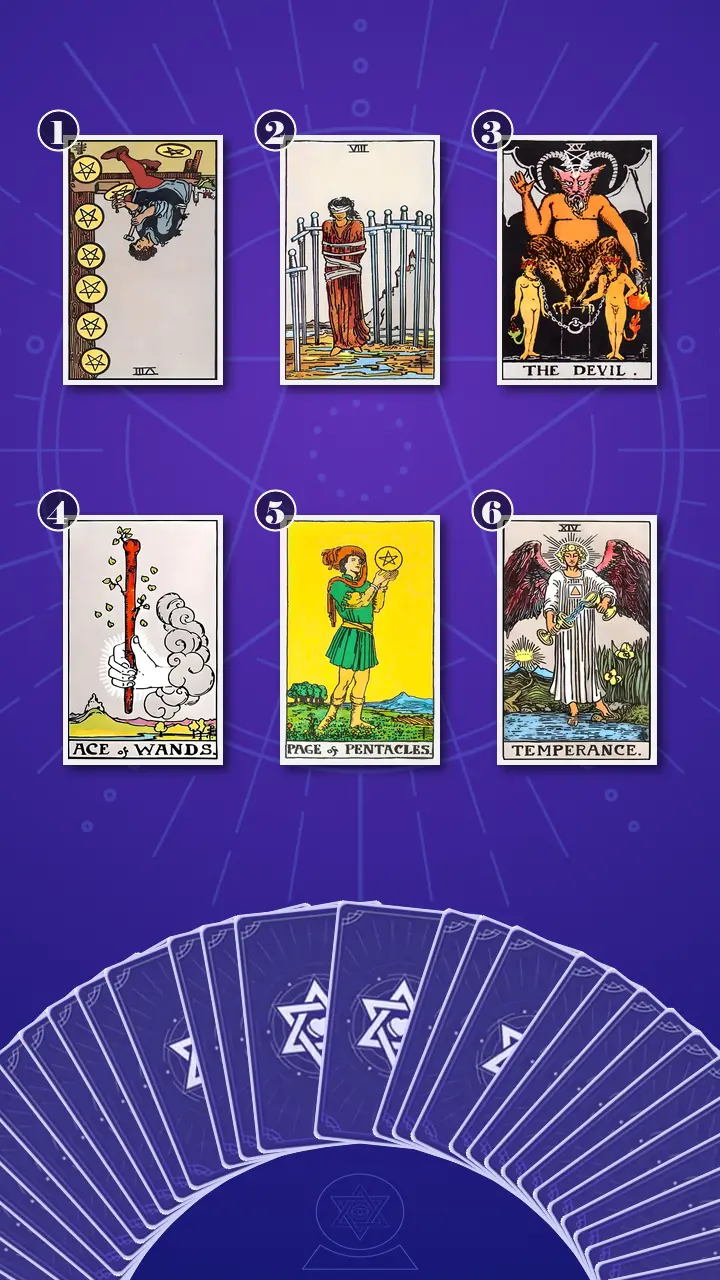
Reading the Closed Upper Row
Position 1: The Workbench with Nothing on It
I began by turning over the card representing Maya's current pattern: the concrete assignment-avoidance behavior and the stagnant energy around it. It was the Eight of Pentacles, reversed.
In the Rider-Waite-Smith image, a craftsperson works on one pentacle while completed pieces hang nearby. Reversed, the card showed me blocked Earth energy. There was no deficiency of effort in Maya's case. The blockage came from an excess of control around the work and a shortage of visible practice within it.
I connected it directly to the previous night. Maya had opened the assignment after her cafe shift and spent twenty minutes renaming files, aligning headings, colour-coding sources, and searching for one more article. The document looked increasingly organised, but it still contained no paragraph that could be revised. It was the academic version of perfecting a Notion semester dashboard while the “Drafting” column remained empty.
Seeing the reversed craftsperson, I briefly flashed back to study cafes I had worked from across several cities: colour-coded notes, immaculate folders, and cursors waiting on white pages. Different languages, same protective pause. Looking productive can temporarily shelter a person from the more exposing act of producing something unfinished.
“Once I organise the research, then I can finally write,” I said, reflecting the rule Maya had been following. “But each new layer of setup postpones the practice that would actually tell you what the draft needs.”
Instead of nodding, Maya gave a short laugh with a bitter edge. “That's painfully accurate. Almost cruel.” Her fingers stopped circling the rim of her mug.
“Cruel would be calling this laziness,” I replied. “This card is more precise. It shows diligence being routed around the task because the first imperfect piece feels unusually exposed. When you think about the last twenty minutes you spent ‘working’ on an assignment, what part of the actual draft existed at the end?”
“A title,” she said after a pause. “A very well-formatted title.” The corner of her mouth lifted, but her jaw remained tight. Recognition had arrived without asking her to turn it into self-attack.
Position 2: The Two Imaginary Buttons
The next card I turned over represented the immediate blockage: the all-or-nothing thought that made beginning feel unsafe. It was the Eight of Swords, upright.
I pointed to the blindfold, the bindings, and the surrounding swords. Upright did not mean that this energy was balanced. Here, Air had moved into excess: evaluation, rehearsal, and analysis crowded the screen until practical alternatives became difficult to see.
I described the modern-life version I heard in Maya's story. She would type half an opening sentence, read it as though a professor were already grading it, delete it, and return to the brief. Her mind presented an interface with only two buttons: “Write something excellent now” or “Expose that I am not capable.” A rough outline, a provisional claim, and a clarification question were available, but the false menu hid them.
“If I can't see the whole route, the first step must be unsafe,” I said. “That's a thought structure, not an objective description of the assignment. The blank page becomes a verdict only when a draft is asked to prove your worth.”
I asked Maya to name the two extreme outcomes in her own language. She pressed a palm against the centre of her chest and looked away from the camera. “Either I sound smart immediately, or everyone realises they overestimated me.”
There it was: an ordinary assignment had become responsible for defending her intelligence, belonging, and other people's respect. The card did not claim that criticism was imaginary. Feedback could be uncomfortable, briefs could genuinely be vague, and asking for clarification or support could be appropriate. The distortion was making one unfinished sentence carry the meaning of the whole person writing it.
Position 3: Relief with Deadline Interest
I turned over the card for the reinforcing root: the short-term relief and attachment cycle linking postponement, deadline pressure, and self-criticism. It was The Devil, upright.
I always slow down with this card because its imagery can be used to frighten people. I told Maya plainly that I did not read it as evil, punishment, an outside force, or fixed destiny. I read the loose chains as a familiar feedback loop maintained by a real reward. The energy was in excess because immediate relief had become the dominant way of regulating the discomfort of beginning.
I brought her back to Sunday at 7:12 p.m. She closes the course portal, her shoulders drop, and she opens short videos. For ninety minutes, the blank page disappears behind StudyTok clips about how to “lock in.” When she returns, three deadlines glow red, her stomach contracts, and panic becomes the torch she uses to activate herself.
“Avoidance gives relief now and sends the pressure to your future self with interest,” I said. “It works like buy-now-pay-later for emotional discomfort. The first payment is invisible, but the later cost arrives as lost sleep, rushed work, and another reason to distrust your process.”
The multiplying tasks in The Sorcerer's Apprentice offered a familiar visual parallel, but I kept the cause grounded in Maya's real choices and conditions rather than magic. The work had not multiplied because she was cursed. A repeatable sequence had made the next exit more likely: dread, escape, relief, accumulated urgency, crisis sprint, exhaustion, and then the claim that pressure was the only thing capable of making her work.
Maya's eyes closed for a moment. Her shoulders lowered as if her body were reenacting the relief of shutting the laptop, then rose again when she pictured the return to the course portal. “I know closing it makes tomorrow worse,” she said quietly. “But right then, it feels like I can breathe.”
“That breath matters,” I told her. “We're not going to shame the part of you that found relief. We need to give it another way to reduce exposure without handing the entire assignment to a future version of you with less time and energy.”
When the Ace Put One Living Sentence on the Page
Position 4: The Hand-Offered Spark
I reached the lower-left position, the key trigger: the smallest catalytic shift capable of challenging the fear of imperfect work. As I turned the card, the radiator behind Maya clicked off. The sudden quiet on both sides of the call made the next image feel unusually clear.
The card was the Ace of Wands, upright.
I showed Maya the hand emerging from a cloud with one budding wand. It did not offer a finished castle, a complete route, or proof of future success. It offered one living beginning. The card introduced a balanced dose of Fire into the blocked Earth and constricted Air above it: enough initiative to create contact, but not so much intensity that the spark became another all-night sprint.
In Maya's assignment, the wand could be one honest line written before research: “I think this campaign works because it makes participation feel private.” The sentence might be clumsy. It might be deleted later. Its immediate value was not quality but function. Once it existed, Maya could question it, test it against a source, or discover that she meant something else.
At this point I used a lens I call Draft Paralysis Deconstruction. I explained that perfectionistic delay can act like a subconscious security system: it keeps unfinished work hidden so potential criticism cannot reach it. The problem is that the system protects the imagined perfect assignment by preventing the real, revisable assignment from being built.
Then I drew two columns on a scrap of paper and held it to the camera. On the left I wrote Maya's core worth. On the right I wrote this draft's current performance. This was my Performance Anxiety Decoupling lens. A rubric could evaluate whether a claim had evidence. A professor could ask for clearer structure. A classmate's polished post could trigger comparison. None of those observations could logically measure Maya's total intelligence, belonging, future potential, or worthiness of respect.
“A rough sentence is information, not evidence against you,” I said. “Separating those columns doesn't make feedback painless. It puts feedback back at the scale where it belongs.”
Even after seeing the two columns, I could see Maya bargaining with the old rule. At 8:47 on the streetcar, she had reopened the brief, renamed the file, added a research tab, and closed it when her chest tightened. By Sunday, three due dates were red.
You are not required to wait for perfect certainty or a crisis to start; take the hand-offered wand as permission to create one imperfect spark and let the work develop from there.
I let the sentence remain between us without immediately explaining it away.
First, Maya's inhale paused. Her fingers hovered above the cold mug, and her pupils widened as if the cursor had appeared in front of her again. Then her gaze slipped away from the screen. I could see her replaying the streetcar, the classmate's message, and every half-sentence she had deleted before anyone could judge it. Her eyes reddened slightly, but her shoulders stayed braced. “Wait,” she said, her voice suddenly sharper. “But doesn't that mean I've been doing this wrong the whole time?” I told her it meant the strategy had protected her from exposure while creating costs she no longer wanted. It did not make her previous self foolish. Finally, her fist loosened against the table. A long breath left her chest, followed by a small, unsettled laugh. Her shoulders dropped, yet a moment of blankness remained: if a beginning could be small, she had a choice, and that choice felt freeing and newly vulnerable.
“Now, using this new perspective, think back to last week,” I invited. “Was there a moment when this insight could have changed how the assignment felt?”
Maya considered it. “Not while I was standing on a packed streetcar,” she said. “But when I got home, before I opened another source, I could have written one line. I wouldn't have needed to finish anything. I just could have made it exist.”
I named the shift carefully. This was not a leap from “procrastinator” to perfectly disciplined student. It was one step in an emotional transformation from dread, relief-seeking avoidance, deadline panic, and self-criticism toward willingness to begin imperfectly and gather real information. Clarity was becoming something action could produce, not an entry requirement Maya had to obtain in advance.
One Pentacle, Two Cups
Position 5: The Assignment Becomes a Learning Object
I turned over the card representing the action experiment: one concrete, time-limited behavior that could replace preparation with a visible first draft. It was the Page of Pentacles, upright.
The Page holds one pentacle at eye level and studies it with steady attention. In this position, Earth energy had moved toward balance. The card did not ask Maya to master the whole assignment. It asked her to make one observable object small enough to examine.
I translated the scene into her week. At a campus desk or her kitchen table, Maya could place one section of the brief beside her laptop, rewrite it as three plain-language questions, and choose one to answer for fifteen minutes. Three bullet points, a rough paragraph, or one bounded question for a teaching assistant would count. The point was contact with the work, not a performance of discipline.
I drew her attention back to the first pentacle card. In the reversed Eight, the finished pentacles on the wall had become imagined standards looming over the first attempt. In the Page, one pentacle became a learning object held close enough to inspect. The same assignment could function either as a verdict or as material for practice. The posture changed before the skill did.
“Which one object could you create for a current assignment?” I asked.
Maya opened her notes app. “Three questions about the media analysis brief,” she said. Her thumb moved once, stopped, and then typed the assignment title. It was a modest gesture, but unlike renaming a file, it pointed directly into the work.
Position 6: A Rhythm That Leaves Room for Sleep
The final card I turned over represented integration: a sustainable rhythm combining drafting, revision, rest, and self-respect without relying on crisis pressure. It was Temperance, upright.
I traced the liquid moving between the two cups, one foot on land and one in water. This was Balance in the clearest sense, though I was careful not to turn “balance” into another polished standard. For Maya, the cups became two modest sessions: one for rough drafting and another for later revision. The land held the real deadline. The water held uncertainty, changing energy, paid shifts, transit delays, and the fact that some days require adaptation.
I pictured the modern version with her: two 20-minute drafting blocks placed before the deadline, a one-line restart note at the end of each, one optional 15-minute rubric review, and a protected stopping time. If a cafe shift changed, she could move or shorten a block without doubling the next one. Missing a session would not create a debt payable through an all-nighter.
“The goal is not an earlier all-nighter,” I said. “It is a start small enough to repeat. One piece now, one pass later, and rest still belongs in the plan.”
Maya lifted her cold tea, made a face, and set it down. As I held Temperance toward the camera, she opened her calendar instead of another productivity video. I watched her reserve two short blocks around a shift and her commute, then add the words “stop and leave restart note.” Her breathing remained slightly uneven, but her shoulders no longer sat against her ears.
Turning the Spark into a Workbench
Once all six cards were visible, I read the spread as one coherent story. The recent past had taught Maya that a crisis sprint could rescue a delayed assignment, so each last-minute submission reinforced the belief that pressure was her source of capability. In the present, the reversed Eight of Pentacles showed preparation displacing practice. The Eight of Swords exposed the excellent-or-incapable binary, and The Devil showed why closing the document felt rewarding enough to repeat. The Ace of Wands restored one imperfect beginning, the Page of Pentacles turned it into a learning object, and Temperance gave that object a rhythm in which revision and rest could coexist.
The spread looked like a blocked workbench opening into a path. On the upper shelf, polished standards, imaginary judgment, and temporary relief kept the usable draft out of reach. On the lower surface, one spark became one object, and one object became a repeatable process.
I named Maya's cognitive blind spot directly: she had been treating deadline pressure as proof of how her ability worked. In reality, panic had been removing every remaining option until action was unavoidable. It could create activation, but it also removed calm revision, support-seeking, sleep, and the chance to learn what a smaller start might do.
The transformation direction was equally specific. Maya did not need a new identity, a flawless productivity system, or a promise never to procrastinate again. She needed a one-week experiment in making one deliberately rough, time-limited draft before polishing, then observing what happened without turning the experiment into another grade on her character.
Her brow tightened. “But seven minutes can't produce anything useful.”
“Usefulness is not the metric for the first experiment,” I replied. “Visible initiation is. You can keep it private, stop when the timer ends, or reduce it to one unfinished sentence. Your sleep and consent remain part of the plan.”
The Inner-Critic Mute Protocol and the Next Three Moves
I introduced my Inner-Critic Mute Protocol as a pre-study boundary, not an attempt to force every critical thought to disappear. The protocol gives evaluation a later appointment so the first draft is allowed to perform its actual job: generating information.
- Mute, then make the Seven-Minute Rough Spark.At Maya's kitchen table or a campus desk, before opening a new source, she would set a 90-second timer and write: “The critic predicts that an ordinary draft will expose me.” Under it, she would write: “For seven minutes, this draft is data, not identity.” She would then draft three rough sentences beginning with “I think,” “I notice,” or “I am not sure yet, but.”Tip: Count visible sentences, not quality. One fragment is enough on a low-capacity day, and stopping when the timer ends protects the exercise from becoming another crisis sprint.
- Turn One Brief into One Question.During the next study block, Maya would translate one section of the assignment brief into three plain-language questions on paper or in the notes app she already used. She would choose one question and create either three bullets or 150 unedited words within fifteen minutes.Tip: Do not build a new system. If the brief remains genuinely unclear, draft one bounded message for the professor or teaching assistant, such as: “For this section, are you looking for X, Y, or either if we justify it?”
- Use the Two-Cup Draft-and-Review Rhythm.For one assignment due the following week, Maya would place two 20-minute drafting blocks and one optional 15-minute review in her phone calendar, with the first block at least three days before the deadline. Each block would end with a restart note such as “Next: explain the second example.”Tip: Move or shorten a block if work, transit, health, or another real constraint intervenes. Do not double the next session. Where the deadline allows, leave one sleep cycle before reviewing once with the rubric.
I asked Maya to choose only one assignment for the experiment. She chose the media analysis rather than trying to repair the whole semester in one burst. That decision mattered because the cards were offering a small test of a pattern, not a new standard she had to perform perfectly.

Six Days Later: One Ordinary Draft
Six days later, Maya messaged me: she had written 164 rough words before opening another source, left a restart note, and gone to bed. She slept through the night. Her first thought in the morning was, “What if it's wrong?” This time, she smiled and opened the draft anyway.
I did not read that message as proof that the pattern had vanished. I read it as the first concrete evidence of expanded choice. Dread could still appear, and an unfinished sentence could still feel exposing, but panic was no longer the only permitted ignition source.
The cards had not written those 164 words. Maya had. Tarot had given us a reflective map, language for the perfectionism-procrastination cycle, and actionable next steps, but the agency stayed exactly where it belonged: with the person whose real life contained the assignment, the cafe shifts, the commute, the limits, and the choices.
That was the quiet result of our Journey to Clarity. Maya had moved neither into certainty nor into perfect balance, but from a blank page acting like a verdict toward a rough draft acting like something she could learn from.
If a blank document makes your chest heavy tonight, avoiding it may feel like protecting your ability for one more hour, even as the deadline pile-up places that same sense of worth under greater pressure. I hope you remember the hand holding one living wand: awareness of the loop already gives you more room than the old two-button screen allowed.
If one rough paragraph were allowed to be information rather than evidence about you, what tiny spark would you be curious to put on the page tonight?