Golden-Child Burnout at 11:40 p.m.: One Quiet Curiosity Gets Tested

Golden-Child Burnout at 11:40 p.m.
Maya (name changed for privacy) was the reliable 29-year-old professional with the respectable Toronto job, the family success story who knew exactly which screenshot would earn heart reactions in the group chat. Yet the praise often faded before her phone screen went dark.
When Maya joined my video call, she told me about the previous Tuesday at 11:40 p.m. A finished strategy deck still glowed on her laptop, its tiny charts bleaching the room blue. The fan hummed beside a mug of cold tea that tasted faintly metallic. Behind the deck sat a Notes page titled What I Actually Want. She had typed two lines about wanting more creative ownership, then switched back to polishing slides that had already been finished for an hour. Before bed, she sent a screenshot of positive client feedback to her family chat and checked twice to see who had reacted.
“I know how to make them proud,” she said. “I just don't know whether the life underneath is mine. Every option becomes a presentation I have to defend.”
I watched her press her tongue against one side of her jaw. The guilt seemed to sit behind her sternum like a stage weight holding the curtain down: invisible to the audience, heavy enough to keep the next scene from beginning. She was building a self-defined path in private while protecting family approval in public, and every career crossroads became a referendum on whether she still deserved her familiar place in the cast.
“Wanting to examine the role does not make you ungrateful,” I told her. “And this reading will not tell you to quit, confront anyone, or gamble with Toronto rent. I want us to separate the variables, see which ones are real constraints, and find one choice that belongs to you. Let's make a map for this fog.”

Choosing a Map for the Inherited Script
I invited Maya to put both feet on the floor and take one unforced breath while holding a single question: What keeps turning my career into a performance for family? I shuffled slowly, using the movement as a transition from rehearsing explanations to observing the pattern itself. Nothing supernatural was required of her. Attention was enough.
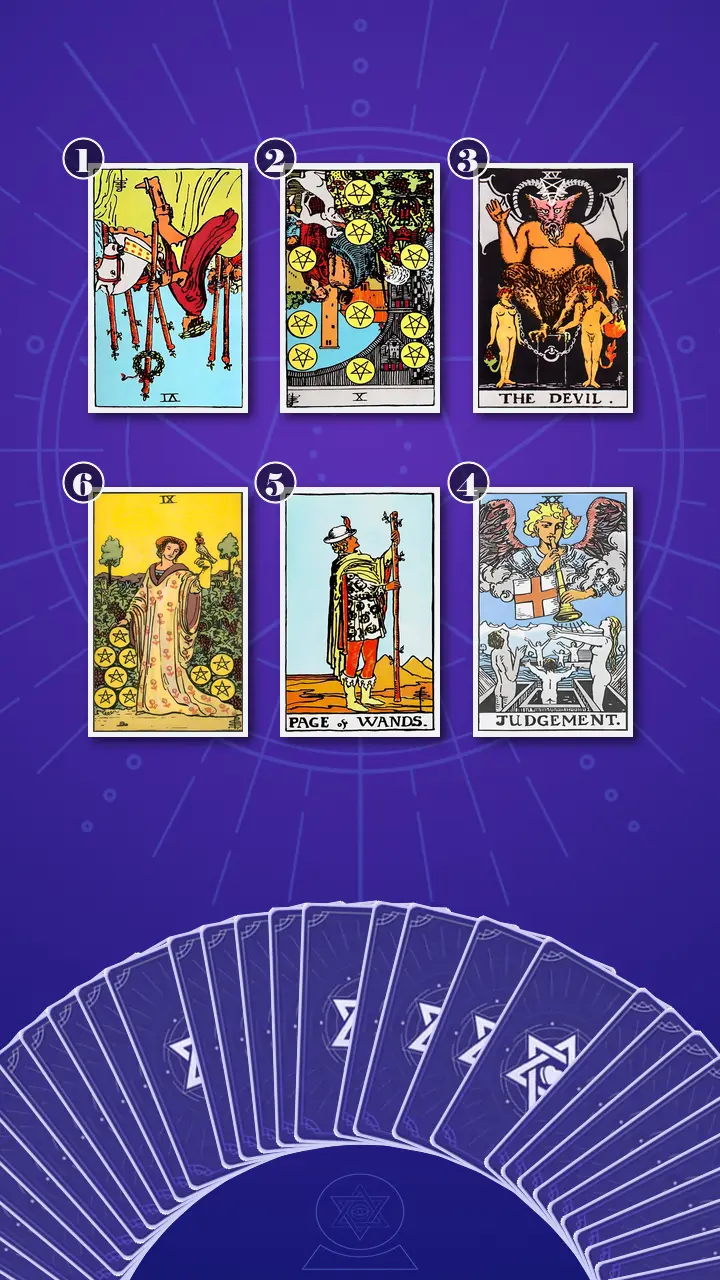
I chose the six-card Transformation Path Grid: Context Edition. For anyone wondering how tarot works in a career reading like this, I use card meanings in context as a structured mirror, not a fixed prediction. The grid externalises behaviours, rewards, fears, and resources so they can be examined with more distance. Maya would still decide what the evidence meant and what, if anything, she wanted to do.
I arranged the cards in two rows like a folded map. The upper route would show the visible performance loop, the structure sustaining it, and the internal bargain beneath it. The path would then drop to the leverage point before moving back through a small experiment and practical integration. The first position would reveal how approval-driven achievement appeared in daily life. The third would expose the rule making repetition feel compulsory. The fourth, directly beneath it, would show where Maya could interrupt the pattern without requiring a dramatic career exit.
“So we aren't asking whether your family is good or bad, or whether your career is right or wrong,” I said. “We're asking what is currently bundled together, where you still have choice, and what kind of evidence could help you find clarity.”
The Applause Loop, Seen from the Inside
Position 1: The Win That Needed a Reaction Count
I turned the card in the position representing the observable success-performance loop: collecting family-legible achievements, monitoring recognition, and remaining privately unconvinced. It was the Six of Wands, reversed.
The upright image usually carries the heat of visible victory: a laurel-crowned rider moving through a crowd of raised wands. Reversed, that Fire was blocked. The achievement could be real, the ambition could be real, and the praise could even be sincere, but none of it was landing as private conviction. Maya was using the audience response to decide whether the win counted.
I brought the card directly into her Friday evening. She had received strong feedback on Slack, screenshotted it before checking whether the assignment had mattered to her, and sent it to the family chat. A thumbs-up arrived. She added that senior leadership had also been impressed. The phone warmed in her palm as she refreshed twice and thought, This should feel good, so why am I already looking for the next piece of proof?
“It resembles letting LinkedIn's recommendation algorithm choose your career,” I said. “The system keeps serving whatever earns visible engagement. It cannot measure whether the work sustains your attention after the screen goes dark.”
I asked what she had felt in the first ten minutes after her most recent win, before anybody replied. Maya gave one short laugh that carried more sting than humour.
“That's so accurate it's almost brutal,” she said. Her fingers stopped rubbing the edge of her phone, and she placed it face down. “I got the feedback and felt good for maybe five minutes. Then I needed someone to confirm that it was a big deal.”
“Wanting appreciation isn't the problem,” I said. “The problem begins when appreciation becomes the only instrument available for measuring meaning. You learned how to win the room before you learned how to hear yourself in it.”
Position 2: The Family Success Package
I turned the card representing the structural blockage that fused family belonging, material security, and a recognisable definition of success. It was the Ten of Pentacles, reversed.
The family beneath the stone archway usually evokes continuity, material support, and an established legacy. Reversed, its Earth energy had become restrictive and unstable. Maya had begun treating salary, title, housing security, family pride, and personal worth as a bundled subscription. If she removed one feature, she feared the entire account might be disconnected.
She described opening a spreadsheet at her kitchen counter on a rainy Sunday night. It contained salary bands, promotion timelines, Toronto housing costs, and a final column labelled What they'll say. Before checking whether a part-time workshop or short project was possible, she deleted one quieter career option because it looked less prestigious.
“If I remove the impressive title, what else do I lose?” I asked, giving language to the question underneath the spreadsheet.
Maya inhaled but did not immediately exhale. Her eyes moved away from the card as if replaying a family call frame by frame. Then her hand rose to the centre of her chest before dropping back to the desk.
“It sounds ridiculous when you separate it out,” she said quietly. “A lower title doesn't change my lease. But in my head it becomes rent, future security, disappointing everyone, and proving I wasted what I was given. All at once.”
“That is the blockage,” I said. “Planning is useful. Toronto costs are real. But practical stability and inherited status are not the same thing. The reversed card asks you to unbundle them, not to reject either your relationships or your responsibilities.”
Her shoulders remained high, but her jaw loosened. The distinction had not solved the decision. It had made the decision smaller, which was the first useful change.
Position 3: The Contract Nobody Had to Sign Today
I turned the card representing the root script beneath the repetition: the internal bargain that achievement protected belonging and preserved control. It was The Devil, upright.
I never present The Devil as a prediction, punishment, or verdict about someone's family. In this position, its attachment energy was in excess. Approval had occupied so much of the decision-making space that Maya experienced a learned rule as if it were an unavoidable external command. I drew her attention to the loose chains around the two figures. The card did not deny the history or rewards of the pattern. It showed that part of the rule was now being enforced through habit.
I asked Maya to picture the last prestigious assignment she had wanted to decline. She described hovering over Accept while her calendar was already packed. Nobody was physically making her click, yet the thoughts arrived in a familiar sequence: I could say no. But if I say no, who am I? And what will they think that means?
“Every preference becomes a presentation when belonging feels like the audience score,” I said. “The praise gives quick relief, so the next impressive assignment autoplays before you have chosen whether to keep watching.”
The image reminded me of The Truman Show, but only in one careful sense: the significant moment is recognising the set and approaching the next door consciously. Growth does not require turning everyone in the familiar world into a villain. Maya could value the love, effort, and security in her family story while questioning the role she had learned to perform within it.
Her hand lifted a few centimetres above the desk and froze, as if it were still hovering over that imagined button. Her gaze went unfocused. Then she released a low breath and let her palm fall open.
“The role works,” she said. “People trust me. I get praised. I know what to do. I also resent that I keep doing it.”
“Both can be true,” I replied. “The bargain may once have helped you feel secure. Seeing its present cost does not erase why you made it. It simply means the contract is available for review.”
When Judgement Sounded Above the Group Chat
Position 4: The Call Before the Verdict
The room seemed to become quieter as I turned the card representing the leverage point: the conscious separation of Maya's present self-evaluation from the family verdict she anticipated. A streetcar bell sounded once beyond her window, clean and distant. The card was Judgement, upright.
The figures on the card rise toward one trumpet. They are not looking sideways to check whether everybody else approves of their response. Upright, Judgement offered balanced, available energy for honest review, awakening, and revision. It did not ask Maya to condemn her past or announce a new identity. It asked her to hear her current assessment before translating it into a defensible presentation.
I put the central distinction plainly: Family connection and career compliance are two different questions. You can care about the relationship without making their applause the test of whether your path is yours.
This was where I used a lens I call Hero's Journey Alignment. Maya had been treating her stagnation as proof that she lacked courage or direction. I saw something more precise: a classic Refusal of the Call. The refusal was not laziness. It was the understandable moment when a protagonist senses that answering the next call could change an identity that has provided belonging, competence, and a reliable script.
At 11:40 p.m., her private note had still been open behind the finished presentation. She wanted to add one honest line, but her hand had reached for the family group chat instead, hoping another reaction would make the achievement feel real. She had been trying to receive a verdict before allowing herself to hear the question.
You are not failing by stepping out of the applause; you are learning to answer your own call, like the figures rising toward Judgement's trumpet.
I let the sentence remain in the quiet.
Maya's breath stopped first. Her fingers hovered over the phone without touching it, and her pupils widened slightly as if an old memory had moved close to the surface. Then her eyebrows drew together. The recognition did not arrive as instant relief.
“But doesn't that mean I've been doing it wrong this whole time?” she asked. The words came out sharper than anything she had said earlier. “I've built my whole career around being the reliable one.”
“No,” I said. “It means you used a strategy that produced real results and protected something important. Judgement is a review, not a prosecution. You are allowed to keep what still serves you and revise what does not.”
Her eyes shone before she looked down. Her closed hand slowly opened against the desk. The tension left her shoulders in stages, followed by a long, uneven exhale. Relief was there, but so was the slight dizziness of realising that clearer choice would bring responsibility back into her own hands.
“Now, with this new perspective, think back,” I invited. “Was there a moment last week when this insight could have made you feel different?”
She returned to the Tuesday-night note. “I could have left the two lines there,” she said. “I could have asked whether the idea was interesting before asking whether it was sensible enough to explain.”
I set a ten-minute timer and asked her to make a private evidence card with three prompts: What am I curious about? What is one tiny way to test it? What would I notice if nobody else reviewed the result? I asked her not to send it to anyone for 24 hours. If ten minutes felt too exposing, two minutes would count. This was an experiment, not a career decision.
Before she wrote, I watched the notification banner from her family chat appear and disappear at the top of her screen. She did not open it. Instead, she wrote one sentence: “Before I ask whether they approve, I can ask whether this is alive enough to test.”
I named the crossing as carefully as I could. This was not instant certainty. It was one step from guilt-driven success performance and approval-seeking hyper-analysis toward practical self-authorship, direct evidence, and family connection with clearer boundaries.
A Beginner's Fire in an Unfinished Landscape
Position 5: The One-Question Career Beta
I turned the card representing the practical action: one small, time-boxed experiment that could generate direct evidence before approval seeking began. It was the Page of Wands, upright.
The Page studies a sprouting wand in a wide, unfinished landscape. Upright, this was healthy Fire: curiosity with enough movement to create information, but without the pressure to establish a prestigious new identity. The Page did not need a five-year roadmap. The Page needed one live question.
For Maya, the modern-life translation was simple. She could book one 45-minute workshop sample, send one 80-word informational-interview request, or complete one small portfolio prompt because it interested her. Immediately afterward, she could record her energy before, attention during, and desire for a second session. The result did not have to justify a career reset. It only had to provide evidence she did not have before.
“So I can explore a career pivot without quitting my job or announcing anything?” she asked.
“Exactly. You do not need a new identity to run one honest experiment. Think of it as a low-cost beta, not a product launch. The question is not, ‘Can this become my entire future?’ The question is, ‘Do I want another session?’”
Maya opened her calendar while I watched. Her finger paused over Saturday morning, tightened, and then tapped a 45-minute space. A cautious smile appeared, accompanied by the faint pinch between her eyebrows that said she still expected someone to challenge the choice.
“I'm gathering my own evidence,” she said, testing the words, “not auditioning for a new title.”
Position 6: The Garden Built Without an Audience
I turned the final card, representing the orientation Maya could integrate: practical autonomy, self-written measures of success, and family connection without career compliance. It was the Nine of Pentacles, upright.
The solitary figure stands comfortably in a cultivated garden, a hooded falcon steady on one gloved hand. Upright, the Earth energy was balanced. This was not impulsive rebellion or isolation. It was stewardship: enough control over time, money, skill, and attention to let a direction become practically hers before it had to be publicly defended.
I translated the card into Maya's actual constraints. She could reserve a recurring block of exploratory time, create a modest budget that did not compromise rent or savings, and evaluate each test against interest, energy cost, practical cost, and desire for another step. Family opinions could remain meaningful, but they would occupy a separate, optional column rather than being mixed into the score.
“This card doesn't ask you to stop caring what your family thinks,” I said. “It asks you to stop treating their reaction as the sole performance review for your life. Keep the connection; change the measurement system.”
Maya looked from the cultivated garden back to the crowded architecture of the Ten of Pentacles. Her head tilted, her eyes narrowed in concentration, and then she nodded once.
“I thought independence meant doing something dramatic enough to prove I was independent,” she said. “This looks more like building evidence quietly.”
I agreed. The spread had no Cups and no Swords, and I treated those absences as useful integration notes rather than missing answers. Feelings had repeatedly been converted into output, so Maya would need to notice longing and disappointment without immediately turning them into a project. Direct language had also lagged behind internal insight, so a later boundary might be one calm sentence: “I'm gathering information, and I'm not asking for a verdict yet.”
The Private Evidence Plan for the Next Seven Days
I read the complete spread back to Maya as one coherent story. The Six of Wands reversed showed the visible symptom: applause that produced a brief lift but no durable conviction. The Ten of Pentacles reversed revealed why the loop carried so much weight: salary, status, safety, and belonging had been bundled into one inherited success package. The Devil exposed the internal contract keeping that package intact. Judgement interrupted the contract with honest self-review, the Page of Wands turned review into a bounded experiment, and the Nine of Pentacles grounded curiosity in practical stewardship.
In the language of a film currently in production, Maya had stayed in a successful but painful scene because the audience knew how to applaud it. My mind went briefly to an editing room, where a scene can be beautifully performed and still no longer serve the story. Cutting away from it does not make the acting false. It means the larger narrative is ready to move.
Her cognitive blind spot was the belief that anticipated disapproval counted as evidence of practical danger. That belief made a $60 workshop carry the emotional weight of resignation, financial collapse, and relational rejection. It also created an impossible standard: she could explore only after producing a choice nobody could criticise. In practice, that gave an imaginary panel an unlimited veto.
The transformation direction was smaller and more rigorous: request family input only after Maya had gathered some direct experience and evaluated it against criteria she had written herself. Family feedback could then become information rather than a verdict.
I shaped the next actions through my Character Bible Directive. In film work, a character bible describes the psychological and behavioural choices that make a person recognisable across scenes. I did not ask Maya to invent a glamorous future title. We wrote three observable specifications for her next-act self: she tests before she explains, separates cost from status, and notices her own response before checking the audience score.
“I can already see myself turning this into another KPI dashboard,” Maya said, half smiling and half wincing.
“Then the dashboard needs a stopping rule,” I replied. “Two minutes is valid. One experiment is enough. A result that says ‘not for me’ is still useful evidence. You are not being graded on how dramatically you change.”
- The 10-Minute Character Bible Card On Monday morning, before opening LinkedIn, use a paper note or locked phone note to write three lines: “I am curious about...”, “One tiny test would be...”, and “If nobody reviewed this, I would notice...” Add one behavioural specification: “I test before I explain.” Keep the note private for 24 hours. Tip: If ten minutes feels too exposed, use two. Privacy during early exploration is a boundary, not dishonesty.
- The One-Question 45-Minute Career Beta Choose one item from the What I Actually Want note and schedule a single block this week for a free workshop sample, portfolio exercise, syllabus review, or 80-word informational-interview draft. Give the session one question, such as “Do I want to do this again?” Immediately afterward, record energy before, attention during, practical cost, and interest in a second session. Tip: Cap the test at 45 minutes so it cannot become a secret second job. Ten minutes is the minimum version, and stopping is a valid result.
- The 24-Hour Applause Delay After the next positive work message, wait five minutes before forwarding it to family. During that pause, write one sentence answering, “Did I value this before anyone reacted?” Sharing the achievement later remains entirely optional; the exercise changes the sequence, not the relationship. Tip: Keep the experiment low-pressure. The goal is to hear your first response, not to suppress pride or refuse appreciation.

A Week Later, One Quiet Piece of Proof
Seven days later, I received a message from Maya. She had sat in a café on Queen Street West while the espresso machine hissed and rain darkened the pavement outside. Instead of opening three review sites and a salary report, she completed a 45-minute creative-strategy workshop sample from the tab she had been saving.
“I kept wanting to decide whether it was a viable career,” she wrote. “Then I went back to the one question. I wanted a second session. I wrote that down before I told anyone, and I didn't send a screenshot.”
She had not resigned. She had not solved her entire future. She had spent less than the limit in her exploration budget, protected her rent, and gathered one piece of private evidence that her curiosity could survive contact with real life.
She slept through that night. Her first thought the next morning was still, “What if I'm wrong?” She told me she smiled, not because doubt had vanished, but because it no longer had admin access.
I recognised that as the quiet proof of our Journey to Clarity. The cards had not selected Maya's career or granted permission from somewhere outside her. They had helped her place applause, belonging, security, preference, and evidence in separate frames. She chose what to do with the map.
Ownership, Not a Perfect Verdict
When your chest tightens before a family update and every personal preference turns into a presentation, it can feel as if keeping your place in the relationship depends on never stepping out of the role everyone knows how to applaud. Simply noticing that the audience score and your own experience are different measurements means the old script is no longer the only one on the table.
If nobody needed a polished update or a verdict yet, which saved tab, unfinished note, or quiet curiosity could become your own ten-minute response to Judgement's trumpet?