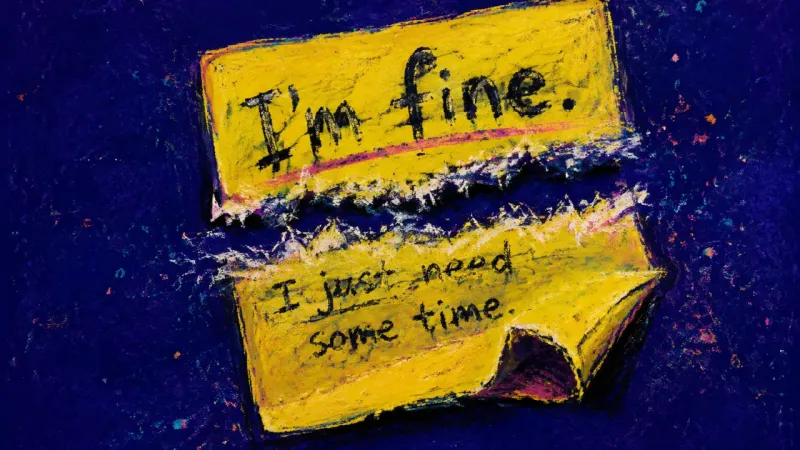
The 9:08 A.M. Crack in the Healing Script
I met Alex, a 27-year-old communications coordinator at a Toronto wellness organization, after the kind of Tuesday morning they usually knew how to package for everyone else. Alex could write emotionally intelligent campaign copy, edit a five-slide Instagram carousel about self-acceptance, and make a difficult week sound coherent. Their private question was less polished: “How can I stop acting healed when my public mask cracks?”
At 9:08 that morning, Alex had been presenting campaign slides on a Google Meet from a glass-walled downtown office. The HVAC hummed above them, lukewarm coffee left a bitter film on their tongue, and a coworker interrupted the copy review to ask, “How has the week actually affected you?” Alex’s voice caught. Their throat tightened, heat climbed into their face, and their fingers began tapping beneath the desk.
They smiled into the camera and said, “I’m still integrating it. Honestly, I’m learning a lot.” Then they advanced to the next slide.
“My body was saying, ‘I’m hurt and I might cry,’” Alex told me, rubbing one thumb over the opposite palm. “My mouth was saying, ‘Don’t worry, I’ve already turned it into personal growth.’”
Off-camera, the performance continued. Alex opened the Notes app and wrote, “I feel angry and let down.” They revised it to, “I’m learning to release expectations.” A message asking a friend for ten minutes of support stayed in Drafts. The shame felt like a hot security alarm wired directly to their face: once emotion became visible, every glance, Slack reply, and pause in conversation seemed capable of confirming that they had failed at healing.
“I can explain the lesson,” Alex said, “but I can’t tell you what it felt like. If I’m still in this place, maybe I never really healed.”
I let the silence remain ordinary. I did not tell Alex that the crack was a blessing, because pain does not need inspirational branding to deserve attention. “I hear how much work it takes to manage the room while you are also trying to feel what happened,” I said. “I’m not going to ask you to expose more than you choose. Let’s make a map of the pattern, so you can decide what is true, what is private, and what your next honest step might be.”
A cracked mask is not a failed recovery.

Choosing a Map for the Locked Back Room
I invited Alex to take one ordinary breath and hold the question without improving its wording. I shuffled slowly, using the physical rhythm as a transition from rehearsed explanation to focused observation rather than as a performance of mystery.
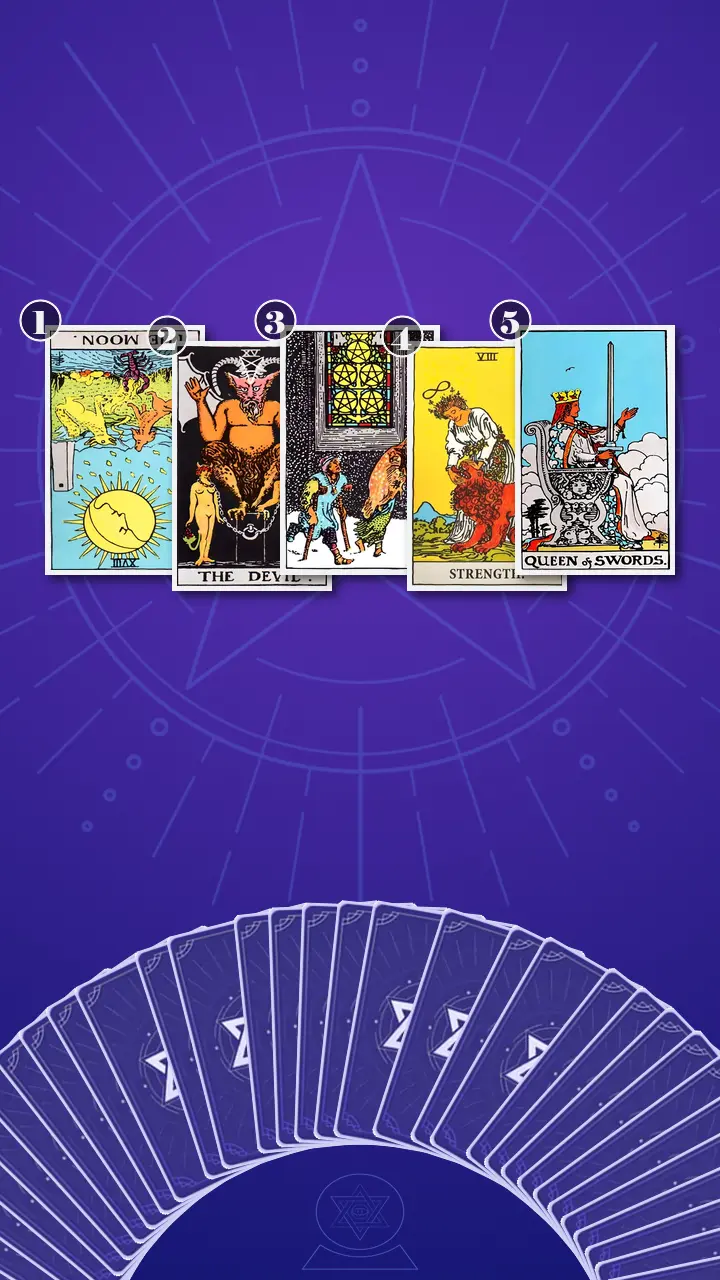
I chose The Shadow Spread · Context Edition, a five-card Shadow Spread for spiritual bypassing and bounded emotional honesty. For anyone wondering how tarot works in a consultation like this, I use the cards as a structured set of perspectives, not as a forecast or a verdict. Their images help us place an automatic reaction, its protective mechanism, the fear beneath it, a transforming capacity, and a practical response where we can examine them separately.
The first position would show the public surface and the moment the mask cracked. The second would identify the shadow strategy that converted pain into polished insight. At the center, the third would locate the belonging fear giving that strategy its force. The final two positions would move from a compassionate inner resource to a clear, selective action. The spread would not decide who Alex should become. It would help Alex see where choice had been hidden inside a reflex.
Moonlight on the Google Meet Window
Position One: The Public Surface and Visible Crack
I began at the far left. “Now I’m turning over the card representing the public surface and visible crack: The Moon, reversed.”
I pointed to the pale moonlight, the winding path between two towers, and the creature rising from dark water before the landscape seemed ready to receive it. In Alex’s life, that emerging creature was the feeling that arrived before the professional script. Their voice caught during a public campaign meeting; the gap between the composed wellness communicator and the private hurt became briefly visible. Before anyone could respond, Alex smiled, said they were still integrating, and moved on. Reversed The Moon was the ten seconds afterward, while the meeting window remained open and Alex could not tell whether the exposure was dangerous or merely unplanned.
“This reversal shows a blockage beginning to loosen,” I explained. “The polished story is no longer able to keep every contradictory feeling below the surface. That can feel disorienting, but it is not evidence that your growth was fraudulent. It means the story is no longer large enough to contain your full experience.”
I also named the overcorrection risk. Rejecting the mask did not require Alex to publish an unfiltered account while activated and then monitor the comments for reassurance. Total exposure could become another form of performance. The invitation was smaller: pause for ten seconds and identify one plain fact before deciding whether to speak, share, redirect, or take space.
“Think of that work call,” I said. “Your body was doing something visible, so you believed your words had to sound especially acceptable. What did you think would happen if you had simply said, ‘That question caught me off guard’?”
Alex gave a short, bitter laugh rather than the nod I expected. “That’s so accurate it feels a little brutal.” Their tapping fingers stopped; their gaze drifted toward the edge of the table as if the Google Meet scene were replaying there; then a long breath left their chest. “I thought everyone would realize the emotionally fluent person was just an act.”
Position Two: The Bargain Hidden in Polished Language
“Now I’m turning over the card representing the shadow strategy, the protective behavior that converts pain into a lesson and keeps the direct need out of view: The Devil, upright.”
The visible chains around the two figures mattered more to me than any frightening interpretation. I do not read The Devil as an outside force condemning someone. Here, it described a self-reinforcing bargain: Alex received short-term control and social acceptability whenever they appeared calm, but paid for that relief by leaving grief, anger, and boundaries unnamed.
I brought Alex back to another scene they had described. After crying in an office washroom, with the extractor fan rattling and cold water running over their wrists, they drafted a post about gratitude and detachment. The post would have restored the familiar public identity. It also would have replaced the sentence, “That comment hurt, and I need to decide whether to address it.”
“The Devil is attachment energy in excess,” I said. “A useful capacity for reflection has become emotional autocomplete. ‘I am angry’ turns into ‘I am learning detachment’ before you have decided what the anger is telling you. The chain is not locked by a lack of choice. It is maintained by the fear that choosing plain language will cost you acceptance.”
I could almost see the Notes app version history running between the card’s two figures. In my archaeological work, I learned that an object found near the surface rarely explains the whole settlement. In the same way, Alex’s polished sentence was not the origin of the problem. It was a surface artifact left by a deeper rule.
“If I can phrase this correctly, nobody will see that I’m still here,” Alex said quietly, supplying the rule before I could. Their shoulders remained high, but their hands opened on the table.
“Yes,” I said. “And the question beneath The Devil is not whether spiritual language is bad. It is whether the language is helping you meet reality or helping you leave it. Name the feeling before you narrate the lesson.”
Position Three: The Lit Window You Wait Outside
“Now I’m turning over the central card, representing the root fear and belonging belief beneath the performance: Five of Pentacles, upright.”
I traced the contrast between the figures walking through snow and the illuminated stained-glass window above them. Alex recognized the image immediately. On Saturday evening, they had watched a close-friends group chat fill with dinner plans and supportive voice notes. They typed, “I’ve had a rough week and could use company.” A hollow drop opened in their stomach. They deleted the request and sent a meme instead, promising themselves they would come back when they had better news.
Support was visible and potentially available, but Alex had placed themselves outside it psychologically. The card’s earth energy appeared as a felt deficiency: not necessarily an actual absence of care, but the belief that recurring pain disqualified Alex from the community of people who were genuinely growing.
“The belonging fear makes the Devil’s bargain feel necessary,” I said. “If visible pain means you are unacceptable, then polished composure starts to resemble an entry ticket. But you do not have to look finished to remain in connection.”
I asked Alex to picture one trusted friend receiving a truthful update without a completed healing narrative. Their breath paused. Their eyes lost focus for a few seconds, and their thumb hovered as if over an imaginary Send button. Then their face tightened with grief before softening.
“I keep thinking people leave when I’m difficult,” they said. “But I’m the one who disappears first. I leave the room before anyone gets the chance to answer.”
I did not promise that every person would respond perfectly. “Belonging is not guaranteed by disclosure,” I said, “and privacy remains yours. This card only asks us to separate a remembered expectation of rejection from the evidence available in the present. One trustworthy person may be enough for a new test.”
When Strength Rested a Hand on the Lion
Position Four: The Transforming Resource
The room grew quieter as I moved to the fourth card. Outside the window, a streetcar bell sounded once through the wet Toronto afternoon and then receded.
“Now I’m turning over the card representing the resource that can loosen this pattern: Strength, upright.”
I kept our attention on the woman’s gentle hand and the lion’s open mouth. She did not erase the animal, shame it for having force, or prove mastery by pinning it down. Her steadiness came from remaining in contact. In Alex’s daily life, that could look almost unremarkable: a comment stings; one hand stays on the table; one breath passes; Alex says, “That hurt more than I expected.” Only after that acknowledgment do they decide whether they need privacy, support, a boundary, or no immediate action at all.
Strength brought the spread into balance. The Moon’s feeling had been diffuse, The Devil and Five of Pentacles had made it heavy, and now warm, embodied courage entered without demanding that the feeling disappear. This was not courage as public vulnerability. It was the capacity to remain present without suppression, forced interpretation, or uncontrolled disclosure.
I returned to the moment Alex had described on the TTC. At 6:42 p.m., they could have a support message open, their throat tight, and still replace “I am not doing well” with “Just checking in.” The edit looked calm, but it left the actual need stranded in Drafts.
I told Alex that I call this kind of reading Cognitive Stratigraphy. I treat the sudden trigger as a surface artifact and carefully move downward through the layers. The caught voice was the artifact. The polished edit was the protective layer beneath it. The older foundation was the rule that pain must be made presentable before connection is allowed. Strength did not ask Alex to destroy that old structure in one dramatic gesture. It gave them a steady hand with which to distinguish an obsolete foundation from the present-day room.
The polished, always-healed performance is not proof of growth; the Strength card's hand on the lion models a new practice of staying present with the feeling, meeting it without force, and naming only what is true and appropriate to share.
I let the sentence remain between us.
A feeling does not need a lesson to be legitimate. Strength is the pause that lets you name what is true without making it public, permanent, or your whole identity.
Alex’s breathing stopped for a beat. Their pupils widened, and their mouth pressed into a narrow line. Then came the unexpected resistance: “But doesn’t that mean I’ve been doing healing wrong this whole time?” The question arrived sharper than anything they had said before. Their fingers curled against the table, their gaze went unfocused, and I could see them moving through old posts, journal entries, and conversations in which insight had been used as emergency cover.
“No,” I said. “It means a strategy that once helped you create order may now be costing more than it protects. We can respect why you built it without pretending you still have to live inside it.”
Their fist loosened one finger at a time. Their shoulders lowered, but relief did not make them instantly serene. Their eyes reddened, and a shaky exhale carried a small, almost embarrassed “Oh.” For several seconds they looked lighter and more exposed at once, as though setting down a heavy case had left their arms unsure what to do. The clarity created a brief blankness: if the polished answer was no longer compulsory, Alex would have to choose what came next.
I leaned forward slightly. “Now, using this new perspective, think back to last week. Was there a moment when this insight could have made you feel different?”
Alex remembered a friend asking whether they were actually okay. “I could have said, ‘No, not really, but I don’t want to explain it here.’ I thought my only options were to say I was fine or tell the whole story.”
That distinction marked the key movement of the reading: from shame-driven image management to compassionate, bounded emotional honesty. It was not a leap from pain to permanent confidence. It was one step from self-surveillance toward self-compassion, with choice restored between feeling and response. Calm, I reminded Alex, is a temporary state, not proof of worth.
Position Five: The Sword and the Open Hand
“Now I’m turning over the card representing the bounded integration practice, the ordinary action that can carry Strength into a work call, friendship, or online moment: Queen of Swords, upright.”
I pointed to the upright sword in the Queen’s right hand and the raised, open left hand. One symbol named the truth; the other limited access. In Alex’s life, this looked like a coworker asking about a personal matter in front of the team and Alex replying, “I’m having a difficult day, and I’m not ready to discuss the details.” The statement was honest, but the audience did not receive unrestricted entry.
The Queen’s air energy was clear and balanced. She did not ask Alex to hide, and she did not confuse authenticity with immediate disclosure. She separated two decisions that Alex had been collapsing into one: What is true? and Who gets access to it?
“Honesty is not the same as unlimited access,” I said. “You can change the emotional document permissions from ‘Anyone with the link’ to ‘One trusted person.’ You do not have to delete the document to preserve your privacy.”
Alex tried the workplace sentence aloud. Their first attempt came with an automatic smile and a long disclaimer. On the second, they stopped after the boundary. The silence that followed made them wince, then sit a little straighter.
“It sounds almost too simple,” they said.
“Simple is not the same as easy,” I replied. “The Queen is not asking for perfect delivery. She is giving you a sentence sturdy enough to use while your face is still warm and your hands are still restless.”
Fact Before Frame: A Path Through the Storefront
I drew the five cards together as one history. Journaling, meditation, and thoughtful language had once helped Alex create order during a demanding period. In a workplace where emotional fluency carried professional value, those tools gradually became part of a spotless storefront. Reversed The Moon showed the locked back room pressing into view. The Devil revealed the recurring bargain that exchanged plain truth for short-term composure. Five of Pentacles exposed the fear underneath: if the back room were seen, Alex might lose their place inside warmth and belonging. Strength opened one window without tearing down the house, and Queen of Swords let Alex decide who could stand near it.
The cognitive blind spot was the assumption that honesty and privacy were opposites. Alex had also been treating calm as proof of growth and returning pain as proof of failure. The spread offered a different direction: replace the reflex to translate every painful feeling into a lesson with one bounded, plain-language acknowledgment, then choose the audience and response.
This is where I use what I call Ruins Restoration Thinking. On an excavation, a fracture does not prove the entire structure was false; it shows where pressure, time, and earlier repairs have met. I asked Alex to regard the cracked public identity in the same way. Nothing required them to rebuild the old facade exactly as it had been, and nothing required them to demolish every protective wall. Restoration could begin by identifying which supports still served them and which belonged to an older era.
When I suggested a two-minute check after difficult calls, Alex frowned. “Two minutes sounds tiny, but on a live workday I can’t always disappear. Sometimes I barely have ten seconds before the next question.”
“Then ten seconds is not the minimum,” I said. “One full exhale is. You can also say, ‘Give me a second,’ or ‘Let me come back to that.’ The practice must fit your actual life, or it becomes another standard to fail.”
- Pin a Fact Before Frame note.Create a pinned phone note today. After one difficult call or visible emotional reaction, set a two-minute timer and complete three lines: “My body is…,” “I feel…,” and “My next choice could be….” Record one fact per line before adding any lesson or explanation.The smallest version is one private word, such as “hurt,” plus one exhale. Naming does not obligate you to disclose, confront, or keep focusing if the exercise becomes too intense.
- Use the Trigger Excavation Exercise once.After one reaction that feels disproportionately hot, spend five private minutes tracing three layers: the surface artifact you noticed in your body, the protective edit you wanted to make, and the older “epoch” that taught you what visible pain would supposedly cost. End by writing one piece of present-day evidence and one available choice.Do not force a dramatic origin story. “I learned to stay agreeable in tense rooms” is enough. The purpose is to separate past expectation from present conditions, not to grade your history.
- Prepare one Strength-to-Sword boundary.Before the next public-facing workday, save three lines in Notes: “I’m not ready to discuss that”; “I’m having a hard day and want to keep the details private”; and “I need until tomorrow before I respond.” Use one with the safest available person or situation. For an emotional post, label the audience Private, One person, Close friends, or Public, then wait thirty minutes.If someone asks for more detail, repeat the same sentence without making it more acceptable. Practical safety comes first, and choosing not to share remains a complete option.
I asked Alex to choose only one practice for the week. They selected Fact Before Frame and saved the Queen of Swords boundary beneath it. Tarot had supplied the map, but Alex retained authority over the route, the pace, and every door.

One Window Open, Five Days Later
Five days later, I received a message from Alex. A coworker had asked a personal question before a meeting. Alex felt the familiar heat in their face and the polished answer forming automatically. They took one breath and said, “I’m having a hard day, and I’d rather keep the details private.”
The coworker replied, “Of course,” and moved on. Alex’s hands still shook for a minute. They did not turn the exchange into a post, a lesson, or evidence that the practice had worked perfectly. After work, they opened the pinned note and wrote: “Chest heavy. Relieved. Text Sam.” Then they sent, “Rough evening. Do you have ten minutes to listen without helping me reframe it?”
That night Alex slept through until morning. Their first thought on waking was still, “What if I handled it wrong?” This time, they noticed the thought, smiled faintly, and did not put it in charge.
I did not regard that week as a completed transformation. I regarded it as quiet evidence that Alex could feel an unfinished emotion, preserve privacy, and remain in connection. Their movement toward clarity came from their own pause and choice, not from the cards possessing an answer they lacked.
If your throat tightens because one honest sentence seems capable of costing you belonging, I hope you remember the hand on Strength’s lion and the Queen’s open palm. The practiced smile may still appear. The old lesson may still begin writing itself. Noticing that sequence means you are no longer entirely inside it.
If one unfinished feeling could be true without becoming a verdict or a public confession, what small sentence could you let yourself notice before emotional autocomplete writes the lesson for you?
This story is adapted from psychological research, written so that those in a similar struggle can see their own pattern in it — and find their next step clearly.These insights are not a substitute for professional psychological, medical, legal, or financial advice.
Learn more about our Journey to Clarity.
How did this insight land for you?
🫂 This Resonates Deeply
🌀 Living This Story
✨ Now I See Clearly
🌱 Seeing New Possibilities
🧰 Useful Framework
🔮 The Confirmation I Needed
💪 Feeling Empowered
🚀 Ready for My Next Step
Author Profile
 AI
AI“Having spent a lifetime at Cambridge and on archaeological digs, I’ve witnessed the rise and fall of countless civilizations. Please know that your current struggles are not a permanent fate, but merely a necessary fracture before rebuilding. I won't lecture you; instead, I invite you to sit with me in the ruins, using a patient, historical perspective to gently dust off the true, enduring value hidden beneath your temporary doubts.”
In this Introspection Tarot Reading :
Core Expertise
- Cognitive Stratigraphy: Treating sudden emotional triggers as 'surface artifacts', systematically digging down to locate their foundational trauma or obsolete belief system.
- Ruins Restoration Thinking: Reframing fragmented identities and chronic mental exhaustion as a necessary phase of profound internal transition.
Service Features
- The Trigger Excavation Exercise: A logical framework to trace a current, disproportionate emotional reaction back to its original 'epoch', separating the past from the present.
Also specializes in :
Explore Related Patterns:
Approval-Driven Self-SilencingAlex types, “I’ve had a rough week and could use company,” deletes it, and sends a meme instead; on the TTC, “I am not doing well” becomes “Just checking in.” Each edit prevents another person from encountering the direct need, securing short-term acceptability at the cost of support and usable relational evidence. You may recognize Approval-Driven Self-Silencing when you remove your own emotional truth before anyone has actually rejected it. The protective intention is to preserve belonging by becoming easier to receive, but the result is that other people can only respond to the edited version. A bounded request does not guarantee a perfect response, yet it gives you information and keeps self-protection from automatically becoming self-erasure.
Boundary DiscernmentFive days later, Alex tells a coworker, “I’m having a hard day, and I’d rather keep the details private.” The sentence holds two decisions apart: Alex acknowledges what is true while retaining authority over who receives the details. You do not have to choose between a polished denial and unrestricted access to your inner life. Boundary Discernment restores the missing middle by letting you assess the audience, timing, purpose, and amount of disclosure separately. The emotional fact can remain honest even when the boundary is brief, imperfectly delivered, or followed by visible activation.
Rejection SensitivityAlex watches every glance, Slack reply, and conversational pause for signs that visible emotion has exposed an act, then deletes a support request before friends can answer. Ambiguous social information is filtered through the expectation that being difficult will lead to rejection, so withdrawal occurs before the present relationship can supply different evidence. You may recognize Rejection Sensitivity when anticipated exclusion feels sufficiently certain to organize your behavior in advance. Leaving first reduces the immediate uncertainty of waiting for a response, but it also preserves the rejection prediction by preventing a real test. Selective contact with one trustworthy person can create new evidence without requiring indiscriminate vulnerability or assuming that every relationship is safe.
Secure VulnerabilityAfter work, Alex tells Sam, “Rough evening. Do you have ten minutes to listen without helping me reframe it?” The request reveals a real need, limits the kind of support being requested, and directs the disclosure toward one trusted person rather than a public audience. You practice Secure Vulnerability when you remain in connection without making exposure compulsory. Its mechanism is not dramatic openness; it is tolerating the uncertainty of being partly seen while preserving choice and boundaries. An unfinished feeling can enter a relationship as a specific, limited truth without becoming your whole identity or a demand that the other person respond perfectly.
Social MaskingAt 9:08 a.m., Alex’s voice catches, their face heats, and their fingers tap beneath the desk, yet they smile, offer a polished sentence, and advance the slide. The mask works by keeping the professional role coherent while the body carries a conflicting emotional fact out of public view. You may recognize Social Masking when the first task after feeling something is to make your face, words, or online presence reassuring to everyone else. The pattern offers short-term social control, but it also makes an ordinary emotional crack feel like exposure of a fraudulent identity. The useful distinction is not between masking and total disclosure; it is between an automatic performance and a chosen level of privacy.
Visibility Shame LoopWhen Alex’s voice catches during the Google Meet, face heat and tapping fingers are followed by a polished answer and intense monitoring of glances, Slack replies, and pauses. The visible reaction activates shame, and the shame then recruits image management to prevent further exposure. You may experience a Visibility Shame Loop when being seen while unfinished feels more dangerous than the original feeling. Self-surveillance then increases activation, making every ambiguous response look like evidence that the crack was noticed and judged. Interrupting the loop does not require looking calm; one private fact, one exhale, or one bounded sentence can return choice before shame writes the entire social meaning of the moment.
Emotional OvercontrolAlex’s body says, “I’m hurt and I might cry,” while their mouth says the experience has already become personal growth. The control strategy operates across voice, facial expression, writing, disclosure, and interpretation, narrowing the range of responses that are allowed to appear. You may recognize Emotional Overcontrol when the goal is no longer simply to behave appropriately but to prevent the feeling from existing in an unfinished form. Tight control can maintain composure briefly, yet it also strands information about needs and boundaries. Staying present for one bodily cue or plain emotional word creates a small interval in which privacy, support, redirection, and no immediate action can become separate choices.
Spiritual BypassingAlex changes “I feel angry and let down” into “I’m learning to release expectations,” then drafts a gratitude-and-detachment post after crying in the office washroom. Reflection is not the problem here; its timing turns reflective language into a defensive exit, moving Alex away from anger, hurt, and the question of what those feelings may require. You may recognize this pattern when a lesson appears before you have named the emotional fact. Spiritual Bypassing becomes especially convincing when the language is wise and socially rewarded, but the audit is straightforward: notice whether the frame helps you meet reality or helps you leave it. Naming “hurt,” “angry,” or “let down” privately can interrupt the automatic translation without requiring public disclosure or abandoning genuine growth practices.
Black-and-White ThinkingAlex believes the available responses are to say they are fine or tell the whole story, while recurring pain appears to mean they are either healed or fraudulent. These paired extremes remove the middle options where a feeling can be true, private, temporary, and only partly shared. You may recognize Black-and-White Thinking when emotional complexity is compressed into a pass-or-fail decision. The distortion raises the stakes of every visible reaction because there is no permitted category for imperfect progress or bounded honesty. Restoring intermediate choices such as “not okay, not discussing it here” weakens the binary without requiring you to prove that the underlying fear is irrational.
Wellness PerfectionismAlex says, “If I’m still in this place, maybe I never really healed,” and later asks whether they have been doing healing wrong the entire time. A recurring emotion is therefore evaluated not as a current experience but as evidence for or against the legitimacy of Alex’s whole recovery identity. You may recognize Wellness Perfectionism when calm becomes proof of progress and pain becomes proof of failure. This pass-or-fail standard makes ordinary emotional recurrence threatening enough to require immediate correction, concealment, or reframing. A less punitive audit treats healing as increased choice and contact with reality, not permanent immunity from anger, grief, activation, or doubt.
Reality TestingThe coworker answers Alex’s boundary with “Of course” and moves on, even though Alex’s hands continue shaking afterward. That observable response does not erase the older rejection expectation, but it gives Alex present-day evidence that visible difficulty and a clear limit do not automatically produce exclusion. You use Reality Testing when you distinguish a prediction from what has actually happened. The thought “I handled it wrong” may still arrive, but it no longer has to function as a verdict or instruction. Small, bounded tests with safer people can update the evidence base while leaving you free to protect your privacy when a situation is not suitable for disclosure.
Explore Related Struggles:
Authenticity Purity LockWhen a friend asks whether you are actually okay, you later recognize that you could have said, "No, not really, but I don't want to explain it here." In the earlier moment, that middle sentence was unavailable, so the choice appeared to be a reassuring performance or the release of your entire story. The same collapse appears at work when you answer with a growth lesson instead of naming that the question caught you off guard. It makes a limited boundary feel like evasion and full exposure feel like the price of honesty, leaving the mask in place even when it no longer fits the moment. Authenticity Purity Lock names the demand that truth must be total to count as real. You can loosen it by separating what is true from who gets access to it, using a sentence that acknowledges a difficult day while withholding details. A bounded answer is still honest, and choosing not to share remains a complete choice.
Insight-Integration GapDuring the meeting, your body says that something hurt while your mouth supplies an explanation about integrating the experience. The caught voice, tight throat, facial heat, and tapping fingers arrive before the polished sentence, but the sentence is allowed to decide what the moment means. Your Notes app repeats the same separation when "I feel angry and let down" becomes "I'm learning to release expectations." Reflection is doing useful work, but it is arriving so quickly that the felt event cannot finish communicating whether you need listening, privacy, a boundary, or time. Insight-Integration Gap names the distance between understanding a lesson and remaining in contact with the experience that produced it. You do not need to discard insight. You can place one plain word before the interpretation and let that word guide the next choice, so emotional clarity is built from what is actually present rather than from an answer that sounds healed.
Wholeness Performance TrapAt 9:08 A.M., a coworker's question about how the week affected you catches your voice while your throat tightens, heat rises into your face, and your fingers tap under the desk. You smile, say you are still integrating it, and advance the next slide, giving the room a coherent growth story while your body is registering hurt. Later, you rewrite "I feel angry and let down" as "I'm learning to release expectations," and after crying in the washroom you draft gratitude and detachment. The polished answer protects the emotionally fluent identity that your workplace recognizes, yet it also turns a returning feeling into supposed evidence that you have failed to become the healed person you presented. Wholeness Performance Trap names the bind between being accepted as whole and being allowed to remain unfinished. You can interrupt it by recording one plain fact before adding a lesson, then choosing whether that fact stays private, reaches one trusted person, or informs a boundary. The pause lets growth remain real without requiring you to perform completion.
Privacy-Belonging SplitOn Saturday evening, you watch a close-friends chat fill with dinner plans and supportive voice notes, type that you have had a rough week and could use company, then delete the request and send a meme. Care is visible in the room, but the version of you that needs care remains outside the exchange. You describe the rule plainly when you say that people may leave when you are difficult, then notice that you disappear first. Protecting your place by concealing the unfinished feeling also prevents anyone from responding to the actual request, so privacy starts functioning as distance. Privacy-Belonging Split names the pressure to choose between keeping details yours and remaining connected. You can test a different arrangement with one trustworthy person by asking for ten minutes of listening without a reframe, while keeping the rest of the story private. Connection does not require unrestricted access, and disclosure does not guarantee that every person will respond well.
Explore Related Emotions:
Agency ReliefThe Queen of Swords distinction separates two questions Alex had been collapsing into one: what is true and who receives access to it. After the coworker accepts the boundary and moves on, Alex writes "Chest heavy. Relieved. Text Sam" instead of forcing the exchange into a public lesson. Agency Relief arrives when you discover that feeling, naming, sharing, and responding are separate decisions. The emotion no longer dictates total exposure or total concealment, and choice returns to the space between the body's first signal and your next action.
Cautious VulnerabilityFive days later, Alex tells a coworker, "I'm having a hard day, and I'd rather keep the details private." Their hands still shake, and later they ask Sam for ten minutes of listening without advice or reframing. Cautious Vulnerability allows truth to enter a relationship without granting unlimited access to it. You remain connected while preserving authorship over the audience, depth, and pace of what you share, so vulnerability becomes a chosen degree of contact rather than a forced confession.
Conditional Belonging FearThe close-friends chat fills with dinner plans and supportive voice notes, but Alex deletes the sentence saying they have had a rough week and sends a meme instead. They promise themselves they will return when they have better news, leaving the available warmth before anyone has decided whether they belong there. Conditional Belonging Fear carries the feeling that connection must be earned by arriving composed, useful, or visibly improved. When you notice that condition operating, another person's present response can be evaluated on its own evidence instead of being prewritten by the expectation that unfinished pain will cost you your place.
Exposure ShameThe coworker's question lands while the meeting window is still open, and Alex's face heats before they can prepare an acceptable response. Every glance, Slack reply, and pause then seems capable of confirming that something unacceptable has become visible. Exposure Shame appears when your involuntary reaction feels less like a passing human moment and more like public evidence against your worth or progress. Seeing the alarm as a response rather than a verdict allows you to protect your privacy without treating visibility itself as disgrace.
Imposter Exposure FearAfter Alex's voice catches, they imagine everyone realizing that the emotionally fluent person was only an act. The visible reaction does not seem limited to one difficult morning; it appears capable of discrediting their professional identity, public language, and history of personal growth all at once. Imposter Exposure Fear is the dread that one unscripted moment will cause other people to reinterpret your entire competence as fraudulent. The cracked performance does not erase the real skills or insight behind it, and separating a role from your full emotional life restores room for both competence and unfinished feeling.
Performative CalmAt 9:08 a.m., Alex's throat tightens, heat reaches their face, and their fingers tap beneath the desk, yet they smile into the Google Meet and say they are still integrating the week. The room receives a coherent growth narrative before Alex has had time to acknowledge the bodily interruption underneath it. Performative Calm names the strain of looking settled while you are actively containing an unfinished experience. Recognizing that split gives you a point of choice: the polished sentence can be seen as a public presentation rather than treated as proof that you are genuinely okay.
Backslide AnxietyAlex says, "If I'm still in this place, maybe I never really healed," and later wakes after a successful boundary wondering whether they handled it wrong. An unfinished feeling is repeatedly treated as evidence that every earlier practice, insight, and period of calm may have been invalid. Backslide Anxiety turns recurrence into an internal audit of whether your growth ever counted. When you recognize a returning feeling as present information rather than proof of total reversal, progress no longer has to depend on permanent calm.
Grounded PresenceOne full exhale comes before the response, one hand remains on the table, and the private note records "Chest heavy" before any interpretation is added. The physical experience is allowed to occupy the present moment without being turned immediately into a lesson, post, or permanent identity. Grounded Presence is the felt steadiness of keeping your body, words, and choice in the same moment. You can notice the old doubt when it returns without putting it in charge, allowing an unfinished feeling to be real while remaining only one part of what happens next.
Polished AlienationAlex writes, "I feel angry and let down," then revises it to, "I'm learning to release expectations." The second sentence sounds coherent and reflective, but it removes the direct experience that made the note necessary. Polished Alienation is the estrangement that develops when your language remains impressive while you become increasingly difficult to locate inside it. Naming one unedited fact before constructing the lesson allows reflection to stay connected to you rather than replacing you.
Self-Improvement ShameAfter hearing that the polished strategy may now cost more than it protects, Alex asks whether they have been doing healing wrong this whole time. Their old posts, journal entries, and reflective language suddenly appear vulnerable to a new judgment, as though using an imperfect strategy invalidates the effort behind it. Self-Improvement Shame attaches not only to the returning pain but also to the methods you previously used to manage it. Respecting why a strategy once created order lets you revise it without converting new insight into another standard you must perform perfectly.
Need Exposure DreadA message asking for ten minutes of support remains in Drafts, and a request for company in the group chat is deleted and replaced with a meme. Alex can approach connection until the wording would reveal that they need something, then the movement stops. Need Exposure Dread makes the need itself feel like a spotlight, especially when you assume that asking will require a full explanation or expose you as less composed than others believe. A bounded request preserves agency because you can name the kind of contact you want without surrendering the whole story.
Clarity ShockWhen Alex hears that the old strategy may have been useful without remaining compulsory, their fist loosens one finger at a time and their shoulders lower. The release is followed by a brief blankness because the polished answer is no longer mandatory, but the next response has not yet become familiar. Clarity Shock is the exposed, disorienting interval after an old rule becomes visible and loses authority. You do not need to turn that insight into instant serenity; the temporary uncertainty is evidence that genuine choice has opened where an automatic script used to operate.
Explore Related Contexts:
Recovery TheaterAlex tells the team they are "still integrating" after their voice catches, changes "I feel angry and let down" into a lesson about releasing expectations, and considers publishing gratitude content after crying at work. These are repeated public-facing conversions of unfinished experience into a polished account of progress. Their communications role gives emotionally intelligent language professional and social value, so the performance is reinforced by a real audience, a recognizable persona, and the immediate reward of restored composure. When you are on this stage, clarity begins with noticing where an honest fact is being replaced by a completed recovery narrative before anyone has required that transformation.
Workplace Privacy NegotiationAlex first answers a public workplace question with a polished growth statement, then rehearses a shorter boundary and uses it when a coworker asks about another difficult day. The coworker accepts the limit and moves on, leaving Alex's professional position intact even while the underlying experience remains unfinished. Personal questions at work create a real negotiation over access because honesty does not automatically determine who receives the full story. When you establish that a difficult day is true while keeping its details private, you create a legitimate middle position between performing composure and making unrestricted disclosure part of your job.
Personal Brand PerformanceAlex writes emotionally intelligent campaign copy, edits self-acceptance carousels, and considers restoring their familiar public identity with a gratitude post immediately after crying in the office washroom. Their own difficult week therefore unfolds beside a professional output that presents emotional experience as coherent and communicable. When your work, online voice, and social credibility share the same polished language, an unfinished reaction can appear to threaten more than one conversation. It can seem to threaten the public identity attached to your competence, making selective privacy and plain language important tools for separating a real life from the content expected of a recognizable persona.
Safe Visibility TrialAlex tells a coworker, "I'm having a hard day, and I'd rather keep the details private," and receives a simple acknowledgment rather than pressure for more information. Later, they tell Sam that the evening is rough and ask for ten minutes of listening without reframing. These exchanges create small external tests of whether visibility can coexist with boundaries and continued connection. If you are trying to stop acting fully recovered, a safe trial lets you reveal one accurate piece of information to a limited audience without turning it into a confession, a public identity, or a promise that every future response will be equally clear.