The Public Disclosure Loop: From Audience Score to One Boundary
The Warm Phone and the Unsent Boundary
'You draft a long caption in Notes after a delayed reply, delete the most vulnerable sentence, publish it anyway, and keep checking the viewer list because being unseen feels dangerously close to the pain not counting.' I said this before Jordan (name changed for privacy) had finished settling into the chair across from me.
Jordan had described the scene to me in precise, almost cinematic detail. At 11:48 p.m. in their Toronto apartment, they sat on the edge of the bed, adding and deleting the sentence that named the most intimate part of the hurt. The phone warmed their palm. The radiator clicked in the quiet room. Their chest tightened before the post went live, and the private message or boundary underneath it remained unsent.
'The post did well, so why do I still feel exactly where I started?' they asked. A few minutes later, they added, 'Why do I keep making my pain public and still feel stuck? I know how to explain my pain better than I know how to protect my peace.' I heard the central contradiction clearly: wanting public disclosure to create relief and movement, then remaining stuck after the audience had responded.
I could hear the longing in the way Jordan spoke, but I could also see it in the body: restless fingers, heavy limbs, and the small recoil that arrived whenever the notification feed went quiet. It was like turning a wound into a livestream. The room filled with witnesses, but no one was tending the injury.
I told Jordan that I would not call them attention-seeking, dramatic, or dishonest. The pain was real, and the support they received could be real too. A post could create witness without creating movement. My role was to help separate those two functions without taking public expression away from them. 'We do not need to force silence,' I said. 'We need to find out what the story is asking for before the audience decides what it means. Today, we will make a map through the loop and look for a small opening into clarity.'

Choosing a Map Through the Notification Loop
I asked Jordan to put the phone face down, take one slow breath, and name the question once without improving its wording. I shuffled slowly after that. I treated the preparation as a psychological transition, a way to move from the immediate pressure of the feed into focused observation, not as a mysterious ceremony that could decide Jordan's future.
I chose the Transformation Path Grid (6) · Context Edition. I explained to Jordan and to the reader that this six-card spread suits a self-reinforcing loop better than a simple yes-or-no layout. The question is not really about timing or a choice between two clean options. It is about how public disclosure brings short-term recognition, how recognition postpones private change, and how the resulting stuckness sends the person back toward greater exposure.
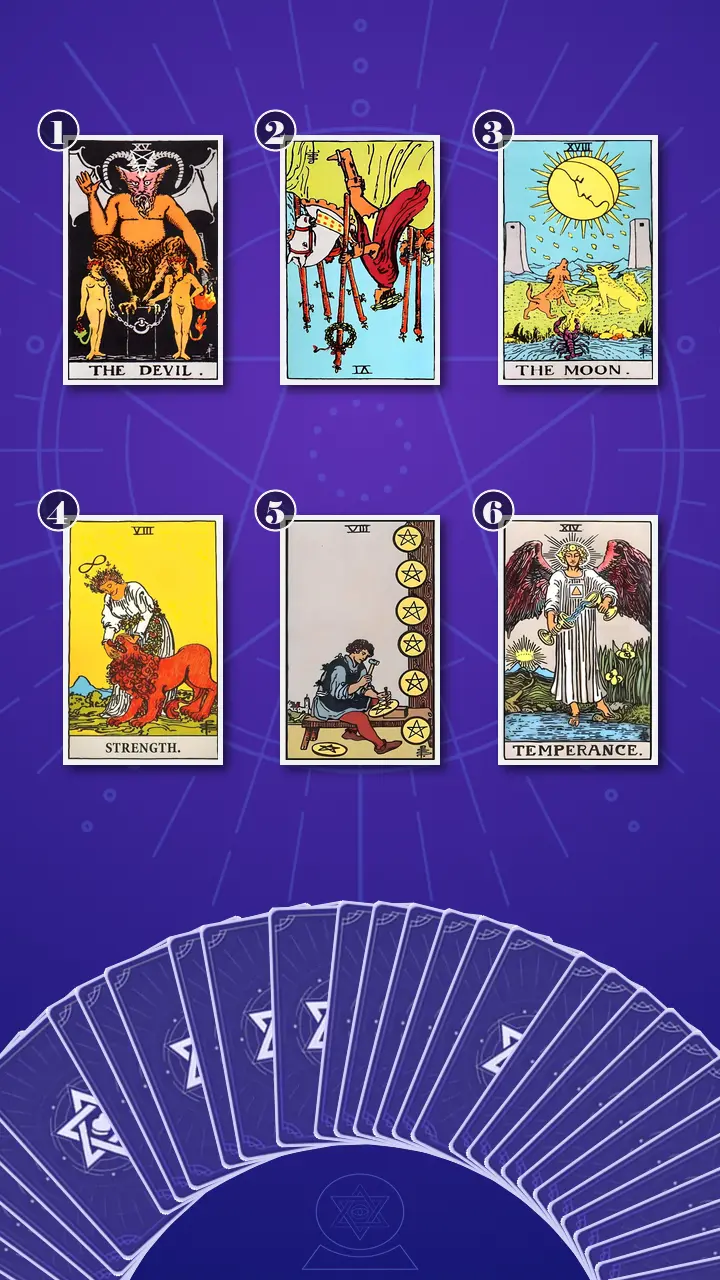
The two-by-three grid works like a street map that turns a crowded public feed into a route home. The top row shows the observable pattern, the immediate blockage, and the fear beneath it. The lower row shows the inner resource that can interrupt the cycle, the repeatable private practice available now, and the integrated perspective that can give public sharing and private healing different jobs.
I told Jordan that the first card would show the loop as it currently operates. The second would reveal why audience recognition had become a scorecard. The third would bring us to the fear that made witnesses feel necessary. Then we would move through quiet courage, a small practice, and balanced sharing. This is how tarot works here: the images organize observable behavior, emotional mechanics, and choices that were already present in Jordan's life.
When the Feed Became a Mirror
Position 1: The Loop That Looks Like Choice
Now I turned over the card representing the observable loop named in the diagnosis: turning painful moments into public posts, monitoring reactions, and still feeling stuck afterward. In its standard meaning, this position describes the present situation or visible condition. The card was The Devil, in upright position.
The loose chains around the figures immediately brought the modern pattern into focus. After a difficult interaction, Jordan posted a raw account because the immediate witness felt safer and faster than a direct conversation whose answer could not be edited. Once the post was live, views, replies, and reposts became the chain. Each notification offered a small pulse of belonging, while the request or boundary underneath the story stayed untouched.
The energy here was excess attachment, not because Jordan lacked willpower, but because the short-term bargain was efficient. Public disclosure relieved the first pressure. Audience response made the feeling legible. Then the attention turned into a task: check again, reread the comment, watch for one person's name, decide whether the post had landed, and wonder whether a stronger confession would finally create the change that the first one had not.
Because Jordan's work and identity both ran through social media, I brought in my Persona Fatigue Diagnosis. I asked how much energy was being spent maintaining the artificial social mask of the person who could make every painful experience clear, relatable, polished, and shareable for a group. The exhaustion did not prove the feeling was fabricated. It showed the cost of being continuously legible.
I also used my Group Archetype Decoding lens. I was not assigning Jordan a fixed identity. I was asking what role the social ecosystem rewarded. It seemed to reward the Explainer: the person who turned raw pain into a story that allowed a crowd to respond without having to enter the slower uncertainty of a private exchange.
Jordan gave a small, bitter laugh. 'That is too accurate,' they said. 'It makes me sound like I am doing this on purpose.'
I kept my voice steady. 'A pattern can reward you without being a deliberate plan. The Devil is useful because it shows the bargain clearly. We can examine what it pays out and what it keeps you from doing, without turning the pattern into a verdict about who you are.' Jordan's shoulders lifted toward their ears, then lowered slightly as their fingers released the edge of the phone.
Position 2: The Public Scoreboard
Next I turned over the card representing the mechanism that keeps Healing Stagnation in place: public recognition becomes a scorecard, so Performative Vulnerability substitutes for private change amid Viral Social Overexposure. In its standard meaning, this position is the immediate obstacle or pressure complicating the present. The card was Six of Wands, in reversed position.
The laurel wreath, raised wand, and surrounding crowd became a public scoreboard. A vulnerable Story reached 847 views. At first, that number felt like evidence that the pain mattered. Then the notifications slowed. Jordan's hand returned to the viewer list, and the original private conversation remained untouched. The urge was to add a more intimate detail, repost, or tag someone, as if increasing visibility could convert recognition into movement.
I named the inner line that seemed to sit beneath the checking: 'If the number drops, maybe the pain did not land.' The reversed energy was unstable recognition, a deficiency of lasting internal confirmation. It did not mean the supportive replies were fake or worthless. It meant that audience response could provide witness for an hour without reliably answering the need underneath the post.
'The numbers can tell you how far the story traveled; they cannot tell you what the pain needs next,' I said. For someone who works with analytics, this distinction matters. Views can be useful professional data about distribution. They are not dependable evidence of worth, seriousness, belonging, or healing progress. A campaign dashboard can show impressions while the actual conversion, a boundary or request, remains at zero.
Jordan's thumb stopped moving. They looked at the card, then at the phone, with the embarrassed recognition of someone seeing an ordinary habit acquire a new meaning. The quiet feed had not been a verdict. It had only been a quiet feed, while Jordan had been asking it to settle an inner question.
Position 3: The Story the Silence Writes
Now I turned over the card representing the underlying fear that the pain will not count without an audience, linking shame and longing to self-worth and belonging. In its standard meaning, this position reveals the hidden root, unconscious influence, or underlying fear. The card was The Moon, in upright position.
The Moon showed the winding path between what happened directly and what Jordan inferred from the audience. A delayed reply became rejection. A former friend's reaction in the viewer list became proof that the person understood, judged, or might return. Silence became a story. A stranger's comment changed the meaning of the whole post for ten minutes, then another comment changed it again.
I described the feed as a comment thread that kept rearranging itself while Jordan was still living inside the original scene. The Moon's dog and wolf faced the uncertain light, each responding to something real but not necessarily seeing the same thing. 'I need strangers to confirm what happened before I can trust myself about it,' I said. 'That sentence does not accuse you. It helps us separate what you know from what the audience is being asked to infer.'
I asked Jordan to distinguish facts from interpretations. The Story had reached 847 views. One person had not replied. A former collaborator had watched it. Those were observable details. The conclusions about worth, belonging, seriousness, or whether the pain counted were interpretations laid over the path like changing shadows.
Jordan became very still. Their eyes lost focus, and their hand stopped reaching for the phone. After a long breath, they said, 'If I stop posting, everyone moves on and I am left with the same feeling by myself.' I let the sentence remain in the room. The fear was not a command. It was information about why public witness had started to feel like emotional oxygen.
When Strength Put a Hand on the Lion
The room grew quieter before I opened the lower-left card. Outside, a streetcar bell sounded once and faded. I could hear the radiator again, but the phone screen was dark between us. We had reached the card that did not simply describe the loop. It offered a way to meet the force inside it.
Position 4: The Resource Beneath the Impulse
Now I turned over the card representing the inner resource that can interrupt the cycle: holding intense feeling with self-compassion before broadcasting it, then choosing a grounded need or boundary. In its standard meaning, this position shows the force or resource that can shift the situation. The card was Strength, in upright position.
The image was quiet rather than dramatic. A woman placed a gentle hand on the lion's mouth. The infinity symbol above her head suggested a capacity that could be practiced repeatedly. I translated it into the moment when Jordan's thumb hovered over Post and the chest tightened. The hand did not erase the lion. It stayed in contact with the force without letting that force choose the next tap.
At this point, I brought my Persona Fatigue Diagnosis into sharper focus. I asked Jordan to audit the energy spent maintaining the mask of the person who must explain the pain perfectly before anyone is allowed to care. I asked what might happen if the core feeling could remain real without immediately becoming a performance for the group. I was not asking Jordan to abandon vulnerability. I was asking them to detach identity from the role the feed rewarded.
My Group Archetype Decoding also showed the shift. The social ecosystem had been pulling Jordan toward the role of the person who makes the wound understandable for everyone else. Strength offered another role: the person who could stay present long enough to discover whether the wound wanted reassurance, clarity, a request, a boundary, connection, or simply a room where it did not have to perform yet.
It is 1:13 a.m. on the TTC Line 1 platform in the version of this pattern I wanted Jordan to recognize. The phone is warm from refreshing a vulnerable post. Station lights hum. Hundreds of people have witnessed the story, but the message or boundary underneath it is still unsent. Jordan was still caught in that old equation: explain harder and perhaps the audience will certify the pain; stop explaining and perhaps the pain will disappear.
Stop treating a visible confession as proof that healing is happening; let Strength's gentle hand on the lion turn the urge to perform into patient, private courage and one boundary-based action.
A public confession can create witnesses, but it cannot do the private work of helping you name a need, choose a boundary, or trust that your pain is real without a live audience.
For a second, Jordan froze. Their breath paused, their pupils widened, and the fingers holding the phone stayed suspended above the dark screen. Then their gaze left the card and went unfocused, as if it were replaying the delayed reply, the 847 views, and the former friend's name in a viewer list. Their mouth tightened. 'But does that mean I was wrong to share it?' The question came out sharper than before, carrying a flash of anger beneath the shame.
I kept my voice even. 'No. Your honesty is not on trial. It means sharing and changing are different jobs. The audience can witness what happened, but it cannot reliably name your need or make your boundary for you.' Jordan's grip loosened by degrees. A long breath moved through their chest. Their shoulders dropped, and their palm opened against the phone. Their eyes shone, but the relief was not clean. It carried the slight dizziness of finding a door where they expected a wall, along with the vulnerability of realizing that the choice was now theirs.
I asked, 'Now, use this new perspective to recall whether there was a moment last week when this insight might have made you feel differently.' Jordan looked down at the card. The resistance did not vanish, but it became less alone. I named the crossing plainly: this was a first step from urgent public exposure and audience monitoring toward private meaning-making, one grounded boundary, and steadier self-trust. Private does not mean unreal.
I showed the change as something barely visible rather than a dramatic breakthrough. The draft could stay in Notes. The phone could lie face down for two minutes. Jordan could notice one concrete need before deciding whether to share. It was not silence versus exposure, but impulse versus choice. That distinction preserved the right to publish while returning the next action to the person holding the phone.
Position 5: The Workbench Instead of the Spotlight
Now I turned over the card representing the repeatable private experiment: process one pain episode offline and practice one concrete boundary or request. In its standard meaning, this position offers practical advice or action available to the querent. The card was Eight of Pentacles, in upright position.
The craftsman at the workbench did not announce a complete transformation. They worked on one pentacle while the others waited along the wall. I saw the modern translation immediately: one private note, one named need, one request practiced without a live audience. This was grounded repetition, not another performance and not a demand to turn healing into productivity.
I asked Jordan to try three lines after the next pain spike: 'What happened?' 'What do I need now?' 'What action is within my control?' The first line could hold the direct event. The second could separate the need from the polished story. The third could keep the next move close to personal agency. The exercise could take ten minutes, and it could end with a public post, a message to one trusted person, a private note, or no response yet.
Jordan opened Notes, typed the first prompt, and then stopped. I watched the urge to create a perfect caption begin to lose its grip. The page was plain and unfinished. That was precisely why it worked as a different kind of space. The story was no longer being asked to prove its seriousness to a crowd before Jordan knew what it needed.
Position 6: The Cups With Different Jobs
Finally, I turned over the card representing the clarity endpoint of the consultation: distinguishing being witnessed from healing and choosing a sustainable relationship with public sharing. In its standard meaning, this position reveals the integrated lesson or perspective that emerges from the reading. The card was Temperance, in upright position.
The angel poured water between two cups, one foot on land and one in water, with a path leading toward distant light. I read the image as a practical audience map. Public expression could communicate context. One trusted person could offer relationship. Private reflection could hold what was still changing. A boundary could define what Jordan would do next. No single channel had to carry every job.
Temperance did not tell Jordan to become private forever, and it did not promise that every carefully chosen post would feel good. It offered pacing and discernment. Before sharing, Jordan could name the purpose: witness, connection, context, request, or release. Then they could choose the smallest audience that could realistically meet that purpose, including no audience if the material was still forming.
Jordan's shoulders had not become perfectly relaxed. They still glanced at the phone once. But this time, they did not pick it up automatically. They wrote three words in the margin: public, one person, private. The gesture was small, almost ordinary. In the language of the cards, water had begun to move between the cups.
From Witness to Action
The Story the Six Cards Told Together
When I read the grid as a whole, I saw a notification loop that began with a short-term bargain. The Devil showed how public recognition temporarily soothed the fear of being unseen. The reversed Six of Wands turned that recognition into a scoreboard, so a quiet feed felt like a verdict. The Moon revealed the uncertain path underneath: audience reactions were being used to answer a private question about worth and belonging. Strength offered patient contact with the impulse. The Eight of Pentacles gave that contact a small, repeatable form. Temperance showed how public expression, trusted support, and private processing could coexist without one pretending to be all the others.
I told Jordan that the cognitive blind spot was not simply 'I share too much.' It was the assumption that if a post received attention but the original situation remained unchanged, the disclosure must have been insufficient. That assumption sent more energy toward wording, reach, and audience management while the private need, request, or boundary stayed off the task list.
The key shift was from using public intensity to prove that pain is real toward using selective disclosure, private reflection, and one concrete boundary action to let the pain inform change. The aim was not to make Jordan less expressive. It was to make expression more chosen. A successful post could still be successful as communication, even if it was not the place where a private decision happened.
The Mask Detachment Protocol
I gave Jordan my Mask Detachment Protocol, a short psychological boundary exercise for separating core identity from group expectations and recovering baseline social energy. I explained that detachment did not mean hiding the story. It meant noticing which part belonged to Jordan's actual experience and which part belonged to the social mask of the person who had to make the experience perfectly legible before it could count.
I framed the next steps as experiments, not rules. Tarot had offered a map. Jordan remained the person who could choose the route, the pace, the audience, and whether any step was appropriate in the moment.
- Hold the Draft Before the FeedWhen the chest tightens and the thumb moves toward Post, save the caption in Notes instead of publishing immediately. Set a ten-minute timer and write one sentence beginning with 'Right now I need...' Keep the draft private while the timer runs.The pause is optional, not a permanent privacy rule. When the timer ends, Jordan can post, edit, message one trusted person, or wait.
- Turn One Story Into One BoundaryChoose one recent pain episode and write three lines: What happened? What do I need now? What action is within my control? If a request or boundary appears, practice it once in Notes, such as 'I need an answer by tomorrow' or 'I am not discussing this in a group chat.'Stop after ten minutes. If the page feels too large, write only one feeling or one need. A boundary can describe Jordan's action without requiring another person to respond correctly.
- Give Each Channel One JobBefore sharing a personal update, name its purpose with one word: witness, connection, context, request, or release. Then choose public sharing, one trusted person, a private note, or no response yet according to that purpose. Afterward, close the app for a set period and notice what changed offline, even if the answer is nothing yet.The label can change later. Public expression remains available. The point is to choose the channel deliberately instead of letting metrics decide what the story must accomplish.
These were small next steps, but they were not empty ones. They moved the story from a public scoreboard to a private workbench, then gave it a route through three different cups. That was actionable advice without a promise: enough structure to begin, enough flexibility to keep the decision Jordan's.

A Week Later: The Quiet Proof
Six days later, I received a message from Jordan: 'I kept the draft private for ten minutes, named the request, and sent it.' They slept through the night, then woke with the thought, 'What if I am wrong?' This time, they smiled before opening the app.
The original situation was not magically solved, and the message did not prove that the loop had disappeared. I noticed something more modest and more useful: the post had stopped being the only possible doorway. Jordan had made one private meaning-making move and one boundary-based choice before inviting the crowd to interpret the experience.
I had not used the cards to tell Jordan what would happen. I had used them as a structured cognitive tool, a set of images that made an existing pattern easier to see and an existing inner wisdom easier to hear. The cards named the chain, the scoreboard, the uncertain path, the gentle hand, the workbench, and the flowing cups. Jordan chose what to do with that knowledge. That is the heart of the Journey to Clarity: not certainty handed down from a reading, but ownership returned to the person living the question.
When your chest is tight and your thumb hovers over Post, it can feel as if more witnesses will finally make the pain count, even while another part of you knows the audience may move on before you do.
I hope you remember Strength's hand on the lion as contact rather than censorship, and remember that a private room can be where a story becomes a choice. If your pain could remain real without being fully explained online, what small private need might you let yourself notice tonight?