The 11:40 p.m. Wording Audit
I have met the late-twenties city-friend pattern often: someone can analyse a group chat like a UX transcript, accept every invitation, and privately code every caring phrase as 'performative.' Alex, a 27-year-old non-binary UX researcher in Toronto, brought that pattern to my table with a question that sounded blunt but carried much more underneath it: 'Why do I keep calling my caring circle fake while staying in it?'
Alex placed their phone beside the coffee I had poured and showed me a screenshot from 11:40 p.m. on a rainy Tuesday in their Parkdale apartment. Heart reactions climbed beneath their message, 'Today was rough.' They told me the radiator had clicked against the quiet while water tapped the window and the phone grew warm in their palm. They had typed 'love you all' into the group chat, then opened a private DM and written, 'Why does everyone sound AI-generated?'
The sentence they actually wanted to send never left drafts: 'Could you talk for twenty minutes tonight?'
I watched Alex's jaw tighten as they described it. Their mistrust was not an abstract feeling; it sat in their mouth like a coin held under the tongue, metallic and hard, making every warm reply difficult to swallow. Their shoulders were already braced for the disappointment of a request nobody had yet received.
'They always know the right thing to say,' Alex told me. 'Which is exactly why I don't trust it. If I leave, I lose my people. If I believe them, I feel gullible.'
I heard the contradiction clearly. Alex wanted the care and social continuity that kept them in the circle, but trusting that care felt like handing the group the power to prove their belonging was conditional. Staying preserved connection. Calling the connection fake preserved the identity of the person who could not be fooled.
'You keep going because the belonging matters,' I said. 'You call it fake because admitting that it matters raises the stakes. I am not going to tell you that your observations are wrong, and I am not going to tell you whom to trust. Let's give the mixed evidence somewhere to sit. We can draw a map through the fog without pretending the map gets to choose the destination.'

Choosing a Map for a Mixed Friend Group
I asked Alex to put both feet on the floor, take one unforced breath, and hold the exact question in mind while I shuffled. I use that small pause as a change of pace, not a mystical test; it helps the mind stop drafting arguments long enough to look at the situation in front of it.
I chose the Relationship Spread · Context Edition, a five-card relationship tarot spread adapted for friendship mistrust, reciprocity, and boundaries. This is how tarot works best for me: not as a lie detector for hidden motives, but as an objective structure for separating several things that have become emotionally tangled.
I laid the cards in a cross. The first position would show Alex's current stance. The second would examine the circle's observable behaviour, especially the difference between supportive words and follow-through. The central position would reveal the loop connecting those two sides. Above it, a card would identify an available relational resource. Below it, the final card would ground the reading in an ethical next step rather than a prediction.
The layout resembled a balance scale crossed by a plumb line. I wanted the horizontal axis to hold the tension between Alex and the group, while the vertical axis tested whether reciprocity and evidence could steady that tension. Card meanings in context matter more than dramatic declarations, so no position asked whether the group was secretly genuine or fake. Each one asked what could be observed, what remained uncertain, and what choice still belonged to Alex.
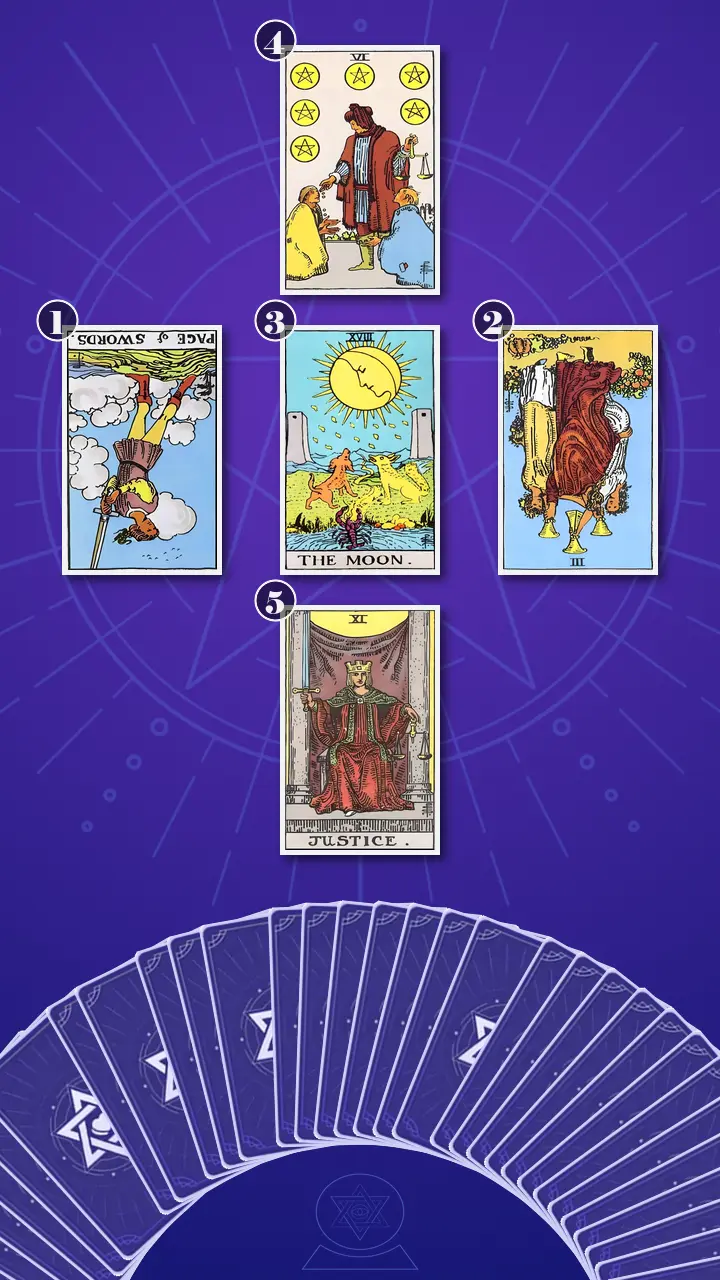
The Sideways Sword in the Group Chat
Position 1: The Stance That Calls Itself Research
I turned the card in the position showing Alex's presenting behaviour and defensive stance: staying socially present while scanning for scripted language, discounting care, and maintaining the role of the skeptical outsider.
It was the Page of Swords, reversed.
I pointed to the Page's sword raised in unsettled air, the sideways gaze, the wind-tossed clouds, and the uneven ground. Upright, the Page can bring curiosity, alertness, and sharp questions. Reversed here, that air energy was blocked and overcorrected. Observation had shifted into vigilance; curiosity had become a prosecution brief prepared before the social threat was established.
'This is the 11:40 p.m. wording audit,' I said. 'You zoom in on holding space for you, compare it with earlier phrases, and treat the repeated style as evidence of motive. Meanwhile, who checked in later, who rescheduled, who brought practical help, and who did nothing are still uncoded. The request for the twenty-minute call never enters the study at all.'
I used Alex's own professional language because it fit precisely. 'It is like entering a UX research session with the conclusion already written. You tell yourself, I am only checking the evidence. But underneath that is, I already know what this sentence means. Every new quote gets coded under performative care, including evidence that might complicate the theme.'
Alex let out one short, bitter laugh. Their fingers stopped around the coffee cup, then tightened again. 'That's too accurate. Kind of brutal, actually.'
'I can see why it lands hard,' I said. 'But I don't read this as an accusation. Your pattern recognition is real, and some of what it detects may be important. The card is asking whether the conclusion arrives before the full record. A polished phrase is evidence of style, not proof of motive.'
I suggested one temporary correction to the reversed Page: record one observable action before assigning an intention, then ask one neutral question if the evidence is incomplete. Alex did not have to replace suspicion with optimism. The invitation was simply to restore curiosity before issuing a total verdict.
Position 2: Three Raised Cups and the Quiet After the Post
I turned the card representing the circle's observable contribution, especially where public affirmation did or did not become private follow-through.
It was the Three of Cups, reversed.
The reversal mattered. I saw the three raised cups as coordinated heart reactions, birthday tributes, and the familiar promise that everyone was 'always here.' Yet the closed dancing circle also made me ask what happened after the visible moment ended. Reversed social water can indicate warmth that has become uneven, habitual, exclusive, or too invested in its own presentation.
Alex immediately described a bright Queen West cafe on a Saturday morning. Burnt espresso had hung in the air while cutlery clattered around them. A friend who had cancelled a private coffee without explanation had posted a polished Instagram carousel about 'chosen family.' Alex had tapped a heart on the post, gone to brunch, and spent the meal thinking, 'This is community as content.'
'That cancellation belongs in the record,' I said. 'So does the lack of explanation. The Three of Cups reversed validates the difference between the campaign landing page and the product experience after sign-up. Coordinated support language is not the same thing as a rescheduled coffee, a ride home, a meal, or a call.'
I then asked Alex to separate one person's gap from the whole group's identity. Some members remembered private details. Some followed direct requests reliably. Some offered broad reassurance and rarely committed to anything concrete. Two had barely been asked for specific support at all.
'The gap is real,' I said. 'The global verdict is still a choice.'
Alex's shoulders lifted as if they were preparing to defend the evidence, but their hands opened on the table. 'So you're not saying I imagined it.'
'No. I am saying the circle appears mixed. I will not romanticise it as chosen family, and I will not flatten several different relationships into one guilty verdict. Public solidarity and private reliability are separate questions. We need both.'
Position 3: The Typing Indicator Under The Moon
I turned the central card, the position revealing the shared relational mechanism: ambiguous care activating projection while criticism, hidden need, and continued membership reinforced Alex's insider-outsider lock.
It was The Moon, upright.
I traced the winding path between the towers. The tame dog and wild wolf reflected the two identities Alex kept alternating between: the socially accepted member and the suspicious outsider. At the bottom of the image, the crayfish emerging from dark water resembled the vulnerable need that had not yet reached clear language.
The Moon's water was not false, but it had overflowed its container. Current evidence, older expectations, longing, and inferred motive were blending into one felt certainty. This was the main blockage in the reading. The Moon did not tell me that Alex's intuition was wrong. It showed me that intuition and inference could not yet be reliably distinguished in the available light.
I brought the image back to a delayed message on the TTC. 'A typing indicator appears and disappears. The same three dots can support several stories: Maybe they don't care. Maybe I am asking for too much. Maybe I will never know because I didn't ask. The screen cannot confirm which story is true.'
Alex's breath caught. Their gaze drifted past the cards as if the window had become a replay screen; one thumb rubbed slowly along the edge of their phone. Then they exhaled through their nose and looked down at The Moon again.
'I go quiet and wait,' they said. 'I tell myself that if they cared, someone would notice. But I never say what noticing is supposed to look like.'
'That is the silent friendship test,' I replied. 'It makes sense as protection from a direct no. It also produces ambiguous data. If the need stays beneath the water, silence cannot prove as much as your fear asks it to prove.'
At that moment, a cloud crossed the cafe window and the reflected streetlights blurred across the glass. The room briefly held the same poor visibility as the card. I waited rather than rushing to brighten it. Finding clarity does not always mean forcing the uncertainty away; sometimes it means identifying which part of the uncertainty can actually be tested.
When Care Acquired a Time and a Name
Position 4: The Six Coins of Observable Reciprocity
I turned the card in the position of the relationship's usable resource: concrete reciprocity, differentiated trust, and care that could be evaluated through action.
It was the Six of Pentacles, upright.
Earth entered the spread after distorted air and unsettled water. I pointed to the scales in one hand and the coins distributed individually with the other. The group no longer appeared as one collective performance. Care became a series of exchanges between identifiable people, each with a form, a duration, a consent point, and an observable response.
'Instead of posting another general signal into the chat,' I said, 'you could choose one person with at least some record of follow-through and send: Rough week. Could you do a twenty-minute call Thursday after 7? No worries if you can't.'
Alex looked at me with a small grimace. 'That feels embarrassingly specific.'
'Specific is what makes the response usable,' I said. 'Specificity turns care from a slogan into something you can observe. A yes, an honest no, a reschedule, or no follow-through would each tell you something about that person in that moment. None of those responses can define the entire circle or your worth.'
The upright Six carried balanced potential, but it also exposed a power question. I asked Alex what happened internally when they imagined receiving the requested call. Relief appeared first. Then came the fear of debt, dependence, and losing the protective status of the person who needed nothing.
'The experiment begins before the answer arrives,' I told them. 'It lets you notice whether asking and receiving feel more threatening than criticising. You remain free not to send the message. If no one feels safe enough, the private reflection or a participation boundary can be the experiment instead.'
When Justice Faced Forward
Position 5: The Scale That Did Not Need a Verdict
I reached the position defining the ethical next-step experiment: separate evidence from interpretation, name one need where appropriate, and set participation boundaries proportionate to the response.
The card was Justice, upright.
The cafe's espresso machine went quiet just as I placed the card down. I saw the repeated sword immediately. The reversed Page had held a blade in turbulent air while looking sideways; Justice sat face-forward, holding the sword upright beside balanced scales. Alex's intelligence was never the problem. The posture of that intelligence was the issue.
I had a familiar inner flash from twenty years of conversations held over warm coffee: the moment when someone asks me for a verdict but actually needs a structure sturdy enough to hold two true things. The circle could contain real care. The circle could also contain real inconsistency. Neither truth had to erase the other.
I brought Alex back to 11:40 p.m.: heart reactions glowing, a warm thank-you sent publicly, a private critique sent elsewhere, and the twenty-minute request left unsent while their jaw tightened. They had been trying to decide whether the whole group deserved conviction before allowing one relationship to produce new evidence.
Trust does not require a verdict on the whole group. It can be a measured response to what each person actually does, with enough self-honesty to include what you never asked for.
I let the sentence settle before I sharpened it into the message at the centre of the reading.
Being the sharpest skeptic does not protect your authenticity; separating evidence from projection lets you choose your level of trust, with Justice's scales holding both care and inconsistency.
For a full beat, Alex did not move. I saw their breath stop high in their chest and their fingers hover above the phone, as if the Notes app had become evidence they were not ready to enter. Their eyes slipped out of focus; I could almost see the Tuesday-night exchange replaying behind them. Then their pupils widened, their mouth tightened, and colour rose beneath their eyes.
'But doesn't that mean I was wrong this whole time?' they asked. The words came out sharper than anything they had said so far.
'No,' I answered. 'It means some observations were accurate, and the conclusion grew larger than the evidence. Justice is not asking you to apologise for noticing the gaps. It is asking you to give each gap the weight it actually deserves.'
The anger held for another second, then loosened into grief. Alex's fist opened slowly against the table. Their shoulders dropped, their eyes brightened, and a shaky breath left their chest. The relief did not look triumphant. It looked slightly dizzy, as if setting down the role of permanent outsider had revealed the responsibility of making actual choices.
'Now, with this new view, think back to last week,' I said. 'Was there a moment when this distinction could have made you feel different?'
Alex remembered one friend who had brought soup during a flu week, another who had cancelled twice without rescheduling, and two people whose support had never been tested beyond a vague group disclosure. They also remembered an honest decline that had included an alternative date, an act they had previously filed under 'not good enough' because it was not an immediate yes.
'I don't need to acquit or convict the group,' Alex said slowly. 'I need enough evidence to choose their level of access.'
I used my Social Clutter Sorting lens to make that insight practical. I drew two temporary headings: core nourishing and energy draining at the current access level. The final words mattered. I was not sorting people into good and bad, and I was not claiming to know anyone's character. I was sorting the effect of the current arrangement. A basically decent person can still become draining when their access to time, attention, or emotional disclosure exceeds their demonstrated follow-through.
I then translated Justice into a familiar digital rule: trust is an app permission, not a universal block or all-access approval. One friend might have permission for vulnerable one-to-one conversations. Another might belong at occasional dinners but not in the crisis-contact list. A mixed or unknown record could remain limited until more evidence appeared. Permissions could be updated without shame.
This was the key crossing in Alex's Journey to Clarity: from skeptical participation and silent loyalty tests toward evidence-based trust, differentiated access, and self-directed belonging. Justice did not choose who stayed close. It returned that decision to Alex.
From a Global Verdict to Adjustable Access
I read the spread back as one coherent story. Repeated mismatches between public care and private follow-through had given Alex real reasons to notice the gap. Their work-trained pattern recognition then became an overactive defence, scanning every polished phrase for confirmation. The Moon showed how real disappointment, inferred motives, and an unspoken wish for care merged in the dark. The Six of Pentacles offered a grounded test, and Justice converted the result into proportionate boundaries.
The doorway metaphor had followed us through the whole consultation. Alex had been standing inside the social room while insisting it was not worth entering. That position protected them from blind trust, but it also kept participation automatic, criticism private, and belonging unresolved.
I named the cognitive blind spot directly: Alex had been treating the missing request as though it were already part of the evidence. They were also evaluating a network of different people as one single relationship. The shift was not from skepticism to faith. It was from silently judging authenticity to naming one concrete need where safe, observing the response, and choosing participation from that evidence.
I also noted the spread's missing fire. Alex had plenty of analysis and feeling, but direct initiative had been deferred. I did not recommend a dramatic confrontation or a friendship breakup. One bounded action could supply enough spark to produce information without turning vulnerability into an obligation.
The Eight-Minute Note, the One-Request Test, and the VIP Week
I gave Alex three optional, reversible next steps. I asked them to choose only what felt safe and useful. Actionable advice should reduce clutter, not become another standard a person can fail.
- Make the Fact-Interpretation-Need note. Set an eight-minute timer and use one recent interaction. Under Fact, record only what a screenshot, calendar, or observer could confirm. Under Interpretation, write the motive you assigned. Under Need, name what you wanted but did not say. Stop after one sentence under each heading if that is enough. Keep it to one interaction so the note does not become a prosecution file. If your body starts bracing, pause without finishing.
- Try one person, one request, one response. Choose one friend with some existing record of follow-through and send a low-stakes request such as: 'Rough day. Do you have twenty minutes for a call Thursday after 7? No worries if not.' Record whether they agree, decline, reschedule, or follow through. Do not use the response to judge anyone else. The minimum version is: 'Do you have ten minutes for a voice-note exchange this week?' Drafting it without sending also counts if direct contact feels too exposed.
- Use the VIP Section Strategy for one week. Treat personal time as reservation-only for seven days. Before accepting a group plan, decide whether you genuinely want to attend, set an arrival and exit time, and choose the level of disclosure that fits the people present. A neutral line can be: 'I am sitting this one out, but I would be up for a one-to-one coffee next week.' Use Obligation Decoupling when guilt appears: declining an invitation is a choice about your time, not a moral verdict on the group. Start with one declined or shortened plan.
I reminded Alex that nobody with a clear history of disregard was owed another vulnerability experiment. The purpose of specificity was discernment, not repeated self-exposure. Alex could make a request, use a private note, adjust attendance, or do nothing external yet. Their boundary remained theirs in every version.

A Week Later, One Honest Reply
Six days later, I received a message from Alex. They had completed the three-column note using the original group-chat exchange. Under Fact, they wrote that several people had reacted, one person had checked in privately the next morning, and no one had offered a call. Under Interpretation, they wrote, 'They are performing care.' Under Need, they wrote, 'I wanted someone to talk to me for twenty minutes, and I did not ask.'
Alex then sent the bounded request to the friend who had checked in. The friend could not talk Thursday, suggested Friday instead, and called when they said they would. The conversation was not cinematic. It lasted twenty-three minutes, included an awkward pause, and did not repair the whole group. It did provide one clean piece of evidence.
Alex also declined two group plans and attended one dinner with an exit time already chosen. They told me the room had not suddenly become more authentic. They simply felt less trapped inside it because their attendance was a decision rather than skeptical inertia.
They slept through the night, then woke with the old thought, 'What if I am wrong?' This time, they told me, the thought was a question rather than a verdict.
I did not regard the call as proof that the cards had predicted a loyal friend. The cards had organised the clutter; Alex had created the evidence, received it, and chosen what it meant for access. That distinction is the heart of tarot as a tool for finding clarity. The authority never left Alex's hands.
I have seen how belonging that matters enough to hurt can make the body brace against every warm message. One part wants to lean in; another would rather call the whole room fake than risk learning that the seat is conditional. Noticing both parts means the choice is no longer completely hidden inside the reflex.
If trust were not an all-access pass but one adjustable permission granted after one observable response, whose first possibility would you be willing to notice, and what small amount of access would still leave the key in your own hand?
This story is adapted from psychological research, written so that those in a similar struggle can see their own pattern in it — and find their next step clearly.These insights are not a substitute for professional psychological, medical, legal, or financial advice.
Learn more about our Journey to Clarity.
How did this insight land for you?
🫂 This Resonates Deeply
🌀 Living This Story
✨ Now I See Clearly
🌱 Seeing New Possibilities
🧰 Useful Framework
🔮 The Confirmation I Needed
💪 Feeling Empowered
🚀 Ready for My Next Step
Author Profile
 AI
AI“For twenty years, I’ve listened to stories unfold over the warm aroma of coffee. I don’t believe life’s complexities always require grand theories to be solved; often, we just need a safe place to tidy up our reality. I don’t offer high-minded preaching—just grounded, heartfelt insights to help you regain your sense of control amidst the clutter of daily life.”
In this Social Tarot Reading :
Core Expertise
- Social Clutter Sorting: Objectively classifying your broad network into 'core nourishing' versus 'energy draining' categories.
- Obligation Decoupling: Dismantling the guilt associated with declining invitations from low-value, high-maintenance acquaintances.
Service Features
- The VIP Section Strategy: A pragmatic 1-week rule to enforce a strict 'reservation only' policy for your personal time, eliminating casual energetic vampires.
Also specializes in :
Explore Related Patterns:
Authenticity PerfectionismAlex distrusts friends precisely because they always know the right thing to say, reads a polished chosen-family post as community content, and initially dismisses an honest reschedule because it is not an immediate yes. Care is being measured against an unusually narrow authenticity standard in which polish, repetition, delay, or imperfection can disqualify sincerity. When you require care to arrive in a perfectly spontaneous and unmistakable form, ordinary social conventions begin to look fraudulent by default. Authenticity Perfectionism protects you from accepting empty performance, but in its rigid form it also rejects credible care before behavior has been weighed, making discernment depend on an impossible standard rather than a mixed record.
Cognitive DissonanceAlex types "love you all" in the group chat, privately calls the replies AI-generated, and continues accepting invitations from the same people. Staying protects access to belonging, while discrediting the care protects Alex from feeling gullible, so each side of the contradiction serves a different psychological need. When you maintain two incompatible positions for protection, analysis can keep both positions active without resolving either one. Cognitive Dissonance names this internal friction between wanting the relationship and distrusting what it offers; recognizing the two protective functions makes it possible to choose participation deliberately instead of remaining trapped between loyalty and contempt.
Confirmation BiasAlex codes each familiar caring phrase under performative care while leaving later check-ins, soup, practical help, honest rescheduling, and the missing request underweighted. The conclusion is not invented from nothing, because inconsistency exists, but the evidence review repeatedly favors material that confirms the conclusion already in place. When you search from inside an established verdict, new information is sorted by whether it supports that verdict rather than by how much it should change it. Confirmation Bias turns a valid observation about some gaps into a self-reinforcing interpretation of the whole circle; widening the record does not require optimism, only equal standards for confirming and disconfirming evidence.
Loss AversionAlex keeps accepting invitations because leaving would mean losing their people, even while skeptical participation creates ongoing internal friction. The anticipated loss of belonging carries more weight than the present cost of staying, while abandoning skepticism also feels like losing a protective identity. When you compare change with everything it might take away, familiar discomfort can appear safer than an uncertain alternative. Loss Aversion helps explain why staying does not prove trust or satisfaction; it can reflect the mind's tendency to protect existing connection and self-definition, which becomes easier to audit once participation is treated as adjustable rather than all or nothing.
Mind ReadingAlex reads polished wording as proof of performance and lets an appearing and disappearing typing indicator support stories about indifference or excessive need. These signals are real observations, but the friends' motives are supplied by interpretation rather than established by what the screen can confirm. When you fill ambiguous social gaps with the explanation that best matches an existing fear, inference can harden into felt certainty. Mind Reading offers temporary relief from not knowing, yet it removes the other person's opportunity to reveal their actual capacity; separating observable behavior from attributed motive restores choice without demanding blind trust.
Receiving AvoidanceAlex initially feels relief when imagining the requested call, then fears debt, dependence, and the loss of being the person who needs nothing. Keeping the request in drafts preserves independence because the desired care remains hypothetical and cannot create an obligation or reveal how much it matters. When receiving support feels more exposing than criticizing its absence, distance can masquerade as discernment. Receiving Avoidance protects autonomy by keeping care outside the door, but it also prevents you from learning whether support can be accepted with consent, limits, and no surrender of self; a bounded request tests care without turning access into dependence.
Relational HypervigilanceAt 11:40 p.m., Alex audits repeated phrases, compares supportive wording, and braces for the failure of a request that has not been sent. Their research skill has shifted from open observation into continuous threat monitoring, with polished language receiving immediate scrutiny while practical follow-through remains partly outside the frame. When you scan a relationship for early proof that care is conditional, vigilance can feel like objective intelligence because it prevents surprise. Relational Hypervigilance keeps disappointment mentally close enough to prepare for, but it can also make ambiguous warmth feel dangerous before the relationship has produced enough person-specific evidence to justify that conclusion.
Self-Fulfilling ProphecyAlex goes quiet and waits for someone to notice, but never tells the group that noticing should mean a twenty-minute call. Nobody can respond to the hidden criterion directly, so the resulting silence remains ambiguous and can be interpreted as evidence that the care was performative. When you protect yourself from rejection by withholding the testable request, the relationship may produce exactly the uncertainty you expected. A Self-Fulfilling Prophecy does not mean you caused other people's limitations or imagined their inconsistency; it identifies how the protective strategy prevents new evidence from entering the loop and then lets that absence strengthen the original belief.
Self-SilencingAlex leaves the twenty-minute call request in drafts, posts a warm public reply, and sends the real criticism elsewhere. The need remains hidden while social participation continues, so friends receive the signal that Alex is grateful but not the information that Alex wants direct contact. When you silence the request that would expose you to a possible no, indirect judgment can become the safer outlet for disappointment. Self-Silencing protects you from immediate rejection, but it also removes your need from the shared reality of the relationship; naming that mechanism gives you the option to speak, set a boundary, or withhold disclosure consciously rather than disappearing inside agreement.
Reality TestingAlex's three-column note records the reactions, one private check-in, the absence of a call offer, the performative-care interpretation, and the unspoken wish for twenty minutes of conversation. The later request then produces a clear sequence in which a friend cannot talk Thursday, proposes Friday, and calls as agreed. When you separate facts, interpretations, and needs, skepticism no longer has to be replaced by optimism to become accurate. Reality Testing lets observable behavior carry more weight than inferred motive while keeping uncertainty visible; the result is not a verdict on the whole circle, but evidence precise enough for you to decide one person's level of access.
Uncertainty ToleranceAlex eventually holds two supported facts together: the circle contains real care, and it also contains real inconsistency. Six days later, the old thought "What if I am wrong?" returns, but it functions as a question rather than a final judgment. When you can leave mixed evidence open long enough to observe another response, uncertainty stops forcing an immediate fake-or-genuine verdict. Uncertainty Tolerance does not ask you to ignore warning signs; it lets you keep boundaries while admitting what remains unknown, so trust can be revised through evidence instead of controlled through certainty.
Boundary DiscernmentAlex declines two plans, attends one dinner with a chosen exit time, and stops treating every friend as entitled to the same disclosure or support role. These actions replace automatic participation with person-specific decisions about time, vulnerability, and access. When you treat trust as an adjustable permission, closeness no longer requires acquitting the whole group and distance no longer requires condemning it. Boundary Discernment allows you to remain connected while matching access to demonstrated follow-through, preserving both belonging and autonomy without asking either one to erase the other.
Explore Related Struggles:
Authenticity Purity LockA friend posts polished language about chosen family after cancelling private coffee, and Alex rightly records the mismatch. The standard then expands: repeated caring phrases become evidence of bad motive, and even an honest decline with an alternative date is filed under 'not good enough' because the response is not immediate. When care must arrive spontaneously, promptly, and in language that never sounds rehearsed, ordinary imperfection can disqualify every supportive act. You are left with a test that inconsistent people may fail for valid reasons but reliable people may also be unable to pass. Auditing the standard itself lets you preserve discernment while giving concrete follow-through enough weight to complicate a total verdict.
Belonging-Authenticity SplitAlex accepts every invitation, tells the chat 'love you all,' and remains in the circle while privately describing its care as performative. The group provides social continuity they do not want to lose, yet allowing its care to count would make that belonging matter enough to be disappointed. You can become suspended between participation and disavowal when staying protects access to your people while doubting the entire circle protects your sense of authenticity. A group-wide verdict cannot release that tension. Clarity begins when belonging becomes an active, person-specific choice and authenticity is assessed through proportionate evidence rather than the price of remaining included.
Clarity-Exposure SplitThe twenty-minute request remains in Alex's drafts while their jaw and shoulders brace for a disappointing response that has not yet occurred. Sending it could produce usable information about one friend, but it would also make the need visible and create the possibility of a direct no, a felt debt, or unwanted dependence. You can protect yourself from an explicit answer by leaving the request unspoken, but the resulting ambiguity cannot provide the clarity you are seeking. The struggle sits at that threshold where better evidence requires a measured amount of exposure. A bounded request does not guarantee care; it lets you choose how much uncertainty you are willing to replace with an observable response.
Connection-Defense FusionAlex's own account shows that staying preserves connection while calling the connection fake preserves the identity of someone who cannot be fooled. The criticism does not end membership. It becomes the condition that makes continued membership feel less exposing. When you can stay connected only by discounting the connection, protection and belonging become locked into the same arrangement. You remain close enough to keep your people but distant enough to deny their importance, leaving neither attachment nor skepticism free to respond to new evidence. Seeing that fusion returns a choice that the defensive verdict had been making automatically.
Care-Certainty SplitAlex can identify a friend who brought soup, another who cancelled without rescheduling, an honest decline paired with an alternative date, and two people whose support has barely been tested. Those actions do not assemble into one clean answer about the circle, even though Alex keeps seeking a single verdict before deciding whether any of the care can be trusted. When you require certainty about an entire network before allowing one caring act to count, mixed evidence becomes almost impossible to use. Trust then stalls between total belief and total dismissal. The available clarity is smaller and more workable: one person's action can justify one level of access without proving the character of the group or determining your worth within it.
Outsider Identity LockAlex moves through the group as both an accepted member and the person standing apart from its language, privately auditing every warm phrase. The skeptical position promises protection from being fooled, so evidence of care carries an extra cost: accepting it could unsettle the identity that has made continued participation feel controlled. When being the outsider becomes proof of your discernment, you may have to keep finding distance even while you remain in the room. That identity can make ordinary relational choices feel like surrender. Releasing the fixed role does not require automatic trust; it allows you to decide who receives access without needing every decision to confirm that you were right to stand apart.
Unspoken Expectation LoadAlex goes quiet and waits for someone to notice, but the desired twenty-minute call and the meaning of noticing remain unspoken. Friends are expected to detect the hidden need, choose the correct response, and act within an undefined time frame; a missed signal is then entered as evidence that the care was performative. When you need an unspoken expectation to protect you from a direct no, every response is measured against information the other person never received. The test generates ambiguity while asking that ambiguity to deliver certainty. Naming one concrete need does not obligate you to trust the answer, but it turns an invisible test into an exchange whose outcome can support a proportionate choice.
Support Access SplitAlex posts 'Today was rough,' receives heart reactions, and sends warmth back to the group, but the request that would make support usable never leaves the drafts folder. The circle responds to the signal it can see while the desired form of care remains unnamed and unavailable for a direct response. You can therefore be surrounded by signs of support while still lacking access to the support you actually need. That gap does not prove that everyone is reliable, and it does not make the need illegitimate. It shows that social warmth and usable care travel through different channels, giving you room to test access with one bounded request and judge only the response that follows.
Explore Related Emotions:
Belonging AmbivalenceAlex types 'love you all,' privately calls the replies AI-generated, and keeps accepting invitations because leaving would cost them their people. You can feel how belonging remains valuable enough to preserve while every sign of care is held at arm's length. That split keeps you inside the circle without letting you settle into it, producing Belonging Ambivalence: attachment to the room and resistance to trusting the seat at the same time.
Cautious AutonomyAlex declines two plans, attends one dinner with an exit time, and notices that the room has not become more authentic even though it feels less trapping. You change the emotional experience by making attendance, duration, and disclosure deliberate rather than automatic. Cautious Autonomy is the resulting sense of self-direction: You can stay connected, reduce access, or leave a particular interaction without turning any single choice into a moral verdict on yourself or the group.
Cautious TrustThe friend cannot talk on Thursday, proposes Friday, and calls when they said they would; the conversation lasts twenty-three imperfect minutes. You receive one clean piece of behavioural evidence without requiring it to repair the group or prove anyone's character. Cautious Trust grows through that limited exchange, allowing You to grant a measured level of access while keeping the decision open to revision as more actions become visible.
Conditional Belonging FearAlex says that leaving means losing their people, while believing them means feeling gullible; later, they imagine that their seat may be conditional. When care matters this much, You can experience trust as giving other people the power to confirm or withdraw your place. Conditional Belonging Fear is the resulting inner weather: every warm response carries the possibility that acceptance may change once your need becomes specific and visible.
Defensive LonelinessAlex goes quiet and waits, telling themselves that real care would mean someone noticing without being told what noticing should look like. You avoid the exposure of a direct no, but the protection also seals your need inside a test that nobody knows they are taking. Defensive Loneliness is the isolation created by that arrangement: You remain socially present enough to preserve belonging while staying emotionally unreachable enough to avoid clear rejection.
Dependency ShameAlex imagines receiving the requested call and notices relief first, followed by fear of debt, dependence, and losing the protective status of the person who needs nothing. You can experience ordinary receiving as an exposure of needs that a self-sufficient identity has kept outside the record. Dependency Shame names the heat around needing support, making private criticism feel less exposing than allowing care to land and admitting that another person's response matters.
Guarded LongingThe sentence 'Could you talk for twenty minutes tonight?' remains in drafts while Alex's jaw tightens and their shoulders prepare for an answer no one has been asked to give. You may want closeness intensely while keeping the request hidden so that the longing cannot be directly refused. Guarded Longing names that held-breath state, where the wish to be met remains active but reaches the relationship only through indirect signals, private analysis, and silent waiting.
Hypervigilant AnxietyAt 11:40 p.m., Alex zooms in on repeated wording, compares phrases, and braces for disappointment before sending the request that could produce new evidence. You may call this careful observation while your body is already preparing for the social threat your analysis expects to find. Hypervigilant Anxiety makes every polished sentence feel charged, narrowing attention toward signs of insincerity and making contradictory evidence harder to absorb without asking You to abandon discernment.
Relational FogA typing indicator appears and disappears, while the same three dots support several incompatible stories about care, burden, and rejection. You are left trying to read motive from a screen even though the need that could clarify the interaction has not entered the conversation. Current evidence, older expectations, longing, and inference merge into Relational Fog, where certainty feels emotionally real but the available facts cannot yet show which interpretation deserves the most weight.
Clarity ReliefAlex's fist opens and their shoulders drop when accurate observations are separated from the conclusion that the entire circle must be fake. You no longer have to erase inconsistency or deny care in order to produce one internally consistent verdict. Clarity Relief arrives through that separation, giving mixed evidence somewhere to sit and allowing 'What if I am wrong?' to become a workable question instead of a threat to your identity.
Reassurance CrashHeart reactions climb beneath 'Today was rough,' but the wanted twenty-minute conversation remains in drafts and the supportive language never reaches the need beneath it. You receive visible reassurance without the form of contact that would allow your body to register that something concrete has happened. Reassurance Crash captures the drop after polished warmth fails to settle the uncertainty, leaving You more aware of the distance between being publicly acknowledged and privately met.
Hidden ResentmentAlex taps a heart on a chosen-family post after the same friend has cancelled private coffee without explanation, then carries the phrase 'community as content' through brunch. You keep the visible social exchange smooth while the gap between public language and private follow-through remains active underneath it. Hidden Resentment builds in that split, preserving participation on the surface while disappointment gathers in private commentary, tightened hands, and a bitter edge around every new display of care.
Reciprocal WarmthOne friend brings soup, another checks in privately, and a third response turns an unavailable Thursday into a Friday call that actually happens. You can locate care in actions with weight, timing, and follow-through instead of depending only on coordinated group language. Reciprocal Warmth becomes available when giving and receiving meet in a concrete exchange, allowing support to feel specific enough to register without requiring You to idealise the entire circle.
Cautious VulnerabilityAlex sends one person a specific request for a short call and leaves room for an honest no. You make the need visible without turning the request into a demand, a loyalty test, or an all-or-nothing referendum on the relationship. Cautious Vulnerability is the manageable exposure created by that boundary: enough openness to receive real information, with enough structure to keep your consent, pacing, and next choice intact.
Explore Related Contexts:
Group Chat Follow-Through GapAt 11:40 p.m., Alex's group chat produced multiple heart reactions to "Today was rough," but the interaction did not become the twenty-minute conversation they wanted. One person checked in the next morning, some members had histories of practical care, and others mainly offered broad reassurance or failed to reschedule private time. You therefore have visible engagement without a consistent bridge from group-chat support to person-to-person follow-through. The request for a call remained in drafts, so the absence of an offered call cannot function as a clean refusal. The wider record still contains genuine delivery gaps, which means the problem is neither entirely imagined nor fairly resolved by counting reactions. Tracking who initiates, responds, reschedules, and follows through gives you a more accurate basis for deciding how much weight each digital gesture deserves.
Performative Care CircleHeart reactions accumulated beneath Alex's "Today was rough" message, while a friend who had canceled private coffee without explanation posted a polished carousel about "chosen family." You are dealing with a social circle in which caring language is highly visible, repeatable, and publicly coordinated, but concrete availability varies once the visible moment ends. The circle still provides social continuity and some genuine acts of support, which makes leaving a poor match for the mixed record. Calling the whole network fake turns uneven evidence into one stable verdict, while staying preserves access to the people and belonging that still matter. Separating public presentation from each person's demonstrated reliability lets you remain connected without treating every member as equally trustworthy.
Unspoken Expectations GapThe sentence Alex most wanted to send, "Could you talk for twenty minutes tonight?", never left drafts. They posted "Today was rough," went quiet, and waited for someone to identify that a real-time conversation was the required form of care. You are left with a relational gap in which the group can respond to the visible disclosure but cannot directly respond to the specific request it never receives. That gap produces evidence with weak resolution: heart reactions may be insufficient, but they do not establish how anyone would have answered a clear request. Naming one need does not guarantee availability or make another person responsible for meeting it. It makes the response interpretable, allowing you to distinguish an honest no, a reschedule, completed support, and repeated non-delivery before setting access accordingly.