How Much Does Work Get to Know?

Map the pressure around workplace privacy through a detailed situation portrait, related tarot cards, and reading insights from comparable sessions.

Workplace Privacy Negotiation
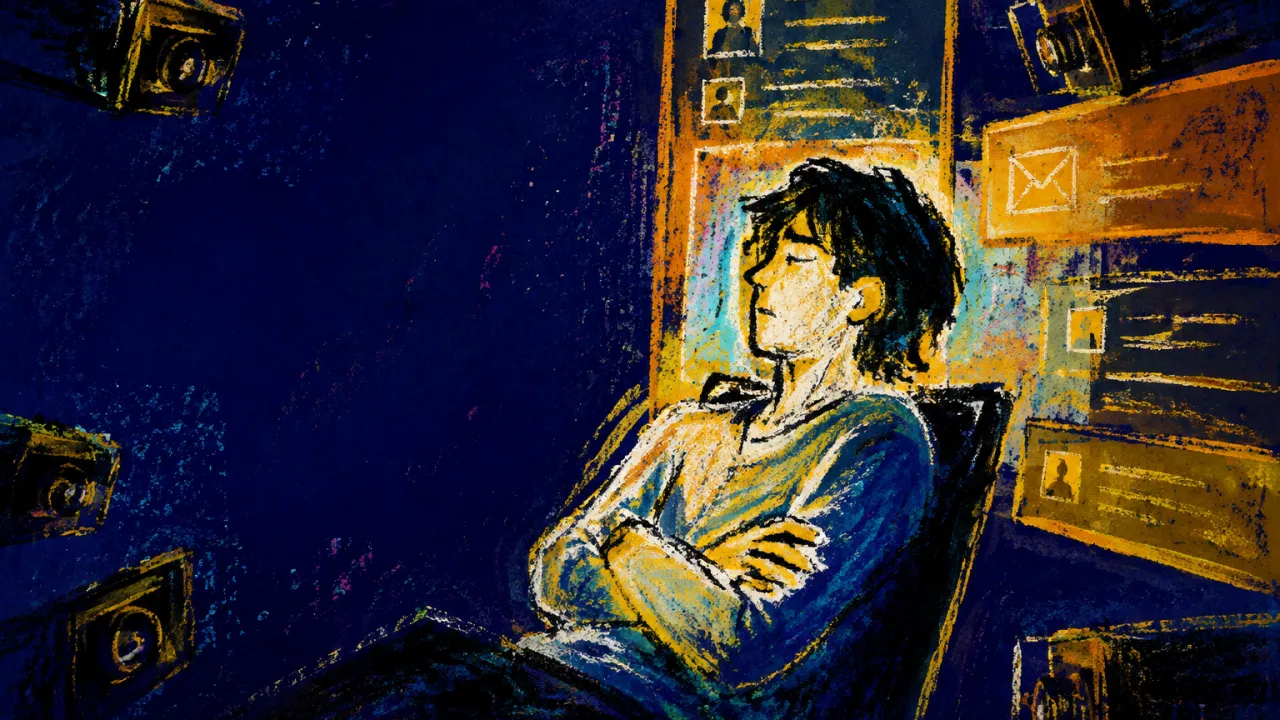
A figure leans back with folded arms as translucent message panels and camera frames press inward through indigo space.

What is this situation?

Workplace Privacy Negotiation is the repeated workplace situation in which ordinary tasks become tied to requests for personal access, and every answer seems to set a new precedent. It can begin during onboarding, when an app asks for your location, personal phone number, or access to a device you also use outside work. Later, a manager asks why you need time away rather than whether the handover is covered; a coworker follows a casual question about where you live, who you live with, or what you did over the weekend with another when your first answer stays broad. In a remote meeting, keeping your camera off becomes a discussion, while status indicators, shared calendars, and response times turn your availability into something other people can inspect. None of the requests may look decisive on its own. The pressure comes from their accumulation and from the fact that the people asking may also assign shifts, approve leave, distribute opportunities, or assess your work. Policies use words like "visibility," "culture," or "security," but the line between information needed for the job and access to your private life stays unclear. You start drafting simple replies several times, pausing over Send and drawing your shoulders tight when another notification asks for an explanation, while deciding whether a brief no will be treated as uncooperative. Even after the workday ends, messages arrive through personal channels, and tomorrow's conversation is already being negotiated. The job is no longer only the work; it includes repeatedly holding a boundary while others test how movable it is, much like the Seven of Wands, where one figure keeps a narrow piece of ground as six wands rise into the same space.

Why it's not you?

This is not a failure to be open, friendly, or flexible. The strain is created by a workplace that treats personal access as the default, leaves necessity unclear, and makes each limit something you must defend to people with influence over your schedule or evaluation. Repeated boundary requests create the burden; your choice to keep non-work information private does not.

Workplace Privacy Negotiation in Tarot Cards

Workplace Privacy Negotiation takes shape when routine requests for personal information, camera access, location, and after-hours availability keep making private boundaries part of the job. The pause over Send and your shoulders drawing tight mark where that repeated pressure meets the body. This is an environmental and structural dynamic, shaped by uneven workplace authority and unclear limits on access. The Tarot Cards below mirror the visible contours of that situation.

The Emperor
Reversed
The armored ruler sits rigidly on a stone throne marked by ram heads, with a scepter and orb held as signs of command. In the reversed orientation, that carefully built authority structure points downward, showing order becoming control and access being treated as a condition of obedience. The workplace version appears when a manager or system can assign shifts, approve time away, distribute opportunities, or assess performance while also asking for personal explanations, device access, location, or constant availability. The request may be described as culture or visibility, but the power behind it makes a private answer feel professionally loaded. The reversed structure identifies managerial overreach rather than a worker's lack of flexibility. You are negotiating with an authority system that can define the cost of a boundary, which is why ordinary privacy decisions become career decisions.
The Hierophant
Reversed
The seated teacher is framed by two pillars while two followers kneel below, creating a formal scene of instruction, ritual, and accepted rules. In the reversed orientation, the ceremony is turned over: institutional language still claims authority, but the shared code no longer feels neutral or mutually agreed. Workplaces can place personal access inside onboarding, security, visibility, or culture rituals and present participation as evidence of fit. You may be asked to accept location permissions, camera expectations, personal channels, or explanations of private time because the organization has made disclosure part of its informal definition of a good worker. The reversed structure exposes conformity pressure inside the policy ecosystem. You are not rejecting collaboration; you are encountering a workplace norm that has expanded beyond the actual task and now treats a private boundary as a challenge to belonging.
Justice
Reversed
The inverted seated figure leaves the scales away from balance while the sword points down into an unstable field. The formal tools of judgment remain visible, but their orientation makes proportionality difficult to access: a rule exists without making its necessity or limits clear. That is the workplace privacy problem when security, culture, or visibility language is used without a clear distinction between what the job requires and what the organization simply prefers to know. You are asked to supply evidence for personal time, private devices, or location while the decision-maker retains control over scheduling, leave, access, and evaluation. The reversed structure locates the strain in inconsistent standards and unequal application. A boundary can be reasonable in principle yet costly in practice when the workplace controls the scale, defines cooperation, and turns refusal into a character judgment.
The Devil
Upright
Two figures stand chained to a shared black pedestal beneath a winged figure, with the chain visibly linking their bodies to the same structure. The scene makes entanglement physical: access to one part of life is attached to continued participation in another system. That structure appears when a job reaches through personal channels, devices, location, camera, calendar, and evenings while holding influence over leave, shifts, opportunities, or evaluation. The requests may be framed as normal flexibility, but the cumulative arrangement makes private life feel like collateral for remaining in good standing. The upright image names a system of attachment and constrained separation, not a fixed identity or inevitable outcome. You are dealing with a work arrangement whose terms allow professional participation to become tied to personal exposure, making daily autonomy harder to maintain.
Four of Pentacles
Upright
A seated figure clamps one pentacle to the chest while another sits on the head and two pin the feet to the ground. The city remains in the background, but the body forms a closed perimeter around what it possesses, making access and movement the central physical problem. The lifestyle system in this situation includes a personal phone, a private device, location data, camera settings, calendar visibility, and the hours that remain after work. When an employer treats those resources as available by default, the ordinary task of organizing daily life becomes a repeated decision about what can be entered, monitored, or carried into the job. The upright hold is not a diagnosis of stinginess; it is a visible act of resource control. You are protecting the parts of your physical and digital life that make work sustainable, while the workplace keeps testing whether cooperation requires surrendering the whole perimeter.
Two of Swords
Upright
A blindfolded figure crosses two swords over the chest beside still water, with a crescent suspended above the scene. The crossed blades hold two responses in place, while the blindfold keeps the consequences of either choice difficult to read. That is the decision structure created when work asks for location, personal contact, leave explanations, camera access, or a reply through a private channel. Disclosure may create a new precedent, while refusal may be interpreted by someone with influence over schedule, evaluation, or opportunity as a lack of cooperation. The choice is therefore not simply open or closed communication; it is a decision made under unequal leverage and incomplete information. The upright stalemate shows why drafting a short response can take so long. You are weighing privacy against professional consequences in a system that has made both options costly, not avoiding a straightforward decision because you lack good judgment.
Eight of Swords
Upright
A blindfolded and bound figure stands in mud inside a ring of swords, with a castle behind and enough ground to suggest movement that is not practically available. The swords surround the body without touching it, showing how the visible options can be narrowed by the consequences attached to each one. At work, a short no may appear technically possible while the surrounding conditions make it feel professionally dangerous. The person asking may control schedules, leave, access to opportunities, or evaluation, and the workplace may describe personal disclosure as visibility or culture. The result is a choice architecture in which privacy is available in theory but costly to claim in practice. The upright image gives form to constraint without turning it into destiny. You are reading the limits of a power-imbalanced workplace, where the burden is created by the surrounding system and not by a lack of courage or flexibility.
Page of Swords
Reversed
The young figure raises a sword into restless wind while clouds move across the open sky. In the reversed orientation, the alert messenger's information-seeking energy loses direction, so questions, notifications, and observations can travel faster than any clear account of why the information is needed. That pattern fits a workplace where a casual question about home or a weekend is followed by another, or where status indicators, response times, and camera expectations turn ordinary coordination into an information stream. The same system can collect, repeat, and reinterpret small details while presenting the process as simple communication. The reversed page names intrusive inquiry and unstable information boundaries without requiring malicious intent from every coworker. You are dealing with a professional environment in which curiosity has acquired access to schedules, devices, and personal context that the job itself may not require.
Queen of Swords
Upright
A crowned figure sits beneath an open sky, one hand extended while a sword is held upright and clearly visible. The open hand keeps communication available, but the vertical blade gives the exchange a defined edge: information can be discussed without making every private detail available. In a workplace, that distinction matters when a manager asks why you need time away, a system requests location, or a coworker treats a broad answer as an invitation to continue. The professional problem is not a refusal to coordinate; it is the need to separate job-relevant facts from personal access while the other party may influence your evaluation or schedule. The upright structure gives the boundary language, clarity, and social composure without turning it into hostility. You remain in the conversation while the sword marks a limit that does not need to be softened into unlimited disclosure.
Seven of Wands
Upright
One figure stands on a narrow rise with a single wand held against six wands thrusting upward from below. The elevated ground is small but clearly occupied, so the image makes a boundary visible as a real piece of territory rather than an abstract preference. At work, that territory is your location, personal phone, private device, camera choice, leave details, or time away from the screen. Each request may arrive as a routine check about visibility, security, or culture, but the people making it can also assign shifts, approve leave, distribute opportunities, or assess performance. The unequal leverage is what turns a short answer into a negotiation over future expectations. The upright figure is under pressure without being erased by it. You are holding a defensible line in a crowded workplace system, where the repeated need to explain the boundary is the cost imposed by the environment, not evidence that the boundary is unreasonable.
Nine of Wands
Upright
A bandaged figure braces on a wand in front of eight more staffs arranged like a defensive wall. The visible injury and guarded posture show a person who has already dealt with repeated pressure, while the barrier behind them makes the next request feel like part of an established pattern rather than a new event. In a workplace, each request for location, leave details, camera access, personal contact, or an explanation of availability adds another checkpoint. You may still be completing the work, but you are also scanning messages, rehearsing replies, and anticipating how a normal limit could affect evaluation or future scheduling. The upright figure is still standing and still has a boundary to protect. The image recognizes persistence as a response to accumulated institutional pressure, not as proof that you are overreacting to one isolated question.
Ten of Wands
Upright
A figure carries ten staffs so densely that the load blocks the face and narrows the view of the road toward town. The destination is visible, but the person cannot easily see the route, because the work of carrying has filled the entire visual field. Privacy negotiation adds another bundle to the daily system: explaining leave, monitoring status, managing camera expectations, checking personal channels, and deciding how much of home life to disclose. None of these tasks has to be dramatic to become heavy; together they occupy the time and attention that should separate work from evenings, rest, and ordinary life administration. The upright burden shows accumulation rather than personal inadequacy. You are carrying the job and the defensive work created around it, so the lifestyle cost is the shrinking of usable attention and the loss of a clean end to the workday.

Workplace Privacy Negotiation in Tarot Card Reading Insights

When others bring Workplace Privacy Negotiation into a reading, the same questions about camera access, personal channels, and explanations for private time often sit beside the cards. The Tarot Reading Insights below show what surfaced across those readings.

Psychological Contexts Related to Workplace Privacy Negotiation