Post-Breakup Friend-Group Limbo: Testing Distance for Two Weeks

The RSVP That Felt Like a Referendum: Post-Breakup Friend-Group Limbo
If you are an early-career creative in Toronto who can map a complicated user journey but cannot answer one Saturday invitation without checking whether your ex is going, you may recognize the post-breakup friend-group limbo that brought Maya to my table.
At 10:47 p.m. on a Thursday, I watched Maya sit on the edge of her bed with the group chat open beside a half-finished one-on-one message to a trusted friend. Her phone felt warm against her palm; the radiator clicked in the quiet west-end apartment. She changed Saturday's RSVP from yes to maybe, checked whether her former partner had reacted, then locked the screen without sending anything. The screen went dark, but the question stayed lit inside her.
She looked at me and said, 'I do not want the breakup to cost me everyone. I cannot tell whether I am staying because I care or because I am scared. Taking space feels dramatic, but showing up feels fake.'
Her ambivalence was not an abstract cloud. It was like keeping fifteen browser tabs open because closing one felt irreversible, even while all fifteen consumed the attention needed to choose. Each notification tightened her chest; each imagined weekend without the group left a hollow space under her ribs. She was torn between staying in the friend group and stepping back, with grief, guilt, loneliness, and belonging FOMO making one invitation carry the weight of an entire social future.
I set a mug of coffee between us. 'You are not failing at friendship,' I told her. 'You are trying to make a complicated change without losing the people you still love. We do not have to force a permanent answer tonight. Let us give the question a shape, draw a map through the clutter, and see what kind of contact your real life can actually hold. That is our Journey to Clarity.'
Choosing a Compass at the Group-Chat Crossroads
I asked Maya to put her phone face down, take one slow breath, and focus on the next invitation rather than the entire history of the group. I shuffled slowly while the coffee cooled, using the small ritual as a psychological transition: a way to gather attention, separate observation from interpretation, and make room for a question that did not need to be solved through another hour of checking.
For this reading, I chose the Decision Cross · Context Edition, a five-card Decision Cross tarot spread. The question itself is structured as a stay-or-step-back dilemma, so this is a smaller and more focused tool than a broad Celtic Cross. It lets me compare both legitimate pulls, look beneath the visible choice for the fear maintaining the stalemate, and finish with guidance that can be tested rather than obeyed.
This is how tarot works in a grounded consultation: the cards do not predict whether Maya's friends will exclude her, choose sides, or recreate the past. They give us an external structure for noticing patterns that are already present in her behaviour, body, and choices. Card meanings in context matter more than dramatic predictions.
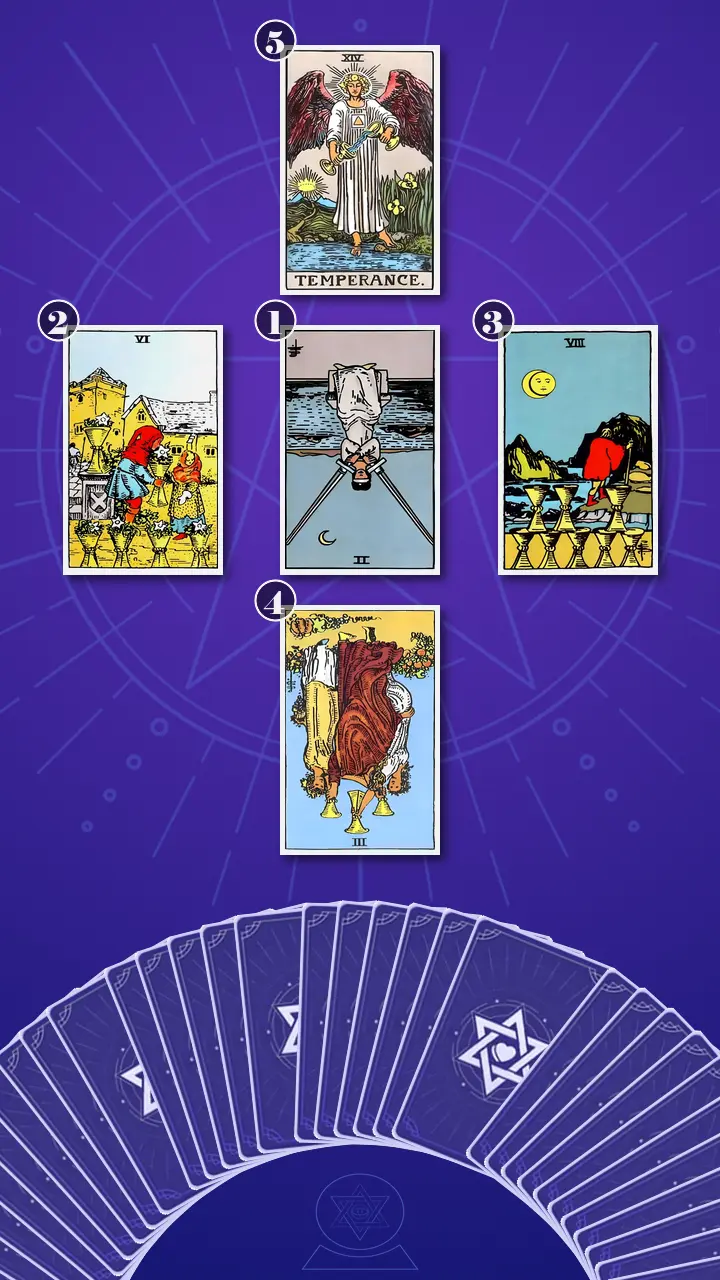
The centre card would show the observable symptom of her limbo. The cards to the left and right would reveal what genuinely pulled her toward staying and what genuinely pulled her toward stepping back. The card below would expose the hidden belonging fear underneath the conflict, and the card above would offer an integrating principle: a reversible boundary experiment that could create lived evidence.
Reading the Map Behind the Maybe
Position 1: The RSVP Loop Under the Blindfold
Now I turned over the card representing the observable symptom of Maya's limbo: tentative RSVPs, repeated checking, and the inability to maintain either consistent participation or consistent space.
It was the Two of Swords, reversed position.
In the Rider-Waite-Smith image, the blindfold is supposed to keep the figure from being pulled by outside information, while the crossed swords hold two opposing judgments in suspension. Reversed, that suspension has become unstable. The information is no longer protecting Maya from a decision; it is multiplying the number of decisions she thinks she has to make.
I brought the modern scene back into the room. 'At 10:47 p.m., you have the invitation open beside the message to your friend. You check your ex's reaction, change Saturday from yes to maybe, and reread the thread because you hope one more reply will settle it. That is like revising the same Figma flow after every stakeholder reaction without ever putting one version in front of a user. More input produces more branches, not more clarity.'
In this reversed air energy, analysis is in excess while embodied choice is blocked. Maya was treating guest lists, response times, seating patterns, and Instagram evidence as if they could answer a body-level question: what level of contact feels sustainable for me at this particular event? They could tell her who might be in the room. They could not tell her what the room would cost.
I said, 'More social data cannot answer a body-level question. An RSVP is not a referendum on whether you belong. For the next invitation, the first decision is smaller: do you want this specific event, and what limit would make it manageable?'
Maya did not nod. She gave a short, bitter laugh and rubbed her thumb along the edge of the mug. 'That is painfully accurate,' she said. 'I keep calling it research, but it is still the same decision.'
I let the discomfort remain without turning it into a verdict. The card was not calling her incapable of deciding; it was showing the loop clearly enough that she could interrupt it. I also named the overcorrection risk: sending a dramatic message that she was leaving the group entirely might end the uncertainty quickly, but it would make a temporary question unnecessarily permanent and could create social fallout she did not actually want.
Position 2: The Flower-Filled Cup of What Still Matters
Now I turned over the card representing what genuinely pulls Maya toward staying in the friend group: shared history, affection, continuity, and the wish to preserve belonging.
It was the Six of Cups, upright position.
The child offering a flower-filled cup in a protected courtyard made the card tender, but not naive. I connected it to a Friday dinner at the group's usual spot. A friend ordered the shared starter without asking, an old joke landed, and Maya's shoulders briefly dropped. For ten minutes, the group felt like a thread connecting her to a life that had existed before the breakup.
'The warmth is real,' I told her. 'This is not simply FOMO. There are people here you genuinely care about, rituals that still give you something, and memories that do not become fake just because the relationship changed. But the question is which current friendships and gestures nourish you now. The entire group does not have to recreate its pre-breakup version for one friendship to remain meaningful.'
I placed the Six of Cups beside the Two of Swords. 'The old group dynamic is like a shared playlist from a specific era. The songs still carry real affection, but replaying them cannot make the circumstances identical. You can miss what the group was and still need space from what it is now.'
Maya's eyes moved from the flower-filled cups to the blank space beside them. Her mouth softened at the corners, then tightened again. 'I miss what we have,' she said quietly, 'and I do not want this version of it tonight.'
I saw her shoulders settle for a moment, as though one side of the argument had finally been allowed to exist without having to defeat the other. That mattered. The Six of Cups did not command her to stay out of loyalty, and it did not ask her to pretend that affection had disappeared. It simply showed that the pull toward connection had a sincere source.
Position 3: The Mountain Path Beyond the Familiar Room
Now I turned over the card representing what genuinely pulls Maya toward stepping back: the need for emotional space, renewed direction, and relief from repeatedly performing normality.
It was the Eight of Cups, upright position.
The cloaked figure in the card walks away from eight standing cups beneath the moon. Nothing has been smashed. No one has been condemned. The image is about leaving an emotionally incomplete arrangement long enough to search for deeper alignment.
I set a second scene beside the dinner one. On another Friday, Maya declined the gathering, left the calendar block empty, and walked beside the Toronto waterfront instead of immediately replacing the plan. She later described feeling the loss first, then a quieter physical relief, followed by a clear wish to message one friend separately. Her shoulders had space to come down. The night had not become happy; it had become audible.
'Distance can be a setting, not an exit,' I said. 'You can miss what the group was and still need space from what it is now. Skipping one event does not require you to condemn anyone or predict the future of every friendship. It gives you a chance to notice what appears when you are not spending the entire evening performing normality.'
Maya looked toward the window. 'I do not want to disappear,' she said. 'But I also do not want to keep showing up just to prove I have not disappeared.'
I watched her hands loosen in her lap, though her eyes remained wet. This was the tension the Six and Eight of Cups held together: authentic affection and authentic need for distance. Neither impulse was selfish, disloyal, or evidence that the other was false. The limbo persisted because Maya believed she had to discredit one need before she could act on the other.
Position 4: The Photo That Became a Verdict
Now I turned over the card representing the contextualized hidden influence: the underlying fear that reduced participation will become permanent exclusion and prove that Maya no longer belongs.
It was the Three of Cups, reversed position.
In the upright image, three figures raise their cups in celebration, their arms linked and their bodies angled toward one another. Reversed, the toast no longer appears to meet. I connected that interrupted celebration to a Sunday morning in Maya's kitchen. She saw an Instagram photo from a gathering she had declined, zoomed in, counted who was standing beside whom, and compared the replies beneath the post. Her coffee had gone bitter. The fridge hummed. Her stomach dropped.
I asked her to separate the two sentences. 'The observable fact is that your friends met without you. The story your fear adds is that they are already becoming a group that does not include you. Those are not the same piece of evidence.'
Her thumb stopped over the screen. Her breath caught, and her gaze went unfocused as if the same cropped photograph were replaying itself. Then she let out a low breath from somewhere behind her ribs. 'I do that every time,' she said. 'I turn not being in one frame into being erased from the group.'
When attendance becomes proof of belonging, every invitation feels like a test. The Three of Cups reversed does not establish what her friends intend, and I would never claim that a card can know their private motives. It shows the speed with which a small social cue becomes a complete belonging story. If she attends every event, stays longer than she wants, and replies with performed enthusiasm to prove that nothing has changed, she may gain short-term reassurance while losing the information her body is trying to give her.
I told her, 'Your place in this group cannot be measured by how quickly you answer one message or whether you appear in one photo. The useful work is to observe the contact itself: what feels warm, what feels costly, and what feels neutral or unclear.'
She went quiet again, but this silence was different from the frozen silence of the first card. Her hand moved away from the phone. The fear was still present, yet it no longer occupied the entire room.
When Temperance Made Room for Both Cups
Position 5: The Bridge Between Staying and Stepping Back
The room grew unusually still as I turned over the card above the centre. Outside, a streetcar bell sounded once and faded, leaving the soft clink of the coffee spoon against the saucer.
Now I turned over the card representing the contextualized guidance position: the reversible boundary experiment that can replace abstract either-or analysis with direct evidence about sustainable contact.
It was Temperance, upright position.
The angel pours water carefully between two cups, one foot on land and one in water, with a narrow path leading toward distant light. I read the image as integration rather than compromise for its own sake. Group contact, individual friendship, and private recovery time could each have a different setting. Maya did not need to grant the whole group full access to her weekends, and she did not need to delete every connection to make space for herself.
I used my signature Analysis Paralysis Deconstruction here. I stripped away the abstract what-ifs: Will they think I am dramatic? Will I still belong in six months? Will everyone get used to me not being there? Those questions mattered emotionally, but they could not be answered tonight. My Complexity Reduction then tidied the decision into a clean, practical binary: attend this specific event under a defined limit, or decline this specific event without making it a permanent social announcement.
At 10:47 p.m., the group chat is still open. You have changed Saturday from yes to maybe, checked whether your ex reacted, and put the phone down, but your chest is still holding the question.
You are not required to choose total belonging or total withdrawal; make one measured adjustment, like Temperance pouring between two cups, and let lived experience clarify the right level of contact.
At first, Maya's breath stopped halfway in. Her face held still, eyes slightly widened, as though the sentence had interrupted a familiar argument before it reached its usual conclusion. Then her gaze drifted from the card to the empty space on the table, and I could see her mind testing the possibility against actual memories: entering for ninety minutes, leaving on her own schedule, keeping one trusted friend reachable. Finally, her shoulders lowered and her clenched fingers opened one by one. She released a shaky breath that sounded almost like a laugh, but a flash of anger crossed her face before the relief settled. 'But does this mean I was wrong for all those months?' she asked. 'I thought I had to keep showing up.' I told her that surviving through uncertainty was not a moral failure; she had used the tools available to her. Then I asked, 'Now, use this new perspective to remember last week: was there a moment when you could have chosen a smaller boundary instead of demanding a permanent answer?'
She looked at the Temperance card again. The relief did not make her instantly certain. For a few seconds, she seemed almost dizzy in the open space where the old emergency had been. That brief blankness mattered too. A clear path brings responsibility: she could no longer wait for the group, the cards, or one perfect piece of evidence to decide what contact felt right. This was the first movement from stagnant ambivalence and repeated social monitoring toward measured self-trust, flexible boundaries, and sustainable contact.
Temperance was the bridge, not the destination. It did not promise that every gathering would feel easy or that every individual friendship would remain unchanged. It offered a way to let connection and self-respect exist in the same room while Maya gathered real information over time.
The Two-Week Contact Test
When I looked across the five cards, the story became coherent. The Six of Cups showed why Maya stayed close: shared history and genuine affection still mattered. The Eight of Cups showed why she needed distance: some current gatherings required her to act more comfortable than she was, leaving no room to recover her own direction. The reversed Two of Swords showed the visible symptom, where every new RSVP and reaction became another branch in the decision tree. Beneath it, the reversed Three of Cups revealed the hidden fear that missing one event would become permanent exclusion. Temperance supplied the missing bridge: a calendar, a limit, and a review date.
Maya's blind spot was not that she cared too much. It was that she had been using attendance to secure belonging and social data to avoid noticing the cost of contact. She had treated distance as a goodbye because a permanent interpretation felt easier to monitor than an adjustable boundary. The transformation direction was therefore practical: move from a final stay-or-leave verdict to a two-week boundary experiment, then let experience rather than imagined consequences inform the next choice.
I reached for a notepad and introduced my Coffee Bean Filter Protocol, a 24-hour pragmatic sorting exercise I use when a decision has become crowded with emotional noise. For one day, Maya would write every decision variable on a separate slip of paper or note. On one side, she would place the Absolute Must-Haves: seeing a particular friend, having her own route home, leaving when her body said enough, protecting recovery time. On the other, she would place Emotional Noise: who reacted first, who stood beside whom in a photo, what a delayed reply supposedly meant, and whether one absence would rewrite her whole social identity. The protocol did not dismiss emotion. It stopped fear from disguising itself as usable evidence.
'We are not trying to prove that the group is safe or unsafe, permanent or temporary,' I said. 'We are testing which forms of contact let you stay connected without abandoning your own limits. Keep the experiment private unless sharing it genuinely helps you. A boundary does not need a group-wide announcement.'
These are the next steps I gave her as actionable advice for the next invitation and the next two weeks:
- Start the private two-week calibration.For eight minutes in iPhone Notes, create a note called The Two-Week Contact Test with a start date, an end date, and one or two rules: attend no more than one group event, choose a planned ninety-minute window, or pause the group chat during work hours while keeping one trusted friend reachable. Add a fifteen-minute Google Calendar review on the final day.If the full experiment feels dramatic, use the minimum version: apply one boundary to one invitation and review how it felt the following morning. The goal is evidence, not a performance metric.
- Put the body before the guest list.When the next group invitation arrives, place the phone face down for ninety seconds. Notice your chest, jaw, stomach, warmth, or relief, then write two lines before checking reactions: Do I want this specific event? What limit would make it manageable? If you go, add a departure time and arrange your own route home. If you decline, send a simple RSVP without a courtroom-length explanation.The smallest version is one word before opening the attendee list: want, do not want, or unsure. You can revise the plan when real circumstances change, but you do not need more social data to delay this particular decision.
- Build the individual-friendship bridge.Choose one friend you value independently of the group and send a direct message this week: I am taking group plans one at a time, but I still really value our friendship. Would you like to grab a thirty-minute coffee near the office or take a Sunday walk at Trinity Bellwoods? Notice afterward whether the one-on-one contact feels different from the pressure of the group as a whole.Make the invitation low pressure and specific, and let the other person accept or decline without turning the response into a verdict on the entire friendship network.

A Week Later, the Doorway Was Still There
Five days later, I received a message from Maya: 'I used the ninety-minute version. I went to trivia, left when I said I would, and texted Jules about coffee instead of checking the photos all night.'
On Friday, she declined a group dinner, met a friend for coffee, and walked home beside the lake. The evening felt lighter and a little lonely; in her apartment, she stared at the quiet group chat for three minutes, then left it muted.
That was not a solved life. It was a small piece of reliable information. Maya had learned that leaving early did not erase her, that individual contact could feel warmer than group performance, and that missing one event did not require her to decide the future of every friendship.
I thought about the five-card Decision Cross as I read her message. The cards had not decided whether Maya should stay or leave. They had helped her stop asking one RSVP to carry an impossible meaning. She remained the person choosing the route, adjusting the boundary, and deciding what sustainable contact looked like in her actual life.
When a group-chat banner makes your chest tighten, it can feel as though every yes protects your place and every no quietly erases it, even when neither choice tells the whole truth about who cares. The first moment of noticing that pressure is already a movement toward finding clarity.
If distance were an adjustable setting rather than a goodbye, what small change in contact would you be curious to test before deciding what it means: one bounded group event, one individual coffee, or one two-week review date?