One Honest Note Became Detachment, Then Desire Became Information

When Spiritual Bypassing Put Desire on Trial
I often meet the self-aware friend who can explain everyone else's patterns but still rewrites "I want this" as "I am practising detachment." In my work, that pattern can reveal spiritual bypassing that turns desire into a moral test and keeps fulfilment on hold. Jordan, a 27-year-old communications coordinator in Toronto, recognised it before I had drawn a single card.
At 8:47 p.m. on a rainy Sunday, Jordan joined my video session from their apartment near Bloor with Apple Notes open on a warm phone. The radiator clicked behind them, wet tyres hissed on the street below, and the screen cast a cold rectangle of light across their fingers. A minute earlier, they had typed, "I want someone to hold me without making me feel ridiculous for asking." Then their throat tightened, their breath stalled, and they replaced it with a polished paragraph about releasing attachment.
"I know better than to call this shame," they told me, pressing a palm against the hollow place in their chest. "So why does wanting it still feel like a confession? Why do I call my shame healed when I still judge my desires?"
I could almost see the shame as a metal detector installed in their throat: every specific want set off an alarm, and every alarm initiated a full character review. I told them, "I am not going to test whether you qualify as healed. Nothing in this reading will turn a returning judgement into a permanent fate. I want us to map what happens between the first honest want and the moment you edit it out. That is where we can begin finding clarity."
Choosing the Four-Layer Insight Ladder
I invited Jordan to place both feet on the floor, take one unforced breath, and hold the question without trying to improve its wording. I shuffled slowly. I use that small ritual as a transition in attention, not as a performance of mystery.
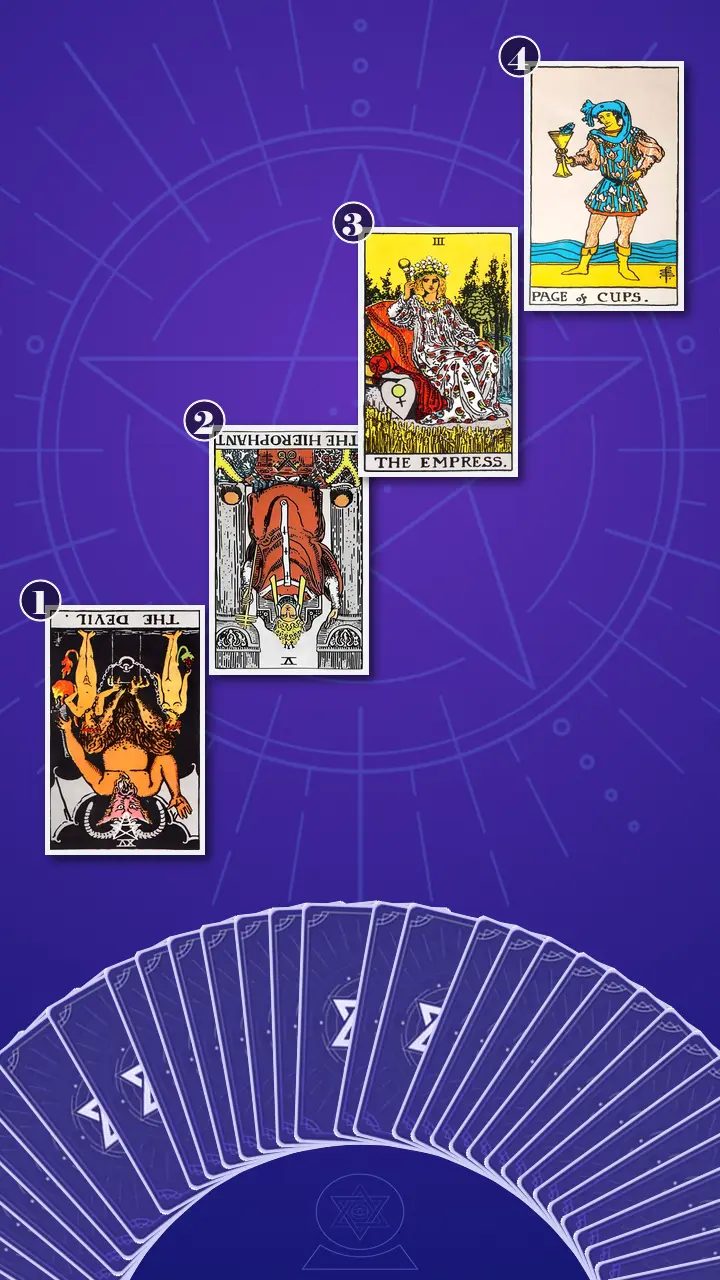
I chose the Four-Layer Insight Ladder · Context Edition, a four-card tarot spread for shame and desire. I arranged the cards beneath my overhead camera as a rising staircase, from the lower-left corner towards the upper right.
For anyone wondering how tarot works in a consultation like this, I do not use the cards to announce whether a desire is good, bad, destined, or forbidden. I use their images as an external cognitive map. Once a private loop is visible on the table, I can compare its claims with observable behaviour, bodily responses, present values, and available choices. Card meanings in context become questions that can be tested, not verdicts that must be obeyed.
This spread was the smallest structure that could do the job. The opening position would reveal the visible gap between Jordan's language of liberation and their daily self-monitoring. The next would identify the inherited rule beneath that gap. The final rise would move through an embodied antidote into one small, reversible experiment. I wanted a map of the pattern, its root, its resource, and its next step, not a prediction about Jordan's future.
The Loose Chains and the Old Keys
Position 1: The Freedom That Had Not Reached the Thumb
I began, "The card now turned over represents the Presenting Pattern: the observable gap between calling shame healed and continuing to judge, soften, or postpone a specific desire." I revealed The Devil, in reversed position.
I directed Jordan's attention to the loose chains around the figures' necks. They were not welded shut. In the context of Jordan's Sunday night, the image matched something painfully ordinary: they could sincerely believe the old shame no longer defined them, write "I want more affection," feel their throat close, delete the sentence, and replace it with an account of non-attachment. Their dating life and requests were still being organised around a rule they no longer consciously endorsed.
I read the reversal as Blockage, not doom. Liberation had begun at the level of belief, but it had not yet been integrated into behaviour. It was like cancelling an old subscription while leaving its recurring calendar alerts active; the service was gone, but the day still rearranged itself around the reminders. The short-term reward was composure. The cost was fulfilment stasis: the desire remained unexamined, so Jordan received no lived information about affection, compatibility, boundaries, or choice.
"Naming the chain is not the same as choosing beyond it," I said. "That does not make the naming false. It tells us where the next piece of work lives. When no one else is watching, what judgement are you still performing?" I offered the sentence their behaviour seemed to contain: "I know this rule is not mine anymore, so why am I still trying to pass its test?"
Jordan gave a short, bitter laugh and lowered the phone onto their knee. "That is so accurate it feels a little cruel."
I let the laugh settle before I answered. "Accurate does not have to mean condemning. The loose chain matters. It shows that participation is now possible. It does not instruct you to disclose or pursue every desire to prove you are free. Restraint can still be wise. A boundary can still be loving. We are only noticing that automatic self-prosecution is not the same thing as discernment."
Position 2: The Gatekeeper With No Current Job
I continued, "The card now turned over represents the Underlying Rule: the inherited purity-based belief and spiritual explanation that keep granting or withholding permission beneath the conscious claim of healing." I revealed The Hierophant, in reversed position.
The crossed keys at the Hierophant's feet gave the pattern a structure. I asked Jordan to recall Tuesday at 6:18 p.m. on the Line 1 train. They had typed, "I had a good time and would like to see you again." As the rails screeched into Bloor-Yonge and the carriage smelled of wet wool, their thumb hovered over Send. They softened the message, added a disclaimer, worried that direct interest meant seeking validation, and finally locked the phone.
No date, teacher, relative, or religious authority had rejected that message. The old gatekeeper had moved inside. It now operated like an aggressive content-moderation queue, automatically flagging words such as "desire," "need," "ambition," and "affection" under labels like "attached," "too much," "unevolved," or "attention-seeking" before context could be reviewed. It resembled The Good Place's moral points system relocated into private thought, where an ordinary want could raise or lower an imaginary score.
Here I saw both an Excess and a Blockage: too much inherited authority and too little access to present-day evaluation. The question "Is this pure?" arrived before the more useful questions: Is it consensual? Is it reciprocal? Does it fit my values, energy, time, and budget? What happens if I try one reversible step?
The crossed keys carried me briefly back to archaeological trenches and long afternoons among Cambridge collections. I have seen road grids continue to organise a settlement long after the rulers who commissioned them have disappeared. Beliefs can survive in much the same way: no longer sovereign, yet still embedded as infrastructure. The survival of the road does not prove loyalty to the former empire. It only explains why movement keeps following the old route.
"When detachment disqualifies a want, shame has learned wellness language," I told Jordan. "Meditation and reflection are not the enemy. The question is what job they are doing at the precise moment desire becomes vulnerable. Are they helping you stay present, or helping you leave the sentence before you have read it?"
Jordan's fingers rose to the base of their throat, held there, and then loosened. Their eyes moved away from the cards. "I do not consciously believe the old rule," they said quietly, "but I still hear it deciding what I am allowed to want. Sometimes it sounds like a purity message. Sometimes it sounds like a Reel about being unbothered. By the time it reaches me, it just sounds like my own voice."
I nodded. "Locating the voice in a learned permission system does not remove your responsibility for present choices. It does remove the idea that the voice is your essential character. The Hierophant reversed invites revision, not a rebellion against every ethical limit. Consent, reciprocity, practical consequences, and personal boundaries remain. What changes is that you choose those standards consciously."
When The Empress Opened the Locked Garden
Position 3: Desire as Living Information
I said, "The card now turned over represents the Embodied Antidote: the quality that can reconnect desire with self-worth, pleasure, creativity, and discernment without requiring you to obey every want." I revealed The Empress, upright.
The visual field changed at once. After chains, a dark pedestal, pillars, and fixed keys, the Empress sat among wheat and flowing water with the Venus shield beside her. At that moment, Jordan's radiator stopped clicking. The rain against their window softened, and the silence on the call seemed to open around the card like a patch of ground receiving light.
I read her upright energy as Balance: embodied self-worth, receptive pleasure, creative vitality, and patient discernment working together. The Empress was not promising abundance as a reward, and she was not ordering Jordan to indulge every appetite. She was offering a different sequence. Jordan could notice a desire for affection, an evening of real rest, or greater creative visibility before opening another healing app. They could register the tight throat, name the want plainly, ask what it might nourish or reveal, and only then make a decision that respected consent, reciprocity, safety, money, time, and the right to change their mind.
"What if you notice what feels alive before deciding whether it is acceptable?" I asked. "The wheat does not submit a character reference before it grows. The water does not become a command because it moves. The Venus shield places worth beside the body, not at the end of a trial."
I then used the diagnostic lens I call Cognitive Stratigraphy. I treat a sudden emotional trigger as a surface artefact and excavate carefully beneath it. Jordan's tight throat was the surface. Directly below it lay the editing ritual: delete the want, translate it into detachment, open more content, postpone the choice. Beneath that sat the inherited rule that visible desire could reduce moral worth or threaten belonging. The deepest layer was not "I want affection"; it was an obsolete equation saying, "If I want openly, I become less safe and less worthy."
I explained that excavation changes the question. An archaeologist does not find a fragment from an earlier century and declare that the whole site still belongs to that century. I can date the fragment, understand why it is present, and distinguish it from the structure being built now. In the same way, Jordan could recognise a shame response as an older layer becoming active without treating it as the final truth of the present desire.
To prepare for the central message, I returned Jordan to 8:47 on Sunday: one honest sentence about affection, a tightening throat, and then a polished paragraph about detachment. The wording sounded healed. Their dating life remained paused.
Do not use detachment as proof that shame is healed; let The Empress's wheat, flowing water, and Venus shield teach you to feel desire, name its needs, and choose from self-respect.
First, Jordan's breath stopped, and their index finger froze against the phone case. Then their pupils widened and their gaze slipped beyond the screen; I could see the deleted note, the unsent message, and the closed campaign document replaying behind their eyes. Their eyebrows pulled together. "But doesn't that mean I was wrong about being healed?" they asked, anger sharpening the last word. "Have I just been dressing shame up this whole time?" I let the resistance have room. "No," I said. "It means your healing was real, and an older layer still activates under specific pressure. Integration is not retroactive proof that every earlier insight was fake." Finally, their eyes reddened, their fist opened, and their shoulders dropped on a long, uneven exhale. Relief appeared, followed by a brief, almost dizzy blankness: if the imaginary judge no longer made the decision, Jordan would have to make it. I asked, "Now, using this new view, think back to last week. Was there a moment when this insight could have made you feel different?"
Jordan recalled the fluorescent nonprofit office on Queen Street. Burnt coffee had hung in the air while a Slack post asked for campaign pitches. They already had an idea open in a private Google Doc, but the wish to be seen had made their chest feel hollow. They closed the document to investigate whether ambition came from ego.
"I could have noticed that I wanted recognition," they said, their voice still unsteady, "without deciding that recognition was the only reason the idea mattered. I could have checked whether the project fit my values and workload. I could have drafted the pitch before deciding whether to send it."
"Exactly," I replied. "Your desire does not need to prove that you are healed. It can be information, not instruction, and you still get to choose what happens next."
I placed the Empress's shield in the space between two imagined rooms. On one side stood the old internal courtroom, where desire had to defend Jordan's character. On the other stood a living garden, where desire could be observed for what it nourished, threatened, requested, or revealed. "I can respect myself enough to hear this without making it a command," I said, offering them a sentence to test. "You do not have to act on a desire to stop prosecuting it."
I named the shift plainly. This was not a leap from "unhealed" to "perfectly healed." It was one movement from shame-based moral surveillance and fulfilment stasis towards embodied curiosity, discerning self-trust, and grounded fulfilment. The new vulnerability mattered: clarity meant Jordan could no longer outsource every choice to the demand to seem pure. It also meant the choice was finally theirs.
Position 4: The Unexpected Notification in the Cup
I continued, "The card now turned over represents the Lived Experiment: a small, reversible practice for naming a desire, asking what it communicates, and choosing whether to explore it, set a boundary, or let it pass." I revealed the Page of Cups, upright.
I pointed to the fish rising unexpectedly from the cup and the Page's attentive posture. The image reminded me of a surprising notification: worth opening and inspecting, but not something that must be accepted, rejected, or forwarded on sight. The Page did not need a complete theory of the fish before looking at it.
In Jordan's life, that could happen during a date, a workday, or another quiet Sunday evening. When an unexpected want appeared, they could record it for five minutes without correcting the language. They could name the judgement beside it, ask whether the desire pointed towards a need, value, boundary, fantasy, or possibility, and then choose one of three doors: explore it through a reversible step, place a boundary around it, or let it pass for now.
I read the Page as a restoration of Balance after a Deficiency of emotional curiosity. Jordan had plenty of analysis, but very little room to be a beginner. The Page turned healing from an identity that had to be defended into a skill that could be practised in one observable encounter.
I gave them three lines for the next honest want: "The judgement says..." "This desire may be pointing towards..." and "For now, I choose to explore it, set a boundary, or let it pass." I emphasised that naming a desire was not consent, commitment, disclosure, or pursuit. No exercise could override another person's autonomy, reciprocity, financial reality, workplace limits, or Jordan's right to stop. If the note felt too exposing, the minimum version was simply, "A want showed up."
Jordan reached for their phone, paused with their thumb above Apple Notes, and looked back at the Page. "So I do not have to decide whether the fish is a profound message or complete nonsense before I admit it is in the cup?"
"Correct," I said. "Curiosity is not obedience. The question is not whether your wanting is pure; it is whether your next choice respects your values."
Restoring the Ruins Without Rebuilding the Courtroom
I gathered the four cards into one coherent history. The Devil reversed showed the visible behaviour: Jordan declared the chain loose but still deleted, delayed, and self-monitored. The Hierophant reversed revealed why: a purity-based permission system survived inside newer spiritual language. The Empress supplied the missing resource, restoring contact with bodily information and value that did not have to be earned. The Page of Cups reduced the whole transformation to one manageable encounter with one honest feeling.
Jordan had been standing outside a locked garden, calling the gate open because they could explain the lock. Their insight was genuine, but explanation alone could not provide the sensory and relational information that a small experience might offer. That was why more research kept producing short-term control and long-term stasis.
I named the cognitive blind spot: Jordan had been treating the return of judgement as evidence that healing had failed, while also treating the noticing of desire as though it committed them to action. Those were category errors. A judgement can be an old reflex rather than a present verdict. A desire can be information rather than a decision.
I used what I call Ruins Restoration Thinking to frame the next phase. On a dig, a fracture is not evidence that an entire civilisation was worthless; it reveals stress, construction, adaptation, and the places where an old structure could no longer carry its load. Jordan's articulate "healed self" and their guarded "wanting self" did not need to compete for legitimacy. The fracture between them showed where an inherited rule had stopped fitting. Restoration did not mean rebuilding the old courtroom with better wellness vocabulary. It meant preserving what remained useful, removing authority from what was obsolete, and designing around present values.
The transformation direction was therefore practical: replace the test "Do I still feel judgement?" with the practice "Can I notice a desire without making it proof of my worth, then choose whether to explore it, set a boundary, or let it pass?" I also noted that the spread contained no Sword or Wand suit cards. I wanted Jordan to add those missing functions consciously: one clear sentence of discernment and one modest act of choice.
The Next Seven Days: Two Reversible Experiments
To carry the Four-Layer Insight Ladder into ordinary life, I adapted my Trigger Excavation Exercise and the Page's cup into two pieces of actionable advice. Neither was a daily discipline, a healing score, or a promise of dramatic change.
- The 90-Second Trigger Excavation The next time a desire tightens the throat during a date, workday, or quiet evening, open a locked note and record four things: the first body cue, the exact judging phrase, the earlier "epoch" or learned voice it resembles, and one present-day fact about consent, reciprocity, capacity, cost, or safety. Stop after 90 seconds. The goal is to separate the old layer from the current situation, not to uncover a perfect origin story. Tip: If four details feel like too much, write only "My throat tightened" and "The old rule said selfish." Noticing remains observational; it does not require action or disclosure.
- The Five-Minute Cup Log Once this week, after a date, work shift, or quiet evening, create one row titled "Want / Judgement / Next Question." Name the desire without moral adjectives, ask whether it may involve a need, value, boundary, fantasy, or possibility, and choose one door: explore, set a boundary, or let it pass. End with two separate sentences: "What I want is..." and "What I choose today is..." Tip: Use one row and a five-minute timer. "Let it pass" is as valid as "explore." If exploration feels appropriate, define only a reversible first move, such as drafting one honest sentence without sending it.
I told Jordan to treat the results as live information, not a self-improvement score. A tighter chest, a sense of relief, mixed motives, or a decision not to proceed would all count as data. Their task was not to produce a pure desire. It was to make a self-respecting choice with the information available.

Six Days Later, the Quiet Proof
Six days later, Jordan sent me one logged row: "I want my work to be seen." They had emailed the campaign pitch and celebrated alone over coffee, proud and exposed. Next morning, "What if that was attention-seeking?" returned; this time, they named the old rule and got dressed.
I did not regard that email as proof that Jordan had solved shame, nor as evidence that tarot had chosen correctly for them. I saw something smaller and more durable: they had allowed a desire to exist, separated it from the decision, checked the decision against present values, and acted with room to change course.
That was the real Journey to Clarity. The cards had provided a map of chains, keys, wheat, water, and a surprising fish. Jordan supplied the honesty, boundaries, discernment, and action. They remained the author of what happened next.
I leave the same gentle permission with anyone who recognises that courtroom in the throat. When a want tightens the breath and initiates a character review, the hardest part is often not the wanting itself; it is the fear that one honest desire could cancel everything already healed. A returning alarm does not relock the loose chain. It simply shows where choice can become more conscious.
I will leave you with the question I gave Jordan: if your next desire arrives like the Page's surprising fish, and you can inspect it without letting the old crossed keys decide your worth, what might you be curious enough to name without promising to act on it?