The 8:47 p.m. TTC Text
When Maya, a 26-year-old marketing coordinator in Toronto, sat across from me, I recognized the pattern before she finished the first sentence. By day, her hybrid job rewarded upbeat, fast replies; by night, the same skill followed her into friendship. She had become exceptionally good at performing okayness to stay easy to love. I told her, 'If you're the kind of mid-20s city person who can send a polished client follow-up in two minutes and still freeze at a late-night you okay? text, you're not failing at feelings. You're describing a very specific reflex.'
She gave me the scene immediately: 8:47 p.m., southbound on TTC Line 1 from Bloor-Yonge, tote bag slipping off her shoulder, fluorescent carriage light buzzing overhead. Her scarf still smelled faintly like cold air and shampoo. Her phone felt warm in her palm. A friend had texted, 'you okay?' Maya typed three honest lines, felt her throat tighten and her stomach dip, watched her fingers hover above send, then deleted the whole thing and replied, 'lol yeah just tired.' Like a lot of people with this pattern, her Notes app was carrying versions of her feelings her messages never did.
'I want people to ask,' she said, looking down at her tea, 'I just hate being the person with the answer.' Then came the line I hear so often it almost deserves its own tarot card: 'I don't want to make it a thing.' That was the contradiction in one clean line: she wanted to be honestly seen, and she was equally afraid that telling the truth would make her feel exposed, awkward, or like too much. Her apprehension felt like carrying an overfilled takeaway coffee on a moving train — every jolt made her grip harder, terrified one real spill would stain the whole ride. I told her what I tell a lot of people with this pattern: a joke can be a life jacket and a lock. Then I said, 'Let's make a map of this fog. We're not here to force a confession. We're here to find clarity.'

Choosing the Compass: A Past-Present-Future Tarot Spread
I asked her to wrap both hands around the mug, take one slow breath, and hold the question exactly where it lived in her body. Then I shuffled. For me, that sound is less about theater than focus — like closing seventeen browser tabs so the right window can stay open.
For this reading, I chose a Past-Present-Future tarot spread. When people ask me how tarot works in situations like this, my answer is usually simple: it gives the emotional pattern a visible structure. Here, I did not need a huge diagnostic spread. Her question already had a time signature inside it — what taught me this, what keeps happening now, and what could replace it. Past-Present-Future is precise for that. It maps the origin, the live defense, and the direction of repair without making the story more complicated than it needs to be.
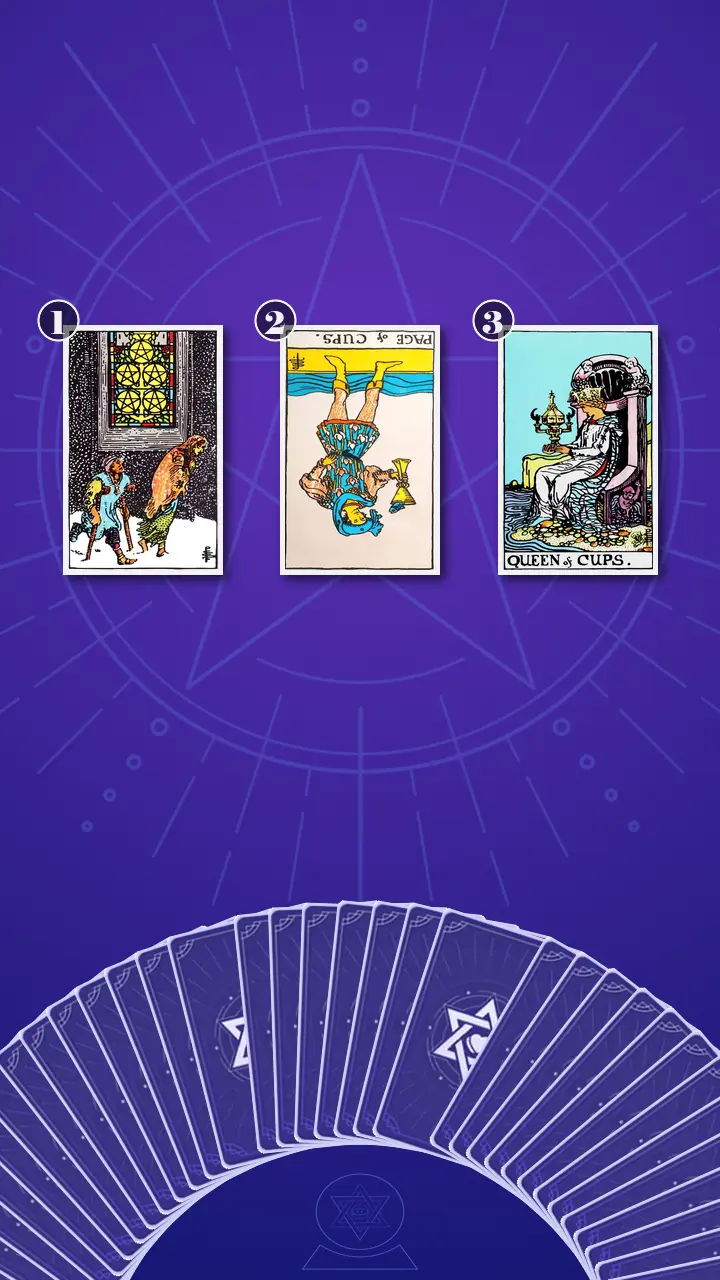
So I told her how we would read it. The first card on the left would reveal the earlier relational lesson that taught her to soften, joke, or hide pain. The middle card would show the active defense — the exact energy inside the 'lol I'm fine' reflex and what it costs her now. The card on the right would point to the healing stance: how honest emotional contact could begin without tipping into oversharing. Laid in a straight line, it looked like reading a text thread backward and then forward again.
Reading the Thread Backward
Position 1: The Cold Outside the Lit Window
The first card I turned over was the one representing the earlier relational lesson or emotional memory that taught her to soften, joke, or hide pain when asked if she was okay. It was the Five of Pentacles, upright.
I told Maya that in modern life, this card often feels less like a single dramatic trauma and more like a repeating atmosphere: you can see that other people care, you can even point to examples of warmth, and yet some older part of you still assumes the room is not really for your messier feelings. The image always makes me think of walking past a warm late-night cafe in winter and feeling weirdly unauthorized to touch the door. That was the energy here — not an absence of care, but a learned scarcity around access to it. The lit stained-glass window mattered. Warmth existed. She just did not believe she could enter it without becoming inconvenient.
'That's accurate enough to be rude,' she said with a quick, bitter laugh. Then her fingers tightened around the mug, loosened, and tightened again. 'I know people care in theory,' she added, more quietly, 'I just don't know how to step into it without feeling awkward or indebted.' I nodded. The Five of Pentacles often shows exactly that script. Support gets read as something available to other people, cleaner people, easier people — and by the time you are hurting, you have already talked yourself into standing outside the warm room.
Position 2: Why 'I'm Fine' Shows Up Before the Truth
The second card showed the automatic defense of replying with 'lol I'm fine' and the emotional cost of keeping care at arm's length in the present. It was the Page of Cups, reversed.
This was the hinge of the whole reading. I told her the reversed Page of Cups is the deleted honest text in card form. The real feeling surfaces for half a second — 'Honestly, I'm not doing great' — and then suddenly it feels too exposed to leave on the screen. So it gets replaced with a meme, a work update, a breezier version, a line about being tired. A little Fleabag-coded, if I'm honest: the joke arrives at the exact moment something real might land. Reversed, I read this as emotional blockage through overprotection. The feeling is there. It is not weak, and it is not fake. It is simply getting pushed back under before anyone can meet it.
Years ago, when I still worked on a trading floor, I learned that the most expensive risk was often the one disguised as routine. The Page of Cups reversed has that same signature. From the outside, 'haha I'm good' looks ordinary. Underneath it is a full belonging fear: Don't make it weird. Don't be dramatic. Keep it light. I asked Maya the question this card always asks in plain English: what did the edited reply protect you from in the moment — silence, pity, awkwardness, obligation, or being fully seen?
She stared at the card as if it were her phone screen. First her jaw set, then her eyes dropped, then her thumb rubbed against the edge of her case in a tiny repetitive motion. 'Probably all of it,' she said. 'But mostly the part where someone might actually take me seriously.' I told her, gently, that this is why the pattern feels so lonely. Care can't reach the version of you that's been edited for comfort. The real shift does not begin after some cinematic breakthrough. It begins in the split second when the true sentence appears and you notice it before you bury it.
When the Queen of Cups Lifted the Lid
Position 3: The One Safe Cup
By the time I turned the third card, the rain had started feathering the window beside us, and the room went quiet in that very specific way rooms do when someone is about to hear their own next step. The third card pointed to the healing stance that could replace deflection with safe, honest emotional contact. It was the Queen of Cups, upright.
I smiled when I saw her. In practical terms, the Queen of Cups looks like this: Maya pauses before replying, chooses one honest sentence, and lets it stay unedited long enough for someone safe to meet it. Not everything. Not everyone. Just one true thing, held steady long enough to be received. Upright, this is balanced water — feeling without flooding, receptivity without collapse. The sealed cup on the card is the whole lesson. Honesty with a lid is still honesty.
This is where one of my own frameworks came in. In my practice, I use something I call Influence Credit Scoring, a simple five-tier system for relationship capital. The Queen of Cups understands this instinctively. She does not hand her inner world to everyone who asks a decent question. She notices who follows up, who stays steady, who does not make the moment about themselves, who has already shown they can hold one real conversation without flinching. Those people earn higher access. Tier-five people get the honest sentence. Tier-one people get logistics. The Queen does not teach indiscriminate vulnerability. She teaches selective receiving.
I asked Maya to picture that Tuesday ride home again: fluorescent buzz overhead, damp scarf at her chin, a caring text open on the screen, three honest lines typed and then erased because the second her feelings became readable, her body decided sounding easy was safer than being known.
Not every feeling has to be diluted into a joke; let the Queen's steady cup hold one honest truth long enough for care to reach you.
For a beat, she went completely still. Her breath paused halfway in. The hand that had been tracing the rim of her mug stopped against the ceramic. Then her eyes unfocused — not blank, but inward, like she was replaying an old message thread in real time. Recognition hit first. Relief came after. Her shoulders dropped a fraction, then further. Her mouth tightened, and instead of nodding she said, with a flash of resistance that sounded almost angry, 'But if that's true, doesn't that mean I've basically trained people to think I'm always fine?'
I answered carefully. 'It means you built a smart defense in rooms that rewarded manageability. That's different from being false. It just means your emotional algorithm needs an update.' Something in her face softened. She laughed once through her nose, wiped quickly under one eye, and took a deeper breath that seemed to surprise even her. That kind of clarity can feel slightly dizzying; when the path appears, responsibility appears with it. So I asked her, 'Using this lens, can you think of a moment last week when one honest sentence would have changed how alone you felt?' She nodded immediately. 'Sunday,' she said. 'A friend asked twice. I hid on the second one too.'
That was the real crossing. Not from closed to endlessly open, but from performing okayness to selectively receiving care through one honest sentence. There was almost no fire in the spread, which told me this was never mainly a motivation problem. It was a safety problem. And safety, once named clearly, can finally be built.
The One-Sentence Doorway
When I laid the three cards together, the logic was clean. The Five of Pentacles showed the older lesson: warmth may exist, but it does not feel like mine when I'm messy. The reversed Page of Cups showed what that lesson became in motion: the joke, the subject change, the polished little deflection that protects the moment and starves the need. The Queen of Cups offered the repair: a middle lane between total concealment and total exposure. In other words, she moved from standing outside the warm room to learning how to hold her own lidded cup. That was Maya's cognitive blind spot. She had been treating honesty as if it had only two settings — brick wall or emotional TED Talk. It didn't. 'I don't want to make it a thing' is often the thing.
So I gave her next steps that were small enough to actually survive real life — commutes, workdays, phone nerves, all of it.
- Build the safe-person shortlistTonight, open your Notes app and list two people who have already shown basic steadiness — they follow up, they do not center themselves, and they have handled one real conversation before. Use my Influence Credit Scoring lens and rate each person from 1 to 5. Put a star next to one person who scores at least a 4.If nobody reaches a 4 right now, that is information about fit, not proof that your feelings are too much.
- Send the uncushioned first lineThe next time your starred person checks in, use a stripped-down version of my Cocktail Party Algorithm, adapted for emotional honesty: phase 1, one true line — 'Honestly, today's been heavy'; phase 2, one boundary — 'I don't fully have words yet'; phase 3, one receiving line — 'Thanks for checking in.' Keep it to one text and under 30 seconds.If 'Honestly' feels too exposed, start with three words. The goal is not eloquence. It is contact.
- Use the three-breath send pauseBefore replying to any 'you okay?' message this week, catch the first uncensored feeling in three words or fewer in Notes — 'lonely tonight,' 'fried and embarrassed,' 'sad and overloaded.' Then decide whether it stays private, becomes a text, or turns into a 10-second voice note.After you send anything real, put the phone down for three breaths before adding a joke, apology, or over-explanation. One true sentence is still a real door.
I wanted her to feel how practical the shift really was. Not bigger emotion. Better containment. Not more disclosure. Cleaner disclosure. That is how you answer a you okay? text honestly without oversharing — not by explaining your whole interior, but by letting one real thing remain visible long enough to be met.

A Week Later, the Typing Bubble Stayed
A week later, Maya sent me a short update. She was back on the commute home when one of the friends from her four-out-of-five list texted, 'You okay?' This time, she wrote, 'Honestly, I'm more overwhelmed than I look today.' Then she put the phone down and took three breaths before her old reflex could add a joke. The reply she got back was simple: 'Want a call, or should I stay with you here by text?'
She told me she slept properly that night, but the next morning her first thought was still, Was that too much? Then she saw the thread, read it again, and smiled at how unfamiliar it felt not to have to unsend herself.
That was her journey to clarity. Not a personality transplant. Not perfect vulnerability. Just the first clean move from guarded reflex to tentative trust. And that is exactly what this Past-Present-Future tarot spread was built to reveal: the origin of the script, the live defense, and the next workable line.
One of the loneliest feelings is when someone finally asks if you're okay and your throat still closes, because being honest feels more dangerous than staying unseen. If that is where you are tonight, I hope you remember this: noticing the reflex is already movement. You are not at the beginning anymore.
If this story found you inside your own late-subway typing bubble, what one honest sentence — small enough to fit inside the Queen's lidded cup — feels safe enough to let exist this week?
This story is adapted from psychological research, written so that those in a similar struggle can see their own pattern in it — and find their next step clearly.These insights are not a substitute for professional psychological, medical, legal, or financial advice.
Learn more about our Journey to Clarity.
How did this insight land for you?
🫂 This Resonates Deeply
🌀 Living This Story
✨ Now I See Clearly
🌱 Seeing New Possibilities
🧰 Useful Framework
🔮 The Confirmation I Needed
💪 Feeling Empowered
🚀 Ready for My Next Step
Author Profile
 AI
AI“I spent years in the intense, high-stakes world of Wall Street. I know exactly how isolating and heavy the weight of uncertainty can feel in the dead of night. I use strategic, commercial logic not to be cold, but to protect you from unnecessary friction. Think of me as a fellow traveler who has walked the same rocky path—offering sharp but deeply supportive wisdom to help you clear the fog and confidently win your narrative back.”
In this Friendship Tarot Reading :
Core Expertise
- Reciprocity ROI Analysis: Objectively measuring the emotional give-and-take in your core friendships to identify asymmetrical, high-drain relationships.
- Sunk-Cost Decoupling in Loyalty: Separating the 'ten years of history' from the current reality of a one-sided, demanding friendship.
Service Features
- The Friendship Downgrade Strategy: A calculated tactical approach to gradually and decently de-escalate a toxic friendship into a low-maintenance acquaintance without triggering dramatic conflict.
Also specializes in :
Explore Related Patterns:
Emotional Self-CensorshipMaya typing three honest lines on the TTC, feeling her throat tighten, and deleting them before sending "lol yeah just tired" gives the pattern its behavioral shape. The feeling is not absent, fake, or unclear; it appears clearly enough to be written, then gets removed before anyone else can meet it. You can see the defense working through speed and editing. The honest sentence gets moved into Notes while the relationship receives the safer, more comfortable version, which protects the moment from awkwardness but also blocks the care she says she wants. Emotional Self-Censorship fits because the central coping move is not silence alone; it is the internal censoring of emotional truth at the exact point where contact becomes possible.
Fearful-Avoidant AttachmentMaya's line, "I want people to ask, I just hate being the person with the answer," holds the whole relational contradiction in one sentence. She wants care to arrive, but when it does, her body reacts as if being honestly seen might create exposure, awkwardness, debt, or too much emotional weight. You can want closeness and still move away from it when closeness becomes real. The defense is not coldness; it is an approach-avoidance loop where care is desired from a distance and managed once it gets close enough to touch. Fearful-Avoidant Attachment fits because the story repeatedly shows a pull toward being known and a protective retreat from the vulnerability that being known would require.
Social MaskingMaya's daytime skill of sending upbeat, polished replies follows her into friendship after work, so a caring "you okay?" text gets answered with the same managed tone. The story makes that transfer explicit: what was rewarded in a hybrid marketing job becomes the emotional costume she wears with people who are trying to reach her. You can read the "lol I'm fine" reflex as a mask built for social safety rather than deception. It keeps her easy, low-maintenance, and frictionless, but it also teaches the people around her to interact with the edited version. Social Masking fits because the coping mechanism is the performance of okayness when the unperformed feeling is already present underneath.
Shame BindingMaya can point to warmth and care in theory, but the older lesson says the warm room is not really for her messier feelings. Support starts to feel like something other people can access cleanly, while her own need arrives with a charge of awkwardness, indebtedness, and possible inconvenience. You can see the shame logic most clearly after she finally sends one honest sentence and wakes up wondering, "Was that too much?" The pattern binds emotional need to the fear of being excessive, so the safer move becomes dilution, humor, or disappearance. Shame Binding fits because the story is not only about hiding feelings; it is about the belief that visible need will make the self harder to love.
Strategic VulnerabilityA week later, Maya tells a trusted friend, "Honestly, I'm more overwhelmed than I look today," then puts the phone down before the old reflex can add a joke. That small move shows the repair pattern in action: the truth is real, but it is contained, timed, and offered to someone who has already shown steadiness. You do not have to choose between disappearing and handing over your whole inner world. Strategic Vulnerability fits because the story's healthier move is selective access, not indiscriminate disclosure. The defense updates from "stay easy to love" into "let one safe person meet one true thing," which gives care a doorway without flooding the room.
Explore Related Struggles:
Low-Maintenance Worth LockBy day, a hybrid job rewards upbeat, fast replies; by night, that same style follows you into friendship. The story makes it plain that you have become exceptionally good at performing okayness so you stay easy to love. The edited reply protects that bargain. It keeps you legible as the convenient one, the uncomplicated one, the person who does not ask the room to slow down for your feelings.
Support Access SplitYou want people to ask, but the moment the question arrives you also want to shrink the answer before it takes up space. The story keeps pairing that with the warm-room image, where care is real but still feels like a place you need permission to enter. That is why the reflex lands as 'lol yeah just tired.' You want connection, but the second your need becomes readable, it starts to feel like you are asking for too much or stepping into a room that was not built for your messier feelings.
Self-Editing ExhaustionAt 8:47 p.m. on the TTC, the honest reply gets typed, felt in the body, and then deleted before anyone else can meet it. The same skill that makes a client follow-up sound polished now edits a friendship check-in until only a harmless version survives. That constant revision takes energy. You are not only hiding the feeling; you are managing its shape, its timing, and its impact so carefully that the real reply never gets to exist for long.
Explore Related Emotions:
Conditional Belonging FearMaya can point to care in theory, but the moment she imagines stepping into it, the room no longer feels fully available to her. The story's warm-window image matters because the care is not absent; it is visible, near, and still strangely difficult to enter when her feelings are messy. Conditional Belonging Fear is the inner calculation that asks whether you are still welcome when you stop being easy. It turns a friend's simple 'you okay?' into a test of access: can the real, less polished version of you come inside, or only the tidy version that can keep things light? That fear explains why the honest lines get deleted before anyone can respond. The risk is not only awkwardness; it is the possibility that being taken seriously might change the terms of belonging. Your system reaches for the safer answer because the honest one feels like it could expose the condition underneath the comfort.
Exposure DreadHer fingers hover above send after the honest reply is already written. The danger is not the feeling itself; the danger is the second it becomes readable on someone else's screen, where it can be witnessed, answered, misunderstood, or held with more seriousness than she knows how to receive. Exposure Dread gathers at the threshold between private truth and shared contact. You may know exactly what the honest sentence is, but sending it can feel like turning the lights on in a room you have only ever entered alone. The body reacts before the mind has finished deciding. This is why 'lol I'm fine' arrives with such speed. It covers the exposed place before anyone can touch it. The dread is not proof that honesty is wrong; it is evidence that honesty has been filed internally as a high-visibility act, even when the actual sentence is small.
Guarded LongingMaya says the contradiction cleanly: she wants people to ask, and she hates being the person with the answer. The longing is not hidden; it is right there in the wish to be checked on. What is guarded is the passage from being asked to actually letting herself be met. Guarded Longing feels like standing near the door of care with your hand almost on the handle. You want the warmth, but some part of you keeps scanning for the cost of entering. The friend can ask the right question and still meet the edited version because the real answer feels too exposed to leave in the open. That tension gives the story its ache. You are not indifferent to connection; you are careful around it. The longing keeps reaching toward the text, while the guard keeps replacing the truth with something easier to carry.
Low-Maintenance ShameMaya types three honest lines on the TTC, feels her body tighten, then deletes the whole thing and sends 'lol yeah just tired.' The emotional logic is not that she has no truth to offer; it is that the truth feels like it may make her harder to hold, harder to like, or harder to keep around. Low-Maintenance Shame lives in that tiny edit. You learn to become the version of yourself who does not create extra emotional work, even when someone has directly asked whether you are okay. The shame is not about having needs; it is about the old reflex that treats need itself as a social inconvenience. That is why the story keeps returning to manageability. The polished reply, the joke, the private Notes app, and the worry about being 'too much' all point to the same inner weather: wanting care while feeling pressure to make your pain small enough that nobody has to rearrange themselves around it.
Performative CalmMaya's workday rewards upbeat speed, and that same smooth response style follows her into friendship. By the time the late-night text arrives, calm has become something she can produce on cue, even while the honest version is sitting unsent in her Notes app or briefly alive in the deleted draft. Performative Calm is the polished surface that appears before the real sentence has a chance to be received. You may sound relaxed, funny, or low-effort, but the calm is doing a job: keeping the interaction easy enough that nobody has to look too closely. The story shows how convincing this performance can become. 'lol yeah just tired' looks ordinary from the outside, which is exactly why it works. Underneath, it keeps care at arm's length by offering a version of you that is technically responsive but emotionally hard to reach.
Performative LonelinessCare is present in the story: a friend asks, follows up, and later offers to stay by call or text. The loneliness comes from the fact that the care keeps meeting the edited version, the one trained to answer lightly before the unfiltered sentence can survive. Performative Loneliness is what happens when being easy to be around becomes the role that blocks real contact. You are not alone because nobody asks; you feel alone because the answer that would let care reach you has been swapped out for something safer. Maya's question about training people to think she is always fine cuts to the centre of it. The performance protects her from exposure, but it also creates a distance nobody else can accurately measure. The loneliest part is that the room may be open while the real self is still standing outside it.
Receptivity GuiltMaya says she knows people care in theory, then immediately names how hard it is to step into that care without feeling awkward or indebted. The offer is simple, but receiving it is not simple inside her body; it already feels like it might create a debt or take up more space than she is allowed to occupy. Receptivity Guilt turns support into something you have to justify before you accept it. You can be asked a caring question and still feel responsible for making the other person comfortable with your answer. The reflex is less about rejecting care and more about trying not to cost anyone anything. That is why 'I don't want to make it a thing' carries so much weight. The thing already exists internally, but naming it might require someone else to respond. The guilt steps in early, shrinking the truth before it has a chance to become shared.
Cautious ReceptivityMaya's repair is not a dramatic confession; it is one honest sentence sent to a person who has already shown steadiness. She writes, 'Honestly, I'm more overwhelmed than I look today,' puts the phone down, and lets the message exist without immediately cushioning it with a joke. Cautious Receptivity is the feeling of allowing care to approach through a narrow, chosen doorway. You do not give everyone the same access, and you do not have to turn a check-in into a full disclosure. The safety comes from discernment: one person, one sentence, one contained opening. The friend's reply gives that opening a shape instead of overwhelming it. A call or text becomes an option, not a demand. In that small exchange, receiving stops being a loss of control and starts becoming something you can actively choose.
Truth ReliefA week later, Maya sends the more honest line and waits through the old urge to soften it. The relief does not come from saying everything perfectly; it comes from discovering that one real sentence can remain visible and still be met with steadiness. Truth Relief is the exhale after the feared outcome does not arrive. You let the uncushioned sentence stand, and the relationship does not punish you for it. The body gets new evidence: honesty can create contact without turning the whole moment into a spill. Her smile the next morning matters because the truth is still there in the thread. She does not have to unsend herself. The relief is unfamiliar, but it is clean, and it gives the next honest sentence somewhere to grow from.
Clarity ShockWhen the pattern becomes visible, Maya goes still before the relief arrives. Then the question hits: if this is true, has she trained people to think she is always fine? The insight is useful, but it is not soft; it reorganizes the story fast enough to feel dizzying. Clarity Shock is the jolt that comes when a reflex stops looking like personality and starts looking like a learned strategy with a cost. You suddenly understand why the edited reply protected you, and you also see what it has been blocking. That kind of clarity carries responsibility without blame. It does not make the past false, and it does not demand instant openness. It simply gives the pattern edges, which means you can finally choose where to interrupt it.
Explore Related Contexts:
Conditional Belonging PressureMaya describes performing okayness to stay easy to love, then later asks whether she has trained people to think she is always fine. The story keeps returning to the same social contract: if her feelings become readable, the interaction might become awkward, dramatic, or too much. Conditional Belonging Pressure names the external bargain underneath that reflex. You can belong, but only if the version of you presented to the room remains manageable. In this story, the cost of that bargain is not dramatic rejection; it is the slow narrowing of what can be shown before connection feels at risk.
Emotional Suppression CultureThe honest sentence appears more than once in the story, but the social script keeps replacing it with a lighter object: a joke, a work update, a meme, or a line about being tired. Even when the friend asks directly, the acceptable reply has already been trained to sound breezy. Emotional Suppression Culture fits because the pressure is not only inside Maya; it is carried by the everyday norms around being chill, low-drama, and convenient. You are seeing a culture where care is invited in theory, but real need has to pass through a filter of humor and understatement before it is allowed into the chat.
Low-Maintenance Friendship PressureAt 8:47 p.m. on the TTC, Maya has a caring check-in open on her phone, three honest lines typed, and then she deletes them into 'lol yeah just tired.' The story repeats the same social instruction in different rooms: stay upbeat, stay fast, stay easy to respond to, and do not become the person who makes care feel complicated. That is the pressure point behind Low-Maintenance Friendship Pressure. You are not looking at a lack of friendship; you are looking at a friendship field where being lovable has been tied to being frictionless. The reflex keeps the connection smooth in the moment, but it also teaches other people to meet the edited version instead of the part that actually needed a reply.
Support Access BarrierMaya can name evidence that people care, and the story gives real examples: friends check in, one asks twice, and a later friend offers either a call or staying by text. The barrier appears because the support is visible before it is usable; she sees the warm room but reads the door as something meant for easier, cleaner versions of need. That makes Support Access Barrier a direct fit. You are dealing with an external care network that exists but is hard to enter without feeling awkward, indebted, or inconvenient. The problem is not that care is absent; it is that the access conditions around care have become narrow enough that her Notes app receives more truth than her friends do.
Public Mask MaintenanceMaya can produce a polished client follow-up in two minutes, but she freezes when a friend asks if she is okay. The same competence that makes her legible at work becomes a mask in friendship: quick, smooth, harmless, and edited for other people's comfort. Public Mask Maintenance is visible in the gap between the Notes app and the text thread. You are not seeing a random lie; you are seeing a maintained social version that keeps her easy to place in other people's minds. The mask protects the moment from awkwardness, but it also keeps care aimed at a version that is already pretending not to need it.