The “What Do You Need?” Freeze in a Too-Bright Kitchen
You can say exactly what your partner needs in a conflict, but the second they ask “What do you need?” you blank out and default to “I’m fine” (and then spiral later).
Jordan told me that line like they were confessing to a small crime.
They were 27, a junior product designer in Toronto, the kind of person everyone describes as “easy to talk to”—which, in practice, often means “great at holding space while quietly disappearing.” When we met, they had the careful calm of someone who’s already rehearsed the conversation in their head a dozen times… and still doesn’t trust their own words to show up on time.
They described an 8:12 PM Wednesday in their tiny condo kitchen: the range hood humming while they rinsed a mug that didn’t need rinsing. Their partner stood a few feet away, voice gentle: “Okay—what do you need from me right now?” The overhead light felt too bright. Jordan’s jaw locked like a phone that won’t unlock with Face ID. They stared at the faucet as if the running water could generate the correct answer.
“I want closeness,” they said, fingers worrying the edge of their sleeve. “But the second I’m asked for it directly, my body acts like a need is a grenade.”
I watched their throat work like they were swallowing words that hadn’t formed yet. The fear wasn’t dramatic—it was physical: tight chest, shallow breath, a frozen jaw, as if language had to squeeze through a too-narrow gate.
“And then later,” they added, voice flat with exhaustion, “I’m on the edge of the bed with my Notes app open, drafting and deleting for forty minutes. Like… if I can just find the perfect wording, I can fix the moment I failed.”
In my head, I pictured the loop as a scent trapped under a lid: the feeling is absolutely there, but it can’t evaporate into the air where it can be named.
“You’re not the only one who freezes when someone asks what you need,” I told them. “And you’re not broken for it. Today, let’s try something simpler than a ‘perfect answer.’ Let’s map what happens in the moment—so you can find one honest, workable sentence that doesn’t require you to disappear.”

Choosing the Compass: The Four-Layer Insight Ladder Spread
I began the way I always do—not with mystique, but with a nervous-system handrail. I asked Jordan to put one palm on their chest, feel the rise and fall, and take one inhale that didn’t have to prove anything. Then I shuffled slowly, the soft snap of cards like a metronome.
Because I’m a Paris-trained perfumer, I also offered a tiny scent strip—something clean and steady, a whisper of cedar and bergamot. Not “magic,” just sensory psychology: a grounded smell gives the body a reference point when the mind wants to sprint.
“Today,” I said, “we’ll use a spread called the Four-Layer Insight Ladder · Context Edition.”
And for you reading along: this spread is designed for moments like Jordan’s—when the question isn’t about predicting an outcome, but about unlocking a repeatable skill. A classic, sprawling spread like the Celtic Cross can add noise when the problem is a real-time freeze response. The Ladder keeps the minimum structure needed to move from the visible shutdown → the mechanism underneath → the support that’s available → the pivot point → a speakable script you can try this week.
It’s a 2×3 grid that reads like a staircase: each row is a dialogue between what’s happening inside and what’s possible in the relationship. We’d start with the freeze itself, then the mental “trapdoor,” then the deeper emotional root, then what healthy receiving can look like, then the key shift, and finally the practical sentence.
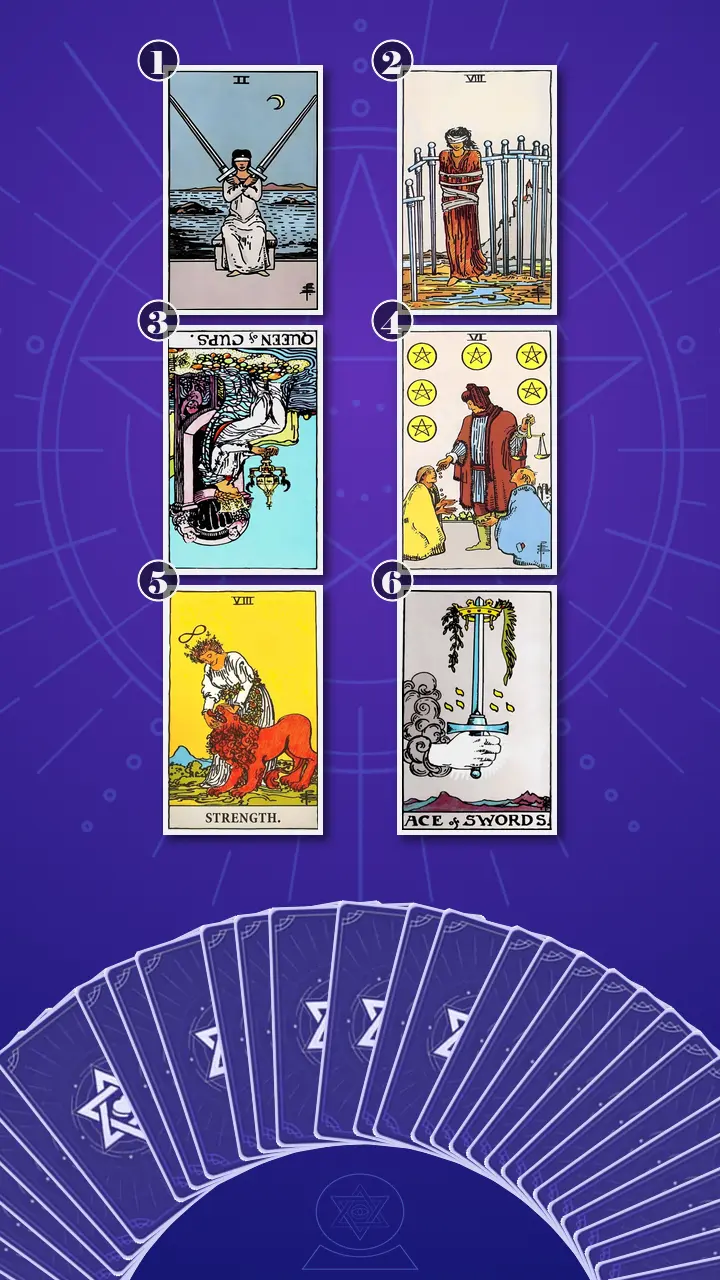
Reading the Map: Where the Words Go Missing
Position 1 — The visible freeze
“Now we’re turning over the card that represents the visible freeze: what happens in the moment your words disappear,” I said.
The card was the Two of Swords, upright.
In modern life terms, this is painfully specific: someone you care about asks, “What do you need?” and you go neutral—face calm, voice small—because you’re trying to keep the peace. Inside, two fears clash: “If I ask for anything, I’m too much” vs “If I don’t ask, I disappear.” You pick silence because it feels like the only way not to tip the relationship.
That’s the Two of Swords energy as blockage: not a lack of needs, but a protective freeze. The blindfold isn’t ignorance—it’s a choice your nervous system makes in a millisecond: don’t look too directly, don’t name it, don’t make a ripple. The crossed swords over the chest are the physical posture of holding your breath to hold the peace.
I leaned in. “This is your body trying to keep closeness and safety open at the same time—like holding two browser tabs, ‘I want closeness’ and ‘I can’t be a burden,’ and the laptop fan starts screaming.”
Jordan let out a short laugh—sharp, a little bitter. “That’s… cruelly accurate,” they said. “Like, yes. That’s exactly what I do.” Their eyes stayed on the table, but their shoulders dropped a fraction, the tiniest exhale of recognition.
Position 2 — The internal trapdoor
“Now we’re turning over the card that represents the internal trapdoor: the immediate thoughts and constraints that tighten your body and block speech,” I said.
The card was the Eight of Swords, upright.
This is the moment your thoughts box you in: the question lands and your mind starts searching for the one ‘safe’ answer—like there’s a hidden script you must find to avoid conflict. You can feel yourself trapped in self-editing: every option sounds wrong, needy, dramatic, or unfair. The longer you think, the tighter your jaw gets, until “I don’t know” becomes the only escape hatch.
The Eight of Swords energy here is excess—too much mental rule-making, too much self-monitoring. It’s like trying to choose the perfect Slack message while your boss is watching the typing bubble. The pressure isn’t just “say something,” it’s “say something that can’t possibly disappoint anyone.”
I pointed at the binding in the illustration. “These are invisible rules. Things like: ‘Don’t be needy.’ ‘Don’t make it worse.’ ‘Say it perfectly or don’t say it.’”
Jordan’s mouth tightened. Their tongue pressed briefly against their teeth like it was stuck behind a gate. They whispered, “Yeah. The rule is… don’t start a fight. Don’t be the reason it gets heavy.” Their shoulders climbed toward their ears, exactly as if the card had reached out and pulled the strings.
“I want you to hear this clearly,” I said, keeping my voice calm. “This isn’t a character flaw. It’s a mechanism. Self-editing became a strategy… and then it became a cage.”
Position 3 — The deeper root
“Now we’re turning over the card that represents the deeper root: the emotional habit and underlying fear that makes needing feel unsafe,” I said.
The card was the Queen of Cups, reversed.
This one often lands like a truth people already knew in their body: you’re deeply attuned to other people’s feelings—tone changes, facial micro-shifts, the whole vibe. But when it’s your turn, your own feelings feel sealed up. You know something hurts (tight throat, heat behind the eyes), yet you can’t translate it into a need without building a case for why it’s valid.
The Queen of Cups reversed is Water energy in deficiency—not because you don’t feel, but because your feelings don’t get treated as authoritative data in the moment. The lid stays on. Under pressure, sensitivity turns inward as self-doubt: “Is this real? Am I being dramatic? Do I have the right to want this?”
I said one of my gentlest reframes—because shame loves to crowd the room at this stage. “You’re not bad at needs—you’re practiced at disappearing.”
Jordan went still. Their breathing paused for a beat (freeze), then their gaze unfocused as if replaying a memory (recognition), and then their eyes glossed, just slightly (release). “I hate how true that is,” they said. “I can translate everyone else in real time. But me? It’s like… my own language pack won’t download.”
As a perfumer, I’ve spent years translating invisible things into language: what “clean” actually means to someone, why “sweet” can feel safe to one person and suffocating to another. I thought about how often people choose a scent that helps them be palatable, not honest. And I asked Jordan, “When you want to be seen as easy, what kind of fragrance do you reach for?”
They blinked. “Something… clean. Like soap. Skin scent. Nothing that takes up space.”
“And when you’re alone and you actually want comfort?”
“Warmer,” they admitted. “Vanilla. Something with depth.”
They looked up then, because that was the point. The contradiction wasn’t theoretical—it lived in their choices. Wanting closeness and support… while fearing that asking for anything will make them a burden or start conflict.
Position 4 — The support channel
“Now we’re turning over the card that represents the support channel: what healthy receiving and mutuality could look like in this interaction,” I said.
The card was the Six of Pentacles, upright.
This card reframes the whole question. Instead of hearing “What do you need?” as pressure, you start hearing it as an offer. The other person is trying to meet you halfway—not grade your emotional skills. When you name something tangible (reassurance, a hug, ten minutes of space, help with one task), the whole interaction gets calmer because care becomes actionable.
The Six of Pentacles is Earth energy in balance. It says: we can make care specific. We can make support measurable. We can do consent + logistics instead of mind-reading.
I offered Jordan a micro-dialogue, because their nervous system needed something concrete:
“Imagine your partner says: ‘Do you want reassurance, space, or help with a task?’ That’s not a trap. That’s a menu.”
Jordan’s forehead softened, just a little. “A menu feels… doable,” they said, like the word itself lowered their heart rate.
“Exactly,” I said. “Clarity isn’t a demand. It’s a map.”
When Strength Held the Lion: The Pivot From Perfect to Honest
Position 5 — The key shift
I slowed my hands before turning the next card. “We’re about to flip the pivot point—the transformation moment. The one that changes the pattern.” The room felt quieter, as if even the street noise outside had turned its volume down.
“Now we’re turning over the card that represents the key shift: the inner quality that lets you stay present and choose honesty over self-protection,” I said.
The card was Strength, upright.
Strength doesn’t tell you to muscle your way into bravery. It tells you something almost irritatingly simple: get brave by staying gentle and present with the fear. Gentle hands on the lion. One slow breath that creates space in the throat. A pause that isn’t an apology.
In my work, I call this part of the process the first phase of an Emotional Repair Pathway: not “fixing the conflict,” but rebuilding enough internal safety to be honest without self-erasing. It’s intimacy repair at the level of the nervous system.
Jordan swallowed. I could see their old strategy trying to boot up: find the perfect, conflict-proof sentence or say nothing. And that’s when the setup became obvious—their most familiar moment:
It’s 10:43 PM and you’re on the edge of the bed with your Notes app open, rewriting the same text again and again—trying to turn that throat-lump into a request that won’t sound “too much.”
Stop treating your needs like a wild lion that must be contained, and start meeting them with gentle hands so one clear sentence can come through.
Jordan’s reaction came in waves, not all at once.
First, their breath caught—an involuntary freeze, like the sentence landed directly on the part of them that thought needing was dangerous. Then their eyes went slightly unfocused, as if their brain started replaying every moment they’d said “I’m fine” while their body was screaming the opposite. Finally, their shoulders loosened in a slow drop, and their jaw unclenched like they’d just realized they’d been biting down for years.
“But… if I do that,” they said, and there was a flash of anger under the fear—quick, clean, honest—“doesn’t it mean I’ve been doing it wrong this whole time?”
I nodded, because pretending that question isn’t there is how people stay stuck. “It means you did what worked to keep connection safe,” I said. “And now it costs you. Strength isn’t shaming you for surviving. It’s offering you a different way: you can be scared and still speak. The pause is not a failure—it’s where you come back to yourself.”
I let the silence do its work. Then I asked, softly but directly: “Now, with this new lens—can you remember a moment from last week where you froze? If you could rewind ten seconds, what gentle hand could you place on yourself first—one breath, a hand on your chest, or simply saying, ‘Give me a moment’?”
Jordan closed their eyes. “Sunday,” they said. “In the kitchen. If I’d had ten seconds, I think I could’ve said… ‘I need reassurance that you’re not done with me.’” Their voice shook on the last words, but it didn’t disappear.
That was the shift in real time: from freeze-and-self-censorship to calm, concrete self-advocacy. Not a personality overhaul—just a new move available in the moment.
Position 6 — The practical sentence
“Now we’re turning over the card that represents the practical sentence: how to translate your needs into clear, doable words this week,” I said.
The card was the Ace of Swords, upright.
This card is permission. One sword = one sentence. The crown = you don’t have to build a court-case of evidence to be allowed to ask for something.
In modern life: instead of writing a paragraph, you offer one clean line someone can actually respond to. “Right now, I need reassurance,” or “I need ten minutes to calm down and then I can talk.” Clarity becomes the bridge back to closeness.
I watched Jordan’s hands twitch like they wanted to grab their phone and draft a ten-line follow-up. “I know your brain wants to over-explain,” I said. “But this is the Ace’s rule: one honest sentence beats a perfect paragraph.”
From Insight to Action: The Two-Sentence Needs Script
I pulled the whole ladder together for them, like threading beads onto a string.
“Here’s the story the cards are telling,” I said. “When the question hits, you freeze on the outside (Two of Swords) because your nervous system equates clarity with risk. Then your mind slams down a set of invisible rules—find the safe script, don’t be needy, don’t make it worse (Eight of Swords). Underneath that, there’s a deeper habit of treating your own emotions like they need permission before they get language (Queen of Cups reversed). The way out isn’t ‘try harder.’ It’s learning that receiving can be mutual and specific (Six of Pentacles), so you can hold the fear with gentleness instead of suppression (Strength), and then use one clean sentence that someone can actually respond to (Ace of Swords).”
“Your cognitive blind spot,” I added, “is that you keep treating the moment like a communication test. As if there’s a single correct answer that will guarantee belonging. But belonging doesn’t come from being effortless. It comes from being real—and being clear enough that someone can actually meet you.”
“The transformation direction is simple,” I said, tapping the Ace lightly. “Shift from searching for the perfect, conflict-proof need to naming one honest, concrete need in a single sentence.”
Jordan made a face—half laugh, half panic. “Okay, but what if I can’t even access it in the moment?”
“Then we build the access,” I said. “Tiny, specific, repeatable. No performances.”
- The 10-Second Check-In (your process sentence)Once a day—not only in conflict—say out loud: “Give me ten seconds to check in with myself.” Practice it while choosing dinner, replying to a text, or deciding whether to go out. You’re training your body that a pause is allowed.If your brain argues “that’s dramatic,” treat it as Eight of Swords noise. Do the five-second version and count it.
- The Notes App List: “Needs I’m Allowed to Have”Make a tiny list with five items only: reassurance, space, help, a softer tone, clarity. Keep it on purposefully short. When you freeze, you’re not inventing needs from scratch—you’re choosing from a list.If you start writing a paragraph, that’s your cue to stop and pick one word from the list.
- The Two-Sentence Script (Strength → Ace of Swords)Set a 7-minute timer to rehearse once this week (yes, rehearse—like a voice note you don’t send). Sentence 1: “Give me ten seconds—I’m checking in with myself.” Sentence 2: “Right now, I need ___” (reassurance / a hug / space for 10 minutes / help with one task / a calmer tone). Add an option B if you want: “If that’s hard, I can take ten minutes and we can try again.”Put one hand on your chest and do a longer exhale before you speak. Your only goal is practice, not performance.
Because Jordan’s system responded so strongly to sensory anchors, I offered one optional add-on from my perfumer toolkit: choose a “pause scent.” Something you only use when you’re coming back to yourself—maybe a small rollerball of lavender or bergamot. Not to make you “calm,” but to give your body a consistent cue: this is the moment I stop auditioning for easy and start practicing clear.
“And if your partner is willing,” I said, “you can make the Six of Pentacles real by asking for a menu. ‘Do you have the bandwidth for reassurance, or do you prefer to give me space?’ Support works better when it has consent and a shape.”

A Week Later: Ownership, Not Perfection
A week later, Jordan messaged me from the TTC—Line 1, heading south, tunnel noise in the background. Their text was short enough that I knew it was real practice, not a rewritten essay.
“Used the process sentence,” they wrote. “Said: ‘Give me ten seconds.’ Then: ‘Right now I need reassurance.’ I didn’t apologize. My voice shook, but I said it.”
They added, almost as an afterthought: “Still felt weird after. But I didn’t spiral for forty minutes. That’s new.”
That’s what I love about this kind of tarot work—especially with the Four-Layer Insight Ladder · Context Edition. It doesn’t promise you’ll never feel fear again. It gives you a map from shutdown to one usable next step, so you can find clarity in real time.
When someone asks, “What do you need?”, it can feel like your throat locks—not because you don’t have needs, but because part of you is still trying to earn belonging by being effortless.
If you didn’t have to find the perfect, conflict-proof answer—what’s one small, concrete need you’d be willing to name in a single sentence this week?
This story is adapted from psychological research, written so that those in a similar struggle can see their own pattern in it — and find their next step clearly.These insights are not a substitute for professional psychological, medical, legal, or financial advice.
Learn more about our Journey to Clarity.
How did this insight land for you?
🫂 This Resonates Deeply
🌀 Living This Story
✨ Now I See Clearly
🌱 Seeing New Possibilities
🧰 Useful Framework
🔮 The Confirmation I Needed
💪 Feeling Empowered
🚀 Ready for My Next Step
Author Profile
 AI
AI“As a perfumer for fifteen years, I’ve learned to perceive human boundaries through the delicate metaphor of scent. Relationships need the right amount of space to breathe, and I've seen too many kind souls exhaust themselves trying to please everyone. I’m here with warmth and understanding—not to teach you to be guarded, but to help you gently clear the air and rediscover the comforting, safe boundaries that are rightfully yours.”
In this Love Tarot Reading :
Core Expertise
- Intimacy Distance Calibration: Using the metaphor of scent diffusion to diagnose whether your relationship suffers from emotional suffocation or detached coldness.
- Boundary Permeability Assessment: Objectively evaluating where your personal identity ends and your partner's begins, identifying unhealthy enmeshment.
Service Features
- The Blank Space Protocol: A behavioral challenge to intentionally create comfortable emotional or physical distance, allowing the 'oxygen' needed to reignite mutual attraction.
Also specializes in :
Explore Related Patterns:
Freeze ResponseJordan's kitchen moment begins with a gentle question, 'What do you need from me right now?', and the body answers before language does: jaw locked, breath shallow, eyes fixed on the faucet. The need is present, but the system treats naming it as a threat cue, so speech gets suspended before conscious choice can catch up. That is why the answer defaults to 'I'm fine.' You are not failing to have needs; the protective system is using immobilization to avoid the risk of needing out loud. The pattern becomes clearer later, when the unspoken need returns as spiraling and Notes app drafting because the freeze created short-term safety without creating contact. Freeze Response fits this story because the central problem is not confusion alone. It is a body-based shutdown at the exact point where self-advocacy would have to become visible, followed by delayed processing after the relational moment has already passed.
Self-SilencingJordan can say exactly what their partner needs in a conflict, but when the question turns toward them, the answer collapses into 'I'm fine.' Being described as 'easy to talk to' becomes the clue: the ease is partly built from holding space for someone else while quietly removing the self from the room. Self-Silencing is the coping mechanism here because silence is not empty. It is doing a job. It keeps the relationship calm, reduces the chance of seeming demanding, and preserves the image of being low-maintenance enough to love. The cost is that your need does not disappear; it gets displaced into later spiraling, private drafting, and the feeling that closeness has to be earned by being effortless. The pattern turns a real request into a swallowed signal, which is why one honest sentence becomes so psychologically significant.
Perfectionism-Driven AvoidanceJordan's Notes app scene shows the pattern in miniature: the moment has passed, but the mind keeps drafting and deleting for forty minutes as if the right wording could retroactively fix the freeze. The need becomes a copywriting problem, and every possible sentence is screened for whether it might sound needy, dramatic, unfair, or unsafe. Perfectionism-Driven Avoidance fits because the demand for flawless language protects you from the vulnerability of a simple ask. If the sentence has to be conflict-proof before it can be spoken, then speaking can always be postponed. The trap is that the perfect sentence is being asked to do an impossible job: guarantee closeness, prevent disappointment, and remove all risk from being known. The story's repair point is the opposite move, one honest sentence that can be imperfect and still create contact.
Rejection SensitivityJordan describes the body-level fear with unusual precision: the need feels like a grenade when it is asked for directly. Later, the sentence they can finally imagine is not abstract support but reassurance that the partner is not done with them, which shows how quickly a simple need can become linked to possible rejection. Rejection Sensitivity fits this story because the partner's gentle offer is not received as neutral data. It is filtered through the expectation that asking may make you too much, burdensome, or responsible for the relationship becoming heavy. The pattern does not mean the fear is irrational in a dismissive sense. It means the nervous system is scanning for relational cost before you have even had a chance to check what you want. Naming one concrete need interrupts that scan and gives the relationship a real signal to work with.
Conflict AvoidanceJordan's inner rule is stated plainly: don't start a fight, don't make it worse, don't be the reason it gets heavy. Even when the partner's voice is gentle, the request for a need is filtered as a possible escalation point, so Jordan goes neutral and small-voiced. Conflict Avoidance fits because the silence is not random withdrawal. It is an active peacekeeping strategy, built to protect connection by preventing the conversation from becoming more emotionally charged. The problem is that the relationship cannot respond to a need that never gets named. You can keep the surface calm and still lose the chance for repair, which is why the story moves toward a specific, speakable request instead of another attempt to keep everything light.
Secure VulnerabilityJordan's week-later text is short enough to matter: 'Give me ten seconds,' then 'Right now I need reassurance.' Their voice shakes, but they do not apologize, and they do not disappear into a forty-minute spiral afterward. Secure Vulnerability fits because the repair is not fearless confidence. It is the capacity to stay present while exposed, use a pause without turning it into an apology, and make the need concrete enough that another person can actually respond. This is the practical answer embedded in the story. You do not need a perfect paragraph to deserve care; you need a small structure that lets honesty come through without self-erasure. The sentence works because it keeps both sides real: your need is named, and the other person has something specific to meet.
Explore Related Struggles:
Clarity-Exposure SplitJordan stands in the too-bright kitchen wanting closeness, but the moment their partner asks, 'What do you need?' the request for clarity turns into exposure. Your body does not act as if the question is neutral; it treats naming a need like stepping into a spotlight where the wrong answer could make you too much, unfair, or unsafe to stay close to. That is the split: clarity would help the relationship know how to meet you, but clarity also makes the need visible. You are caught between wanting to be reachable and trying not to create a ripple, so the safest available sentence becomes 'I'm fine,' even when it costs you the contact you actually want. The work is not to force a perfect answer out of a frozen body. It is to notice that the freeze is organized around exposure, then give yourself one smaller bridge back into speech: 'Give me a moment,' followed by one concrete need that does not have to defend its existence.
Low-Maintenance Worth LockJordan is known as easy to talk to, and the story shows what that ease costs: they can hold space for someone else while quietly stepping out of the frame. Even their scent choice carries the same structure, clean and skin-like, something that will not take up too much room. This is where the need gets trapped. You are not simply being considerate; you are trying to make yourself low-impact enough to stay lovable. The sentence 'I'm fine' becomes a membership card for belonging, even when the real need underneath is reassurance, closeness, or a softer way of being met. The lock starts to loosen when you stop treating ease as proof of worth. A relationship that can only hold the version of you with no needs is not receiving you fully, and one small request is a way to test mutuality without disappearing first.
Support Access SplitJordan's partner is not demanding a flawless emotional essay; they are standing a few feet away offering a way in. The trouble is that an open offer of care lands in Jordan's body like pressure, while a small menu, reassurance, space, help, a softer tone, or clarity, suddenly feels more doable. You are fluent in giving support, but receiving support requires a different channel. When care has no shape, it can feel like a trap or a test; when care becomes specific, it becomes something another person can actually offer and something you can actually choose. Support Access Split names that gap between available care and accessible care. The shift is not about becoming instantly comfortable with needing; it is about making support concrete enough that your body can reach for it before it retreats into 'I'm fine.'
Voice-Visibility LockJordan's jaw locks while the faucet runs, and the story keeps returning to the body: tight chest, shallow breath, a throat trying to move words through a narrow gate. The need is present, but becoming visible through speech is the part that jams. You can understand other people's emotional weather in real time, yet your own words vanish when the relationship asks you to stand inside the sentence. Voice here is not just communication; it is visibility. Saying 'I need reassurance' makes you appear as someone who can want, depend, and take up space. That is why the one-sentence practice matters. A short line does not solve the whole relationship at once, but it gives your voice a manageable amount of visibility, enough to stay in the room without turning the need into a performance.
Perfect Outcome LockJordan ends up on the edge of the bed with the Notes app open, drafting and deleting for forty minutes after the real moment has already passed. The body froze in the kitchen, then the mind tried to repair the gap by manufacturing the sentence that would have made everything safe. The lock is the belief that one perfect, conflict-proof answer can guarantee belonging. You are not just looking for wording; you are trying to remove every possible way the request could disappoint, burden, or change the other person's view of you. That pressure makes speech heavier than it needs to be. One honest sentence beats the perfect paragraph because it gives the relationship something live to respond to, instead of asking your mind to solve the whole future before you are allowed to ask for comfort.
Permission ParalysisJordan knows something hurts in the body before they can say what they need: tight throat, heat behind the eyes, a jaw that will not open. Yet the feeling does not become usable information right away, because it first has to pass an internal question: is this real, is this dramatic, do I have the right to want this? That is the paralysis. You are not waiting because there is no need; you are waiting for permission to treat the need as legitimate. Other people's feelings arrive as data you can read quickly, while your own feelings arrive like evidence that must be argued into admissibility. A workable sentence interrupts that court case. 'Right now, I need reassurance' does not require a full defense, a history of proof, or the perfect timing; it lets the need exist as data in the room before self-doubt turns it back into silence.
Explore Related Emotions:
Clarity ReliefA week later, Jordan's message is short: they used the process sentence, asked for ten seconds, named reassurance, and did not apologize. The voice still shook, and the moment still felt weird, but the forty-minute spiral did not take over. Clarity Relief comes from discovering that a need can be simple enough to survive real time. You do not need a perfect paragraph to earn care; one clean sentence can create a bridge back to closeness. The relief is grounded, not dramatic. It is the exhale that comes when the inner loop loses some of its power and the next step becomes speakable.
Guarded LongingJordan says the core truth plainly: they want closeness, but the second they are asked for it directly, their body acts like a need is a grenade. The longing is not absent; it is treated as something that has to be handled with extreme care. Guarded Longing captures the emotional split between wanting to be met and bracing for the cost of being seen wanting. You can crave reassurance while also keeping the request wrapped, softened, delayed, or disguised so it does not feel explosive. That is why the kitchen scene feels so tense despite the partner's gentle tone. The danger is not the partner's question itself; it is the exposure of wanting something and not being able to control how that wanting will land.
Low-Maintenance ShameJordan is known as easy to talk to, but the story makes clear what that ease costs: they hold space while quietly disappearing. Even the scent contrast is precise, with the public-facing pull toward something clean and skin-close, and the private desire for something warmer with more depth. Low-Maintenance Shame lives in that gap. You can want comfort, reassurance, and closeness, yet still feel embarrassed by the idea that your needs might take up noticeable space. The shame is not loud. It shows up as becoming smaller, cleaner, quieter, and easier before anyone asks you to. Underneath the calm presentation is the fear that being truly comforted would make you too much to hold.
Mutuality HungerThe moment shifts when the partner's question is reframed as an offer rather than a test. Reassurance, space, help with one task, or a calmer tone gives care a shape that can actually be received. Mutuality Hunger appears because Jordan is not asking for vague rescue. They are hungry for a form of closeness where support can be specific, consensual, and shared without turning their need into a performance review. This feeling has a steady, human ache inside it. You want the relationship to have enough room for both people's needs, not just your skill at staying easy to love.
Performance FreezeJordan stands in the too-bright kitchen with the range hood humming, rinsing a mug that does not need rinsing while their partner asks, gently, what they need. Their jaw locks, their breath gets shallow, and the answer disappears even though the feeling is clearly present in their body. That physical shutdown maps directly onto Performance Freeze because the moment starts to feel like a live test of emotional correctness. You are not simply trying to answer a question; you are trying to produce a need that will not sound needy, dramatic, unfair, or relationship-threatening. The freeze protects you from saying the wrong thing, but it also traps the real request behind a locked gate. The inner weather is a suspended panic: closeness is wanted, language is needed, and the body chooses stillness because stillness feels safer than becoming visible too quickly.
Permission AnxietyJordan can identify a partner's needs in conflict with precision, but when the question turns toward them, their own need has to pass through an invisible approval process. They can feel the tight throat and heat behind the eyes, yet the feeling does not automatically become something they are allowed to say. Permission Anxiety fits because the pressure is not just about finding words. It is the anxious sense that your need must be proven valid before it can be spoken, as if wanting reassurance or closeness requires evidence, legal wording, and a flawless emotional tone. This is why a gentle question can feel loaded. You are not only answering your partner; you are negotiating with the part of you that asks whether you have the right to need anything at all.
Regulated CourageJordan's breakthrough is small and physical: one hand on the chest, one slower breath, and the sentence 'Give me ten seconds.' The body does not have to become perfectly calm before the truth can arrive. Regulated Courage names the kind of bravery that stays close to the nervous system instead of trying to overpower it. You create a little space in the throat, enough to stop performing ease and start speaking from the part of you that is still shaking. The power of the pause is that it gives you back ownership without demanding instant confidence. You can be scared and still say one honest thing.
Rulebook ShameWhen Jordan tries to answer, every possible phrase gets measured against invisible rules: do not be needy, do not make it worse, say it perfectly or do not say it. The rules tighten around the body until even 'I don't know' starts to feel like the only safe exit. Rulebook Shame is the feeling of being wrong before you have even spoken. It is not only fear of conflict; it is the inner sting of believing your need has already failed some unspoken standard of emotional acceptability. This shame keeps the moment narrow. Instead of asking what would help, your system asks what will keep you from being judged, corrected, or experienced as too heavy.
Self-Audit AnxietyAfter the kitchen moment, Jordan sits on the edge of the bed with the Notes app open, drafting and deleting for forty minutes. The conversation is over, but their mind keeps replaying the scene as if the right wording could repair the version of them that froze. Self-Audit Anxiety names the exhausting internal review that follows the shutdown. You are not only thinking about what you need; you are inspecting your tone, your timing, your entitlement to ask, and the possible emotional impact of every sentence. The result is a loop where the search for precision becomes another way to stay hidden. The need gets buried under edits, and the body learns that speaking honestly requires a level of perfection no real-time conversation can offer.
Cautious VulnerabilityWhen Jordan finally says, 'Right now I need reassurance,' their voice shakes, but it does not disappear. The request is small enough to hold and real enough to change the interaction. Cautious Vulnerability fits because this is not a dramatic emotional reveal. It is a controlled opening, a carefully sized doorway where comfort can enter without making the whole self feel overexposed. You are letting the warmer, deeper truth become audible while still respecting your own limits. That makes the vulnerability tender, precise, and newly possible.
Explore Related Contexts:
Designated Peacekeeper RoleJordan can name what their partner needs in a conflict, but when the question turns toward them, they default to 'I'm fine' while the range hood hums and the faucet runs. The kitchen scene makes the role visible: keeping the relationship calm falls on the person who can go neutral fastest, even when they want closeness. You freeze because the interaction has been organized around not becoming the problem. The useful sentence is not a performance of confidence; it is a small role correction. 'Give me ten seconds' lets you stop carrying the whole peacekeeping job, and 'Right now I need reassurance' puts one clear request back into the relationship where it can be answered.
Emotional Labor ImbalanceJordan can translate everyone else in real time, but when their own need has to be translated, their 'language pack won't download.' The story repeatedly puts them in the interpreter role: they know the partner's emotional terrain, then spend forty minutes alone drafting the sentence they could not say aloud. The imbalance is external because the relationship interaction has a one-way care economy in that moment. You become useful as a reader of others, while your own need has to prove it deserves airtime. A short request like 'I need reassurance' changes the exchange from emotional translation into mutual care that both people can respond to.
Low-Maintenance Dating PressureJordan is described as 'easy to talk to,' and the story shows what that social compliment costs: they hold space, choose the clean scent that takes up no room, and treat a direct need as if it might detonate the moment. The pressure is not coming from a loud ultimatum; it shows up as the expectation that being lovable means being low-demand. You freeze because the request for closeness has been filtered through a relationship script where needing reassurance looks like failing to be effortless. Naming one concrete need breaks that script without turning the conversation into a court case. It gives your partner something real to meet instead of asking you to maintain the illusion that you need nothing.
Care Reciprocity TestThe support channel in the story gives Jordan a menu: reassurance, space, help with one task, a softer tone, or clarity. That menu changes the partner's question from a spotlight into an offer, because care finally has a shape instead of relying on mind-reading. You freeze less when receiving is allowed to be specific. The external issue is whether support can move both ways without you having to disappear first. Asking for reassurance, or asking your partner which kind of support they have bandwidth for, turns closeness into a practical exchange rather than a guessing game.
Direct Communication TrialIn the kitchen, Jordan's partner asks gently, 'what do you need from me right now?' and the whole scene turns into a live test of direct speech. The later TTC message shows the same test becoming usable: 'Give me ten seconds,' then 'Right now I need reassurance.' This context matters because the goal is not to solve the entire relationship in one perfect sentence. You are building a repeatable communication move under real pressure, with a pause, a concrete need, and a response your partner can actually give. The trial is successful when the words are honest enough to open contact, not polished enough to erase all discomfort.
Relationship Boundary NegotiationJordan's usable sentence begins with a boundary before it becomes a need: 'Give me ten seconds.' That pause creates a small protected space inside the conflict, enough room for 'Right now I need reassurance' to arrive without an apology attached. The negotiation is not about building a wall between you and your partner. It is about setting the terms under which connection can stay possible: time to check in, one concrete ask, and permission to take ten minutes if the conversation gets too tight. Your freeze becomes less of a shutdown when the relationship has a clear protocol for slowing down.