After Deleting an Apology, Three Lines Lead Back to the Study Group

The Study-Group Chat That Stayed Unsent
When I hear, “If you're an undergrad commuting across Toronto and you keep opening the study-group chat on the subway, only to close it when you see everyone has moved to a new topic, you may be caught in a shame procrastination cycle rather than a simple time-management problem,” I know we have reached the real doorway into the consultation. The question is not merely how to manage a backlog. It is how to return without feeling that unfinished work has become a public statement about who you are.
I watched Maya settle into the chair across from me with her phone face down on the table. At 11:38 p.m. on a Tuesday in her shared apartment bedroom near Toronto's Bloor subway line, she had opened WhatsApp beside a half-finished reading, typed “Sorry I've been MIA,” deleted it, and replaced the message with a colour-coded Notion catch-up board. The radiator clicked in the quiet room; the screen warmed her palm while her throat tightened.
“How do I rejoin my study group after falling behind?” she asked. Then she gave me the sentence she had been using as a locked gate: “I will message them once I have caught up. Showing up behind feels worse than staying away for one more week.”
I could see the contradiction clearly. Maya wanted the structure, shared explanations, and belonging of the group, but feared that returning would make the gap visible. Shame was not floating around her as an abstract mood. It sat in her body like a classroom door wedged shut inside her throat, while her stomach dropped each time the group chat lit up. Beneath the dread, I could also feel a quieter longing to learn alongside other people again.
“I understand why the private catch-up plan feels protective,” I told her. “It gives you a brief sense of control without asking anyone to see the unfinished part. But being behind does not cancel your right to learn with other people. We are not here to predict whether the group will approve or reject you. We are here to make the divide visible, find its smallest crossing, and return the choice to you. That is our Journey to Clarity.”

Choosing the Five-Card Bridge Spread
I asked Maya to place both feet on the floor, take one ordinary breath, and name the question in one sentence. I shuffled slowly while she focused on the next study session, treating the movement as a practical transition from rehearsing possibilities to examining what was observable. The cards were a cognitive map, not a verdict.
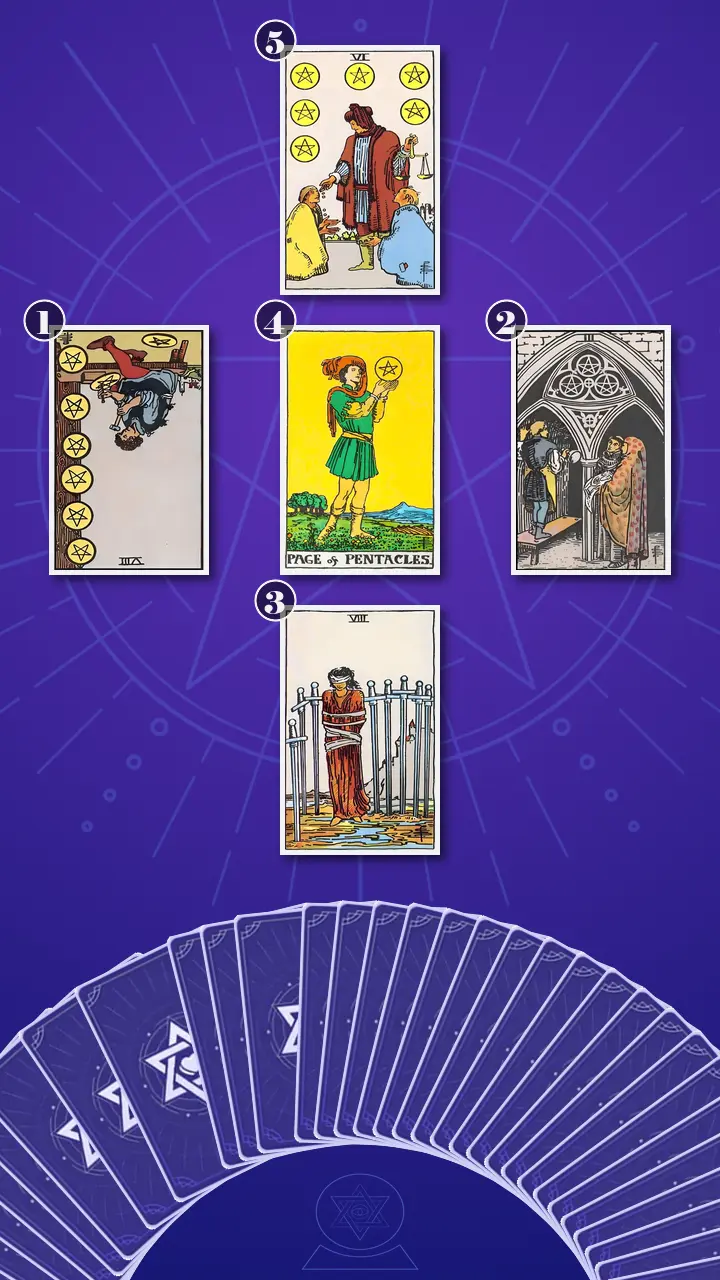
For this consultation, I chose the five-card Bridge tarot spread. For anyone wondering how tarot works in a situation like this, the value is in the structure: the spread separates Maya's present behaviour from the collaborative context she wants to recover, identifies the belief making the gap feel uncrossable, locates a practical crossing action, and then shows what sustainable participation could look like. The card meanings matter in context, because a symbol becomes useful when it helps connect an inner assumption with an actual choice.
I explained the sequence to Maya. The first card would show the current side of the divide, including the habit interrupting her study practice. The second would describe the other side, the useful function of the group as she currently perceived it, without pretending to read anyone else's private mind. The third would expose the obstruction. The fourth would be the bridge itself, and the fifth would describe the shared ground she could practise through repeated, reciprocal participation.
The Workbench Beside the Closed Door
The Interrupted Craft: Eight of Pentacles, Reversed
Now turned over is the card representing the observable current symptom: Maya interrupts her own study practice and delays responding because she believes she must recover privately first. The Eight of Pentacles, in reversed position.
At midnight, Maya has the course reading, the group chat, and her notes open, but her effort keeps moving sideways. She renames folders, adjusts a Pomodoro schedule, searches for a better study template, and designs another academic comeback plan. From the outside, the desk looks diligent. Yet the assigned reading remains open at page twelve, no study block is complete, and no reply has been sent.
The Eight of Pentacles usually speaks of repetition, skill development, and patient craft. Reversed, its earth energy is blocked. Effort is present, but the rhythm has fractured. Maya is using organisation as a substitute for the specific work and contact that could produce new evidence. Her inner sentence sounds like this: “Once the system is perfect, then I can study properly. Once I have studied properly, then I can reply.” The condition keeps moving.
I pointed to the solitary artisan in the card and the distant town behind him. “This is the active group chat on one side of your desk and the isolated workbench on the other,” I said. “The tools are real. Your wish to work is real. The problem is that preparation has become the place where you can feel competent without having to risk being visibly unfinished.”
Maya gave a short, bitter laugh. “That is exactly what I do,” she said. “I organise everything again, and then I still have not actually gone back.”
I did not turn that recognition into a scolding. “The plan is not proof that you are lazy or unreliable,” I said. “It has been a short-term shield. We can respect why it appeared while noticing what it costs now. Measure this week by one completed study action and one sent message, not by how impressive the recovery dashboard looks.” Her fingers stopped rearranging the edge of her sleeve, and she looked at the card as if the artisan had finally turned toward her.
The Shared Workbench: Three of Pentacles, Upright
Now turned over is the card representing the collaborative structure Maya is trying to rejoin as she currently perceives it, without claiming to reveal the private thoughts of other group members. The Three of Pentacles, in upright position.
I described the three figures gathered around a building plan beneath the stone arch. I asked Maya to imagine bringing one partially solved problem to a library table, where students compare methods, correct assumptions, and decide who will cover which question next. Nobody in that image has to carry the entire plan alone. The work is still in progress, but it becomes more intelligent because it is visible and shared.
Here, the earth energy is coordinated rather than isolated. The Three of Pentacles does not guarantee a particular reaction from the group, and I made that boundary clear. It shows the function of collaboration that Maya wants back: shared structure, accountability, explanation, and the chance to discover that a question can be a contribution rather than an admission of failure.
“What do you actually miss about the group?” I asked. “Not what you think you should miss. What would make this week's material easier to navigate?”
Maya looked down at her hands. “The way someone explains one step and suddenly the whole problem has a shape,” she said. “Also the fact that I show up because other people are there. I miss the rhythm more than I miss being praised.” Her shoulders remained high, but her gaze moved from the card to the empty space between us, where a real answer had begun to take form.
The Doorway Made of Predictions: Eight of Swords, Upright
Now turned over is the card representing the root barrier beneath recovery avoidance: the belief that visible incompleteness will threaten Maya's standing and belonging. The Eight of Swords, in upright position.
I brought us to the campus library doorway at 3:16 p.m. in imagination. Maya sees two group members through the glass, checks Canvas as if the screen has suddenly become urgent, and changes direction before anyone speaks. Her thought says, “They will see the gap and revise what they think of me.” The observable fact is simpler: no conversation has happened yet.
The Eight of Swords is air that has become overcontained. The blindfold represents negative rehearsal replacing new information; the loose bindings and incomplete enclosure show that the discomfort is real, but the conclusion that there are no partial options is too absolute. The backlog exists. The rule that Maya must eliminate it before making contact has not been tested.
Because I have spent a lifetime at Cambridge and on archaeological digs, I use a diagnostic lens I call Academic Stratigraphy. I separate the layers before deciding what the whole site means. The top layer here is factual: missed sessions, unfinished readings, and an unanswered invitation. Beneath it lies a prediction: “They will stop seeing me as a peer.” At the foundation is an identity fear: “If they see the gap, I will prove that I do not belong.” My Research Bottleneck Analysis treats the block as a signal that effort is piling up at the wrong layer, not as evidence of a personal failure. We do not need to condemn the ruins; we need to find where the passage has narrowed.
Maya's breath stopped first, and her fingers hovered above her phone. Then her eyes lost focus as if she were replaying the library doorway, the unopened invitation, and every imagined expression she had assigned to the group. Finally, her jaw tightened and she whispered, “But if I send something, they can actually decide. What if I have been avoiding the answer because I already know it?” A moment later, she let out a shaky breath from somewhere deep in her chest.
“That fear deserves care,” I said. “It does not deserve to masquerade as information. The backlog is real; the verdict on your belonging is still a prediction. A concise message would not control the group's response, but it would give you information that another hour of rehearsal cannot provide.” I watched her uncurl one hand from a fist. The door was still a door, but it was no longer a confirmed wall.
When the Page Held One Coin
The Learner-Sized Crossing: Page of Pentacles, Upright
The room grew quiet when I turned to the card placed directly between Maya's side and the group's. We had reached the Bridge position: the smallest credible re-entry action that can interrupt procrastination before the backlog has been eliminated. The Page of Pentacles, in upright position.
The modern scene was immediate. Maya sends a concise message: “Hey, I've fallen behind and I'd like to rejoin while I catch up. What's the most useful current topic for me to prepare for the next session? I can bring one question or a short set of notes on it.” She does not erase the backlog, guarantee the response, or write a complete account of every missed interaction. She names where she is, asks for one current priority, and offers one contribution she can actually prepare.
This is grounded beginner's mind, not a performance of confidence. The Page's upright earth restores the stalled craft of the reversed Eight of Pentacles and gives the Eight of Swords an observable exit. Instead of demanding certainty before contact, Maya can use contact to gather information. Instead of treating re-entry as a final examination, she can treat it as a small learning experiment.
At this point, I used my Research Bottleneck Analysis again. When a research project stalls, I look for the narrowest point where too much material is being asked to pass at once. Maya has been trying to carry every missed reading, every apology, and every fear through one imagined conversation. The Page holds one pentacle steadily. The bottleneck opens when the whole field is reduced to one current topic, one request, and one promise.
I returned Maya to the Tuesday night desk. The apology was typed, deleted, and replaced by another colour-coded plan. The plan offered brief relief, but the unread pages and unanswered chat remained exactly where they were. It was the familiar bargain of private effort now and belonging later, with later moving farther away each night.
Being behind does not mean you must stay outside; take one learner-sized step, as the Page of Pentacles holds one coin steadily instead of trying to carry the whole field.
I let the sentence rest between us, then added, “Participation is not the prize you earn after catching up; it can be part of how you catch up.”
Maya's thumb froze above the screen. First, her breathing paused and her shoulders held their familiar defensive hunch. Then her eyes widened slightly and went unfocused, as though the sentence had opened several old scenes at once: the muted chat, the library door, the unfinished chapter, and the plans she had mistaken for progress. Finally, her clenched hand loosened against her knee; her eyes grew bright, and a small, unsteady exhale left her. “But does that mean I was wrong to try to fix it alone?” she asked, with a flash of anger beneath the hurt. “No,” I said. “It means that strategy protected you briefly and is now blocking the help you want. You can change the strategy without rewriting yourself as a failure.” I offered a ten-minute experiment: draft three lines, remove any private detail she did not want to share, and remember that sending was optional. “Now, with this new view, was there a moment last week when this insight might have let you feel or act differently?”
Maya read the imagined message twice. The whole backlog had not become smaller, but the social reckoning had become a bounded experiment. I could see the first step of the emotional transformation: shame-driven silence had not vanished, yet it had begun to make room for cautious trust in a learner-sized act.
A Landing with Uneven Scales
The Exchange That Can Become Balanced: Six of Pentacles, Upright
Now turned over is the card representing the integration mindset Maya can practise: receiving limited help, contributing what she can, and rebuilding participation through reciprocity rather than perfection. The Six of Pentacles, in upright position.
I imagined a future Thursday study session without claiming that the group would automatically welcome her or that every exchange would feel easy. Maya asks for a brief recap of the current priority, stays for one hour, and brings one practice question for the table to compare. The scales in the card do not show identical amounts in every hand. They show explicit exchange, clear limits, and the possibility of rebalancing over time.
“Receiving something today does not make you permanently less equal,” I told her. “One uneven exchange is not the definition of the relationship. You can accept a five-minute recap and still offer something proportionate. You can also say that you have capacity for one hour, not promise an impossible recovery marathon.” Maya's shoulders lowered a fraction. She wrote “one question” in the margin of her notebook, then added “ask what matters now.”
The Six of Pentacles completes the movement from interrupted solo work to collaborative participation. It does not ask Maya to overcompensate for absence or to owe the group an emotional confession. It asks for a fair process: make a bounded request, state a realistic limit, bring a useful contribution, and let trust be built by repeated follow-through.
Rebuilding the Argument Beneath the Noise
When I placed all five cards together, I could see why Maya felt trapped. The reversed Eight of Pentacles showed practical effort diverted into perfect preparation. The Three of Pentacles showed the shared structure she genuinely missed. The Eight of Swords revealed the rule beneath the avoidance: if anyone sees the gap, her belonging will be downgraded. The Page of Pentacles supplied the crossing, and the Six of Pentacles showed that belonging could be rebuilt through proportionate exchange rather than instant equality.
The cognitive blind spot was not simply “I need better time management.” Maya had been treating equal preparedness at every meeting as the only proof of peer status. She was also confusing a real academic backlog with a settled social verdict. The key shift was from waiting until fully caught up to sending one honest re-entry message with one manageable request and one concrete contribution. Participation could become part of recovery instead of a graduation prize awarded after recovery was complete.
I then adapted my Thesis Stratigraphy Framework for the message. On an essay, the framework helps rebuild an outline so the core argument can pierce through intellectual clutter. For Maya, I reduced it to three layers: the foundation was the fact that she had fallen behind; the middle layer was the current topic she needed help prioritising; the top layer was the contribution she could reliably bring. This was a structure, not another elaborate Notion project. It gave her enough shape to communicate without forcing her to excavate every detail of the past.
I wrote down the next steps as actionable advice, small enough to test and specific enough to begin:
- The One-Pentacle MessageAfter one 25-minute catch-up block this week, Maya can open the existing WhatsApp chat and send no more than three sentences: acknowledge that she has fallen behind, ask which current topic is most useful for the next session, and offer one question or a short set of notes. She can place one current task in a calendar block of no more than 30 minutes before that session.I asked her to set a five-minute message timer and stop editing when it rings. She does not need to disclose private details, promise a full recovery date, or write a perfect apology. If three sentences feels too exposed, the minimum version is enough: “I've fallen behind but would like to rejoin. What should I prepare for the next session?”
- The Known / Predicted Gate CheckBefore opening the chat when a notification appears, Maya can use her notes app for two minutes and make two short columns. Under “Known,” she can list up to three observable facts, such as missed sessions or unread chapters. Under “Predicted,” she can list up to three thoughts, such as “They will no longer see me as a peer.” She can circle one prediction that a brief message could give her new information about.I told her to avoid colour coding, research, or turning the exercise into a new planning system. The goal is not to prove that the group will respond positively. It is to separate the real backlog from the untested belonging verdict and notice what her body does when facts and predictions stop sharing the same label.
- Reciprocity Over Instant EqualityAt the next session, Maya can ask for one bounded form of help, such as the group's current priority or a five-minute recap, then offer one proportionate contribution: a solved practice question, a half-page summary, a room booking, or confirmed attendance for one hour. She can name her limit plainly, such as “I can stay for the first hour and focus on Topic 4 today.”Before promising anything, I asked her to estimate the time and halve the scope. Reliability matters more than volume. Receiving support does not create a permanent debt, and declining a role that exceeds her capacity is compatible with healthy participation.
I reminded Maya that none of these actions could control another person's response. They could, however, restore her ability to choose, collect new information, and practise being present while still unfinished. That is what a useful tarot reading does: it makes a hidden pattern testable without taking the steering wheel from the person living it.

The First Reply, Not the Academic Comeback
Four days later, I received a message from Maya after she had completed one 25-minute block on the current problem set. She had used the short version of the Page's message. One classmate replied with the group's current priority, and another offered to compare one question before Thursday's session. Maya joined for the first hour, brought a single practice problem, and left before her energy ran out.
She was not suddenly caught up. She came home relieved but alone, made tea, and sat by the window instead of staging a dramatic academic comeback. She slept a full night, but woke with the thought, “What if I still get this wrong?” This time, she smiled, opened Topic 4, and began with the one question she had promised to bring.
I saw the evidence I had hoped for, not a solved life but a changed relationship with the next move. Maya had moved from shame-driven silence and perfectionistic catch-up planning toward cautious, reciprocal participation as a visible learner. The cards had not decided her fate or guaranteed acceptance. They had given her a clear structure for noticing what was real, what was predicted, and what she could do next. Maya was the one who crossed the bridge.
When the chat lights up and your throat tightens, it can feel safer to disappear for one more day than to risk having people see that the capable version of you is still catching up. That feeling deserves understanding, but it does not have to become a permanent address.
If you let participation become part of catching up, what is one learner-sized way you might imagine stepping back onto your own bridge, carrying one clearly named Page-sized commitment instead of trying to carry the whole field?