After Friends Talk Behind Your Back: From Chat Checking to a Boundary

The Missing Sentence: Why I Kept Chasing Answers After Friends Talked Behind My Back
'You can write a calm, diplomatic update for your nonprofit team, but after a mutual friend mentions a private conversation, you spend the London commute rereading WhatsApp messages for a change in tone,' I told Maya. 'That is friendship-betrayal closure seeking, not a random need for drama.'
Maya had arrived from work with rain darkening the shoulders of her coat. At 10:38 p.m. on a Tuesday, in the shared kitchen of her London flat, I watched her reopen a WhatsApp group chat she had already read twice. The radiator clicked behind us, the overhead light buzzed, and her phone felt warm against her palm while her jaw stayed clenched.
'Why do I keep chasing answers after friends talk behind my back?' she asked. 'I am not asking for drama. I am asking for the missing piece. If they would just tell me what happened, I could let it go.'
I could see the conflict in the way her restless fingers reached for the screen and then pulled away. She wanted direct truth, but she feared that stopping the search would leave the betrayal unresolved and place her belonging outside her control. Her hurt had become a browser with forty tabs open: every new clue opened another page, yet the original question about trust remained buried underneath. Anger, longing for reassurance, and shame about needing more information were all crowded into that small pool of phone light.
'I believe that you are trying to protect yourself,' I said. 'We do not have to decide whether the friendship is over, force a confrontation, or pretend the breach did not matter. Let us use the cards as an objective map of the pattern: what is known, what is being assumed, and what choice still belongs to you. Our Journey to Clarity can begin with making the air breathable again.'

Choosing the Compass: Relationship Spread · Context Edition
I invited Maya to place the phone face down and take one slow breath, long enough to notice her jaw and the pressure in her chest. I shuffled slowly while she held the question in mind. For me, this is how tarot works best: not as a surveillance camera pointed at other people's private motives, but as a structured reflection that makes an emotional pattern easier to examine.
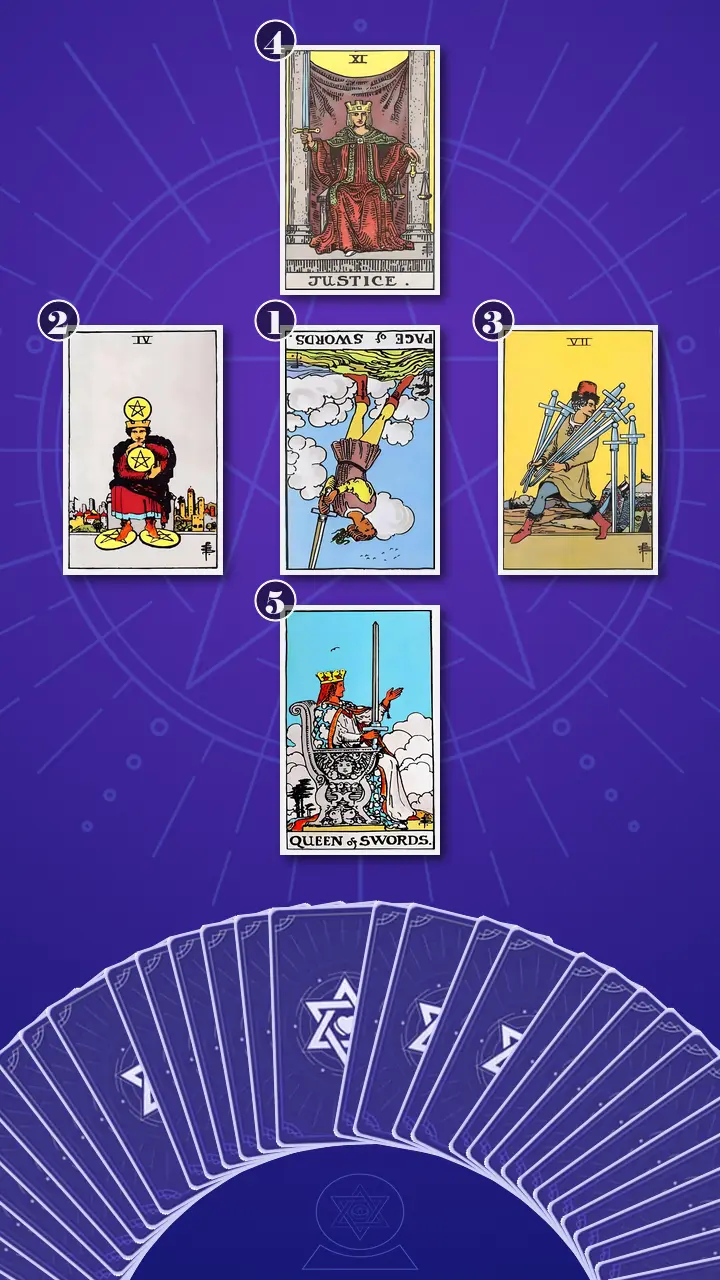
For this friendship betrayal, I chose the Relationship Spread · Context Edition. It is a five-card relationship tarot spread for friendship boundaries and closure because the problem is not only an unanswered conversation inside Maya's mind. It also includes the shared atmosphere of indirect comments, partial disclosure, private side chats, and public politeness. This is the smallest structure that can hold the whole problem without turning it into a hunt for a villain.
The center card would show the present wound: the rereading, checking, and questioning that followed learning she had been discussed privately. The card to the left would reveal the attachment mechanism and the fear beneath the grip. The card to the right would map the external social field without claiming proof of anyone's intentions. Above the center, I would look for the closure reframe, and below it, the one agency step Maya could choose for herself.
'The spread will not give us a perfect transcript,' I said. 'It can help us ask a more useful question: what information is necessary for a fair decision, and what information would only keep you monitoring the group?'
Reading the Map of a Friendship Betrayal
The Raised Sword Over the Refresh Button
I began with the card representing the present wound: the observable answer-chasing that followed learning friends had discussed Maya privately, including rereading, checking, and asking for more details.
I turned over the Page of Swords, in reversed position. In the Rider-Waite-Smith image, the young figure holds a raised sword while standing on uneven ground beneath restless clouds. Upright, that alert stance can mean curiosity, observation, and a willingness to ask questions. Reversed, the energy becomes excess vigilance and blocked clarity: attention keeps moving, but it does not arrive anywhere.
The modern-life translation was immediate. This was Maya at 10:38 p.m., switching between an old WhatsApp thread and Instagram, comparing punctuation, reaction emojis, and reply times after learning friends had talked about her. Each new detail gave her a few seconds of relief, then opened another question. The raised sword had become a thumb hovering over refresh. Being informed had quietly turned into being on surveillance duty.
'The card is not saying that your curiosity is the problem,' I explained. 'It is showing the moment when useful alertness becomes a substitute for direct clarity. You are gathering information to avoid making a decision while the story is incomplete, but the checking itself is keeping the betrayal present.'
Maya gave a small, humourless laugh. 'That is too accurate. Almost cruel.'
I slowed down rather than asking her to agree with me. 'Then we should keep the accuracy and remove the cruelty. What answer are you hoping the next screenshot will finally give you? Is it the exact wording, the reason you were excluded, or proof that you still mattered?'
Her hand stopped above the chat. She did not nod. She looked at the card, then at the phone, as if the two objects had finally become part of the same picture. The first card had not condemned her; it had shown the behavior that offered brief relief while postponing the boundary conversation.
The Screenshot Pressed to the Chest
Next, I turned over the card representing the attachment mechanism: what Possessive Attachment was trying to hold onto and which fear beneath the Betrayal-Closure Lock made uncertainty feel intolerable.
The Four of Pentacles, in upright position, showed a figure clutching one pentacle to the chest, standing on two more, with another held above the head. The energy was an excess of holding. Earth had become a clenched fist around security, position, and control. In Maya's case, the complete explanation had become a possession she believed she needed before she could decide whether the friendship was safe to trust.
I described the image as a screenshot folder held against the body like a spare set of house keys. The saved fragments documented a former place in the group: old affectionate messages, invitations, private jokes that once included her, proof that the closeness had been real. But she was also holding the explanation itself as if it were a friendship receipt. If she could recover every detail, perhaps she could protect her dignity, restore her place, and prevent future exclusion.
'I am not only trying to find out what they said,' Maya admitted. 'I am trying to know whether I can still belong there. If I stop looking, it feels like I am accepting that they can leave me out and I cannot do anything about it.'
I pointed to the pentacle against the figure's chest. 'That is the difference between wanting truth and needing the explanation to prove you still belong. The search is doing two jobs at once: it is looking for facts, and it is trying to secure your place in the relationship. Facts can help you judge trust. They cannot make another person's private behavior safe by becoming complete.'
For a few seconds, Maya's breath slowed. Then her eyes went unfocused, as though she were replaying the saved screenshots rather than looking at the card. Her fingers tightened around the phone, and she quietly named the compound emotion I had been hearing beneath the questions: hurt mixed with a fear of being replaceable, with anger and shame underneath. When she noticed her jaw relaxing, she released a long breath that sounded almost surprised.
'So another detail gives me relief because it feels like I have recovered something,' she said. 'But I am still holding the whole relationship in the same locked position.'
'Exactly,' I said. 'The grip protected you for a moment. It is not a moral failure. It is simply no longer the only protection available.'
The Side Channel I Could Not Call a Verdict
I placed the card representing the external field on the right: the Backchannel Politics of partial disclosure, indirect communication, and social ambiguity, without treating the card as proof of anyone's private motives.
The Seven of Swords, in upright position, showed a figure carrying five swords while glancing back at two left near distant tents. The path was uneven, and the backward look mattered as much as the swords. The energy was fragmented Air: information was moving, but not openly or completely. It created a blockage because Maya kept trying to walk forward while looking over her shoulder for the part of the story left behind.
I brought in the scene she had described from the nonprofit office kitchen. At 12:16 p.m., a mutual friend had replied, 'It is complicated.' The printer hummed, her coffee tasted bitter, and her fingers tapped the edge of the mug while she asked what that meant. The group remained publicly polite. A private joke, a delayed invitation, or a conversation that resumed after she was omitted could all feel like evidence, but the card could only map the atmosphere. It could not prove whether anyone had been malicious, careless, frightened, or simply avoidant.
'This card explains why you keep searching,' I said. 'It does not give me permission to invent the missing conversation. The question is not whether every fragment can be collected. The question is which information would genuinely change a boundary you can choose, and which detail would give you one more thing to monitor.'
Maya looked down at the three cards. 'Every vague reply makes the story feel worse. If someone says it is complicated, my brain hears, there is something terrible that I have not found yet.'
'Uncertainty is uncomfortable; it is not always an instruction to investigate,' I replied. 'A private Slack channel you can sense but cannot enter can occupy a huge amount of attention. But the existence of a closed channel does not require you to map every room inside it before deciding how much access to give the people standing outside your door.'
Her shoulders lifted when she first heard that, then lowered slightly. She reached for her phone, stopped herself, and turned it face down again. The pause was small, but it was the first time during the reading that an unanswered question did not immediately receive her next action.
When Justice Balanced the Phone Screen
The Scales Beside the Chat
The room changed when I reached for the card above the center. The radiator went quiet, the overhead buzz seemed farther away, and a siren passed along the street before dissolving into London traffic.
I turned over the card representing the closure reframe: the truth, standard, or proportionate judgment that could loosen the Betrayal-Closure Lock without requiring access to every private conversation.
Justice, in upright position, is the catalyst and the antidote in this spread. Its balanced scales ask for evidence, impact, and fairness; its upright sword asks for clear language. The card did not promise Maya a confession or tell her what the friendship must become. It offered a different source of closure: she could acknowledge what was confirmed, recognize what the breach had done to trust, and choose a response proportionate to the access she was willing to offer.
I thought of my fifteen years as a perfumer. Scent can cross a room without permission, cling to clothing, and alter the atmosphere long after its source has disappeared. Relationships need space to breathe, too. I use a personal lens called Boundary Permeability Diagnosis to notice when another person's unspoken tension, lack of limits, or indirect communication has metaphorically bled into a client's inner space and begun to cause emotional suffocation. It is not a verdict on the person. It is a way of locating the boundary that needs care.
I added a second check that I call Vibe Contamination Auditing. I do not use it to label a friend as bad or toxic. I use it to ask whether a highly charged social atmosphere is polluting the psychological air in which someone is trying to make a decision. Maya had begun breathing other people's ambiguity as if it were her own evidence. Justice gave her a way to clear the air: separate the camera-record facts from the meaning her nervous system was adding.
At 10:38 p.m. on Tuesday, in a London flat-share kitchen, Maya reopens the group chat, the phone warm in her hand while the radiator clicks. She wants the missing sentence to make the betrayal legible, yet each reread tightens her jaw and postpones the question she actually needs to ask.
I placed the image of Justice beside the phone and imagined the scales as an Apple Notes page with two visible columns: what I directly know and what I am filling in. Then I said the sentence that formed the hinge of the reading.
You do not have to keep chasing every missing detail to prove that the betrayal mattered; weigh what is known, state what you need, and let Justice's scales guide a proportionate boundary.
I let the sentence remain between us. Then I added, 'The missing detail may explain why the betrayal hurt, but it does not have to decide your worth, your access, or your next boundary. You can take the breach seriously without making complete surveillance the price of self-respect.'
As the words landed, Maya's thumb froze above refresh and her breath stopped halfway in. Her eyes widened, then drifted past the card as if she were replaying every timestamp, emoji, and delayed reply at once. Her fingers closed around the phone, and her jaw worked. 'But doesn't this mean I was wrong before?' she asked, irritation arriving before tears. I did not rush to turn that resistance into a breakthrough. 'No,' I said. 'It means your earlier search made sense as protection, and it is no longer the only protection available.' Her gaze returned to the scales. First, her fist loosened by one finger; then her shoulders dropped with a small, shaky exhale; finally, a quiet 'Oh' came from her chest. Her eyes reddened, not because the betrayal had disappeared, but because she could feel the difference between honoring the breach and obeying its demand for more surveillance. The radiator clicked again. For a moment, the room gave her back an inch of air.
'Now, use this new perspective to recall last week,' I invited. 'Was there a moment when these scales could have helped you feel differently? Maybe when you reread the reply, when you checked the Story viewers, or when you drafted the direct question and deleted it.'
Maya pressed her lips together and nodded once. 'The moment I saw the group photo,' she said. 'I knew it hurt. I did not know I could decide what the hurt meant for my access without first proving every private sentence.'
That was the key shift: from treating complete closure as a prerequisite for agency to separating confirmed facts from interpretations and choosing one proportionate, self-owned boundary. The betrayal remained real. The missing details remained missing. What changed was the ownership of the next decision. This was the first movement from betrayal-triggered vigilance and compulsive information-seeking toward steadier self-trust, proportionate discernment, and self-owned boundaries.
The Door With a Clear Guest List
The Queen Who Faced Forward
Finally, I turned over the card representing the agency step: one clear communication or boundary Maya could choose for herself this week, without using it to force a confession or manage the entire group.
The Queen of Swords, in upright position, sat with a steady sword in her right hand and an open left hand extended toward the viewer. Her direct gaze was receptive without being porous. The energy was balanced Air: honest speech, independent judgment, and firm limits guided by clear perception rather than by the emotional weather around her.
I connected the Queen to Maya's familiar pattern of drafting a direct question, deleting it, and asking a mutual friend for an indirect version instead. The card did not ask her to send an angry paragraph, expose the group, block everyone, forgive on command, or stay available to prove she was easygoing. It asked for a concise communications brief: one confirmed fact, one impact on trust, and one request or boundary. No twenty-slide appendix designed to force a confession.
'The Queen can ask one clear question,' I said, 'or she can choose not to ask tonight. She can take space from group plans, keep one-on-one contact limited, or wait until she has more emotional room. A boundary is a privacy setting you control. It is not a tool for managing another person's private messages.'
Maya opened the Notes app. Her first draft was long. I watched her type the names of three people, several dates, and a paragraph about the group photo. Then she deleted most of it and wrote: 'I learned that a private conversation about me happened, and it has affected my trust. I want direct communication if there is an issue. I am taking some space from group plans for now.'
She did not send it during the reading. Instead, she read it once, placed the phone on the table, and looked at the Queen. Her breathing was not perfectly calm, and her first instinct was still to ask a mutual friend whether the wording sounded too much. But she noticed that impulse before obeying it. That was discernment in practice: not the absence of feeling, but a clear line between feeling and action.
'You are allowed to choose access based on what you know now,' I told her. 'You can revise the boundary as new information arrives. You do not have to build a locked building around yourself. A door with a clear guest list is enough.'
The One-Page Boundary That Let Air Back In
When I placed all five cards together, they told one coherent story. The reversed Page of Swords showed the visible symptom: hurt had been converted into message-checking and digital surveillance. The Four of Pentacles showed the grip beneath it: Maya was holding the explanation as proof of belonging, dignity, and control. The Seven of Swords mapped the external field of side chats and partial disclosure, while refusing to turn ambiguity into a factual verdict. Justice interrupted the loop with proportionate judgment, and the Queen of Swords carried that judgment into a direct statement and a boundary.
The pattern also explained why the search felt so persuasive. Four Swords cards filled the spread, while the Four of Pentacles was the only Earth card; there were no Cups or Wands. I did not read that absence as a lack of emotion or desire for repair. I read it as a sign that emotional hurt was being routed into analysis, surveillance, and attempts to make social security tangible by holding information tightly. The browser with forty tabs was trying to perform the work of a heart that had not yet been given a safe place to name what trust now required.
The blind spot was not that Maya cared too much. It was the assumption that she needed a courtroom-level reconstruction before she earned the right to set a boundary. The transformation direction was simpler and more demanding: facts could inform the boundary, but they did not have to supply every detail. Complete story was not the same thing as trustworthy friendship. Agency could return before the full account did.
I wanted the actionable advice to stay small, reversible, and owned by Maya. So I introduced my Space Calibration Ritual, a behavioral practice I use when a relationship has become too psychologically close to every notification. We create deliberate digital and physical blank spaces: a short period without the chat or Stories, and a physical action that gives the body somewhere else to place its attention. The ritual is not punishment, silent treatment, or a dramatic cutoff. It is an air gap that prevents enmeshment and lets a person choose rather than react.
Three Small Ways to Reclaim the Air
- The Fact-Interpretation-Boundary CheckOn one evening this week, I asked Maya to set a ten-minute timer in Apple Notes and create three headings: confirmed facts, interpretations, and one proportionate boundary or question. She could copy no more than three exact facts from the messages, write the story her mind was adding beside each one, and circle the single item that affected her trust or contact decision. When the timer ended, she would close the chat and put the phone down for ten minutes.I warned her not to add a fourth column called what I still need to find out; that would turn the reflection back into research. A two-minute version was valid, and no decision tonight was a valid boundary.
- The One-Message BoundaryIf Maya decided to communicate, I asked her to draft one concise message in Notes during daylight: one confirmed fact, one impact on trust, and one clear request or boundary. She could write, 'I learned that a private conversation about me happened,' name the effect on trust, and ask for direct communication or state that she was taking space from group plans. She would wait at least thirty minutes before sending, revising, or keeping the note private.The draft did not need a mutual friend's preview. A direct message was an option, not an obligation, and making it longer could not control the other person's answer.
- The Space Calibration RitualFor one thirty-minute window this week, after completing the fact check, Maya could mute the WhatsApp group and Instagram Stories. Her physical blank space would be equally specific: she would place the phone in another room or inside her bag, then make tea, take a short walk, or sit at the kitchen table without opening a side channel. When her hand reached for the phone, she would write the exact urge in one line and wait for the timer.I suggested muting rather than blocking, because the goal was breathable distance rather than punishment. She could begin with ten minutes, and she could remind herself, 'I am choosing not to investigate during this window; I am not choosing to stop caring.'
'The point is not to become guarded,' I said. 'It is to let the room belong to you again. You can take the betrayal seriously without investigating every private sentence, and you can choose a limit without pretending you know the entire future of the friendship.'

A Week Later, the Quiet Proof
Six days later, Maya messaged me: she had sent one concise message, then sat alone in a café while her coffee cooled. Relief arrived beside a small ache; the old group did not magically return, but she did not ask anyone else to decode the silence.
The reply she received was polite and incomplete. This time, she copied its exact words into the first column of her Notes page and left the assumptions in the second. She chose to pause one-on-one plans for the week, muted the group chat for thirty minutes after work, and went home without trying to calculate who knew what. Her chest still tightened once the next morning when she saw the group online. She noticed it, breathed, and did not open the chat immediately.
I saw that as the first concrete evidence of the Journey to Clarity. Tarot had not extracted the missing conversation, repaired the group, or made uncertainty disappear. The cards had given Maya a reliable structure for hearing what her own standards were already saying. She moved from a detective trapped in missing evidence to a boundary-keeper who could acknowledge the hurt, weigh the facts, and decide what level of trust and access she was willing to offer.
When a friendship goes quiet after a private conversation, I know how the jaw can stay clenched because stopping the search feels like handing over both the missing story and your place in the group. I do not ask anyone to call that reaction dramatic or to let it go before it has been understood. Sometimes noticing the pull toward another screenshot is the first sign that the betrayal no longer owns every spare minute.
As I close this Relationship Spread · Context Edition, I leave the same gentle invitation I gave Maya: if you could let the facts you already have inform one small, self-owned boundary without deciding the entire future of the friendship tonight, what would feel like a fair next step to imagine - the blank space after muting the chat, one concise sentence, or a door with a guest list you control?