Deleting the Check-In, Then Sending It: A Slow Fade Reframed

The Slow Fade: Relationship Ambiguity and the Unsent Question
I met Casey, a 28-year-old non-binary junior content strategist on the train home from the Sydney CBD, rereading the last affectionate messages while today's reply gap quietly became a full evening. I could see the familiar digital ritual before they explained it: affection from two months ago, silence from today, and a thumb moving between the two as if the right comparison might produce an answer.
At 8:47 p.m., the carriage lights buzzed above us while the train carried us toward the inner west. Casey typed, "Can we talk about where this is going?" The phone felt warm against their palm; their shoulders had climbed toward their ears. They deleted the sentence, reopened the thread, checked the other person's active status, and watched the read receipt remain unchanged.
When I asked what they wanted from the connection, Casey looked down at the phone and said, "I want to ask where I stand, but I keep waiting through the slow fade instead. I can wait one more day before I make this awkward. Maybe consistency will come back if I stay easy to be with." The core contradiction was plain: wanting a clear place in someone's life while continuing to wait for the fading contact to explain itself.
Longing had become a waiting room with no appointment time: the chair was always occupied, the door never quite opened, and every notification sounded like the receptionist finally calling a name. Anxiety tightened Casey's chest; disappointment made their limbs feel heavy; self-doubt kept their hands restless over the keyboard. I told them that the waiting made sense as protection, but it was also costing them information and self-trust.
"I am not here to predict what this person will feel or to make you chase an answer," I said. "We can use the cards as a clear, objective mirror for the pattern you are participating in, the need you have been postponing, and the choice that remains yours. Let's draw a map through the fog together."

Choosing a Compass for the Unanswered Thread
I asked Casey to put both feet on the floor, take one slow breath, and name the question without editing it into something more convenient. I shuffled at an unhurried pace, treating the movement as a transition from monitoring the phone to observing the problem in front of us.
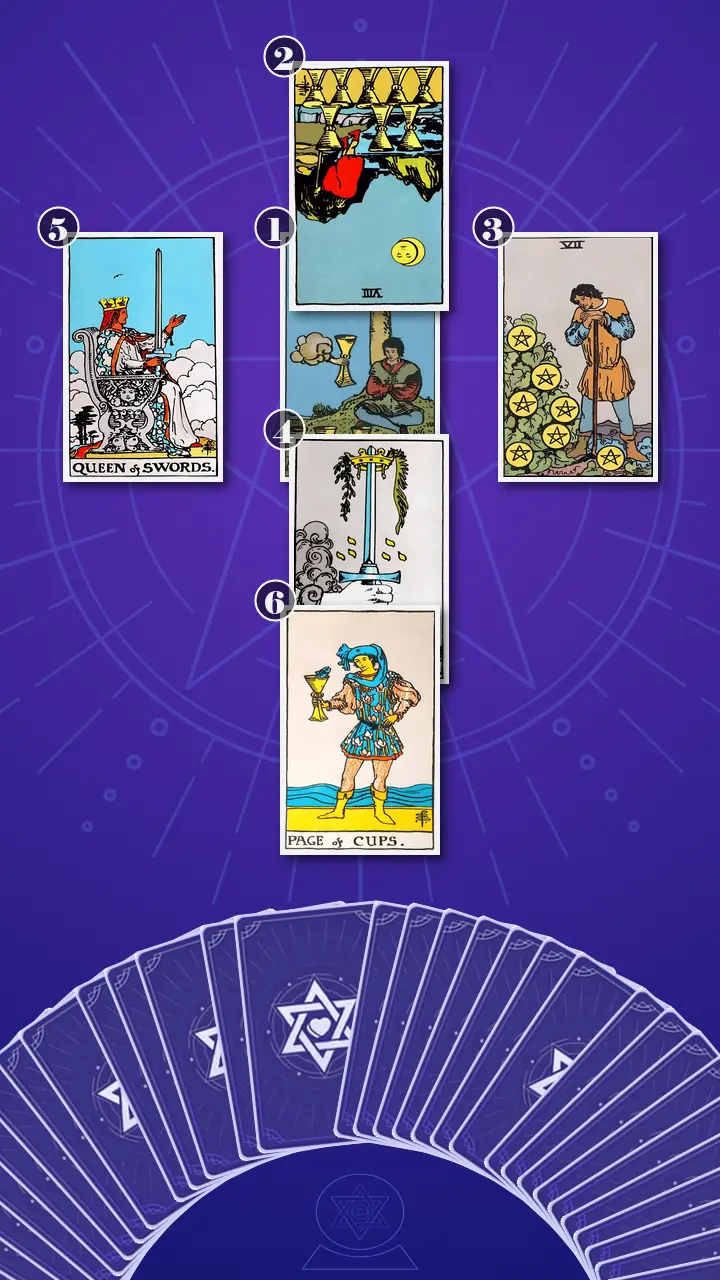
For this reading, I chose the Contextualized six-card Relationship Spread, a cross-shaped layout designed for relational ambiguity, communication, boundaries, and self-directed next steps. It is a practical way to explore how tarot works without turning another person's private feelings into a prophecy: each position gives us a different angle on Casey's observable choices and needs.
The spread fit because the central issue was not choosing between several external futures. It was the loop of sporadic replies, postponed plans, rereading old warmth, and deleting a direct check-in. The first card would show Casey's present stance; the second would map the current relational rhythm; the third would expose the hidden waiting mechanism. Below them, the Ace of Swords would identify the communication that needed to become conscious, followed by a boundary resource and one proportionate next step.
I explained that the cards could organize evidence, language, and reflection, but Casey would remain the person deciding what access the connection received. The layout would not tell them whether to stay or leave. It would help them stop outsourcing their decision to timestamps, green dots, and one more maybe.
The Closed Cups and the Open Sky
Position 1: The Four Cups at the Edge of Attention
Position 1 showed the observable self-position in the connection: drafting and deleting a check-in, monitoring replies, and treating patience as protection from clarity. I turned over the Four of Cups, upright.
The seated figure's crossed arms and lowered gaze were almost an exact visual translation of Casey's train ritual. The three cups on the ground became the old affectionate exchanges, the earlier easy conversations, and the memory of when contact felt reciprocal. The fourth cup offered from the cloud was the direct question sitting just outside the chosen line of sight. Casey could see the option, but looking at the evidence felt safer than entering the conversation.
In energy terms, the Water here was blocked by withdrawal and preoccupation. Feeling was not absent; it was held so tightly that it could not become participation. The excess was private interpretation, while the deficiency was a present-tense request. I asked, "When the thread is open, are you staying connected by asking, or by watching for a sign that makes asking unnecessary?"
Casey gave a small laugh with no amusement in it. "That is too accurate," they said. "It is almost rude how much time I spend looking at the three old good messages." Their fingers tightened around the phone, then loosened when I placed the card beside it.
I told them I was not using the Four of Cups to accuse them of passivity. "This is a protective position," I said. "It helped you keep possibility alive. The question is whether it is nourishing the connection now or merely postponing an answer you already have the right to request."
Position 2: The Door Casey Keeps Reopening
Position 2 mapped how the slow fade was being experienced as an uneven relational rhythm: reduced contact, postponed plans, and the emotional pull to keep waiting. I turned over the Eight of Cups, reversed.
The cloaked figure on the moonlit path seemed to have paused halfway between departure and return. In Casey's life, it was the Thursday night decision to stop keeping Saturday open, followed days later by a casual message saying work had been hectic. The small warm reply made the emotional door swing open again. Casey did not truly leave, and they did not ask what had changed; they returned to the same unclear arrangement and treated the return itself as permission to wait another week.
This reversed Water energy showed blocked movement rather than a command to end the relationship. The figure's interrupted departure represented difficulty completing a threshold: the connection was no longer consistently fulfilling, but hope kept pulling Casey back before a clear question could be spoken. One warm message became a progress bar that moved one percent and somehow looked like proof that the whole project was back on track.
I asked, "After the next vague cancellation or long reply gap, what does the rhythm between you actually show over time, and what does one small reply make you overlook?" Casey slid the phone toward the middle of the table, as if placing the device farther away might stop it from setting the pace. A second later, they pulled it back.
"I decide I am done initiating," they said, "then they send one normal message and I feel ridiculous for ever thinking anything was wrong." I let the contradiction stand without forcing it into a verdict. A pattern could be noticed without assigning motives, and noticing was already different from chasing.
Position 3: The Spreadsheet of Past Effort
Position 3 exposed the hidden mechanism beneath the fulfillment stasis: the belief that more time and investment might eventually create mutuality, alongside the fear that asking would confirm its absence. I turned over the Seven of Pentacles, upright.
The figure leaning on the staff and studying the pentacles reminded me of Casey at lunch in the agency meeting room, reviewing the connection like a campaign dashboard. They counted the good conversations, the time they had known each other, the plans that had once happened, and the chances they had already given. Early engagement was visible. The current numbers were quietly flat. Still, Casey returned to the same private calculation: "I have already waited this long, so leaving now would mean the waiting was for nothing."
Upright Earth energy can offer patience, cultivation, and a sensible pause to assess results. Here, though, patience had become overextended. It had stopped being a value-based choice and turned into a bargain that required ignoring present evidence. Patience can be a value, or it can be a bargain that asks you to ignore the present. The card did not say that the history was meaningless. It said that history could be honored without allowing it to purchase unlimited access to Casey's time.
I used the image of a junior content strategist checking a performance spreadsheet: hours invested, a promising first week, and a current dashboard that was not moving. Casey went completely still and reread the last few lines. Their eyes lost focus as if they were replaying every postponed plan, then their jaw released with a quiet click. A long breath came from somewhere below the sternum, carrying recognition and a little grief.
"I have been calling it patience because that sounds generous," Casey said. "But maybe I am waiting for the investment to justify itself."
"Prior effort deserves acknowledgment," I replied, "but it does not guarantee future mutuality. We are assessing what is available now, not trying to make the past win an argument."
When the Ace of Swords Made the Question Speakable
Position 4: The Raised Blade
Position 4 clarified what asking where Casey stood could bring into conscious view: observable facts, personal needs, and communication that could replace speculation without predicting another person's choice.
The room changed before I turned the card. The air conditioner clicked off, and the sudden quiet made the faint traffic outside sound unusually far away. I turned over the Ace of Swords, upright.
The hand emerging from the cloud held the blade straight up into an opening sky. The crown at its tip was not a prize for getting the other person to choose Casey; it was the dignity of making a thought speakable. This was the moment to replace indirect hints with one precise sentence: "I have noticed we are talking less and plans have been harder to make. I value this connection and would like to understand whether you still want to keep building it."
The Air energy was clear and proportionate. It cut through theories about reply timing, online status, and the imagined deadline by which consistency might magically return. The Ace did not promise a comfortable answer. It separated observable information from imagined reassurance so Casey could respond to what was real.
At this point, I drew on a diagnostic practice I developed during my Wall Street years: Resource Readiness Assessment. Before a major pivot, I ask whether internal resources match external timing. In a relationship check-in, the internal resources were not a perfect script or certainty about the other person. They were three observable facts, one honest need, and a personal boundary. The external timing was not the moment when the other person might become consistent; it was the pattern already visible.
Casey was ready enough to ask. They did not need another week of emotional data to earn permission. I also used my Strike Timing Calibration: a strategic hold has a purpose and an end point, while an anxious hold simply refreshes the dashboard. The useful timing was neither an impulsive midnight follow-up nor indefinite waiting. It was one calm question, sent once, followed by a boundary Casey chose for themself.
Casey was back at 8:47 p.m. on the train, the phone warm in their palm, typing the direct sentence and deleting it while another quiet night pretended to be patience. They were caught between preserving possibility and gathering enough information to choose how much access the connection received. The question felt dangerous because it could turn uncertainty into an answer that could not be softened.
You do not have to keep waiting for a Slow Fade to explain where you stand; you can ask one clear question and let the Ace of Swords' raised blade separate observable information from imagined reassurance.
For two seconds, Casey's thumb froze above the screen and their breath stopped halfway in. Their eyes widened at the blade, then slipped out of focus as if the last week were replaying itself: green active dot, unanswered thread, three-word reply. Their jaw trembled once. The sentence did not erase the fear; it rearranged it. A long breath moved through their chest. Their shoulders lowered from their ears, and the hand gripping the phone opened finger by finger. When Casey spoke, their voice was low and rough: "I cannot make the outcome safe, but I can make my question honest." Their eyes shone, and a small, almost embarrassed laugh escaped. Then came the new vulnerability: a light-headed pause, the blank space after a familiar coping strategy loses its job. I watched Casey look at the sword, then at the unsent draft, no longer asking the card to promise an answer.
I asked, "Now, with this new perspective, was there a moment last week when this insight might have let you feel or act differently?"
Casey thought of the vague Thursday cancellation, the open Saturday calendar, and the time spent watching the green dot appear and disappear. "I could have asked before I spent the whole evening making their silence mean something," they said. Their fingers hovered over the draft again, but this time they did not edit it.
This was the first real movement from longing-driven waiting and fear of rejection toward information-based clarity. Clarity is information, not a verdict on your worth. The Ace of Swords did not make Casey certain. It gave them a clean question and returned the meaning of the answer to the person who would receive it.
Position 5: The Queen Who Gave Time a Voice
Position 5 showed the boundary and self-respect needed to stop ambiguous contact from setting the pace of Casey's emotional life. I turned over the Queen of Swords, upright.
Her upright sword, open hand, and direct gaze offered a model of clear-eyed honesty without cruelty. The Queen could hold attachment and discernment in the same frame. She did not require Casey to pretend they no longer cared, and she did not ask them to keep carrying the connection alone in exchange for belonging.
The Air energy was balanced here: enough distance to read the pattern, enough humanity to name the need. I invited Casey to write, "I want mutual communication, and I am not willing to keep carrying the connection alone." That sentence was not an ultimatum or a punishment. A boundary is an access setting, not a revenge post: it describes what Casey would participate in, not what the other person had to feel.
Casey looked at the sentence for a long moment. Their lips parted as if to argue with it, then closed. "Would that make me cold?" they asked. I answered, "No. It makes your time part of the information. A boundary gives your time a say in the relationship." Their posture stayed tender, but their spine came up a little straighter, as though a chair that had been missing one leg had finally been steadied.
Position 6: The Fish in the Cup
Position 6 turned clarity into one small action: a direct, non-accusatory check-in paired with a personal limit around continued waiting. I turned over the Page of Cups, upright.
The Page's attentive gaze toward the fish emerging from the cup felt very different from the Four of Cups' lowered attention. The Page did not know what the message would be, but stayed present enough to receive it. In Casey's life, this became one short, warm sentence: "I value our connection, and I would like to know how you see it now."
This Water energy was open but contained. It allowed sincerity without turning vulnerability into a courtroom closing argument, a long explanation, or a plea for reassurance. The fish represented information Casey could not script in advance. Their task was to offer the cup once, look at what came back, and avoid turning the response into an instant verdict about their worth.
"One honest question is not a demand for a particular outcome," I said. "It is an invitation to information. You can send it, or you can decide you are not ready today. Either way, the choice is yours; the card is not taking it from you."
Casey read the draft aloud, removed two paragraphs that explained why their need was reasonable, and left the phone face down on the table. Their hands still shook slightly, but they were no longer searching for a second message to soften the first. For the first time that evening, the silence had room around it.
The One-Page Map Out of the Waiting Room
I gathered the cards into one story. Earlier warmth and current disappointment had drawn Casey into the Four of Cups' closed attention. The reversed Eight of Cups showed why a small return kept reopening the door. The Seven of Pentacles revealed the private bargain underneath: if Casey waited long enough, perhaps the time and care already invested would finally become proof of mutuality. The Ace of Swords interrupted that bargain, the Queen of Swords gave the insight a boundary, and the Page of Cups returned emotional openness in a form small enough to remain self-respecting.
The elemental movement was Water, Water, Earth, Air, Air, Water: feelings held in suspension, patience turned into accounting, clear language and boundaries, then emotional expression with agency. There was no Wands card, so the answer was not a dramatic pursuit or a performance designed to win someone back. It was a modest, honest movement from passive hope to information-based self-respect.
The cognitive blind spot was treating waiting as neutral. Deleting the check-in felt like doing nothing, but it kept the slow fade running and allowed the other person's response time to organize Casey's evenings. The transformation direction was clear: replace waiting for the connection to explain itself with one direct, time-bounded question and a personal limit for what continued ambiguity would receive. Casey did not have to outlast the silence to earn an answer.
I gave Casey a small plan rather than a grand conclusion. It was designed to make the next step specific, reversible, and owned by them. This was actionable advice, not a command to force closure or a promise that directness would produce reconciliation.
From Insight to Action: The One-Clear-Question Check-In
- Make the evidence readable.On one quiet evening this week, in the share-house kitchen or another place where Casey can sit undisturbed, set a 10-minute timer and write three lines: "I observed...", "I need to understand...", and "I will decide..." The first line can name only facts: communication used to be frequent, two plans were postponed, and the last message remains unanswered.Use the minimum version if the full exercise feels activating: three bullet points with no guesses about motives. The list is for orientation, not for building a case against anyone.
- Send one clear check-in.Before the end of the week, Casey can write to the person involved: "I have noticed we are talking less and plans have been harder to make. I value this connection and would like to understand whether you still want to keep building it." Casey can read it once for tone, remove extra explanations, and choose whether sending it genuinely serves the information they want.Keep the message to two or three sentences and send it once. A direct check-in is an invitation to information, not a demand for a label, a guaranteed reply, or a particular feeling.
- Use the Strategic Holding Pattern.After the check-in, Casey can choose a personal seven-day no-follow-up boundary, put one independent plan on the calendar, and stop leaving Saturday on an indefinite hold. When the urge to check the person's online status arrives, Casey can wait five minutes and take one visible alternative action, such as messaging a friend, going for a swim, or working from a cafe.This is a tactical micro-plan for the waiting period, not a hidden test or punishment. The boundary can be revised, and Casey can stop or delay the exercise if it feels too activating. The point is to prepare their own choices while time passes, instead of feeding the monitoring loop.
I reminded Casey that the cards could not make the other person consistent, and no strategy could guarantee that outcome. What the cards could do was make Casey's own position visible. The other person's answer would be information. Casey's boundary would be a choice. Their worth would remain outside both.

The First Quiet Proof
Four days later, Casey sent me a message: "I sent it, then went for a swim. The reply was not the neat reassurance I wanted, but at least I was not building a whole relationship out of timestamps anymore." The next morning, the old thought still arrived with the light: what if I got it wrong? Casey made coffee, opened the curtains, and kept a Saturday plan with a friend. The doubt had not vanished; it simply no longer held the calendar hostage.
I thought of the spread's final image: the Page of Cups looking directly at what emerges, without chasing it and without pretending it can be scripted. Casey's Journey to Clarity was not a prediction fulfilled. It was the first evidence that they could treat clarity as information, protect their time, and decide how much access an ambiguous connection received.
When your hands hover over a direct message and your chest tightens, waiting can feel like the only way to keep belonging possible, even as the silence asks you to carry the whole connection alone. If clarity could be information rather than a verdict on your worth, what small honest sentence might you let yourself imagine sending, and what personal limit would give your time a say in the relationship instead of leaving Saturday on an indefinite calendar hold?