Two WhatsApp Chats After a Breakup, Then One Boundary Stayed the Same
The 10:45 p.m. Cost of Post-Breakup Loyalty Fatigue
At twenty-seven, working a context-switching agency job in London, Maya (name changed for privacy) had somehow turned her evenings into unpaid project coordination for two post-breakup friendship camps.
At 10:45 on a Tuesday night, she joined my video call from the edge of her bed. Two WhatsApp chats were open on the phone warming her palm. Her radiator clicked behind her, the room held that stale end-of-day quiet, and her jaw tightened as she deleted, “I had drinks with them,” replacing it with, “I had a quiet evening.”
“I’m not taking sides,” she said. “But somehow I’m doing twice the emotional work. I change one sentence depending on which chat I’m in.”
Another notification appeared. I watched her eyes flick toward it before she turned the screen face down. Her shoulders remained lifted, as if her body expected a loyalty test even when she had not opened the message.
“The moment I say what I actually think, someone will call it betrayal,” she added. “I just want to stay friends with everyone without becoming the group’s mediator.”
I heard the guilt underneath her resentment, but I also heard the fatigue in the small delay before each sentence. It was like watching an overheating phone keep too many apps technically alive: every process was still running, yet none of them had enough power to work well. She was trying to keep both sides connected, but each edit disconnected her from her own position.
“I’m not going to tell you which side is right or predict who will stay,” I told her. “That would only hand your judgment to someone else. I want us to understand why every message feels so high-stakes, then find a way for you to care about people without disappearing inside their reactions. Let’s draw a map through this fog and see what clarity belongs to you.”

Choosing the Compass for a Divided Friend Group
I asked Maya to put both feet on the floor, let her tongue drop from the roof of her mouth, and take one slower breath before naming the question again. I shuffled while she focused, not as a performance of mystery, but as a deliberate transition from reacting to notifications toward observing the pattern beneath them.
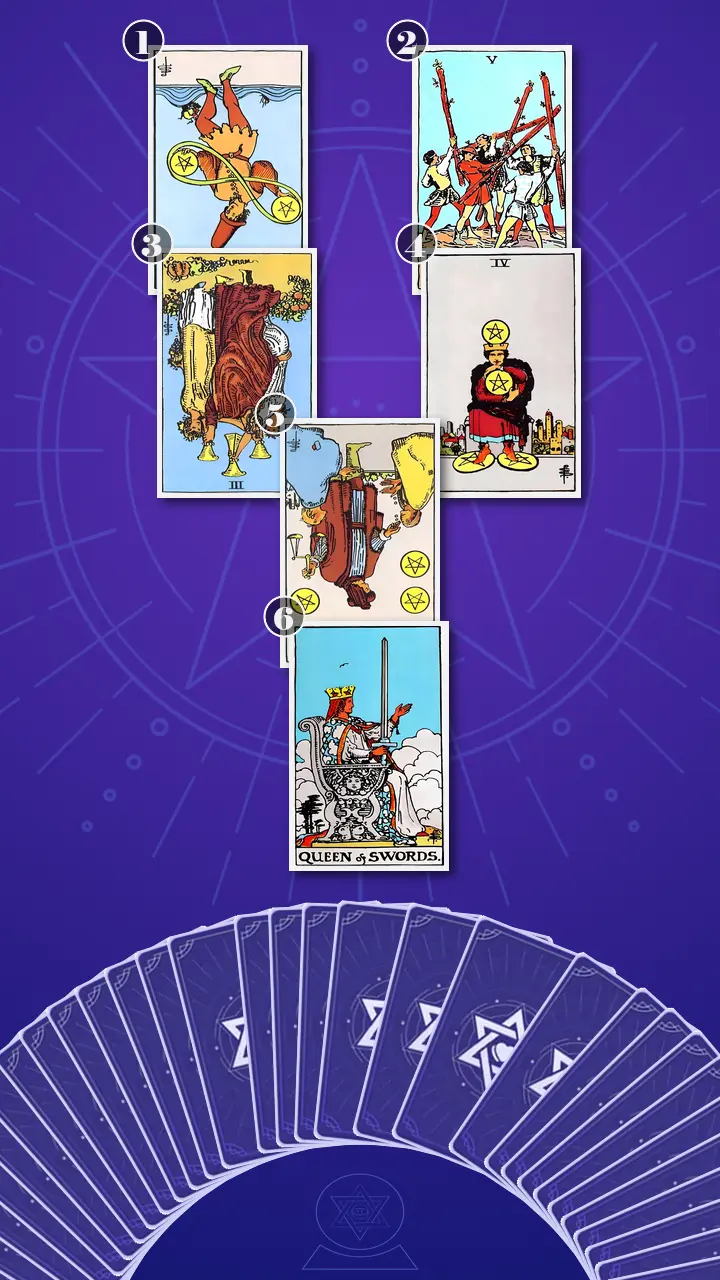
I chose the Relationship Spread · Context Edition, a six-card relationship tarot spread adapted for a divided friend group. This is how tarot works at its most useful: the cards do not issue a verdict about other people’s motives or prescribe a predetermined future. They separate a crowded situation into visible behaviour, underlying needs, the exchange those behaviours create, and the response still available to the person asking.
For Maya’s question, the first two positions would compare her visible social juggling with the conflict expressed by the two camps. The next pair would look beneath those behaviours, first at her need for belonging and then at the possible security needs operating across the group. The fifth card would reveal the exchange keeping the exhaustion alive. The sixth would identify the clearest self-directed response.
I placed the cards in two mirrored columns that narrowed toward a central card, then laid the final card beneath it. On my desk, the arrangement looked like two crowded conversation threads gradually resolving into one line of communication.
Reading the Crossed Threads
Position One: The Infinity Loop Between Two Chats
I turned the card representing the observable pattern behind Maya’s current social energy drain: the invitations, disclosures, and reassurance she kept juggling until her own priorities disappeared.
It was the Two of Pentacles, reversed.
I pointed to the infinity-shaped loop tying the two pentacles together. “This looks remarkably like your two WhatsApp chats,” I said. “You confirm separate weekend plans, adjust what you disclose to each camp, and keep changing the wording until you cannot remember which version you sent. Your flexibility is visible. The overloaded calendar, fragmented attention, and missing personal preference are not.”
I read the reversal as Blockage in the card’s practical Earth energy. The ability to coordinate has become an endless reassurance circuit. Instead of helping Maya organise a life she has chosen, that skill is being used to prevent every possible interpretation of disloyalty.
“Your inner script sounds something like this,” I said. “If I answer this side first, I need to reassure that side. If I mention this plan, I need to explain that one. If I wait too long, the blue ticks will become evidence.”
The card reminded me of the split consciousness in Severance: a work self, one-chat self, another-chat self, and no clean doorway back to the person who gets to ask, What do I actually want this Saturday? Maya was running two socially acceptable versions of herself and manually checking each line because she no longer trusted there to be a single source of truth.
She gave a brief laugh, but there was no amusement in it. “That’s so accurate it’s almost cruel.” Her fingers tightened around the phone, then loosened.
“The card isn’t calling you disorganised or dishonest,” I said. “It is making the labour observable. You developed a sophisticated response to a real fear of exclusion. The question is whether that response is still protecting you, or whether it has started consuming the very life and friendships you hoped to preserve.”
I let the image rest between us before adding, “Neutrality that requires two different stories is not neutral; it is self-editing.”
Position Two: Five Voices, No Shared Conversation
I turned the card showing how the two friendship camps expressed tension, competing narratives, and implicit pressure for alignment.
It was the Five of Wands, upright.
Five figures lifted staffs that crossed in the centre, each body facing a different direction. I saw no single villain and no reliable winner in the image. I saw activity without coordination.
“This is the group chat filling with incompatible versions of the breakup,” I said. “There are defensive jokes, screenshots, indirect loyalty cues, and several people speaking at once. Everyone is active, but nobody is working toward the same conversation. Then you enter the crossed signals and search for a reply that validates every voice.”
I read the Fire here as Excess: too much reactive motion and not enough shared purpose. Maya’s careful phrasing could lower the temperature of one exchange, but it could not create alignment between people who had not agreed on what the conversation was for.
“Which comments in the last disagreement invited an honest exchange,” I asked, “and which comments seemed designed to find out whether you would join a side?”
She looked away from the cards. “When they ask what I think, they usually follow it with, ‘You know what they’re like.’ So I already know the acceptable answer.”
“Then the invitation is not always to share your view,” I said. “Sometimes it is a request for confirmation. You can notice that request without satisfying it. You can care about both sides without becoming the route between them.”
Position Three: The Invitation That Became a Belonging Score
I turned the card revealing Maya’s deeper need for continued friendship and belonging beneath the people-pleasing behaviour.
It was the Three of Cups, reversed.
I asked her about the previous Sunday. She told me she had stood in her small kitchen while the kettle hissed and cold daylight flashed across an Instagram carousel from a brunch she had not attended. She opened the viewer list twice, studied the tags and likes, and hovered over the heart button as if an ordinary tap might publicly assign her allegiance.
“The thought wasn’t even, ‘I wish I’d been there,’ was it?” I asked.
Maya’s mouth pressed into a thin line. After a few seconds, she said, “No. It was more like, ‘If one circle closes, I need to know the other one is still open.’”
The reversed cups showed Blockage in Water, the element of emotional connection. Access to every invitation, chat, and shared joke had become evidence that she still belonged. She attended events she did not have energy for and hid one gathering from the other camp, because uncomplicated access to the old circle felt too valuable to risk.
“A reversed Three of Cups does not say you are destined to be excluded,” I told her. “It shows how fear can make belonging feel like a subscription that must constantly be renewed. You start reading every guest list as a status report and every Instagram carousel as an unofficial seating chart.”
Her breathing paused. Her eyes lost focus as though she were replaying several weekends at once. Then she released a low breath and rubbed the heel of her hand against her sternum.
“I don’t even enjoy half the plans,” she said. “I just panic at the idea that I might stop being invited.”
“That distinction matters,” I replied. “Being present in every room is not the same as being secure in any relationship. The card is asking which friendships still offer mutual enjoyment, and which require performed neutrality as an entry fee.”
Position Four: The Grip Beneath the Loyalty Questions
I turned the card examining the security and loyalty needs that might be operating across both camps, without pretending to know any individual’s private motive.
It was the Four of Pentacles, upright.
The figure held one pentacle against the chest while two more pinned the feet in place. I described the energy as Excessive concentration: security held so tightly that movement and openness become restricted.
“Questions about where you went, whom you saw, or what someone said may be attempts to secure loyalty and control uncertainty after the breakup,” I explained. “That does not automatically make anyone malicious, and this card cannot prove what a specific friend intends. It simply helps you notice that another person’s desire for reassurance does not create an automatic right to your schedule, private conversations, or independent friendships.”
Maya lifted her phone again and read one message aloud: “No pressure, but I assume you know why they’re not invited.”
“That sentence contains both an invitation and a loyalty cue,” I said. “You can respond to the practical invitation without taking responsibility for the emotional test hidden beside it.”
“But if someone is insecure, I feel harsh not reassuring them,” she said.
“You may choose to offer care,” I replied. “The distinction is whether you offer it freely or surrender information because you believe their discomfort has become your obligation. You can acknowledge, ‘I know this situation is difficult,’ without reporting where you were, defending another friendship, or promising to restrict your own life.”
Position Five: The Friendship Ledger Nobody Else Can See
I turned the card identifying the shared exchange pattern that transformed Maya’s scattered energy into a self-reinforcing cycle of overgiving, hidden expectations, and depleted reciprocity.
It was the Six of Pentacles, reversed.
“This is the main blockage,” I said. “You distribute replies, invitations, reassurance, and selective information as if fairness means giving both camps identical access to you. You have become both the person supplying the emotional resource and the person expected to measure the balance. The cost to your rest, privacy, and honesty never enters the calculation.”
I asked her to remember the message she had received in the agency kitchen at 6:37 the previous evening: “Be honest, what did they say about me?” She described standing beside the humming fridge, the smell of reheated pasta lingering in the room, while she rewrote her answer three times. Her shoulders had felt heavier with every draft.
“Your internal equation was, ‘If I give equal reassurance, equal time, and equal secrecy, the system will stay fair,’” I said. “But the reversed Six shows Distortion in the exchange. Visible equality is hiding a very unequal personal cost.”
As an artist, I suddenly pictured a film set where one performer had quietly been made actor, script supervisor, continuity editor, production coordinator, and conflict hotline. Everyone else could remain inside their own scene because she was running between sets making sure the stories did not collide.
“That’s what I’m doing,” Maya said. Her shoulders rose first, as though resisting the conclusion. Then her gaze moved back to the card, and the muscles beside her jaw softened. “I’m the customer-support desk for a conflict I didn’t create.”
“Exactly,” I said. “And because you are competent at the role, the group keeps functioning around your labour. Equal access to you is not the same as fair friendship.”
I pointed to the scales in the card. “Who is doing the measuring? Who decides when you have reassured one side enough? Who notices when you are depleted?”
“Me,” she said quietly. “Only me.”
“That is why better emotional accounting cannot solve this. The answer is not to distribute yourself more precisely. It is to step out of the position of distributor.”
When the Queen Raised One Clear Line
Position Six: The Standard That Does Not Change Between Chats
I reached for the final card, the position defining Maya’s clearest self-directed response: one consistent communication standard, firm information boundaries, and enough tolerance to let other people have their own reactions.
Her radiator clicked off. The sudden quiet sharpened the faint rain against her window. On my side of the screen, I turned over the Queen of Swords, upright.
The Queen held one sword vertically, a single clear line after the looping pentacles and crossed wands. Her other hand remained open. I read her Air energy as Balance: discernment without cruelty, directness without performance, and conversation without surrender.
“In modern terms, this is you writing one sentence in Notes,” I said. “Something like, ‘I care about you, but I am not discussing the other side or carrying messages.’ You use the same sentence in every conversation. You do not add a long defence, choose a winning camp, or demand approval. You choose the standard by which you participate.”
I used what I call Typecasting Analysis to show Maya the restrictive character arc hiding inside the group dynamic. No secret committee had necessarily assigned it to her, but repeated interactions had typecast her as the Adaptable Neutral: the reasonable character who listens to every subplot, softens every conflict, and never receives a scene in which her own position can remain intact.
Then I applied Group Dynamic Rewriting. The invisible script read: If Maya stays agreeable, everyone can avoid the risk of direct conversation; if Maya breaks character, she may be blamed for disrupting the cast. The Queen did not ask her to become the Cold One or the Blunt One. She offered a more truthful role: the Caring Friend With an Independent Mind.
“You are not choosing the winning side,” I said. “You are choosing the standard by which you participate. Someone’s disappointment is information, not a verdict on your belonging.”
Then I brought her back to the ordinary scene where the whole pattern had become visible.
“At 10:45 p.m., you are still editing one ordinary evening into two acceptable stories, listening to the radiator click while your jaw stays tight. The real task has stopped being friendship; it has become preventing every possible disappointment.”
You do not need a perfect sentence that keeps everyone comfortable. You need one honest boundary that remains yours in every conversation.
I allowed the silence to hold for a moment before pointing again to the Queen’s sword and open hand.
You do not need to soften every boundary to preserve belonging; raise one clear standard, as the Queen of Swords raises her sword, and let honest friendship meet it.
For a second, Maya did not exhale. Her thumb hovered above the dark screen of her phone, her eyebrows drew together, and her pupils widened as if the cards had abruptly turned on a brighter light. Then her head shifted back by half an inch.
“But doesn’t that mean I’ve been doing all this wrong for months?” she asked. The words came out sharper than anything she had said before. “I’ve wasted so much energy trying to be fair.”
“It means the strategy once reduced immediate conflict,” I replied. “That is different from saying you were foolish. You used the tools you had to protect belonging. Now you can see their price, which gives you a choice.”
Her gaze dropped. I watched her fingers curl into her palm, hold, and slowly release. The anger thinned into grief; her mouth trembled before settling. Her eyes shone, but she did not look relieved in any simple way. When her shoulders finally lowered, she seemed briefly unsteady, as though putting down a heavy bag had revealed how long she had shaped her body around its weight.
“Oh,” she said on a long, uneven breath. “Then I don’t have to make them agree that my boundary is fair.”
“No,” I said. “You are responsible for making it honest and proportionate. They remain responsible for what they feel and what they choose next.”
I asked, “Now, with this new perspective, think back: was there a moment last week when this insight could have made you feel different?”
She returned to the agency-kitchen message: “What did they say about me?” This time she imagined replying, “That is something to discuss directly with them.” She sat with the possibility, then admitted that the friend might have been annoyed.
“And what would the annoyance prove?” I asked.
She considered it. “That they wanted an answer. Not that I had betrayed them.”
That distinction marked the first step from hypervigilant social self-editing toward clear boundaries and sustainable belonging. It was not complete confidence. It was the quieter, more realistic beginning of self-trust: allowing a reaction to exist without immediately reorganising herself around it.
I invited her to set a ten-minute timer and open her Notes app. She drafted, “I care about you, but I’m not discussing the other side or carrying messages.” When she started adding, “I hope that doesn’t sound horrible, and obviously I understand if you’re upset,” I asked her to read the original sentence aloud first.
She did. Her jaw tightened on the word not, then eased. She deleted the second paragraph and saved the note without sending it.
“Clarity can arrive before confidence,” I told her. “Tonight, saving the sentence is enough.”
The One-Script Boundary and the No-Relay Rule
I gathered the six cards into one story. The Two of Pentacles showed Maya trying to solve a belonging problem through calendars, rapid replies, and constant context switching. The Five of Wands showed that the conflict around her had no shared purpose she could organise into harmony. The reversed Three of Cups revealed the fear beneath her overfunctioning: losing access to the old circle. The Four of Pentacles showed how other people’s understandable desire for security could become pressure on her privacy. The reversed Six exposed the unequal exchange that kept the whole system running. The Queen of Swords brought in the missing resource: language clear enough to stop routing every emotional demand through Maya.
The cognitive blind spot was not simply “I hate conflict.” It was the equation disappointment equals rejection. As long as that equation remained unquestioned, Maya would keep trying to eliminate disappointment through better wording, equal attendance, and selective disclosure. But discomfort after a boundary is not the same as abandonment, just as access to every invitation is not the same as belonging.
The transformation did not require a dramatic confrontation or a public declaration. It required moving from privately managing both camps’ reactions to holding one consistent boundary, then allowing each friend to decide how to respond. I turned that shift into three small experiments.
- The Recasting Exercise: Keep One Script.For five minutes tonight, keep the Notes-app sentence: “I care about you, but I am not discussing the other side or carrying messages.” Use it only when the next mediation request arrives, whether that happens in a private chat or at the next gathering. Say it once, then stop performing the familiar role of the endlessly reasonable go-between.Start with the minimum version, “I am not mediating.” After sending or saying it, put the phone face down or step away for ten minutes before deciding whether any practical clarification is actually needed.
- Run the Seven-Day No-Relay Rule.For one week, do not forward screenshots, paraphrase criticism, report who attended, or explain one camp’s motives to the other. When asked what someone else said, reply, “That is something to discuss directly with them,” using the same wording each time.If a friend says the change feels cold, acknowledge the feeling without reopening the channel: “I get that this is frustrating, and I’m still not passing messages.” The minimum experiment is refusing one relay request.
- Put Capacity Before Loyalty.When the next invitation arrives, start a twenty-minute phone timer before replying. Check your calendar, Citymapper travel time, next-day energy, and whether you genuinely want to go. Then use the same neutral line with either camp: “Thanks for asking. I’ll check my weekend and get back to you tomorrow.”If twenty minutes feels impossible, begin with two. Declining one plan does not require disclosing another plan, balancing the social ledger, or inventing a persuasive excuse.
I called the first experiment recasting because Maya was not trying to erase years of friendship or become a harsher person. She was testing whether she could change one piece of behaviour while remaining recognisably herself. A boundary becomes trustworthy when it stays the same in every chat.
“Some people may welcome the clarity,” I told her. “Some may push against it, especially if they benefited from the old arrangement. Neither response determines whether the boundary is valid. The experiment is not designed to control the ending. It is designed to make your participation honest enough that you can finally observe which friendships have room for the whole of you.”

A Week Later: The Quiet Proof of Sustainable Belonging
Six days later, I received a message from Maya while she was in the agency kitchen. Another friend had asked, “What did they say about me?” She copied the sentence from Notes, sent it without an apology, and put her phone face down beside the humming fridge.
“I felt physically sick for about three minutes,” she wrote. “Then nothing exploded.”
The friend replied, “Okay, fair,” and changed the subject. Another person challenged the same boundary two days later, so Maya repeated it rather than composing a personalised defence. The second exchange remained uncomfortable, but she noticed something important: discomfort moved through her body and eventually passed when she did not feed it with six more paragraphs.
That weekend, two invitations arrived within an hour. Maya waited before answering, chose the plan she expected to enjoy, and declined the other with the same brief message she would have used for either camp. She did not hide where she went, but she also did not volunteer a report.
That night, she slept through until morning. Her first thought was still, What if they decide I’ve changed? This time, she smiled at the ceiling, let the question exist, and did not reach for her phone.
I did not read that week as proof that tarot had fixed Maya’s friendships. The cards had not chosen her friends, guaranteed inclusion, or made anyone approve of her limits. They had helped her see the role she was playing, the fear that kept her in character, and the next line she could write differently. Maya created the change by practising it.
That was her Journey to Clarity: not certainty about every friendship, but belonging without brokerage, care without mediation, and the cautious discovery that an honest difference does not automatically erase connection.
When every notification makes your jaw tighten because one honest sentence might cost you the room, staying included can start to feel like disappearing in public. Simply noticing the role you have been playing is already the first moment of recasting.
If your next boundary needed no defence and had to remain true in every chat, what is the shortest sentence you would write in Notes tonight?